Eduardo de Sales Bartolomeu
Chief Executive Officer
Replay available
Vale (B3:VALE3) Q3 2020 earnings call, held 2020-10-29. Watch the replay and read the transcript on 6ix.
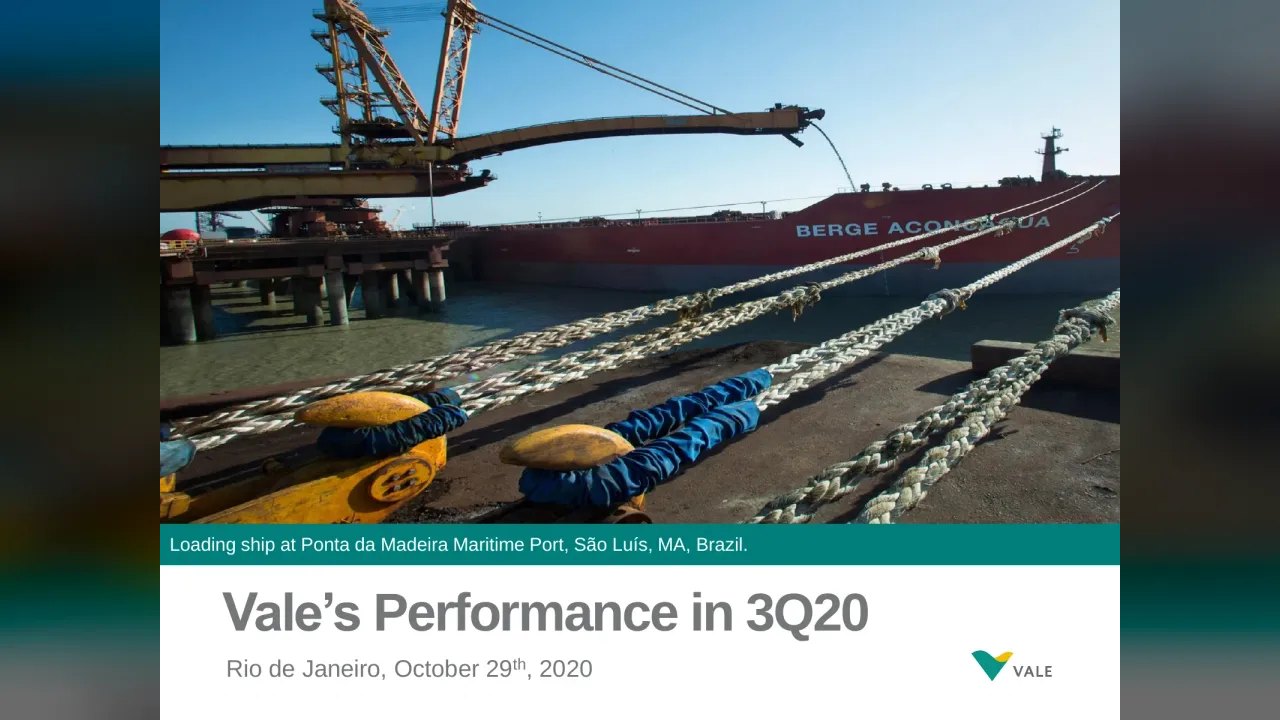
Automated transcript · Written by software from the replay's audio. It can mishear names and figures; the replay is the record.
0:00 Ladies and gentlemen, welcome to Vale's conference call to discuss 3Q20 results. At this time, all participants are in a listen-only mode. Later, we will conduct a question and answer session, and instructions will be given at the time. If you should require assistance during the call, please press star zero. Thank you for watching. The broadcasting via internet, both the audio and the slide changes, has a few seconds delay in relation to the audio transmitted via phone.
0:52 Before proceeding, let me mention that forward-looking statements are being made under the safe harbor of the Securities Litigation Reform Act of 1996. Actual performance could differ materially from that anticipated in any forward-looking comment. As a result of macroeconomic conditions, market risks, and other factors. With us today are Mr. Eduardo de Sales Bartolomeu, Chief Executive Officer, Mr. Luciano Ciani Pires, CFO, Mr. Marcelo Spinelli, Executive Officer for Ferro's Minerals, Mr. Mark Travers, Executive Officer for Base Metals, Mr. Carlos Medeiros, Safety and Operational Excellence Executive Officer, Mr.
1:39 Luis Eduardo Osorio, Executive Officer for Sustainability and Institutional Relations Mr. Alexandre Pereira, Executive Officer for Global Business Support Mr. Paulo Couto, Director of Coal Mr. Alexandre Pembrosio, General Counsel and Mrs. Marina Quental, Director of People First, Mr. Eduardo Bartolomeu will proceed to the presentation on Vale Street Q20 Performance And after that, he will be available for questions and answers. It is now my pleasure to turn the call over to Mr. Eduardo Bartolomeu. Sir, you may now begin.
2:19 Okay, thank you. Good morning, everyone. First of all, I hope everybody is safe and sound. Well, it's been more than seven months since we've started managing Vale in a remote way. And one thing has not changed. The safety of our employees comes first. Vale continues to face the COVID-19 pandemic with discipline and sense of urgency. We maintain our guards very high, and our priorities remain intact. Safety, people, and the reparation of Rumadinho. We have been learning a lot since Rumadinho and transforming our culture and practices for a better Vale.
3:10 With that in mind, I am pleased to share that our processes and results continue to improve together with our de-risking process. Please, next one. Starting with the reparation, our commitment to Brumadinho remains steady. We already disimbursed $2.6 billion on the reparation. The indemnification process continues With about 8,200 people covered by agreements for moral and material damage. 600 people more since our last call. The works for infrastructure and environmental recovery are progressing as well.
3:55 We completed the water man at Pará de Minas to ensure the supply of water to a city with a population close to 100,000 people. We have concluded the tailing containment structures at the Paraopeba River. Since May, the river has no longer received sediments. And, most importantly, we continue open for dialogue and to active listening throughout the reparation process. This quarter, we delivered the integral reparation plan for Brumadinho. which was built on the community's perspective and submitted in September to the municipality. We are certain that with this, we have a solid plan in our hands to repair the damage and support the development of Rumadinho.
4:50 Finally, we are having encouraging conversations with the State of Minas Gerais and other stakeholders To get a framework agreement for collective damage indemnification and compensation for the society and the environment. With that, we continue to pursue our goal of reaching a stable agreement for reparation and compensation. Please, next one. As well, we continue to enhance our safety and dam management. The engineer record is already implemented for 100% of our dams in the iron ore business with an improved continuous monitoring. In risk management, our risk identification program, HIDA, continues now including our dams.
5:39 59 operational units were assessed since 19, 42 in 2020, and another 12 sites will be assessed until the end of this year. This program is being applied to our dams as well, with pilots underway in Sudbury and Long Harbor. The heater will be fully implemented by 2022 in Bali. Finally, our new tailing management system is under implementation, and we are doing that by also complying with the ICMM standard launched in August. Our initial assessment indicates Close to 60% of adherence to the ICMM recommendations. We want to be fully compliant by 2020. So, our ambition is clear, to be world-class and have effective standards and processes in place with a safety-driven culture.
6:35 I can assure you that Vale is on a journey to become a safer and more reliable company. Next slide, please. Brumadinho required us to become better listeners. We are listening to the communities and society and building a strong and consistent relationship with all of our stakeholders. Based on their demands, we have mapped 52 ESG gaps, which have already closed 31 of them. In 2020, we already addressed five gaps, and five more must be closed by the end of this year. Our ambition is to transform Vale into a benchmark in ESG practice.
7:22 In this agenda, another important subject is the protection of the Amazon. Let me reinforce this. We have been operating in the Amazon for more than 30 years. During this time, we have helped to protect close to 800,000 hectares of rainforest, five times the size of Greater London. In fact, we already protect about 1 million hectares of forest globally. With those actions, I believe that we will contribute for sustainable mining and act accordingly with our new packed society. Next one, please. Well, talking about the operational performance of our business, we continue with our plan to stabilize our production.
8:14 A path that was detailed in great length during our Investor Tour in September. And I'm glad to share that the iron ore production results for this quarter was very strong. An increase of 21 million tons versus the second quarter, a 31% growth. We had an all-time production record in Carajás. That indicates That we are making progress with our plans for production stability and the initiatives for operational excellence. Spinelli will come shortly to explain the dynamics between production and sales for the quarter. In base metals, as anticipated last quarter, some maintenance postponement was strategic before the pandemic. We have normalized that routine and expect better results for the fourth quarter. In relation to VLC, We are taking steps to place it in carry maintenance in 2021. We also have a new group of potential investors interested in the asset. However, all possible solutions contemplate Bali's exit. In coal, this was also another chapter, highly impacted by weak demand, which continues to wait on our production.
9:30 But on a positive note, we expect to finally start the plant revamp in the coming week. After that, we should reach a run rate of 50 million tons per year. Next one, please. Besides that, we are focused on recovering our production. But we are also taking important actions to make our production capacity more flexible. The launching of Serra Sul 120 project in Carajás is one of them. Besides creating An important buffer of production capacity ensuring operational flexibility, we allow growth of 20 million tons in the longer term with the dual logistics. Also, we launched project West Tree to expand the Shulanhu port capacity in 20 million tons per year, bringing it to a total capacity of 40 million tons, securing a strategic port capacity for Vale's BRBF in China. In summary, we are taking the necessary actions to ensure the stability we need to operate with efficiency and the growth options required by the market.
10:45 Please, next one. Well, to finalize, we are the risking valley to build a better valley. Let me walk you through the most important steps on this journey. First, we are repairing Brumadinho. In a fast way and with quality, listening and engaging with the families and community. Second, we are becoming a safer company. With discipline, we continue to make solid progress with our tailoring management system and our operational safety process as well. Third, we are resuming production under safer conditions. I'm sure that we will achieve the 400 million ton brand rate during 2022.
11:30 We have a clear understanding of what we must do and we are fully capable of delivering it. And finally, we are building the conditions for a long-term, stable business, keeping focus on capital discipline. With that in mind, we resumed our dividend policy and paid a solid dividend last September. Well, to conclude, We intend to continue creating and sharing value for all stakeholders. But most importantly, I assure you that we are doing everything we can to guarantee the safety of our employees in our operations and in our communities. Now I pass to Marcelo Spinelli, who will give some details about the results in Iron Ore. Thank you very much for your attention.
12:21 We will get back to you at the Q&A.
12:26 Thank you, Eduardo. I have some information to share about iron ore production and sales. I think you have a lot of questions about sales. So let's start with the production. So can you pass, please, the slide? Some weeks ago, we had a chance to detail, as Eduardo said, the roadmap to reach it. So, today, I think we have a checklist, transparent checklist. We can have some deviation quarter by quarter, but definitely now we can follow together the evolution of the recovery of production.
13:11 So, in Q3, first information is what I've said, huge production in the North, 57 million tons record. On track with production also all the projects around the north. And in the south and the southeast, so far so good, on track projects, production, and the initiatives with the dams. For Q4, we are running the production around 1 billion tons a day. It's a good news, so far so good. Our target, you know, we are on the lower level of the guidance, around 310 million tons.
14:01 It's very important to say that at this time of the year, we don't have any more capacity to offset some deviations if you face some problem. So, we must deliver exactly what we have in our plan. And what kind of risk you have ahead? So, I can say two. First one is related to the license of East Range. It's still waiting for the license. We are in the last mile of that. No more information to the regulators, but we need to receive this to start this operation. We are waiting for that. And we also, we've been hearing about the rumor of La Nina effect. Well, I mean, in fact, in Brazil, just to understand, it comes with more rainfalls in the north. You can anticipate this process in the north.
15:01 And you have a dry season in the very south of Brazil without so many impacts in our operations. So we have to track this trend day by day. I'll let you know if you have any change in our guidance. So let's focus on the sales now. I think it's the most important information to the end of the year. You can pass the slide, please. Well, I have a rationale here to share with you in three steps. So I'll start with the number one. You know that we've been growing our production, our blending process in China. It's a very successful strategy. Very over volume. We bring the high silica product from the south of Brazil.
15:51 Today, we have a discount of $30 for that. And it meets with the IOCJ, Caritas Science. You can see the growth in this slide for $94,000 to $145,000. So we have a stable product growing in the market. Our clients are very well satisfied. The same information here. It's about our exposure to China. China in our sales are now reaching almost 70% of our sales. Why? This is due to COVID, you know. China is in a V-shape. The rest of the world is struggling to recover the production and demand. So what does it mean?
16:38 We have 45 days of transit time, just transit time, the shipping part. And after that, we have the discharge, the blending time, and also the retrieval period. And remember that the last quarter, China suffered with a lot of delays in the discharge time with the congestion in the ports. So the lead time to close the sales is not the same as you have in a FOB or a CFR, traditional CFR. When you are more exposed to China, you're selling more BRB. We had some questions about this in the last call. And it's very important to understand the difference between shipping, you know, the FOB sales, the CFR sales, and the blending sales in China.
17:29 Because sometimes in FOB you can find price in the time you sell. But when you have the CFR, you can sell during the shipping. But the price will be only when the product arrives in the client. And also, the BRBF will spend more time to blend, to have the product to blend. Another information here to understand the whole picture, we have the inventories. You know that in the last year after Brumadinho, we have to reduce our inventories to keep the supply chain of our clients. So, we reached the minimum level in the end of last year. So, This quarter, the last quarter, we have the first chance to have a gap in our production, to increase our production. And we need to have this time to put this product in China. So we are not talking about speculating inventors that I heard about some ideas about this.
18:33 It's about operation inventors. We need this to make it happen and we are more focused on China. The two main information here that I want to say to you for Q4. First information, we don't have any intention, we don't have any planning the gap of inventories or gap of production. You know, Q4 in our forecast for Q4 in our production. So we don't see any necessity to have another kind of gap like we have in this quarter. The second information, we don't see many deviations between the Q4 sales and the Q4 production, Q3 production. So as we are moving our inventory to both in Asia, both in China, we have probably numbers close sales and ventures as we are just moving this inventory to the sales after a lot of time that we need. So if you have further questions, I can help in the Q&A session. Now I pass to Luciano Cia.
19:48 Okay, a few selective remarks here, starting on iron ore. In the cost side, you saw we reduced costs from $17.2 to $14.9 per ton. We have guided for $14.5 for the second half. We will not achieve that. and the reason is because of the price increase on the third-party ore that we purchased. Although the volume is small, we have a C1 for third-party purchases of around $50 per ton and the $25 increase in the 62% index impacted those purchases to the point that we decided to include information in our release about what the C1 for Vale looks like without those third-party purchases.
20:41 And we have $12.5 per ton for the quarter. We also showed the numbers for past quarters. And that's the best measure of Vale's competitiveness because it shows how the operations are performing, not the ore that we purchased from third parties. So something for you to track going forward. If we didn't have that price increase, we would have Gotten to our 14.5 guidance, but we're not going to for a good reason, price increase. Q4 costs tend to trend down because we had some maintenance, especially in July in the northern system that we will not repeat this fourth quarter.
21:26 For that all in assuming stable exchange rates, right? Because they've been fluctuating a lot, so. and they are a tailwind for us. For 21, costs tend to stay flat compared to 20. Counterintuitive, but the reason is although costs will be diluted by bringing more volumes, the volumes will come from the less competitive operations in the south and in the southeast. So the mix effect will offset the cost dilution effect. My remark on base metals goes to copper. All-time record for copper EBITDA. And also on the byproduct revenues. Just a reminder for you, in 19, we have collected 1.25 billion U.S. dollars on byproducts other than nickel and copper. I'm talking about gold, palladium, platinum, cobalt, and rhodium. And that amount will increase this year to approximately 1.4 billion U.S. So something to track. And finally, the fourth quarter will be strong because we don't have any planned maintenance in our nickel operations, and we're going to have Onsapuma back on full steam.
22:42 And depending on prices, we expect Onsapuma to start generating between $40 million to $50 million U.S.,
23:03 Every quarter in EBITDA.
23:08 Going through the P&L, you saw financial expenditures, some one-offs. These were fundamentally why we missed the consensus on earnings per share. We had a 550 million U.S. expense on the debentures, the participation debentures. These debentures, they were issued at the privatization of Vale More than 20 years ago, and they work like a royalty, and they therefore own iron ore sales, and they therefore are mark to market. Every time iron ore prices go up, they are mark to market. This is not a cash expense, and they flow through our balance sheets. And the news here is that the most important holders of these debentures are the National Treasury and the Brazilian Development Bank.
23:56 They announced the intention to sell those debentures. That poses an opportunity to Vale because those debentures are a royalty or a leakage to our shareholders. This year alone, we're paying $200 million on those royalties. So we have the fiduciary duty to look at this opportunity. And eventually, Vale, if we decide to repurchase those debentures, that would We had also increases in the value of guarantees provided by Vale to some of its affiliate companies. That relates to the depreciation of the Brazilian real estate.
24:45 All those indebtedness are in U.S. dollars, so therefore the increase in value When translated to Brazilian reais, and this flows through the balance sheet to the P&L. Other important thing, we have updated the guidance for capital expenditures for this year. We have guided on Valley Day 5 billion U.S. for this year. The exchange rate depreciation would bring that number down to 4.5, but with COVID delays, we're now into 4.2 territory. And Those COVID delays, they will necessarily impact capital expenditures for next year because the work needs to be done and it just shifted from 20 to 21.
25:30 Finally, on cash generation, you saw robust cash generation this quarter. Although working capital was still negative, the change in working capital for two reasons. Spinelli talked about inventory buildup still. And secondly, because the sales That were marked to market at the end of the quarter were marked to a higher price than the sales marked at the end of the second quarter. So that increased accounts receivable. So again, those two effects should revert next quarter, and you're going to have a better conversion from EBITDA to cash on the fourth quarter. Financial net debt decreased despite the substantial dividend distribution.
26:16 An expanded net debt also decreased. And I assure you that, and that wasn't, and the expanded net debt is at 14.5, which is still far from the target of 10 billion U.S. Important here is that the 10 billion U.S. dollar target for expanded net debt is a long-term goal. It is not something to be reached on the short term, and it will not prevent us from keep paying extraordinary dividend on the path which is our goal. Now on to Q&A. Thank you. Ladies and gentlemen, we will now begin the question and answer session. If you have a question, please press star one.
27:02 If at any time you would like to remove yourself from the question queue, press star two. Please restrict your questions to two at a time. Our first question comes from Carlos G. Alba, Morgan Stanley.
27:18 Good morning, everyone. Thank you very much. I hope you are doing fine. My first question is regarding the potential agreement or the negotiation discussions that you are currently having with the authorities on the Brumadinho settlement. Could you explain to us maybe what are the next steps and a roadmap on this process to the extent that you have it and second, on this same topic, it is my understanding that there are four big blocks of potential payments. One is the collective damages, two, the socio-economical damages, three, individual socio-economical damages and four, environmental damages.
28:03 Are all these four, if I am correct, included in the ongoing discussions that you are having or only some of them are part of the discussions. And then if I may ask you just very briefly, maybe an update on Samarco and also given that Luciano spoke about potential opportunity for why to buy back the shareholders, the ventures, What about the potential sale or divestment of shares owned by the steel, I guess, controlling shareholders that is expiring in November? There might be some regulations that I think prevent you or may prevent you from buying those shares in the market, or directly you might be able to buy it in the market.
28:49 But if you could help us understand that situation, that would be great. Thank you. Thank you very much.
28:55 Okay, Carlos. We are fine. Thank you. The agreement, I'll give you a broader picture, and I'll ask Alex D'Ambrosio, our legal counsel, to detail. I think it's everybody's question, so I think it's better to tackle everything so we don't leave any room for doubts. I think, first of all, we've been discussing with you during the last calls and in the meetings that we have, that we were having discussions with all stakeholders. When we mean stakeholders, it's the state, the prosecutors, the defendants, even the AGU is a Brazilian entity at the federal level.
29:41 So what is different now? It's different that now we are making a process of mediation that was brought to the Court of Justice And that improved, in a way, the convergence of the framework. Because one thing that we have been consistently saying is that we want a stable, with legal certainty, that we can execute on the compensation and a reparation of the strategy. So the need is that now we are under a different environment. On a different approach. And then I think we'll come to your question about a roadmap.
30:27 There are steps that have to be taken. And I think Alex will come and cover you, will explain to you a little bit more detail on those kind of steps that are necessary to achieve this framework agreement. And secondly, it's encompassed everything, but I think Alex can manage it as well, because you know we have three civil actions that refers to those elements that you mentioned. And of course, they will have to be covered on this, okay, more holistic or whole agreement. Can you help me with that, Alex?
31:07 Of course. Thank you, Eduardo. Hello, Carlos. As Eduardo was saying, there's been a very positive evolution as of last week since the conversations have now moved to the mediation chamber of the Court of Appeals of Minas Gerais. It's a formal mediation chamber. They call it the Sejuski. As a result of this, the negotiations will now take place in a more structured environment and With the support of mediators who are judges themselves of the Court of Appeals. Indeed, the president of the Court of Appeals himself is participating in this mediation process since he wants to see this agreement succeed. Now, if we reach an agreement in this environment, we'll have much more legal certainty as it would be sanctioned by the Court of Appeals itself.
32:07 So that's why we think it's positive. All the plaintiffs are invited to this mediation. And so it's a large group of people and conversation is mediated by the judges, as I mentioned. And so the idea is that it would be encompassing for all the parties involved. Okay, conversations are indeed evolving and they're very constructive, but as you can expect, there are many challenges to overcome and the main one is to draft a document that would be acceptable for the many parties involved and that would offer legal certainty. So, we need legal certainty, that's been stated from the outset.
32:53 We need governance that ensures speed of reparation and There's still no definition of values, okay? This will be discussed after we have this framework. The second part of your question, what will this cover? Well, we have, as I said, four basic blocks. One, which is not in this agreement, is the individual indemnification. So people are coming to discuss with Vale directly and that's Eduardo mentioned 8,200 people as of this date approximately have already been indemnified. What we expect is that the agreement would sanction the individual discussions with these people.
33:45 So that's been already agreed in concept that that would be part of it. There's environmental reparation that would be in this agreement. Although environmental reparation is an obligation that we would undertake to deliver. We don't have a value. We may have estimates, but that's not something that we will pay off. We would actually continue to pursue the reparation. There's a collective damages part that would be capped and that would be paid off. And there's what we call the social compensation part. which would also be capped and that would be paid off. So I think I covered the four and that's what we are proposing, that's what we are discussing at this time. I hope I answered your question.
34:32 Thank you.
34:34 Okay. San Marco continues to be on track for a restart in December. It will produce to the capacity of 8 million tons. Thank you very much. Can eventually, that would be a public offer, like a follow-on offer, a secondary offer in the capital markets.
35:26 There will be a book building process. Demand could be X times higher than the supply. And yes, Vale could theoretically put a bid on those shares. However, according to Brazilian legislation, if demand is higher than the supply of shares from Any selling shareholder, Vale would be the first one to be cut because it is considered a related party in this process. So if Vale wants to buy shares in the market, the most obvious way would be to launch a buyback program rather than go into such a follow-on because it's very unlikely that we will be able to buy those shares in such a process.
36:21 Thank you. Before I proceed, please restrict your questions to two at a time. Our next question comes from Tima Tanners, Bank of America.
36:34 Yeah, hi, and I hope everyone is doing well. I wanted to ask a bit more about your market outlook on iron ore, if you could give some specific comments on the pellet premium outlook and So, along those lines, just, you know, asking, I guess, about the better demand outlook for Europe that would support higher pellet premiums. And, you know, with the announcements recently of some additional supply coming on, how are you thinking about the outlook for supply and demand in the next year or two? Thanks.
37:09 Go ahead, Matty.
37:11 Okay. Hi, team. Thank you for your questions. Well, let's start with the The pallet premium. Well, what we see, as you know, we have, I think, two main markets here in this case. The direct reduction pallets is more related to the Middle East. And in the U.S., we see a recovery in these markets. Obviously, all the problems with COVID that we can have further problems. We see these markets more stable and recovering for next year. And in case of direct reduction, we have one thing that we must track, that China is again opening the import of scraps.
38:07 This can bother the scrapping market, the seaborne scrap market that is around Turkey and the U.S., These can improve the price of this crop and bring more margins to this middle-waste market. So, must recommend that. We see that trend for short-term is we just see a stable price, a stable premium, but we can have some gap between the blast furnace palette and the rack production palette for next year. But one must track that. On the other hand, the blood furnace palette is quite the same that is happening in the market of Europe or Japan. So we are struggling with this new lockdowns in COVID. Our number for this year that we have for the whole of China, a decrease of around 12%.
39:15 In these most developed countries, we see 19%, but depends on the new COVID outbreak. And we see a recovery for next year around 9%. So that's to outlook what we're seeing in the market. The supply-demand balance, I see today, during this quarter and the next quarter, we are more balanced. We are returning around 60 million tons, only valley. With the market, we see some new edsoctics producers that are coming to China, like India, or other regions like Europe going to China. I think they will probably go back to their original markets.
40:09 That's a tendency that we see. Our next question comes from John Brent, HSBC.
40:37 Hi, good morning, good afternoon. Thanks for taking my questions. Luciano, I first wanted to ask you about the C-1 cash cost. So I certainly appreciate the disclosure around sort of your own C-1 cash cost of $1,250. If I'm not mistaken, the target and the guidance that you historically talked about has been sort of total C-1 cash costs, including third-party purchases. I'm wondering... If you can give some more guidance or target as it relates to your own C1 cash costs in the next three to four years as you ramp up production closer to that 400 million tons, how much further should we expect your own C1 cash costs to fall?
41:22 And my second question, I guess, is more related to nickel and the EV battery theme. Is this something that you're potentially looking to move further upstream in the battery supply chain given your exposure to nickel and cobalt, especially considering the government of Indonesia's ambitions to become an EV battery destination and your relationship with the government? Could we see more investments further upstream here? Thank you.
41:55 Okay, Jonathan. I'll give you numbers. The full numbers, okay, including the third-party purchases. The best quarter we had was 12.8, fourth quarter of 18 when we were producing at a rate of 385 million tons. So that gives you an idea of where we can get. With the adjustment for the new FX rate, that 12.8 would be perhaps between $10 and $11 per ton. Yes, we have had some depletion, which means transportation distances have increased. But if we have the licenses, for example, we then open up new mines at the rate that we would like to, then we could reasonably get, when we get to 400 million tons, to $10 to $11 per ton at existing FX rates.
42:59 Mark.
43:01 Yeah, no, I want to answer this question first. John, thanks for the question because I still have my foot on the base metal. So, first of all, there's a lot of interest on OEMs and the kinds to talk about VASF. A lot of players are coming to talk to us. But we have no intention whatsoever to go upstream. We were focused on using our assets and our mining assets. That's a very important point as well. So there are initiatives that are looking to different mining assets that would require that kind of approach to defamation around governments and helping like specifically in Canada we are having this kind of discussions but we will stick where we know and where we are good at is at the mine site.
43:56 Mark, you're still in the line? Yes.
43:59 Oh yeah, that's absolutely the case. And I would say that we already have some options for some participation. For example, we do have the Pomola project in Indonesia where the product would be suitable and would be directed towards the electric vehicle batteries. So those kinds of things are there. Also, some of our products, for example, coming out of Sudbury and UK refineries are suitable for electric vehicles. But as Eduardo said, if we see the kind of growth that we're anticipating in the electric vehicle market, the supply chain is going to look for some tremendous amount of supply. The typical source people are talking about are HPEL technologies out of Indonesia. But we would think that we're going to need more mines developed in the coming years to meet that supply.
44:54 And obviously, that's our interest is trying to find the right ways to get those mines up and running to support the electric vehicle industry and meeting the returns that we need to see. Our next question comes from Andreas Buchenhauser, UBS.
45:17 Thank you very much. I hope you are all well. Just a quick question on freight. How has it been kind of so far over the past year in terms of your freight, especially to China? Has that mostly been on valet maxis and delocks? And equally as important as you kind of progress towards 2022 and aim to get those 400 million tons of production back, You know, what is your vessel capacity there? Do you still have new vessels coming in the shape of Malamax and Deluxe, or are you going to be more dependent on the third-party vessels, possibly in the spot market in that scenario? Thank you very much.
46:00 Thank you, Andreas. It's Penelope here. I think you have a question. Regarding freight, I think we... We have, let's talk about the fleet, firstly. We are improving our Weiba Maxis fleet. Yes, so the strategy to have vessels, the big vessels, are on track. So our trend in one year, two years, is to reach our level, what we consider the optimal level, to 400 million tons. So that's the track that's going on. In short term, we have some exposure in the spot market. It's not so high.
46:45 We had some reflections in the freight this quarter, and we'll have some next quarter. But probably all the fluctuation in the bunker price, there will be some For the next short-term period. Another point is about the scrubbers and the freight. You know that we have the curb installations almost on track, so today the gap between the high surfer and low surfer is lower than before. Now it's 60, but most of our freight will be We'll be using this year, and we'll count on that next year, is higher than 90%. So that's a trend. Keep this strategy to grow the fleet, but in the level that we can manage the support and the flexibility of the support and our own vessels.
47:59 Our next question comes from Chris Terry, Deutsche Bank.
48:06 Hi, Eduardo, Luciano, Marcelo, and team. Two questions from me. Just on the sales versus production, if I understand it correctly, you're saying sales should be close to production in full queue. And as we focus on 21 and 22, as you ramp up to 400 million tonnes, Can you just give some colour on what you expect the inventory build to be as you add additional blending sites over that period? And my second question is on coal. After you do the three-month revamp, how long will it take you to get to the 15 million tonne run rate? Thank you.
48:49 Thank you, Chris, for the question. Again, it's important to understand the... The fluctuations are related. Most of the time, we should not compare the production in the quarter and the sales in the quarter. So I think the best comparison is between the, in this case, Q4 sales and Q3 production. So if you consider all the time of transit and lead time, this is the best comparison today. We can have some gaps. Inventory in case of a gap of production like we had. So as you build, we've been building for a long time.
49:36 We lost an inventory last year. Now we're going to return this inventory building because it is the quantity we need to make the glass. So we see few gaps, probably in one, two years. Every time you have a difference between production in one quarter. But as we have the inventory in China, we have more flexibility. So we don't have significant difference between sales and production during the period. So this was the first time we had this gap after the decrease of inventory. But that's not what we think in short and long term. We're going to increase gradually this inventory.
50:22 and we have some differences but not significant.
50:29 Paulo, can you go ahead? Yeah, thanks for the question. After the maintenance program, we'll have a small run period and we expect to reach the 15 million tons per year run rate starting from the second half of the year of 2021. Excuse me, are you ready for the next question?
51:02 Yes, go ahead. I think he answered the question from Chris. Yes. Our next question comes from Alfonso Salazar, Scotiabank. Please proceed.
51:15 Thank you. Thank you for taking my questions. I have two. The first one is regarding iron ore and the implications of the Chinese restrictions of medical imports. On your iron ore operations, I don't know if you can explain if you expect the use of different calls to change the needs of blending or adjust the marketing strategy of your products. The second question is regarding your base metal division, and in particular on copper. There is a lot of interest on good performing copper assets, but apparently the ones that you own look buried in your iron ore and nickel portfolio. So just wondering if you can share thoughts on how to unlock value of those assets in particular, copper assets and the expansion projects that you have on copper, and if it's possible to unlock that copper value before nickel.
52:09 Those are the two questions I have.
52:14 Thank you, Alfonso. That's Penel here. Well, if I understand your question, so... Our product is very stable quality, the BRBF in China. As we can have some demand regarding the problems now, they are increasing the cost of coke, and if they have a better margin, they can save some cost of energy, they can improve to better quality. So we can We've been working on a very stable operation for BRBF. It's very important for the choice that the steelmaker can take when they want to change the blast furnace.
53:19 So, we must take the quality in a stable way.
53:26 Okay. Alfonso, if I got your question clear, I agree with you that we have to unlock value in copper. There's a good discussion undergoing Bali now around exploring our Carajás province. We have a tremendous province there. There are some synergies with Arnoa that we are unlocking. So we are talking about Alemão. We are talking about even Salou before, if we can revise reserves. We can talk about Paulo Afonso, a series of assets that we have there. So I think there's a, we call here a copper dream.
54:11 Everybody wants copper. It's obvious. It's the dream. The commodities, I think iron ore and copper are the no-brainers. And we do have exceptional assets in Carajás that need to be developed. And while you talk about unlocking value, I think it's a more complex question. Because since the beginning, and we started the turnaround of the whole base metals business, and we believe it's undergoing pretty well, as Nico has been proving, We need to fix the house as well. So there are, I think, double, I would say, phase story here. One is to fix the assets that you have, and second is to grow the assets that you have on the ground.
55:02 So we are extremely optimistic that we can, and we're going to show that on Valley Day, by the way. On our expectations about copper. We are very upbeat on that. If we come back to the famous 30% of relevance of base metals inside value, we could unlock on that way when people start to perceive value on the base metals business besides iron ore. Iron ore is too big still in relation to base metals. We won't have time to discuss in the call what kind of options we have, but one for sure is to do the right thing with the right assets and have something that the market, how could I say, values it. But I'd like to ask Mark as well, because Mark is very passionate about this team as well.
55:52 Eduardo, you're right. I am very passionate about the copper business and base metals. It's a... An excellent business. It generates a tremendous amount of free cash flow, and it's got tremendous opportunities going forward. We spent a lot of time stabilizing the business. We're seeing some good stability coming this year. Salobo is performing very well now. Sasego has performed extremely well this year and staying on budget. Next year, I think we're moving more into a productivity-type agenda to increase the returns of the base that we have right now. As Eduardo mentioned, the growth opportunities are there, not only the ones we've talked about in terms of Cristalino and Alamau, which are on our agenda, but also unleashing through synergies with iron ore and the railroad system that are there can bring us even further. And finally, I will note that we have a very good world-class project in Project Huhu in Indonesia. We've been releasing drill results.
56:58 This is a world-class copper project in the making as well. So very excited about the copper business as well as the nickel business. Thank you. Our next question comes from Sylvain Brunet, a Kizen BNP Paribas. Please proceed.
57:18 Good afternoon, gentlemen. So two questions. The first one on iron ore, just to maybe get some sense of the demurrage costs you would guide us to for Q4, if we should assume some continued decline there. And my second question is on VNT. Should we assume zero production in Q4 as you're ramping down? And what is the value left on your books after the several impairments? Thank you.
57:51 Okay. Yes, the cost will continue to come down on the fourth quarter because we don't have any major maintenances and we're going to spend less and dilute through the production. On the books, VNC has zero value. We just wrote down the rest of the value that it had this quarter. Mark.
58:19 Yeah, and Luciano, just in terms of production at DNC, the way the care and maintenance process works is we do need to prepare for consultation with the workers and we continue to operate at, I would say, sort of a stabilized rate while we go through that. So you will see production of the nickel hydroxide in Q4, let's say roughly what you would have seen in Q3. Our next question comes from Christian George, Societe General.
58:57 Yes, thank you very much. Luciano, can you just go through again your cash costs for Vale I&O operations? You mentioned 10-11 was your best performance for Q18. That was at the FX rate of today, I understand. And you're saying that you can achieve again 10-11 in future. Is that also just for Vale or does that include the purchase or... That's my first question. And the second question is on those ventures that you may be considering purchasing or being for into the new year. What kind of order of value magnitude should we take into consideration?
59:46 Thank you.
59:49 Okay. Yes, the 12.8 of fourth quarter of 18 at today's exchange rate would be between 10 and 11. And yes, we may get to there, but also you should normalize by the price of iron ore. If the price of iron ore was the same price of the fourth quarter of 18, the third-party purchases cost would be lower and the overall price Agregate C1 of today, as we speak, would be perhaps another $2 below what it is. So instead of 14.9, it would already be at 12.9, and we would be targeting 10 to 11. So those are important.
1:00:37 I think on the last question, I had mistaken my answer. The question was about the merge costs. So There's no meaningful decline of the mortgage costs from the third to the fourth quarter. And I think the next question is for Marcelo Spinelli, right?
1:01:00 The volumes for purchase, we don't have a lot of source of purchase in Brazil, so there must be a stable number compared to this year. Thank you. Our next question comes from Tyler Broda, RBC.
1:01:24 Great. Thanks very much for the presentation. My questions have been answered, but I just have two quick follow-up ones. I guess with Project West, if all goes to plan, when should we expect that inventory to start building for that extra 20 million tons? And then secondly, I guess just on BNC, in terms of – I see the bidder is back at the table – If nothing is able to be agreed, what should we look at in terms of the shape of the closure costs? Thank you.
1:01:57 Thank you, Tyler. It's Pineda here. Well, the West product, we have this partner in China, Shulang Hu Port. We already operate there. It's in the delta of the Yellow River, the Yansha River, sorry. So, it's a very important position for our blending and all this fusion in China. So, when you're improving that, we don't say that we're going to use this, increase this inventory, considering the whole picture of us. That's our main market in that area, so we want to evolve there. Sometimes we can offset with other boards.
1:02:45 And we're expecting to run this new operation in two and a half years. So it will give more flexibility rather than increase our inventors.
1:03:01 Hey, Tyler, just on New Caledonia, as you mentioned, There are some bidders that are looking at the asset. There's one group that is, I would say, put forward a rather fulsome offer. That's an offer by management working together with employees and supported by Trafigura. We'll know in the next, you know, in the coming week or so how that's panning out. But we haven't stopped on the planning for care and maintenance. And just in terms of estimates... What we're planning for is care and maintenance rather than full closure. And just in terms of how that looks, it is quite a detailed process that's underway and we're preparing for it. And it does require us to sit down with the Workers Council and talk about what that looks like. So at this point, we don't have an estimate we can release. What we can say that is if you look at the requirements to fund New Caledonia, if we were to operate for the full year next year, This concludes today's question and answer session.
1:04:30 Mr. Eduardo Bartolomeu, at this time you may proceed with your closing statements.
1:04:37 Okay, thank you. Thank you again for your questions, attention, and the opportunity to share with you our story. I think, as you perceived, the quarter was a really positive one. It encourages us that we are on the right track, but I'm being repetitive on this. We are not in a sprint. We are in a marathon. And I think we've been making strides in Brumadinho. I think we're repairing, as I mentioned before, with quality, with empathy. Safety is a priority. We've been improving. We are very happy with the results in Carajás this quarter. Thank you very much. Thank you.
1:05:43 What we want to convey to you that we are striving to reduce the company, but that will make us a better company. And again, thanks a lot for your attention, and let's see you in the next call. Have a good day and stay safe. That does conclude the Values Conference call for today. Thank you very much for your participation.
Follow Vale S.A. into a list and get an email when it puts out news.
Chief Executive Officer
Executive Officer for Ferrous Minerals
Chief Financial Officer
Executive Officer for Base Metals
General Counsel
Analyst, Morgan Stanley
Analyst, Bank of America
Analyst, HSBC
Analyst, UBS
Analyst, Scotiabank
Analyst, Deutsche Bank
Analyst, RBC
Analyst, BNP Paribas
Analyst, Societe Generale