Eduardo de Sales Bartolomeu
Chief Executive Officer
Replay available
Vale (B3:VALE3) Q2 2020 earnings call, held 2020-07-30. Watch the replay and read the transcript on 6ix.
Automated transcript · Written by software from the replay's audio. It can mishear names and figures; the replay is the record.
0:00 Good morning, ladies and gentlemen. Welcome to Vale's conference call to discuss second quarter 2020 results. At this time, all participants are in a list and only mode. Later, we'll conduct a question and answer session, and instructions will be given at that time. If you should require assistance during the call, please press the star key followed by zero. As a reminder, this conference is being recorded, and the recording will be available on the company's website at vale.com at the investors link. This conference call is accompanied by a slide presentation, also available at the investors' link at the company's website, and is transmitted via internet as well. The broadcast in the internet, both the audio and the slide change, has a few seconds delay in relation to the audio transmitted via phone.
0:48 Before proceeding, let me mention that forward-looking statements are being made under the safe harbor of the Sixth Mitigation Reform Act of 1996. Actual performance could differ materially from that anticipated in any forward-looking comments as a result of macroeconomic conditions, market risks, and other factors. With us today are Mr. Eduardo de Sales Bartolomeu, Chief Executive Officer, Mr. Luciano Ciani Pires, CFO, Mr. Marcelo Spinelli, Executive Officer for Ferro's Minerals, Mr. Mark Travers, Executive Officer for Base Metals, Mr. Carlos Medeiros, Safety and Operational Excellence Officer, Mr. Alexandre Pereira, Executive Officer for Business Support, Mr. Paulo Couto, Director of Coal, Mr. Alexandre D'Ambrosio, General Counsel, and Mrs.
1:48 Marina Quental, Director of People. Mr. Eduardo Bartolomeu will proceed to the presentation of Vale's 2Q20 performance and after that he will be available for questions and answers. It is now my pleasure to turn the call over to Mr. Eduardo Bartolomeu. Sir, you may now begin.
2:08 Okay, thank you. Good morning to everyone. First of all, I hope you and your families are doing well and overcoming this unprecedented moment. The first thing I would like to highlight is that Vale Continuous to face the COVID-19 pandemic with humbleness, discipline, and sense of urgency. For almost five months, we have been managing the company in a remote way. The pandemic demands us to make important choices. It puts our planning to the test. We are learning a lot during this process. And not just that planning based on the new situations that we face. As I have said in the last quarter, this war will not be a quick one. So we will keep our defense high. Finally, our priorities continue intact.
2:56 They are safety, people, and the full reparation of Brumadinho. Next slide, please. Well, our de-risking plan continues, and our response to the pandemic has been incorporated on it. Let me remind you that our risk The risk focus has four fronts, which prioritize, first, the reparation of Rumadinho, second, the safety of our employees, our dams, and to support for our communities, third, the stability of our operations, and last, the discipline in capital allocation. I'll detail a little bit each of these four fronts to you in the next slides.
3:43 Please, next one. Starting with the reparation, our commitment to Brumadinho remains steady. In this pandemic, we are there helping to ensure resources necessary for the health care of the affected communities. The identifications continue remotely, with more than 7,600 people covered by agreements, which totals about R$ 3.9 billion with the emergency aid. We have already entered into a fair number of agreements with the authorities focused on reparation projects from protection of fauna and flora to water security in the region. So far, we have invested R$11.5 billion in the reparation of Brumadinho and actions with them. That is to say that we have already done a lot and we will continue to do so, aware of our commitment to the reparation.
4:41 Would you please pass the next slides? Well, I have been saying repeatedly, our top priority is safety. Speaking of our people, in all our operations, we have implemented world-class standards to face the pandemic. In Brazil and Indonesia, we have implemented mass testing in the operational areas and we have already tested our workforce more than once. It's important to say that we have strictly followed the WHO protocol for test, track and treat. We continue with our daily checklists and in screening to our employees that enter our operations. I was in Carajás recently and it was very important to see how we are applying what we learned when dealing with this absolutely new situation for everyone, as was the case with Itabira, for example.
5:37 On another front, We continue to implement the Hira, our identification and risk treatment program. In 2020, we have already completed its implementation at 11 sites, with another 47 planned by the end of the year. We are also implementing Hira for dam safety, starting now in August. Speaking in dam safety, we continue to make progress on our de-characterization plan. We are advancing with the work for the completion of the Fernandinho Dam and the construction of the containment structures. Finally, the engineer record mentioned in the last call continues to support improvements in the safety standards of our dams.
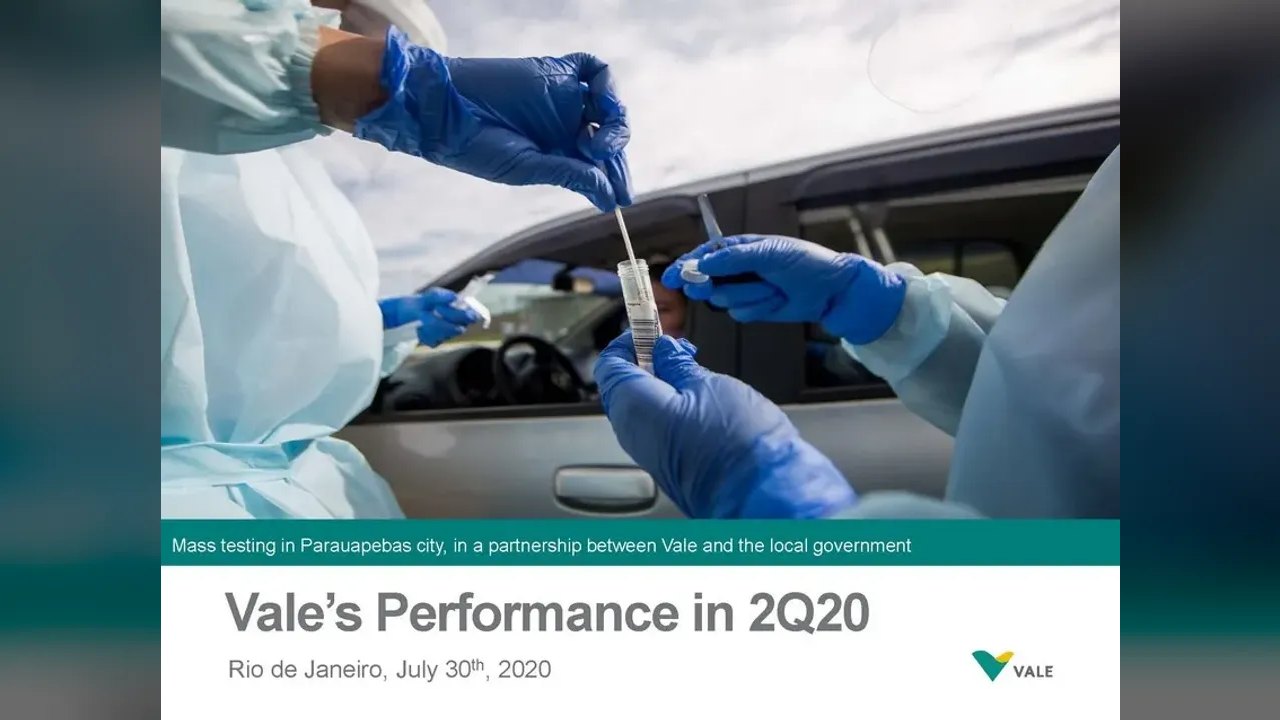
6:22 Would you please go for the next one? Safety also involves the care for our communities. We continue to support society aware of the essential role we have in the economy. In the city of Parauapebas, for example, in a partnership with the city hall, we had made mass tests available to the population. Parauapebas was the first municipality in Brazil to do mass testing with the PCR exam. By the second quarter, we had already disbursed R$ 470 million in actions to fight the pandemic in our operations around the world. I would like to stress that it's not just about financial resources. We are working together with the communities and with the authorities, as in Paraupebas, with the expansion of the capacity of the hospital there and the construction of one field hospital, which we constructed and operated.
7:16 As you can see, our obsession with safety continues with great discipline from our teams and collaboration with communities and authorities. Would you go for the next, please? Well, within our new pact with society, we continue to evolve in our ESG agenda. Recently, we took important steps with the creation of the nomination committee, which aims at the evolution of our governance model and which will work already for the election of the board in 2021. And the announcement of our chief compliance officer responsible for managing our third line of defense is strengthening our governance. Also, we remain firm in the ESG Gaps Closure Plan. We have a target of closing 10 gaps this year, of which we already closed 3, the formation of the Audit Committee, the disclosure of Management Compensation, and the release today of our Tax Transfer Report.
8:13 On the environmental front, our ambition regarding climate change is even more up-to-date. We announced last quarter that we work to reduce 33% of our emissions in Scope 1 and 2, in line with the Paris Agreement. And very important, we have an ongoing roadmap to achieve these ambitious goals. Already looking at Scope 3, we recently announced a non-binding agreement with Scope Steel and Mitsui to establish a new company targeting on supplying low-carbon metals to the steel industry. This new company will use existing and new technologies such as our Tecnored and Dmitrex process. And why is prioritizing ESG factors so important? Because we believe that the integration of ESG in our routine will be essential for value de-risking.
9:03 Here is the next slide. As a third point of our de-risking, we continue to stabilize our production. Amid the restrictions that were imposed by the authorities due to the pandemic and our own safety measures, this process has been very challenging. An example of this is that we operated with forced absenteeism to protect our employees, as a result of what I explained about testing, tracking and treating people. Even those who did not test positive but had contact with positive cases were quarantined. Our efficient was impacted so that we could maintain a safe work environment and continue to operate. The good news is that since June we have been able to plan our production and maintenance without any restrictions.
9:52 Also, we had important achievements in the resumption of our production in Aranora. We had the restart of Timbopeba and the speed up of the production phase in June and July. We have moved on to a very strong second half aiming to meet the guidance for the year. We'll still have some steps to follow in the resumption plan, and Spinair will give you more details about them soon. In base metals, we continue to bear the fruits of the good work carried out in North Atlantic, with robust nickel production since the fourth quarter of 2019. Boises Bay Mine operations resumed safely one month ahead of schedule, after three months in carry maintenance as a preventive measure for COVID-19. In relation to VNC, we continue to negotiate the definitive sale of that asset to New Sentry in a transaction that guarantees the continuity of VNCs by this new operator. For this, we have indicated a commitment of $500 million in the financing package for that business continuity.
10:51 In cold, we face the challenge quarter, highly impacted by demand, which in turn impacted our production. We continue to be prepared to start the revamping of the asset as soon as possible, as soon as we can guarantee the logistics for entering equipment and materials on the site. Looking a little bit further to conclude, with discipline and highest safety standards, we will resume our production capacity of 400 million tons of iron ore by 2022. Could you please pass the next one? Lastly, Capital discipline is fundamental to the de-risk of value, a point that we have reinforced on several occasions.
11:36 Looking at our capital allocation, it mainly serves three purposes. First, our commitments, for example, Brumadinho and our own financial debt. As I said, we are making progress on all those fronts. For Brumadinho specifically, we have provisioned $3.4 billion, having already spent $2.6 billion in the reparation. which has been progressing consistently, quickly and with quality. The next is safety and operational continuity. And for these aspects, we have annual investments around 4.5 to 5 billion dollars for the next years. Of course, includes replacement projects and some growth initiatives. And finally, the remuneration of our shareholders. Therefore, we believe that Vale fills in the necessary conditions to resume the payments of dividends. Our commitments are ongoing.
12:28 Our financial position is robust to meet these commitments. For this reason, Vale's Board of Directors, with the support of our Executive Board, restored the shareholder remuneration policy. Well, to conclude, our commitment is to continue to do everything we can to ensure the safety of our people and our operations. Finally, I would like to thank all of our employees and partners for their efforts in recent months. I now pass the floor to Spinelli, who will give more details on the company's resumption plan, and afterwards, Luciano will give some details about our results in the second quarter. Thank you very much for your attention, and let's get back to you on the Q&A. Please, Spinelli.
13:11 Thank you, Eduardo. We know that you have some questions about iron ore production. I want to address the answer in three blocks of information. So firstly, it's important to emphasize that we have a plan to resume capacity to 400 million tons by 2022. We are sticking to the plan and we know what to do, what we have to do. Secondly, We had, obviously, we had an additional challenge after COVID. So we had to change many, many things. I want to remind you that four main issues that we faced after COVID. So first one was related to absentees. So now we are in one third of the peak that happened in April. We're dealing really well in the north, even now in the southeastern and southern system that the problem is growing, but we're so far so good.
14:27 We had the stoppage of Itabira. We lost one million tons with this, and we learned a lot and improved our controls after this case. Those impacts, those two ones represent 3.5 million tons. So loss flexibility in our production, you know very well, any buffer now we need to deliver. Just to give an example, we moved one maintenance from the wet season to the dry season, so we lost more. We are planning to loss more production in the second half because of that. Thank you very much. The third information, the third block of information, I'll drive you in this slide line by line.
15:41 It is important to show that we have a different roadmap for each system that we have in Brazil. But it's important, you see, I want to drag your attention about this. We have some options. Thank you very much. What kind of challenge do we have? We are more exposed to the upstream dams. So we have the sequence that we already told you many times that we need to test the impact of the operations in the dam, return the dry operations, the wet operations, and the blasting.
16:37 So in the first half, we improved our operations in Valle Grande. We are now Thank you very much. to resume the operation of Fabrica. We didn't do this yet. We have the plan. We need some authorizations from the agency and the prosecutors.
17:23 We already have this plan with them. We are not counting on this production for this year, but we'll be back in next year. The second point here is about Maravillas 3s. And again, I want to draw your attention about this. This is a new asset that will give the possibility to return the dry production for Vargem Grande and we can have the full operation in 2021. Second line is about southeastern system. It's a little bit different problem that we have here. The challenge is The problem with upstream dams is now behind. So we already resumed the operations in Timbopeba.
18:11 We are running the operations in wet processing. We had some problems with COVID. And what is the main points that we need to address in the second half of next year? I want to remind you that we are moving from a common operation that use dams to an operation that we need to filter the tailings and dry stack the tailings after that. But there is a construction for that implementation that will be ready only in 2022. We use the dams that we have and we lost capacity as we are assessing two main dams in this corridor.
18:57 One is Itabiruçu in Itabira and the other is Laranjeiras in Brukutu. We are really almost done in Itabiruçu. In a few weeks, we're going to have the full assessment. and probably will be read to return the operation and actually return the construction of the improvement of capacity. So we need to plan this when you're going to have the full report of the depth. And Laranjeiras is a little behind. We still have to improve our assessment. We are drilling some tests and as soon as you have information, We're going to have the plan to resume this operation. But it's important to say we also have another option for operations in Brukutu. There is a new dam called Torto that is under construction. We are not counting on this capacity for this year.
20:00 Remember that we had some delays with the COVID. But we're waiting to have, and we have a high expectation to have the full operation of a Brook Tool next year. So there's a, after that we'll have the bridge with the capacity of the dam, and in 2022 we'll move to the dry stacking operations. The third one is the Northam system, and this is a total different game. The name of the game here is New Pit and RAMPAP of S11D. We had a problem in the first half with a very heavy rainy season. We had some problems with COVID and the delay of Morrone, that's a new pit in North Ranch. What do you have in the second half?
20:47 Full operation of North Ranch. The S11D is running amazingly Well, yesterday we had a daily record of 370,000 tons in one day. It's an amazing record. The run rate of S11D is 110 million tons for the last 20 days. And we also have another... Thank you very much. Just to conclude, the last two, actually two months and a half, what we are planning, we are delivering our production.
21:59 Definitely we have many challenges after COVID, but from the last 20 days, almost 30 days, we are delivering more than one million a day. So we are committed to deliver our guidance in the lower level of the guidance. We have many challenges, but we have great assets to make it happen and the right people. So I want to pass to Luciano.
22:30 Thank you, Marcelo. So a few highlights on the financials, starting by iron ore performance and costs, which was the negative highlight of the quarter. Costs increased from 16.2 to 17.1. And the major culprit here is low production. Low production has several consequences. So it reduces the cost dilution. And because of the production below plan, we had many ships awaiting at the port to being loaded. And the demurrage costs skyrocketed. We had one of the worst quarters ever in terms of demurrage. We paid $81 million U.S., for the weighting of those ships, an increase of 28 million from the prior quarter, which in itself is an increase of 50 cents per ton in terms of costs.
23:27 So we expect for the second half that this will all revert. So cost dilution will take off about $2 per ton from costs and the fall of Thank you very much. But the FX, the valuation already had positive effects in some other parts of the iron ore business.
24:18 For example, stoppage expenses, I don't know if you noticed, they fell from $3 per ton to $2.2 per ton, mostly on FX. The pallet margin expanded substantially, $22 per ton in the quarter. Okay, we had $5 per ton in price. We had $7 per ton in dividends that only come every other quarter. But half this margin expansion, for example, about $8 per ton can be attributed to FX and lower cost performance of our pelletizing plants. So once we normalize the iron ore fines situation, we should also see important boosts in our competitiveness from FX.
25:06 In base metals, the results are self-explanatory, great performance production-wise for the assets, but low sales because of low demand. I want to highlight four opportunities for Q3 and thereafter for improvement of results. First one, sales will be above production. This is obvious. We've been building inventories substantially and now We intend, according to market conditions, to offload those inventories. Second thing, gold is going up substantially. Average price, $1,700 for the second quarter, now approaching $2,000 per ounce. Every $100 per ounce means an additional $11 million in quarterly EBITDA.
25:58 So it's a boost. Onsapuma is coming back after finally we were able to do the comprehensive maintenance in July. It should come back at a rate of 25,000 tons of nickel per year. and generate EBITDA because today it's a marginal operation. So this will boost results as well. And last but not least, Voise Bay ramp up. It was stopped generating expenses. Now we will come back and copper production will increase and expenses are going to come down. So watch out for these factors going forward. Cash flows, they were modest. Very leveraged on volumes. The performance only started to improve on volumes by June.
26:46 As a result, we finalized the quarter with lots of outstanding sales to be collected. These sales were collected in July already. And just to give an example, in 15 days in July, the cash flow generation of Vale was as large as in the entire first half. So the pace of cash flow generation is very different now in the second half than it was in the first half. About the revolver, as we're resuming the dividend policy, we also said that we would repay first the revolver. We already gave notice to the banks, but we're discussing a few small amendments to the contract before we repay, and that process should be concluded in August. Finally, I want to highlight an important Thank you very much.
27:58 It's still not the final milestone. We still have some minor adjustments that will be made by the agency and the ministry. But this bodes well was the final major roadblock towards the approval. And now we're very positive that we may sign the agreement this year. There are some associated investments. Those investments are known by Vale since the proposal was crafted two years ago. So no surprise here. and it's already incorporated in our long-term planning, both the sustaining investments and some capital investments to build assets for the federal government. That was my summary and now let's move to questions and answers.
28:46 Thank you. Ladies and gentlemen, we'll now begin the question and answer session. If you have a question, please press the star key followed by 1. If at any time you would like to remove yourself from the questioning queue, press Start 2. Please restrict your questions to two at a time. Our first question comes from Team Natana's Bank of America Merrill Lynch. Yeah, hi, great. Thanks for the opportunity and good morning. Hope everyone's doing well. Good afternoon there. Wanted to just ask a little bit more about the production outlook. Clearly, the $400 million is the medium-term goal, and you laid out some challenges in the short term. I was just wondering if you're concerned about the shortfall having added to the ability of your customers to find alternatives or to produce their own mines or to add to their own mining plants, such as encouraging seam and dew.
29:47 So if you could just talk about that and your concerns about the high iron ore price or the shortfall in supply. And then I was just wondering if you could lay out a little bit more in terms of timing for when we could expect to see further updates on your divestiture plans in coal and BNC. Thanks.
30:05 Okay, Timna, thanks for your questions. I think Spinetta can detail the R&R perspective. Of course, I think prices are, in a sense, where they shouldn't be. So attracts, of course, investments that wouldn't be. So I believe that the supply-demand balance is key. But we see some medium-term losses in supply as well. But Spinetta is the most fit to answer that. And I come back with the divestitures. Okay.
30:35 Hi, Timna. Thank you for your question. Firstly, Vale is the only company that can bring back almost 100 million tons in the next two years. So as I mentioned, if you have some problems, I'm talking about delays of some month, but we'll be back. So this is an Thank you very much. We are developing another possibility to sum another 20 million Z11D. We are finalizing the project and we're going to submit this as soon as possible to our board. Again, You're right that the price is high. We don't see a support for the price in the short and mid-term actually.
32:08 Remember that we are now bringing more than 50 million tons to the market in the second half. You're right that the demand in China is amazing. They have many stimulus for even for second half related to infrastructure. But we see that all those information that there's no support to keep so high the price. Eduardo.
32:38 Yeah, thank you, Spinelli. I think just to add on Spinelli's point, I think we are the growth option that is the obvious one and the cheapest one. That's why we are going to announce, we're going to submit, by the way, to our board the expansion of S11D to use our logistic capacity. And of course, we have to remember our mantra, value over volume, not to mix up the Vs. So we're going to be able to. It doesn't mean we need On the Coal Olimoates, it's the same. There's no updates. Unfortunately, we weren't able to start the event because of COVID. I think, by the way, coal was the most impacted by COVID in all dimensions from demand production, but not for COVID. We had no COVID problem there.
33:26 But the fact that we were not able to enter the asset to fix it will take a while. So our first strategy, as we've been saying, is fix the asset. Then we're going to decide what to do with it. By VNC, we have good news. I think we just added a little bit more time to New Century to go over some due diligence and some papers. But we are very confident that we are going to be able to close the transaction. That's why we did the relevant fact yesterday. But I think I would like Mark to add some color, just to give clarity, because it's very important to understand that we want a win-win solution for VNC. But we want to leave that.
34:05 Yes. Yes, and Timna, I believe your question was around the timing, and as Eduardo was saying, we feel that we're in very good position to sign documentation with New Century as well as the French state before the expiry of exclusivity in early September. We feel like we're in a very good position to do so. And then we will go through a period of primarily the conditions around financing, concluding the financing, and we expect that the closing would occur before well before year end so that's the timing and in terms of it's maybe some additional color the financing package is I would say is quite well defined in terms of our current discussions Luciano has already set out some of the parameters of the financing package.
34:56 It was set out in our press release, a total of 900 million, 200 million euros from the French state, 200 million from New Century, 500 from us. Just an important note about our contribution is that it is... Starting as of July 1st, so there are expenditures that we're already incurring and will incur up till closing, which would be deducted from that 500 million. There's also a deferred compensation component in the discussions where we could earn money back based on price in future years. And other than that, I think it's shaping up quite well and New Century is coming to the table with a very robust package to continue the handoff of this asset to them with us handing it off. Other than the contribution to the financing, we would pass off the obligations and liabilities to the owners going forward after closing.
35:56 Our next question comes from Carlos de Alba, Morgan Stanley.
36:03 Hopefully everyone is doing fine. So my question is, maybe Eduardo, if you can comment on any updates on the potential comprehensive agreement with the authorities in Brazil regarding the Brumadinho, particularly the legal exposure and any other provisions or money that the company may need to pay on that front. And then for either Eduardo or maybe Luciano, Just wanted to confirm the dividend situation so the way I understand is the company will pay in August 7th the interest on shareholders equity announced in December plus then in September subject to board approval there might be another dividend on the back of the first half performance and then next March another dividend on the back of the second half 2020 performance. If you could confirm this, that would be great, plus any comments that you may have on upside or potential special dividends and or share buybacks. Thank you.
37:09 Carlos, thank you. I'll address quickly the first one, and then Luciano can give some more color on the dividends, but you're almost there. I think we are engaged, yes, with all the stakeholders at Minas. We are, actually there's a meeting even today, so just to be clear, but it's a convergence, right? There's many stakeholders and we know the government of Minas is interested, VAT is interested, everybody is interested in getting to a more broader agreement as you mentioned. The difficulty is just to get the legal certainty, the governance and the scope correct. And I think we are, how can I say that? We are advancing on that sense because, as I mentioned, there is interest from the government, there is interest from the prosecutors there.
37:55 So it's just a matter of trying to meet those stakeholders' needs because, of course, each one has its own priorities and we need to converge. So I cannot give you an idea. How can I say, a timeline for that, because it depends on this convergence. But one thing that I want to highlight, and maybe get to your point in the end, that we are doing the reparation, because as we speak, it's our obligation, and we are progressing well on that front. We're doing the ramifications, we're doing the reparation, the environmental, how can I say that, reparation. Sobrinho, Marcelo Feriozzi Bacci Let's change the dollar, right? It's around, what is in our provision, Luciano?
39:02 730 to 1.5, it's on the footnotes.
39:06 On the footnotes. We believe those numbers, they talk to the projects that we listed with the government. So we don't see any other provisions coming from that discussion, okay? So Luciano can give some more color on that. Specifically about dividends, I think it's important that we resumed the policy because we are confident with our business and I think it's in the press list so I don't need to go over that. It is that we are going to pay now in August the interest on the one that we announced on December. The first half is in September and then follows on the predictability that we want to have with the policy. We haven't discussed yet any extraordinary dividends because Luciano will give you more clarity on how mindset are, but of course we need to know how the world, our business is in September, how much you're going to pay in March, and etc. I think you can help me on that, Luciano.
40:07 Okay, first on the provisions, why do we separate on the footnotes that amount of money and why don't we incorporate in the existing provisions? The list of initiatives and programs and projects being discussed with the government is very adherent to the provisions that we already have in the balance sheet. So no change here. The thing is, the icing in the cake, like the major gift, for example, for the people of Minas Gerais with such an agreement would be some major infrastructure works already identified that have no relationship to Brumadinho. and then if and when we get the legal certainty all the conditions that we want we would be willing to do those extra up and above infrastructure works in order to have closure on all of this but if you look strictly on the reparation of Brumadinho the estimates both the ones we have on the balance sheet and the ones being discussed with the government they are very very very similar on the dividends yes the Thank you very much.
41:31 and it will be decided in September because the board has always the prerogative to increase and pay an extraordinary dividend and again as you said in March there will come another dividend related to the second half performance when September comes we will look into our cash position trajectory of the markets we will have a better idea of the performance on the second half and therefore of how much we will need to pay in March Remember that first quarter is usually a weaker quarter in terms of cash flow, so you need to look at your balance sheet already considering probably the commitment to pay another dividend in March. Thank you very much. Our next question comes from Alex Hacking, CT.
42:46 Good morning, everyone.
42:48 I hope you're doing well. Luciano, just to follow up on the dividend question, could you remind us what your balance sheet targets are in terms of net debt? You know, I remember at one point you were kind of targeting net debt of $10 billion, but that feels like a lifetime ago, and obviously a lot has changed since then. Just trying to remind myself about how you're kind of thinking about that through the cycle at this point. And then the second question would be, I guess, to Marcelo, you know, on the 400 million iron ore target, you know, kind of midterm, is there any flexibility or latency, you know, in Vale's ability to achieve that 400 million tons? Or effectively, you know, does every single thing have to go correct?
43:37 So those would be my two questions. Thank you.
43:40 Okay, Alex, thanks. We said 10 billion U.S. We continue to stick to it as the target absolute net debt. Perhaps and maybe in a circumstance like the one we're living right now, you could be a little more conservative. But the way to make the correspondence with the situation we are in right now is our net debt is 4.7 today. So it's well below 10 billion. However, we still have 3.4 In Brumadinho-related liabilities that we didn't have when we established that target. So in comparable terms, it would be at 8, for example, 4.7 plus 3.4, and that would compare to 10, and that would say, okay, we are where we want to be, perhaps even a little better, which means that pretty much all the extra cash flows should be returned back to shareholders.
44:40 And this is it. That's the way we think about it. And through the cycle, again, I would say the only circumstance which is different right now is COVID, which may warrant a little bit more caution. But nevertheless, we are where we wanted to be.
44:58 Alex, thank you for a question. Talking about flexibility, that's a mid-term plan, but let me remind you some new assets and capacities that weren't here before Brumadinho. So we have Gelado that is coming in the North Operation. The expansion of S11D to 100 million tons. We also have, as I mentioned, the two dams that will give flexibility in our operations in the southeastern system. We also have new pits that are coming in the north range, small pits that can stabilize the operation there. And Serra Leste is the east range that wasn't here before Brumadinho. So all those assets and improvements weren't even considered in the operations before.
46:02 But obviously, we have challenges. And if you consider the COVID today, sometimes we have some bumps to make it happen. But so mid-term, we have also this new capacity that can give us some flexibility rather than wait for the return of the common operations that used to have the best.
46:25 and Marcelo. And just to reiterate, the 20 million tons that we will submit to the board would add to that package of flexibility as well.
46:34 And then, Luciano, just to remind us, our old gold time, good old times, logistics used to be one big bottleneck. So there's nothing more on that. So we can go up on the, not medium, but a little bit more longer to 260 on the north because if we need it, right? So there's not... In this two to three years time horizon, but for sure we have a huge flexibility on the infrastructure, both on the south and then the north. We just need to get back the mine, the mine fronts and the dams in the south, as Espinelis explained, on the immediate term and on the medium term. So I think we used to have even more than 400 million tons of available capacity. So we do have flexibility.
47:22 Our next question comes from John Brent, HSBC.
47:27 Hi, good afternoon. Thanks for the opportunity. Luciano, I first wanted to ask you about working capital. I know there's about a billion dollars in working capital increase, and a big part of that was because of the production and the sales in June, plus a higher percentage going to China. It sounds like a lot of that has reversed out in the first 15 days, but I guess I'm wondering, should we expect a complete reversion of that billion dollars in the third quarter, even as production continues to increase into the second half? And then my second question is just related to the $560 million provision that you took for Samarco and Hanover.
48:13 Could you just maybe give me a little bit of clarity as to what was driving that? Was it just a sort of a broad-based increase across a variety of different things? And then if I could just confirm the 400 million tons in production that you're expecting in 2022, is that for the year or do you expect to reach a run rate of 400 million tons by the end of 2022? Thanks. Okay.
48:40 Just a call on working capital. So we had sales outstanding of about 5 million tons at the end of the first quarter. And then we have at the end of the second quarter about 11 million tons. So 6 million tons times the current price, just that we have over 600 million of buildup in working capital in terms of accounts receivable. Then you have the provisional price, which is very strong. It adds a little bit to that. So it's basically explained by the better rate of production and sales in June compared to March, which is the close of the prior quarter. So these collections are already happening. So as I mentioned, most of these sales were already collected in the month of July, and the cash flow generation in July is already increasing.
49:32 We're approaching the end of the month is already substantially higher than for the full first semester of this year. And when you look at the third quarter end to end, it is expected that there will be outstanding sales also at the end of the third quarter. So therefore, I would say what we're seeing here is a kind of a normalization of working capital at a higher level because it's In normal times, you would have more sales outstanding than what we ended up in the first quarter, right? So you will not recover that working capital, but collections will be much, much, much, much higher. The fourth quarter will be the same. So we will start the quarter with a lot of collections, but we will win the quarter also with many collections. Maybe only on the first quarter of...
50:19 and many more. Thank you very much. Thank you. All of the authorities shortly thereafter the dam breach, but the prosecutors only came into the agreement in June 2018. And there were many changes in the agreement, including a provision for a re-scoping of the agreement two years down the road, which is June 2020.
51:05 So a review of the programs, of the amounts, and everything else. That review, that amendment to the June 2018 agreement, Thank you very much. and so on. So this is kind of an anticipation of that re-scoping that is already provisioned for the agreement signed in June 2018.
51:58 And if I may jump directly here, the 400 million will be run rate. At some point in 2022, we'll get to a run rate of 400 million, but not the full calendar year will be 400.
52:11 And more importantly, Luciano, you use it if needed, right? So that's another thing. So we need to build up flexibility. It was asked prior. So we're not saying that we're going to shift or sell or else 400. We're not giving guidance. We're just saying that we are going to put our assets back to a 4 million run rate. We even have higher numbers, but we believe that is a reasonable target to be in a run rate for 2022. Yeah. Our next question comes from Andreas Bockenhauser, UBS.
52:48 Thank you very much. Just two effectively incoming investor questions. Can you provide a little bit more clarity on how the negotiations with the state of Minas Gerais is going, about any liabilities relating to Brumadinho, also in terms of timing, and where do you stand versus what the other part is asking for at this point in time? So just giving a little bit of clarity around that. And secondly, if you would, just in terms of credit buybacks or bond buybacks, any thoughts as to whether you would think about buying back Samarco bonds given where they're trading at this point in time? Those are the two questions. Thank you very much.
53:32 Okay. Thanks, Andreas. We pointed out that we are on the table. People say the agreement is with the prosecutors. No, it's with more people enraged. So there is the state of Minas Gerais in the agreement, there is the public defenders, there is the prosecutors, and there is Vale. So we stand exactly in the discussions of how we create a right governance, how we create caps, and how we create the scope to be executed. Because most importantly, we want to... How can I say that? Get the responsibility to execute things that can be executed. So that's one of the most important matters. And of course, have legal certainty about the civil actions that are undergoing now.
54:17 So those are the key issues that we on the table, converging, these four main stakeholders are discussing now. Actually, I've mentioned there's even a meeting today about that. There is no timeline because, of course, there are divergences, but not necessarily on value because I think you're asking more concern about what we perceive as provisions. And I think Luciano mentioned that before on the last question, that we are very comfortable with what has been provisioned and the footnotes that we put in our balance because we discussed that with the government, with everybody on the... On the list of projects and not only those compensatory projects, but on the reparatory as well. So we believe that the numbers that we are working in either in our provisions and in the footnotes are more than comfortable to strike an agreement.
55:10 That's not what's impending our agreement now. It's much more on the governance and much more on how we create a legal certainty. to be sure that we will be able to execute what is supposed to do. So I think this is a... And I think if Luciano can add a little bit more on that part and then go back to the buyback, I think it's the same as we mentioned before. It will be, of course, something that we need to assess all the time. Time is not now because, of course, we just resumed our policy. In September, we can take a look again and I think, of course, we can submit to Bob, but I think there are so many variables, right? So that... I think Luciano can explain again how we see this, how is our mindset around, right?
55:55 Eduardo, nothing to add on the provisions. You were comprehensive. On the credit buybacks that Andres asked, bond buybacks, they will, on Vale, they will come back to the table at a moment in time when we Look, most companies are going through that crisis with a greater cash balance. And even if we're not talking about net debt levels here, the amount of gross debt and the amount of cash that you want to hold, I would say it's higher now than pre-pandemic. So therefore, we're not in a hurry to continue to buy back We would prefer, at least for the next couple of quarters, to have greater cash balances.
56:52 On Samarco, I'm sorry, but I cannot do any comment on this because of the ongoing legal arrangements with the creditors, so I cannot comment on credit buybacks.
57:06 I'm sorry, Andres, I confused the question. I thought we were talking about buybacks from half. Sorry for that. Excuse me, this concludes today's question and answer session. Mr. Eduardo Bartolomeu, at this time you may proceed with your closing statement.
57:27 Okay, thank you very much for your attention, for the questions. I think we had a more comprehensive explanation in the beginning, but it was necessary, I think, to give you clarity on how we see Because I want to separate things into two lengths of time. One is the most immediate, what people expect about the second semester. And I think we built a very strong basis, even after COVID, to be ready to deliver in our guidance and our commitments. But I would like to stress that we're not in a sprint in Bali. We are in a marathon. We are looking to de-risk this company profoundly. And we need to see those four elements that I mentioned in my initial comments as interrelated. They are not separate. You know, I said, oh, look, like now we pay dividends, so now, now, no. Dividends just show that value management has confidence in our business and we see that we have robust financial position to face our commitments.
58:26 We need, first of all, as I want to again emphasize, we need to repair Brumadinho. We are advancing. We need to do much more and we are doing. We need to improve our safety. We are doing that. We need to effectively turn around the safety perspective of the company and we are trying and we will do that. And we have an aim to be one of the safest and maybe even obligation to be one of the safest mining companies in the world. Third is the resumption of capacity. I think the questions were around that, how much you can do in the second semester, but what is our goal in the medium term? We need to get there with consistency. We cannot just go and set a target. We need to be delivering We will do that with safety. That's what I tried to say when I was doing my initial comments.
59:13 If we need to postpone, we'll do it, but we are pretty confident that we have the assets, we have the people, we have the logistics for that, and we will resume as safe as possible, or SAP. And finally is the dividend, the capital allocation. I think it's very important to bear in mind that Vale is extremely conservative. So, we are extremely focused, of course, on the remuneration of our shareholders, but we need to look at the world more broadly. And this world, just to conclude, is a new world, and a new world that exactly we don't know a lot about that. So, we need to keep our balance sheet extremely strong, and of course, if there's any excess, we'll get back to the shareholders, but our commitments, as Luciano mentioned, are pretty high. In a nutshell, again, I would like to thank you for your attention and remember that we have these four elements to the risk valley and we are working with our team thoroughly to get it there.
1:00:12 Okay, thank you and see you in the next call. That does conclude Vale's conference call for today. Thank you very much for your participation. You may now connect your lines.
Follow Vale S.A. into a list and get an email when it puts out news.
Chief Executive Officer
Executive Officer for Ferrous Minerals
Chief Financial Officer
Executive Officer for Base Metals
Analyst, Morgan Stanley
Analyst, Citi
Analyst, HSBC
Analyst, UBS