Nina Alalopa
Investor Relations
Replay available
Vaisala (Helsinki:VAIAS) Q2 2026 earnings call, held 2026-07-21. Watch the replay and read the transcript on 6ix.
On 6ix: 6ix.com/event/vaisala-oyj-0geg-q2-2026-earnings-call
Automated transcript · Written by software from the replay's audio. It can mishear names and figures; the replay is the record.
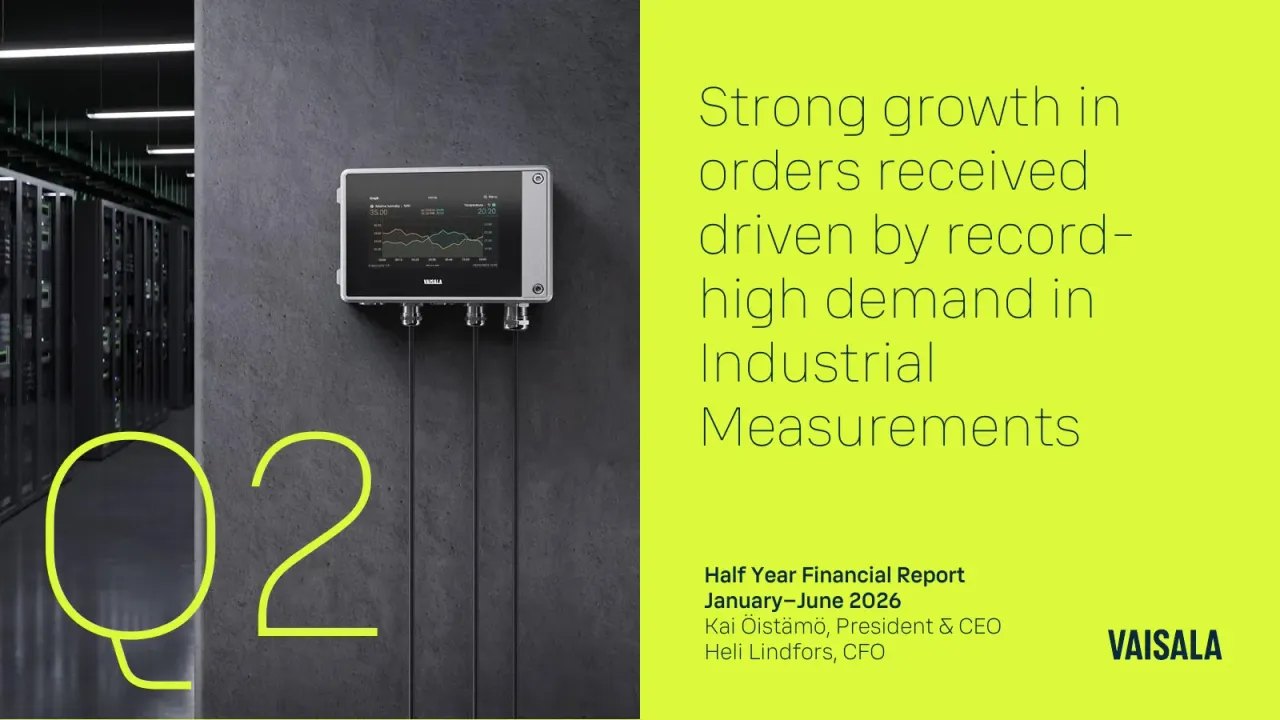
0:01 Hello and welcome to Vaisala's Second Quarter and January June twenty twenty six Results Call. I am Nina Alalopa from Investor Relations and today with me in this call are President and CEO, Kai Oyjsama and CFO, Heli Lind foss. Like always, first Kai and Heli present the results and then we proceed to Q and A. Kai, you may start now.
0:26 So, sorry about this. So, I heard that there have been some audio problems, so maybe I'll restart so that everybody can hear what I say and hopefully the technical challenges are overcome in a second. So, as I was saying, a very strong orders received in the quarter. We continued to perform across the company very well and really the order intake was really driven by extraordinary demand in terms of industrial measurements and that drove the company's order intake to increase 11% compared to the year before.
1:18 Exweather continued on a good track on double digit growth, 15% year on year growth in constant currency. A key event in the quarter for Exweather and for the company itself was the acquisition of the AI weather company Atmo Inc. That we announced in the second quarter. I will talk about that in a little while. In terms of weather, energy and environment, the quarter was more muted as we expected going into the quarter but even in this environment, I think the team performed really well and delivered strong profitability results.
2:07 And we we still having problems now? Okay. We are reconfirming the business outlook as I'll conclude in the end.
2:25 But before going into the numbers themselves, I will talk about the two key events during the quarter. I'll start with product launch which I rarely do but I think this Preziqa product that we launched in the second quarter I think merits very much of taking it as a key highlight in the quarter. So the state of the art way of measuring rain is what we would know ourselves if you have your own rain bucket somewhere in your summer place, at your house, at your place, so it's a bucket which catches all the drops and then you just read how much water is in the cup.
3:10 But if you own one, you also know that in the fall it's full of leaves, it will have insects, the accuracies are whatever they are, it requires maintenance and it's kind of remote operation really is not possible at all without maintenance on-site and this has been the state of the art way of operating RAIN measurement since almost the past one hundred years. We took on a challenge that with modern technologies, this probably is not the best way of doing things, given all the challenges related to the rain buckets. So what we did is take a miniaturized version of a radar, turn it pointing upwards so that we can actually measure with it, with the Precica sensor now, every single droplet that it sees.
4:09 So not only can we measure all the rain, but we can actually see the size of the droplets, we can distinguish the different sizes of what kind of a rain or hail it may be, and we can actually see even the direction that the rain comes, I. E. We can see the wind impact on the rain as well. And, oh, by the way, it is also more accurate. It requires no maintenance to speak of so it's very easy to save on the maintenance cost and use especially on the remote sites. It's a great example of taking something which everybody works and then nobody thinks about it, even the challenges that it has, that can be reimagined with the right kind of insight, right kind of a team, the right kind of capabilities and it really is what defines really innovation and I think it really kudos to the capabilities that the company and the team involved really has had. It also highlights how well we understand the phenomena in order to in order to do these kind of reinventions such as, in this case, RAIN.
5:30 This very much actually combines, to to the AI topic that I'll talk next. In terms of an AI world, there are two things that are super important. It is all about the data, what kind of data, who owns the data, who understands the data that feeds AI. I think Precicap is a fantastic example of how we as a company, we actually understand and measure weather related data better than anybody else. That in combination of what we have been building in XWeather in terms of capabilities on forecasting and big capabilities in machine learning and AI, building the entire asset on machine learning and AI.
6:29 And now, together with ATMO, which we find really the world's leading by far in terms of a company, an asset and a team in terms of weather related
6:43 AI capabilities. Weather forecasting is going to change based on that's already happening and so lots of attempts by different companies, different teams around the world. What sets Atmo apart is that they really have a unique scalable model where you can take, based on local data, that can be weather data that I was talking about, it can be customer data as well, and you can create a local AI based weather forecasting model, very scalable, in a very scalable way. You can do very local, just imagine we could do on our site here at our headquarters, or it could be regional, it could be global, anything where Atmos model is not based on a single AI model but it actually takes as an input and can utilize anything that anybody else may innovate and it can ingest those into its own world's leading model.
7:52 It's also run by a team which we find really a best AI capable team that we've seen within our industry and proven by a very, very interesting customer set who are paying for the service already today. A couple of examples of this would be from the civilian side, met agencies, VITI's meteorological agency has been relying on ATMOs model for more than a year in weather forecasting and other great examples is on the defense side, are multiple branches of US military but most notably US Air Force, who is also, relying on some of their operations in AIs, in Atmos AI based model.
8:46 So, what we, together now with what we know in a traditional side of the weather, what we've been building on X weather and now in combination with ATMO, I think we have world's leading assets, teams, capabilities in all parts whether business will look like in the future from providing and understanding the data to building that into a modern platform, customer focused offering based on AI. So very, very exciting news. Now with that, I will hand over to Helene to talk about the financials in more in-depth.
9:37 Thank you Kai and good afternoon from my part as well. Kai already mentioned the financials, but if we dig in a little bit deeper, so the growth in orders received 11%, really driven by the industrial measurements with 28% with constant currencies, while the weather side had a little bit muted and saw a slight decline on the orders received side. These orders increased growth also boosted the order book close to $200,000,000 7% above the level at the end of twenty twenty five. And also the ARR similarly rose by 7%. If you then look at the net sales, it increased by 4% or 6% in constant currency.
10:25 Is Here the main coming from the industrial measurements with 10% growth and ex weather with 13% growth. Also here the net sales had on the weather side a slight decrease. Decline of net sales growth as well as the favorable sales mix improved the gross margin and it also had a positive impact from the kind of lower tariff level of 10% we have seen since February. Going further, we do expect that this has been a temporary level of 10% and once The US and EU trade agreement comes to force, it may be again 15%, but we will of course see then what it will be later on now in Q3.
11:16 The gross margin improvement and the increase in sales also improved the EBITDA to 14.6 percentage points. Of course, here we do see that we also increased our spend in our OpEx by eight percentage points and that is investments in the sales and marketing activities as well as the R and D in our growth areas of Industrial Measurements and XWARE. Also, the return on capital employed improved from last year to 18.2 percentage points, driven by the higher EBITDA as well as the strong cash flow and releasing our capital employed. If we then move on to the industrial measurements and a record high quarter in all means, the oil indices increased by 28% in constant currencies coming from a very wide base. So all market segments and regions were growing, but particularly The Americas, and it was further boosted by the large orders from data center and power customers.
12:20 This one also boosted the order book to 33% above the level of the end of last year. This is due to the increase in the larger data center and power related orders. So, if you consider a year back and before, most of our orders were delivered within weeks, whereas now these larger orders on top of these kind of deliveries within weeks, we have now orders that also span across a few months going further. And this is visible in the order book. We are delivering 44,000,000 out of this order book still within this year, so it is still a fairly short order book overall.
13:10 Net sales increased by 10% and here you see that the increase was less than in the orders received due to this change in the mix of orders. This was still 13% in constant currencies and here the driver was the APAC region. The gross margin improved then following the net sales increase and also the positive impact on the tariff side. This also boosted our EBITDA to 24.5%.
13:40 We also gave you some further granularity on our largest market segments in the industrial measurements side and this is now you can see the news split here. So the life science continues to be the 30% as we have said before and now the new information is the quantification of data centers and power segments both being at around 10% of sales. We do have the other key of focused industries, as we have been saying, semiconductors and battery manufacturing and then, of course, a wide range of other industries as well.
14:23 If we then look at the Exverter side, the annual recurring revenue increased 7% from a year ago. Here we can remember the seasonality we have in our ARR as well as this is then including the FX. And now, of course, in the beginning of the year, we still had a larger FX impact compared to last year, whereas now at the end of Q2, we have now seen a full year of
14:57 the decrease dollar and related currencies. So now the impact starts to be smaller. And this you can also see that the net sales increased by 1315% in constant currencies. So now the reported currency as well as the constant currency are much closer to each other again. Here you can also see that the net sales growth came from many areas, not only one, so insurance industry as well as transportation and logistics and then also the developers and API customers that buy more of the DOS side of business. The increase in net sales also boosted our gross margin, the same as in other businesses and this also boosted our EBITDA percentage.
15:44 And of course, if you see the kind of EBITDA improvement, it is material but as the ex weather figures are still fairly small, this is of course only €800,000 difference to
15:56 last year. Then moving on to the weather, energy and environment side. It was a slower quarter as expected. And the orders decreased by 5% mainly coming from the project orders. The order book as such remains on the same level as it was at the year end. The Indonesian
16:20 weather project order that we have announced already a while back, it did move ahead and the customers' financing arrangements were clarified. We are still missing the last steps of this order before we book it to our order book and that we do expect to happen now within the third quarter.
16:40 Net sales as such were close to previous year's level. We did see an increase in the project and product deliveries on the weather side whereas the decline in the renewable energy sales continued on that side. The favorable sales mix then also improved the gross margin and also the EBITDA side. Here you can see that also the operating expenses were maintained following the development on the sales side as well.
17:17 Moving on to the cash flow side. The cash flow from operating activities increased to 48,900,000, not percentages. And it is really boosted by the kind of increased net result as well as timing of tax payments compared to last year as well as lower level of project receivables. The cash burn of earnings was strong, 1.3 in January June. Then if we look at the
17:50 half year results as such, so net sales increased by 7% in constant currencies as is our strategic target. The operating expenses increased by four percentage points and this is investments in the industry measurements and etcetera. So in the areas where we grow. The corporate and non operative items were $4,500,000 up from 2,700,000 last year. These are one off items among other M and A expenses.
18:23 As such, the solid profitability continued and improved to 14.8% and then one item to highlight is also the financial income and expenses that is fairly different from last year. So there you can see that the kind of volatility of the currencies have been less and as we are also less leveraged, the core financial expenses were more than half less than last year. This of course then boosted also our earnings per share in total to be the €0.78 The strong profitability as well as cash flow does bring us to strong financial position that continued has been
19:08 strong for us also for a long time so we continue to be low leveraged in our balance sheet. One thing to highlight here is the CapEx that is on lower level than last year. Last year, we were building our automated logistics center and we don't have that this year, so that is why we are on a lower level of CapEx year to date. Then we move on to the market and business outlook. Yes, so when we look at the market outlook for the rest of the year, no changes in this. We expect all markets underlying industrial measurements as well as X weather to continue to grow, so industrial, sciences, power
19:54 and then the markets for X weather and subscription sales. And then the weather, energy and environment is focusing on meteorology, aviation and renewable energy continuing to be stable for the rest of the year. And this leads into reconfirming the business outlook. In terms of our net sales, we continue to estimate that our net sales will be in the range between 600,000,000 to €630,000,000 and our EBITDA result will be in the range between 95,000,000 and €110,000,000
20:40 And this brings to the end of the prepared remarks, and we would be happy to answer any questions that you may have. If you wish to ask a question, please dial 5 on your telephone keypad to enter the queue. The next question comes from Nico Ruokindes from SEB. Please go ahead. Hello, this is Nick Roanis from SVB. Thank you for the presentation. I have a couple of questions and I'll go one by one. And first one, you highlighted large orders in data center and power segments in industrial measurements, and I guess individual orders have typically been relatively
21:35 small in the area earlier. So how big were the individual large orders now in Q2, and how much of the order growth in industrial customers was extraordinary, as you phrased in your presentation? The larger orders are a few millions of euros, the largest ones. But as Kai actually mentioned, the order intake came from a very wide kind of wide range of different industries. So, as such, we say that it's extraordinarily good, but it was not solely driven by these larger orders. Or extraordinary orders per Yes, exactly.
22:21 Okay, good, thanks. That clarifies. Then on X-ray side, the ARR did not grow Q on Q despite the year on year growth. You highlight the seasonality there, but how much was this seasonality impact and can you give a bit more color on that? Okay, so the extraordinary seasonality in the ARR comes from the winter maintenance contract as well as lightning. So these are something that the best comparison point is the year before that you can compare to. And the best kind of the cross year seasonality would be last year's ARR development. Yeah. And we've got to object about, like, maybe just a little bit of a explanation why that's the winter maintenance on the winter months.
23:12 And the lightning is seasonal as well that
23:15 in especially in the Northern Hemisphere, the lightning activity is related to certain parts of the year, more than other parts of the year. Okay, thanks. But I guess if we compare it to last year, we have the FX impact last year as it was quite big a year ago. Actually, no, because the ARR is actually kind of that is translated with the end of the month currency rate, not the average one. So it is the end of the month. So last year, the rate was 1.17 at the end of June, and now it was 1.14. So actually, I think question was more seasonality.
24:01 So that the end of the year, you need to look at we look at the end of the quarter kind of exchange rates. Yes. Yes. So if you compare last year's seasonality, they
24:09 were correct. So q one was still with the higher rates, and then q two was actually with the headwinds of the US dollar. Yes. That's what I mean. If I can ask one more question and then I'll So just relating to the ATMO acquisition, you've already discussed a bit on. But can you give a bit more color from financial point of view, both on sales and profitability outlook and then also reasoning behind the price paid for that business? Yeah, so at this stage we cannot give anything more than what we've said. The last year's number was 2,000,000 USD and then this year's contracted value at the time of signing was 6,000,000 USD and obviously there's a plan for a higher number since there was a good part of the year to go.
25:08 We'll comment once that deal closes and we'll see more kind of where we are and so on, but this is how much we can comment at the moment.
25:17 Then the amount paid is we can have a few things on this. Obviously, is based on the business case that we have and we can't consider that represents right value vis a vis what the opportunity it brings and especially long term thinking about this is more of a long term than thinking about the kind of short term on this. So that's first consideration in any M and A, that it needs to be rebalanced in terms of what the opportunities and what the returns expecting with the financial returns. Then the the second thing is that that obviously part of this is the capabilities as I was highlighting in my prepared notes that the capability, we believe that this is the world's best AI team that there is in the domain.
26:17 Now we stop. The second thing is that it what I said in in in the my prepared remarks was that they also have a very interesting customer base that has verified their service, it's really like a verified and there's customer traction people are willing to pay for it and the customers are very interesting customers as well offering us more synergies as well as new growth terms of where we have had access to before and mostly highlighted the med agencies, three d police med agency, but also the defense side and especially the US Air Force is very interesting reference.
27:05 Alright. Great. Thanks. That's all from me. Thank you. Then I see Matsi has up next. Yes. A couple of technical questions first. Actually, of technical ones. Now you have given some new information on the industrial measurement sales split, so that medical is 30%, eight percent is 10, power is 10%.
27:34 Earlier you have said that these four growth areas would be 30% and of that 8% is on power where mentioned, but also semiconductor and batteries. So does it still apply that the 30% goes to all these four so that semiconductor plus batteries would be 10% combined? Yeah. The math is exactly right. Yes. Okay. Good. Then to Helly. Now the group costs were quite elevated in the second quarter. I suppose they related to the M and A. But should we expect that now the high level in Q2 would come back to earlier levels, which are closer to 1,500,000 or less?
28:23 Is that the way to assume future quarters?
28:28 One, of course, of course, vary between quarters depending on how high activity we have on the for example, on the M and A front or whether we have some restructurings or something as such. Also if you compare the last year, it depends really on the quarter on the kind of off the level of this one, of course. But other than those, there is no changes in the activities per se. Right. Okay. And then to the industrial measurements order backlog question that you already answered to some extent. Now, the reason why you didn't deliver all orders, there was a big spike, of course, but was it because you didn't have capacity or your sub suppliers couldn't do it?
29:16 Or was it so that the contract stuff were for a longer period of time?
29:22 The latter, we did not meet any deliveries or sales or anything because of lack of care that we needed to deliver. So that's not the reason at all. It's more reflecting on what Hailey was saying that part of the order book now has a little bit longer profile than what the traditional three weeks has been. Okay. And then
29:47 when you talk about the service contracts being roughly
29:51 10,000,000 and 17% of the order book, how long are they actually? Are they longer than for one year, for instance? Yes. They can be longer, so can be three to five years. So it depends on it. Like, they vary they vary from typically a year to to two years. Okay. So it's a bit difficult to estimate how much of that part of the order book would land in a specific period, so we have to just take some while the guess is that it varies. Yes. But actually, if you think about it, so why we now highlighted it is because it has somewhat increased.
30:41 We also give you the figure of how much of it is coming after the 2026. And, of course, the longer we go, the less there is to deliver. So the kind of long tail is there, but it's it's, of course, goes to a small figure. Yes. So you you see that maybe what we are expecting out of the order book, what we are expecting to deliver this year. So that that that fact you have. And for but if you think about what is not delivered in this year, that majority of that is service contracts. Right. Alright. Thanks. Then two questions which are more broad. So regarding your guidance, now your first half has been fairly strong. Mhmm. You haven't changed your guidance. Is there any kind of specific risks that you see other than geopolitical that makes you not change your guidance at this point?
31:37 It really is geopolitics and then consequential, like, what what that means to to overall economics and and financial economic activity. That's it. Alright. Then finally, the Admiral acquisition that's already discussed. I mean, the price is astronomically high and it would be nice to hear your thoughts why do you think that you must pay up to $130,000,000 to get this company. So is it something that you are afraid it would slip to a competitor or it would become a big competitor to you if you don't buy it out from the market and use it yourself? And how do you otherwise justify the payback period for the company? Mean, just by the company's current financials, it would be like fifty years, which is fairly long.
32:35 But any thoughts on that? Why is the price astronomical compared to your previous acquisitions in the past twenty years or so? Yeah, so a couple of things. I made most of it, most of what I wanted to say already when answering to Nico, But first of all, I like, if you're asking if we acted from a fear perspective that there would be a competitor that that we wanted to take out of the marketplace, that's not the reason at all. It is purely seen as a opportunity rather than something that kind of it's an offensive move rather than a defensive move, if you think about it that way. And as I was alluding to, it offers us completely new capabilities which we think are completely unique as well in the marketplace in addition to what we have already.
33:32 Obviously, we've looked at how long would it take to develop similar things ourselves or do it from other sources, and has been taking into consideration in the price we paid, as well as then I was alluding also to the customer set and the references that we get from the customers that that model really has. And then finally, just maybe quite a bit my sarcasm on financial map that you did, that was last year, this year. Is as I said, we only can't comment at this stage what ATMO had at the time of signing, but there was more than half a year to go by that time.
34:20 Alright. You didn't comment about payback period. We've no. We and and we don't typically give you even, like, own kind of business cases and payback periods or anything else on any any m and a we do. But we looked at this in fact, we believe that this is a a good investment from a shareholder shareholder perspective, and we have our business case where we do have the kind of the payback period on on this with with our expectations. And maybe the last comment on on just the numbers that you you quoted. Of course, this is a that it's a fixed part of the payment and a variable part of the payment and part of the variable part part of the variable part is based on the financial performance on then that would have to happen in order for us to pay the full amount of 130,000,000.
35:15 And I will just say this way that that I would say I would say this way that if we would fulfill that business case, I think it would be a fair and a good business sense to pay the full 130,000,000. Alright. Fair enough. Interesting to see your further disclosure on this topic. Thank you. Thank you, Martin. Next, Valtteri. Hi. Thank you. Two questions after these two gentlemen that Good job asking all my questions basically already. So, one, if you look at the data center order growth, can you give any kind of estimates on how much is explained by volume component and how much is by price component?
36:10 Big bio, vast, vast majority. It's really driven by the beliefs. Okay. Okay. Fair enough. Thank you. Then the second one, you you said that the quarter in industrial measurements was extraordinarily good. I can can we interpret that in a way that you do expect some kind of moderation in the demand now in H2? Don't interpret it that way. It was extraordinary good compared to the past. Okay. No remarks, no references, no connotations towards future expectations. Okay, okay, fair enough. So I guess you are just being cautious on not increasing the guidance as always, Is that correct?
37:00 Our guidance is reflecting on what we think is the right guidance. Fair enough. Okay, thanks a lot. That's all from me. Thank you, Valtteri. And then, Pauli. Good afternoon. I also wanted to ask about data center orders and specifically because those are quite long projects. So, like, in what part of that construction or commissioning process your equipment will be sent to those customers? Let's say, if they're ordered today and it will be commissioned in, let's say, '29 or '30, when do you deliver? Yeah. So so, typically, these days, when we get an order, it is for a data center that is expected to be operationally in a year's time. So if we, today, sign a deal with somebody, typically that that the person who's building a dataset is expecting that dataset to be operational in a in a year from now.
38:06 Okay. That's that's helpful. Then I think in the industrial measurements there was a growth in fixed cost days, almost €3,000,000. So, could you open up the drivers behind that and further growth in the following quarters? Yeah. So so part of what has led into into so first of all, I'll I'll take a take a step back. So I I think it's a kind of testament to a very good execution of it over time in order to be where we are today in terms of being able to highlight two new segments that are sizable enough worth highlighting in terms of data centers and power. So, we have been consistently and consciously investing into those and building those.
38:52 That has meant also that we have invested into those segments so that we have some dedicated resources driving both the offering and also kind of starting to have more in the how to package it in the go to market side and how to approach the customers as it starts to be big enough to merit that. Part of the investments that you are seeing in the fixed cost of your OpEx side are exactly that type of investment that are invested into areas that where we see for further growth opportunities, which merit dedicated investments either mainly on the offering and gold market side.
39:48 Should I interpret that the run rate of fixed costs has increased or whether kind of big bonus items because of higher orders? We continue to invest into our operations as we have been and if I look at the total company as an example, as Heli was saying, going through the financials, our net sales has grown in terms of constant currency 7% during the first half and our operating expenses have grown 4%. So we do invest into the operating expenses in order to grow the company further, but we do it in a scalable way. Alright, Then about the expected profitability, there is also some increase in fixed costs and, of course, profitability improved year on year in Q2, but do you expect any significant further investment in the space going forward? Yeah. So, actually, there is very much a similar kind of a case that we do expect kind of invest into the future growth and as we've said in the earlier comments, we are not really seeing the need to invest into the R and D side that much, it really is on the go to market, sales and marketing side and as the business grows in
41:18 data as a service software as a service business, you actually can kind of run this very much on a number space that we got looking at the kind of the your funnel, you look at the conversion rates, you can look at your retention rates, so you can actually see typically a bit of visibility from your sales and marketing investments into kind of how they turn into future revenues and profitability as well, mobile margin. Alright. Thank you. That's all from me. Thank you, Pauli. Do you have any other questions? I don't see any hands up. So And one more time, apologies for the all the technical hassle that we have to add this list on, and we'll make sure that it's not going to be repeated in the in the future calls.
42:11 Yes. Thank you for your questions and for joining the call, and I wish you a very nice week and rest of the summer. Alright. Thank you, everybody. Thank you very much. Bye.
Follow Vaisala Oyj into a list and get an email when it puts out news.
Investor Relations
President and CEO
CFO
at SEB