Dev Rishi Singh
at CBR India
Replay available
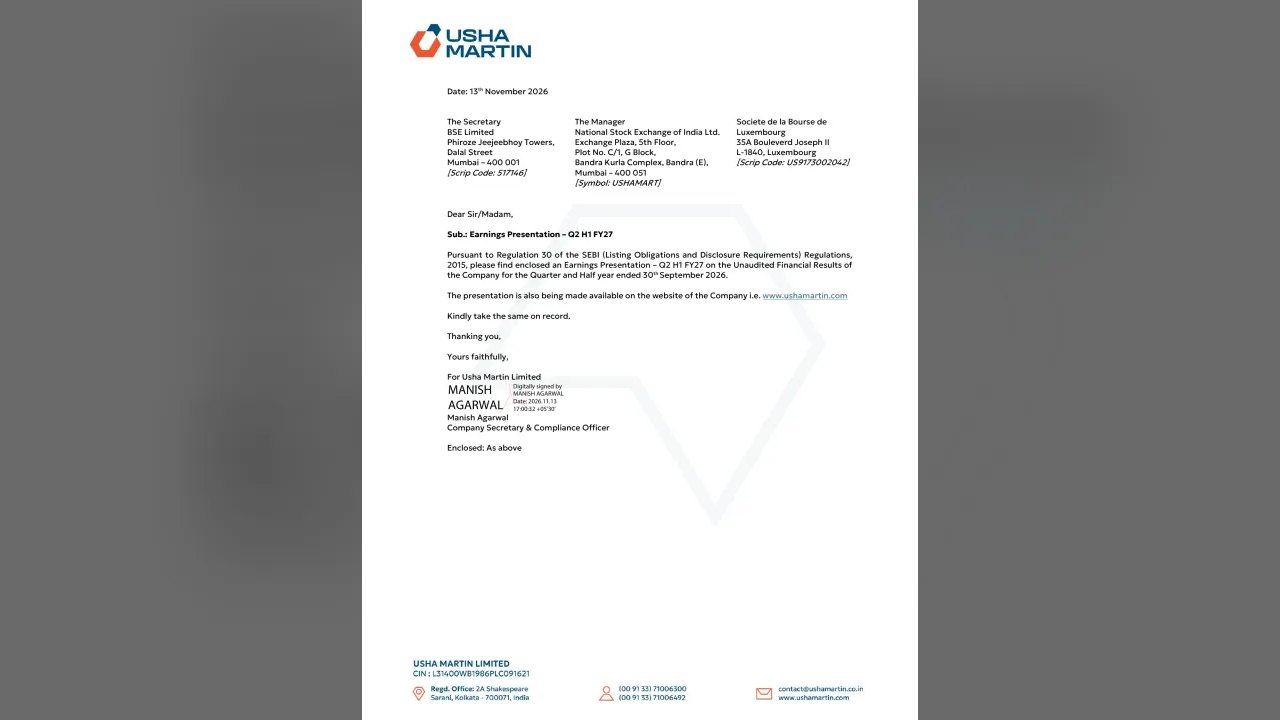
Usha Martin (NSE:USHAMART) Q2 2027 earnings call, held 2026-11-13. Watch the replay and read the transcript on 6ix.
On 6ix: 6ix.com/event/usha-martin-limited-ushamart-q2-2027-earnings-call
Automated transcript · Written by software from the replay's audio. It can mishear names and figures; the replay is the record.
0:00 Ladies and gentlemen, good day, and welcome to the Earnings Conference Call of Usha Martin Limited. As a reminder, all participant lines will be in the listen only mode and there will be an opportunity for you to ask questions after the presentation concludes. Please
0:24 note that this conference is being recorded. I now hand the conference over to Mr. Dev Rishi Singh of CBR India. Thank you, and over to you, sir. Thank you, Reo. Good evening, everyone, and thank you for joining us on Usha Martin's Q2 FY 'twenty seven Earnings Conference Call.
0:45 We have with us Mr. Rajiv Chawar, Managing Director of the Company Mr. Abhijit Pall, Chief Financial Officer and Ms. Shreya Jawad, Director of the company. We will initiate the call with opening remarks from the management, following which we will have the forum open for a Q and A session. Before we begin, I would like to point out that some statements made in today's call may be forward looking in nature and may involve certain risks and uncertainties. I would now like to invite Mr. Rajiv Chawar to make his opening remarks. Thank you and over to you sir. Thank you. Good evening everyone and thank you for joining us for the Usha Martin Q2 FY twenty twenty seven earnings conference call.
1:36 I will begin with an overview of our business performance and key operational developments during the quarter, following which our CFO Abhijit will take you through the financial results in a greater detail. We delivered a healthy performance during Q2 and H1 FY twenty twenty seven with continued growth in revenues, sustained operating margins and strong cash generation. Q2 consolidated revenue stood at INR1000 crores representing growth of 12.4% year on year. Operating EBITDA increased by approximately 17 to INR202 crore with margins at 20.2%.
2:28 For H1, revenue grew by approximately 15% to 21 crore, while operating EBITDA increased by 28.5% to INR $4.10 crores. EBITDA per ton remained healthy at approximately INR 40,700 per metric ton, supported by improved realizations and product mix. Our wire rope business delivered revenue growth of approximately 13% year on year during the quarter, while volumes remained marginally lower. One of the encouraging developments during the quarter has been the performance of our domestic business.
3:15 Demand for wire ropes has remained healthy across key applications and we recorded volumes of 12,700 metric ton in Q2 despite the monsoon season, an increase of 14% from the same period last year. We have also seen an improvement in realizations by 12% supported by the evolving product mix and market conditions. Internationally, volumes in The Middle East remained soft, although profitability stayed intact. Geopolitical uncertainty, higher freight costs and cautious stocking by distributors affected demand, particularly for the general purpose roads.
4:01 We focused on end customers served through our own rigging shops and service network. In Europe and U. S, we have continued to focus on improving our product mix with a greater emphasis on specialized and higher value rope applications. This has supported better value growth across both markets. While wire rope revenues have grown well, volumes have remained broadly flat during the first half. Improving volume growth remains an important priority for us and we will continue to invest in expanding our capabilities in segments where we see strong demand potentials. During H1, we invested approximately INR143 crores in capital expenditure.
4:52 Our elevator rope expansion at Raji is now being commissioned and we expect the full incremental capacity of 500 metric ton per month of elevator rope to be operational by Q1 of the next financial year. We are seeing encouraging demand from our dealer network as well as our OEM, which give us confidence in growth potential of this segment. We also commissioned new capacity of mining growth of approximately 100 tonnes per month of higher value added products where we see opportunities to strengthen our presence internationally. The wires business had another strong quarter with volumes up 21.7% and revenue up 35% year on year.
5:45 Domestic demand was healthy and export relationships and approvals are building steadily in higher value applications. Conventional LRPC volumes remain under pressure. The long term direction as we have mentioned in Plasticated LRPC project activity has picked up in this segment and we are quoting on several large opportunities both in the domestic and export markets. From a capacity standpoint, we are preparing to support higher volumes as these projects convert into orders. Beyond the quarterly performance, we have also made progress on two important initiatives aimed at sharpening our business focus and improving operational competitiveness.
6:32 First, during our last call, we had mentioned that cables is not a core business and that we were evaluating different options for the U. M. Cable division. During the quarter, we entered into an agreement for its divestment and have since received INR77 crore in consideration and further working capital adjustments should happen resulting in the final payment to happen within the next thirty days. This is in line with our strategy of focusing on businesses where we have stronger competitive advantages. The cables business had limited scale and pricing power and further growth would have required additional capital that we believe is better deployed in our core business of steel wire rods.
7:26 Second, we have launched a comprehensive turnaround program for our Thailand facility where profitability remains significantly below the group's average. The program has two aims, lower the cost base and improve the product mix. On mix, while we have made strong progress globally, we see considerable opportunity in Southeast Asia, particularly in ports, elevators, piling and construction. We have strengthened our commercial team to develop these segments with Thailand positioned as our primary manufacturing hub for this region. On the cost side, we are integrating Thailand more closely with Ranchi, moving certain upstream processes to India where costs are lower, while retaining significant manufacturing in Thailand to stay close to customers.
8:19 We are rationalizing manpower and overheads, modernizing older machinery and selectively investing in new rope finishing equipment to support the higher value products these segments require. Together, these initiatives are expected to improve Thailand's cost competitiveness and profitability over the next eighteen months. Importantly, we continue to pursue these growth and operational improvement initiatives from a position of financial strength. During FY 2027, we generated operating cash flow before tax of INR413 crores, representing 101 conversion of operating EBITDA into cash.
9:07 We closed September with a net cash position of Rs. $4.15 crores even after dividend payments and the CapEx spend during the quarter.
9:19 Altogether, the net balance is INR415 crores. This provides us with financial flexibility to continue investing in our growth initiatives. On our outlook for FY twenty twenty seven, we remain confident of achieving our financial targets of 15% revenue growth, operating EBITDA margins of around 20% and cash conversion of approximately 100%.
9:46 We expect volume growth to improve during the second half, although the external environment remains uncertain. Looking ahead, our priorities are clear, strengthening our position in specialized wire role, expanding global customer relationship and enhancing operational efficiencies across the group. With our ongoing investments in capacity, our diversified geographic presence and the strong balance sheet, we believe Usha Martin is well positioned to deliver a profitable growth. With that, I would now like to invite our CFO, Mr. Abhijit Paul to take you through the financial performance for the quarter in greater detail. Thank you. Thank you and a very good evening to everyone.
10:33 I will now provide an overview of the company's operating and financial performance for the quarter and half year ended 09/30/2026. Starting in the second quarter, our consolidated revenue from operations stood at INR 1,000 crores compared to INR $8.90 crores in Q2 of FY 'twenty six, registering a growth of 12.4% year on year. Operating EBITDA increased by 16.5% year on year to INR $20.02 crores compared with INR 173 crores in the corresponding quarter last year. Operating EBITDA margin improved to 20.2% from 19.5, an expansion of approximately 70 basis points year on year.
11:21 Profit after tax from continuing operations stood at INR136 crores compared with INR128 crore in Q2 of FY 'twenty six. PAT of last finance ally at Q2 FY 'twenty six included onetime exceptional income of INR 16 crores. Excluding this, our PAT during this quarter has grown by 10% year on year.
11:45 The growth in operating EBITDA translated into stronger profitability on a part ton basis. Operating EBITDA per ton stood at INR $40,006.80 per ton compared with INR 40,580 in Q1 FY 'twenty seven and INR 34,915 in Q2 of FY 'twenty six. For the first of FY 'twenty seven, consolidated revenue from operations stood at INR2021 crores compared with INR1760 crores in H1 of FY 'twenty six, registering a growth of 14.8% year on year.
12:23 Operating EBITDA increased to INR $4.10 crores from INR $3.19 crores in corresponding period last year, with margins improving to 20.3% from 18.1%. PAT from continuing operations stood at INR $2.78 crores compared with INR $2.30 crores in H1 FY 'twenty six, which included last year's numbers included a onetime income of INR 24 crores. We have restated previous year's numbers by excluding EM Cable as the same has been shifted to discontinued operations in percent. An important highlight of our performance during the past year has been the strength in cash generation, Consolidated operating cash flow before income tax stood at INR $4.13 crores during the half year ended FY twenty seventeen, translating into a cash conversion of approximately 101% of operating EBITDA.
13:22 We also made progress in improving working capital efficiency. Consolidated net working capital days reduced to one hundred eighty five days from one hundred ninety four days in March 26, supported primarily by better inventory management. Inventory days declined to one hundred sixty six days from one hundred seventy six days for the same period, while maintaining adequate inventory levels to support our international operations and customer requirements. We have generated a free cash flow of INR186 crores during H1 of FY 'twenty six. Return on capital employed also improved to approximately 21.6% compared with 20.6 in the end of FY 'twenty six.
14:09 During the quarter, we also took advantage of the onetime settlement scheme introduced by the Punjab government and settled old entry tax disputes by paying INR 4 crore. This reduces our contingent liability by about INR 37 crore and removes a long pending legacy issue.
14:28 Looking ahead, our financial priorities remain focused on sustaining healthy operating margins, maintaining strong cash conversion and efficiently deploying capital towards our growth initiatives. Our strong financial positions provides us with the flexibility to pursue these opportunities while continuing to generate long term value for our stakeholders.
14:51 This brings me to the end of my remarks. I would now request the operator to open the floor for question and answer session. Thank you. Sure. Thank you very much. We will now begin the question and answer session.
15:17 Session. Ladies and gentlemen, we will wait for a moment while the question queue assembles. The first question is from Aman Kumar Sotallia from AK Securities. Please go ahead. Good evening, sir.
15:46 First of all, congratulations for the satisfactory results under very challenging international scenario. Sir, I have few questions related to this quarterly result. Number one, why were ROP volumes were relatively flat this quarter? Has the Gulf War played a role in this?
16:09 Thank you for your question. Yes, volumes for ROP were flattish for the quarter, but first and foremost, I want to say that volume growth does remain a very important priority for us, particularly in the specialized wire rope segment. Having said that, as you mentioned, I think it's also important to look at the broader geopolitical environment over the last six months, which has been quite challenging.
16:35 The situation in The Middle East did impact the demand sentiment in the region, which led to lower volumes, particularly in a market like The Middle East where we had significant growth ambitions planned for the year. But even at these lower volumes, we were able to protect the profitability in the region through the business model that we have there and the improved product mix. Along with that, we've also seen significant disruptions on the logistics front as a result of the war. And just to put things in perspective, compared to February this year, freight rates to our key markets like U. S, Europe and Middle East increased by as much as four to six times since the peak in September
17:20 from February to September and the transit time also increased. So this obviously affected the pace of the order execution and volume growth. But more recently, we are seeing easing of some disruptions in the Red Sea, which are starting to give some relief to freight costs in U. S. And Europe, which should help us in H2 with volumes as well.
17:40 But on the other hand, there has been positives on the volume front also. As we mentioned in the opening remarks, the domestic business has performed well during the period both in terms of volume and value, which supported our top line growth and profitability. And even in terms of overall volume efforts, increasing our coverage in various markets that has stayed intact. We made good progress in securing some long term contracts and consignment arrangements,
18:08 particularly in the Southeast Asian and The U. S. Region, which are going to support our volume growth going forward. Just to give you an example, recently we secured a three year port contract with one of our large port operators in Southeast Asia, where we've been able to meaningfully increase our share of wallet. So these are the kinds of opportunities we are actively pursuing because they will give us better visibility into our volume going forward and a more recurring base of business. So yes, like you said, while the Gulf War and the external environment has impacted volumes, we are quite confident about the opportunities ahead and we'll focus on driving more profitable volume growth with the right mix and healthy margins. Next question, how did the European and U.
18:55 S. Market performed in the last quarter? And what is the outlook for this market going forward?
19:04 Both The U. S. Market and the Europe market had strong quarter than the first half. So for the U. S. Market, last quarter, we saw both volume and value growth. In fact, in H1, we saw approximately a 12% growth in volume and 22% growth in revenue for The U. S. Entity. But we still feel that the potential in The U. S. Market is massive and we haven't really scratched the surface yet. So this is a market definitely that we are going to aggressively pursue going forward. We are also looking to build our frontline team there to expand coverage for the key high value segments like mining, elevator ops, but also for crane groups where we feel still we are a drop in the ocean compared to what the market size is.
19:55 So we just got into in fact a framework agreement with one of the customers in The U. S. To expand our crane group presence and we feel
20:02 that will be an important stepping stone for us to grow in the next two to three years in that market. And on the European side, from the various entities that we have in Europe and also the direct exports from India to Europe that we do, altogether, our sales increased by about 11% in the first half.
20:23 The growth primarily came from the service part of the business and a better product mix. But like we said, because the freight rates have been elevated for Europe almost 4x since February, the demand for GP ropes has gone down quite a bit as the big distributors are not looking to stock materials at such high rates. Like I said, that's eased a bit since September, so H2 should pick up. But our focus in the Europe market will continue to be that the premium customer segment where we sell more high performance slopes and we will look to build our service capability for the Europe market. And I was just questioning that what is the current update of Thialing business? Can we expect top line and bottom line growth going forward?
21:13 The Thialing business as I mentioned, we have like what we had taken in Europe complete review of our business model. We have now started our similar exercise in Thailand as I mentioned in my opening remarks. And that should help us improve our volume, also improve the product mix as we would be focusing more on the value added products like elevators, cranes, piling, port ropes in those markets, which has a fairly strong demand in Southeast Asian market. And with integration of our upstream facilities with Ranchi, we will be able to be much more competitive in terms of our conversion costs and operating costs as a group as a whole.
22:09 And we should be if this will help us to enhance our EBITDA margin then profitability. Overall, we expect this to improve our EBITDA margins which are 6% to 7% to close to 14% to 15%, whereas it should also have with an increased volume of 10% to 15%. So it should have a fairly strong over the next eighteen months, it should have a very strong betting on our overall performance and profitability and should help us improve the profitability and the EBITDA margins for the whole group as a whole. And sir, one last question that we are sitting on a substantial cash reserve and we are also generating good cash every quarter.
22:58 So whether we are planning any acquisition and any concrete discussions underway? Yes. So we are continuing to look at inorganic opportunities that can help us accelerate our growth, especially in terms of access to new markets and increasing our high value products. And we feel that this will be important to take our growth to the next level. In terms of specifics, there's nothing specific to share at this stage, but our approach, like we said before, quite clear, looking for medium sized, good quality businesses that integrate well with integrate and complement our existing business and that will help us deliver incremental ROCE for the whole group without, of course, changing our balance sheet. But as and when these develop, we will make the necessary disclosures if there's a material development of the Just to add, we are seriously pursuing this.
23:56 Okay, sir. Thanks a lot. You. The next question is from Varun Jain from Dollar Capital. Please go ahead. Yes. Hi. Good evening, sir. So a couple of questions. Firstly, on the volumes part, there is a big divergence in wire and volume and wire and scan volume. I mean, one is growing 25%, other is down 2.3%. So those factors which are affecting... Should be affecting both of them. Right? Yeah. So, you know, on the... We look at the wire rope and the wire business, right, the wires business for us is primarily right now on the domestic part.
24:48 Export is something that we are developing. But some of the broader geopolitical factors, logistics, etcetera, that have impacted particularly the GP rope part of the wire rope business in the international market, that hasn't impacted the wire part of the business. So wire is something that we have seen has grown at 20% on a half year basis in terms of volume. Wire rope has stayed mostly flat, but the product mix of course as we mentioned in the wire rope part of the business has improved significantly and a large part of that reason it's flat is Middle East as well as the GPO part of the business, which was affected by the logistics. Okay. So on the domestic part of wire, if that is growing, then there should be like a 3%, 4% growth, right? Because some kind of 30% or 40% is still domestic even in wire rope also, right? So why is that also growing?
25:51 So no, firstly, the domestic side has grown, like we mentioned in our opening remarks, both the quarters, most recent quarter, we did almost 13,000 tonnes. But The Middle East, which is also a significant part of our business, was the volumes were down 30%. So that had a significant impact, though we are seeing a little bit better volume in H2, but the environment still remains uncertain. On the U. S. Side also as I mentioned, we did see a 12% growth in terms of volume and value grew more than that. Europe, if I look at it, volumes were more on the flattish side, but because of our service as well as our product mix, our value increased. So it's been a balance where The U. S. And the domestic market has shown us growth. Middle East has been down and it's a significant part, whereas Europe has stayed flat in terms of volume, but the mix has improved.
26:54 So the balance of all these factors led to more sort of flattish performance in the first half. In the second half, we hope to do better, but again the environment remains uncertain. Our focus will be to ensure that the 15% top line growth, 20% EBITDA margins and the 100% plus cash conversion, those are some things we are very confident of meeting even in these uncertain environment. Sure. And secondly, we've been always saying that the elevator market is there's a lot of demand there, and we were not able to supply because of capacity. Now that we will get to 6,000 metric tons of capacity, So in FY 'twenty eight, is it fair to assume that we'll at least sell 5,000 metric tons and assuming a 300 per kg kind of realization, there will be an incremental INR 150 crore revenue and at 30% EBITDA margins of INR 45 crore EBITDA for FY twenty twenty eight from this capacity.
27:58 Is that a fair assumption? On the volume front, yes, both the domestic demand, the domestic demand is fairly strong and is expected to grow. The elevator industry is growing by at least 20%, 25% every year on the back of new and the Tier two, Tier three cities, way they are expanding the multistory buildings and as well as the replacement market. So, are unable to meet the current demands of the elevator rope in our domestic market. So, this entire capacity we feel that we should be able to sell in the domestic market. In addition to that, there is an opportunity that because of the current strong demand, we are unable to meet all our international clients and there are opportunities to build volumes there as well. So that should also help us to come in. The price is between INR230000 to INR240000 a ton. Sometimes it will be higher in the international market.
29:02 So altogether, this is the top line we should be able to around INR130 crores to INR150 crores on the top line we should be able to add because of this elevator road capacity coming in. And of course, the EBITDA margins should be what you mentioned should be around the similar numbers. Sure, And what is the CapEx outlook for FY twenty twenty eight and where will that CapEx go? The CapEx, this is the ongoing CapEx. So we are what we had mentioned even earlier, our CapEx is close to about between INR 200 crores to $2.50 crores a year would be our CapEx outlay. So one is completion of this elevator row project.
29:49 Then we are looking at expanding our specialized row, particularly the mining row, a part of which has just been commissioned. And also further expanding into our plasticated LRPC capacity as well as increasing the specialized wire where we are developing markets as I mentioned in the opening remarks internationally. So our CapEx on the for our organic growth would be close to around INR 200 crores to INR $2.50 crores every year. And that should help us to continuously keep on improving the capacity of our ropes for the areas where we see demand coming up. Sure, sir. Just the last one, what is the revised volume and realization guidance for FY 2027 now that H1 has been quite flat?
30:41 Yes. I mean, yes, when you look at the first half, volumes have stayed flat at 101,000 metric tons. Rokes have stayed flat, but quires have increased. LRPC is what has been down about 17% from say twenty three thousand to 19,000 H2. We see, like we said, stronger both on a sequential basis as well as on a year on year basis and our target and ambition both for the core of the rope segment and the wire segment remain intact. But of course, the first half, there was a little bit of a setback. But overall, for rope and higher, we still have that ambition. LRPC is what has caused a major drag of about 4,000 tonnes in the first half.
31:27 And that is something that we don't want to sell LRPC at a loss. It's become normal black LRPC has become such a commoditized product that it is fast moving product in the sense that from production to conversion to cash is fast. We have the capacities. We are continuing to be in that market, but you don't want to do volumes at the cost of volumes and sell it at a loss. So that is something that we will play it by year. But the focus on plasticated LRPC, like we said, and we do see projects that we are quoting for Q4, large projects both in the export and domestic market, which if they materialize and we do have the approvals in place, so that can meaningfully boost it.
32:12 But since that's project based, cannot commit to a specific number on that right now. If I'm on your wire rope, if you keep your earlier target of, say, 10%, as in h one, you're minus 1%, so that is mainly due an h two estimate of 20%, 22% in that range. So are you confident in H2 that can be achieved and has October and mid November, has that kind of a rate been seen? You see, we have volume increasing the volume is going to be our focus on a continued basis. However, as I mentioned in our previous calls also, while volume is important, but more important for us is to ensure that our value, which is the value added products and the wire rope with the higher value addition, whether it is the crane rope, elevator, mining, which gives us a much higher EBITDA margin and contribution per ton.
33:14 So that we want to protect at any cost and that we have been able to successfully do and we would continue to strive. But the volume also depends on how the geopolitical situation emerges, how the logistics costs, particularly for the GP rope where we are able not able to pass on the pricing or the customers are not ready to take a higher. So those are the challenges we are facing. So in a nutshell, I can tell you our priority is to keep on increasing the volume. We are hopeful that we should be able to come close to our target. But more important for us and where we are more confident is to ensure our revenue growth resulting in and with protecting our margins and overall profitability growth over last year that is something we are more confident about.
34:10 Okay. Thank you, sir. Thank you and all the best. Thank you. The next question is from Parthiv Jonsa from Anand Rathi. Please go ahead. Hi, sir. Happy Diwali to you and the entire team. Just wanted to quickly check up on a couple of very sorry, I actually joined in late. If you have repeated, would really be sorry for that. Quickly, just wanted to check on couple of things. Number one, the as ma'am mentioned, the LRPC volume is low. So is this does this volume actually consider anything from the plastic LRPC or is it purely black LRPC as a whole?
34:53 Black LRPC mainly the black LRPC volumes are down because of a monsoon as well as the extremely low prices and margin in the domestic market. So that was lower. Plasticated LRPC is going as per our target and we expect this to continue to grow in the coming quarters. All the approvals are in place. We have quoted for certain very good projects both in India as well as overseas. We made the first shipment of Class A Gated LRPC to Southeast Asian customers and that has been accepted well. And now we are hoping to grow that part of the business. So our focus would be to reduce the black LRPC as much as possible because they don't add contribute they don't they may add volume, but not considerable to not much of value addition coming out of it.
35:51 I would say in the next two years, our focus would be to really build a very strong portfolio of the plasticity and LRPC. Wherever we have supplied, it has got good acceptance and we are hoping to get significant orders in the coming quarters. Okay. Perfect, sir. So my second question is particularly for U. S. I just wanted to quickly check what was the amount of your spend for the tariffs and The U. S. Customs along with if you know you can just give some broad break of the raw materials across your services and all. So that would be actually helpful. Sorry, can you come again? I could talk Can you just help us out with the tariff amount what you have spent for the volume what you have exported to The U.
36:36 S? Abhijit, can you answer this, please?
36:45 Tariffs on U. S. Imports is around 50%. So on a turnover around INR $2.50 crores in a year, so the tariff will be so for the last year, it was around INR 40 crores. This year's number, we have to we'll share in detail once we have that detailed with us. Sure, sure. We can share. No problem, No problem. I will connect on the street also. I'll just draw him back in the queue, sir. Yes. Thank you so much.
37:15 Thank you. The next question is from Kartikiya Pandey from three sixty one Capital. Please go ahead. Hi, sir. I just have two quick questions. Firstly, how do you see the Middle East conditions evolving like right now? And secondly, if you could just give me the capacity utilization numbers across the product broadly? Yes. The Middle East, as Shreya mentioned that our volumes, we were expecting growth with our expansion in Saudi Arabia, we were expecting to grow there significantly. Unfortunately, since February where this problem of the geopolitical has happened, The volumes have dropped. We have seen a drop of almost 30% volume vis a vis what we did last year.
38:13 Instead of a growth, there was a de growth. In terms of absolute volume, we lost in the first six months close to 2,500 tons compared to the same period last year, so which is approximately 30% lower volume than last year. The good part is that while the volumes have come down, we have been able to improve our product mix by getting into more higher value added products as well as the service the cut to length and service to the end industry and able to improve our margins. Our freight costs also we have been able to pass on to customers. And even though the volumes were down by 30%, we could maintain our profitability at the similar levels as last year. So that has been on the positive side on The Middle East.
39:05 And sir, if you just could give me the capacity utilization number. Yes, the capacity utilizations across the board are about 70% to 75%. Again, that depends on the product mix.
39:26 For LRPC, it's obviously lower because we're only producing as and when we are getting the right floor price we're setting on it. On the plasticated LRPC front, currently we have a capacity of about 6,000 tonnes. This year we are on track to deliver about 3,500 tonnes. So that is something where we still have room for expansion. And in fact, we are increasing our capacities in that as well.
40:00 Okay. Thank you. Thank you. The next question is from Sahil Doshi from Thinkwise. Please go ahead. Hi. Good evening and thank you for the opportunity. Just want to recheck on the volume guidance. Post Q1, we had called out that adjusted for Middle East, our volume growth was flat. I would assume that the same case in Q2 as well. And our guidance was that assuming the Middle East situation remains the same, we would do 10% kind of a growth for the full year. So just wanted to understand what really transpired over the same course of time? Have some other geographies de grown or not working out to our expectation?
40:49 Or can you just qualitatively call out what's really happening? That will really help. Yes. I think one of the main things is consistently we've seen, like you mentioned, the logistics cost increase as well as the transit times also increase quite a lot, which has impacted the order execution. For U. S, for example, though we did 12% volume growth, there was more potential, but the freight cost was so high that at that point a lot of the distributors and stockists were not willing to build up stock at those higher freight rates assuming that they would come down over the next few quarters, which we've seen it ease down from the peak level.
41:36 It has eased over the last month, month and a half. So I think that was one of major issues. One of the second issues was in Southeast Asia, we were quoting quite a few projects in Singapore. The ultimate destination for those projects, the fabrication was being done to be done in Singapore, but the ultimate market for that was also Middle East. So even though Middle East demand is down, it has to some extent trickle effect on project activity in some of the other regions. So these projects are not canceled. They are just delayed. So we are still actively working with those
42:20 digging shops, fabricators, who ultimately will supply to these projects. We're in continuous touch and hope that these projects do get executed. So I would not say it is lost demand, it is more sort of delayed and in the second half and early next year hope these projects get executed in due course and we're able to recover the volumes. And also the you see while the value added products where the prices are good, the margins are good and those are project based, are able to
42:54 still push those volumes. But products, particularly the general purpose ropes, whether it is Middle East, whether it is U. S, whether it is Europe, where the customers, distributors of materials and the freights have actually gone up not double, it went up to four to six times. So that passing of that entire acceptance of those increased prices was a challenge. Slowly it is settling down and hopefully once that happens, we have the capacity we can push up those volumes. But let's see how things emerge. Things have softened significantly in the last one month. Let's hope with the Red Sea and this current situation things improve and we are able to push volume. We have the capacity, but we have to also ensure that we protect our margins while we are pushing these volumes.
43:52 Sure. That really helps. So just in elevator routes, I understand that we are supply constrained in demand at this point of time. So as the new capacity ramp up goes through, are you really confident that we should start seeing the benefit from Q4 at least in that segment and that should really support the volume growth for the next couple of years at least?
44:17 Yes, you are right. The project is going on target and we should start getting the benefit from Q4. And the full project should get commissioned by March, April and the benefit we should be able to get the full volume benefit. The demand is very strong. We are unable to meet the demands of the existing customers even at the current level and the market of elevator is growing by 20% to 25%, the new build is growing by 20% to 25%. So that should definitely help us
44:51 take the entire shortage in the market. And also because the demand is so strong in the domestic market, we are also not accepting orders from some of our increased volumes from some of the international markets also. So, because we don't want to lose our turf in the domestic market. So, we don't see any problem in selling the entire quantity of 6,500 tonnes per month, 6,000 tonnes at an average price of INR 230,000 to INR 250,000 a tonne. So that should increase the volume and the top line also for the next financial year with a decent margin. And just lastly on Plasticated LRPC, I understand the approvals were some other constraint.
45:40 Has there been any delays there? And also with the outlook, meaning you were thinking at some point in time, you may look at expanding the facility or the capacity here. So at what point or what junction would you consider that? You see the LRPC plasticated approvals are all in place now. So and we have the all the customers have with whom we also got the approval now have started quoting with our products. And we are at active negotiation of some of our contracts both in India and overseas with them. However, these are all
46:23 it's all project based and hopefully these are all in the final stages or in the next two, three quarters. Next two quarters, we should have significant order book both in the domestic and export markets from some of these approvals as well as our existing approvals. On a we have also taken steps to expand our capacity from current 6,000 tons to
46:50 11,000 tons to 12,000 tons per annum capacity, which should be getting completed by June next year. So on volume front, 3,500 tons we expect to complete due this year. Next year, we expect to be close to 7,000 to 8,000 tons. Of course, subject to these projects getting commissioned and we get the orders and we are able to get the delivery schedule, but we are reasonably confident to do about 7,000 to 8,000 tons next year and close to about 10,000 tons hereafter. So Plasticated LRPC is on track and we hope that there are no delays in these projects and we should be able to get decent volumes as I mentioned in the coming quarters and coming years.
47:38 Perfect. Thank you so much and best wishes for the rest of the year. Thank you.
47:46 The next question is from Prahlind Nandu from Eagle Vice Public Alternatives. Please go ahead. Yes. Hi, Pashe and Rajivji. My question is again on the volumes in the wire rope, right? Now if I look at the trend for the last three years, right? FY 'twenty five, you were at 104,000 tonnes FY 'twenty six, you were at 106,000 tonnes. And in the presentation, you have mentioned that in wire rope, the value add segment is already 71%,
48:18 right, in H1 FY 'twenty seven. So while you continue to mention that value add is your focus, but I'm sure there is a sticking to it, right, to what extent you can take the value add within the overall mix. At some point in time, we will have to think about volume growth as well, right, in some sense, maybe at the cost of sacrificing the margin as well or maybe think about new markets wherein we can sell, right? So what are our thoughts, right, while we completely appreciate the fact that our focus is on margin and focus is on value add, But there is a feeling which you will hit at some point in time, wherein the shift has to come back on the volume, right, in some sense. So what are your thoughts on it? Because again, as previous participant also mentioned, we sounded very confident that full year we'll do a double digit volume growth, right, even if there is a Middle East crisis and now we sound we don't sound we are not very sure about that number as well. So what is our long term strategy on volume growth in the wire rope segment?
49:19 I think we have mentioned with this we had quite a few questions on this and we tried to answer it. And it's I think the same I would again repeat my answer. That volume is going to be our is our priority. Geopolitical situations have been there.
49:40 And I think and which has not only resulted in the demand, but also it has affected the freight rates and which is four to six times the freight rates have gone. So for value added products where the prices are at $4,000 $3,500 $5,000 a ton, it is easier for us to adjust with the customer and able to manage it. But when the products are at $1,400 $1,500 a ton, the GP ropes, not being able to pass on to the customers means basically supplying the products at variable cost plus little margin, which would completely impact the profitability and margins.
50:27 Number two, the customers are not ready to even stock is seeing the freight rates going from say $150 to $800 a ton going into the European market for a product which is of $1,500 or $1,400
50:41 per ton. They are waiting for the prices to come down for us to be able to for them to be able to place the orders on us. So it's not a very simplistic calculation. The capacity, yes, we have the capacity, but the willingness of the customers to be able to take the products at these prices where there is at least a meaningful margin. I'm not saying the margins of 20% what we achieved, but there has to be a meaningful margin. So one has to take a calculated view and we personally feel that we don't expect this current situation to last forever. We have already seen in the last one month the freight rates have started coming down.
51:27 So at the end of the day, it is the willingness of the customer to buy at these prices or to share the freight cost increase or the freight prices to come down for them to conclude businesses. So it's not a straightforward calculation or a straightforward thing, but the endeavor is to increase the volume, but at a decent price or at least at a margin. We don't want to keep on building volumes and tomorrow to see that the margins come down to 15%. So that itself will have a completely different impact on the business. So it is a balance which we are trying to do. And I can tell you the global situation is not it's not for our value added products where we are competing with Europeans and all, it is it's a niche market, which we are building and increasing our stake is still doing well and we expect to increase our presence over there. But in general, the overall environment internationally and I'm sure that all of us we know that it is not very strong with the challenges, which we all know.
52:37 But hopefully things get better, our plant is ready and we'll be able to push the volumes. But one thing is very clear, we would not like to push volumes at marginal cost, at the cost of and with the kind of challenges right now. And also we need to be sure that by pushing volumes, we should be able to get paid for our products and not land up into
53:07 oversupply and delayed payments or even losing our debtor. So all this is in a current global environment, we weigh everything. Our endeavor is to push volumes, and we will do that. But with some of these challenges,
53:28 would see how to build it with safety built into our system. Sure. Thank you, Rajiv. Just a last point on that, is there a room to increase the value add segment within wire rope to upwards of 75% or even to 80% based on the capacity as well as based on the demand?
53:52 Yes, definitely. And that 70 plus percent number is in terms of value, in terms of volume, it's still lower than 60%. So as the volumes increase and we get better realizations and a better mix, definitely it's possible to push it up beyond those levels that you mentioned.
54:12 Okay. And one last question, Sayagy, is that if I look at your margins, right, they have been very healthy, right, in H1 of 20.3% and on an EBITDA per ton basis of INR 40,600 odd Is there any element of any kind of a premium on the margin or on realization because of these disruptions, right? So what I'm trying to understand is that while we have lost a little bit on volume because of whatever is going on in Middle East or whatever this freight that we have already discussed
54:43 extensively on the call. But are we gaining some bit on margins, which means that when the volumes come back, maybe we can see some decrease in margins?
54:54 No. We're quite confident of maintaining the margins at this level because the margins are primarily being driven by an overall better mix that we've seen both within And overall, if you see the Vairo Viro. As a percentage of our top line has also increased. I think for the first half almost at 70% more than 70%, 76% of our top line comes from the Vairo part of the business and LRPC has
55:23 decreased. So that also overall has contributed to better margins. So we are quite confident of maintaining it at these levels. And this has come even though all the input costs, etcetera, have increased, like we said, freight costs have increased, to a large extent, on the value added side, because we were able to pass on the input cost increase as well as freight cost increase, we've been able to hold our margins where they are right now. Thank you so much, JRG and Ariri. You all the very best. Thank you. Thank you. The next question is from Shraddha Kapadia from SMIFS.
56:10 Please go ahead. Hello. Am I audible?
56:15 Yes. Thank you for the opportunity. So if we take a look basically at the wire business, so the wire has delivered a strong growth with revenue increasing approximately 35% and the volumes growing 25%. So if you could just help us understand the categories or the sectors or the geographies which are driving the growth for the wire business?
56:42 Yes. Thank you. So the wire business, the auto sector is one of our prime markets, which we focus both in the domestic and international market. Predominantly 90% of our wires are sold currently in the domestic market. So we are and our share is also fairly low in our domestic market. So we have an opportunity to increase our share in the domestic market. So oil so first sector is the
57:14 one of the important sectors which we are supplying is the auto sector, then it is the springs, the door springs is another important market and the power sector, basically the transmission line towers and the trans electrification for those products that is also important. And finally, the zinc aluminium wires, which is having rockfall barriers as well as demand in export markets for
57:44 various applications of springs as well as Gabion wire. So those are the applications where we are focusing. And one of the reasons that our the market size, our percentage share is fairly low and we have focused on this over the last three years. So we expect similar healthy growth in the coming years as we are focusing on these products and markets. Sure, sir. That was quite helpful. Also in this virus only, if you could help us bifurcate further value added, would that be possible? How much would be the value added products and how much would be the conventional products? Can answer this question offline.
58:33 Can go into the details. So anytime in next one or two days, we can connect with you. Sure. Not a problem. Just one more question from my side. So if we take a look at the Viral Group, then the revenue had grown approximately 13%, but the volume has declined. So there is an increase in the realization. So if you could help me understand how much of this would be because of the product mix and how much would be because of the pricing? I would say most of it is the product mix. Pricing is basically as our focus for more value added products are there, pricing has been fairly stable in the international market. So it's mainly getting more and more into the value added product, which is getting the
59:28 better mix and ultimately resulting into better realization. Okay, sir. Sure. Thank you so much for answering my questions and all the best. Thank you very much. We'll have to take that as the last question. I would now like to hand the conference over to the management team for closing comments. Thank you. I would like to thank everyone for attending this call and showing interest in Usha Martin Limited. I hope we have been able to answer to all your questions. The company is dedicated to creating value for its stakeholders in a sustainable manner. Should you need any further clarification or would you like to know more about the company, please feel free to reach out to us or to CDR India.
1:00:18 Thank you once again for taking the time to join us on this call and see you all in the next quarter. Thank you. Thank you very much. On behalf of Usha Martin Limited, that concludes this conference. Thank you for joining us. Ladies and gentlemen, you may now disconnect your lines.
Follow Usha Martin Limited into a list and get an email when it puts out news.
at CBR India
Managing Director at Usha Martin Limited
Chief Financial Officer at Usha Martin Limited
Director at Usha Martin Limited
at AK Securities
at Dollar Capital
at Anand Rathi
at three sixty one Capital
at Thinkwise
at Eagle Vice Public Alternatives
at SMIFS