Chiara Valentini
Manager of Investor Relations
Replay available
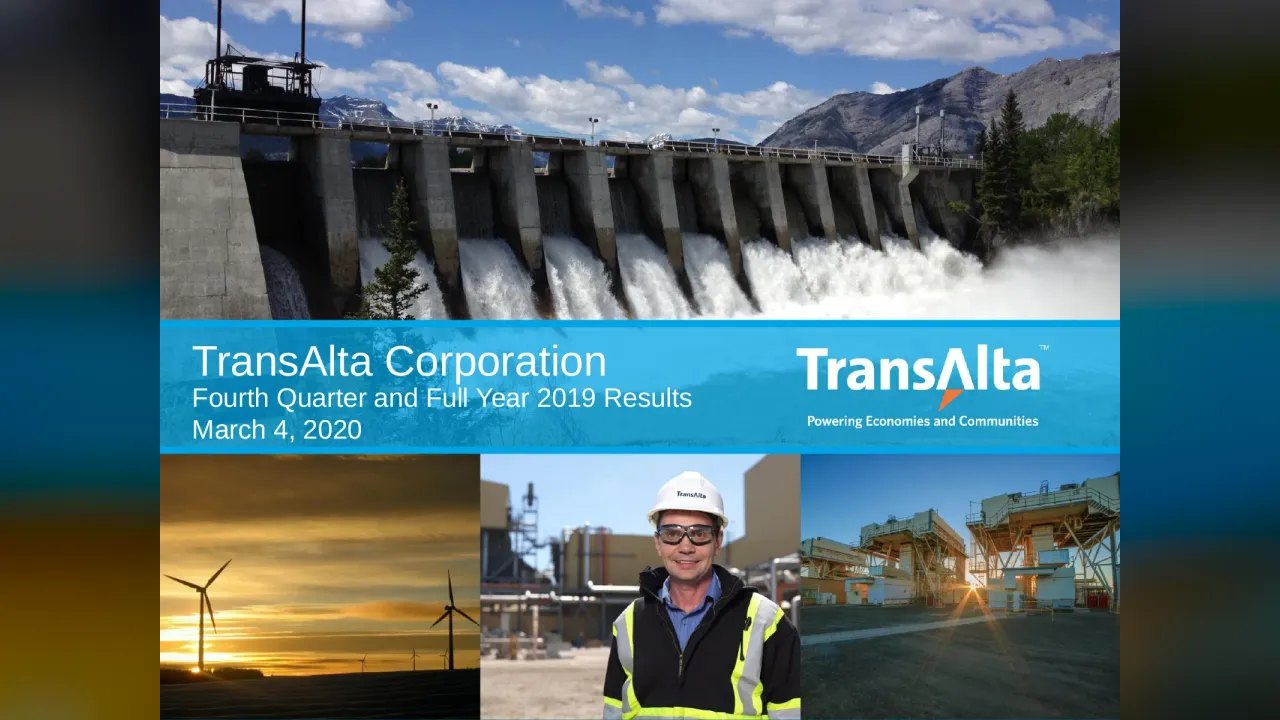
TransAlta (TSX:TA) Q4 2019 earnings call, held 2020-03-04. Watch the replay and read the transcript on 6ix.
On 6ix: 6ix.com/event/transalta-corporation-tac-q4-2019-earnings-call
Automated transcript · Written by software from the replay's audio. It can mishear names and figures; the replay is the record.
0:01 Ladies and gentlemen, thank you for standing by and welcome to the TransAlta Corporation fourth quarter and full year 2019 results conference call. At this time, all participants are in a listen-only mode. After the speaker's presentation, there will be a question and answer session. To ask a question during this time, you will need to press star then one on your telephone. Please be advised that today's conference is being recorded. If you require any further assistance, please press star zero. I would now like to hand the conference over to Chiara Valentini, Manager of Investor Relations. Please go ahead.
0:41 Thank you, Amy. Good morning, everyone, and welcome to TransAlto's fourth quarter and year-end conference call. With me today are Don Farrell, President and Chief Executive Officer, Todd Stack, Chief Financial Officer, John Kousinioris, Chief Operating Officer, Brett Gellner, Chief Development Officer, and Carrie O'Reilly Wilkes, Chief Officer, Legal, Regulatory, and External Affairs. Today's call is webcast, and I invite those listening on the phones to view the supporting slides that are also posted on our website. A replay of the call will be available later today, and the transcript will be posted to our site shortly thereafter. As usual, all of the information provided during this conference call is subject to the forward-looking statement qualification set out on slide 2 here, detailed in our MD&A and also incorporated in full for the purposes of today's call.
1:36 All amounts referenced during the call are in Canadian currency, unless otherwise stated. The non-IFRS terminology used, including comparable EBITDA, funds from operations, free cash flow, and deconsolidated FFO, are also reconciled in the MD&A for your reference. On today's call, Dawn and Todd will provide an overview of the past year and expectations for 2020. After these prepared remarks, we will open the call for questions. With that, let me now turn the call over to Dawn.
2:07 Thanks, Kiera, and welcome everyone to the call. Today, as Kiera said, I'm going to make a few comments on our key accomplishments in 2019, and then I'll turn it over to Todd, who will take you through the details of our financial results. We are off to a great start on our objectives for 2020. and we're going to leave plenty of room at the end of the call for questions on both 2019 and our expectations for 2020 and beyond. So in 2019, financially we did deliver $379 million of free cash flow, which is above our expectations coming into the year and above our results in 2018. We also recovered an additional $56 million in cash from the Sundance PPAs that were terminated in 2018.
2:52 So when you take those two numbers together, we delivered 435 million of total free cash flow in 2019, which was a great result for this company. The operations in our company delivered strong availability, averaging over 90% for the year, so congratulations to them for a great year. And importantly, we delivered significant reductions in our OM&A, which now has a run rate that is 8% below our 2018 levels. and of course this work came as a result of all the hard work by the TransAlta teams across the company. We did return 68 million of capital to our shareholders through our share buyback program and we ended the year with liquidity of 1.7 billion.
3:38 And then finally in January we decided to increase the dividend by 6.25%. So a very strong operational and financial year which the company is very proud of. On strategy, we advanced our Clean Energy Investment Plan that we announced last September. We are on track to deliver our first coal-to-gas conversion at the Sundance Unit 6 this year. And we are on course to complete our conversions for Keep Hills Units 2 and 3 by the first half of 2021. We've advanced our Sundance 5 repowering project. The two Siemens turbines acquired in Q4 will be used at the site. Permitting is underway and we now have Shell Energy North American as a key customer at that project.
4:25 We are continuing to permit a hybrid combined cycle plant at QPLC Unit 1. As many of you know, Pioneer Pipeline was commissioned early thanks to the hard work of the Tidewater team and contributed to cost reductions and margin increases in our coal fleet in 2019. Big Level and Antrium were finished in December, and we welcomed them into our fleet, and they're now fully producing cash flows for all of 2020. And we're pleased to welcome Microsoft, Partners Healthcare, and New Hampshire Electric as new customers to TransAlta. We executed an agreement with SEMCAMS Midstream to construct and operate their new cogeneration facility at KBOB. and detailed construction activities have now commenced and COD is targeted for mid-2021.
5:18 We significantly advanced our windrise project and we were excited to receive AUC approval ahead of schedule and we continue to target a 2021 COD date for that project. And we are in the final stages of building a world-class battery at our Summerview wind site that will be completed later this year. The Skookumchuck wind site is under construction and will be completed later this year. And of course, we have an option to buy 49% of that project at COD once it's completed. And finally, at the very end of the year, we acquired a development portfolio of seven wind sites across the U.S. that our team is working on for the corporate PPA market that is expanding in the U.S. Turning to our goals on ESG, I'm proud to say that this was our fifth year of voluntary integrated reporting. We continue to drive industry-leading sustainability practices, and I'm proud of the work that we advanced in 2019, especially the work that we did at the end of the year to set new goals for our ESG targets.
6:21 We reduced our carbon emissions in 2019 by over 200,000 tons compared to 2018, thanks in part to our early integration of the Pioneer pipeline. And of course, safety is a key corporate value. and it's critical to all of us here that our employees go home safe and to their families every day. 2019 was a tremendous result by all the teams across TransAlta. Our total injury frequency declined to 1.12 which was a 40% improvement relative to 2018 and our third straight year of improved performance. So it was a very, very strong year on many fronts. And with that, I will turn it over to Todd so he can go into details on the financial results.
7:08 Thank you, Dawn, and welcome to everyone on the call. Before I jump into the financial and operational results, I'd like to start by reviewing the Alberta prices we saw in the year and what we expect to see going forward for 2020 and 2021. For the full year, the Alberta pool price averaged $55 a megawatt hour, which was $5 a megawatt hour higher compared to 2018. Throughout 2019, our merchant coal assets performed well, and we were able to realize power prices significantly higher than the average pool price. Year-to-date in 2020, power prices have averaged around $78 a megawatt hour due to the extreme cold weather experienced in mid-January and overlapping thermal outages and D-rates. As we look at the balance of 2020, the final year where our Alberta assets will be under their PPAs, the forward curve is currently around $54 a megawatt hour.
7:58 and prices in 2021 are slightly higher at 56. Currently, we've hedged about 60% of our base load merchant production in the $55 a megawatt hour range. We do consider additional hedging opportunities and in any given month, we may target increasing our hedge levels up to 90% of our expected base load production for that month. In addition to our expected base load production, we have significant peaking capacity at the Sundance units which provides us additional opportunity to benefit from higher prices in times of market tightness. To reduce our fuel cost risk in 2020, we've locked in roughly 65% of our Alberta natural gas prices for the year. Our results for the fourth quarter were strong and in line with our expectations.
8:45 Comparable EBITDA was lower by $22 million compared to 2018, primarily due to the loss of expiring contract payments on Mississauga and Palmer Creek. This was partially offset by strong performance in energy marketing and our Canadian coal segment. Free cash flow increased by $23 million to $121 million in 2019. Lower sustaining capital and lower distributions paid to partners on our Mississauga contract more than offset the lower EBITDA generated in the quarter. Overall, we delivered 43 cents a share of free cash flow, a 26% increase over the same period in 2018. I'll turn now to the full year 2019 results. For the full year 2019, we produced 984 million of EBITDA, which includes the 56 million that we received from the settlement of the PPA termination dispute.
9:37 Without the PPA settlement payment, this was very close to the midpoint of our 2019 outlook. What's important to remember is that the Mississauga and Poplar Creek contract changes that occurred at the end of 2018 were expected to reduce EBITDA by approximately 142 million in 2019. Normalizing for these known contract changes, we delivered year-over-year EBITDA improvement of $66 million. This shows that we've been able to increase performance in our remaining key business segments. Canadian Coal delivered an incremental $31 million of EBITDA for the full year compared to 2018. The operational improvements implemented over the past year continue to show strong benefits in the segment in lower OM&A. As well, the early completion of the Pioneer pipeline allowed us to take advantage of the lower all-in cost of burning natural gas, including lower carbon compliance costs.
10:30 Though the U.S. coal segment performed well for the majority of the year, we were unable to offset the lower results in Q1 due to an isolated and extreme pricing event in March. Centralia was unable to commit one of its units to physical production for the day ahead supply due to an unplanned forced outage repair. This isolated event negatively impacted our annual results by approximately $25 million. In the Canadian gas segment, excluding the impact of the previously mentioned contract changes, EBITDA improved $3 million for the full year and in line with 2018. Our Australian segment performed as expected, but did generate lower EBITDA in the year when compared to 2018 due to a weakening of the Australian dollar relative to the Canadian dollar and the ongoing legal costs associated with our dispute with FMG.
11:20 The wind and solar segment results for the year were relatively consistent with prior periods. Our hydro business delivered strong results, which were consistent with 2018, both for the quarter and the full year. For the full year, we generated $110 million of EBITDA from these assets, which is consistent with prior years. As we've discussed previously, with the expiration of the PPA at the end of 2020, we anticipate seeing a substantial step up in cash generated from these assets, as all revenue created by the assets will be retained by TransAlta. Lastly, I do want to highlight the strong performance that we saw from our energy marketing segment for the year. The segment generated 89 million of EBITDA in a year, which was substantially higher than 2018. These results were generated across the marketing portfolio with particularly strong performance from the U.S.
12:08 Western markets. I do want to quickly note that this year was an exceptional year. For the 2020 guidance that we outlined in January, we are anticipating a more normalized year for the energy marketing segment of approximately 50 to 60 million of EBITDA. Slide 9 breaks down the performance of our Canadian coal fleet and helps highlight the benefits we continue to see from our decisions made in 2018, along with the impacts of increased coal firing through the Pioneer pipeline. While overall revenue and production were lower for Q4 and for the full year compared to 2018, comparable gross margin was similar. On a per megawatt hour basis, gross margin increased by 10% for the full year. For the year, EBITDA margins increased by $4 a megawatt hour from $16 to $20. This represents over a 25% improvement to EBITDA margins, driven by both higher realized prices, lower OM&A costs, and lower fuel and carbon costs.
13:10 We continue to maintain strong liquidity. At the end of 2019, we had $1.3 billion available on our credit facilities and over $400 million of cash on hand. This strong liquidity position, along with expected cash generated from the business, as well as the second tranche of the Brookfield investment, sets us up well in 2020 to meet our upcoming bond maturity, fund our coal to gas program, and advance our development projects. For 2020, We are targeting to repurchase up to 80 million of shares throughout the year. Lastly, with confidence in our cash flow and a positive outlook for growth, the Board is able to declare an increase in our common share dividend to 17 cents annually, which represents a 6.25% increase over the previous dividend.
13:55 With that, I will now pass the call back to Dawn to provide a brief summary before questions.
14:00 Thanks, Todd. TransAlta's performance in 2019 is the culmination of work undertaken to shift our strategy, cost structure, and operating models to adapt to the new market and regulatory realities. We've made great progress, and of course, we always believe here that our work is never done. We're still fine-tuning the business with the right cost structure and business model to ensure that we're competitive as we enter into a fully deregulated market here in Alberta in 2021. You'll notice on this slide that our 2020 goals are more of the same, and that's great news. Our strategy is in its execution stage, and we are staying the course in terms of delivering our clean energy plan and transitioning our fleet here in Alberta. And of course, continuing to grow TransAlta Renewables.
14:47 Our teams are preparing for the merchant market, and we have a nice foothold now. We also have a portfolio of assets that we now can start to develop in the U.S. markets for that market there. So I'm not going to add much more. I think everything is pretty straightforward at this point in terms of what we're doing. So I'm going to turn it back to Kiara so that we can take your questions. And thank you.
15:11 Thank you, Dawn. Amy, would you please open the call up for questions from the analysts and the media? At this time, if you would like to ask a question, please press star then 1 on your telephone keypad. Your first question today comes from the line of Maurice Choi of RBC Capital Markets. Your line is open.
15:34 Thank you and good morning. My first question is on, I guess, your approach to evaluating projects with positive environmental attributes. Do you look at it as just being like a straight MPV of the cash flows you receive, like from Credits or do you use a different discount rate or another quantitative measure, especially if there is a project that helps accelerate your sustainability goals?
16:06 Yeah, thanks for the question. It's a very good question. It's Brett Kellner. Yeah, really, I mean, our first and foremost approach is we look at the cash flows. I mean, that's fundamentally how we approach all our projects. certainly as we see the need for new more renewables and less carbon footprint type projects certainly we've factored that into how we strategically want to position the company overall but I'd say just generally we still take the same fundamental approach in terms of cash flows and discount rates so no real real change obviously if there's environmental attributes that we can get credit for or sell. Certainly that factors into the cash flows. A big part, obviously, is the term of the contract, the off-taker. You know, those are probably more important considerations.
17:08 Thank you. And my second and final question, just to finish off, obviously you've got a new partner when it comes to I wonder whether if you've had much dialogue with them. Do you guys have any differences or changes in how you strategically approach this asset?
17:29 Yeah, Maurice, it's John Kousinioris. We continue to work with the new owners at Sheerness. I don't, from our perspective, we think it's a good constructive relationship. We haven't seen any kind of change in the overall strategy that we had before the change in terms of the way the units are being operated in the plants to eventually convert them, which we will be doing to gas. So it's very much we're staying the course with the assets. Great. Thank you very much. Thank you. Your next question comes from the line of Mark Jarvi of CIBC Capital Markets. Your line is open.
18:12 Thanks. Good morning. Obviously you've got some wind assets that are coming closer to completion and you've added some more in the U.S. here. So I'm just thinking about timelines here for drops to R&W and maybe you can just give us a clarity on what you're thinking is there and then maybe just bring in also how you think about consolidated leverage and the ability to use more project level at R&W now.
18:37 Hey, Mark, it's John. Thanks for the question. So you're right. We have a number of wind farms that are under construction, even the SEMCAMS project, that are the kinds of assets that we think would make sense for them to be dropped down to trans-alta renewables. We can't sort of signal any specific timing in terms of doing that other than to say that, you know, it makes sense for that sort of suite of assets that we have when we think of wind rise, wind charger, SEMCAMs to be of the types of assets that would make sense to go down. And the only other thing I would say is that now that TransAlta Renewables has digested sort of Antrim and Big Level, it would make sense if they would be considering a new suite of assets.
19:26 And maybe I'll just touch on the leverage metrics. So we've communicated, especially since Investor Day, that we're really focusing on deconsolidated debt metrics at the TransAlta Corp level. So I don't really see any restrictions on TransAlta renewables from applying project finance or leverage down at the TransAlta renewables level. That would inhibit their growth or their ability to add assets or TransAlta's overall ability to grow. You know, also at the TransAlta level, as we've mentioned, we're basically on track. We are on track to reducing our senior debt. So I'm very happy with where our credit metrics ended at the end of the year and where they're on track to for the end of 2020.
20:08 So Todd, just following up on that, so no real governors in terms of consolidated leverage metrics that you guys are really mindful of. It's really the deconsolidated metrics that you're really going to sort of drive your decision-making there.
20:21 That's correct. That's right.
20:22 Okay. And then maybe just clarify a little bit on the comment about hedging of base load. You said exclude Sundance, so that would be Key Pills. What about things like hydro and gas plants in Alberta?
20:34 Well, remember that hydro is under PPA this year, and we don't really specifically go out and hedge hydro, and it is under PPA at this point. So that's why I wasn't discussing hydro. And just remember the Sundance units, you can look on the market. They generally run... you know 30-40% of the time or call it at 30-40% of capacity so there is a lot of opportunity to ramp those units when prices are higher.
20:59 So really it is the keep bill units that you're talking about having hedged in the balance of the year.
21:05 I think that's the right way to look at it when you think of keep bill 3 which is basically running most of the time the rest of the year that's the way we focus our hedging approach
21:12 on. Okay and then turning to Ontario I mean there was a directive for the IESO to reach out to I think there was supposed to be a timeline of them to come back to the Ontario Ministry of Energy sometime in February. Have you guys had much dialogue along that and any updated thoughts around Sarnia or any other gas plants in Ontario?
21:40 Mark, it's John. We did participate in the consultation process. We did make a written submission, and our team is in sort of continual discussion with the government in Ontario and the ISO trying to come up with a path forward, I think. My recollection is that the ISO has completed its report. I think that they actually socialized with the government late last week. I don't know when they'll be publishing the report. I expect it'll be coming out in the next week or two, I suspect publicly. You know, we continue to be optimistic that we'll be able to, you know, recontract our Sarnia facility. It's highly valuable to the offtakers that we have there, and we think it does fulfill an important role in the province given where it's situated.
22:25 So we continue to work, and as you know, the expiry of the contract from the ISO isn't until 2025, so we have quite a bit of time before that to secure that.
22:37 Does your level of engagement get to the point where you're even talking about term and pricing, or is it just that you're willing to come to the table?
22:46 I think that we'd like to think that we made a sort of constructive proposal that we think works well in terms of an extension of the contract and also meets some of the objectives that the government of Ontario has in terms of where rates will be in the province.
23:02 Okay. I'll leave it there. Thanks, guys. Your next question comes from the line of Andrew Cusk of Credit Suisse. Your line is open.
23:14 Thank you. Good morning. The question just relates to your energy transition, the coal, the natural gas in Alberta. And it really focuses on just what you're seeing with labor rates and productivity factors at this point in time. You know, given when we look at the province right now, there's not a lot of activity going on as we saw in past cycles. So what are you seeing from a labor rate standpoint and just productivity factors?
23:39 Yeah, it's Brett, Andrew. No real change. I think your comments are very fair. We see that obviously there are some big projects still underway more on the petrochemical side of the business, so it's not like there's not anything going on. There's a lot of pipeline construction going on in the province. Remember, though, we generally enter into a negotiated fix, more or less fixed price deals on our coal to gas, and we'll be doing something similar when we get into our repowering. So that will all be factored in. We go out for a competitive bid for those processes, and that allows people to come forward with the best options.
24:31 The best cost structure possible. I don't know, John, if you have.
24:34 Yeah, Andrew, the only other thing I would say is I think, and this will be directionally accurate, I think the amount of capital spending that you see in the province, if you were to compare it to where it was sort of five or six years ago, is about a third of the level in terms of inbound sort of investment in the province. So compared to kind of a capacity constraints that we were accustomed to seeing in the province a few years ago, kind of a The pressure is off, but as Brett said, we tend to just focus on contracting the projects and trying to get cost certainty in terms of the development that we're doing.
25:07 That's helpful. And then related to the transition plans, how do you think about the interplay of the federal carbon pricing regime with Alberta power pricing dynamics? You have a slide that's got the Ford prices. They're notoriously illiquid, but really what do they say about carbon expectations? We've got the $50 a ton carbon price out into the future. Is the implication really prices are too low in the forward markets, or what other commentary can you provide?
25:35 Yeah, so when we're looking at, you know, Andrew and Sean, when we're looking at kind of the pricing for 2021, I know that there's been the court case, and, you know, we're in a position where we end up going to the Supreme Court of Canada, but Our expectations are that over time, carbon prices are going to go up. I think in our own minds, we do look at 2021 having a $40 kind of carbon price. At least that's the way the company sees it overall. And I don't, at least from a TransAlta perspective, see that that Okay, very helpful. Thank you. Your next question comes from the line of John Mould of TD Securities.
26:40 Your line is open.
26:41 Good morning. I'd like to start with the U.S. wind development portfolio you acquired. I'm just wondering if you can give us a little more color on the scale, location, and status of those projects and what might be the best near-term development opportunities in the portfolio.
26:56 Yeah. John, it's Brett. So as John mentioned, we have seven projects. They're all at marginally different stages of development, but they cover PGM to SBP and a bit in ERCOT. Right now, we're just very focused on going into each project in terms of their stage of development. Part of this will be driven by what kind of customer opportunities we see and where those customers want projects. Very much like, you know, the Microsoft big level type contracts. So a little bit of it is just getting them all kind of positioned and then we'll advance them as we see the opportunities come along. But, you know, overall, you know, it's probably in the range of, you know, 1200 megawatts of opportunity if all of them were to proceed.
27:57 Okay, great. And then just on the distributions to non-controlling interest in the fourth quarter, it was down relative to earlier quarters in 2019, and I appreciate it can be a bit lumpy, but I think it was about $111 million in 2019. Is that kind of the right ballpark for 2020, or does the Q4 number point to something a bit lower?
28:19 Yeah, I would look at the annualized number for 2019 being the appropriate number. I don't know off the top of my head why Q4 was slightly different, but think about the annualized number being the right value for looking forward to 2020.
28:33 Okay, great. And then just maybe one last thing on the regulatory front in the context of the Sun 5 repowering and just the carbon pricing construct there. As you advanced That process, can you maybe just provide a little bit of color on what you need to see on the carbon side of things from a regulatory perspective to have comfort to go ahead with that repowering?
28:56 Yeah. So right now, as you know, there's a performance standard of about 0.37 tons per megawatt hour. So combined cycle plants are generally in that area. So we don't see the carbon as a big factor here. In fact, I mean, you know, as you saw, we already have purchased gas turbines last year. And so we, you know, obviously, we have to make our final investment decision this year. But right now, we're full steam ahead with getting regulatory approval, and also, you know, going out for EPC type bids for that project. So unless something changes dramatically, you know, We still see that as a very good project. And remember, we're setting up the fleet to be very competitive long term.
29:46 And we think combined cycle plants like that are going to be very well positioned, especially in a brownfield, as a brownfield investment. You know, K1, we're also permitting. That decision will be made a bit later as we see how the market unfolds. But again, long term. Those kind of projects, in our opinion, make a lot of sense.
30:10 Okay, I'll leave it there. Thanks very much. Your next question comes from the line of Charles Fishman of Morningstar Research. Your line is open.
30:21 Good morning. Dawn, I had a question on slide 10. Just make sure I understand this. I'm pretty confident I got the fourth bucket over, the common share dividend. That's coming from 10% to 15% of the FFO. The last bucket, the 30%, 50%, you get clean energy investment, share buyback. So the way I read that is if you don't have the opportunity, and let's talk about those seven development projects and U.S. wind projects you bought. If maybe none of those move forward, then you go with the $80 million of share buyback. If some of those move forward... That's your valve to turn on and off, and you can invest that money in the wind projects instead. Is that the way to look at that?
31:11 So let me start it, and then Todd or John or Brett can add in. You know, Charles, it's really worth looking at both TransAlta and TransAlta Renewables. So when we're developing those wind farms, we ultimately have in mind the R&W vehicle is where they head. So we often start the development in TransAlta, but we end up dropping them down into renewables. So from a capital allocation perspective, we don't generally make a tradeoff between share buyback and wind farms because it's really the capital structure and the currency of R&W and the balance sheet that's available there that gives us the confidence to develop those projects.
31:59 So when we think about share buyback, I think it really comes out of the cash flows at the corporate level. So remember, corporately, we have RMWs, we have the coal to gas investments, and we have the hydro, and we have the energy marketing. And so this slide here is deconsolidated FFO at the TransAlta level. So maybe, Todd, you want to just add in?
32:24 Yeah, I think you covered it well there, Dawn. In our Investor Day and prior discussions, we talked about down in TransAlta renewables for building out the wind portfolio and other contracted coal, gas assets. We expect TransAlta renewable to be largely self-funding. We're not looking to contribute TransAlta deconsolidated cash down into RMW. We expect them to be able to finance those growth projects by themselves. In this slide, when it's talking about the clean energy investments, what we're largely focused on is the coal-to-gas conversions and the repowerings. and what's really the constraining item there is how many repowerings are we planning over the next five years. Clearly the three simple conversions are either fully underway or just about to get underway and then as we talked about the repowering at Sun 5 is just in the permitting phase but additional repowerings beyond that, that's what gets covered in this envelope.
33:20 The guidance that we gave to the market on the share buyback is that we would be looking to buy back up to $80 million this year and that's That's basically where we're
33:30 at. Okay. Very helpful. Thanks a lot. I appreciate that. That's all I had.
33:34 Great. Thank you. And again, ladies and gentlemen, if you would like to ask a question, please press star, then one on your telephone keypad. Your next question comes from the line of Matt Lithgow of Carbon Pulse. Your line is open.
33:52 Good morning. Thanks for doing this. My question relates to the year-on-year change in revenue from environmental attributes. So for 2019, the annual report shows revenue of 27.6 million from those attributes appears to be inclusive of both Alberta carbon offset and renewable energy certificates. Just noticing the change from last year's description in the 2018 report of $21.6 million, but that appeared in the report to be limited to just Alberta carbon offsets. I was just wondering if there was a change in methodology for the year-on-year change in the reports. It appears the numbers are the same, but just wondering if you have any further info on that or are able to parse out the revenue from both environmental streams.
34:45 Thanks.
34:47 Yeah, Matt, it's John. Let me try to answer the question. I don't have the details in front of me, but when you look at 2019, you know, a couple of things just come to mind. One, given the sort of increase in carbon pricing, we're seeing sort of an increase in the value of some of the environmental attributes that we would be selling. The other point that I would make is our energy marketing team, and really it's the folks in our asset optimization team, are beginning to trade environmental attributes in other jurisdictions. So they're not just trading in Alberta or in Ontario, effectively, where we have the bulk of our generation, but they're actually looking at trading in some of the other jurisdictions, particularly on the East Coast and a bit in California as well. So I think what you're seeing there is just the gradual evolution of the space within the company as we're sort of more active in the area.
35:44 Great. And then just a follow-up there. Last year, Grant Arnold predicted $25 million in revenue from Alberta carbon offsets through the expansion of the carbon competitive incentive regulation. Obviously, that program has changed once again this year into the tier regime. I'm just wondering if you all have any projections for carbon revenue this year now that tier is in place. and that a $30 price is in store for at least the remainder of 2020.
36:21 No, Matt. I think it's John again. I think our view remains constant basically. We think the environmental attributes that our fleet generates, our hydro and our wind in Alberta is that kind of run rate that you heard us talk about is broadly aligned with what our expectations would be in the year this year. That's generally what our expectations are.
36:44 Thank you. And there are no further questions in queue at this time. I turn the call back to the presenters.
36:57 Thank you, Amy. Thank you, everyone. That concludes our call for today. If you have any further questions, please don't hesitate to reach out to the investor relations team here at TransAlta. Thank you and have a good afternoon. Ladies and gentlemen, this concludes today's conference call. Thank you for participating You may now disconnect
Follow TransAlta Corporation into a list and get an email when it puts out news.
Manager of Investor Relations
Analyst, RBC Capital Markets
Analyst, Carbon Pulse
President and Chief Executive Officer
Chief Financial Officer
Analyst, Credit Suisse
Analyst, Morningstar Research
Analyst, TD Securities
Chief Development Officer
Chief Operating Officer
Analyst, CIBC Capital Markets