Sally Taylor
Manager, Investor Relations
Replay available
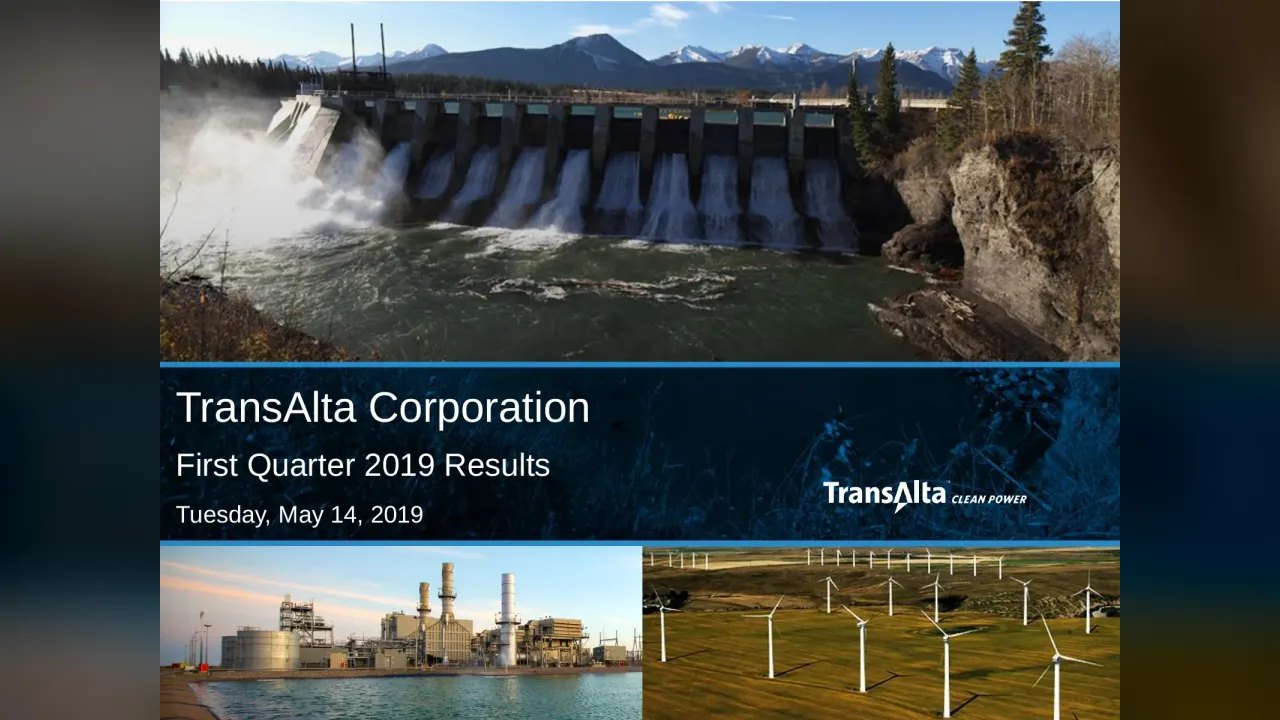
TransAlta (TSX:TA) Q1 2019 earnings call, held 2019-05-14. Watch the replay and read the transcript on 6ix.
On 6ix: 6ix.com/event/transalta-corporation-tac-q1-2019-earnings-call
Automated transcript · Written by software from the replay's audio. It can mishear names and figures; the replay is the record.
0:00 Good morning, my name is Chantal and I will be your conference operator today. At this time, I would like to welcome everyone to the TransAlta Corporation first quarter 2019 results conference call. All lines have been placed on mute to prevent any background noise. After the speaker's remarks, there will be a question and answer session. If you would like to ask a question during this time, simply press star then number one on your telephone keypad. If you would like to withdraw your question, press the pound key. Thank you. Sally Taylor, Manager, Investor Relations. You may begin your conference.
0:32 Thank you, Chantal. Good morning, everyone, and welcome to TransAlta's first quarter 2019 conference call. With me today are John Farrell, President and Chief Executive Officer, Christophe Duhout, Chief Financial Officer, John Kousinioris, Chief Growth Officer, and Brett Gallner, Chief Strategy and Investment Officer. Today's call is webcast, and I invite those listening on the phone lines to view the supporting slides, which are available on our website. A replay of the call will be available later today and a transcript will be posted to our website shortly thereafter. As usual, all information provided during this conference call is subject to the forward-looking statement qualifications set out on slide 2, detailed in our MD&A, and incorporated in full for the purposes of today's call. All amounts referenced during the call are in Canadian currency unless otherwise stated.
1:22 The non-IFRS terminology used, including growth margin, comparable EBITDA, funds from operation, and free cash flow, are reconciled in the MD&A for your reference. On today's call, Dawn and Christoph will review the quarterly results and expectations for the remainder of the year. After these prepared remarks, we will open the call for questions. With that, let me turn the call over to Dawn.
1:45 Thanks, Sally, and welcome everyone. Today, as Sally said, I'll start with some color on how I saw the quarter. and I'll also talk about our growth portfolio and what we're seeing on the horizon. After Christophe takes you through the financials, I will have just a few brief comments on the execution of our strategy. On the slide that's on the screen now, you can see that we delivered strong results in line with or better than last year. After adjusting for the one-time positive cash flow in 2018, our year-over-year funds from operations increased by 5%, and our free cash flow increased by 17%. Now, for those of you that follow us, you recall that last year during the first quarter, we received $150 million in cash for the early termination of the Sundance PPAs, which has been excluded from these numbers so that you can get a good comparison of how we're operating.
2:43 These improved financial results year over year are primarily due to strong performance from our energy marketing and hydro segments, which more than offset a one-time event in US coal, and the expected lower EBITDA from our Canadian gas segment. During February and early March, we had extreme cold temperatures here in Alberta, which strengthened power prices for the quarter and benefited our portfolio in the province. Our hydro segment, which is predominantly in Alberta, generated $27 million in EBITDA this quarter. an increase of 59% compared to the first quarter of last year, but still less than half of what our hydro segment would have made without the PPA in place.
3:33 Christophe will go through this in more detail in his section. Our U.S. coal team experienced what we call a tail event, which resulted in EBITDA being down 35 million compared to the first quarter of 2019, when extreme market conditions caused us to change our hedging strategy during a forced boiler outage. The good news is that our energy marketing team also experienced a positive tail event and were able to offset most of this loss through trades around their transmission positions that benefited from the same extreme conditions. A combination of high demand due to cold weather and very high gas prices due to pipeline constraints created extreme power pricing in the day ahead market.
4:23 Hedges in the Pacific Northwest market are settled against the pricing in the day ahead market. So even though the unit was able to return to service in record time, production from the plant could not be used to fulfill those hedges. Unfortunately, once the plant was up and running, the extreme conditions passed and we could only collect revenue in the spot market which was much lower than the day ahead market. We've frankly never seen such a mismatch between the day ahead and real-time markets in the Pacific Northwest and we don't expect this kind of event to persist on an ongoing basis. The Canadian call segment once again had improved availability of 91.3% during the quarter compared to 90.5% in the quarter of last year.
5:14 Cost reductions as a result of moth-falling Sundance units 3 and 5, as well as the benefit of co-firing with natural gas, resulted in the EBITDA from Canadian coal remaining consistent with the first quarter of last year when all four Sundance units were running under their PPAs. This is quite a remarkable achievement and shows that the market in Alberta will compensate for capacity when the market is tight. It also shows that the team up at Alberta Coal has done a tremendous job when it comes to cost and availability. In summary, we're ending the quarter with strong results from our existing operation and we are well positioned across the fleet to deliver free cash flow at the high end of our previous guidance of $270 million to $330 million.
6:06 Turning to slide five, today we announced the Skookumchuck project which is a construction-ready wind facility near our Centralia plant. In April, we signed an agreement to acquire a 49% interest in the 136.8 megawatt project at COD, which is expected in December of this year. Our investment will be approximately 155 million Canadian. Guconchac and Windrise are currently being funded by TransAlta. Both projects are underpinned by 20-year PPAs with strong counterparties and therefore are excellent future candidates for TransAlta Renewables. As I discussed during our fourth quarter call, by investing moderate development dollars in Greenfield and Brownfield projects in TransAlta and then taking advantage of the lower cost of capital in TransAlta Renewables, we can finance growth in TransAlta Renewables to the benefit of both sets of shareholders.
7:08 The top two projects on this slide, Big Level and Antrium, were great wins for TransAlta Renewables last year, and both projects will be funded directly by TransAlta Renewables. Construction is advancing well, and we expect both win projects to reach commercial operation later in 2019. Turning to slide six, on a consolidated basis, you can see how this growth will lift our future EBITDA. As you can see from this chart, we expect to see the benefits of Big Level and Antrium later this year, and next year we will start to see the benefit from some of the recently announced growth projects, including the Pioneer Pipeline, which will also drive growth in EBITDA in the near term. By 2022, we expect to have more than $60 million of EBITDA added to our run rate.
7:57 This year, we are investing over $400 million in growing the business through new development projects. Over the next three years, we will commission these five projects which have a total capital investment of approximately $850 million. Excluding the gas pipeline investment of approximately $100 million, we will invest $750 million in our four wind projects with high single-digit returns to investors. Approximately half of the investment will be funded with tax equity and project debt. As I said earlier, These kinds of projects fit well in the TransAlta renewables portfolio when investors want long-term stable contracted cash flows to support a high dividend payout ratio. With that, let me turn the call over to Christophe to provide more details on the financial results for the quarter.
8:47 Thank you, Dawn, and welcome to everyone on the call. Turning to slide 7, as Dawn noted at the beginning of her discussion, our results in the first quarter were strong. with funds from operations and free cash flow both higher than last year after adjusting for the early termination payments of descendants B and C PAs received in the Q1 of 2018. With the same adjustments, comparable EBITDA for the quarter decreased 15 million compared to last year. Although Alberta operations benefited from higher prices in the quarter and energy marketing showed better results than last year, EBDA was negatively impacted by lower results in our U.S. coal operations due to the one-time event described by Dawn, by the expected expiry of the contract at Mississauga on December 31st, 2018, and lower scheduled payments from the Profecric finance lease in our Canadian gas unit.
9:53 Moving to slide eight, as you can see from the chart on the bottom of this slide, Segmented cash flows from our power generating assets totaled $186 million during the first quarter, a decrease of 12 million or 6% year over year, after correcting for the one of $157 million payment in 2018. Cash flow from the cold segments was down $40 million, primarily due to the one-off event at Centuria. At Canadian coal, the positive impact of stronger power prices in Alberta, the benefits of co-firing and lower OM&A costs were mostly offset by increased environmental compliance costs during the quarter and the loss of PPA revenues.
10:45 In our U.S. coal segment, reduction in the cash flow was due to the one-time event in early March of 2019. when one of the units at Centralia had an unplanned outage, as described also by Don. Most of this reduction was recouped through our energy marketing segment, which benefited from the market volatility. As expected in our Canadian gas segment, the expiration of the contract at Mississauga and the reduced revenue from Pueblo Creek led to lower cash flow compared to last year. These reductions were more than offset by reductions in corporate costs as a result of our green light initiatives, as well as the realized upside in Alberta pricing in our hydro segment, which I discussed earlier.
11:37 As you can see on slide nine, we had strong power prices in Alberta, which benefited our Canadian coal and hydro segments, as well as the Alberta wind assets. Average power prices for the first quarter of 2019 almost doubled year-over-year at $69 per MWh, compared to $35 for the same period in 2018. The increase was primarily due to weather-driven demand in February and early March, resulting from significantly below normal temperatures throughout the province. Lower volumes of power imports into Alberta were also observed due to strong power prices in the Pacific Northwest stemming from below normal weather in that region.
12:31 While we are observing relatively modest spot power prices in the second quarter, this is not uncommon given the weaker season on demand in April and May. We expect demand to increase as we move into the summer. The forward prices for Q3 and Q4 are stronger than Q2 and are being supported by air prices in California and the Pacific Northwest. We're also seeing very low natural gas prices here in Alberta, which is favorable for co-firing capabilities. I would also note that uncertainty about what changes will be enacted by the UCP with respect to carbon pricing is being reflected in the forward curve for coal prices. which may explain why the 2020 prices are trading at 50, $51 per megawatt hour when the balance of 2019 is averaging at 53.
13:29 On slide 10, the slide you're becoming actually familiar with as we presented the same during our year-end results, showing the upside of the hydro assets once they come off the PPA. During the first quarter of 2019, our hydro assets generated 27 million in EBDA. However, they would have generated 67 million if the current PPA did not exist, assuming the capacity market was up and running and delivered similar capacity revenues. Going to Qlik quickly walked you through this chart. We generated 58 million by selling energy and auxiliary services revenues. Both PPA will continue to sell these services at market prices.
14:14 We also received 40 million of capacity payment under the existing PPA, which will go away once the PPA expires, but will be replaced by revenues under the capacity market in late 2021, or through energy prices in the event the capacity market is not adopted. We also generate $5 million in other revenues through Black Start, water management and transmission. If we subtract our cost of $10 million during the first quarter, we get $67 million of EBDA that would have been generated if the PPA did not exist and we were in a capacity market. Under the PPA, however, we paid to the balance pool in the first quarter of 2019 a net amount of $40 million. for energy and non-salary obligations, net of some costs.
15:08 This amount goes away once the PPA expires. So as you can see, there is significant upside from our hydro assets in the future. Before I turn it over to Dan, I will touch on our capital allocation. As we look forward over the next three years, we'll continue to focus on several key areas. Debt reduction, investing in coal-to-gas conversions, growth, and returning cash to our shareholders through our non-sphere buyback. This quarter, we committed to return capital to shareholders through a share buyback program. We will invest up to $250 million over the next three years in our own shares through this program. On the balance sheet front, we intend to repay the $400 million bonds maturing late 2020 with a strong excess cash flow generated by further strengthening our balance sheets. We remain committed to increasing our record debt to $1.2 billion by the end of 2020, coming from $3.4 billion in 2015.
16:11 Further debt reduction occurs at TransAlta and TransAlta Renewables through mandatory principal payments associated with the amortizing debt. With that, I will now pass the call back to Dawn.
16:24 Thanks, Christophe. As many of you know that follow us, Our goal is to deliver 100% clean power by 2025, a task yet achievable objective that requires the fundamental transformation of our company. To further extend our strategy, in March, we increased our financial capabilities through an innovative financing and cornerstone shareholding arrangement with Brookfield Renewables. We now have all the tools in the toolbox that we need to complete our transformation. As we look ahead, our focus is squarely on the execution of our strategy. We are now ready to move forward with significant investments of approximately $200 million into our coal-to-gas conversions. Our first conversion outage will be in late 2020 at one of our Alberta units.
17:13 We'll announce our schedule of outages, plant by plant, for the post-2020 timeframe at an investor day event that we are planning to hold in September in Toronto. We have also determined that under certain market conditions, an investment in a hybrid generator is compelling. We'll complete that work and update you on this front at that same investor day. We now have the cash to complete our conversions on an accelerated schedule, which will increase returns for shareholders in the 2020 to 2025 timeframe. Turning to our hydro assets, the combined TransAlta Brookfield Operating Committee created by our strategic partnership will be focused on optimizing and maximizing the value of the hydro assets now and into the post-PPA future.
18:03 Our job now is to ensure that we will grow the EBITDA based on the post-PPA market where capacity will be valued separately from energy. The higher the EBITDA, the greater the value to our shareholders. And as we look into the future, we see competitive costs for renewables, which are the generation of choice for most of our large customers. Growing TransAlta Renewables means matching customer contracts with projects. In addition to what we're currently building, we also see the potential for a number of cogeneration wind and solar projects. These projects can be candidates to be dropped down into TransAlta Renewables, which benefits from a lower cost of capital and is well positioned for growth.
18:46 So with that, I'll turn the call back over to Sally. Thank you, Ellen. Chantel, could you please open up the call for questions from the analysts and media? At this time, I would like to remind everyone, in order to ask a question, press star, then number one on your telephone keypad. We'll pause for just a moment to compile the Q&A roster. Your first question comes from Mark Jarvey with CIBC Capital Markets. Your line is open.
19:13 Hi, good morning, everyone. Good morning.
19:17 Yeah, good morning.
19:19 I just wanted to maybe start on the coal segment. You know, some improvements in the OM&A cost there. It was kind of the lowest we've seen in a number of quarters, or $10 million before, lower than sort of the trailing four-quarter average. Maybe just tell us what drove that and whether or not it's sustainable over the next few quarters here.
19:38 Well, as we said to you, when we repositioned units last year, so remember we've got three coal units that are still on PPAs, and then we have... two units operating that are merchant. And the units that are operating that are merchant are dispatched, you know, sometimes they're operating and sometimes they're off because their market conditions are low. So we've been able to really adjust through our transformation all of our costs, fixed and variable, and including costs at the mine to be able to reflect an operation that has three baseload plants and two merchant plants. So that continues as long as those are the number of units that operate. And then as we develop our plans here to switch to gas, as the mine comes off and gas comes on and there's more co-firing, that allows us to take more costs out, both in the cost of goods sold, which is where the mining costs are, and in the OM&A.
20:39 Once you get to a gas operation, it's a significantly different operation.
20:46 So just to clarify and confirm, so then given where you are now and plans to operate over the next couple of quarters, you should be able to maintain where you've got the cost profile down to? Yeah.
20:54 Okay. That's right. That's right.
20:56 And then going to the U.S. wind project in Washington, maybe you can just kind of outline in terms of what it is that ultimately decides whether or not you guys confirm to buy that interest and maybe give some color in terms of the process to acquire that interest. Was it a competitive or some sort of bilateral negotiation?
21:13 Yeah, Mark, it's John. It was something that, you know, frankly, kind of fell into our lap in the sense of looking at some of the development that was going on in the region. I think just by virtue of the fact that we've got the facilities that we have in Centralia with that footprint, the need to sort of have transmission for that farm going over the lands that we have from the mine that were there just made sense that we would be a party to that transaction and resulted in us being given the opportunity to participate in what is really an excellent project with a really strong PPA. We're also quite big on the area, generally given just the trading expertise that we have all along the West Coast, and generally it's an area that we're looking to have more growth. We were happy with the returns.
22:05 We were happy with... with our partners. And it was really the positioning that we had from our facilities kind of in the central western part of the state that resulted in it being kind of a natural place for us to participate
22:20 in. Yeah, there was no competition for that interest. It was really because we had something that they needed and they had something that we wanted. And if you look at the Pacific Northwest markets, they're shutting down Coal plants everywhere and not building gas and really committed to a future of renewables. So they're good investments.
22:43 Okay. And then just the timing on when you actually make sort of the final investment decision, why not now and why later? Does it have anything to do with the PPA industry?
22:51 No. The way that the acquisition is actually structured, they're going to proceed and actually begin construction shortly. The whole arrangement is that we just buy in. The agreement's been signed. We buy in at COD and fund it at COD, which we're expecting to be around December of this year, later this year. It's just the way we structured the deal.
23:09 Okay. And then just switching to the hydro, which had a really solid quarter, you highlighted. So obviously strong pricing. And then on top of that, realized the hydro assets in the energy only realized a pretty strong premium to spot. Maybe just kind of comment on what sort of drove the... Even Improved Premium, whether or not this level here is something we can expect going forward or if there is something a bit different in the setup with the higher power prices and maybe some weaker spot generation.
23:42 Yeah, so Mark again, it's John. I think that the performance that we had in the quarter was just really reflective of the circumstances that we saw in the market with the extreme cold that we had. In February and March, you know, the prices were high. There was times when our hydro ran and was able to take advantage of both very strong energy pricing and also the ancillary services that we had. I don't know that I would be reading a lot more into that from kind of the steady performance that we're looking at for the hydro other than it's just It was just sort of symptomatic of the environment that the fleet found itself in.
24:21 Yeah, yeah. I mean, think of the hydro as a deck of cards with 52 cards in it, and you play your 52 cards. You try to play your 52 cards at the highest price in the hour throughout the year because you're rationed effectively. There's only so much storage that you can play. So the team did an excellent job of playing their cards through the quarter with the water that they had to maximize the value, and we have a team of people that work on that.
24:48 Okay, so if we think that maybe it was 30% premium to spot this quarter, and you look over the last couple of years, it's generally sort of in the high single digit to mid-teens, so we should kind of continue to assume something in the prior run rate of 50%?
25:01 Yeah, I mean, you're not going to be able to get that perfect. Different quarters will have different attributes. I would say that in markets where there's Really tight. I mean, remember, it was 30 below all of February. That's a one in. I've been forecasting in the province since 1985, and we've never had 30 below for the whole month of February. So, you know, when you see those kinds of conditions, then I would expect a little higher premium. But if it's just your regular run-of-the-mill pick off the top, I think that 15% is a good number. That's right.
25:40 Okay. And maybe moving just into the impact of the UCP or switching government here, obviously some unknowns around the capacity where I'm sure you'll provide your views. And then is there anything for you guys to advocate for? What do you think in terms of the industry in terms of forming ultimately how the CCIR moves over to what they call the tier now? Is there... Do you think that's largely established or is there a lot of room for discussion on ultimately sort of the nuances of that implementation?
26:14 You know, I don't know. I mean, I think the truth is they're just establishing the government. They'll set up that process. There'll be discussions. I would never speculate on what an outcome might be in a government process. I do know that if you think about – if you look at energy-only markets worldwide, there aren't very many of them. And unless you get your capacity pricing correct in terms of – remember, the big mechanism used in an energy-only market to drive capacity pricing is the ability for price to run up in a shortfall. And all energy markets cap that price. In Alberta, it's capped at $1,000. In southern Australia, where they had an energy-only market, they had to move the cap to like $14,000 because they ran out of capacity by not having prices go up enough to respond to sort of conditions in real time. The other issue is that you're trying to attract new investment and a lot of – it's hard to get equity – sorry, it's hard to get debt investment and lower the return or the cost of capital of your project – if you are just relying on a spot market price for capacity pricing, which is why the capacity market is superior because it should fundamentally drive lower cost of capital for consumers and better pricing and more long-term investment. So those will be the kinds of comments that we'll make as we go into it, but nothing has started yet, and until we get the process set up, there'll
27:46 be lots of lobbying and lots of people talking, but it's got to be a very Okay, I'll leave it there. Thank you guys. Thanks. Again, if you would like to ask a question, press star, the number one on your telephone keypad. Your next question comes from Charles Fishman with Morningstar Research. Your line is open.
28:28 Hi, thank you. Dawn, on slide 11, you said evaluating hybrid options. I also realize you said you're not prepared to discuss hybrid. You know what the conclusion of that is, but what do you mean by that? I mean, what are the potential options that you're looking at? Can you at least add color on that?
28:46 Yeah, so Brad Gellner is working up all those options, so he'll explain what that hybrid is and just what decision we'd like to bring to the investors by the time we get to September.
28:59 Yeah, so for the most part, we've been talking about repowering being kind of simple boiler conversions where you just switch out the existing burners and put in natural gas burners. Today, we can co-fire those units up to a certain amount, but be able to get to 100% gas, we need to switch out all the burners. So that's straightforward conversion, low cost, very short duration. The thing is, you don't really change the eat rate of that plant. So the other option we've been exploring, which we introduced here, I think, a couple calls ago, relates to installing new gas turbines on site in HRSICs where you capture the heat. And then we apply that steam, use that steam in the existing steam turbine of the coal unit.
29:53 And so basically bypassing the boiler. That is a more capital-intensive opportunity, but certainly a much lower heat rate. and the economics today look very compelling. We need to do more work on configurations, whether it's one GT or more, and which units we would tie into in terms of the steam turbine. We have visited sites of both nature, the simple conversion and the repowering, and both are very good projects and have been very successful. And so that's the additional work we're doing.
30:32 Does that help you? Absolutely. Absolutely. And you have mentioned it in the past. I guess I was just confused by the terminology hybrid. But certainly the conversion with the gas, you know, the HRSIC and doing a combined cycle type conversion, you certainly discussed in the past. Thank you.
30:52 Yeah, just think of hybrid as a cheaper, more cost-effective combined cycle where we get to reuse a lot of the equipment at the plant.
31:02 Got it. Thank you.
31:03 Okay. Thank you. Your next question comes from Marise Choi with RBC Capital. Your line is open.
31:15 Hello, Marise. Are you there?
31:17 Yep. I'm here. Sorry. Good morning. I just want to discuss a little bit about Alberta electricity prices, and this relates mainly to Slide 9. I recall back in the Q4 results, you showed obviously beyond 2020. Obviously, there's an external forecast by EDC, but you had total power prices of closer to $70, $80. I wonder if there's anything in your, I guess, past few months that would point to a different conclusion from your perspective.
31:51 Yeah, so let me just clarify. That slide had some pricing from an external service provider, and we stated at the time, and we should have put it on the chart, that probably, you know, no one can read the future, but if you look at the past in Alberta, an average of about $60 seems to show up in the market over 15 years, over 10 years, over five years. There were two really low years where the market wasn't operating as a market. which if you take that out, really the price should be in that $60 range. So in terms of looking at the future, you know, who knows? It depends on a lot of factors. When we look at the forward curves today, this is what we've seen. In Alberta in the past, the forward curve tended to trade at a premium to the spot. Recently, in the last six months to nine months, and including this last quarter, the spot trades a premium to the forward curve. which would say that a lot of customers should be trying to buy that forward curve but they're not for whatever reason and I think it's the uncertainty around carbon pricing and policy and all that sort of stuff so people just sit on the sidelines.
33:01 But if you actually look at the last quarter and now the old demand forecaster is coming out in me and you look at sort of 30 degree cold weather in February where it's pretty light at the time when the peaks usually hit so you don't really have even all the loads on The market was very tight. So what it kind of indicates to you is the real market in real time tends to be in balance. And the forward market may or may not be reflecting the true value of the cash market. So for your analysis, month by month, watch your spot market pricing against the forward market pricing that was in the market for the last couple of months before the market settled. And it will start to tell you more about supply and demand in the marketplace.
33:50 So I would always run about $60 in your models, despite what forecast you see, because that's a safe bet looking out in the future. And then there'll be times when demand and supply are, you know, in balance or tighter. And certainly I think that a quarter was $69, which to me shows that there was more demand than there was supply in the first quarter of this year in the spot market.
34:19 Yep, it does. I guess I'll follow on to that, switching to that other part of that graph, which is obviously the capacity market. Any comments or thoughts on any changes since the last update on that?
34:35 On the capacity market?
34:37 Correct.
34:38 Yeah, I mean, from what I understand, the hearing is going well. I think all the kinds of things that you would expect to see in a capacity market hearing and all the kinds of Issues are well underway, and I think it's going quite well. So I think that capacity market will be a very strong, viable option, and it's being heard by a very reputable regulator, and it's being recommended by a world-class, reputable regulator on the ISO side. So my hope is that there should be a lot of confidence in that process, given that I think we've got world-class institutions here in Alberta.
35:21 Perfect. Thank you very much. Thank you. Your next question comes from John Mould with TD Securities. Your line is open.
35:30 Good morning. Thanks for taking my questions. Firstly, on the Centralia outage, are there any takeaways going forward there from that outage during the mid-season spike in March in terms of how you approach your operations or hedging there? Do you really view it as a very unlikely set of circumstances that came together there?
35:51 Yeah, no, I did a lot of work on it myself personally to try to understand because it was such a, you know, it was so interesting that here the traders had, they were jumping up and down for joy and then we looked over at the plant and it was like, you know, how could this be? And so we did a lot of work on it. I concluded that at the end of the day they had to make a decision as to whether or not they would they would settled the plant in the day ahead market and they had to make that decision on a Friday for a Sunday and a Monday. And the way the market was trading at that moment with $800 prices on the horizon was that there was clearly a massive risk that if we nominated the plant and it didn't come back, so remember these are plants where you walk into them and you see is there one boiler tube that needs to be fixed or is there four?
36:46 And that's the difference between 24 hours and 48 hours, right, for your outage. So they had to take a risk of whether or not they should nominate the plant to run. And in those circumstances, at that moment, there was no question that if they had taken the risk for the plant to run and it didn't run, that the consequences would have been horrendous because we wouldn't have been able to supply the hedges and we would have breached our contracts. And we're a strong ethical company and we don't breach contracts, so I think they made the exact right decision. It was bad luck, I guess, in a way that by the time they got to sell the plant in real time because it came back, prices had dropped. And so I mean, it's the first time we've seen in a long time where the, I don't even think we'd ever seen a situation where the real time and the day ahead market trade is away from one another.
37:40 They're usually within about 10% of each other is what we typically see.
37:46 What I took away from it is it is an unusual set of circumstances and it's also an unusual set of circumstances on the energy marketing side. The fact that they made a whole bunch of money in that event, the good news is we have a diversified portfolio and we had those transmission assets to trade around which helped offset some of the pain at the plant. But you shouldn't look at the one-time in energy market as being permanent and you shouldn't look at the one-time loss at Centralia as being permanent.
38:15 Okay, great. I appreciate the color there. And then, Don, in your earlier comments about the market structure in Alberta, you referenced the need for a capacity signal, whether that's in a capacity market or an energy market. If the government doesn't proceed with the capacity market in the end, what kind of specific changes do you think, if any, are needed to the current energy-only market structure to ensure that capacity signal is there?
38:44 Yeah, I mean, if I was the ISO and I was in charge of that, and I had to guarantee reliability to Albertans as part of my mandate because I'm legislated to do that, I'd have to take a very, very close look at whether or not I would want to reinstate some PPAs or I'd want to change the pricing signal to reflect what is known globally is the cost. It's really the way you do that cap is you say what is the opportunity loss to a load not being able to be supplied? And that loss is in markets like Alberta is somewhere between $10,000 and $20,000 a megawatt hour. You have to do that kind of work if you're the guy who's in charge of reliability.
39:32 It's really up to them. Currently, the energy-only market for the incumbents, $69 in the quarter is fine. I can live with that. The real question is, will $69 in the quarter here and there, and then a quarter that's maybe $40, and then followed by a quarter that's $75, will that incent new people to show up with plants? and that's what the ISO will have to get under to really think about. Because it's not so much about us, the incumbents in the market, it's really about how do you attract new supply.
40:10 Right, right. Okay, that makes sense. And then maybe just a couple questions on the conversion. So just as far as the SvenSix timing, does that outage effectively run from the end of 2019 through the end of the conversion process? absent other notice to proceed announcements leaving you with the one operating unit Sundance through that period?
40:36 No, it's Brett. So as we've indicated in the past, those conversions are about 60 days in length. And so right now it's just planning and ordering equipment that we're going through, and that just has a long lead time associated with it. The actual outage itself, you're only taking a unit out for that kind of 60-day period. And, you know, there will be some startup commissioning that goes on after that. But generally, that's the timing. So you're really not – and then, obviously, we'll stage them in over time and not do them all at once, clearly.
41:13 Okay. That's what I thought. Thanks for the clarification. And then just on the repowering, I recognize, you know, you probably don't want to steal your thunder. for your investor day later this year. But can you talk maybe a little bit just about the kinds of market conditions that you're looking for to make that investment in the hybrid conversion a more attractive option for the company?
41:38 Well, again, a big part of it is always the capital costs. So the work we've done to date, as always, is – It's not a complete detailed capital cost estimate, so we're working with capital costs that have a range to it. So I would say that is always the biggest variable. The heat rate is pretty known. I'd say the other element is just as you're tying these units into existing systems, clearly you've got to really go through and make sure that You've captured all the right bits of work that are required in each unit. It's going to be different from that perspective. But again, back to that price that Don mentioned, that $60, which is really an all-in price, whether it's an energy-only or a combined energy capacity price, makes these very compelling because the capital cost is a lot less than a brand-new combined cycle, as you would expect. And so really the only other piece of decision or big decision and work we're doing is do we do, you know, what we refer to as a one-on-one-on-one, which is one gas turbine, one HRSEC, and then tie into one steam turbine or a two-by-two-on-one.
42:58 So two gas turbines, two HRSECs into one steam turbine. And clearly, you know, with two gas turbines, you get more steam generated and therefore more You're utilizing that existing steam turbine more.
43:11 Yeah, so just one other thing. I mean, clearly, if you look at the economics of a hybrid, it's more capital. And as you saw with our financing with Brookfield, I mean, frankly, what we were doing was giving ourselves the financial flexibility to be able to make these kinds of decisions. So that's really positive for us. But it's more capital. And typically, when you're going to spend more capital, Thank you very much. will proactively support gas for generation over the next 25 to 30 years. And I'll be working with the Premier to ask him for a proactive policy that supports generators to make those investments with an obligation by the province to assure us that if some future government decides to change their mind, that there's recovery of our foregone profits.
44:36 So those are considerations that have to be made in a world where greenhouse gases have such a high profile. So that's another piece of work that we'll be doing.
44:50 And the only other last bit, which also ties into the light, remember on the simple boiler conversions, federally, we have a finite light to those depending on the emissions of each unit. For our units, most of them we expect eight years beyond what they could have run under coal, and some of them will be 10 years. Whereas the hybrid repowering, other than what Don just mentioned, there is no policy limiting you other than the technical aspect of the plant because it'll be a very efficient plant, very similar to a brand new combined cycle. So there's that added element to it.
45:33 Right. Okay. Thanks for all the color. Much appreciated. I'll leave it there. Okay. Thanks, John. Your next question comes from Chris Barco with the Calgary Herald. Your line is open.
45:46 Hi, Dawn. Just to follow up on those questions on the gas-to-coal conversion plans, is there anything that would change your timing or your intention of the strategy? And I'm thinking specifically here on whether the government reversed its decision on the capacity market. or on any of the future carbon price changes that they're talking about introducing.
46:07 Hi, it's Brett, Chris. So, no, we and we laid this out again, I think, back in February. There are, you know, a number of factors that are going into our decision to convert. The carbon pricing is one element of it. And as Don says, as long as the If they do stick with an energy only and the price signals are appropriate, then that's not an issue for us. And really, there's a lot of benefits for converting. You know, the NOx stocks go way down. We get the extra lives out of it. As Don mentioned, our maintenance capital goes significantly lower, as does our OM&A. So there's a whole bunch of benefits from converting.
46:56 and so we're well down the path of not changing on that. The timing will be more staging and making sure that we're managing that properly but it's still over the timeframe that we talked about.
47:13 Yeah, Chris, just to add, I think the challenge you have with trying to have a foot in both camps is you end up with having to pay for an expensive mine and expensive coal handling equipment at the same time that you're paying for a gas pipeline and gas. And effectively, you make yourself quite uncompetitive. So you really got to stay in one camp or jump to the other. And we made the decision in February, and we were very clear with investors that we're taking both of our feet and we're planting them firmly in the camp of converting to gas.
47:52 Thanks. Just on a separate question, the new government has said that they're going to ask the Auditor General to look at doing an audit on the losses within the PPAs held through the balancing pool. I'm just wondering, what are your thoughts on that? Do you think it's necessary? And if so, are there any questions that you think need to be determined by any audit of those losses?
48:13 Well, I think that a new government can do whatever it wants. They're in charge, and I would have no opinion on that. You know, I... It's not something that I've even focused on or looked at. You're the first person to tell me that is another way to say it, Chris. Thanks for the information. I'm going to go away and think about it.
48:37 All right. But you don't believe there's any questions that TransAlta would want to see answered as a result of an audit that is being done by the Auditor General or by the government itself into those PPA losses through the balancing pool? Yeah.
48:49 No. You know what? This company needs to look ahead. We've got a big strategy to execute. It's super exciting. We're spending some great money on some renewables. We're converting our plants to gas. I'm looking at this hybrid. I am focused on the future here, not the past.
49:07 Thank you. Thanks. There are no further questions at this time. I'll now turn the call back over to Sally Taylor.
49:17 Thanks, Chantel. Thank you everyone. That concludes our call for today. Please don't hesitate to reach out to myself or Alex if you have any other questions or contact us through the investor relations email. Thank you. This concludes today's conference call. You may now disconnect.
Follow TransAlta Corporation into a list and get an email when it puts out news.
Manager, Investor Relations
President and Chief Executive Officer
Chief Financial Officer
Chief Strategy and Investment Officer
Chief Growth Officer
Analyst, CIBC Capital Markets
Analyst, Morningstar Research
Analyst, RBC Capital Markets
Analyst, TD Securities
Journalist, Calgary Herald