Replay available
Tata Chemicals (NSE:TATACHEM) Q2 2027 Earnings Call
Tata Chemicals (NSE:TATACHEM) Q2 2027 earnings call, held 2026-11-07. Watch the replay and read the transcript on 6ix.
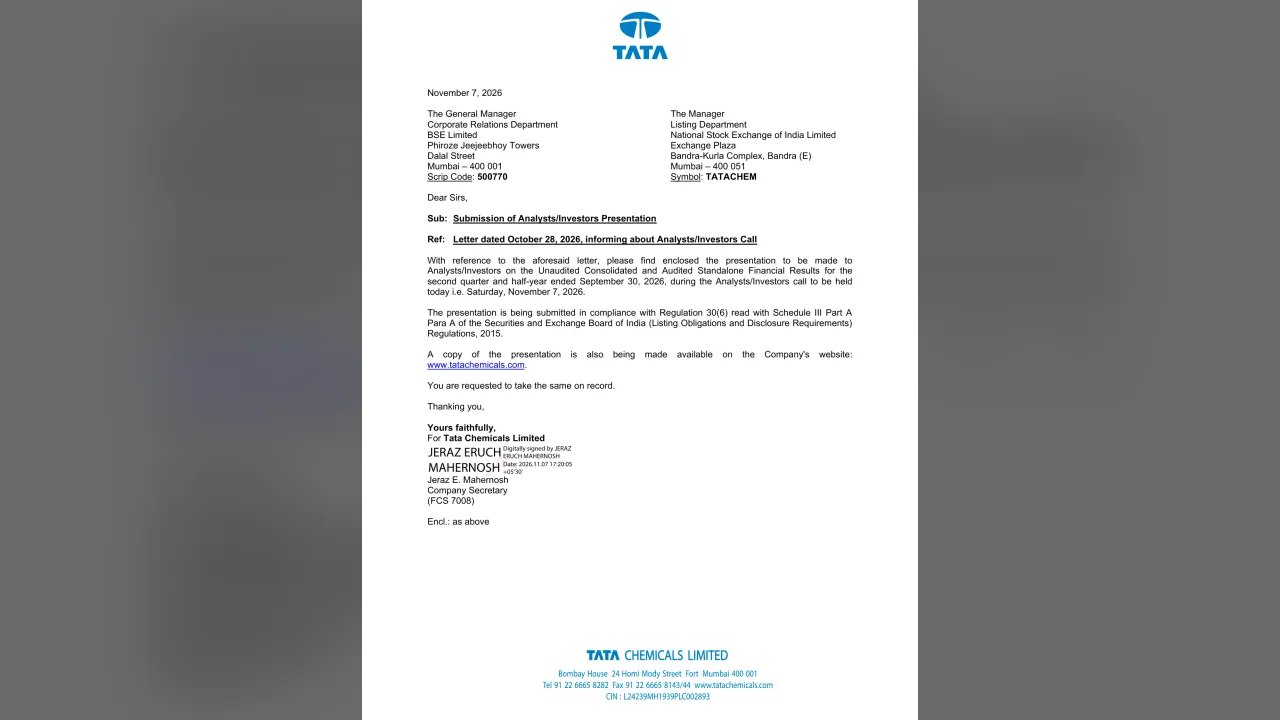
- Company
- Tata Chemicals Limited (NSE:TATACHEM)
- Period
- Q2 2027 earnings call
- Date
- Sat, Nov 7, 2026, 9:46 AM ET
- Replay
- Watch the replay on this page · 30 min
On 6ix: 6ix.com/event/tata-chemicals-limited-tatachem-q2-2027-earnings-call
Replay
Transcript
Automated transcript · Written by software from the replay's audio. It can mishear names and figures; the replay is the record.
0:00 Good evening, ladies and gentlemen, and welcome to the Q2 and H1 FY 'twenty seven Earnings Conference Call of Tata Chemicals Limited. Please note that this conference is being recorded. As a reminder, all participant lines will be in a listen only mode, and there will be an opportunity for you to ask questions after the presentation concludes. We have with us today, Mr. R. Mukundan, Managing Director and CEO and Mr. Nandakumar Pirumalai, Chief Financial Officer of Tata Chemicals Limited. Before we begin, I would like to mention that some of the statement made in today's discussion may be forward looking in nature and may involve risks and uncertainties.
0:56 I now hand the conference over to mister Al Mopindan to begin with the proceedings of the call. Thank you, and over to you, sir. Thank you, Sapnali. Good evening, everyone, and welcome to our Q2 FY 'twenty seven and H1 FY 'twenty seven earnings call. It's a pleasure to connect with all of you during this festive season and I would like to start by wishing you and your families a very happy and prosperous Diwali. I begin with brief overview of industry landscape followed by key operational business highlights across our markets and geographies during the quarter and first half of the year. Starting with the customer end, which is demand scenario across various segments and geographies, in the living essential, which is mainly bicarbonate, salt and FOS, the demand outlook remains supported by premiumization, increasing consumption across food, feed and pharma and beverage applications.
1:54 Salt and bicarbonate are expected to provide continue to provide stable growth while prebiotics offers attractive long term opportunities driven by increasing customer focus on gut health and wellness. In terms of industry essentials, which is mainly soda ash and also silica, the near and near to medium term outlook for global soda ash industry continues to remain challenging. Market conditions are characterized by persistent oversupply, subdued industrial demand especially in China and intense competition across export markets. Significant capacity additions China over last two years coupled with slower than expected demand recovery in the end use sectors have continued to pressure global soda ash prices and produce a margin. The ongoing conflict in Middle East including disruptions impacting regional shipping routes and energy markets have increased freight volatility and supply chain risks.
2:49 While large scale demand destruction has not materialized, in fact in some parts of the world the demand is robust, customers remain cautious in procurement decisions amid macroeconomic uncertainty. China remains the key determinant of global market dynamics, high operating rates continued export and competitive pricing from Chinese producer continue to influence global soda ash prices and trade flows. This is coupled with weak domestic demand from China's real estate and construction sectors resulting in additional export volumes entering the international market. Amidst all this, India continues to outperform most global market. Demand growth remains healthy, supported by strong activity right across segments. Capacity expansion by solar glass manufacturers continued infrastructure investments are expected to continue to provide above average global demand growth.
3:42 Southeast Asia remains highly competitive. While the region is growing, it remains competitive especially from Chinese exports who continue to gain market share in that region. In terms of farm essential, uneven rainfall, delayed sowing affected demand during parts of the quarter. Although, Kariv Raykray subsequently recovered, the broader agriculture outlook remains cautious, supported by crop coverage, improving irrigation policy support technology adoption and resilient rural demand. However, weather volatility, crop price movements and elevated input costs continue to weigh and remain a near term risk. In terms of supply scenario, broadly Mainland China continues to be the driver of supplies, including in the bicarbonate, we saw increased supply on account of new capacity.
4:42 Global soda ash market has already been highlighted is beset with high Chinese capacity growth and inventory levels. Export volumes from China remained elevated. By the end of September, producer inventory had reached nearly 1,890,000 metric tons. Inner Mongolia, Perun's Phase one five million ton underwent maintenance outages in October. This capacity is expected to full operating rates at the end of the month. Meanwhile, Chinga is Salt Lake solvent based soda ash producer will reduce operating rates end of October. The magnitude and duration of these impacts remain uncertain. In addition, TingXing Technology parent company of Shandong, Haitong also announced that they will close the soda ash and bicarb operational lines.
5:37 Recent announcement by U. S. Producer to reduce production at Wyoming by 1,500,000 ton and exit on economic export volume underscores the severity of current market conditions. This remains one of the key concern that is persistent low export realization and the structural demand supply imbalance causing which are facing the global soda ash industry. Within India, DGTR has recommended quantity restrictions on soda ash imports for two years after concluding that imports have surged and are causing serious injury to domestic industry. Imports had increased by 89% in FY twenty twenty and remained at elevated levels and driven by global oversupply and capacity additions in export countries and diversion of export volumes to India.
6:31 The pricing environment does remain under pressure for soda ash. The Indian domestic pricing softened towards the later part of the year following improved import availability and increased domestic supply. U. S. Export pricing remains under pressure. Looking ahead, pricing is expected to be range bound and as market participants continue to content with elevated inventory level. Any sustained improvement in prices is likely to depend on combination of supply rationalization and strong demand growth in the applications and the geographies. Now I will turn to the operational highlights and TCL performance in Q2 and H1. The company delivered a relatively resilient operating performance in a very challenging global environment.
7:18 Higher sales production volume improved operating efficiencies and cost management helped mitigate impact of continued pressure on soda ash prices. The elevated input and energy logistic cost weighed on the results. Despite a resilient operating standalone performance, our consolidated results were sharply impacted by natural gas cost increases in UK. The prolonged Middle East conflict continued to drive input costs both in CO2 as well as in freight and logistics. These were additionally weighed down by temporary suspension of Kenya operations on the consolidated performance. Stand alone highlights, revenue from operations stood at INR13003 crore, up 8% compared to Q2 FY twenty twenty six.
8:06 EBITDA at INR292 crores was up 22% compared to Q2 FY twenty twenty six. Our profit from tax was down 31% at INR122 million. In terms of consolidated highlights, the revenue from operations was also up at 4,177 by 8%, driven by higher volumes both in India and U. S. EBITDA at $3.81 compared to $5.37 was lower mainly due to lower realization in overseas subsidiaries, especially U. S. Exports to Southeast Asia markets, higher energy and logistic costs in UK and suspension of operations in Kenya. The loss after tax at INR50 crores compared to profit after primarily due to lower realization, higher energy costs and reduced other income and lower JV income.
8:57 Net debt without leases stood at INR6127 crore. Likewise, in standalone H1, the revenue was up 9% at INR2584 crores. EBITDA at INR656 crores was up 29% from H1 of twenty twenty six and profit after tax was down 4% at INR465 crores compared to H1 FY twenty twenty six. In terms of consolidated highlights of H1, the revenue from operations at INR 8,432 crore was up 11% compared to previous year H1. EBITDA at INR $9.36 as compared to INR1186 crores was lower mainly due to lower realization in overseas subsidiaries and higher cost incurred in logistics and energy.
9:45 Profit after tax before exceptional NCI at INR10 crores compared to INR535 for H1 twenty six, thus impacting the profit after tax. Unit wise highlights, India performed as highlighted better, mainly due to higher volume of salt, FOS, silica, higher depreciation due to capitalization of projects, increased the finance cost. However, in India, the overall demand picture remains stable and positive, pressured with oversupply and steady import pressure. In U. S. During the quarter, EPNA was declared the successful bidder for Chapter 11 bankruptcy proceedings of Surge Valley Minerals and this led to acquisition of customer contracts representing 500,000 ton to be serviced over two years.
10:39 On business performance, higher revenue compared to previous year due to higher volumes, mainly due to various contracts which we had acquired during the year was partly offset by lower pricing during the quarter in export market. UK, the lower revenue compared to previous year is due to lower realization in Salt and the variable cost increased sharply in UK due to increase in gas cost. Supply chain also resulted in lower realization of sales especially to Middle East markets. As highlighted, Kenya operations remained suspended during the quarter. Singapore sales performance was in line with expectation. Atlas monsoon shortfall and delayed sowing affected agrochemical demand during the year. Curif acreage recovered as the season progressed.
11:27 Against this backdrop, Atlas delivered resilient performance aided by growth in crop care and soil health. Profitability however remained under pressure due to input costs inflation and unfavorable operating conditions. In conclusion, operating environment continues to be challenging. These are characterized by geopolitical uncertainties, evolving trade flows and continued oversupply. We continue to focus on disciplined execution, operational liability and strong customer partnership to ensure resilience. Near term market conditions are expected to remain a range bound, especially due to the impact of capacity addition in China and sustained export activity. The demand is going to be supported by several segments including solar glass, lithium, food pharma applications.
12:20 The U. S. Producer announcement reinforces our view that industry is entering the phase where cost competitiveness, operational excellence and capital discipline will be the key differentiator. In this environment, our priorities remain clear, strengthening cost competitiveness, enhancing supply chain resilience, driving operational excellence, optimizing working capital and maintaining disciplined capital allocation. We remain focused on protecting cash flows, preserving balance sheet strength and ensuring financial flexibility amidst this uncertainty. We continue to advance our strategy of increasing contribution of non cyclical specialty and value added business, reducing earnings volatility and strengthening quality and resilience of our portfolio. Our investments especially in the living essentials coupled with innovation and sustainability led solution will support long term value creation. Company's performance continues to reflect strategic direction outlined under life framework with sharper focus on application oriented businesses.
13:22 Through a balanced approach of strengthening core business while expanding non cyclical segments, we are building a more resilient enterprise. With this, I close my comment and hand it back to the moderator to open the Q and A. Thank you. Thank you, sir. We will now begin with the question and answer session. You may press star then two. Participants are requested to please use handsets while asking a question. Ladies and gentlemen, we will wait for a moment while the question queue is sent. Participants are requested to limit their questions to two per participant and can rejoin the queue in case of further question.
14:25 We have the first question from the line of Saurabh Jain from HSBC. Please go ahead. Yeah. Hi. Thank you for the opportunity. My first question is, can you give us more details around what's happening in the Kenya operations? You mentioned that the operations continue to remain suspended. But then trying to take a mid to long term point of view, it seems to be entangled into political issues. So what is the way out now? Because you also closed the court, and it seems that the court has kind of, you know, not, you know, looking to in... Looking to this matter. So what are the future course of action, what are the possible solutions and what is your outlook on the Kenya business? So I think it's a fair question in terms of the risk facing the company. Kenya operations as you know are fairly resilient and have it's a debt free operation and continue the unit has continued to generate positive margin even in this challenging environment.
15:22 It's unfortunate that the operations were suspended post notice from the Ministry of Mining. We are engaging both with administratively with the Ministry and the government officials also through the legal mechanism because we also have to protect our legal rights. We do believe that we have strong legal rights with our lease which is extended right up to 2053 and these are inalienable rights. In addition to that, the mining licenses are layer on top because the mining law itself came much later and we have on hand approved mining licenses for which fees have been paid but not issued. So effectively I think the discussions are ongoing with the technical committee. We have given them certain options in terms of how to engage with the progress.
16:14 In parallel, the legal process did not end. The court actually directed us to go to a special court, which is the economy and the environment and land court where these matters are decided. And we have placed our matter to them. They have notified the other participants and the court will be hearing during the course of November the proceedings and we'll wait for those proceedings in parallel. After that, of course, there is a long way of in terms of the judicial as well as administrative remedies. But fair to say that we remain committed to Kenya, we remain committed to the business and we will do whatever is right the way we run our businesses in a very ethical and sustainable manner.
17:05 Sure, that is helpful. But then whatever the news and the media was reflecting and highlighting, you think it is possible that if the, you know, political leaders come to a decision and choice that we would kind of seek for the operations to end. So despite Tata Chemicals owning these mining licenses, can... Are they in a position to kind of direct Tata Chemicals and then can it be a result that Tata Chemicals has to shut shop the operations and then kind of close the business in Kenya? I think for that, Saurabh, there are multiple remedies. We have not actually we are in the process and the legal teams will evaluate. And fundamentally, I think this operation is covered under UK Kenya bilateral investment treaty because this is a UK investment into Kenya.
17:54 And that PIT actually protects the investment. So we have not we are yet to determine what is the next course of action. We are going through the legal process and the if you ask me what is the ultimate, I at the end of the day every business has a right to seek compensation in courts beyond Kenya. But right now we are in the courts of Kenya to seek justice. Okay. Are you also looking to make any other kind of business diversification into Kenya or investments to kind of showcase that you remain committed to the development of Kenya? Any sort of that plans if you can highlight? No, I think as a group Tata is very much invested in Kenya and also Tata Chemicals we have highlighted how we are we were in the midst of our expansion to doubling the capacity.
18:45 We were also in the midst of adding bicarbonate unit and also getting a partner to set up container glass because we ourselves are not in the business, it has to be done with someone who is in that business. So all these have been highlighted to them. It is part of the submission we have made. Okay, understood. So any outlook in terms of for how long you would believe that these operations will take the minimum to start operations like a quarter or two quarters, any sort of that comment? I would not like to comment, but as a long term investor in any country, we are ready for ensuring that we do everything in ethical and sustainable manner. Okay. Thank you. My second question is on the U. S. Business. You were a successful bidder for CLS and you kind of got some contracts which are existing with the CLS.
19:40 But what is the mid to long term benefit of kind of making these kind of bids? Is it only acquiring certain portion of revenues in any ways given the realizations that we see? It will be very difficult to make profits on these contracts in my understanding. Correct me if I'm wrong here, but then is it also does it also have to do anything with taking a midterm or long term benefits that also come to you along with this acquisition? So to be fair, I think Surge Valley Minerals had an operation in California. They have very strong position within the state of California and are joining country of Mexico. I think we get the benefit of being able to service customers before in geographical proximity, which obviously enables us to also have much greater control on logistic cost, which is one of the issues which is impacting the business today in terms of netbacks.
20:36 The main issue has been the increase in cost of diesel as well as the increase in the cost of the shipping freight and also non availability of shipping logistic connections from time to time because most shipping industry is now impacted by the long routes they need to take to avoid various conflict zones. So this being overland sales, most of them are positive for the company and we hope to serve the customers well enough to continue to have their continued flow of the orders from them for a long term. So any binding commitments you have with these customers for these contracts? So once these ends, would there be kind of an automatic order that will come back to you?
21:29 No, these are over two years as well as it been mentioned. And beyond that I think we'll have to go through renewal process. Hopefully, we are able to renew them and hopefully we continue to serve those customers well enough, not just serve those customers also pick up some additional customers. Okay, sure. Thank you so much. All the best and I'll join back. Thank you. Thank you. We have the next question from the line of Abhijit Akhila from Kotick Securities. Please go ahead. Good evening. Thank you so much for taking my questions. The first one was on the Living Essentials segment. So we see that the segment EBIT at the console level is significantly below the segment EBIT at the stand alone level, implying that the subsidiaries do seem to have made an EBIT loss. Is this primarily the U. K. Salt operations? If so, is this because of the energy cost and other cost escalations there? And what's the outlook for that?
22:30 Yes, I think it's mainly The UK operation and mainly on account of the I would say bicarbonate and salt put together. The impact on salt is mainly coming in from I would say the higher gas and energy cost. In terms of bicarbonate, it also is coming in from the higher cost of getting the feedstock soda ash into the business in addition to the energy cost. So I think that is fair into it as the energy cost moderate and as logistic cost moderate, these would come back to the normal levels. And these have been very recent spike in the quarter two where some of these costs escalated very, very sharply. Understood.
23:15 Okay. And then on the U. S. Operations, just wanted to get your thoughts on, number one, Surge Valley contract, what sort of contribution margins could be aspired to for at least for the next couple of years that we've contracted? And how will this be accounted for the payment that you're making? Will that be netted off against the revenues? Or is it going to be amortized as an intangible over its lifetime? Abhijit, hi, Mandu here. So on that accounting treatment for this is like our intangible treatment here, We paid them CAD22 million over intangible over five years' time as a moderation part.
24:00 And on the pricing part, it is much more than the export option we have. Exact pricing we can't disclose, I think it's substantially more than the export option which we currently have. Got it. Okay. Thank you. Yes, sure. As Nandu has said, because these are logistically closer to us, that's why the whole benefit of being in California and parts countries surrounding us, they are more logistically much more efficient and that plays into your netbacks at the plant level. Understood. And one last thing from so just on the U. S. Operations, one more thing, please. The announcement by the one of your U. S.
24:46 Peers to shut down and downsize. Do you see a broader trend around this across other producers in The U. S? Is this something that maybe we may also have to consider at least in parts of our capacity? So in terms of exports to Southeast Asia, as I said, they are fairly under We are in the last leg of servicing whatever was left over, most of them would have been done. And we also don't intend we have taken this intent not to serve Southeast Asian market much, much before, much ahead of everybody else. And we were only having residual contracts. So there is no change in our strategy because we had come to the conclusion much ahead. And we would continue to focus on what we call the Western world, which is North And South America and also markets which continue to give positive netbacks post contribution and there are parts of Asia which do that, but large parts of Asia don't do that.
25:52 All right. And just a final quick thing from me. The cash flow statement shows the proceeds from sale of non current investments of about INR $7.96 crores. What exactly is this pertaining to and what line of the balance sheet does it relate to? And the second one is just what is your CapEx budget for this year and next year now? On the first part, I think the last thing we spoke about in the last Q1 call also, this is a sale of investments we hold in group companies. So we sold some of those shares in July and that came to us and we again, we used it again to pay off debt in U. S. And U. K. So it's part of our strategy to bring down debt. So that's all the shares we are holding in group companies. See, if you look at how we hold around INR8000 crores of shares, which we have at market value in the group companies. So some of them got sold in July.
26:40 Yes, got it. Thank you. That's the CapEx budget please for this year next year? Around INR1000 crores, Bijeet, for the current year. Next year, they are not same, changed too much. I'm sorry, there are growth projects also. So is that included within this INR1000 crores or that's includes growth projects. Includes, sir. Okay. Thank you so much and all the best. Thank you. We have the next question from the line of Kartik Chawla, an Individual Investor. So I have a question regarding the monetization plan, which you just mentioned, that you already sold some of the holdings you have into your companies.
27:41 And regarding monetization of the state held by the company Tata Chemicals Limited. Because I'm not seeing any value, like the share performance and the performance has been not up to the market. So it will be better to reward the shareholders by just getting the value and knocking out. So what we sold is the listed shares in the last quarter versus all? No, I understand that, but the quantum of that is very small. If you see, like all the EBITDA you have earned over the last five years, that pays in the value to the prospective value you would get out of selling the stake in Tata Sons because Tata Trust have already given an offer to ST Group. So even on those terms, we would make a lot of money and it would be a good way to enumerate the shareholders because again the share is at high end lows and even we had a loss in this quarter, so it's not really good.
28:34 So we can't comment on that, Thank you very much. Ladies and gentlemen, we will take that as the last question. And with that, we conclude the question and answer session. I now hand the conference back to the management for their closing comments. Thank you. And over to you, sir. Thank you for joining us today and for your continued interest in our company. As discussed during the call, the operating environment continues to be shaped by geopolitical uncertainties, evolving trade dynamics and inflationary pressures, especially in the area of soda ash, the market remains oversupplied. While these factors create near term challenges, we remain confident of underlying strength of our business.
29:19 Our focus continues to be on operational excellence, disciplined cost management, customer centricity and prudent capital allocation to navigate this cycle and create long term value. Thank you once again for joining the call. Wish you and your families happy and prosperous Diwali. We look forward to speaking to you again when we announce Q3 FY twenty twenty seven results. Thank you. Thank you, members of the management. On behalf of Tata Chemicals Limited, we conclude this conference. Thank you for joining us, and you may now disconnect your lines.
Follow Tata Chemicals Limited into a list and get an email when it puts out news.
Latest news releases
- NSE:TATACHEM — Tata Chemicals Limited has informed the Exchange regarding a press release dated November 07, 2026, titled "Unaudited Consolidated and Audited Standalone Financial Results of the Company… · Sat, Nov 7, 2026
- NSE:TATACHEM — Tata Chemicals Limited Press Release Sep 01 2026 · Tue, Sep 1, 2026