Arjun Segal
promoter and Hold Time Director at Tarsons Products Limited
Replay available
Tarsons Products (NSE:TARSONS) Q2 2027 earnings call, held 2026-11-13. Watch the replay and read the transcript on 6ix.
On 6ix: 6ix.com/event/tarsons-products-limited-tarsons-q2-2027-earnings-call
Automated transcript · Written by software from the replay's audio. It can mishear names and figures; the replay is the record.
0:00 Ladies and gentlemen, good day, and welcome to Tarsons Products Limited Q2 and H1 FY 'twenty seven Earnings Conference Call. As a reminder, all participant lines will be in the listen only mode, and there will be an opportunity for you to ask questions after the presentation concludes.
0:25 Please note that this conference is being recorded. This conference may contain certain forward looking statements about the company, which are based on beliefs, opinions and expectations of the company as on date of this call. These statements are not guarantees of future performance and involve risks and uncertainties that are difficult to predict. I now hand the conference over to Mr. Arjun Segal, promoter and Hold Time Director of Tarsons Products Limited. Thank you, and over to you, sir.
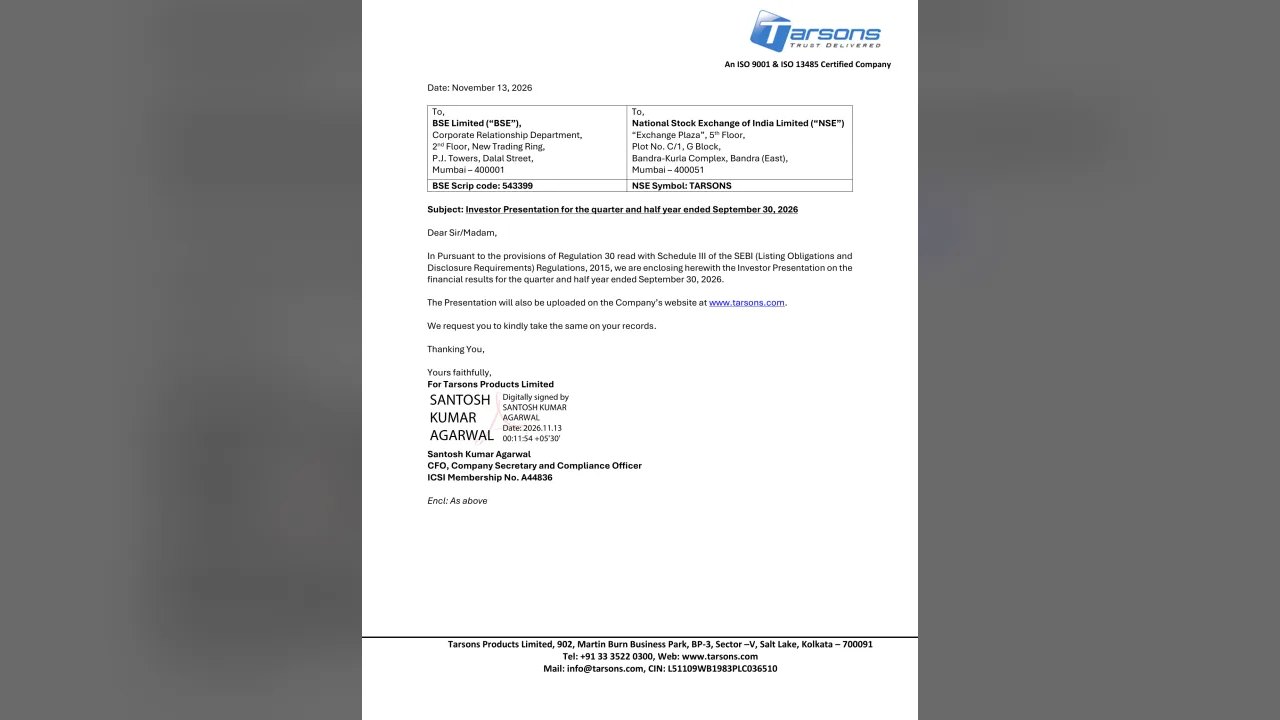
0:57 Good afternoon, everybody, and a warm welcome to the Q2 and H1 FY 'twenty seven earnings call of Tarsons Products Limited. I'm joined today by our CFO, Mr. Santosh Agarwal and SGA, our Investor Relations Partner. We have uploaded our investor presentation on our website and stock exchanges. I hope everybody had the opportunity to go through the same. We are pleased to deliver another quarter of strong performance where our standalone revenue grew by 25% and consolidated revenue grew by 21% in Q2 FY 'twenty seven on a Y o Y basis. This marks our second consecutive quarter of over 20% revenue growth, reflecting the resilience of our business model, strong execution capabilities, diversified product portfolio and brand strength.
1:58 Importantly, growth was largely driven by our existing product portfolio with minimal contribution from new product categories. The uptick in inquiries, better customer engagement and improvement in the demand momentum across our end user industries, especially in pharma and healthcare industry gives us the confidence that demand trajectory has the potential to sustain. Along with uptick in our existing portfolio with the addition of new products, we are optimistic of delivering similar performance for FY twenty twenty seven. On the profitability front, ongoing geopolitical tensions and global uncertainties have triggered sharp volatility in crude oil and crude linked commodities.
2:51 Since the onset of the West Asia conflict in March 2026, crude linked raw material prices have surged between 3050%, putting considerable pressure on our gross margins. While the situation remains dynamic and difficult to predict, we have implemented calibrated price increases wherever feasible to offset higher input costs while protecting customer relationships and maintaining competitiveness.
3:28 Despite significant gross margin pressure from elevated input costs, the impact at the EBITDA level was largely mitigated with increase in volumes resulting in operating leverage. Additionally, costs relating to our new established facilities are already reflected in our P and L. The revenue contribution is yet to ramp up meaningfully. As these facilities scale up and utilization improves, we expect higher revenues and operating leverage to support improvement in operating margins.
4:11 Despite these external challenges, we have remained focused on what is within our control. Our strong operational discipline, agility and proactive approach have enabled us to navigate the evolving environment effectively. We have maintained a sharp focus on supply chain management to ensure the timely availability of raw material while simultaneously maintaining uninterrupted supplies and timely deliveries to our customers. This has been particularly important in an environment characterized by fluctuating prices and supply side uncertainties. On the CapEx front, Tarsons undertook one of its largest ever CapEx programs to support its long term growth, focusing on expanding manufacturing capacities, diversifying its product portfolio and entering new product categories.
5:09 We are in the final phase of this expansion with most planned capacities commissioned and operational. Select existing product lines have commenced operations at the new Parshala facility, while the radiation line, warehousing space and the expanded manufacturing capacities at Armed are fully operational.
5:30 Commissioning of the cell culture lines at Parsla is expected in the second half of the year. As the creation largely behind us, our focus now shifting towards improving utilization, securing customer validation and driving commercialization. As the product ramps up and customer validations and adoptions of newer products gather momentum, we expect these investments to translate into meaningful revenue growth over the next two to three years, with benefits becoming increasingly visible from FY 'twenty eight onwards. Higher capacity utilization and improved fixed cost absorption should drive operating leverage, supporting better margins, profitability and return on invested capital.
6:23 This expansion goes beyond capacity addition. It is about building a stronger, more scalable and diversified business. With a wider product portfolio, enhanced manufacturing capabilities and established brand equity, Tarsons is well positioned to deepen its presence across the domestic and overseas market and capitalize on emerging opportunities in the life science industry. Our international business, we are expanding our global presence, remains a significant priority with significant headroom to scale our overseas business. Our standalone export business has witnessed a strong recovery, growing 37% this quarter and 33% in H1.
7:15 Our sustained participation in international trade fairs and exhibitions, coupled with showcasing our comprehensive product portfolio, catering to the life science industry has enhanced Tarsons global visibility, strengthening our position and expanding our customer reach. This has also resulted in a significant uptick in customer inquiries while improving traction, translating into stronger order conversions. To conclude, we strongly believe that Tarsons is at the cusp of an extremely exciting phase in its growth journey. The groundwork has been laid through investments in capacities, capabilities and new product categories. As these investments mature and translate into higher volumes, we will see significant headroom for growth alongside an opportunity to improve operating efficiencies and profitability.
8:15 While the near term uncertainties may persist, our confidence in the long term prospects of the business remains strong. We believe we are well positioned to capitalize on the growth opportunities ahead and create sustainable long term value for all our stakeholders. With this, I will hand over the call to Santosh to take you through the financial performance. Thank you, and over to you. Thank you, RNG. Good afternoon, everyone. I will take you through the financial highlights for the quarter and half year ended 09/30/2026.
8:55 We are pleased to announce that Tarsons has delivered highest ever quarterly and highest ever half yearly revenue during this period. Speaking about the revenue, standalone revenue grew by 25% in Q2 FY 'twenty seven and twenty three percent in H1 FY 'twenty seven on a Y o Y basis. Notably, Q2 standalone revenue crossed the 100% mark for the first time in the Tarsons history. Consolidated H1 FY 'twenty seven revenue stood at $2.33.9 crore, registering a growth of 21% Y o Y.
9:33 Within the stand alone business, domestic revenue grew by 19%, while export revenue recorded a strong growth of 37% in Q2 FY 'twenty seven on a Y o Y basis. Narnesh continued its growth trajectory with revenue increasing by 7% in Q2 FY 'twenty seven and thirteen percent in H1 FY 'twenty seven on a Y o Y basis.
10:00 About margins, on a stand alone basis, gross profit for Q2 FY 'twenty seven stood at INR 67.4 crore compared to INR 58.6 crore in Q2 FY 'twenty six, registering a growth of 13% volume by. H1 gross profit grew by 14.4%. Gross margin moderation was primarily attributable to the increase in raw material prices. At the consolidated level, gross profit grew by 14.2% in Q2 FY 'twenty seven and fourteen point seven percent in H1 FY 'twenty seven on a Y o Y basis. This impact was largely offset by healthy volume growth, operating leverage and operational increase. Standardized EBITDA for Q2 FY 'twenty seven stood at 30.6 crores, growing 15.9% Y o Y, while H1 FY 'twenty seven EBITDA growth stood at 13.1%.
10:56 It is important to highlight that operating expenses of our newly commissioned facility are already reflected in the P and L, while meaningful revenue contributions are yet to materialize, providing headroom for margin expansion as these facilities ramped up.
11:13 Consolidated EBITDA stood at 31.1 crore in Q2 FY 'twenty seven, registering a growth of 13.3 Y o Y. As highlighted earlier, PAT continues to be impacted by accelerated depreciation and interest cost associated with the new facilities. We expect the gradual ramp up of these facilities over the coming year to increasingly offset this impact on support profitability growth. Despite the muted fact, we continue to generate steady cash flow. Our stand alone operating cash flow increased from INR 40 crore in H1 FY 'twenty six to INR 49 crore in H1 FY 'twenty seven, while consolidated operating cash flow improved from INR 44 crore to INR 53 crore in H1 FY twenty seven.
11:59 Cash PAT has grown by around 13% on consolidated as well as tangible basis in H1 FY twenty seven. This demonstrates the underlying cash generating strength and resilience of the business. With that, I would like to open the floor for questions. Thank you very much. We will now begin the question and answer session.
12:35 Ladies and gentlemen, we will wait for a moment while the question queue assembles. The first question comes from the line of Aditya from Securities Investment Management. Please go ahead. Yeah. Hi, sir. Thanks for the opportunity. My first question is on our gross margins. So we have done well to stabilize around 67%. But now that crude prices seeing some correction, should one see his gross margin now slowly expanding to 70%, 71% which we used to do here?
13:27 So, yes, I think as the crude pricing correcting is one thing, but the raw material prices eventually settling down to the pre West Asia prices levels would be key. So at this point in time, we still see raw material prices anywhere between 25% to 35% higher than original levels. As they settle back, we will see our margins go back to original levels of early 70s. Got it. But have you seen some correction from Q2 levels?
14:02 No, we have not. We had seen certain corrections towards the end of Q1, but then there was the last month, month and a half, we have seen further spikes. So overall, whatever small corrections we have seen has been overdone by the spikes. Got it. Got it. Sir, secondly, on exports, now this is a, you know, second consecutive quarter of 50% plus growth for us. So if you could just help us understand, you know, what is leading to such a strong growth? Is it that our customers are sitting at lower inventory levels and now they are starting restocking or, you know, we have badged some bigger export contracts, sir, which we are planning earlier?
14:49 So we've... You know, I I... We can't speak specifically on existing contracts or customers in detail. But yes, we are growing our wallet share with certain key customers globally. Inventory levels have also lowered and customers are restocking in bigger levels. But also, I think the timing, I've spoken about this in earlier calls as well. The West Asia crisis is such that container availability and transportation has become a big issue in the last five to six months. And getting availability of containers to ship both to Europe and U. S. Is a large concern, very big concern. So sometimes
15:36 we have a lot of pending shipments and a lot of shipments move in a certain period of time when you get container availability. At this point in time, as a company, we have never seen this before where we have multiple containers waiting in the inventory, waiting in our warehouse where the customer has paid the money or where the customer has already transacted for their business, but there is no availability of containers. So now sir, then how should we understand the sustainability of this growth? So is it more to do with logistical issues and you are getting some benefit for one or two quarters or you believe this kind of growth rate you will be able to sustain for the rest for the coming quarters as well, please?
16:24 I'm not sure whether we can sustain this in the long term, late 30s, because 3735, '37 growth moving forward quarter over quarter is quite an uphill task. But we do have a lot of new projects coming in, a lot of new products, and we are in active discussions with a lot of new customers, both in Europe, U. S.
16:48 We are in a lot of discussion with our subsidiary company in Germany to be able to ramp up production and sale to them as well. So we expect a very strong and healthy growth, but may not be as high as 35% to 37%. Got it. Got it. Yes. Generally, what would be the contract sizes for some of these contracts? So is it that the scaling up of, you know, three, four contracts only would help us sustain strong double digit kind of growth rates? Or these are more smaller contracts where we have to keep on lagging newer and newer contracts to sustain our growth rates? So how does it While work
17:33 it's not always in our hands, the size of the contracts, but generally the contract sizes are do not exceed more than 1,000,000 to $1,500,000 We consciously try and ensure that
17:49 a large portion of our business is not coming from one or two isolated customers because that puts a risk of replaceability once the contract is lost or transferred to some other suppliers. So we try and balance out our international business to the best of our ability, where certain customers are not no customers are counting for more than 15% or 20% of the total business.
18:15 Understood. And for this newer inquiries which we are getting, is it primarily for our existing products or we have started buying contracts for our bioprocess products as well? And secondly, on the geographical side as well, so we were pretty strong in U. S. Are we now seeing stronger inquiries from Europe and other parts or other rest of the world as well? So we are trying to build teams to be able to look into geographies and areas where Tarsons is not very strong. I believe that Tarsons is reasonably strong in certain countries in Europe, certain countries in Asia and The United States. But we have a long runway of growth even in these countries where we are strong because the global market is very large as well as in countries like Latin America, Middle East and Africa where we are relatively weak as a company and most of our competitors do a much better job than what we do.
19:11 So international business would have a multi strategy. We've tried to focus on areas where we are not strong. We try to build on our stronger areas by getting even stronger, push a lot with our subsidiary company, Minobe, as well as on the Tarsons business go to prong, right, which is OEM as well as the branded Tarsons business. So it's not one straight way of doing international business, different geographies, different strategies. So a lot to do in the international business, and I think that's where our biggest growth will come from moving forward. So my question was the new inquiries which you are getting, is it primarily from our existing products and our existing geographies only, or we have been able to crack some new product? Yeah.
19:58 Between between new and existing products, but all from existing geographies. Got it. Got it. Understood. So secondly, you know, in the domestic markets also, is the end market which is seeing some strong growth, or there is global competition intensity from some of the smaller and and organics players, you know, which is helping us post stronger growth in domestic markets as well? The market scenario is very, very tough domestically. The competition is there and the price input costs are at an all time high. So it becomes difficult for all the players, including us, to be able to sustain margins and move forward.
20:44 Having said that, I think from the private sector, which is the CRO, the CDMO and pharma, biopharma space, I think the private customer base, which is related to life science and vaccine production, I think the demand is quite strong. The demand from the government and the semi government side, which is a research institute still I think is yet to recover and pick up, but the private sector continues to grow at a very strong pace for us as a biosupplier. Got it. Got it. And sir, this cell culture facility, we were expected to commission second half. So where are we on that? Is it going to be commissioned in Q3, Q4?
21:38 We've actually commissioned quite a few products of cell culture already, but the market still prefers a company to be able to provide the complete solution, which is all the 100 plus SKUs together, what we will plan to launch. So more than 50% of the products have been successfully launched, internally tried, tested in terms of quality, packaging and other things. So over the next few months, I think we should be able to complete the remaining SKUs. Got it. Got it. So, but is this... Why is this taking so much time? Because we... This is getting delayed quarter by quarter because this was supposed to commission sometime back.
22:29 But, again, with your commentary, believe now it's going to get commissioned in q four. So can you help us on what is leading to such a delay in commissioning this CapEx? Stabilizing of multiple SKUs. Okay. Okay. Next, sir, the question was for. So this... We have a different government grant of, you know, in our balance sheet. And in our p and l, we recognize government grant income of, you know, 8 to 9 crores. So how long will this continue for us? This is basically related to EPCG license, right? And at the time of import of any kind of machines and mold, we take the EPCG license, and this is the India's treatment of Euro APTG license in the group rating of government grant.
23:33 Okay. So this 9 crores of revenue which we had recognized last year, this would end next year or by FY 'twenty nine? So this will depend on what kind of CapEx we are doing. So larger the CapEx we are importing, the larger will be the revenue in the P and L side. The lower the CapEx we do, the lower will be the EPCG on the income side. But of course, the EPCG related to those will keep on happening on the debit side in the P Okay. Understood. And last question from my side. Sir, if you could just remind us what kind of revenue potential is possible for facilities?
24:19 And what kind of revenue potential is possible from our newer facilities? And if you could just bifurcate between cell culture, bioprocess, and our older products, that would be helpful. We've not... We don't generally declare revenues based on product groups, but older facilities 400 crores and newer facilities 400 crores with a revenue potential of close to 800 crores. So, sir, I'll thanks for answering questions. I'll come back in the queue. You. The next question comes from the line of Jasdeep Walia from Clockwind Capital. Please go ahead.
25:06 Hi, sir. Thanks for taking my question. So my question is with regard to the cell culture products used in bioproduction. So you commissioned some of the products used in this domain in, let's say, the last quarter. So has any marquee customer approved your products for bioproduction? By marquee, I mean, large pharma companies like Biocon or Poonawala or Bharat Biotech, etcetera? The approval process is still underway? No, none of the customers have we've not got any formal update from any customer. But even if we do, we don't announce that to any of the investors or the market.
25:53 Got it, sir. Sir, the growth in Narbe has been subdued in this quarter despite the industry environment improving significantly. So what is the problem in that business? And when do we see Nerve start growing in constant currency terms? The market trend Nerve is still a strong German focused market and there are a lot of concerns at this point in time in the economy in Western Europe. Most of our growth, what you see is not coming out of Germany as a company at Tarsons. And at this point in time, I think Norway is doing exceptionally well to sustain itself. The way it has sustained itself over the last two to three years in a very depressed and very tough economic situation in Germany.
26:43 And we continue to invest our resources into Nerve and ensure that over the next few quarters, a lot of the business purchase of Nerve would come out of Tarsons. But the overall top line scaling up of Nerve would only depend on how the situation in Germany improves or if Nerve scales beyond Germany. Got it, sir. So there are no growth targets for Nerve in this year? There are targets. Again, as we've just as for the Tarsons standalone business, we do not announce any kind of a forecast or a target for the company for each financial year to the market. So internally, our sales teams and our execution teams, we have targets and we will see how that pans out in December 31, is the financial year end for Novi and March 31, which is our financial year end.
27:46 Got it, sir. And sir, the margins at Nerve also appear to be lower subdued versus last couple of quarters. So what's the reason behind that? Jaspir, I think you're talking about the EBITDA margin, right? Yes. EBITDA margin is lower because of some new employee hiring and the inflation cost already there in the P and L. The corresponding revenue, if increase in the coming quarter, then that will be operating leverage. Got it. So do you expect to maintain EBITDA margins at Nerve for this year or because of cost inflation, the margins will go down below what the normalized levels of 10% around 10 odd percent, which was there earlier?
28:44 Margins will be lower right now, Vivek, on the EBIT level, but we will be able to maintain and grow the gross margins, the material margins, right, Navi. And what about the EBITDA level, would you be able to maintain margins at the EBITDA level? So EBITDA and EBITDA both you will not be able to because there's not much of a difference in Norway in the EBIT and the EBITDA levels. Our selling prices at Germany have remained constant, and we've been able to secure in increased prices as well in Germany. So from a product level from a selling level, we are at a strong base. But Tarsons is working on certain strategies for the future for Nerve to be able to scale Nerve up to significantly different level over the next three to five years, and that involves certain in the operations of the new people hiring in the sales team and beyond Germany hiring. So that's adding to additional employee benefit expenses, traveling expenses and so on and hence the EBITDA levels are subdued.
29:46 Got it, sir. And sir, when do supply start from Tarsons India operations to Naveen? It's already started, but we will see significant ramp up over the next quarters. In this year, by the end of this year, we will see a ramp up and by next year, we will see a significant ramp up. Got it, sir. Sir, considering that in the second half, you'll start launching commercially your self help products, should we expect further acceleration of sales growth rate in the stand alone business in the second half versus the first We should expect similar growth rates to what we have achieved in H1 to in H2 because the pricing also, we are not very sure why the pricing would land because the raw material costs are very volatile.
30:39 At this point in time, we have had certain price increases in the market over H1. We do not know whether that price increases will remain constant in H2 go further up or come down. Got it, Got it. Thanks a lot, sir. That's all from my side. Thank you. The next question comes from the line of Ruchul from Pinc Wealth. Please go ahead. Hello. Yes, sir. Hi. So my question is that since we have seen the increase in the inflation in the raw material prices and understand that there's a competition in the domestic market, But don't you think that if this inflation continues then there will be a price hike or at the industry wide are also we need to also take a price hike?
31:29 See the thing is price hikes are very, very nominal in nature in the industry and not correlated to the actual input cost increase in the company because what's happening is from a company point of view both for us as well as our competitors both in India as well as internationally. The competition is as brutal internationally as it is in India. It's not just limited to the raw material, is packaging material and there are lot of other input costs which are increasing. But unfortunately, the nature of the industry and the comparative intensity of the industry doesn't allow most of us to be able to pass on the entire input cost increase to the customer because then we lose comparative intensity and open the way up for a lot of competitors to propose their product lines and enter into accounts, which we've built and maintained over years. So higher inflationary increases on the raw material, higher costs of the raw material are always unfavorable to the company.
32:38 And sir, like have we seen that increase in competition over the last three to four years that earlier we used to make like good margins like around 40, then 35 EBITDA level I'm asking. And now we are being currently to 25, 26 and do understand that 300 bit, 400 bit might be due to unable to pass on the price due to increase in the input cost. But do you think that the competition has increased significantly and that is what has hampered our margins, if I have to look like three to four years view? Right. I would look at the competition perspective from the material margin, not from the EBITDA margin because the EBITDA margin has nothing to do with the external competition, it's to do with internal cost structures of the company.
33:26 Material margin, ten years ago, we were around late 60s, then we expanded close to late 70s in COVID. And then at this point in time, we are in early 70s till last year. Now because of West Asia crisis, we are back to the late 60s, which we were originally as a company ten years ago in 2017 or 2018. So we've circled between 6879%, 78%, 79% material margin over the last decade depending on the situation and depending on the crisis like what we have today. So as a company, our price realization has been robust through the last ten years and better predictor or indicator of what the competitive intensity and how we are positioned in competition in the market.
34:20 EBITDA levels are because the company structurally has changed drastically over the last three, four years. We never imagined that we would have such large overhead costs without having revenue and have the potential to be able to sustain that. I believe that there is a huge significant revenue potential, which could be realized without increasing costs very, very significantly costs, which have already been ingrained into the system. So hence, I'm not too bothered about the lower EBITDA margins. It's the cost of being for us to scale up over the next two to three years. I'm more concerned about the material margin. And sir, how do we see the demand going forward? And like since we have entered into a new cell culture and then we have been doing that continuously following, then what gives you confidence that we'll do very well over the next two to three years again? And how is the demand environment?
35:18 We were if I didn't have the confidence of doing very well, I would have not put in so much money as a promoter in the company. There were a lot of other avenues to use that money rather than put it into these facilities and these product lines. So there's a tremendous belief that there's a large market for these consumables and being the first indigenous player in India, I think we stand to gain a lot from our brand equity as well as first mover advantage in India. And
35:44 having built very strong sustainable relationships internationally, I think we'll use these large facilities and capacities to our advantage. Demand environment, I believe as our facilities are coming to life, I think we are at a very strong inflection point in the industry where we've gone through three or four years of the weak demand post COVID. And I think that the industry is about to flip and demand is about to get back to stronger levels. And we are right in the right time with these facilities to be able to take advantage of the recovery in demand in the industry in India as well as internationally.
36:30 So, sir, basically we can say that at the right time our facility has got an operational since we have seen the same attraction and the demand?
36:38 I would say, Bhavan, of course, we had facility delays. These facilities were supposed to be up and ready a year ago and there's been delays. Delay is always expensive for the company operationally and as well as in terms of costs. So, it's not ideal if you had done this twelve months or fourteen months earlier, it would have been better for the company financially. But having done this, having completing these facility readiness now is going to place us in a very strong position for the future over the next three to four years. Got it, sir. Thank you, sir, for answering our question. Thanks. Thank you. The next question comes from the line of Madhu Agarwal from Agarwal Family Office. Please go ahead.
37:24 Hi. So one thing I'm trying to understand is 60% of the business comes from consumables. Is there any way in which we track whether the same customer is offering a larger total volume of these consumables on a quarterly or an annual basis? I'm not sure. I didn't understand your question very well. If you could repeat it, please. So I'm thinking about the part of the revenue, 60% orders coming in from products which are consumed, which means they'll be repeatedly ordered by the customer. And do we track whether the same customer, if they ordered 1,000 units last year,
38:04 is perhaps ordering 1,200 units or 1,500 units in subsequent years? Like, are we tracking whether the same customer is ordering larger volume of the products, which should be consumed frequently and therefore are repeat orders for the same product. Am I clear in my question?
38:29 Yes. I think consumer is the heart of our business. So it's tracked very, very closely, both at the end customer and the distributor level because that's what defines the growth of the business. The reusable and the benchtop equipments continue to be a support system in the business, which are very important revenue drivers. But it's the consumables which define the growth trajectory and also the pulse of the market. So it's tracked very, very closely. And would you be comfortable sharing what the numbers are telling us in terms of exactly that, right, growth trajectory? And in the market, are we seeing that there is generally more structural demand in the market perhaps with the same customers ordering more volume?
39:14 So if you see all I can tell you is if you see our quarter over quarter growth or if you see our annualized growth from Q2 of this year versus Q2 of last year, If our growth is a particular number, it's 20%, 21%, consumables always leads the way. It will always match or exceed that growth levels with the reusables and benchtop being slightly lower. Okay, lovely. So we can sort of take that as a proxy for demand uplift in the market? So it would be slightly higher only because the reusables would not grow at that level, so then the growth will be balanced out, yes. Understood. And my only other question is, would you be comfortable sharing what's our margin profile for exports versus the domestic business?
39:58 I I wouldn't know that at the back of my head, to be honest, but should be very similar on a material margin level. But we don't have any metrics at this point in time to track on an EBITDA level. Understood. Okay. Thank you. Thanks. Thank you. The next question comes from the line of Rajeev Shah from Ascent Capital. Please go ahead. Yes. A couple of questions. Sir, despite the sharp rise in raw material prices, working capital has been well managed. So we would normally expect inventory to go up in this kind of volatile environment. So are you deliberately buying only as much as raw material you need right now? And how is material availability at present? And do you see any risk of losing business because supply is short?
40:48 We are placing the orders on the basis of order forecast from our customers. That's number one. And number two is that because of this global crisis, we also give advance ordering also. So that because
41:03 of the delay in the transit time, we should not face any kind of issue. Currently, if you talk about our inventory, we are maintaining around the middle of about INR 47 crores to INR 48 crores. And we are maintaining a minimum inventory of about INR 45 crores. So overall, our inventory days are in the range of one hundred to one hundred five days and data are about to be eighty two days. So overall working capital cycle is at INR one hundred seventy one days.
41:30 Okay. Also, another question is how do you see gross borrowing moving in the next one to two years? I mean, there any CapEx planned or one should expect the debt to come down?
41:42 Can you repeat your question, please, Yes. How do you see gross borrowing moving in the next one to two years? Is there any CapEx planned or one should expect the debt to come down?
41:55 See, currently, our total debt is about to be $3.70 crores to INR $3.80 crores, right? And we believe that the depth should be in the range of INR $3.70 crores to INR $3.90 crores. And we believe that going forward, we will be we are going to do not more than INR 30 crores to 40 crores of CapEx that includes some commercial CapEx and some maintenance CapEx.
42:20 Okay. Okay. Thank you. Thank you, sir. That will be all from my side. You. The next question comes from the line of Devjit from Frontier Capital. Please go ahead. Sir, it has been another good quarter in terms of growth. You have mentioned that demand has been picking up well. However, at the same time, there are uncertainties due to geopolitical situations in Europe and USA.
42:46 Firstly, how much of the growth in Q2 or even H1 has been driven by volumes? And structurally now, I wanted to get your thoughts on the whole operating environment. Do you feel post COVID slowdown is now behind us and are and we are headed for a sustained period of, say, to high teens kind of growth for the next two to three years at least?
43:09 And is the double digit kind of volume growth realistic in your view? Yes. I think the post COVID demand slump, I believe, is behind us. And I think we are poised for strong growth over the next two to three years. I wouldn't be able to put a number on whether it would be high teens, low teens, double digits or not, but I think that will be very, very strong and sustainable growth moving forward over the next two to three years at least.
43:42 And sir, with the back to back quarter of good growth, is that the Tarsons has gained market share or the entire industry has grown at a similar rate?
43:50 I won't know exactly on a quarter by quarter basis whether the industry is growing at these levels, but I believe it's more like an more of an industry phenomenon. We could be slightly better than the industry. But I think the entire industry should have grown. Most of our competitors are private in nature and getting a real feel of the numbers is only on an annualized basis.
44:13 But I personally believe that the industry has benefited. And Tarsons maybe a slightly better beneficiary than their competitors, but I believe our competitors would have also grown. Thank you. The next question comes from the line of Saket Saurabh from Sagri Capital. Please go ahead. Hey, am I audible? Yes. Yeah. So, pertaining to the deck that you have shared, so you have talked about the end user industries, right? Academic institutions, pharma, then CROs and then diagnostic industry. So, these seem to be the, again, the domestic side of the equation. So how does the revenue breakup typically look like for these four segments? Just a broad one.
45:01 I think the private sector, which is pharma, biopharma and CRO, CDMOs would be about 60 odd percent of the industry and diagnostics and healthcare and the rest would be about 20% and then the government business would be about 15% to 20%. Okay. And sir, within Diagnostic Industries, while we see most of the chains being here, so do we also cater to say non chains of a standalone diagnostic centers or the larger than the national chains or say the regional chains would account for the bulk of our purchases?
45:43 Cater to all kinds of healthcare and diagnostic customers which find value in the products what we offer. Diagnostics is a very, very cost competitive business and lot of times smaller diagnostic chains would look at unorganized players or lower cost alternatives. Okay. And sir, as far as our use case for our products would be especially for the labware products, so these would primarily be used at, say, centers that have, say lab testing facilities or even collect centers would have used cases for our offerings? Mostly by products where
46:31 blood is collected and then tested to be able to diagnose whether the patient has got the particular problem or not. I think that's where the majority of the product would be used. Okay. And sir, keeping in view the new products that we are launching in the cell culture space. So how based on your market distribution that you might have done outside the go to market part, so
46:57 how will the say, target segment would be like? Is it... Would it be same 60, 20, 20, like, percent biopharma and pharma and 20% diagnostic, 21 research, or it would be tad different for, say, the cell culture offerings?
47:16 It will be similar. Research would play probably a good role in that because cell culture is also worth a lot of production as well as research. So maybe not so much in the diagnostic and the healthcare segment, but a lot in the private as well as the government research segment. Okay. And sir, gross margin for these new offerings would be at par or I'm talking about stable state, I understand that currently again these are maybe par. At par. At par or
47:46 and do we also intend to say target the exports market for these cell culture products as well?
47:54 No, we need to. If we need to be able to sell to capacity, we need the international overseas business to play a large contribution to this revenue. Okay. And I think maybe if I heard you correctly, you talked about INR400 crore revenue potential. So is it from the new segment or new plus underutilized existing segment combined, the INR400 crore number that we use? At
48:21 current CapEx levels and at current levels of the company, we expect to be able to generate INR800 crores of revenue. Okay. INR800 incremental or both? A company, as a company So whatever we've done, not over and above INR800 crores over this, total as a company INR800 crores on a standalone basis, not on a consolidated basis. Okay. And when you talk about consultant only that German entity would be over and above that or so standalone include only the domestic sales or exports also included because that's almost one third now?
49:00 It includes Tarsons standalone. Okay. Okay. Okay. Thanks for the opportunity and best of luck for the coming quarters. Thank you. Thank you. The next question comes from the line of Ghansham Mina from Moonshot Ventures.
49:20 Is it audible?
49:23 It is. So I have a couple of questions. First question is regarding the impact of impeding cost of raw materials because when I see the inventory days are very high in our business because we have to get the huge amount of inventory because of the number of SKUs, etcetera. But when we see on the cost of goods basis,
49:54 think we have the inventory for around nine months or almost one year if we compare on the gross... On the raw material side only.
50:07 The increase in raw material, which is increased in last two quarters. So how much of the raw material we secured in the last one quarter or two quarters? Because of that, our gross margins are impacted around 500 basis points.
50:24 We are purchasing about to be 80,000,000 to 94,000,000 raw material in India, right?
50:29 And regarding your question on inventory days, you are calculating the inventory days on the raw material consumption. But in our kind of let's say, we have the gross margin are quite high. We should calculate the inventory days on the sales. That is coming about to one hundred four days. One hundred and four days? Yes. If we buy around 80,000,090 million in a year, so how much of the raw material was recorded in the last two quarters? Only if we see in the last quarter, because in the last quarter, gross margins are impacted by around 500 basis points. We don't have the number quarter wise, but on a yearly basis, what we can say that INR 80 crores to INR 90 crores is our material getting prices. The raw material margin has been impacted based on the purchase cost.
51:23 Okay. My next question is regarding the we have done recently a huge amount of CapEx. And in the near future, where we are will be get benefit on the consumable side or reusable side? Both. On both. Equally or we'll wait some different proportion? No. The issue should remain similar. Okay. Okay. Which is doing currently?
51:52 Okay. Okay. Okay. Thanks. That's all from my side. Thank you. The next follow-up question is from the line of Aditya from Securities Investment Management. Please go ahead. Yeah. Thanks for the follow-up. Sir, in export markets, so does increased government funding of research institutes or, you know, or increase the biotech funding help in demand growth? On the end user, you know, demand is pretty diversified, and one or two factors does not impact demand. So where I was coming from was that are there any positive factors playing out in the export markets currently, which is also helping us post strong growth?
52:35 No. I have not heard of any increased government funding in any of the countries in the last six to twelve months. In fact, I've heard of a lot of reduced biotech and government funding in The U. S. Over the last twelve months. Understood. And in spite of that, the industry is seeing such strong growth?
53:01 See, the thing is for us in the international business, growing at these levels does not pose much of a problem because of our very, very low market share compared to the entire industry size. That doesn't work in India because in India being a major player, any small movement in the industry starts affecting us. Got it. Understood, sir. And lastly, any benefit which we are expected to get from commercialization of ANTA sterilization facility, or this would happen post the commissioning of cell culture facility only?
53:42 Benefit in terms of we have cost benefits because we have our own sterilization facility. And that's about it. I think as we scale up our facilities, a lot of these fixed costs come into play and then the fixed costs remain the same, revenues grow and then our EBITDA margin start getting better and better. Yeah. So when I was coming, what... Have you started realizing benefits from this sterilization facility?
54:13 Yes. Yes. Facility has been running well for the last one year. Got it. And what kind of margin benefit does it give us? We can't disclose that because, again, we don't disclose that to the market, but it's for outsourcing to in house. So would at least be a cost saving of about 20% to 25% from our sterilization cost last year. Okay. Got you, sir. Thank you. But of course, you have to see it like for like because the volume of sterilization has also drastically grown from last year to this year. Hello?
55:05 Sir, I'm done with the question. Thank you. Yeah. Thank you. Ladies and gentlemen, we will take this as the last question for today. I now hand over to the management for closing comments. Over to you, sir. Thank you, everyone, for taking the time to join us today. I hope we have been able to address your questions and provide necessary insights into our business and performance. We remain committed to maintaining regular and transparent communication with the investor community and will continue to keep you updated on our key developments and progress. Should you require any further information or have additional queries regarding Tarsons, please feel free to reach out to us or our Investor Relations partner, SGA.
55:55 Once again, thank you for your time, continued interest and support. Thank you. On behalf of Tarsons Products Limited, that concludes this conference. Thank you for joining us, and you may now disconnect your lines.
Follow Tarsons Products Limited into a list and get an email when it puts out news.
promoter and Hold Time Director at Tarsons Products Limited
CFO
at Clockwind Capital
at Agarwal Family Office
at Ascent Capital
at Sagri Capital
at Moonshot Ventures