Vidhi Wasa
at MUFG Endyme
Replay available
Stove Kraft (NSE:STOVEKRAFT) Q2 2027 earnings call, held 2026-11-05. Watch the replay and read the transcript on 6ix.
On 6ix: 6ix.com/event/stove-kraft-limited-stovekraft-q2-2027-earnings-call
Automated transcript · Written by software from the replay's audio. It can mishear names and figures; the replay is the record.
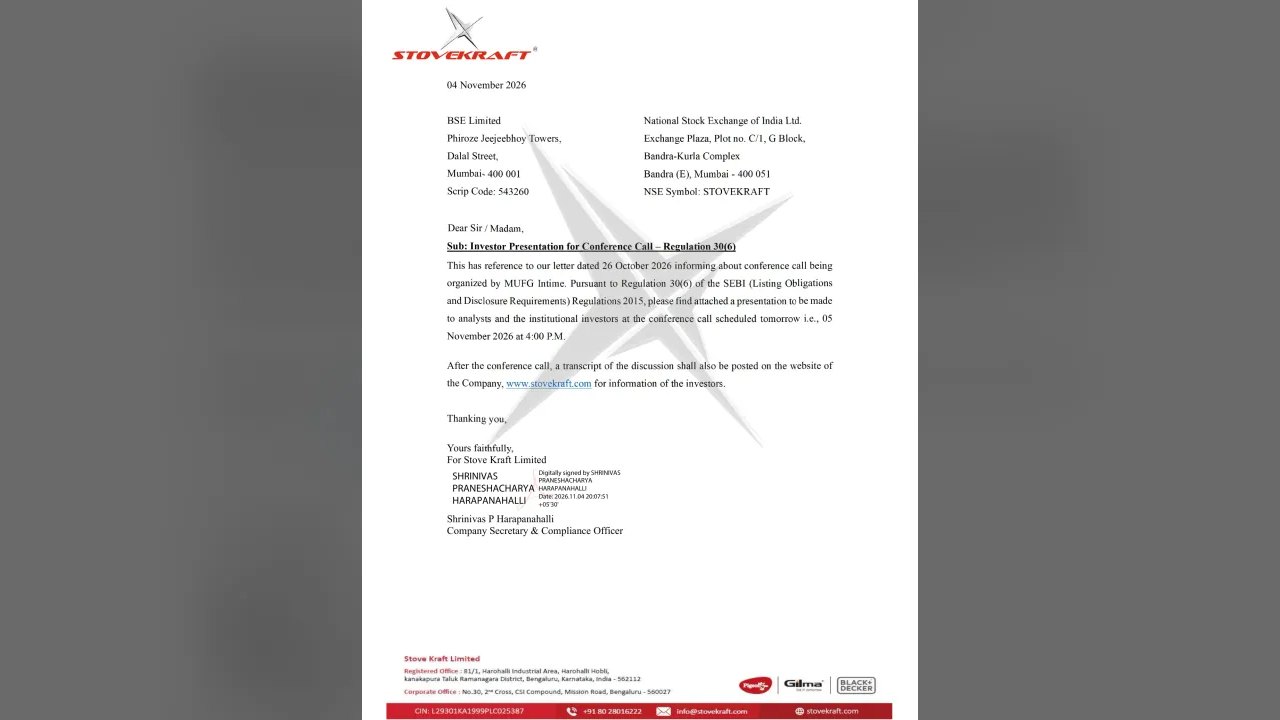
0:00 Ladies and gentlemen, good day, and welcome to STOVEKRAFT Limited Q2 and H1 FY 'twenty seven Earnings Conference Call. As a reminder, all participant lines will be in the listen only mode, and there will be an opportunity for you to ask questions after the presentation concludes. Please note that this conference is being recorded. I now hand the conference over to miss Vidhi Wasa from MUFG Endyme. Thank you, and over to you. Thank you, Anam. On behalf of MUFG Endyme, I welcome you all to STOVEKRAFT Limited q two and h one FY twenty seven earnings conference call.
0:45 Today on this call, we have mister Rajinder Gandhi, sir, managing director mister Subhadeep Pal, sir, chief financial officer mister Chandra Kalru, sir, vice chairperson and mister Hemant Kumar Kothari, sir, vice president, investor relations. Before we begin the call, I would like to give a short disclaimer. This call may contain some of the forward looking statements, which are completely based upon our belief, opinion, and expectations as of today. These statements are not a guarantee of our future performance and and involve unforeseen risks and uncertainties. And with this, I would like to hand over the call to Gandhi, sir. Over to you, sir. Thank you. Good afternoon. Good afternoon, everyone. On behalf of STOVEKRAFT Limited, I extend a warm welcome to all participants to the Q2 and H1 FY 'twenty seven financial results earnings call.
1:40 We also have MEFG in time with us on this call, who are our advisors on Investor Relations. Along with me is industry veteran Sandro Kalro, Vice Chairman Mr. Sudhadeep Pao, CFO and Hemant Kothani, Vice President, Investor Relations. We have uploaded our investor deck and earnings press release on the stock exchanges and on the company's website. I hope everybody had an opportunity to go through them. We are pleased to report a robust overall performance in Q2 FY twenty twenty seven despite persistent inflationary pressures and raw material cost volatility.
2:26 Our strong back end manufacturing capabilities supported by operational efficiencies and cost optimization initiatives have enabled us to deliver healthy revenue growth of 23.5% year on year. We have improved our EBITDA margins to 12.9%, which is our highest ever EBITDA margin, improved by 90 basis points and achieved PAT growth of 35.7% with FAT margin at 5%. This performance underscores the strength of our integrated manufacturing model and our continued focus on profitable growth and strengthening our market position. Discussing about our product wise performance, the Induction Cooktop category witnessed robust growth of 108% year on year.
3:17 The Pressure Cookware category witnessed growth of 46.8% year on year supported by healthy underlying demand trends and our ability to capitalize on emerging market opportunities following geopolitical disruptions. Our strong manufacturing capability enabled us to respond swiftly to increase demand and strengthen our position in this category. Further small appliances grew by 9.1% year on year. Overall, our diversified product portfolio manufacturing agility and expanding distribution network continuing to support our growth momentum across key categories. Product innovation continues to remain a key focus area as we expand our portfolio to address evolving consumer preferences.
4:02 During the quarter, we introduced several new products under the pigeon brand, including the portable blenders, new models of air fryers and new models of mixer grinders, the immersion heating rod and toasters. These launches are aimed at strengthening our presence across kitchen appliances categories, enhancing consumer choice and supporting our long term growth ambitions. Kitchen continues to demonstrate strong growth momentum, delivering a CAGR of 21% over the past three years, supported by its strong positioning in the value segment and expanding distribution network, including both offline and online. During Q2 FY twenty seven, we added 16 new stores across nine cities, taking our Pigeon Total stores down to three sixty.
4:50 Alongside this, we have relaunched Gilmar, our premium brand in the Southern markets with 17 stores operational now. We believe this dual brand strategy combining Vision's value led growth with volume with Gilmar's premium positioning will further strengthen our market presence and support our next phase of growth. We believe premiumization will continue to be a significant growth lever for the company and play an important role in driving both revenue growth and margin expansion in the years ahead. Moving on to the channel wise sales. Our channel wise performance, e commerce and general trade continued to be key growth drivers. During Q2 FY twenty twenty seven, e commerce grew by 16%, while general trade recorded a of three year CAGR of 16.3% for H1 FY twenty twenty seven. General trade and e commerce registered healthy year on year growth of 52.224.2%, respectively.
5:52 Modern retail also demonstrated strong momentum, growing by 11.9% in Q2 and 27.3% in H1 FY twenty twenty seven. Our own retail channel continued to expand, registering growth of 70.3% in H1 FY twenty twenty seven. We remain focused on strengthening our omnichannel distribution network and expanding consumer reach to sustain long term growth. Now I will discuss the Q2 FY twenty twenty seven financial performance. The consolidated revenue for the quarter stood at approximately INR $5.85 crores, registering a growth of 23.2% year on year compared to INR $4.75 crores in Q2 FY twenty twenty six. This represents the company's highest ever second quarter revenue, reflecting strong business momentum and a healthy demand across our business segments.
6:42 Gross margin has improved from 38.5% in Q2 FY twenty twenty six to 39.6% in Q2 FY twenty twenty seven. That is improvement of 115 basis points. EBITDA for Q2 FY twenty twenty seven stood at crores versus INR56.8 crores in the same quarter last year, representing a growth of 32.7% year on year. The company also recorded a highest ever EBITDA margin for the current quarter, which stood at 12.9% versus 12% in Q2 FY twenty twenty six. Profit after tax Q2 FY twenty twenty seven stood at INR29 crores versus INR21.4 crores in Q2 FY twenty twenty six. The PAT margin for the current quarter stood at 5% versus 4.5% in Q2 FY twenty twenty six.
7:33 The growth in profitability ahead of revenue growth reflects the continued benefits of operating and financial leverage supported by improved operational efficiencies. Our focus continues to remain on strengthening profitability, improving cost efficiency and enhancing overall business performance. On the working capital front, we have made significant progress with net working capital days improving to thirty two days in Q3 FY twenty twenty seven compared to forty five days in Q1 FY twenty twenty seven, driven by better inventory utilization and strong seasonal demand. Our return ratios are also continuing to improve with ROCE and ROE standing at fifteen point six percent and ten point four percent in FY twenty twenty seven, respectively against 12.68.3% in FY twenty twenty six, reflecting improved capital efficiency and our continued focus on strengthening shareholder returns.
8:34 Now I will discuss financial performance of H1 FY twenty twenty seven. The consolidated revenue for H1 FY twenty twenty seven stood at INR $10.65 crores, registering a growth of 30.8% year on year compared to INR 814.5 crores in H1 FY twenty twenty six. The gross margins for FY first half of FY twenty twenty seven stood at INR $4.22 crores, registering a growth of 34.8% year on year compared to INR $3.13 crores in H1 FY twenty twenty six, improving gross margins to 39.6% in H1 FY twenty twenty seven from 38.4 in H1 FY twenty twenty six, that is improvement of 120 basis points. EBITDA for H1 FY twenty twenty seven registered a growth of 39.7% year on year, while FAD grew by 44.8% year on year, reaching Rs. 46 crores compared to Rs. 31.8 crores in H1 FY twenty twenty six.
9:35 The strong growth is in profitability relative to revenue reflects the benefit of operating leverage and our continued focus on driving profitable growth. Overall, our H1 performance reflects strong revenue momentum, improving profitability, better working capital management and strengthening the return ratios. Looking ahead, we remain confident of sustaining our growth momentum through product innovation, premiumization and deeper distribution penetration. Our focus on manufacturing efficiencies, working capital optimization and disciplined capital allocation will continue to support margin improvement and long term value creation. We thank all our shareholders for supporting us in our journey.
10:22 Now I request the moderator to open the floor for Q and A. Thank you very much. We will now begin the question and answer session. Participants are requested to use handset while asking a question. Ladies and gentlemen, we will wait for a moment for the question to assemble. The first question comes from the line of Praneet from SG Investments.
11:09 Go ahead. Hi, sir. Thank you for the opportunity. So just one question with regards to our exports. I think exports revenue has not moved that much, and but we and I guess it was supposed to contribute during this quarter. So I'm just trying to understand what happened with OEM and exports. We continue to focus on our exports. We are tied up for good growth on exports. There is a change from the partners that we are working, some of them and some of the products that we have now developed for the new market. As per the new market, we have let go on some nonstick that PTFE cookware to ceramic cookware and so on. And also the IKEA partnership, both of all of these will start reflecting.
11:59 For the year end, we will end up at a good growth. And going forward, we have a very strong order book, because these export orders are tied up for long term. And so we have a strong order book. We are very confident of good growth in exports. My question with regards to why was there an underperformance during this quarter, sir? Was there specifically There are some are some changes in the products that we were exporting in the past, and we are developing some alternate products for the similar same customers. So there is a lag in this change. So the revenues for the earlier products have gone up the revenue stream, but there are new products that we are adding with the existing customers.
12:44 And the ITR thing is just started now. Understood, sir. Got it. And with regards to our receivables and not receivables, at the customer inventory and payables, they have shortened quite drastically during this quarter. Could you just explain what happened here and why was there such a drastic decrease? So the strategic decision and the plan that we started this year, we are a manufacturing company, but our business is differs over the quarters. So we wanted a uniform manufacturing, which gives us optimum cost realization. So we have rationalized when uniform production around the year. So because quarter one is smaller and the quarter three is quite larger, so we have built up the inventory for these quarters, the second and fourth quarter.
13:34 And as you see, as we progress in the year, you will see that inventory coming back to its original and the same cycle will continue. Every year, probably in the second and fourth quarter, we will have higher inventories, but end of third quarter, it will come back to normal and the fourth quarter will be again back to its original. Because we want a uniform manufacturing, so that we have that cost optimization in our cost. Otherwise, we are not able to produce the products when they're required and then we are not utilizing the full facility, the capability of our manufacturing during the lean period of the last and first quarter. Understood, sir. And coming to our borrowings, I think was this was this a factor of the same Can you be a little louder, sir?
14:19 One second, sir. Sir, is it better now? Yeah. Yeah. It's better. So I was trying to understand that the borrowing, sir, last quarter, we cleared up almost everything, but we added back during this quarter. Just trying to understand why was this so? I think it explains. See, our inventory, we have increased our inventory during this period. And we have also done meaningful investments during this period. We are with the high growth, we are also expanding. So we have bought some facilities new we are building some land and new facilities. And also we we have invested in our subsidiary in China. All this collectively is where the cash is moved. But with the inventory coming back to its normal before the end of this quarter and with additional inflow into our generation of cash, you'll see meaningful and positive cash flow coming back before the end of the year.
15:25 Got it, sir. And as you alluded to the fact of China subsidy, could you explain the plan with that because you mentioned substantial amount? Is there going to be substantial more amount invested there? And what's the We have a plan have a plan of of investing investing R and D equivalent to about INR29 crores, INR30 crores and that is tied to that. We are investing both in our subsidiary, the wholly owned subsidiary, which is trading arm. And then we have a step down subsidiary, is the manufacturing arm, which is the JV. All the total investment in the China operations, both in the WS and the subsidiary is capped at INR 20,000,000 or equivalent to about INR 2,930 crores. We are expanding our facility.
16:12 We are actually we have applied for this. It's not that we have got there's a process where the government has to allocate this. So we are expanding our manufacturing facility at Himachal Batik. We already have a plan, but we are expanding our facility there. And we are also applying to KTB in Bangalore, adjacent to our factory, and we are acquiring some lines. All so all these have absorbed some investments, which will which will actually protractify over the next, say, six to eight months. We'll actually get to get the position of all this. And the manufacturing facility at China will start maybe, say, by end of December, early Jan. Got it. In the China manufacturing basis, is it getting still built? Or are we acquiring some brownfield one in China?
17:00 It's a brownfield. It's brownfield. Got it. And what exact components are we going to make there? Is it electronics or something else? No. This is raw material for inputs of our pressure cooker and cookware. This is a facility which will make drive life cycles. So it's a cladding facility for aluminum, stainless steel or any other metal. It's a new trend for cookware and pressure cooker. It will go into the manufacture of our products. It's kind of a backward integration, mitigating supply chain risks and also cost optimization. Got it, sir. So why did we have to do it? So is it the cost advantage, the fact that we are doing it in China instead of India? Or what is the specific reason that we are doing it there? Both in technological availability today and also the cost advantage of exporting it from China.
17:54 Overall, it is a cost advantage. The reason why we want to set it up in China is there's a cost advantage. Got it, sir. And coming to my last question with regards to Gilma strategy. So I think we really pre memed our branding and everything. So just trying to understand what's the strategy here? And where are we at today in terms of sales and number of stores? And where do we expect it to go in the next one to two years? Yes. Hi, this is Chandrub here. I'll take that question. So know Pigeon is a value brand. We need a second brand to transcend certain price points and to attract certain customer cohorts. Gilma will be our premium offering to customers who are looking for technologically superior products, innovative products and for a distinct brand experience, which is going to be very different from what Pigeon's offering is. Pigeon is a mass brand. So this is a little more exclusive brand, and therefore, we are largely keeping it d two c to begin with.
18:57 And the idea is to sell it through our own stores and eventually through our website and other marketplace. So that's the that's the idea with this Gilma brand. Got it, sir. But in terms of sales and stores, where are we at today? And where do you think We have 17 stores right now, largely in two states, Three states, actually, of Telenana, Andhra, and Karnataka. The idea is to take that, you know, to about a 100 stores in the next twenty four months. And right now, we are we are talking about it throughout the month, and that's quite rapidly, you know, moving up. We've seen very good response to the brand, and it's largely D2C. Got it, sir. And the gross margin and net margins are similar to our Pigeon stores or It's slightly higher than Pigeon. It's slightly higher than Pigeon. The idea is that it should it should pay us back because we would be investing in marketing in the brand.
19:52 It's a new brand. We have to build it. So the margins are slightly higher. Got it, sir. And with regards to Stove, we are planning on doing around 100 with Gilman in next two years and region stores also will add on to it. That could be around 100 more power. Regent Region will also add between seventy five and one hundred stores every year. And we want total of 500 stores in the by the next twenty four months, five twenty eight thereabouts. Got it. So so the retail is going... So next two years, 200 stores is going to be added combined brands? Yeah. Correct. Got it, sir. And going forward, do you see any other with our... With regards to our partnerships with companies like Black and Decker and other things? Are we adding more like this? Or are we just letting those be in... No, we want to build brands which are in house, which are our own.
20:41 And therefore, we would put all our energies in both Pigeon and Gilma going forward. Got it, sir. Understood. That's it from my side. I'll get back in the queue. Thanks. Thank you. The next question comes from the line of Rajesh Joshi from Chris Capital. Please go ahead. Good set of numbers, and thank you for your opportunity. My question would be, firstly, about... If I look at a current manufacturing footprint, what what level of... I mean, at a broad level, what... Could you give some sense on the price level of utilization that we are at in terms of our manufacturing capacity? And then after one thing of the CapEx that we're doing, part of which will be in India specifically, will that be for existing products where sort of capacity? Or will that be more so for some of the newer products?
21:32 And is it I mean, while you're acquiring land in the short term, do we expect to spend on, I mean, facilities per se in the short term? It's more of medium to long term CapEx? So a bit on the CapEx number for the short and medium term, that would be really helpful. Yes. So the line of acquisition is for the medium term, lots of immediate. We have enough line and these are lines adjacent to our factory. The process that was being a long back, but it will take the next six to eight months, I believe this will be on the books of the company and there is some more investment in the land. But this is for the medium term, not for the immediate. But we are acquiring a factory building, a complete ready building in Badi. This is for the immediate short term immediate term.
22:17 And we are expanding some more products and within our product category, we are expanding capacities for appliances at Badi. We have affected Badi, which is producing pressure cooker, inner lift pressure cookers and we are growing very fast there. In fact, fastest growing inner lift pressure cooker brand, currently we are the fastest growing. So we are expanding both for the pressure cooker and smaller appliances there. And the rest I've told you about the China investment. This is to augment our requirement for right flight both to mitigate the supply chain risk and also to be cost effective. It is a it's an investment that will definitely help us in our cost strategy.
23:08 Some color on utilization or or on the way to ask the same question would be Currently, all the facility that we have, and if we don't expand, we will still be able to get to 2,500 to 3,000... Between 2,500 to 3,000 crore revenue with the current facility. This is for future growth plans, and we believe we are growing faster than plan. So we are easily advancing our investment strategy now. This is very helpful. And secondly, a small query with regards to some of our product segments, which had seen sharp growth after the Iran war conflict given what LPG constraints and otherwise we were seeing. So how is that kind of demand holding up for us? Are we seeing any change there?
23:56 If you could just share your thoughts around how we're seeing that, please? Yes, you're right. I mean, labs and good talks had a very sharp increase, but you can see that even in Q2, we've grown more than doubled I mean, we've more than doubled our sales, 108% has been the growth. The other thing that we are very conscious about is what is the growth outside of that. And you will see that there is a mid teen growth in the other products as well. So that's one. The second thing that we are seeing is that the Inception bookshop and Inclavement bookshop combined would still see a higher baseline sales as we go along because now people are, a, getting used to using these products and b, they'll probably come back for the better products and upgrades also, which also we are preparing ourselves for. So it's a very important category for us, and we intend to keep it growing, and it is still growing for us.
24:49 And the ancillary benefit of pressure cookers and cookware growing alongside the induction cooktop category, all does very well for Stove Kraft. This is very helpful. Many thanks and wishing you all the very best. Thank you. Thank you. The next question comes from the line of Anand Mundra from Soar Wealth. Please go ahead. Good evening, sir. Congratulations on good results. Sir, wanted to understand what is the price point difference between Gilma products and PGN products? Yes. Good afternoon, Anandji. The Gilma brand is positions premium. Of course, the product differentiation is also there. For the consumer, they will be around 30, 40% higher than the option.
25:42 Okay. And But they are not same like to like products. They are different. Understood. Understood. And our gross margin will be slightly better as compared to pigeon products? Yeah. In the d two c, we see all the pig... Gilma is sold only through our stores. Obviously, the gross margin is much higher. And initial period will be investing more on the rebuilding the brand. So but gross margins are definitely higher. And where we are getting these products manufactured within our own facilitation? Both. Some of the SKUs, which have already have scale, we manufacture within our facilities. But it is a premium brand and initially we will also be sourcing, of course, importing. If not fully built units, which there is lot of restriction today because of years, You may still buy security parts of this and assemble them. We may call it manufacturing, but some of them will also be importing.
26:39 Okay. And sir, with respect to your change in manufacturing, now you want to do manufacturing throughout the year as compared to when the season happens. So your interest cost generally will be higher as compared to earlier No, the company is generating enough cash, free cash. Maybe we have delayed our net debt zero a little later, which we still believe will be a net debt free company very soon. I don't think cost of interest cost is anywhere in our mind will be our working capital will not require our growth will not require additional working capital. Understood, sir. And sir, your guidance for export for this year given the second quarter was subdued?
27:31 Will grow. Over the last year, we'll still grow. Okay. And sir, what is the CapEx guidance for this year for the cash from the cash flow statement? See, some are CapEx that are going into manufacturing. We still continue to be below INR50 crores. But there are some CapEx that we are investing in land and the new subsidiary. So this will be outside that number. I think between these two, it could be around 100 crores. Okay. Noted, sir. Sir, in the recent notice to accounts, there was an appointment of joint MD where it was mentioned that the incentives are designed to the extent 2,503,000 crore revenue in the next two, three years.
28:17 So the incremental, assuming we would be doing closer to INR 1,900 to 2,000 crores revenue, the incremental INR 1,000 crores revenue, which products you are focusing more or it would be across products, any new categories you want to add? There is an... There's a fan which has already been added. So can you throw some light on that, sir? We are continuously introducing new product, Anandji, and also continuously adding new variants of the existing categories. We are also expanding our channels. So all these will definitely lead to growth. There are some categories which are... We are currently not into, and definitely we are getting into these categories. We'll definitely announce all this when we do. For the near term, I'll tell that we are getting into coolers and heaters.
29:11 That is water heaters and coolers. We have started with one product, one heating rod for now, but we'll get into pieces and coolers. This is to offset both the seasons for hot and cold. We are getting into this. But there are several categories that we are getting into. After the last quarter, during the current quarter, we have got into air purifiers. Already, if you have seen any of our marketing activity. So there are several categories that are planned. And there are also categories there within our existing portfolio. We are expanding them. We are expanding our airfires category. We are expanding into new variants of our pressure cookware. There's a complete new lineup for our cookware coming. So there is a lot of plans that we have in plan. And this is ambitious and what you call these are and to grow to that, I mean, to a number that is part of some arrangement with Sandro, but it is not giving you... It should not give you some guidance.
30:16 Understood, sir. Understood, sir. This is very helpful, sir. Thanks a lot, and wish you all the best, sir. Thank you. The next question comes from the line of from Simple. Please go ahead. Thank you for the opportunity. Good evening and congrats on a decent set of numbers. My first question is aluminum prices have declined recently. And if easing of raw material costs continues, will this be passed on to customers or there will be some level of discounting or promotional offers across categories? And also with this, how do you see the competitors, unorganized and the large regional players responding?
31:11 Actually, when your question is true, but it's not the fact. The aluminum prices have gone up by upwards of 50% and corrected by about 10%. So there is no meaningful reduction in cost. We have also observed some there have been severe margin pressures when the costs have gone up. But there is a lot of shift from aluminum to stainless steel, irrespective of the input cost. So a lot of this pressure cooker market and the consumption of pressure cooker is moving to alternate methods like stainless steel, dry fly and such things. Of course, we are a cost plus company. If there is a lot of changes that are going to happen in the aluminum cooker market, definitely we will also adjust accordingly.
32:04 Currently, there is no meaningful correction. Actually, the price increase is far higher to what some we are seeing some correction. Okay. Understood. Second would be on the overall demand environment for kitchen, cookware and appliances. If you could give some color of how it is shaping up across different price segments, categories, and channels which are doing better overall in the industry as well as for us. And after the festive season, what will drive growth for the kitchen appliances industry? And do you think the demand will sustain or slow down? And also the competition from unorganized players is easing.
32:51 And if it is happening, which category is seeing a larger share of unorganized players exiting? So you have to understand, Stove Kraft, a little more. We are a manufacturing brand and distribution company. All these house in one company. The competitive advantage that we have, we can always challenge any anonymous player at the size and scale that we operate and highly backward manufacturing facility, it will be extremely difficult for anybody of any size in this country currently to compete with us. With a strong distribution network that we have, various channels, in fact our general trade in the last two quarters is growing in the range of 50%. It is far higher than our company's growth rate.
33:42 E commerce has continued to be growing. Our own retail network will be large enough to compete any kind of competition, whether it is organized or unorganized. Overall, we don't we don't see any challenge in terms of our market position and our growth and our capability to acquire market share in all the categories of products that we are currently dealing with. We are very confident of our growth. After the... Of course, the festival seasons gives spikes to sales, but it is not that every year we have this festival. And every year, that is why our quarters are divided and we have different performance in different quarters. The second and third quarter, which most of the festivals in India are housed in these two quarters, we have higher revenue. We also have worked on how to minimize the impact of the variance between the quarters, between the first and fourth quarter.
34:44 Definitely the fourth quarter and the first quarter can never match the second and third quarter. Otherwise, we are in the category where these are of daily need and daily use. They're not only you bought for the fancy of FSG one, these are now consumer products. Lifecycles of most of the category of products that we deal are going down. People are willing to change early. So both the life cycle and the way people are consuming more and more of our category of products in their homes, all this is giving us huge opportunity for growth. Fine. Ma'am, you're not audible. Hello?
35:31 Yes, ma'am. Yes. Okay. Understood. So the overall demand for kitchen cookware and is... Will be stable over the long term. Is that the right assumption? Absolutely. Absolutely. Okay. Last question would be, over the last few quarters, we have seen a lot of new product launches. If you could give, you know, a brief ballpark figure, how much do those contribute to our revenue versus two, three years back? So this is a continuous activity at STOVEKRAFT. We keep innovating. We keep getting into newer categories of products, which are accepted by our channels and our consumers.
36:21 So these are continuous activity. To bifurcate and give you a number, it will be very difficult, but to get you can get a cue from the growth that we are doing. We are growing at the moment at about 25% and we are also very confident of a continuous 20% growth in the near term. So some of that growth will definitely come from new products. There are also the products examples see I was explaining to you about the aluminum. It was a large category for us. And it continues to be a large category, but it is moving. From there, we are moving to stainless steel and tri ply. So it is also getting offsetted by letting go some older products. And some of the businesses we rationalize. In the past, we have built an LED business. So we realized that it was not making too much synergy with our business. And also, there was a continuous drop in the ASP of this and the margin pressures will let go of this category.
37:13 So that these corrections will continue to happen. The bigger growth drivers will be margin our expansion distribution channel expansion and new product introduction. We'll continue to innovate new products. We'll continue to expand our channels. This is how we'll grow. Okay. Understood. Thank you and all the best. Thank you. The next question comes from the line of from Doreth Capital. Please go ahead. Hello. Thank you for the opportunity. So how should we look at exports for this year and for the next two, three years? Like, how would be the export contribution? And my second question is how was the growth in the South versus non South, if you can quantify?
37:59 Exports will continue to grow. We have had a correction here. Sometime back, we had challenges of tariff and all that. We have a correction in the portfolio of the products. There is overall negative consumer sentiments on PTFE cookware. So we have moved to a different type of cookware that we currently ongoing development and addition to the range from our consumers. And we also added IKEA. So both these will contribute. To answer your question, we will be around 11%, 12% as contribution currently for the annualized period for export. But in the next three, four years, you can see this moving to 15% or export will grow. On the South, non South, we are stronger in the South. Of course, in terms of percentage growth, we will be smaller in the South. In terms of percentage growth, definitely, we are growing faster in the North. But absolute terms, North is relatively smaller than the South. And for us, the differentiation is only comes in the GT channel. Otherwise, through the other channels, particularly when we talk about ecommerce and ecommerce channels, we are spread across the country and almost uniform growth across.
39:13 Okay, sir. And do you have guided for 100 with expansion in gross margin every year? So are we sticking to that guidance? And also EBITDA margin, can we clock around 14, 15% in the next two, three years? We are definitely working towards improving our gross margins. And as we grow, definitely, there will be financial leverage that will also add and improve our EBITDA. And, definitely, we would be at a better... Our endeavor is to get in the range between 12 to 15 in the coming years. So maybe in the next three, four years, we should be in the range. There will always be challenges, price input pressures or something like that that will crop up. But we are working towards getting to between the 12 to 15%.
40:02 We are still not there. Of course, it's only the quarter that we have done. Annualized, we still believe that it's a different scenario. But our ambition is definitely to be between the 12 to 15, and we are confident in this. Okay. Thank you. Thank you. Ladies and gentlemen, in order to ensure that the management is able to address questions from all the participants in the conference, Please limit your questions to two per participant. The next question comes from the line of from Yes Securities Private Limited. Please go ahead. Good afternoon, sir, and congratulations on the good set of numbers. So my question was mainly regarding if you have taken any price hikes during this quarter and what is the magnitude of price hikes that you have taken?
40:53 The immediate quarter was a festival period. We did price corrections before the beginning of last quarter. And generally, there is always a lag when this implemented over the last three, four months. This price impact has come, but there is also an impact of cost increase. So overall, after considering the impact of the price increase and the impact of input cost, that's what you see in the gross margin expansion 11%. Okay. So because the reason I asked this question is that copper has structurally moved higher and your induction cooktops sales have also moved higher. And if I'm not wrong, the coils used in induction cooktops are made up of copper.
41:38 So how will you manage the raw material going forward? As last quarter, you had said that you had preemptively stocked on raw material, and hence, you did not see the impact of the RM inflation. So that's that's what... That's the that's the reason behind this question. If you could just provide some light on that. That's our strength. We are able to effectively source components at the right price, not only at the right price and at the right time. That is our strength. We continue to do such activity. We have a very strong team to on sourcing and sourcing at the right price at the right time. And, also, we continuously work on value engineering and cost optimization.
42:24 All this is helping. Of course, the oil that you mentioned need not necessarily only copper, but all measures have gone up. So we have to pass on those pricing figures. All input price pressures has to be passed on. We are a costless company. If there is price increase that we cannot observe, then definitely we have to pass it on. We have corrected prices for all these... The current inflationary scenario. We have corrected the prices.
43:11 Okay. So... And my and my last question would be, sir, so this quarter, we have seen a very strong margin profile. But could it just mean that because it's a seasonally strong quarter, you have seen the benefits of operating leverage and maybe because you have some lower cost raw materials left, hence your gross margins and your EBITDA margins have seen improvement and maybe going ahead in Q4 and the coming quarters, you might see a bit of margin pressure. Is this the right way to think or maybe you can correct quarters me? Will definitely have better margins, But it is not correct to say that we are continuously working on our cost. So I don't think there's any challenge on that account. But larger quarters will have financial leverage and better margins.
43:59 This the second and third quarter are larger quarters compared to the percentage of quarter. They always be between say 0.5% to 1% difference between unless there are some other meaningful advantages during this quarter. There'll always be a little different in the margin percentage between the these two quarters versus the first and the last quarter. Okay. Okay. Thank you, sir, and happy Diwali. Thank you. Wish you the same. Thank you. The next question comes from the line of Sriyansh from Swan Investment Managers. Please go ahead. Hello. Yes. Can you hear me? Hello? Yes, you're audible.
44:45 Sir, congratulations on good set of numbers. My first question is, sir, on our plans to increase capacities and obviously incur some CapEx. So I'm just trying to understand, sir, given that we have enough capacity to reach about INR $20,053,000 crores of top line. So why are we going forward with this CapEx right now? Because in the past, we've seen that we've added CapEx and the whole industry sort of slows down and then you tend to suffer on the margins in the ROCE front. So I'm just trying to understand why not delay it and wait for us to reach 2,002 and 5,000 and then probably look at new CapEx? Yes. We are confident we are fully on it. We are confident of delivering higher ROC with the plans that we have. We only see ourselves growing a little faster than we had planned. It's not that we're doing very large CapEx.
45:40 We are building some reserves for the land adjacent to our own facility. And investment in China will only add to our margin because it will mitigate the challenge of challenges of supply chain and also it will have improved costs for our products. Both the pipeline raw material will go both in the manufacturing of pressure cookers and cooker. There's a small investment that we are doing for the near term at our facility. And this is to increase our capacity on appliances. And this all this takes some time. This does not happen overnight. And we assume our capacities will be fully utilized even before the end of next year.
46:28 I'd like to add to that. I'd like you to look at CapEx in two buckets. One is on capacity expansion, the second is on capability change or capability additions. Now what you see in China is clearly a capability addition towards sourcing and raw material backward integration, which is very strategic in nature. None of our peers have that capability. And we see that as a distinct advantage, competitive advantage going forward. So it's not capacity, it's capability. The second is technology. Last year, for example, we added the gold spray plant, which no one has in the country. This means that we can acquire customers which no one else can in India. So that was a capability expansion. You're right when you say up to 2,500, we don't have to add capacity. We're not adding there. What we are adding is these things, just to make it clear.
47:23 Got it. Sir, I mean, I clearly understand your point and it's well appreciated. But it's just that when you sort of add capacities before time, we've seen last three years, three, four years, the profit suddenly goes for a toss for a company of our size, just doing INR 30 crores, 40 crores of profits. That was the only point that I was trying to understand. Next question, sir, is we see a significant increase in the other expenses that even on a H1 basis, INR120 crores has become INR180 crores, which is a 43% increase. So what's happening there? If you could just point a few line items, which have increased a lot. Hi, this is Shubalip here. I'd like to start with telling that our other expense in the P and L basically comprises three important levers or drivers.
48:13 So there is one bucket that is showing expenses linked to sales, where there is a increase in commission that we pay to our retail stores. The retail stores have moved from a company owned format to a franchise format over a period. And year on year, the quarterly numbers 44% to 62% is the composition change. So that's one very important conscious move that we did, which is also more efficient in the way the store functions when it is more franchise run. On the second lever, there are expenses, which are linked with manufacturing and production volume linked. So which is where the contract labor, the direct cost of power, fuel, freight went up. And lastly, we took cognizance of the demand outside and we arrested that opportunity using job work that we did for the first half. So it's again something that we have done in the first six months.
49:15 We have captured that demand. And in the next half, it will not appear. So that is the other expenses would only improve from here on a full year basis as a percentage of sales. Got it. Sir, my last question is, we mentioned somewhere on the call that we intend to do about 100 odd crores, including investments in our China WS, right? But when I look at your cash flow statement, sir, you already have done INR90 crores in H1. So is it fair to understand that the next six months will only entail INR10 crores of incremental CapEx? So the overall CapEx and the cash flow may not be the same. There are some payments in the cash flow for which there will be deferred payments for earlier investments.
50:05 But for the CapEx, would want to guide you that we are well within the 50 crores for the CapEx side. The non CapEx what we consider the investment in our China subsidiary and the new land acquisition are not part of the originally planned CapEx. And for the remaining part of the year, we don't have any meaningful large CapEx. We don't have. Got Got it. Thank you and all the best seasons greetings to the entire team. Thank you. Thank you. Thank you. The next question comes from the line of Varun from Equity Capital. Congratulations on good set of numbers. So my question is with regards to the small appliance category.
50:53 We have since last one, one point five years, we have seen that growth has been tapering down despite we adding so many products. First of all, I wanted to understand how do we we have been launching so many different categories like fans, now air purifiers. So what makes you enter such different categories? And how is the decision made? And despite that, we are not able to grow much on this. If you were also provide a breakup of the major revenue contributors in this segment, it would be helpful. It will not be right that we are not growing on our appliances category. Some of the appliances category already got to leadership and growing from there. Example, we launched our airfires a few years back, not very long time back. We are very large in the air fryer category.
51:42 We launched our cattle car during the COVID time. We are by far the largest in the category. Similarly, there are several products that we are leaders in the appliances business And we continue to believe that we will be the strongest players in the appliances because of the capabilities that we have built around this category. We've manufactured them completely and of course the distribution network that we have. But there would also be some I mentioned to you that we let go some of the business in the which are qualifying under this. So currently the Black and Decker brand, we would want to slowly let it go. And so we are letting go of that category. And because of the larger base, we are growing in terms of percentage much higher in the past because the base was smaller.
52:34 Today, the appliances category is pretty large, almost 45% of our business. So which of the products are dragging the overall growth? Last year, we grew 5% in value terms. So any specific products which are dragging the overall growth? Last particular, since you mentioned about last year, I want to guide you on that. When we get into any new category, new appliance category, initially we would have imported this. And so the ASP of these products would have been higher. As we get to the competitive space and want to acquire more market share and get to leadership, while there is a cost reduction, our cost goes down, but also the ASP also has gone down. So while we have grown particularly about the last year, while we have grown on volume, the value growth would have been either negative or I mean no growth. That's why the growth of the was subdued.
53:32 And the previous to that year, our base was smaller and we are growing very fast on both these categories, both the cattle and air fryers. Regarding the new category, of course, when we get into any new category, we do our own research, consumer research and arrive at what we... What is our strength. If you see that we can get to leadership and definitely we'd want to initially get and try the market. If we find that we are getting good consumer acceptance, then we'll get into manufacturing. And if we get into manufacturing, I can assure you that most of the time whenever we got into the Phase three that is completely manufactured the product, we get into leadership. There is no doubt about our capability on delivering on appliances.
54:19 We are very confident about this strategy. And this new product is purifiers currently we must be importing? Initially, yes. Right? Yes. Okay. And whenever we import, so how much margin do we need on that? Is it We will not dilute our margin. The company's margin will protect. It's not that when we introduce new products, just because we source, we dilute our. So we want... At this stage, we are only testing customer acceptance. Understood. And also chimneys come under this category. Right? Small Chimneys also now come under the appliances. How much revenue do we generate from that? Currently, I will send you the revenue on chimneys.
55:06 We have started manufacturing chimneys and we are growing. And with both Gilman and Kitchen brands, you'll see good growth in chimneys in the quarters ahead. Understood. One last question. So this year, we'll close out INR $2.50 crore plus EBITDA. Next year, do you target for more than 300 crores of EBITDA? You are asking me some question which I cannot answer you. But we'll continue to grow and you would have got to see you are a financial analyst and you understand how numbers move better than us. I'm sure you'll be... Have done your own math. But we are... Sorry? 12% margin is sustainable. Right? Yeah. Yeah. We are confident of between 11% to 12% margin this Okay.
55:54 You. Thank you. The next question comes from the line of Kevin Shah from Ajithya Villa Institutional Equities. Please go ahead. Yes. Hi, Thank you for the opportunity. So my question is on the air purifier segment. Just wanted to get your thoughts about the industry, the opportunity at hand here. And given that we have a stronger presence in the South, whereas the demand for this segment is more in the Northern And Western region. So how is our regional strategy there? And any escalation which we are looking for getting the market positioning and how the segment can be? We are equally getting stronger in the North. It's not that we are in all the channels in the North. We are there through e commerce, e commerce channel. We are there through our own stores in the North. We have our general trade to cater to the markets in the North.
56:54 And this is now not limited only to the North. Of course, initially, the market grew, started growing from there. This man, the air purifier is now being accepted or a kind of sought after across various cities, may not be in the rural, but in the cities. And we are seeing good traction. This is our first year or rather first two months of our launch. And we are seeing very good traction on this category. Understood. And are we have we planned or are we taking any particular marketing initiatives here in this segment to increase the penetration since the if we see the penetration is low and even the awareness is going to work. GTM strategy when we launch any new product, we will communicate to our consumers both through various media including today's strong socialdigital media and newsprint.
57:53 However, we want to reach our consumers, initially we were to communicate, we do that. I think with all the marketing communications so far that we have done for the air purifiers, it's already got the traction that we wanted. We are fully confident of delivering... I mean, whatever we set out to do for this year. We launched it with only one model. And like earlier, one of you had inquired with us. We are just importing and selling now. But that when we see market acceptance of this product, obviously, we'll manufacture this year, and it will be extremely difficult for anybody to complete that. Understood. Yeah. That's it from my side. Thank you, and best wishes to you. Thank you. Ladies and gentlemen, we will take this as the last question for today. I now hand over to the management for closing comments. Over to you, sir.
58:47 Thank you. We hope we could answer all your questions. But if there is any... Anything that you'd want to know, you can always reach out to our investor relation partner in UFG. Write to us. We'll definitely try our best to answer any of your queries. We really thank each one of you for participating in this call and having all the... So much of interest in getting to know about the company. I really thank you, each one of you, participating. And we wish from Stove Kraft, we wish you all a very, very prosperous Diwali, very happy Diwali, very prosperous new year ahead. Thank you again. Thank you. On behalf of STOVEKRAFT Limited, that concludes this conference.
59:36 Thank you for joining us, and you may now disconnect your lines.
Follow Stove Kraft Ltd. into a list and get an email when it puts out news.
at MUFG Endyme
managing director at STOVEKRAFT Limited
chief financial officer at STOVEKRAFT Limited
vice chairperson at STOVEKRAFT Limited
vice president, investor relations at STOVEKRAFT Limited
at Chris Capital
at Soar Wealth
at Ajithya Villa Institutional Equities