Hassan Al-Warkil
Analyst, Barclays
Replay available
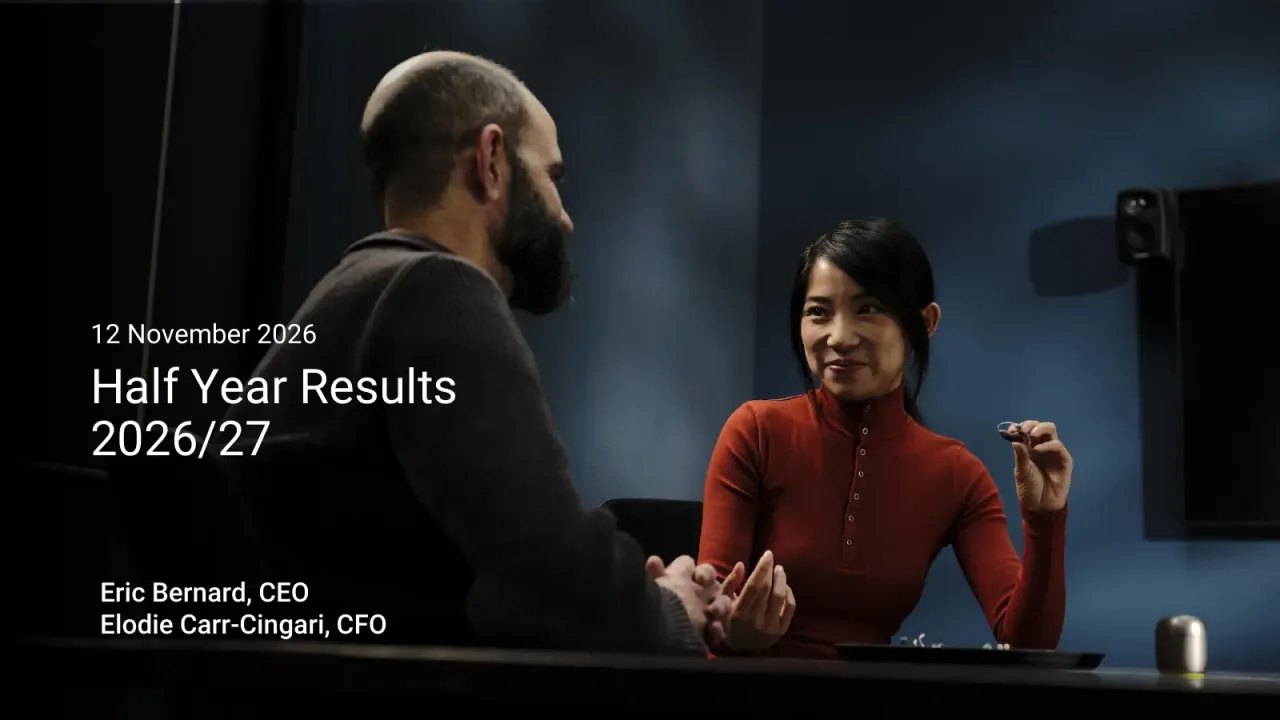
Sonova Holding (SIX Swiss: SOON) Q2 2027 earnings call, held 2026-11-12. Watch the replay and read the transcript on 6ix.
On 6ix: 6ix.com/event/sonova-holding-ag-0qpy-q2-2027-earnings-call
Automated transcript · Written by software from the replay's audio. It can mishear names and figures; the replay is the record.
0:00 Ladies and gentlemen, welcome to the Sonova AG Half-Year Results 2026-2027 Conference Call and Live Webcast. I am Sandra, the Chorus Call Operator. I would like to remind you that all participants have been listened only mode and the conference has been recorded. The presentation will be followed by a Q&A session. You can register for questions at any time by pressing star and 1 on your telephone. For operator assistance, please press star and 0. The conference must not be recorded for publication or broadcast. At this time, it is my pleasure to hand over to Peter Dixon, Senior Director, Investor Relations. Please go ahead, sir.
0:42 Good afternoon, everyone. Welcome to Sunova's half-year results presentation for 2026-27. I'm Peter Dixon. The presentation slides are available on our website. Joining me today are our CEO, Eric Bernard, and our CFO, Elodie Karchindari. Eric will begin with the business review and then update on strategy execution. Elodie will then cover the financial results, capital allocation and outlook. Eric will conclude the prepared remarks before we move to your questions. Today's call will last roughly 60 minutes. Those joining by telephone can register a question by pressing star and one.
1:30 The operator will guide us through the Q&A after the presentation. Before we begin, please review the disclaimer in the presentation. Today's remarks include forward-looking statements which are subject to risks and uncertainties. Actual results may differ materially. This presentation is neither an offer to sell nor a solicitation to buy securities. Let me also mention one important point. Unless otherwise noted, growth rates cited today refer to changes in local currencies and figures refer to continuing operations.
2:11 With that, I'll hand over to Eric. Thank you, Peter. Good afternoon or good morning, everyone, and a warm welcome also from my side. So we had a strong first half. Group sales grew 7.5%. Hearing Instruments grew 9%, Wholesale grew 11%, and Core EBIT grew almost 23%. And we continued to gain market share. So, good results. But let me focus on what matters. In March, we laid out where we want to take Sonova. And six months later, we are executing. We are on track. Our innovation is translating into growth.
2:57 E.ON. is off to a strong start. We are getting share and Asia is accelerating profitably and our operating execution is improving. Against that background, we are accelerating our strategic investments and we are raising our four-year guidance. And we now expect sales growth of 6% to 8% and core EBIT growth of 10% to 13%. And Elodie will take you through the outlook in more detail later. So let me take you through those results one by one. Let's start with hearing instruments. Sales were up 9%. Core EBIT increased 26% and margin expanded by 260 basis points to 22%. That is growth translating into profitability.
3:53 Let me turn to the products and commercial execution behind it. Wholesale grew 11% in H1. Double-digit growth for 12 months and 11 consecutive quarters of market share gains. So the United States was the largest growth contributor, supported by expanded major customer relationships and increased VA deliveries. Vietor and Infinio Ultra continued to perform strongly. And towards the end of the first half, we added E.ON. For us, innovation always starts with the user. People want to hear well in difficult situations.
4:42 But they also want a hearing aid that is small, comfortable, easy to use, and well-connected. And that's what drives our product development. Infineosphere and then Ultrasphere made a major step forward but we all know that device size remains a trade-off. EON brings our real-time AI into a device that is 25% smaller with superior acoustics, strong connectivity and significantly improved performance in wind. and the early response has been very strong. A recent external survey data backs that up.
5:29 Among US audiologists, Phonak ranked number one for the attractiveness of recent product launches. And we all know there were many. It was a busy innovation period. Kion made a healthy contribution, but just in the final weeks of the period. Now if you travel back in time, our Infineon launch wasn't perfect. On time fulfillment was 64%. With E.ON, it was above 95%. Early complaints are down by more than a third. Retail and wholesale. On time, on quality. So the improvement is clear.
6:17 Now we are in a multi-year transformation and we're still investing to improve our operations. Users are choosing Sphere. Around two-thirds of units sold globally in the first two months were Sphere. We expect the mix to normalize over time, but to remain above Infinio Ultra. Where it settles is a bit too early to say, but this is very encouraging. Then we continue to see strong performance from our IT rechargeable portfolio, including Viato and the Phonak and Insera and the Unitron.
7:04 We reached our fair share quickly and share is now broadly stable at that level. Despite competitor launches in the meantime, look at the latest VA numbers as a proxy. That gives us a strong position to build from as we continue to innovate in the category. And it shows us something simple. Design matters. Not everyone wants a hearing aid behind the ear. It validates our strategy to expand beyond RAKE. Our opportunity is to make discrete in-the-hearing care easier for more people to adopt. We will have more to say on that soon. Now on to retail.
7:50 Wholesale gives us broad reach to our customers and retail gives us direct access to users and a direct feedback loop into the organization, back to marketing, back to R&D. So we need both wholesale and retail. Retail sales grew around 7% in the first half. More than 5% was organic with a nice acceleration in the last quarter. Acquisitions contributed slightly, but M&A activity is picking up. Examples, Aura Service Denmark and Haber Audiology. We remain on track with our retail bolt-on ambition and we see multiple opportunities and LOD will come back to the financial discipline behind how we deploy that capital later.
8:40 Now let me turn to cochlear implants. Sales were down in the first half, although largely in line with our expectations ahead of the Integro launch. Sales declined 10%, systems were down 3%, and upgrades down 27%. We had three main effects. China VBP, lower system sales in the United States, and significantly lower upgrade sales. As we said a year ago, we need to accelerate innovation and make better use of Sonova's technology. And Integro is the first important proof point. Cochlear implant recipients should benefit from the same advances in speech understanding, connectivity, and ease of use that we develop across Sonova, and with the Phonak brand in particular.
9:34 It is not just hearing a sound. It is knowing where the sound comes from, knowing if that bus is on your left or your right, and INTEGRO brings precisely sound localization, smart speech technology, and phonak connectivity to advanced bionics. Our unique microphone, Roger On Sphere, addresses another challenge. Following a conversation across the table, in a meeting, or a noisy restaurant, It brings the microphone closer to the conversation and puts our real-time AI into the microphone itself. And that extends access to real-time AI processing for advanced Bionics users and for around 90% of the Phonak installed base.
10:31 So we're talking different use cases, shared technology, Innovating for Adoption, our first strategic pillar. Integro launched in Europe in mid-October. It is now in 18 countries. Germany is ahead of the curve and feedback is strong. Now, it's very early days. About the US, the launch remains subject to regulatory approval. So the technology is exciting, but financial performance is not where it needs to be. and Integro is an important step. Now we need to execute. So overall, a strong first half, strong growth in hearing instruments, continued market share gains in wholesale, a very good start for E.ON and better operational execution.
11:27 In cochlear implants, we have a new product cycle starting with Integro, but clearly more work to do. And with that, let me hand over to Elodie Elodie will take you through the financials, the broad-based regional growth, including the acceleration in Asia, profitably, and the outlook. Elodie?
11:50 Thank you, Eric, and good afternoon also from my side. So, in the first half, we achieved strong earnings growth and cash generation. My focus is on how we convert that performance into returns and how we put capital behind the next stage of growth. Group sales reached 1.8 billion, an increase of 7.5% in local currencies and 6.7% in Swiss francs. Organic growth contributed 7 percentage points, while M&A contributed Foreign exchange reduced reported growth by 0.8 percentage points.
12:44 Growth was broad-based across all three regions. EMEA and Latin America grew 6.8%, with strong wholesale and retail momentum, led by Germany and supported by our latest platforms. North America grew 7.5%, low double-digit wholesale growth, supported by innovation and major customer relationships, more than offset lower cochlear implant sales. Asia Pacific led the growth at 11.4%. Hearing instruments grew in the mid-teens, led by Australia, China, and Japan. while cochlear implants sales in China remained under pressure.
13:37 Asia is a significant opportunity, but not a single market. Needs, channels, price points, and consumer behavior differ. We need to win, country by country, the right people on the ground, the right activation of our portfolio, and over time, solutions developed specifically for Asian needs. We are still early, but this first half performance is encouraging. The market environment was also supported. Based on currently available track market data and our estimates, we believe that the global hearing aid market grew around 5% in the first half, with an acceleration during the second quarter.
14:26 We also believe there is some degree in selling effect from a busy launch period in the second quarter. The market was stronger and we grew substantially faster. We continued to gain market share. Turning to our margins and gross profit. Poor gross profit increased to 1.4 billion While the core gross margin reached 74.7%, an improvement of around 230 basis points in local currency. For this, there were three main drivers. First, strong volume growth.
15:13 Second, positive AESP in both wholesale and retail. And third, We did not incur the temporary manufacturing and logistics costs that affected the prior year period. Part of the year-on-year margin improvement therefore reflects this comparison. But the underlying development is also strong. Volume, pricing, and better operational execution all contributed positively. Moving on to operating expenses. Poor operating expenses grew 6.9%, slightly below sales.
16:01 R&D grew 4.2%, supporting our product and technology roadmap. Sales and marketing grew 7.8%, including coordinated launches and increased investment in retail lead generation. We are not yet satisfied with the efficiency of that spend and improving conversion remains a priority. Acquisition-related amortization, including in sales and marketing, was lower in the period, but we expect it to increase again as M&A accelerates. G&A grew 4.9%. We will invest for growth, not maximizing margin in a single period. but every investment needs a clear rational and accountability for delivery.
16:52 Take our operational transformation program. We committed 50 million of investment and remain on track to deliver the expected 90 million annualized savings and recurring profit improvement by year four. So bringing these elements together, We delivered strong operating leverage. Core EBIT grew 22.9% to 384 million. The margin reached 20.9% versus 18.4 a year ago. That's margin expansion of 260 basis points. Reported EBIT was 372 million. Non-core item, amounted to 12 million, primarily reflecting restructuring expenses and a 5 million reassessment of provisions related to a legacy cochlear implants product.
17:57 For the full year, we remain within our expected 35 million to 40 million corridor for non-core costs. Below EBIT, The financial result also improved materially. Poor EPS increased 38% to 5.37 Swiss francs. Reported EPS amounted to 5.18 Swiss francs. Consumer hearing is presented here as discontinued operations and the divestment process remains on track. The 68 million impairment resulted in a 57 million loss after tax. Reported EPS including discontinued operations was 4.22 Swiss francs.
18:58 Let me now turn to cash flow. Operating cash flow increased to 378 million. Operating free cash flow increased to 287 million compared with 90 million in the prior year period. Working capital increased, primarily reflecting planned higher levels of inventory and trade receivables ahead of our product launch. Expect that to normalize in the second half. We'll also be stepping up our transformation investments in the second half. Operating free cash flow also benefited from lower tax payments, reflecting timing differences between the two periods.
19:48 Overall, cash conversion remains high and consistent with our track record over the past few years. Free cash flow reached 266 million compared with 60 million a year ago. Earnings growth needs to translate into cash, and in the first half, If we look at our balance sheet, inventory and receivable days increased, reflecting the timing of product launches. Payable days were higher, reflecting the timing of supplier payments. Grossing increased to 20.9% from 19.5%.
20:35 Earnings growth translated into higher returns despite an increase in capital employed, mainly from currency effects on goodwill and the working capital buildup around product launches. Net debt to EBITDA was 1.1 times unchanged since March and lower year on year, reflecting strong free cash flow generation. We have capacity to invest in technology, operations and acquisitions but available capital is not a reason to spend it. Two measures guide how we deploy it. Core EBIT is our principal operating profitability KPI and it includes acquisition related amortization so the cost of M&A stays visible.
21:28 ROSI holds us accountable for the capital we deploy. M&A activities picking up and we are seeing plenty of opportunities coming across our desk. In retail, we have invested approximately 50 million in bolt-on acquisition by October. We remain on track with our ambition to invest around 80 to 100 million annually. Every deal has to clear the same hurdles, strategic fit, valuation and returns. If it does not, we walk away. And once we buy, we are accountable for delivering the business case. We are accelerating M&A, but not at any price. The objective is profitable growth and returns, not unacquired revenue or spending number.
22:20 So with this, let me finish with our outlook. When we issued our guidance in May, We expected the global hearing aid market to grow between 2-4% during the current financial year, gradually improving towards the mid-term assumption of 3-5%. The market has developed more strongly than we expected the other day. Based on currently available tracked market data and our estimates, we believe that the global hearing aid market grew around 5% during the first half, with an acceleration in the second quarter, supporting by a busy launch season. We are therefore increasing our full-year market growth assumptions to 3% to 5%.
23:11 At the same time, our own execution has been strong. In wholesale, we expect continued support from E.ON and the broader product portfolio. In retail, we expect continued organic growth together with an increased contribution of farm acquisitions and new store openings. And in cochlear implants, we expect Integro to support an improvement in the second half, the extent of which is subject to the timing of regulatory approval in the United States. The strength of our first half performance gives us the capacity to accelerate strategic investments in the second half by low double-digit CHF Million Amount.
24:00 That is core operating expenses. We are investing to enable a 5% to 10% mid-term sales growth target and support other strategic opportunities. In practical terms, that means investing in R&D for next generations of products and technology, improving manufacturing and supply chain capabilities, and strengthening the digital systems that support our commercial, retail and finance organizations. This includes IT investments to make the organization more productive and resilient, alongside investments to digitalize and improve the consumer journey. This is fully consistent with the mid-term financial targets we set out in March.
24:50 We are deliberately reinvesting part of our strong first half performance, where we see attractive opportunities to support future growth, productivity and operating leverage. Against this background, we now expect consolidated sales growth of 6-8%, compared with 5-8% previously. and we are also raising our core EBIT growth guidance to 10-13% compared with 7-10% previously. Based on exchange rates as of early November, we expect currency translation to be broadly neutral for sales and core EBIT for the full year. But with a long history of Swiss franc appreciation, we remain prudent.
25:40 Our focus remains on what we can control. Our midterm framework remains unchanged and we remain focused on delivering against it. With that, Eric, back to you.
25:53 Thank you very much, Elodie. And before we close and go to the Q&A, one point on culture. Strategy is executed by people. And so we want our people close to the customer, empowered to act in their best interest and accountable for results. We are seeing progress, and the latest employee survey in August shows that employee engagement climbed to 74%, up six percentage points compared to our baseline from December 2025. Just over four months after its launch, our employees know our refined strategy, and more than 90% understand what behaviors we need to foster in order to execute it.
26:41 In sum, The survey indicates that our people are clear about our North Star and motivated to do their part in reaching our ambitions. There's more to do, but we're moving in the right direction. Let me close with the four messages on this slide. First, we are gaining market share. Wholesale grew 11%, double digit growth for 12 months. We have now delivered 11 consecutive quarters of year-on-year market share gains. Over that period, our share in tracked markets has moved from the mid-20s to the low-30s percent. Second, we are translating growth into earnings and cash.
27:30 Third, the strategy we presented in March is translating into execution. Vietor R, Ion, Roger on Sphere, and Integro are proof points. So are the improvements in operations and retail expansion. And fourth, we are raising our four-year guidance. Continuity against a stronger market and disciplined cost management support that confidence. CI needs to improve. Asia is accelerating profitably, and there is much more opportunity ahead. Now we need to double down on execution The direction is set, the proof points are building and we will keep executing. Thank you.
28:23 Thank you, Eric. To make sure we get as many people as possible, please limit yourself to two questions. Operator, please open the line for Q&A. We will now begin the question and answer session. Anyone who wishes to ask a question may press star and 1 on the telephone. You will hear a tone to confirm that you have entered the queue. If you wish to remove yourself from the question queue, you may press star and 2. Questioners on the phone are requested to disable the loudspeaker mode and eventually turn off the volume of the webcast while asking a question. Anyone with a question may press star and 1 at this time. Our first question comes from Richard Felton from Goldman Sachs. Please go ahead.
29:09 Thank you very much, thanks for taking my questions. Two please, one on guidance and then one in the year category. So first question, on the guidance and particularly what's implied for EBIT growth in H2, I know you're calling out that you've pulled forward some of your strategic investments which I guess is weighing on the EBIT growth. Maybe just comment on the rationale for accelerating those investments and should we think about that as a phasing of investment between this year and next year or is it incremental? And then the second question on Virto R. Did you continue to see sequential growth for that product through H1? And then if you could provide any high-level commentary on innovation plans for the in-the-year category, and could we expect something this fiscal year?
29:55 Thank you.
29:58 Maybe you take the first question, Elodie, and I will take the second one.
30:01 Absolutely. Hi, Richard. Thank you for your question on our guidance. So when you look at what we set out to do and if you recall our March strategy update, we did talk about how we would support the growth not only from a top line perspective but also from a core EBIT perspective around a number of pillars. and in our ambition, we have the ambition to grow above the market with the contribution from a number of strategic initiatives. For these strategic initiatives, we set out a roadmap and in particular into three areas. One is innovation and R&D.
30:57 Second is our excel in operations where if you remember we said that we would invest 50 million to come to a 90 million run rate saving in four years from now and the third one is the consumer journey where we are investing in digital and IT so we are very consistent with what we explained back in March and these investments are ramping up They are ramping up in the second half to enable our strategy compared to our first half. And as I mentioned, we expect those investments to be in a low double-digit Swiss franc amount in the second half. So that's broadly the assumption that's included in our guidance.
31:52 Thank you, Elodie. So I will take the question on Vietor. So Vietor has been an incredible success. It was an entry for us in the category where we were not playing, which was the IT rechargeable. And you might recall that after launch in October last year, we saw great numbers emerging. I think the VA is a good proxy. Within months, we were north of 60% in the category in the VA. In previous call, we said that annualized sales were about 120 million Swiss francs. In the end, we are higher than this. And I would say that now our share has stabilized. Again, look at the VA numbers during the last months where we saw new competition coming in. Different, not exactly a true custom, but then now things have stabilized and VO2 is number one.
32:48 We still have room to grow, obviously not as much as we did when we launched the product because we started from a zero base. Now the base is there, but we still have, even in our own stores, room for growth in this category. So we're going to double down in the custom category over the next few months and the next few years with more innovation to come. and then there are other innovations that will be coming in a not too distant future in the IT category in general but I will stop here and not share too much about competitive elements that we are not ready to share.
33:26 Great, thank you very much. The next question comes from Julien Wadour from Bank of America. Please go ahead.
33:35 Good morning, this is James Nin on behalf of Julien Wadour. So the question would be, you previously indicated that M&A spending could exceed 80 to 100 million level if the right opportunity emerged. And given that the guidance does not appear to have increased at the half year and leverage is still low, like should we infer that the larger M&A pipeline has not yet converted? And if there is no meaningful transaction, like in the near term, what would prevent the board from considering a share buyback? Thank you. Thank you for the question.
34:09 Good. So two parts of the question. I think first part, as I mentioned, we have a strong M&A pipeline. We have seen already quite some movement in the first half. We expect some acceleration in the second half. And based on that, We are currently holding back on starting any new buyback for this fiscal year as we have previously communicated back in May and this is very much in line with our cash deployment strategy priorities. The next question comes from Kaya Deshpande from UBS.
34:56 Please go ahead.
34:58 Good afternoon, thank you for taking my questions. My first one is just on the sell-in effect in calendar Q3, which you mentioned. Apologies if I miss this, but I think one of your peers estimated it was 1% of wholesale market growth, volume growth in calendar Q3, so fairly minimal. Does that roughly align with what you saw? And then my second question was on the market itself. Some of your peers have been speaking about how it's been helped this year by companies By a trend in the US of managed care, terminated patients, re-entering the self-pay channel. Does that align with what you're seeing? And how sustainable do you think this trend is?
35:37 Thank you. Maybe I start with the second question. Managed Care is normalizing, but we don't see a significant movement out of that. So I wouldn't be that ambitious about Managed Care recovering. It's more positive than it used to be. It's normalization, but that's it. About stocking effect, yes, there has been some stocking effect, but not from Sonova. And there was no specific push or creativity around optimizing the end of the quarter. So yes, some, not from Sonovan.
36:13 Perfect, thank you very much. The next question comes from Hassan Alvarkil from Barclays. Please go ahead.
36:24 Good afternoon, thank you for taking my questions. Two, please. Firstly, on wholesale, you've now gained share for 11 consecutive quarters. Can you help us understand the cadence of wholesale growth throughout the quarter, throughout the half and then into the second half? And how much of this share gain was the benefit from some of these larger accounts that you call out? And then secondly, on retail, retail organic at about 5%, but U.S. and Canadian retail only slightly positive. You can talk about what's holding that back relative to some of the stronger performance you're seeing in other markets such as Germany, Poland and Italy. Thank you.
37:08 Okay, so many points here, so Elodie, help me if I miss anything. First, wholesale growth throughout the first half, very stable, very good, month after month, no peak towards the end, as I've said it answering the previous question, no optimization of the end of the first half. So very stable. What's behind market share growth? Virtual. Ultra that continued to do very well. The tail ends the launch of E.ON certainly in the markets where we were early. So think of the US, for instance. And then certainly, you know, a federal base of comparison when you look at a very large retail account in the US.
38:01 But in general, it's the combination of our innovation bringing more customers to us. Growth-based growth, by the way, we were very explicit about that. And again, stable growth in wholesale throughout the entire first half. About retail, what I would say without being too granular is that we had a good organic growth. And if I'm a bit more specific, in our second quarter, so the second half of the first half, we accelerated and clearly gained share on average across the world. What I would just say is that U.S. was a bit slower. That's internal, but it's actually accelerating.
38:46 So actually rather good news on that photo.
38:51 Thank you very much. The next question comes from Veronica Dubajovar from Citi. Please go ahead.
39:01 Good afternoon and thank you for taking my questions. I'm going to keep it to two, please. One, I want to return back to the revenue growth guidance upgrade. If I sort of look at it, obviously you've raised your market growth expectation by a point. You have raised the low end of the growth guide by a point, kept the top unchanged. Should we think about sort of the guidance upgrade as mostly being driven by better markets or are you all, because it's sort of hard for me to see, it would sort of suggest that maybe the share gain momentum is as expected and really the surprise has been market or is there an element of better share momentum and I'm just not seeing it. So that would be sort of my first question. My second question is a little bit on price and mix in the industry. We've obviously seen a very nice tailwind over the last three to four quarters from price and mix, and I think mostly from mix, both from the IT innovation and then some of the platform innovation that's coming through right now.
39:58 How sustainable do you think that is given the health of the consumer around the world? And as you kind of look forward over the next 12 to 18 months, what are your expectations around price and mix for the industry? given the sort of high bar that we've seen in the last three quarters. Thank you so much.
40:17 So, Veronique, let me start maybe with the second question. And my response will be consistent with other forums where we've exchanged. What we've seen is the following. When you bring innovation Thank you very much. is tangible, perceived, measured price has not been a problem.
41:09 And we've seen that both as a wholesaler and as a retailer, number one. Now going back to your first question, When we started the year, we said we expect the market to grow between 2% to 4% and gradually going towards 3% to 5%. And this is what we said when we spoke about our midterm targets. We got faster to the 3% to 5%. We also know that the last quarter, so for us our Q2 fiscal, was a little bit extraordinary with maybe some stocking effects. This is going to normalize and again I insist, we are not going to see returns because we didn't play the game of stocking.
41:57 Let's be very, very clear. The consequence of this is when we look at the way we got and the upgrades, we gained market share in the first half and we will continue to gain market share in the second half. Elodie, do you want to add anything to that?
42:15 I think, you know, we had a strong H1 and the market was strong in H1. There was a peak in the second quarter, as Eric mentioned. Again, maybe some stalking effect, but not coming from Sonova. And the market expectations that we have now put forward reflect that dynamic for the year. Again, we outgrew the market in the first half and we are planning to do so again in the second half. The next question comes from Jack Reynolds-Clark from Morgan Stanley. Please go ahead.
43:00 Hi there. Thank you for taking the questions. Just kind of to follow up on the market growth points. So your guidance assumes that the kind of implied slowdown in H2 from the level seen in Q3 is due to destocking in the industry from other manufacturers, but not from Synova. Can I confirm that I've understood that correctly? And then my second question was on the horse service acquisition in Denmark. Could you quantify the revenue contribution here and how much kind of opportunity do you see to roll this out in other geographies? And is it a means to expand the funnel or is it a means to take share from other retailers?
43:44 Okay, let me start maybe with Denmark. So you've understood that this acquisition is a particular one. We had a mobile solution system already in our ecosystem. By buying this company, we become the clear leader in Denmark in this new channel that is growing faster than the average of the markets. So it's just doubling down on a channel we're already operating in because it grows faster than the rest of the average. Can we quantify this more specifically? I mean, you have the contribution from both on acquisitions in the financial notes in total, but on individual deals, we generally don't disclose the actual revenue contribution. But you would see it in the notes of the financial statement as part of a deal done in the first half.
44:32 And overall, the contribution from M&A in the first half, as I mentioned, was not extremely significant as we are ramping up. and there was not a lot of carryover from the previous year. So this only contributed to 0.5% of our growth. So if you look at our results overall and if you look at the 7.5%, that really meant that we had a 7% organic growth with a relatively limited contribution from M&A towards revenue in the first half.
45:12 Second question?
45:13 Second question was related to, again, the same, similar question as I understood it, which was our lift 35% on the market and our sales guidance 6 to 8%. So as we mentioned, again, we saw a peak in the market growth in the last quarter, so our fiscal Q2. And we do anticipate that there was maybe some stocking effect, but again, did not come from Sonova. And the revised market expectations that we put forward for the rest of the year, they reflect those expectations.
46:02 Basically, a slowdown of the overall market driven by that in the third quarter, fourth quarter. Again, not driven by Sonova. And in that environment, we expect to continue to gain share in the second half.
46:20 And what we could highlight, Jack, is that we also expect As we all know very well, a large merger is taking place, is effective, and we expect therefore what used to be a large customer of ours to convert rapidly to sourcing the product from the company it is acquiring. So this is also reflected in our guidance for the full year and therefore what you see, which is potentially a slower growth. Again, we repeat it. We can do the math. You can do the math. We keep getting here in the second half. And we expect, based on the initial numbers that we see from E.ON, very good growth.
47:03 And what Eric is talking about was included in our guidance. We did expect that towards the end of our fiscal year. And so we are very much in line with expectations in this area.
47:18 That's typically it. Thank you. The next question comes from Martinian Rula from Jefferies. Please, go ahead.
47:26 Good afternoon, everyone. This is Martinian from Jefferies. I would have two questions, actually, if that's okay with you. So the first one would be on cochlear implants. So the performance in this division has been quite volatile over the past, let's call it, two and a half years for a handful of reasons, including VBP, competitive pressures, and, for instance, South US market conditions. and as such I was wondering if you could help us unpack all the moving parts for CI into H2 and actually help us frame expectations for that division into the second part of your fiscal year. And the second question would be on wholesale momentum. So at Juha you sounded quite confident about E.ON's competitive positioning after seeing the latest launches from peers and now with more customer and audiologist feedback coming in, and E.ON actually starting to contribute financially.
48:22 I would like to know whether you are even more confident today in E.ON's value proposition and its ability to drive share gains.
48:29 Thank you. So you cannot see the smile on my face, but indeed E.ON is very, very well received. It's very early days, but for instance, in the VA, we have very positive feedback. We're happy with the numbers we're seeing as a proxy for the success of this product. But across the board, from France to US to Germany, et cetera, the reception of the product is very, very positive. What I like, and I highlighted that in the presentation, is that the demand is particularly exciting for higher technology levels. What I would highlight also is the conversion from Ultra to E.ON is incredibly fast, very, very fast, actually faster than we were expecting.
49:23 So all of this is pointing into what I would define as success We launched back in mid-August in the U.S. Now it's market after market. U.S. is on a roll, but so far so very good. Cochlear. So first half was obviously not satisfactory, minus 10, but very much in line with our expectations. We had communicated. I was very excited about that on the call we had six months ago, so no real surprises. What's behind these negative numbers? We had no innovation to bring to the market for a while, so we were not very competitive in that sense.
50:14 This is changing. And we have now launched Integro in Europe, in Germany in particular, since October 15th. We see very good reactions and very good demand very, very early days. And what works very well is the simplicity of the description of the innovation. It's localizations. It's knowing where the sound comes from. It's the fact it's powered by Phonak. It's the fact that you can connect it to Roger On Sphere and benefit from... are AI in action, et cetera. So great, great results.
51:03 VBP China, it's, you know, China revenues for Cochlear at the level of the Sonovar group is somewhat marginal, but we have really, you know, reached almost ground zero there. So now we have to rebuild China and VBP has impacted us. Competition, I touched on that. We were not innovating. Now we are. and US market conditions, we actually did okay. So yes, there might be a slight slow demand or people delaying because the reimbursements are not as generous as they were, but I don't see that as a major hurdle for the future. So long story short, we were not performing in the CI segments. The launch of Integro is changing the game. These are early days and we as a result expect an H2 that will have a very different profile.
52:00 What's pending is regulatory approvals in the US and that's not under our control.
52:09 Okay, perfect. Thank you. Operator, and we have the next question.
52:31 Disconnect. Operator. We take the next question from Oliver Metzger from OdoBHF.
52:42 Yes, good afternoon. Thanks a lot for squeezing me in. First question, can you make a comment about your US private market performance? Second one is on Asia-Pacific, so it has the strongest regional growth, also I would say with the lowest comparable base, but you mentioned over the year that you have set a stronger focus on Asia-Pacific. Can you elaborate about the regional growth composition? I remember you mentioned Japan as a positive example. So Asia is huge, so it would be great also to decompose the region and also to which extent your initiatives bear fruits.
53:28 Thank you.
53:30 Thank you very much, Oliver. So, first part, U.S., so you've seen it in the numbers, very strong performance, and that's a reflection of the success of Vieto. You know, very good numbers from the VA when you compare to the same period the year before. Market share gains in a very large retail accounts. So, across the board, very good performance in the U.S. And again, I would say that early days, E.ON, very, very, very promising. Okay. Asia Pacific, your question gives me the opportunity to explain again what we're doing in Asia Pacific. Two-step process, doing the basics that we're missing in our house, having a leader based on the ground, having the right focus.
54:24 So just fixing the basics that were not there. And phase two, which will take a bit of time, is innovate specifically for Asia with more simple products, probably difficult, easier to dispense, and at more affordable prices, but also lower cost and lower cost to serve. We are in phase one. Very good numbers, double digit, and if you look at wholesale specifically in the mid-teens. Now let's deconstruct Asia Pacific. Strong position historically in Australia and New Zealand. We did very well there. China, wholesale retail performing very well. And if I single out wholesale in China, it was double-digit, meetings, very good, and profitable.
55:20 Japan, double-digit, loss of 20% growth. I won't give the specifics. Profitable growth. India is growing as well, mind you, on a small basis. Again, profitable. So in general, I would say that phase one is in motion. We have more potential. It's growing very well and growing very profitably. And then you might have seen that this office that we are creating, this base in Singapore, supported by the Singapore government, is now in motion. And from there, we will start innovating specifically for Asia and meeting the specific needs of both the HCPs and the consumers, the users. So all in all, it's going well in Asia.
56:13 It's on track. It's a proof point that we are executing on our strategy.
56:21 Okay, thank you. May I just ask one follow-up to my first question because I did not ask my question precisely enough. Actually, I meant the performance towards independent audiologists in the US. Sorry for that.
56:36 So we will not be too granular, but it's going fine.
56:42 Okay, thank you. The next question comes from Susanna Ludvig from Bernstein. Please go ahead.
56:50 Good afternoon, and thanks for taking my questions. I have two, please. First, with regards to Asia and your reference to product design specifically for Asia, could you elaborate on some of the different features You see as required for this market is this sort of different pricing, different form factors, different fitting software for the HCPs or something else. And then second, you talked about I think two-thirds of users choosing a sphere hearing aid. What factors need people to choose a non-sphere version now that size is not an issue?
57:29 All right. So let's start with Asia. And you can imagine I will not go into too many specifics because that's competitive information. But if the only thing we do is try to sell in Asia, and again, we would have to deconstruct Asia because Asia means nothing, right? I've explained that several times. Just talking about China means nothing. Tier 1 to Tier 3 to Tier 5, different needs, different situations. India, multiple Indias, and then Japan is another market. Korea, different one. Southeast Asia is another opportunity. Fine. But if we only sell in Asia what's been designed for Europe and the US, we face challenges. And not just prices.
58:17 Complex products, complex softwares, So we have to bring to Asia products that are more simple to offer, certainly at different price points. We certainly have to consider direct-to-consumer approaches, concrete examples of what we are doing. You spoke about form factors. We were not playing with a product like Viato in Japan. We brought it into the market. Incredible success, significant gains in market share. That was an easy one. There was a gap. We're not playing. We bring it. We are looking at now specific products for Asia. Call them de-features or more simple, just addressing fundamental needs. This is what we are talking about.
59:11 Your question about sphere, now it's off my...
59:14 Two-thirds of users are using sphere.
59:19 Who chooses non-sphere? First, let's remember that it's the HCP that very often calls the shots. So it can be the HCP deciding that there's no need to go for a sphere because there's no need to pay that much of a price. That's one. And... Thank you. The next question comes from Andriela Bozinovic from BNP Paribas.
1:00:10 Please go ahead.
1:00:13 Hi, good afternoon and thank you for squeezing me in at the very end. Maybe two from my side, one on Cochlear and one on Costco specific. So on Cochlear, can you maybe give us a little bit more details on when do you expect the US approval and what is embedded in your current diet in terms of the US approval? I'm just trying to see how big of a factor can it be for the Full year sales guidance. And if you can confirm that without the US approval in Cochlear, you can still grow the sales for the full year in the segment. And for Costco, if you can give us an update on your market share. I remember last time we spoke, you said you want to achieve around like 20-25%, which is your Thank you so much. So first, let me start with this launch VTEL account in the US. We have reached our fair share.
1:01:23 So I won't be specific about the exact number, but that's where we are. In fact, if you consider there's a fifth player now, American, right? You could say the first year is about 20%. We're north of that. So it's better than this. And to be specific, yeah, well, now, you know... Our colleagues at Costco are very clear. They now have the five suppliers in the game. And you have to be very competitive, very innovative, and be on time and quality if you want to win. So far, so good. About Cochlear, so I don't have a crystal ball. I cannot tell you where we're going to get the approvals from the U.S. this next time. We're not getting any complicated questions at the moment.
1:02:10 It's just taking time and we don't know whether it's going to be next week or a bit later. We had anticipated this to allow us to start selling the product towards the end of this calendar year. Early next year, it could be delayed a bit. And so it may have an impact on our ability to generate positive growth for the full year. But let's keep in mind that this is only a delay. that Integro is a processor. And so what it will drive is a lot more upgrades versus system cells. It will drive system cells. And this is just postponing cells. So if we're a bit delayed, it's not lost. It's going to come up later. It's not that significant in the scheme of things for the Sonova group.
1:03:00 Okay, amazing. Thank you so much. The next question comes from Daniel Yellow from ZKB. Please go ahead.
1:03:10 Good afternoon, guys. Thanks for a great semester. Just one question left. You had now four semesters in wholesale with around 10% growth. So despite high comps, you always deliver on that. So I wonder a bit going forward. Of course, I know the guidance, but... How confident are you with all the products, especially EON and so on in wholesale to also deliver this housing legit or even 10-11% wholesale growth? Thank you.
1:03:45 Thank you for the question. Again, I will repeat that we expect to overperform the market, therefore gain share in the second half of the year. Of course, it's a bit more challenging because the base of comparison is higher. I mentioned the fact that our Italian colleagues are likely to source more from our Danish colleagues, so we will see a drop in revenues out of that. Now we are about two months in the market or so more with E.ON. I will repeat that what we see is very strong. So we are confident that we're going to keep performing there. So I'd say again, I'll repeat it. We are confident that we will outperform the market in the second half.
1:04:34 That's very good. And I guess you cannot disclose how much of your sales were Our last question comes from David Arlington from JP Morgan.
1:04:44 Please go ahead.
1:05:14 Mr. Eppington, your line is open.
1:05:18 David, we're struggling to hear you. The line is breaking.
1:05:28 I'm sorry, we can't hear you so very well. Can you try again, please?
1:05:39 Can you hear me now? Yeah, let's try, David. Yep.
1:05:44 Yes.
1:05:48 Perfect, great. Yeah, just on cash flow, good improvement in free cash flow in the first half despite the working capital headwinds. Just wondered how you see that developing in the second half. And then related to that, it looks like you're on track to get to sub one times net debt EBITDA. I know you see an attractive pipeline of MA opportunities Could that be sufficiently large to prevent you from doing the buyback or could you do both? And then just speaking of squeezing at the end, just in terms of some net financial income guidance, obviously, essentially no, essentially flat in the first half, just some guidance for the four of you would be helpful. Thank you.
1:06:24 Yes. So indeed, we had a strong cash generation in the first half. I mean, that's also consistent, by the way, with the cash generation that's an overall Thank you very much. and from other movements like I mentioned in taxes with just timing effects and we did have some I would say temporary movements in land working capital that we deliberately did to support the launch of E.ON and with that we saw our inventory increase. We do expect that temporary inventory movement to normalize In the second half and we do expect also continued strong cash generation as we have done in the past. So then the next part of the question is capital allocation and we remain very consistent with our framework that we talked about. So first and foremost we're going to So first and foremost. Second is we talked about M&A.
1:08:07 We are on a good track to reach our M&A ambition on Bolton between 80 and 100 million for the year and as you know a big part of our capital allocation is also linked to our dividend policy which is above 40% payout so far in this fiscal year. We paid quite an increased dividend back in June. On top of that, we talked about larger M&A opportunities. As I said, we will remain extremely disciplined on those. but we do see a strong pipeline and opportunities we will obviously look at this very closely in the second half so for the time being we have said to enable for this capital allocation framework we are not We are considering a share buyback in the second half and we will remain within our net debt to EBITDA corridor of 1 to 1.5 and last but not least obviously cash return to shareholders is always a very strong part of what we consider and what we look at and we will continue to also very much focus on that.
1:09:45 Ladies and gentlemen, this concludes today's question and answer session. I would now like to turn the conference back over to Peter Dixon for any closing remarks.
1:09:55 Thank you, operator. I'd just like to thank everybody for their participation, and we look forward to meeting many of you over the coming weeks on Roger. Thank you. Thank you very much, everyone. Ladies and gentlemen, the conference is now over. Thank you for choosing Chorus Call and thank you for participating in the conference. You may now disconnect your line.
Follow Sonova Holding AG into a list and get an email when it puts out news.
Analyst, Barclays
Analyst, Goldman Sachs
Analyst, Morgan Stanley
Analyst, J.P. Morgan
Analyst, Bernstein
Analyst, UBS
Analyst, Citi
Analyst, BNP Paribas
Analyst, ODDO BHF
Senior Director, Investor Relations
Chief Financial Officer
Analyst, ZKB
Chief Executive Officer
Analyst, Bank of America
Analyst, Jefferies