Fred van Beers
CEO (until 1 August 2026) and Advisor to the Executive Board
Replay available
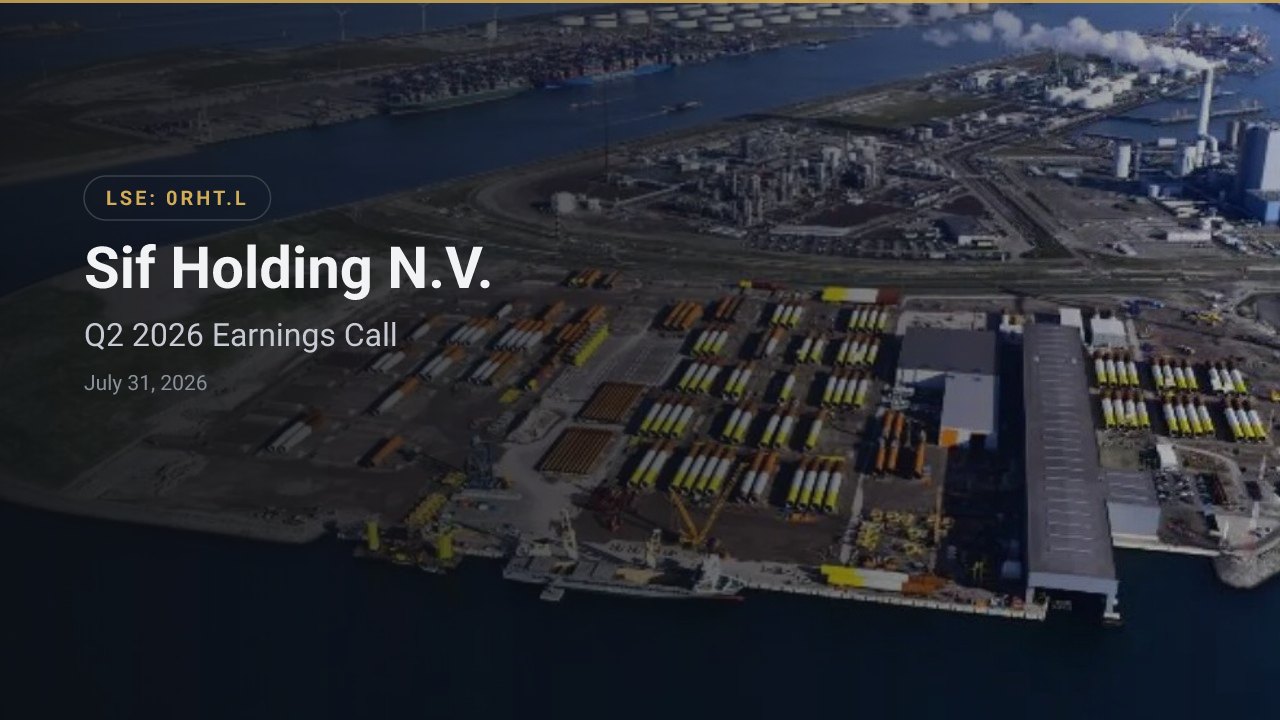
Sif Holding (Euronext:SIFG) Q2 2026 earnings call, held 2026-07-31. Watch the replay and read the transcript on 6ix.
On 6ix: 6ix.com/event/sif-holding-nv-0rht-q2-2026-earnings-call
Automated transcript · Written by software from the replay's audio. It can mishear names and figures; the replay is the record.
0:00 Good morning everybody here in Amsterdam and online for this half-year 2026 presentation of CIF group. With me are two colleagues, to my left-hand side Boudewijn Van Schaik, our CFO, and to my right-hand side the incoming CEO. Can we click?
0:24 Can we click?
0:28 Sorry, we need a... There we are. Incoming CEO, Koen Bogers. Maybe, Koen, you can give a short introduction to the audience.
0:42 Yes, my name is Koen Bogers. I'll be succeeding Fred as of 1st of August. I've been being introduced to the company the last two months. I started at the beginning of May and looking forward to bring SIF to the next level. Thank you.
0:57 Thanks, Koen. And my name is Fred van Beers, CEO till midnight today. After that, advisor to the executive board, helping my two colleagues to the left and the right in indeed doing what Koen just announced, bringing SIF to the next level again. Because life continues, and so does the company. So, what are... We're going to present today. I think two things, three things that stand out and we will deep dive into today. First of all, the important thing of an improving, steadily improving health and safety performance, which is key to us, key to our people, and key to our customers, and a license to operate in this business.
1:44 And as you all know, we have seen quite dramatic downfall last year, early this year, but we're happy to see that that is improving. and the second main point and that we are actually pretty proud of is the fact that the plan we announced exactly one year ago in how in the revised plan in ramping up the factory has become 100% materialized and we are now on a steady base producing these four to five monopoles that we talked about quite a lot per week. We'll come back to that a bit later what that means. The results we will of course explain a bit more, especially why this 40 million shift to 2027 was a good decision in our view. And then a point of concern that we will dive into for sure is the fact, and you will hear that more companies announcing their numbers today related to offshore wind. We see a very difficult period ahead of us in 27-28, given the fact that a lot of projects have been on hold or have a lot of delay in FIT taking, which is a concern for the continuity of this business, knowing that from the end of 28 onwards a lot of activity is expected to be seen in this market, which... and that's an important point we'll come back to later, is also very much supported by actions taken at various governmental bodies.
3:10 And then, last but not least, we will tell a bit more about the status of this exclusive 190 kiloton project that we've been talking about now close to two years, I think, that we have it in our book. And, of course, that relates quite heavily to what I just said in relation to delays in FID taking of projects in general. But first of all, our health and safety performance. Let's start with health this time. You know, and we've talked about it quite often, that we have done a lot of things to bring down our sick leave, but have never been successful. This time, though, we can see that the sickness leave is declining, given the efforts we're taking, partly due to the fact that quite some long-term sickness people have left the company, so to say. That helps, of course, in the statistics, but I think more importantly... We've been able to improve the circumstances, especially in the new factory in relation to dust, quite significantly, and that helps. As simple as that. Besides the fact that individual effort given to people is paying off as well.
4:20 On the safety side, the total recorded injuries actually have increased a bit. But the good news is it's relative, I would say, minor things, like cutting in a finger, stumbling over and hurting a knee, with not the more serious lost-time injuries that we saw happening early this year. They haven't materialized anymore, I would say, close to half a year now, which is good news. Looking at the market, and I've shown this picture, we've shown this picture I think six months ago as well. Here you can see the numbers of gigawatts connected to the grid, excluding China and excluding the U.S., so predominantly Europe.
5:07 And here again we see that the dip that we are facing now relates to the gigawatts connected for 28, 29, 30 that are predicted. So you can see that quite a lot of gigawatts will be connected this year and next year, but the production of equipment for those gigawatts connected to the grid has been done two years ago. or today, as we speak. We are literally delivering, as I said before, four to five monopiles, but also turbines, etc. That's full speed ahead at this moment to deliver on what has to be connected in these two years. But after that, we see a quite significant drop in gigawatts connected to the grid. And that, in combination with a significantly ramped up supply chain in all areas, whether it's installation vessels, Turbine manufacturers or in our case foundation builders means that the market will be thin coming in two years. We said that before and we clearly see that happening today as we speak in the time it takes for tenders to materialize in exclusive or shortlisted exclusive or contracted stages.
6:18 That doesn't mean it's dead. We do clearly see on the other hand as well that all these predictions coming from basically the Nord Sea Summit declaration in Hamburg earlier this year and now being addressed by the NSEC organization, the Nord Sea Energy Coordination Teams of governmental bodies, that all that are working hard on materializing on these gigawatts, both on wind farms, but most of all on grid investments, grid connections and interconnectors between countries. So what are the highlights for 26? And the picture on the right is actually showing the North Sea planning related to what I showed on the previous picture. And the green parts are the offshore commissioned or operational wind farms. The blue ones that are in the pipeline and the yellow ones that are in development stage. So there is...
7:21 Unchanged, a lot to happen in this market. The only and most important key point in the market today is time with which the ambitions are translated into real projects. So, looking at us, the top two parts basically relate to the fact that this factory is running now, as it should. One note to be made on that, and that relates to the top part, we are extremely busy delivering on the order book that basically is the order book that we had materialized or in the pocket when we took an FID for the new factory. And the nine-month delay on those projects means that the projects are quite squeezed on one after the other. We have delivered and completed Ecovende.
8:07 We are close to finalizing Baltic 2.3. The last monopole is finished from a black steel perspective in the coating now. And we have started up Oranjewind for the Netherlands and East Anglia 2 for the UK. And they're progressing quite nicely. So the point now is, and I think Boudewijn, you will come back to that later as well, that after having delivered now on these projects and after having a factory up and running, we now need to focus on costs and efficiency of that factory. That's the next phase in our process, to focus now on not only delivering, but also delivering fully within the cost projections we have made for these projects.
8:52 And that is reflected also in the numbers, because that costs us a bit of money. Again, in Q2 delivered 59 monopiles, should have been 60 actually, it was up to us, but it would have been nicer. But 59 monopiles in three months only is, I think, the best proof of the fact that we are delivering on a constant basis now the monopiles we promised the market. And that is all related, and again, maybe we're going to say it ten times this time, because you have to celebrate your successes as well. We are so happy that we were able to deliver, as a team of 1,000 people, on the new plan that we released in August last year. It's working.
9:38 So that's good. The third one, I guess, is the important one for the future. Because that is our stick in the sand for the future order book, and that is this 190 kiloton project. There has been a lot of progress made on this project. You have to, just to give some numbers, there's about 60 to 80 people on a continuous basis working now on all the preparations for the execution of this project by customer, by us, by supply chain, by designers, all in order to be prepared if the final goal comes that we go immediately ahead, full steam ahead, We are doing things in parallel And without, because that could be your next question, without taking massive costs at this moment, but by simply being clever on how we work, purely investing in people, and if costs have to be made, we are discussing things like early works agreements, etc. So there's a lot of progress that I want to share with you that is being made, a lot of efforts that are being put in place.
11:06 But I can also imagine that everybody's saying that's all nice and dandy, but show us the contract. And of course, that's also the main discussion topic we have with our customer and governmental bodies related to this project. Last but not least, I said it already, a lot of progress being made on the governmental decision-making level, all levels, whether it's Wapke Hoekstra, the DG Trade, DG Climate, DG Grow, and at the member state levels in Berlin when it comes to steel protection measures for our industry, and Germany is an important one. We worked our hand in hand with our colleagues in this industry through our OFA branch organization.
11:54 We see quite a lot of action there, but the only problem in this field of expertise is time. What we consider quick is an hour, what they consider quick is a quarter of time. And that is the... Thank you for watching. But time, and that's the warning we put in here as well, time is running out though, because the order books start being empty. Colleagues from us are also running out of order books, and if we want to materialize the ramp-up that I just talked about, we need to have continuity in the European supply chain in this business.
12:50 With that, I hand over to you, Boudewijn, to take us through the numbers. Always the best part of this project.
12:58 Thanks. I want to start, and Fred alluded to it, but celebrating our successes I think is important, but also standing still from where we've come from over the last 12 months. And when we sat here a year ago, my first session with you guys was quite painful. We explained that we were more than halving our EBITDA guidance for 2025, basically resetting the ramp-up of the plant, taking a step back, focusing on long-term reliability and consistency. I think our literal words were short-term pain for long-term gain. Looking where we stand today, we have delivered on that commitment. We said by the end of H1, we will consistently be delivering 45 monopiles per week and delivering on our order book, and that's exactly where we are. It's not just that, but it's also these numbers. We've almost doubled our revenue. At this point, we're almost where we were full year 2025. Same for EBITDA. Contribution margin also significantly improved.
13:50 So it's not just the performance in the factory, but also the translation to the financial performance that we knew we could achieve and we are achieving now. To Fred's point, though, there is still room for improvement, not necessarily in the number of monopiles per week, but in the efficiency of how we operate and also in our cost base. So those are things we're going to definitely continue to work on going forward. The consequence of the market slowdown that Fred spoke about indeed is that our order book is shrinking. We still have 422 kilotons, but of that 197 is still exclusive, so still needs to be firmed up. So historically seen, we do have quite a thin order book. We recognize that. And again, we're doing everything we can in a very thin market to push forward and secure what we can. on the projects that we are tendering at the moment. We're shortlisted on most of them.
14:44 Again, nothing is committed, nothing is in writing, nothing is in contracted, but we do see where we are focusing on that we are well positioned with those customers. So that's what we're working on and prioritizing now is securing that order intake at terms that work for SIF. And particularly, as Fred mentioned, the 190 kiloton one, that's our top priority. Obviously, with the struggles we had, the ramp-up, there's been quite a bit of focus as well on our liquidity, on our working capital movements and working capital needs. That's obviously something we're still very much focused on. We see unwinding of a lot of working capital this year, which relates to those projects we secured at the time of taking the investment decision and that we have to deliver on now, with higher costs on our operations than we initially anticipated.
15:32 Robert van Warmerdam. Robert van Warmerdam. Robert van Warmerdam. Thank you very much. Thank you. I think back to the numbers, we delivered 101 monopiles, which is a fundamental achievement in six months, and a number of precision pieces as well for East Anglia. So that's the last project in the order book.
16:29 And we've also spent a lot of time, and I think that translates as well to the operational improvement we've seen, is better alignment with the business in terms of our management. We really are running Remont and Maasvlakte now as two separate businesses, as independent business units. They both have a strong management team. They both have a director running the business. So we see a lot more focus site-specific rather than focused on just one whole, because there are two separate businesses that work very well in tandem. and of course Koen, who just introduced himself, who will take over the reins at one minute past midnight today. Just a graphical representation of the results.
17:17 It always looks much nicer in bar charts that stick out nice and high, but it really does show the substantial improvement both in terms of the kilotons we produced, the contribution, the EBITDA, and... Some discussion on whether this is an improvement or worsening of working capital. I think the jury is still out. For me, it's an improvement because we have less liabilities on the balance sheet, but obviously that uses cash. But where we've come from in the last two years really showed the nature of having these lumpy advance payments from customers and having to deliver the work later. And that is flowing out of the order book to a much more sustainable level, I think, than where we've come from over the last two years. The last point on the slide, because of the accordion effect that Fred was talking about, where with the delay in the startup, the decision we took last year to slow things down, but an order book that had fixed delivery milestones under the contracts, that compressed to an extent where contractually we had to take reservations for what we call liquidated damages towards customers.
18:23 So we still delivered the projects on time for the installation campaigns, but under those contracts there were already LD milestones prior to the final delivery dates, and being held to those contracts by customers meant about 19 million in downward adjustments to revenue in Q1, which also has a direct translation to EBITDA. And from an ESG perspective, I think a logical consequence of much higher production, much more work taking place in the factory is an increase in our CO2 tonnage. So that's fairly linear in terms of the increased production. Also contributing to a lot more renewable energy with the monopiles that we've produced. and coming back to Fred's point on improved safety on an LTIF basis, we see an even bigger reduction in our injury frequency rate than we've seen of the past years other than 2024. So that focus also translating into the reduction in the frequency relative to the number of hours worked.
19:31 Then again, looking at the order book, so particularly focusing on the orange bar for 2026 on the left-hand chart, the 225 that we have in the order book, that's a relatively low number, but with the exclusive project that we hope to translate into a contractual order in the coming months. Thank you very much. Thank you very much. Contribution per ton, still at very healthy levels, slightly lower than 2025. That has just to do with the tonnage on the Empire Wind monopiles, which were a lot larger in weight than the monopiles we're producing now.
20:21 So relatively per ton, a slightly lower contribution, but still at very, very healthy levels. And I think what we, more importantly, the contribution per month that has improved significantly compared to historical years. Just quickly on the covenants, there's been a lot to do about that since we did the amendment in September last year where we faced a covenant breach, again due to the decision to slow things down. Good constructive discussion with the banks at the time, we amended the covenants and as per the 30th of June, so now we've come out of that amendment period, so we amended them for December and March and now for the first time we're back at the original levels under the financing documentation, so good that we've come out of that dip.
21:09 and that's again a translation of the financial results as we're becoming more profitable and as we're building up our EBITDA because leverage is on the last 12 months basis we're replacing sort of low EBITDA months in 2025 with high EBITDA months in 2026 so we'll continue to see leverage improving and we expect solvency to improve as well as we move forward.
21:34 Fred, back to you. Yeah, we've come to the last slide already, to open the floor for questions after that. But to recap and expand a little bit on the last one, to recap... Our strategy remains unchanged and that is a total solution provider of monopiles for the longer term and maintain our market share as it is. But the focus of course has shifted very clearly to filling the order book for the 27-28 period which is a fighting market period. We're good positioned with the run rate now that we have in the factory. That is clearly showing off in the discussions we have with potential customers. But there's not enough projects for the total supply chain. Our position in Rotterdam is a benefit. The output is a benefit.
22:22 But we fight for it every day in everything we have. I think that's important. also what is to be expected from us as a team to do instead of spending a lot of time on a very long term nice planning etc. You have to survive also tomorrow. And that survival is a clear message that we're bringing out not only today, but are actually constantly bringing out in our discussions with the EU and EU member state representatives. We need to speed up the rollout of what is now predicted to be installed up till 2040, which is an extremely nice ambition. But ambitions alone don't feed much. We need to see the projects materialize. And I think the good news here is that the agreements that have been made between the UK and the Netherlands, between Germany and Denmark on interconnectors, on actually in Denmark, for example, building wind farms for the German market, are clear signs that this is taken serious by politicians.
23:28 But again, it's the speed with which they translate ambitions into action that is our concern. We are making very good progress on this 190 kiloton project. And I think you could say, why isn't the contract there? That's one way of looking at it. The other way of looking at it is that, hey, we're talking with 60 to 80 people on the project. And that's still today, two years after the first announcement. That probably means that everybody is taking this one very serious, but life and the world has changed, and we need more time to conclude on the whole chain from PPAs down to supply chain, and that needs to be covered. But everybody is working on that. I'm pretty confident that this project will materialize.
24:17 The question is will it materialize in time for us to close the gap that we are facing after delivering the last order. And that is probably a nice bridge to the last point that I first want to address or that I want to address is the fact that this is the reason The explicit and only reason, actually, that we are pretty confident that this project should materialize for the start somewhere between May and September next year, that we have said, okay, We have a float in our last project, East Anglia, mainly, and a bit of float at the end of the other project, Oranje Wind. Let's use the time now to the maximum for producing those projects at a little bit lower pace, but with continuity well into 27, so that we can make a connection by having sufficient people actually in the team with experience that is needed to ramp up again for the next order.
25:16 Instead of focusing fully on delivering on the earlier guidance of 135 million minimum for 26 and then facing a massive gap in 27, which means two things. 27 is looking a little bit less favorable but far more important we will lose a lot of experienced people than by the end of this year that we know by the hard way we learned that the hard way we know that it takes a lot of time and effort and money and pain to take them through the learning curves again for ramping up for the next project that will materialize in May or September. So that was an explicit decision and we know that it could be seen as a bit disappointing for this year.
26:03 I think the drivers behind this one are totally different from the drivers we explained last year. For us this is a conscious decision to secure continuity in the company in difficult times. And with that, Boudewijn, correct me if I'm wrong, we've come to the end of the presentation?
26:21 We have.
26:22 And now we come to the fun part again, and that's opening the floor for questions, remarks, whatever. Thijs, welcome. Good to see you here as well. Good to see you. Sure, I don't know, but in this role, yes. Can I open the floor then? No, no. You came in last. Maarten,
26:49 I guess. When you come half an hour late, you're not allowed. 15 minutes. It's Maarten van Beek of the IDA. A couple of questions from my side. First of all, the 18.8 million kind of penalty you have taken. Firstly, is that related to the total order? So how many kilotons does it involve? Or is it related to those monopiles who have been delivered too late? And the third part of it is this 18.8, this is purely allocated to Q2 or to H1 in total?
27:22 So I'll start with the first one. It's predominantly related to H1 indeed. So we see the projects that we had to deliver end of last year, H1 this year, were the ones that were most compressed and where we had this problem. It's typically on a per monopole basis. Under the contracts, we have certain milestones to deliver what we call ready for loadout to have the monopoles ready. If we're not, there's typically a day rate or a week rate that starts accruing every time you're late. So it's not tonnage based, it's date and monopole related.
27:57 Then a brief follow-up. If you could make a split into Q1, Q2, and how many monopoles does it refer to?
28:07 I don't know exactly how many monopoles because it's split over two projects and it's very specific on milestones for specific monopoles. In terms of split over the two quarters, we took a provision of 5.5 million in Q1, so the remainder would be in Q2.
28:29 And then secondly, you're still working hard on this 190 kiloton project. The cost you make to get this project going, firstly, how much is it and is it taken in the P&L account or have you capitalized those costs?
28:48 So at the moment they're in the P&L because there's no contractual basis for us other than the exclusive agreement. So if there's an early works agreement, an EPCI agreement, a formal contract, then we'll start capitalizing costs.
29:01 It's basically manpower.
29:03 It's basically manpower.
29:04 Then you will reverse it. I need to look at that, yeah. And again, the cost more or less in a proxy, how much, how many costs?
29:14 It's not significant. There's very little external cost because it's all internal manpower, so it's internal hours, internal rates. We're talking a few million in the course of the next few months.
29:25 Okay, thanks for now. Philip Nogoto from Kepler. I would like to focus on the liquidity position. First of all, can you maybe indicate what you expect in terms of working capital outflow for the remainder of the year? And I also see the contract liabilities are still at about 140 million. So how is that going to evolve going towards year-end? and the other point I have is on the accelerated payments on payables. You mentioned that it was to optimize solvency. Can you help explain that? Because I was a bit surprised to see, I mean, how does solvency relate to payables? And what do you expect going forward as well? Should it normalize or are you seeing maybe Suppliers actually asking for SIF to pay sooner, given, of course, your liquidity position.
30:22 And the other question I have is on the remaining 225,000 tons in the order book. How much do you expect to produce in the second half of this year?
30:32 I'll start with the solvency one. So it's not necessarily the liability, but it's the current asset associated with it. So the minute we invoice the customer before they pay, that drives the solvency because it impacts the asset value. So the denominator of the solvency calculation. So that's more the timing. And if we have cash, it increases the asset as well. So in effect, it doesn't matter depending on what we do with the cash, but the current asset is typically what we focus on for the solvency. How is working capital going?
30:59 And you haven't seen any suppliers actually asking for quicker, faster payments?
31:05 No, we have ongoing discussions because clearly our suppliers read the press as well. But we have contracts with all of our suppliers. We have payment terms with all of our suppliers. Our contracts are structured in such a way that Everything is aligned with when our customer pays us versus when we pay our suppliers. So in essence, our suppliers run very little risk in that sense. They're not dependent on future sales that are not contracted for their payments. It's all linked to those milestones, to those payments with our customers. So there's a good match, let me put it that way, in the cash flow timing of our payments vis-à-vis our suppliers. Yeah. On the working capital point, so we'll see a lot of that, and we'll see with the East Anglia project specifically, we received quite some upfront payments from them and the capacity reservation payments quite a while ago. That impacts the first part of the project, so we'll see that winding through the working capital.
32:02 will be ordering and receiving most of the steel for East Anglia in the second half of this year. And that's where the biggest mismatch comes from, because we'll get paid by our customers for the steel, we'll receive the steel, but the revenue recognition only comes on a percentage of completion of the actual monopiles. So that's going to first increase before it decreases. So it's just going to depend where we are in terms of percentage of completion at year end, what the exact impact is going to be in the second half of this year. We might see a small increase in contract liabilities towards the end of this year and then come down early next year. That's more of an IFRS thing, not a cash thing, but an IFRS thing that largely impacts those contract liabilities. But cash-wise, we'll certainly see quite a bit of movement there because the steel is obviously a big part.
32:49 But again, payments are linked. When we pay for our steel, it's because our customers have paid us for the steel. So there's no mismatch there in terms of cash-out. That's also well-balanced.
32:59 Can you give any guidance on what you expect in terms of really working capital outflow for the second half?
33:06 Cash-wise, it's fairly neutral, again, because most of our payments are linked to cash inflows from the customers. Okay.
33:17 Just last question then. Given the liquidity position as it is now, just short of 60 million, do you think that's sufficient to run the business until the remainder of the year?
33:29 Good question. Is it sufficient? Yes. Why did we look to do the bond and why are we continuously looking at improving that is for a business like ours, which is quite lumpy. So for example, steel deliveries come in on a weekly basis, customers pay on a monthly basis. So there are sometimes some timing mismatches. So we need a company like ours should have a stronger balance sheet to manage that, to not be surprised by a delay on one side or the other side. So the way we finance now, we have enough liquidity. Do we have a lot of headroom? No.
34:09 Sorry, Jeremy Kincaid from Van Lanschot Kempen. Sticking with the capital structure and liquidity headroom, can you talk to the different scenarios around how that is impacted, say, if the 190-kiloton project starts up in May versus August? Do you think you don't need to do anything if it starts up in May, and does that change if it's August?
34:36 Yeah, good question. Look, I think either way we need to strengthen our balance sheet and improve our liquidity position. So I think regardless of whether it starts in May or August, I think it's something the company recognizes is important and that we'll continue looking at. But clearly there's a big difference between those two scenarios because, you know, three, four months, we have different scenarios in terms of how we can reduce our cost base, how we can further ramp down our workforce. But, you know, what Fred alluded to, we have to balance that with operational risk of every person you let go, you have to rehire them or somebody else a few months later. and there's a cost associated there, there's a risk associated to that, so we need to balance that, but we need to be able to fund it as well. So clearly the cash burn is much higher if the project only starts in September versus May, and for that we have all the scenarios on what we can and can't do, cost savings, less people, but also from a funding perspective.
35:28 And now that the bond issuance didn't go ahead, Do you think you're still trying to shore up the capital structure before you get the 190 kiloton announcement? Or do you think you'll now wait for the 190 kiloton as locked in before deciding anything?
35:45 Yeah, I think it would make sense to wait and to have that as building positive momentum to then use that as the backbone of a form of funding if we go down that route, yeah.
35:57 Okay, clear. On the liquidated damages topic as well, 19 million, was that in your guidance already? Because obviously you're reducing your guidance by 40 million, but that reflects the timing shift. Correct.
36:11 So we knew last year that we were under pressure, so we really took that into consideration in the minimum. That's why we said minimum 135, because we knew there were a few things that could work against us, work for us, but we knew that 135 was achievable regardless.
36:24 That's good. And then just a small operational one. You mentioned you're starting up Oranjewind and East Anglia at the same time. So does that mean you're doing TPs for one and then monopiles for the other? Or are they both the same spec monopiles?
36:39 Separate locations, though. Yeah, it's the thing of separate locations. It's not exactly parallel. It's work in progress now parallel. But we started up with, I think, the TPs together with the top sections at Roermond. and now we have started up the rest of the monopiles of Oranje Wind at Maasslager.
37:00 Thanks. My name is Nico Inberg from the Aandeelhouder. I have one question for Fred, Mr. Van Peerst. You talk about the competition is in need as well for orders. How exclusive are the negotiations you have with the customer for the 190 kiloton? Is there a possibility that somebody of the competition...
37:23 It's an exclusive negotiation, as we said, and that literally means exclusive.
37:27 The only one.
37:28 Will the customer do market signings on pricing, etc., whether we are still in line? Yes. But the whole discussion and the whole setup of the agreements is a 100% exclusivity with SIFT.
37:41 Are you aware of any of the competition of the other players in this market that are in trouble? Yes. Some kind of trouble?
37:51 We know.
37:52 One or more?
37:53 No, well, it depends on how you define trouble. I mean, there's two of them that have disappeared from the market. Okay. There's basically one in Spain and one in Denmark, with respect to Monopass, not as a company at all, but with respect to Monopass. We know for a fact, and it has been in the press I think also quite often, that the startup in the UK, having spent 1.2 billion euros, is still having issues in, not only ramping up, but starting up. They haven't produced a single monopole yet. So that is a different kind of trouble, so to say. And then we know that basically the ones that are left are EW, is doing good work, but also is expected to see, I think, holes in their order book 28 onwards, so they look relatively okay for 27.
38:55 Steelwind and Isaiah are on a more or less in-between basis. It comes to 27. And then the big threat for the European supply chain is mainly Dijin in China, who is very aggressively bidding for projects, but has also its limitations on capacity. but that's always a bit of a dark horse that you don't know exactly what they do and can do and will do.
39:24 All right, thank you. No further questions.
39:28 Edwin de Jong, Edison Group. A couple of questions. Maybe starting with the 190 kiloton project. What is the scenario if it doesn't go through?
39:45 We can't live from dreams alone. Then you look at, I think we discussed that also half a year ago, then you come to a significant size down of the company. That basically means letting go the biggest chunk of your experienced people, not only the flex workers, but you also have to look at temporarily outsourcing our payroll people.
40:09 So that will be a more dramatic scenario.
40:13 It's quite dramatic. We have a continuation in our OSS at Roermond with the offshore steel structures. But that is, as you know, limited tonnage and limited possibilities. But much luck that you look more or less at a sort of mod-built factory for a while.
40:32 Okay. And then, let's say, the financing of the bond didn't really go through. What were the conditions that made it not going through?
40:44 Yeah, interesting question. I think there were a number of factors, but if I summarize, it was the progress on the exclusive project that is not yet firmed up. Although with the sizing of the bond, that risk was pretty well mitigated, but then the follow-on risk was, okay, but when does the market return? Is that mid-28? Is that mid-29? And that timing uncertainty in combination with not yet a firm contract for the exclusive project was what investors were worried about. and to Fred's comment as well, then you start talking about structure and pricing and that is where we said, look, if it doesn't work for us, it doesn't work.
41:23 Okay, so the most probable scenario if the 190 kilotope project goes through, it will be again the bond? It could be, yeah.
41:33 Definitely an option. Okay, thank you. Thanks.
41:38 Thanks.
41:39 Thijs Bergkelder, ABN AMRO, Otto BHF. First, a big thanks for Fred.
41:45 Thank you. Being here for so long and being probably the nicest CEO I've ever seen. There you go.
41:55 Big sigh from me. Thanks, Mark.
41:57 Where your successor won't be able to beat you, but of course a question for Koen. What is your ambition level? Where do you think you will do things differently than Fred? Or maybe a short explanation of what really your standard style maybe is. Let's start there.
42:29 Thank you. I'll be bringing SIF to the next level of performance. Of course, I have to deal with the same market situation as Fred and Boudewijn just explained, so there will be for sure a dip in the next few years. But we're very confident about the market developments after that. The last two months I've been... working intensively with all the teams in Roermond and Maasvlakte and visited several customers and partners together with Fred. So I'm very impressed with the ambition of the sector, the craftsmanship of our people and I'm looking forward to working with them and bringing the business forward.
43:10 and Thijs, he's actually quite a nice guy, because we worked together now for three months, and I can tell you, there's nothing wrong with Koen in that respect.
43:18 Okay, thanks. Good to hear. That may be the tougher questions. The press release clearly states discussions with your shareholder. Debt market says no to you, so that means... Discussions with shareholder, I read then also discussions on potentially acting on your equity lines. Can you maybe further explain? If I look at a global, you asked for it, global market circumstances, Daijin raised a lot of cash in Hong Kong for further expansion. EW a year ago or so got Sumitomo in as a co-shareholder, big shareholder.
44:04 Big conglomerates with big cash positions. So the name of the game is Big Boys and Consolidation. So is one of the scenarios also potential consolidation with, let's say, Steelwind Deeling Uite or with Hyzaea or someone else, or are discussions open, or is the mindset open for having also a larger outside industrial shareholder coming in.
44:38 Okay. Yeah, I think, and Ed, if you want to, but from my perspective, and I think to Koen's exact words, you know, we're positioning CIF to be ready for the next level, for the next growth phase. And we're looking at all options, you know, what is necessary for CIF to be there. It could be that we do nothing. It could be that we just raise funding. It could be that we consider a strategic transaction. I think all options are on the table. We don't have to do anything. but we're looking at what is in the best interest of CIF going forward to be there for the years ahead.
45:13 Has Dijin already approached you for potential acquisition or CS Wind or one of the others? We found out on Arcadis that three weeks after they received the letter it suddenly was published, so have you been approached already?
45:30 Yeah, we can't comment on that. We can't say yes or no, we just...
45:36 You're not saying no is this yes?
45:39 No, we're not saying anything.
45:42 Okay. And a follow-on question on the exclusive project. My understanding is that the prime hiccup is in the connection to the shore that we're close to settling that connection.
45:59 Sorry? Sorry?
46:02 It's primarily related to the connection to the shore. Let's say the DSO or the DSO wanting to have an adjustment or the population wanting to have an adjustment. And that's maybe the key reason for the delay. But I'm just asking, so is it... that the project, in your view, will land. And that's only a matter of May or September. In no way December.
46:45 No, I think there's a few things here. First of all, to your point as well, Nico, anything that is related to the delay has nothing to do with the customer relation with us or the supply chain as such. So that is basically a done deal. That's why I'm saying we're exclusive here for a reason. That's not the issue. The issue is more, and then you come to what basically is the issue in many more projects at the moment, is do we have, one, an on-time right grid connection? And secondly, do we have sufficient take-off guarantees once we start delivering power to justify a business case and an FID taking?
47:34 and that in relation to EU governmental bodies, understanding damn well, as we have mentioned here a few times, that time is of the essence now and continuity is at stake if things don't move quickly. And I think that these factors, three factors, Pressure on continuity, pressure on everybody realizing that grid and power take-off are a bit of an issue at the moment and need support from one way or another in a kind of governmental support without being a subsidy when it's not allowed, is at this moment the key discussion going on. and the progress being made on that for us is sufficient reason to believe that we should be able to start between May and September with this project.
48:26 But as we all know, it's only a deal when the signature is set by all parties.
48:32 And the 190 is a split between monopiles and transition pieces? Only monopiles? Yes. Because what is the outlook then for the Remont factory for 27?
48:48 Oh, that doesn't matter basically, because whether it's TPs or TP-less designs, the top part of the TP-less design or the TP are dedicated to Remont.
49:03 Even with low Rhein levels and...
49:08 Yeah, yeah, but 190 kilotons, you can imagine it's quite a sizable project. It's the biggest project ever from a kiloton perspective, actually also from a gigawatt, of course, related perspective. It's a huge thing. And that makes it so binary, so to say, on and off for us when it goes on or not.
49:32 Yeah, coming back on the consolidation discussion, so it's also not that you are actively approaching others to consolidate.
49:42 We're focusing on exactly what we said here on the top, get the orders in, and make sure that the factory reaches now also its cost level, because that is the main way out of continuity of the company.
49:58 Simple answer, we don't need more production capacity, we need more orders.
50:03 But also from a consolidation point of view.
50:06 The big voice in town, EW, is heavily expanding in Korea.
50:13 is expanding in Korea.
50:15 Your Korean adventure?
50:19 That's a good question. It's not our adventure, it's the adventure of Gia Zentec. We are supportive there. The factory has now went successfully through its site acceptance test and is doing its first steel production over there. They are also delayed, because the Asian market in general is delayed when it comes to orders. But they have a running setup, smaller but equally set up as the Maasvlakte site is. So we're ready for that market. Ready to compete in that sense with our friends from Germany.
50:57 And the contribution from Korea this year should roughly be what?
51:02 Zero.
51:05 And once the factory is up and running, what should it be?
51:09 We have never disclosed the numbers on that, but what we have disclosed is that we will get an IP, what is it, a license fee per the Monopulse flight. And then how high that is, for commercial reasons, I hope you understand, do not disclose.
51:30 Then in this room, maybe the big question mark is not 26, because the guidance was given, so roughly 27 ABBA-DA guidance. Should the project start in May, ABBA-DA, then something like... 90 million, and if it's not starting, more like 40 million, 30 million. Can we get a rough indication on scenario analysis?
52:03 Not yet. I think it's too early to tell because it also depends on what we finally agree with the customer, what our final production schedule is. It's going to be very dependent on how we phase the production, what the percentage of completion is during the year, whether we start May or September. So it's too early to tell, but when things firm up, we'll provide guidance.
52:22 I think if you look a little bit at run rates, what we're doing today, and look at May versus September as a start of the fact that we have said that 40 million will shift to next year, should give you the building blocks to build your own analysis.
52:40 Thanks. Okay. Is there more that you can do on the cost base?
52:48 Thank you very much. We see a gap in the sense that we have more people now than what we anticipated at the start of the project for logical reasons. And now we need to look at, okay, what is the right size of our operating footprint? Also in the context of having spread these orders out longer to see what reduction is possible there without jeopardizing safety quality output.
53:25 And by the way, to add to that, don't forget the effect of the spread from 26 to 27. That gives us the possibility to reduce also in the cost structure.
53:36 And at the same time, also looking at our overheads, at what we call indirect personnel, so not directly operational, but supporting there, also having a more critical look at there, what's absolutely necessary. It's mostly in staff? Mostly staff. Most of our cost is steel and staff.
53:52 The steel part is pretty fixed.
54:00 One more, Jeremy Kincaid here again. Will there be liquidated damages in 2027? 2027? As you see it now, no. Thanks.
54:12 Yeah, I still had one follow-up. There was an earlier question that I raised, like how much of the 225,000 tons this year, that's in the order book that you'll be producing this year. two thirds roughly and the other question is still a little bit related to Thijs' question as well about strategic question consolidation. Does it, given the structure of the business and the markets, you know, the lumpiness and also the fact that you have mass flux through single asset risk, you say, okay, you have room on this world, but it's really mass flux through that. Thank you very much. Thank you.
55:22 You know, it's a good question, and I think it's a question that's not new, and it's a question that is also sort of constantly on our mind. But when you go into that consideration, I think the first next step is that you have to find the logic and the logical match in doing so. Consolidating, just for consolidation reasons, should not be the driver. But it's definitely so that with the lumpiness of the business we're seeing, it is something to seriously look at, which I think my colleagues also will continue doing, as we did it in the past. But it's also a special business.
56:02 But I think there definitely is a basis for SIF to be a standalone company. I think our biggest dependency is on the politicians delivering on their ambitions, translating that into projects, and providing visibility and reliability in the timing of that order book and those projects. With that volatility, we're very vulnerable to ups and downs. If that can be smoothed over a consistent period of time, then for sure. Then it's a very healthy and a very good business to be in. Introduce volatility and you become very prone to the risks of being a one-trick pony.
56:38 That's a good addition, Boudewijn, and that makes it such a... It's not that easy.
56:42 Never good to be dependent on politicians. Your words. And then the last question is about when you said, when you're discussing different options on strengthening the balance sheet or not, that you could also, there's an option also of not doing anything. Yeah. But at the same time, is it really realistic not doing anything? Because if I look at the more expensive equity options, where the charge, the expense of that is actually moving up as time passes by, it feels like you have to do something.
57:15 Realistically, at some point, particularly around the timing of the exclusive project, we need to manage that. But I think the point is more, is there a temporary solution until the project starts, or is it a structural balance sheet strengthening exercise? And that will just depend on all the options that we consider available to us. Are they available to us? The cost-benefit analysis. We have one large shareholder. We also have a lot of minority shareholders that we have to take into consideration. So we have to balance everything and find the optimal solution. Firstly, to get us through this difficult period and to make sure that we have the, I said the firepower, but the liquidity to manage the volatility that we're going to see in this period without overdoing it.
57:59 And it also makes sense that Things like preference shares that are now seen as equity, that in a new situation, one or two years from now, you would still need a similar level of equity at least, right? Correct.
58:12 If you look at it from a solvability perspective, yes. Obviously, the assets are coming down as we depreciate the plant, but equity has to, at worst, come down at the same pace as what our assets are depreciating.
58:25 Yeah.
58:30 I couldn't understand Jeremy's question, but you mentioned by postponing or transferring business into 27, we don't expect another penalty. Correct. It takes more or less nine months to prepare to start, or bring steel and whatever. Imagine it would be very late in September. Is it then still possible to Even spread out more the production into 2027? No, not without incurring penalties. And delaying the projects for our customers, which we're not going to do. That deadline is more or less May 1st? Or even earlier? Give or take. And then, obviously, in the past you decided we're going to only focus on Europe.
59:17 Is that still your view, because now you're just dependent on what's happening here whilst there are other dynamics in other parts of the world? Or simply you can't compete on price in other parts of the world?
59:29 We look at other parts of the world, but there is no activity. Real activity. There's a lot of planning, ideas, what have you, like Australia, for example. India has been on the map, but Brazil is looking at it. Canada is looking at options. U.S. Don't go there. Although there's a lot of people that want offshore wind to come back again. It's really depending on one certain person that's in the way. So, yes, we look at that. But we've been in this business, you've been in this business for quite a while, from talks to real tangible projects and a pipeline sufficiently stable to also justify investments, etc., is something we don't see happening at all at the moment.
1:00:23 Having said that, on the other hand, the European market is and was the most stable one. Don't forget Europe, including the U.K.,
1:00:34 And then maybe lastly, GSN Tech is now starting production. Imagine, or don't know how the situation is, they will experience the same problem SEA has. Could that be a lucky hand for you that you can assist GSN Tech in production, et cetera, et cetera?
1:00:51 We definitely will assist anyhow, vice versa. It could also help us in the other way around, extra capacity from their side. And on to your point on SEA, they're Factory is a copy from our factory, smaller but exactly the same. So all the learnings we took, they have been able to implement a little bit quicker. And their people, the Korean people, have been at our side for over close to a year now, working alongside us, our people, to learn the trick and learn how to do it. We see a completely different pace of ramp-up at that site compared to our site.
1:01:32 So we say I built a new plant based on their own idea of how to build monopiles. GSN Tech have done it based on our blueprint, but then also taking into account our lessons learned from the ramp-up phase. So you could almost say the factory might actually work better than ours, especially in the ramp-up phase, because they've been able to leverage our lessons learned.
1:01:54 and the good thing is that because of that experience, we now can implement their solutions longer term.
1:02:02 They're helping us as well.
1:02:04 It's really vice versa. The Dutch state declared you a strategic asset within the Netherlands. Is that a big positive or a big negative? Because I think now no one can acquire you any longer. So for financial market, I would say it's more a big negative than a big positive.
1:02:37 Thanks for that. Indeed, good question. It is declared strategic under the Net Zero Act. So that strategic position is related to the Net Zero Act, the industrial act from Europe. That's one thing. And basically what it means is that we get extra, I'd say, attention in permitting and eventual financing or insurance processes. That was it. Having said that, they also... independent from this strategic view, see the importance of a company like ours and the site we have for the rollout of the Dutch offshore wind pipeline.
1:03:26 So we are in good contact with the Hague on also the situation we're in and the eventual support they can give without giving state subsidy. Yeah, but...
1:03:42 The most important thing is whatever happens in the future, that manufacturing capacity and capability stays in the Netherlands. I think that's the key strategic importance, that we have that capability here. Yeah. Yeah. Yeah.
1:04:11 So you can't compare it with strategic positions, for example, on military vessels or military equipment. That's from a different kind. It's of a different kind. This is more under the net zero industrial act, which is different under the NATO act or whatever. One more question. Yes. or whatever.
1:04:40 Just one final question. Can you give an update on the Anti-dumping investigation, or was it not anti-dumping, you know, of two structures?
1:04:51 Yeah, we are not officially allowed to disclose everything, but what I can say is that the DG Trade has taken our case on board and has now appointed a case handler on this case, which means that this investigation is now taking off. as we speak, and should lead to some first feedback from DG Trade in the coming, I think this quarter four this year still. So definitely on the rollers. What I also tried to say here in this presentation that this is a good example of them picking up the ball on anti-dumping and on protection measures under the steel.
1:05:45 What is it? Rules, new steel rules, import rules. Any measures would still take... That's the point. The measures we need to see happening or the penalties to be paid, so to say, that need to be announced soon. Otherwise, the markets for now are officially still open.
1:06:07 But realistically, what timeline could something be announced and implemented?
1:06:13 I would expect between 6 and 12 months from now.
1:06:17 I would add, though, that the combination of the safeguard measures on steel imports from non-European countries, CBAM, and this threat of anti-dumping together, we do see that customers are taking that into consideration, the risk of that materializing, because obviously the projects that we're tendering now for 28-29, they do see All three of these are significant risks in non-European monopiles facing extreme costs that are right now not transparent. So that risk, some companies are fine and maybe some bidders outside Europe absorb that cost themselves, which will hit them later. But there are developers out there who are uncomfortable with that exposure and therefore prefer to have European monopile manufacturers.
1:07:06 So it is helping us, but it's not tangible yet. Yeah.
1:07:11 Good addition. Any more questions? No?
1:07:19 Seems nothing.
1:07:20 All right. Then I think a few closing remarks from my side. Thanks a lot, Thijs, but also all the others around this table, for being nice but also being nasty. Sometimes in asking the spot-on questions like you and the others do, it has been a pleasure for me personally to be here, and as a minority shareholder, as Koen and I have been discussing, I will follow this company for sure, with a lot of interest in the coming time, but only after January, because until January I'm full-time connected to SIF, helping and assisting and advising, wanted or unwanted, these two guys here on SIF.
1:08:07 Thanks a lot for your interest and time during these eight years.
1:08:13 On behalf of the company and also myself personally, thank you. It's been an absolute pleasure. This is our third session together here, and I think every time we've managed to laugh and smile, even though it's not always good news, and a lot of respect for everything you've done, so thank you. Thank you, and good luck, Koen. With that. Thanks, everyone.
Follow Sif Holding N.V. into a list and get an email when it puts out news.
CEO (until 1 August 2026) and Advisor to the Executive Board
Incoming CEO (starting 1 August 2026)
Chief Financial Officer
Journalist, IDA
Analyst, Kepler Cheuvreux
Analyst, Van Lanschot Kempen
Editor, De Aandeelhouder
Analyst, Edison Group
Analyst, ABN AMRO