
Claire Bay
VP Exploration & Business Development at Golden Sky Minerals
VP Exploration & Business Development
Replay available
Join us for a great event!
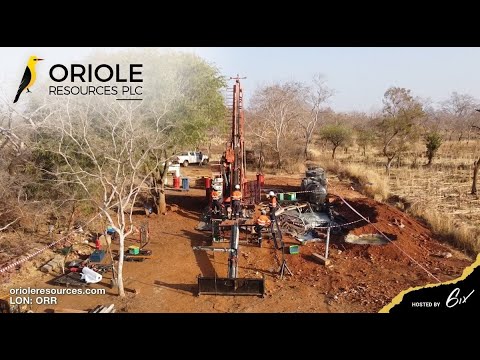
On 6ix: 6ix.com/event/senala-developing-resources-in-a-mining-district
Automated transcript · Written by software from the replay's audio. It can mishear names and figures; the replay is the record.
0:07 Hello, I'm Claire Bay, Executive Director for Exploration and Business Development at Oriel Resources, and today I'm going to be talking to you about our Sonala project in Senegal. This is our usual disclaimer, and it's available on the website along with the presentation, should you wish to have a closer look at any of the facts and figures presented here today. By way of background, for those of you new to Oriel, We're an A-listed junior exploration company focused on gold exploration in West and Central Africa. Our most advanced asset in the portfolio is Senala in Senegal, which I'll be talking to you today. But we've also got a portfolio of exploration projects in Cameroon. At the Bibimi project in northern Cameroon, we've recently completed maiden drilling for 3,000 metres, which has reported multiple intersections over multiple prospects.
0:56 And we'll be following up with a programme of further drilling next month. We also have a district scale package of licenses in central Cameroon. These are recently granted at the beginning of the year. They were identified by our team as being highly prospective for gold exploration but as yet they've not been explored by modern mining techniques or exploration techniques. And so we look forward to following up on that as the year progresses as well. We've already started to see positive results from that program through our stream sediment sampling program which is currently underway And we reported those results last week. And here's where our projects sit on the Lassonde, or project valuation curve. They're all within the first half of the curve.
1:44 I won't dwell on this too much, because our CFO, Bob Smeaton, talked to this in detail during our last investor video, but effectively we operate in this space because we believe it gives us the most value for our exploration capital. In essence, relatively cheap exploration can be used to develop the projects to resource definition stage, and it's through development of these resources and expansion and increasing confidence in these resources that we would expect to see a lift in asset value and therefore in the company value. So moving on to the Sonala project, our red license in the centre of the KKI is located within Berymian Age rocks that outcrop in eastern Senegal and into western Mali. We have, with the help of our partners, recently secured the license for a further 10-year tenure.
2:34 As you can see, we're located right in the center of the district and are surrounded by multi-million-ounce deposits, including Focola, Sadiola, the Sabadala-Masawa complex recently acquired by Evendeva Mining, And the gold endowment for the whole region is more than 45 million ounces. Most importantly for us is the blue dot just to the southeast of our license area, which is Iron Gold's 2.5 million ounce Boto Gold Mine Development Project. Iron Gold is our partner on the Sonala license. And they are currently in year 4 of a six-year earning period to spend $8 million for a 70% interest. The most recent update at Sonala is the fact that we've published a made-in-JORC compliant inferred resource at 1 of 3 targets within the FARI prospect, and as you'll see from the presentation, we've got much more potential within the wider license and also at Fari for additional resource development.
3:36 Prior to IonGold's involvement, the company undertook a number of exploration programs at Sonala, which identified 5 main geochemical targets identified by the gold stars here on the right hand side. The most advanced of these assets is the Farrer prospect and the Medina-Bafo prospect. And these are the 2 that Ion Gold has focused on to date. You'll see in the green boxes there are some previous intersections that we've reported there from drilling back in 2013 and 2014. Iron Gold's Year 1 and Year 2 programmes progressed well, and the work was focused on initially on the Medina Bafe and Cerrudo prospects due to their proximity to the Boto Mine Development Project. Really here, their intention of undertaking exploration is to identify satellite targets that could provide additional feed for the Boto Mine Development Project.
4:31 But then in year 3, we've seen them move up to the Fari prospect. This is by far the more advanced target. We've undertaken a significant amount of drilling here to date. And we believe as a company that there's the potential to host for it to host a standalone resource and mine development project.
4:53 Prior to undertaking any further drilling at depth at Farae, Iron Gold completed 6,000 meters of airport drilling, which was really undertaken to confirm the geochemical footprint of mineralization at Farae. And following that confirmation, they then moved on to a year 4 program, which we're currently in. And they've actually completed phase 1 of that programme. So Farae is a flagship prospect, as I've mentioned. Here on the map on the right hand side, we've got some previous drilling intersections reported by the company following our drilling programs in 2013 and 2014. And as I mentioned, prior to this, prior to infilling drilling around here, Iron Gold wanted to complete air-pored drilling over the entire 6.5 kilometer strike length of the system.
5:52 That had been previously identified 3 main anomalies, Far-A North, Far-A South and Far-A Far South. The purpose of that drilling campaign, as I've mentioned, was to define the geochemical footprint. We had actually already defined the geochemical footprint through soil sampling, but sometimes in these terrains, the presence of a lateritic cover or an iron-crusted cemented cover and a deep weathering profile can sometimes mask the geochemical signatures. And there can be questions over the representativity of the sample should there be transported material. And so the AC drilling was really conducted to test below the influence of these factors. And I'm pleased to report that the AC drilling confirmed very similar results to the soil sampling. It defined all 3 anomalies pretty much identically, except the fact that we do have some higher grade anomalies outlined in the Far North target and primarily that is just reflecting that the sample has been taken deeper below surface and so it's less, the gold response is less diluted by the weathering process.
7:07 But effectively that gave them the confidence to move forward to their year 4 program which as you will see there comprised just under 700 meters of diamond drilling in 2 holes and just under 5,000 meters of RC drilling in 42 holes. The diamond drilling is focused on the center of the far east-south prospect to test previous high-grade intervals returned through the company's drilling. And the RC drilling was really focusing on fully testing the anomalism at Farae North and Farae South which as until recently hadn't had any subsurface testing. So moving on to the Farae South anomaly, the mineralization here is associated with quartz tourmaline veining.
7:54 The 2 diamond holes that were completed to test previous intervals and the depth extension of mineralisation here are highlighted by the yellow boxes. And you can see how they clearly sit within the previous intersections reported up to 60 meters at 2 grams a ton by the company. Hole 30, the bottom 1 here, confirmed that the system extends to around 350 meters below surface. Meanwhile, the hole 31C reported a best intersection of 70 meters, grading 1.46 grams per ton, including a higher grade zone of 31 metres at 2.72. This intersection is from 1 metre below surface, so practically from surface, and shows we have a significant zone of wide mineralisation close to surface, and again supporting our opinion that we have a standalone target here.
8:52 And this is how it looks in cross-section. You can start to see quite visually where an open pit would sit here. We've got multiple multigram intersections close to surface. That's been confirmed both by our drilling and now also IAMGOLD's drilling. Again, we've got the white labels here are denoting the previous drilling intersections and the yellow labels or orange labels are denoting the recent results from Irongold. We've got mineralised zones up to 100 metres wide and we've got an oxidation depth of about 80 metres. Importantly, the mineralisation looks to be very disseminated in the near surface. We've previously reported a north-northwest striking breccia zone and this seems to be important in controlling the distribution of grade in this area, particularly where it intersects the north east trending shear.
9:51 And as we get further down to the system, out of the oxide zone into the fresher rocks, that mineralisation becomes more constrained to discrete veins. But ultimately with an oxidation depth of 80 meters below surface that's telling us that Mother Nature has broken down the rock, liberated the gold, made the whole rock more friable to dig out and this has really important commercial implications should this reach mine development stage. And on the basis of the results that have been reported to date, including those 2 new holes from IAM Gold's diamond program, We've been in the position to instruct an independent consultant to pull together a maiden resource estimate for the Far East South prospect target, that central anomaly where the majority of the drilling has been done.
10:44 And that modelling, as you can see, has defined a pit, a resource over a 950 meter strike length, which has returned a dual compliant inferred resource of 155,000 ounces at 1.26 grams per ton. This, as per all our intersections that we've reported to date, is based on a 0.3 gram per tonne cutoff. And it falls within a pit shell that's been defined using an $1,800 per ounce gold price. This resource sits within a larger exploration target. Effectively, that resource target has been defined on the basis of exactly the same data set and holes as the resource. But as you'll see from the image on the left, it's not made it into the resource shell or wireframe because those lines are too far spaced to give confidence and continuity of that zone.
11:43 But we really expect that infill drilling here will start to see some of those resources being pulled into the resource. And with infill drilling and extension drilling and drilling at depth, it's open in all directions currently, we should start to see those volumes and the confidence levels of that resource improving. Going back to the plot I showed you of the anomaly, you'll see how these resource outlines or these pits fit within that anomaly and it sits perfectly within that anomaly. You can see those lines, those northeastern most fence lines, you can see the potential for that 950 meter strike length to be increased within that 2.2 kilometer anomalous zone.
12:28 But really, this is just the first step. We do have more targets just at the Farae licence prospect. And it doesn't take into account any of the recent drilling that we've just reported, the RC drilling for Farae North and Farae South. And so we believe we've got significant potential for additional resources here, as well as upgrading the existing resources. So moving on to Farae South, last week we reported results for 4,854 RC meters. These intersections are reported in yellow here on the map and it relates to 24 holes at Fari North and also 18 holes at Farae South, Faroe Far South. As I previously mentioned, Faroe Far South has never been drill tested before.
13:24 And so we're very excited to see these results coming out. Importantly, because the best results from there, just from 1 fence line, was 35 meters at 3.61 grams per ton. Within that, we have a high grade interval of 18 meters at 6.46 grams per ton. So exceptional results. As I say, it's the first fence line. We've got another fence line that we're yet to fully report results for. We've got 4 holes outstanding. They should be reported later this quarter. And again, it's just highlighting the significant potential that we've got at this prospect alone. And with all the excitement of FARE, we really shouldn't forget Medina Bafe. As I mentioned right at the start, Medina Bafe has the potential, and I am boldly looking at it as a potential, for hosting satellite resource for BOTO.
14:19 Previous drilling by the company had returned a best intersection of almost 10 meters at 16 grams per ton and that was within this 1.2 kilometer long 30 to 45 meter wide corridor, structural corridor here as outlined by the blue dots. Those blue dots are highlighting part of Iron Gold's year 4 phase 2 drilling program there. They're the RC holes. There are also some yellow dots there which are the diamond holes that they've drilled. We've recently reported results for that diamond drilling which included a best intersection of 10 meters at 1.69 grams per tonne and we are awaiting results for an initial 3,111 metres of RC drilling, which we expect to receive later this quarter.
15:11 IAMGOLD has had to take a respite due to the weather, but we're expecting the programme to restart in October, or at least Q4, once the seasonal rains have subsided. We await their guidance on that and of course we'll report anything as soon as we get it. So in terms of what's coming up over the next 6 months from Senegal, we've of course got results for the 4 remaining RC holes at Farifar South. We've got completion of the remaining 2,000 metres of RC drilling at Medina Bafé during Q4. The delivery of the 3,000 metres, the results in Q3. And then details, once Irongold's had a chance to review all of this data, to decide the next plans for the programmes, either 1 or both prospects, We wait to hear their intentions there.
16:03 Towards the end of the year, we also expect to have further guidance on the continued infrastructure development at Boto. And finally, as we head into 2022, The end of February is the target for Ironbill to confirm that they've completed their year 4 investment with a minimum commitment during this year of $1.672 million. Upon that confirmation and completion of the programs, we anticipate that they would trigger their option to acquire 51% interest of Sonala and then we move towards their next investment period. Thank you very much for listening today. If you have any questions, please email us at info at oriolresources.co.uk.
16:54 And we look forward to seeing you
Follow Oriole Resources PLC into a list and get an email when it puts out news.
VP Exploration & Business Development at Golden Sky Minerals
VP Exploration & Business Development