Transcript
Automated transcript · Written by software from the replay's audio. It can mishear names and figures; the replay is the record.
0:04 Say good morning, good afternoon, or good evening, depending on where in the world you're logging in from today. I did see about 9 time zones represented at least, so I really appreciate people popping in from all over the world to join us today. I'm very excited to have with me the team from Scotty Resources. I've got Brad Work, the company's Executive Chair, Thomas Mumford, CEO and Presidente, and Sean Massey, the company's COO. Brad, Thomas, Sean, how are you guys today? We're good. Thanks for having us. Awesome. Now, here's how today's going to work, just for the investors in the room. First, the executives here are going to be running through a brief presentation. Then I have a series of questions, but then we are opening up to the live audience. So this is an interactive event today. There's a chat button at the bottom of your screen. Please press it at any time during today's event. You can ask questions of the folks in the room.
0:49 We're trying to keep today to about 45 minutes. So if we don't get to your question for whatever reason, likely we just ran out of time. I'm still going to make sure that the Scotty team gets those questions afterwards. So still feel free to ask them. Don't feel too bad if we don't get to them, but I will try to get to a number of them today. I'll also say that the recording will be available for today's event, likely about 2 hours after it closes. It'll pop up in the exact same link that you're watching the event on today, but it'll also be on 6's YouTube channel. My last piece of extremely boring housekeeping, but I encourage you to actually do it, is there's a request meeting button at the bottom of the screen. If at any point during today's presentation, you're inspired to try and meet with the Scotty team, please do press that button and I'll make sure to connect you with them. But that's enough out of me. I want to get into the meat and potatoes.
1:34 So Thomas, I'll throw it to you to start today's presentation. I appreciate it. Thanks, Romeo. Yeah, I'm going to go through a corporate update for the company here, and then I'll briefly talk about our exploration plan that's coming up this summer, coming on us very rapidly. We just news released that a couple of days ago. And then we'll go into some questions from Romeo.
1:54 So for those that don't know us, we're Scotty Resources. I will be making some forward looking statements here. We are sitting on a very healthy capital structure. So we've got a great treasury position right now. We've got a very tight, clean structure in terms of the issued and outstanding of the shares in the company. Market cap about 160 million right now Canadian. We've got very low warrants in the company. Fully diluted, we're only at 82 million shares, issued and outstanding. We've got some strategic partnerships that I'd like to discuss. So we've got Franco Nevada, they purchased a royalty office about 24 months ago, also put an equity investment into that. And what makes that notable is we were the first investment from Franco-Nevada to buy a royalty where the company didn't have an existing published resource.
2:41 Subsequently to that we have published a resource but prior to that we didn't have one. It was a great technical validation to our exploration and the discovery we made. And then the newest one is Ocean Partners. They are now our largest shareholder partner, equity position over 11% of the company. They've got an offtake agreement in place. Those are the group that's going to buy the ore that we're producing for our direct ship ore model. And I'll talk more about that as we go on through here. But they've also committed $25 million US to construction and cost overrun facility for the project itself. In terms of insider ownership, management directors own about 15% of the company. Brad, the exec chair on here, owns about 4% of the company himself. We have another strategic advisor that owns just about 9% of the company.
3:29 We've got some major shareholders, some very high net worth individuals and institutions that are into the story. So you've got Eric Sprott, you've got Ross Beattie, we've got Phoenix Gold Fund. We've got, oh gosh, I'm drawing a blank on a couple other ones there. Brad, you can chip in there. Well, Stiglitz & Templeton, our second largest shareholder now, just in front of Kevin. And yes, and then 20% of the companies, essentially 20% of the companies out of Switzerland, one of the funds there being Conwave or Eric Mayers, I think it's the best performing Gold fund in Europe, or at least last month it was. Anyway, so yeah, I'll let you keep going on Thomas, sorry.
4:16 Thanks, yeah.
4:18 So today on the call, you've got Brad, myself and Sean. I've been with the company now about 8 years. Brad's going on just over 10 years with the company. And then Sean came into the company about this time last year. Sean's prior job before this was the GM of Bruce Jack Mine, which is the mine just to the north of us. It was purchased twice while he was there. So once from Pretium into Newcrest and then Newcrest into Newmont. And so he's a gentleman that really knows mining in BC.
4:50 We've got a fantastic board of directors. None of the board knew each other before the formation of this company. The newest board of directors member is Brent Omland. So he's the CEO of Ocean Partners, that metal trading group that has taken a large interest in our story. And then we've recently hired a new CFO, so Chris Noon, he came out of Silvercrest after that transaction as well. In the last 12 months, we've had a pretty transformative year for the company. So we've published a maiden resource. We were in this area where we've got what was called Ascot before is now Cambria Goldmines, it's down the road from us. Starting up that mill, we were often considered to be a satellite resource to that project. But that had failed twice while we were starting to operate and after we'd made our discovery, and we were kind of ramping up and recognized that we needed to change course and show that we were a standalone entity.
5:44 And The easiest way to do that, and the most sensical way, was to basically become a direct ship ore model project. We're blessed that we have a road that goes down to a deepwater shipping port. It's just 40km down to the port in Stewart, BC, making us the second closest gold mine in the world to a deepwater shipping port, the premier of Goldmine being the first. So we published this maiden resource in May last year, came out with 700,000 ounces, an average grade of 6.1 grams per ton, making it very amenable to direct ship or shipping, given the high grade and the shipping costs associated with that model. Bear in mind you don't need the capital really to make the same standalone style project. It's very capital light because you're not building a full mill or a tailings facility.
6:30 Once we had to kind of committed to this DSO route, we went out for a strategic partnership with a metal trader. And so ultimately, we ran a process and Ocean Partners was selected. They put an equity position, which they subsequently bought more in the market from that. They've also put this $25M construction and cost overrun facility in place for the eventual construction of the project. Based on those 2 parameters, we were able to then go right into a PEA. So Sean led that process through last summer and the early fall. We published our PEA in October last year. Very favorable numbers. It was done at a gold price of just $2,600 US, having very robust margins. Even at the base case, the IRR was over 60%. To further support this whole thing and to show the proof of concept on it is we did a bulk sample. So, under our exploration permit, we were granted a permit. We applied for it in January. We received it in July. A couple of weeks later, we were mining and blasting.
7:29 We ended up liberating 4,500t of ore and shipping it overseas. The average grade rectified on the other end worked out to be about 14 grams a ton and we netted over 7.5 million dollars on that bulk sample. But more importantly, we showed proof of concept. So we were able to send more than 100 truckloads down the Grand Duke Road, operated with the port, and really got this whole thing done all before Christmas last year. So everything wrapped up within 1 year's time frame from the permit application to the mining, to the shipping, and the sale of the product. I'm gonna walk through what makes our project so simple and so easy to see how it gets from here to production. So everything based on where we are finance-wise, the jurisdiction, exploration upside, and then the team and the horses that we have to run this project. So I'm going to walk through these steps as we go through the presentation here.
8:28 So we're located in BC's Golden Triangle. It's a very prolific area for mining and for the geology and the mineral deposits that are hosted here. Our 2 nearest neighbours right now are Newmont, the world's largest gold company, and then Cambria Gold Mines to the south, which has the Premier Mine down just 20 kilometres south of us. Bruce Jack is the Crow Flies, is about 20, 25 kilometres to the north of us, but we're connected via road to Cambria's project down in the south. So we're in the southern portion of the Golden Triangle, one of the more infrastructure rich areas in the Golden Triangle. And so here you can see a claim overview map of our project. Most of our work is done up around the past producing Scottie Gold Mine. That's up in the northeast corner of this map. You can see that it's connected by a road all the way down to Stewart BC. So that's a 40-kilometre all-season road.
9:18 It's currently not being plowed out in the winter, but it was created in the 60s and 70s. It operated year round. It just hasn't been plowed out during the winter for the last number of decades. But We envision using it year round once we get operational in terms of mining. Cambria Goldmine, as I mentioned, is about halfway down. So we pass by it on our way down to the port in Stewart, BC. And then we're road accessible all the way down to Terrace, BC, which is where most of our crews come in and out. You've got the Bruce Jack transmission line going up right along the side of our boundary up to the north there. You can see that coming through. And you've got all in all we've got over 58,000 hectares of land. While most of our exploration is done around the Scotty Goldmine, we do have 2 other large contiguous pieces of land, what we call Cambria, which is located between Ascot, or sorry, Cambria's 2 pieces of land.
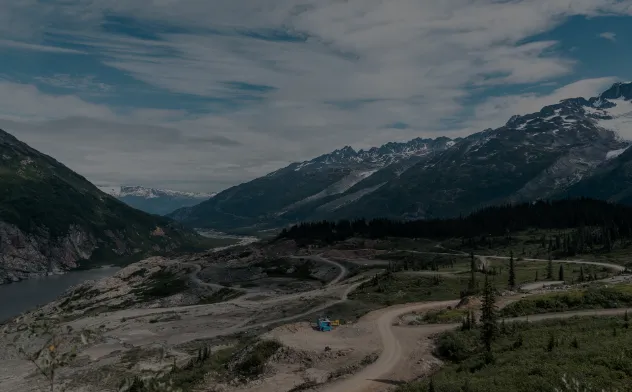
10:08 It's a little bit confusing now, but then down to the south, we've got the Georgia River Mine, which is our next most advanced asset. It's got a non-compliant resource on top of it, a very high grade classic quartz vein gold system through there. We've had some great drill seasons drilling it, but right now we're really focused on advancing the Scotty Gold Mine through to production. This is what the site overview looks like. So you've got the historic past producing Scotty Gold mine on the left hand side of the screen. You can see there's 4 adits in and around that. Those 3 adits that are closest together, those are the main access points to the mines. The bottom 1 is where the mill was. The one above that was where the power plant and generation was. And then above that is the main access portal to the deposit itself. And then you see that high at it up on the cliffside. That's really where the deposit sits up there. So it's a series of high grade veins. They're pure type pyrite rich gold structures. They're running largely east west, dipping slightly to the north, and they extend down underneath that lake bed. And what I've superimposed here is the lake level from the 1980s when the mine operated.
11:15 And you can see that yellow road there, hugs that shoreline just above the lake level. Now, subsequent to that, the lake has now completely drained out. You're just left with these small ponds and little streams in the bottom of the lake bed. And that's because the lake in the 80s was dammed up based on a large glacier down screen here. That was blocking the flow of that lake. But once the natural retreat of that glacier happened, then the lake flushed out. So you've got now this opportunity to look for the vein extensions of the Scotty Gold mine. You've got 2 piles of tailings that were deposited in the lake in accordance with the permit back in the 80s Those are now exposed at surface We've got an average of 2.1 grams per ton gold in the tails themselves from over 115 samples that we've taken from the tailings And then you've got the discovery we've made. So the Blueberry Contact Zone. So that's up on the right-hand side. So it's at the high point in the valley bottom. It watersheds off to the north and the south from the Blueberry Contact Zone. So that discovery we've made starting in 2019 and have been expanding it and developing it. And that's where the bulk of the resource sits.
12:19 All together we call this the Scotty Goldmine Project. Between Scotty and the Blueberry Contact Zone, that's a 2 kilometer distance. They're connected via the road but they're also connected via tunnel. That portal over by the Blueberry Contact Zone actually connects up to the Scotty Gold Mine. And then the Blueberry Contact Zone actually extends down under the lake bed. It's in this dotted white line here. That extends down under the lake bed. So something that they couldn't even have explored for back in the 80s when the lake was full. And so we've been pushing them down along that lake bed, continuing to expand mineralization in that direction over the last number of years as well. Looking here, overview of the blueberry contact zone. You can see that we've got 2 rock types bordering the yellow line down to the south, that fuzzy line. So that's the Blueberry Contact Zone. What it is, it's the contact between this andesite and siltstone rock or the Hazleton Formation.
13:11 And the mineralization is really locust around about a 40 metre wide on either side of the contact zone. So it's about an 80 meter wider band of mineralization that goes north to south along this contact. It is truncated on the north by a fault. You can see there's a strike slip fault at the north end there between the diorite and the siltstone that offsets the mineralization. And we've got a pretty clear idea where that offset occurs to. And we've been exploring that to the Northwest, which is, sorry, the Northeast, which we call the Stockport zone. But this really explains the strike length that we see at Blueberry. You can see these fantastic grades and strong widths of the deposit. And what really sets us apart is that the mineralization goes right to surface and it's right along the road. All of this drilling that we do at Blueberry is all done with skid-based drills.
14:00 And so it's quite a bit more operationally simple. It's also cheaper to operate. So we don't need a helicopter to operate this part of the drilling. When we do get up into the Scotty and some of our other targets, we do use a helicopter for helicopter-supported drilling. The closest analog in terms of a geological model for this would be the SNP mine owned now by Askena. It is a Gold-Pyrite intrusion-related system. Very little amounts of visible Gold in the system, but fairly high-grade, well-disseminated mineralization associated with these Pyrite-bearing veins that we see in all the deposits that we have on the property. When I look here in a long section, so we've taken a slice right down the contact, we're standing here on the andesite side looking toward the siltstone.
14:47 You can see the fault at the north end truncating the mineralization. You can see these high grade clusters of mineralization kind of projecting down into the north, down into the left on this, and that's really the orientation of the veins intersecting the contact between the siltstone and the andesite here. And that's really where the high-grade zones for the underground deposits exist. At surface, we envision mining this with an open pit system. So what I've superimposed on this image here is the pit from the resource. So the 700,000 ounce resource that we published, this is the pit from that. In our PEA, we've actually tightened up the pit, moving it more to the north and focusing on just the really highest grade material there to give us the best economics on the project. It also eliminates, you know, any dead zones created by a crown pillar, that buffering between where you go open pit to underground as well.
15:41 Here's we've got to look at the old Scotty Cold Mine. So back in the 80s, most of the production was from what they called the M zone. That's where the 95% of the production from the project came from. They pushed over to the O zone late in the mine life, but then the mine shut down shortly after they got into the O zone. Subsequent to that, we've discovered what we call the Wolf Zone to the south and then the Pea Zone to the north. You see there's a very, very rhythmic set of periodicity between these zones. And so we're kind of early stages in both the Pea Zone and Wolf Zone. And so we continue expanding those. And the reason the mine shut down in the 80s is a bit interesting. So it had a very high cutoff rate. So 10 grams a time was the cutoff rate. So anything less than 10 grams was considered waste when the mine operated. But the issue was, you know, was the interest rate. So they took a loan out at $20 million in
16:33 1979, 81, so late 70s, early 80s at 22% interest. And so that loan just became unbearable when the gold price fell from about 700 down to less than 350 over the mine life, which was 3.5 years. Now, when they shut down the mine, they had about 2 years of production ahead of them in reserves.
16:54 So, you know, the mine didn't run out of ore, it just, the economic situation of the day killed this mine. The mine permit's still in care maintenance, and so what we envision is taking that M139 permit, taking it through what we call a JAPA, a joint permit amendment application, to restart this project under that guidance. And so we've confirmed that with the regulators. So we're not planning to do a full EA. It's a joint permit amendment application in order to get this project up and running again, which is about a two-year process ahead of us right now. So we're looking to be in production in about 2028. And this process isn't that novel to the area. So this is what Ascot used to get restarted as well because they had a past producing mine as well in the area. Here's the resource estimate that we published last May. So this doesn't include any of the 27,000 meters of drilling that we did in 2025.
17:47 And then it also doesn't include anything that we're gonna do this summer. So we've got a large program planned for the summer, kind of the largest program we've ever done. But all in all, this resource was designed to support a DSO project. You can see the grades there. So it's average grade is 6.1 grams per ton, contained metal is about 700,000 ounces, most of it being in underground at both Blueberry and at Scotty.
18:13 And so I've mentioned DSL a few times already and what that stands for again is direct shipping ore. So taking ore without processing it at site and then shipping it down the road and then shipping it across the ocean and selling it to ocean partners who have a facility in Taiwan where they're going to grind it and then mix it in with concentrates and sell it off to smelters. We actually get paid on the raw material contained on the ship. So once it sails 5 days after bill of lading, we receive a payability structure based on the contained metal in that shipment. So we're not really worried about extraction on this, although we do have quite favourable mineralogy on the project. Past production at Scottie had mid-90% recoveries from a cyanide leach plant, and then we've also done some network that supports that. But in terms of a DSO shipping product, we're shipping a very coarse grain product. So we're looking at shipping 3 inches or less size fragments down the road.
19:12 We are looking to jaw crush it at site and then run it through an ore sorter. And the ore sorter allows us to upgrade the product so that we're shipping less waste and at a higher grade, both which are advantageous to us with the agreement that we have with Ocean Partners. We're rewarded on higher grade payability structure and also reducing shipping costs is a major portion of the success of this project here.
19:37 So looking here now at the mine plan, this is looking at Blueberry. This is at the same aspect that we were looking at that long section. So you can see the 3 small open pits. These are about 70, 65m depth on the pit. So they're quite shallow. They're very short-lived. So they're only going to be operational about 18-months for the project. And the average grade of that open pit is 7.7g per tonne gold. And that really de-risks the project because that really helps pay back the entire capex of the project. And then we're going underground with that at Blueberry. And so you can see there's a ramp structure on the far right side, which would be the south end of Blueberry going down and then accessing all these stokes as we go. What we're planning to do is contract mining for both open pit and underground. I mean running a pit for just 18 months doesn't really justify buying all the heavy equipment and then for simplicity of the operation and trying to you know have as many components as a variable cost model as possible. We're looking at contract mining for both the open pit and the underground.
20:39 The plan is once we finish the open pit, so after about 18 months, then we'll start the underground development at Scottie. You can see that ramp structure on the left side of Scotty here. There's a lot of expansion potential at Scotty still to date and so that'll be something we do over the coming years here to expand this resource.
21:00 We also have some opportunities with the rehabilitation of old workings. The PEA envisions 100% new development in here. So we're going to look at that as a trade-off study in the new feasibility that we're underway with. The other thing is there's some sterilization of stopes based on the modeling we did on the existing workings. And so we're bringing in a scanner this year, so a drone scanner to go underground to scan the existing stopes so we'll get a better control on exactly where the stopes were back in the 80s. And with that we can hopefully unsterilize some of the land that we have here and where we know there's high-grade mineralization. So that should support resource growth on the project just through that exercise.
21:44 Looking at the overall mine plan, I mean, It's more of a quarry than a mine per se. The big infrastructure pieces for us are really the camp. We've got a shop and a warehouse and a power plant. We're looking at natural gas generations. We need about 6 megawatts of power to operate this project. We've got the sorting plant, so that's where we're gonna do jaw crushing. We're gonna run it down a conveyor and then into twin
22:09 parallel ore sorters. So both XRF, or sorry, XRT systems. So It's a density-based system to sort ore from waste. And we're getting about a 50% mass pull in the PEA, which suggests that we're almost doubling the grade of the product, but stripping out about 50% of the material from it, which would be waste. And So we're upgrading the product and really cutting down what we're shipping and what we don't need to ship. And then we're looking to put a road in the valley bottom to access Scotty to bypass that long tunnel that they used in the 80s. The largest surface disturbance actually on the project is really the waste rock storage. So once you start separating out all that waste from the ore with the ore sorter, placing that is kind of our largest surface disturbance because there is no tailings, there's no mill associated with the project.
22:59 Looking at the economics here, So down the bottom right, you can look at the quarterly Gold production over life of mine. The light blue is the production from the open pit. Then you're into the blueberry underground and then coming in late in the mine, you've got the Scotty Gold mine producing there. And so as it stands today with the resource that we have in place. We've got a 7-year mine life. The average grade works out to 6.8g per tonne. That's before ore sorting, so that's the average mine grade. The Gold recovery, that's based on the ore sorting. You're losing about 5% to the ore sorting process.
23:32 You're looking at an average production of 65,000 ounces a year. And if you look at gold price at $4,200 gold, which was the highest that we did the study, you're looking at a $670M NPV on the project with a 150% IRR and the capex to MVV ratio is crazy at 5.2%. Now one other thing that we looked at in the PEA was, you know, instead of shipping this overseas, what if we were to toll mill it through a nearby mill? So we looked at the potential of going through the premier mill, which is just 20 kilometers down the road. We have no agreement in place with Cambria at the time being, but we've just looked at the economics. Essentially, you're changing the payability structure And you're also
24:17 cutting out the shipping costs here. And so that has a serious impact on the NPV. At any of these different prices that we've done the study at, you're adding about $150M in NPV to the project on that. And you're driving that NPV to CapEx ratio up as well. Now the project looks like an US$830M project at US$4,200 Gold. This is based on the resource that we had prior to the drilling that we did last year. This is also without any optimisation.
24:46 This is taking the rocks that we would have planned to ship overseas and just running them through the toll mill at Cambria as an alternative. So it doesn't envision, you know, we could probably drop the cutoff grade, increase the resource, increase the amount of gold that goes through the project. So I think this is a starting point for what a synergy could be between these 2 projects, between the Premier Mill, which has a struggle to fill it and our project just 20 kilometers up the road. In terms of resource upside,
25:19 we've been only drilling since 2019, but together as a company, we've only drilled about 100,000m of drilling. Most of our drilling has identified that there's a primary control, which is the contact between the Texas Creek Plutonic Sweep, which is really in the northwest
25:35 portion of this map here, all the mineralization we've identified is usually within about a couple of hundred metres of that contact. And the 2 most intensely drilled zones, the Scotty Gold Mine and the Blueberry are what really constitutes the bulk of the resource that's in the deposit right now. There's many other zones that don't make it into the resource yet. So you can see there on the bottom right there, things like Stockwork, C&D. These have fantastic grades, strong wids. These are very analogous to what we see at Scotty and Blueberry, similar styles of mineralization. These are the areas that we continue to explore year after year and looking to expand them to the point where we can include them into future resources. All in all, we're targeting over 2 million ounces in a resource and we're standing today with just 700,000 ounces in a resource.
26:23 I'm going to skip over this side because in shortly I'm going to discuss what we've done, what we're planning to do in 2026. So this is kind of looking back and so I'll talk here in a moment about what we're gonna do in the future. But just for now, I just wanna highlight the project timeline of where we're at today. So we have made that decision, the EA pathway decision. So we've news released that. So we've decided to go this joint permit amendment application route. So not doing an EA. We are well underway with our environmental baseline studies.
26:54 And we are, you know, ongoing engagement with the First Nations, very important to us and something we've been very diligent about. We've recently signed a capacity funding agreement with the Nishika Nation and are moving forward with an IPA negotiations on that and collaborating with them on the environmental baseline studies and the development of the Joint Permit Amendment application. In terms of engineering,
27:17 we're entering a season, we're looking at potential early works, you know, road development this year. We are well underway with the feasibility study. We've selected Tetra Tech as well to run that feasibility study. Tetra Tech was the environment or the engineering group that also did our PEA. And so really what we have happening next year in early 2027 is the release of our feasibility study and the completion of our environmental baseline studies. And those are the 2 long lead time items. And those are what are necessary to really trigger our permit application and get the permitting process underway. In terms of timeline for the permit, once submitted,
27:54 our timeline suggests about an eight-month turnaround. And that's based on the ASCOT permitting. So they submitted their permit and received it about 8-months later. So that would put us into mid-2028 receiving our permit. And so we could be in production that year. As I mentioned before, with the bulk sample, mineralization goes right to surface. Open pit mining is quite effective and easy
28:17 to get going with this type of project. So we look like, you know, late, mid to late Q3, we're going to be in production in 2028 with the timeline that we've laid out for us right now. In terms of First Nations, so I mentioned the Nishka. So, you know, they're heavily involved with the process right now. We have monthly meetings with them. They're well aware of what's going on. They've also recently
28:43 made a joint purchase of the bulk shipping facility in Stewart. So that's where the concentrates for Bruce Jack, for Red Crest, and that's also where we ship sent our bulk sample out of. So Nishika, our part owner on that, in conjunction with the Tall Tan, as well as Arrow Transportation. And then we've got the Ski Kamalasah as well, a small band that's nearby, and we're using them as pad builders this year up at the project. So in well communication with both First Nation groups in the area.
29:13 And as far as this season goes, I mean, we've just released it, we're planning over 50,000 meters of drilling this season, largely focused at Scotty and Blueberry, advancing that project. But we're going to hit a lot of exploration targets that we haven't hit in a few years. So we've got Domino, we've got C&D on the books, Stockwork Zone as well.
29:35 Yeah, you're going to see a tremendous amount of drill results coming out of us. We're starting to push the road in June 1st and hoping to be drilling by mid-June. And so news releases probably late July, early August, and then they'll continue well through the early winter. And then we're looking to publish our feasibility study in March, April next year, ideally. So a big exciting year for us. We've got, in addition to, I mean, that's just our drilling. So we've, In addition to that, we've also got geophysical plans. We've got an MT study. We've got 3DIP going. We've got a new LIDAR survey and all the environmental baseline work continuing throughout the winter, sorry, the spring and into the summer this year and right into the fall. Yeah, it's a very robust year for us.
30:22 By far our biggest project yet to date. Yeah, looking forward to getting going there.
30:30 Awesome, Thomas. Thank you so much. I really appreciate the thorough presentation. It covered a lot of my questions, which is great to be able to save us some time. But Brad, I want to get you in here. Give Thomas a break for a second, if you mind. Just to talk big picture for a second. How would you describe the evolution of the Scotty Goldmine project over the past 12 months. Over the whole past year, what's your what's what's your view of how things have changed?
30:53 You know, once we signed the deal, I mean, things started to change when we did the Franco Nevada deal a few years ago, and then because of the technical credibility that perhaps we received from that. And then, you know,
31:09 we've been sideways for 5 years, so really things changed about not even a year ago today because I still hadn't signed. We were working on the deal. We ran a process with the metals traders. Right around this time we knew we were going to get this deal done, but we couldn't tell anybody and we were 80 cents and we had a drill program and we didn't have enough money. So, I've raised a lot of money. And so things really changed when Ocean Partners came in, funded to do a 27,000m drill program. And then of course, the drill bit was very kind to us as it has been year after year. Tommy failed to mention he won an award for exploration excellence in 2026, so we're not going too far back and relying on old awards.
32:04 The amount of people who are now willing to explore what's going on at Scottie, where before it was really us pushing in. And so that's a big change we see. And Yeah, a big transformational year. And again, I think sentiment in the market for our company and because everybody did well. I mean, 2025 was a hell of a year for metal investors if you're up at the top end of the pyramid. So, you know, that trickle down effect is real because it's mathematically, you can prove it. So I think,
32:36 you know, they're just much more eyeballs. My phone, it's insane how many emails and phone calls I get every day. So that's what you want. So going into a big season, 50,000 meters, that's a lot of news that we're fully funded for. It's been a lot different than when Thomas and I first started and there were 5 of us on site. Now with Sean, he's got a lot of people on site now. They don't even let me up there anymore. So you can spend some time at home. That's good. As you said, 2026 is potentially quite transformational for the company. To put a fine point on it, what does success look like by the end of this field season? What's going to have us at the end of this season on another webinar with you saying, Holy smokes, we got that?
33:26 Is that to me? That question is to me? Yeah, go for it, man. Okay. I mean, first off, because there's so many moving parts, safety is what keeps me up at night, you know, because there's just, we'll have 7 rigs and helicopters and so you just always have to be aware of that. But, you know, we even blushed with 2025 season. Now, I understand that's a lot of development drilling, but what it did is our proof of concept on the model strengthened and how do we get a program done like this? It's almost twice what we did last season. So Sean and Thomas have hired a heck of a team where we're a lot bigger company now.
34:13 So I mean, first off, yeah, that's my biggest thoughts. It's not that in the first 5 years you just pray every drill hole works, right? You know what I mean? Until you put the truth machine on, you don't know you have these theories. You know, I'm less concerned about hitting. It's just we're developing, we're expanding. So safety and then hope the market holds in for us. We've just been blessed with such great financial partners, our shareholders, because a lot of those names that Thomas mentioned have been supporting us for years, even though the market, it's been a tough road. Again, we were kind of sideways. We didn't really lose anybody any money. We just weren't getting any traction in the market. That seems to be changing now.
35:01 And yeah, well, I mean, 50,000 meters, that's a big program for such a little company like ours. No, it's a big deal. Thank you, Brian. I appreciate it. I'm sorry, I'm just rambling on, but the reality is I'm really excited about that feasibility study and the updated MRE. And that's less than a year away. And I think that it just puts a few bullets in your quiver and maybe there's more credibility to be had there. I appreciate that very much and hope to speak to you again once all that's through. But Thomas, I'm going to give you a break. So I'm throwing it back to you now for some exploration strategy questions, if you don't mind. One is, I know you talked about during your presentation, why is that blueberry contact zone the major focus this year? And what do you believe the market might be underappreciating about that right now?
35:54 So the reason that Blueberry is a main focus is it'll be the first production from the mine. So putting that in the feasibility, getting as much of that resource to indicated and expanding on the indicated ounces. But the feasibility is very important to us. So obviously, the open pit comes in first in line and then going underground there. I think what the market maybe doesn't fully, hasn't baked in yet, is that the deepest hole that we've drilled at Blueberry is at 525 meters depth from vertical. And we hit on the same structure. It was mineralized. And so we've got 2 holes at that depth. They both hit structures down there, both had grade in them. So there's no limit to the depth on this project yet. And then along strike we're at 1.6km in strike length. So we've got a huge amount of exploration at depths that we've never tested at.
36:44 We've really focused in the last 2 seasons, we're really focused on the top 400,350 meters, trying to get something to put into a resource as quickly as possible. And now we have the meters this year in the budget to go down deeper and show that this thing really expands in depth. And that's how we get to 2 million ounces, is we expand Blueberry, make a few more discoveries along the trend that we've identified, and just kind of grow it that way. And Blueberry is the cornerstone to this because it's the first to that in terms of production. Awesome. I got one more on exploration strategy and then Sean, I'll be dragging you in for a bit if you don't mind. But Thomas, last question for you here. I know there's also several newer, less tested targets included in the program. Dominance RAC are good examples. How important are these regional targets to the kind of broader district thesis you guys are building?
37:37 Yeah, so that's what gets us, you know, 2 million plus. That's how you can show how we can get to 3 million ounces if you can really expand on Domino. So Domino is really interesting. It's kind of 1 that we've not really been able to sink our teeth into. So we drilled it for 2 seasons back in 2020, 2021. And we got a little bit of sniffs on it. I mean, the surface sampling is great. It's got a good geophysical target on top of it. The veins outcrop at surface, you're getting 50g a ton all over the place. But we weren't getting the widths that we were getting at Blueberry. So at the same time, we were getting the widths at Blueberry and Domino requires a helicopter to get up and over to the other side of the mountain. So it just dropped off the priority list of where we wanted to put our meters in when we were drilling these small 10,000m programs.
38:24 Now that we've got 50,000m, the goal with Domino is to strike some big long holes and look for the structures that give us the width that we have at Blueberry. We're at a higher elevation. Basically, the Scotty Goldmine and Blueberry are stratigraphically at a little bit of a lower elevation. We're hoping that what we see at Domino is just the surficial expression of the same mineralizing system. So we've got a lot of hope for Domino. It's got a great strike length. It's about 800 meters in length on the surface that we're sampling anomalous material. And then it's 2 kilometers from Scottie. So it just gives us this huge blue sky opportunity. So if we hit 2 or 3 metres of above 10g a ton at Domino, I think that really will sell the market. We've got another blueberry Scotty style zone on the project And it's got absolute legs in order that we can carry the project forward on that and show that pathway to multi-million ounce deposits. I appreciate it. I love flicking behind the curtain on exploration strategies.
39:25 So appreciate it. Sean, I'm going to get you in here and I will start by saying I am biased. I love DSO. Rocks in a box. It's easy for me to understand conceptually. But can you talk about how the bulk sample helped validate the DSO concept operationally and economically? Well, the bulk sample was really great because what we got to do was essentially run the mine short of the sorting process. But basically we did a small open pit trench cut. We crushed it on site with a contractor, trucked it to Stewart, and then we crushed it with a cone crusher in Stewart and put it on a ship and sold it. So we got to test all of our permitting processes for sending material overseas. There's quite a bit of work involved in that.
40:16 Arranging shipping, dealing with shippers, the trucking down the road was significant to make sure that we were, you know, the road is still in a good condition to truck those size trucks and that many. And what does the traffic look like coming through Stewart? All those things, you know, really help proof of concept wise. So really the only piece we were missing, you know, this was all sort of smaller contracts that we did to do the work, but we were really only missing the ore sorting. And that was basically what the mine is going to be. It's a gravel quarry. And I would just point out, when we were doing the bulk sample, we also partnered with the town of Stewart. And so when those trucks were going back up the hill empty, we actually had them filled with gravel.
41:05 And so we were improving the road on the back haul. And so the town of Stewart really supported us on that. And they paid for the gravel and we just paid for the trucking that we were doing anyway. Awesome, that's great kind of local cooperation. Sean, I got another one for you. I know the company's now, and Thomas mentioned this briefly, but just to have you reiterate, I know the company's now advancing extensive environmental and technical baseline studies. Wonder if you could just speak more to that, give us a bit more context on how those are going at the moment. Yeah, so like what Thomas said is the really, the critical path to permitting in BC is the environmental baseline work. You need 24 months of meteorology, water quality, water quantity, a few other value components.
41:52 And then you'll need 12 months of study of wildlife and the flora in the area. So there's a specific process of environmental baseline work to be done in order to be ready to submit a permit application. So what all that information does is it informs with the biologists and the specialists on what the conditions are before the mine is built. And then what happens is you've described what the project is and then it can, these same professionals say, OK, well, if we do this pit, it's gonna have this new effect on the environment and it's gonna change the baseline to this.
42:42 So then what happens is you design, okay, if that's gonna be a negative effect on the environment, we have to do the X, Y, and Z to make sure that we're protecting the environment. So that's what that whole process looks like. And at the same time, you also need to advance your basic mine engineering. So your road design, your building design, your what the mine design looks like, where the tunnels are, what the ground support is, what the pit looks like, how you get into the pit, what's the scheduling, all that kind of detail gets done on the mine engineering side, and you need all of those to submit your permit application. So the permit application in this case is going to be thousands of pages. It's going to be probably 10,000 pages of documentation to submit for this permit. What we're going to get back is a 10-page document that says, we agree with what you put in this permit application, and these are the conditions of doing this work.
43:49 So that's how the process works. And like Thomas said, Ascot at the time did the very same process for Premier and the permitting process once they submitted was 8 months turnaround. So that lines up with the deck that's available on our website, the 1 Thomas went through and that timeline. So that timeline has been vetted by the consultants. It's, you know, basically we've talked with the regulators about it and it all fits timeline wise. Awesome. So that's what all this stuff is about. It's getting to a permit application. That's the work people don't see, but obviously it's important to getting across the finish line.
44:34 Thomas, I've got one for you. I was on with Byron King a while ago and he said the only thing sexier than visible gold is a road. And I thought that was such an interesting comment. I know the Scotty project is road accessible and located near existing infrastructure in the Golden Triangle. So for new investors, I know there's a bunch in the room, might not even be familiar with the region. How important is that, like the infrastructure to future development? Yeah, I mean, it's Very, very important from a variety of different aspects of it. I mean, it allows us to have our drill costs around $400 a meter. We're driving right into site. It's an hour drive north of Stewart. So it drops your exploration costs. It makes that a lot easier to operate. You're not restricted by helicopter windows associated with that.
45:20 And then when you get into development, I mean before you want to build anything you need to put the road in and then the road takes years to do and it takes years to permit. And then there's the cost. I mean in the mountainous terrain of the Golden Triangle, you know, everything is over 1 million dollars a kilometer and other places it's 2 plus million, depending on the terrain that you're looking at. And then you start looking into tunnels or conveyor systems and piping. So the road makes the bar to entry so much lower for us. That's how we can have a project that's got the economics that it does with a CapEx of only, you know, less than 130 million Canadian. That's why it exists because the road and the infrastructure and the support systems that are already in place for the area. Awesome, I appreciate that. I'm gonna throw 1, Brad, to you. I had this question, but it's also reflected in the chat. Somebody asked, will current treasury get you through 2026's program, or is there gonna be a financing this year? So basically, that question is better framed than mine, so I'll throw that to you.
46:21 No, I understand the question. We get asked a lot. I mean, today I think we're US$37M in the Treasury, we're quite forward. I mean, The drilling this year is going to be US$24M to US$26M and that permitting that Sean was speaking about is not cheap. We plan to spend all that money this year. As far as are we going to do a financing, essentially we're in lots of discussions right now. There's many different things for us to consider because that feasibility is coming right at us. We're in lots of discussions right now with our partners first. Again, we could put 60% of the stock around a large private dinner table.
47:09 And so just conversing a lot with the partners on what strategy and how much maybe existing shareholders would like to contribute. We've got some very well-heeled mining investors in our ecosystem. So It's something that you never stop thinking about, but right now I think what will be really busy this year with the 7 drills and all the people up north is we're going to do an awful lot of site tours this year. And so if anybody's watching and thinking you'd like to come up and do a site tour if it's appropriate for you. It's going to be a very busy time up there, again, with lots of groups coming as we look at different ways in which we go forward from a capital structure point of view. So lots of discussions.
48:06 Yeah. Awesome. No, appreciate it. And last one for me, and then I promise I'll get to the audience questions. I have time for a couple before we break. Thomas, big picture, best shirt in the room. What should they be watching for over the course of the 2026 season? What news items should they be keeping a keen eye out for to see what happens next? Scotty? Yes, I think you're looking for exploration success on the project. Look for the deep holes that we drill at Blueberry, look for the holes that we're drilling at Domino and C&D. Those are future resource growth areas. Those aren't going to be reflected immediately in the feasibility study. That'll be focused on the near-term production of the indicated ounces, but look for those, how do we get to 2 million ounces? So I think you'll get a glimpse of that with the exploration success that we have this year. And then early in next year is gonna be the feasibility, the resource update, and any potential financing structures associated with the capital cost of raising the project.
49:02 Because once we have the feasibility, we're going to have the baseline studies in hand. That's when we're going to start really looking at what this permit application looks like and getting that in as soon as possible to start that clock. Awesome. OK, let me get into one question that came in in advance of our email. And Sean, I think I'll throw it to you. When is the next bulk shipment going to take place? And what do you anticipate that income might be? So one of the interesting aspects of mine exploration permitting in BC is you're allowed to have a bulk sample permit once every 5 years. So our next bulk sample is gonna be full production in 2020. Awesome, I appreciate that answer. There's a couple in the chat that we've already sort of been through, so I'm not going to get too in the weeds with them. But one person asked, I think this is worth reiterating, I know, Thomas, you mentioned it quickly, but I just want to remind you of which Indigenous groups you're in conversation with in your district.
50:01 Yeah, the Nishika Nation, the first treaty nation in B.C., and then the Sikikum Lata group. Those are the 2 that are most impacted by the Scotty Goldmine project itself. We have some other nations that we're in contact with for other parts of our project, but for the Scotty Gold Mine project it's the Sikkimata and Nisga'a Nation. Great, thank you. Paul from the chat who first wants to congratulate the team on the terrific work accomplished today. He says taking the original postage stamp size footprint to the now encompassing size is a credit to you guys, So I'll start with that. But his question is, he mentioned one of the biggest problems is the waste rock. He wants to know what's the expected grade of waste rock, and is it possible to be used as backfill in underground stopes? And do you expect the mining permit to be adversely affected by that waste rock? So all a series of waste rock questions, Sean, I guess I can throw it to you, but anybody who's got feelings can jump in. Yeah, I did see that question in the chat. I mean, the waste rock isn't really a problem. It's just the biggest footprint on the site. So it'll, again, it's part of this whole, all this environmental work. So we'll have to, we'll have to characterize what it is, what it might do to the environment. And then we'll have to have a plan for whatever that, whatever that does.
51:17 It definitely could be used and will be used for backfill. Once we have the volumes of Scotty's old stopes, we're going to likely have to backfill those as well. That'll be part of the feasibility study. So we'll understand from a geotech perspective, you know, what needs to be backfilled in the historic mine workings. And we also could put some of the waste into the pit when it when the pits are done too. So there's going to be waste left over. There's going to be waste rock left over. There's no question just from a volumetric perspective. But yeah, we'll put it wherever we can stick it. I appreciate that. Now, I know I'm already 6 minutes over like a jerk. So I'm going to end with 1 really quick question. Somebody in the chat sounds like they've been burned before in Ontario. They just want a refresher on what permitting timelines are like in BC from here.
52:10 I know you mentioned targeting production, but Thomas I'll throw it to you just to speak on what those permitting timelines look like from here. Yeah, I mean, go ahead. I was gonna say, maybe I could take that one. Ontario is quite a bit different than BC. BC, we've done quite a lot of work in BC on sort of codifying the permitting process and the First Nations is more straightforward. It's actually, there's quite a well-defined process in BC with First Nations. So as Thomas mentioned, the Nishka is actively a part of our permitting team already. So, I mean, the way that it works is very codified in a way. Also, again, we're sort of copying, we're using the same timeline as what Ascot had for Premier.
53:03 So we have an example 20 kilometers away with the same nations in the same location, slightly different project. They have a cyanidation plant and a mill and stuff, which we don't, which makes it simpler. And we don't have tailings, which they do. But it all you know, it's very analogous kind of jurisdictionally for sure. And within the last 5 years that they permitted as well, It's very relevant to today's position. If anything, the political climate has gotten more favorable. That's a word on the street, so I appreciate that. Thomas, Sean, Brad, thank you so much. I know I've taken us over time a bit. And everybody in the chat, I know I couldn't get to every question, I do apologize.
53:48 What I'm going to do is make sure all those questions get to the Scotty team, they'll be able to get back to you on email or phone depending on which you entered on registration. But Sean, Thomas, Brad, thanks for the presentation, but also for letting us all grill you. I really appreciate you taking time and speaking to the market. I hope you guys all have a wonderful rest of your day and same to everybody in the crowd.