Transcript
Automated transcript · Written by software from the replay's audio. It can mishear names and figures; the replay is the record.
0:00 Silence. Good morning, afternoon, evening, everybody. Welcome to Spotlight
1:37 Mining and 6 Media hosting Rupert Resources for an investor update. For those of you who've joined us from Beaver Creek, thanks for dropping out. It's been a great show so far. Lots of good meetings. We're very pleased to be joined tonight by Tom and James from Rupert. So I don't know if you want to start just by introducing yourselves quickly, Tom. I'm Mike. Yeah, I'm Tom Cuddy. I'm head of development at Rupert Resources. I've been with the company for almost 5 years now. I'm involved with the kind of acquisition as part of our project in 2016. Yep. Great. Hi everyone. Thanks for taking the time to join this. James Withel, CEO of Rupert Resources, joined in April 2017. Previous to that, I was 13 years as a partner and fund manager at the Bexsteel Capital Managers Precious Metals Fund on the gold equity side, and a geologist prior to that. So anyway, thanks for taking the time. Good to see it.
2:35 Thanks guys. And a quick thank you to 6 as well for hosting us on their platform tonight. It's the first time we've used it. So I don't know if Tom and Sam and James are on the call. I don't know, maybe if you want to give a guide to where the chat features are, the Q&A's. I can see a Q&A feature on the right. But feel free to get your questions in throughout and we'll come to a Q&A at the end and all have a good chat together. So without further ado, Tom, if you want to take it away and enjoy the show, guys. If you can share the slides, I'll let James kick things off. Okay, well thank you again. So, just going to start off with a presentation. I think we're going to try and keep it all within 30 minutes, wrap it up. So just going to head through this. And yeah, I guess we'll give you a bit of a background on the company and also show you a quick video clip of some of the recent core that we've been been logging that was in the press release on Monday. So Rupert Resources, for those who don't know, I guess, acquired this part of our project, which is the mine and everything, which is on the left hand side of this image.
3:41 And that was in 2016, for just 2.5 million dollars, right at the bottom of the market. It's a great opportunity really. And it's just all about timing this business. So, you know, getting that right at the bottom. And then the picture on the right is actually our exploration. So there's the 2 parts of this company. It has a, we have the mine and the infrastructure and everything that comes with it and a growing resource there. And then the real opportunity and probably the real driver behind me joining Rupert Resources was the potential I saw beyond the mine. Not only did they acquire a mine and mill that's permitted, but they also acquired 40 kilometers of this belt, which ourselves and some of our peers are showing to be very, very prospective. I mean, it already hosts Europe's largest gold mine at Kitteler. And I think with the 6 discoveries we've managed to demonstrate in the last 18 months coming through pretty quickly really. We're just beginning to sort of scratch the surface of what could be the opportunity here.
4:39 So a few cautionary, usual cautionary statement, obviously be some forward-looking statements, so referring to this. So again just a few of these highlights here. As said, we acquired a permitted recently producing mine, last produced in 2014. Finland is a fantastic place to operate. It also has hosted some significant deposit or continues to host some significant deposits, you know, greater than 2 billion dollars worth of NSR value. But obviously we're focused very much in the central, in the top of Finland here, right in the Central Atlanta Greenstone Belt, that's where Paatavaara is, and Kittilä, Skaati, Kivitsa. We also have some assets down in the central part of Finland here, but there's a number of really large deposits that have been found over the years.
5:30 My background, obviously as a fund manager, probably brings a slightly different approach to exploration and that background as well as being a geologist, I think you'll see comes through in our approach and what we're trying to demonstrate. And that's obviously, there's a big box there. So all about exploration is obviously, it's about finding deposits and everything that comes with that. But underlying that, you know, we're trying to demonstrate the geological and economic potential of all our projects, but do that, you know, by with the same time issuing the minimum amount of shareholders capital. So absolutely maximizing that return on the money put in by by equity shareholders into what is obviously a high-risk business. But as we're demonstrating that the returns that can be made if
6:12 you get it right and have the discoveries can be pretty spectacular. So another point should note Agnico Eagle took a strategic investment in the company in February this year. They've been working, we've been continuously working with them since then, but they're obviously watching what we were doing before and the success we were having. So just a few other points about Finland while here. I mean, it is currently the most attractive destination. Europe is certainly for exploration and mining. Just really just out surpassing some of those other areas, but still top 3 is not bad. Australia, Europe and Canada. I'll take that. I guess I'll come back to the chart on the top right in a second, have a slightly larger one, but the other thing is, you know, you want to be in a great jurisdiction like Finland, and then you want to be able to acquire assets like we did right at the bottom of the cycle. So, it's important to acquire assets, around this point in here. So, no one else is spending money, market's quiet, 2015, you can pick up things cheaper. Because when you do that, and you pick up the bottom, spend money, that's when the discoveries are made, sort of 4 or 5 years later. We've been exploring for 2 or 3 years. We're just starting to make those discoveries, obviously here, putting in these question marks. So I think that's an important angle. You could raise money this summer when the gold price has gone up, but it's probably going to take you 2 or 3 years to get set and really understand what you're doing on a new project.
7:37 Yeah, I think, James, if you go back to that previous slide, I think if you look at each of those, you look at the 50-year chart of discoveries and investment, I suppose the theme is that in each of these decades you have 1 region which really kind of set the world alight, you know, and you know in in the sort of 2000s onwards it was West Africa, maybe in the 80s and 90s it was it was kind of Western Australia. I suppose, you know, we're looking at Finland as a kind of, as a very exciting place to be. It's got the same age greenstone rocks that you'd have in some of those big orogenic gold belts. What I'd say is that within Europe, the top 10 gold intercepts over the last 2 years, 9 of them have been in the central Lapland greenstone belt and the top 5 have been made by Rupert either at the part of our mine or at the new Hickory discovery.
8:29 Thanks Tom. So how do you achieve that success? I guess it's all about having a very well-planned, systematic approach to your exploration. I joined in 2017. The company by then had already proven up the potential for the mine to be bigger, probably acquired 100,000,150,000 ounces left. By 2018, when we reviewed the early work, that came up to 474,000 ounces at 3.2 grams just at the Potsdam Iron Mine. Then we started stepping out into the region. So we acquired a mine which probably had $120 million worth of sunk capital with declines and plants and everything the kind of infrastructure but also had for 40 or 50 million dollars worth of sunk capital in exploration dollars but really it had never been looked at. Lots of it data gathered and geologists, exploration companies are great at using shareholders money to gather data, but they often don't spend the time to interpret it.
9:22 So we actually were a bit quiet for a couple of years, working out the opportunity within that data set and the opportunity on the package. And this is the process you work through. You compile your historic data, layer it on with new data, bringing the right people to understand it, and then that, you know, find a method that really works. We'll talk about the base of till method here, a combination of base of till, drilling through 20 meters of cover. Most of our, all of our licences mostly covered in 20 metres of cover. So it's a challenging area. And then combining that with the geophysics, that generates the targets. Then you move on to the drill testing stage. So, you know, it was simple to write in here, but it takes time. And I think
10:05 our team has done a fantastic job. And I've spent too much time on the board side of this. I guess the key point I want to go across is we have a very strong board, some great experience with geology, mining engineering, and finance, and also in the region. Again, I know our chair, Swedish guy, understands the region and building businesses in this region. But probably what I want to focus on most is the fact that in country we are entirely affected well apart from our exploration manager Dr Charlotte Seabrook who's living in country for us which is English. The rest of the team is Finnish, or studying at Finnish universities or resident there, and they're all based up in Finland. And I think that's incredibly important. You can even, you know, managing director, they know it's very experienced, he knows all the right, all the people to speak to in different government groups on the local community side and local government side, and also on the permitting side. And you need to have all that side of the business really well understood. So then you can facilitate our exploration team, you know, and our exploration manager and have geologists to really focus on discovery and exploration.
11:10 And then we have, through Charlotte and my contacts, We have some great advisors or people associated working with us, consultants. Many of those names, Julian Barnes, Brett Davis, Brian Williams, Dave Selle, you may have come across or seen in papers or something to do with deposits. But, you know, very, very well regarded consultants in the industry who we use them to discuss ideas and how best to progress the project. So I think the Finnish component is really important in the current climate. I think we have a Finnish based team so we haven't had to repatriate any, any, any, any kind of workers in the kind of, because of COVID and things. So we've managed to kind of basically work fairly uninterrupted over the last 6 to 9 months. Okay, capital structure wise, well, that's just numbers here.
12:07 A key thing is probably the cash position. Supposedly we did a financing in July for 25.6 million. The financing before that was with Agnico Eagle when they took their 9.9% stake in February for 13.1 million. So the company is really well funded, over $30 million in the bank at this point in time. And that sees us very well set through next year. And as you see, we announced in our press releases that we'd be doing it in the order of 50,000 meters or more of exploration. The financing also brought on some new institutional investors as well. Plus we have some warrants with Agnico a dollar which are a couple of years out but obviously that's another source of another 11 and 500,000 dollars of funding. I guess important just the strategic value of why is the mill important obviously you can maybe compare to some of the intercepts you're seeing at Icary and when you're drilling 170 meters or odd 3 odd grams you know people say oh why do you own it's new what's the relevance of having the mine in the middle?
13:09 Well, the big difference for us is obviously it allows you that infrastructure that you can use potentially to develop that deposit and develop the business. So, you know, you're in the same position as the likes of Integra or Richemont. You know, they had existing infrastructure, demonstrated the exploration upside, and then obviously they were acquired because of that, you know, and that ability then for the acquirer or that they've carried on themselves to move from the expiration stage, the production stage without, with a significantly reduced hurdle in terms of dilution and that progressing stage and even the timing to be able to do that to unlock the value. So that's why that's important. And yeah, it gives you a much higher potential valuation on the ounces you're discovering. So we might spend $20 or $30 an ounce to discover something.
14:00 If we can get a multiple of even 10 times that, that's a phenomenal multiple on the money that you're spending. So just to see an area map of the region, just key things just to know this is our license area here, obviously 40km long. B2 Gold is in a joint venture with Orion, they're on this ground to the west of us, directly west of the Ikari Discovery. Kinross is operating just around here, the outer project, and obviously the Agnico and its Kittler project is up here. So it's, you can see by the grayed out areas, it's pretty well held, the licensing. And then Beledin's got its large Kavitsa basement as operation and Anglo-American's Sikati project, you know, 50 million tons of 4% copper equipment is a phenomenal discovery down the road. And as Tom mentioned, our guys are all based here in St. Anchorage, so no one's flying fly out here. We just get on with the job of working up here and they're all based there.
14:59 It's just an idea of some of the targets we're working through. Our approach, we're looking for large deposits, we're not looking for another 100,000 ounces, we're looking for deposits that could potentially yield production centres that could be north of 200,000 ounces a year. So in that case, you're trying to find 2 to 3 plus million ounce deposits. And our entire exploration approach is about that. And the way we work, 18 months ago, 2 years ago, that was only the part of our mind here. So within 2 years, we have 20 odd targets. These are the key ones where we've been allocating capital to because we feel these have the potential for those sort of size deposits. And obviously you whittle them down as you go through them and you steadily allocate money and de-risk those projects. And so if it still qualifies for that scale, it gets more drill meters each, as it progresses up the curve.
15:53 Yeah, James, and I'd add, 9 months ago, probably Icari was probably only in the reconnaissance stage. So, we're managing to cycle through the ground. We've got this 20 kilometers trend that James is gonna talk about, but the Icari discovery was a true grassroots discovery made first drill holes probably in April. So, it's really important that we cover the ground because we're in the early days and just been drilling out the belt and there may be more Icarus out there to be found. Yeah, and we'll try and go on to show you that opportunity now. So I guess, Staying back 2018, how do you approach such a big licensed area? Yes, there's lots of geological data. So we built our own geological maps here. The government wants to find, but they didn't have the structural component we needed. So we brought in Brett Davis to do a whole structure interpretation of the region.
16:45 With that, we looked at a comparable. So I'm going to draw a couple of features on here. So this is the Scotia-Kanona Dome on the right-hand picture in Western Australia. So this whole area is like an Archean dome complex. And then you've got mines like Kanona Bell, Paddington sit around it. And obviously, go to Kalgoorlie, and you've got the super pit and everything up here. And these are these duplex corridors that run off them or structural corridors around them. If you go to Pata Barrow, this is your Archean dome complex. Remember we're on the same scale, the images, And this is one of the duplex corridors we're working on. And I'm going to change the color on here. And this area down here is area 1, which we're going to go to in a second. It's going to show you what has been a focus of our exploration. Part of ours sits in a reasonably favorable area to find deposits. It's probably 1 million ounces if you include what has been mined and what we still think is there and we still think there's potentially more upside to that. But this 20 kilometre long corridor is a big focus of what we're doing.
17:52 So zooming in here a bit more again this is the key thing to the key takeaway here is again we're going to just highlight a couple of features here. This corridor here, you see this line here is that 20 kilometre long corridor, focusing on area 1. You'll see that referred to in our press releases and I'm going to give you a zoom into that in a second. It's about 5 kilometres of that and each of those numbers there represents inside area 1, 1 of these discoveries. So you can see the names on the right-hand side of that image. But we're exploring what is classified as a domain boundary between the purple rocks to the right, and the orange rocks going up towards Kittler, that's the Kittler group.
18:39 This is the Savikoski group, which is the purple rocks, and some younger quartzite group rocks, which are the Kunkka group rocks, which sit to the south. But this is a key structural zone which is going to focus the fluids, which is going to potentially generate gold deposits. So let's now zoom into area 1 and start looking at the discoveries. So this map again is proprietary, I guess it's ours, we generated it from, there wasn't any real geological mapping here of substance. And remember this area is covered in 10 to 20 meters of glacial till cover, So there's actually not a lot of geology or rocks to see on the surface, unless you go to these Kunpu court sites on the southern side of this image, the light blue color. So initially, we were doing These north-south lines here, as you see them go across, they're all base of till lines. So this is a method where you do 25 metres space, small holes to the base of the till, get the geochemistry at that point.
19:41 From that, even in the first couple of lines that we did, which are through here and through Haina South, and ultimately eventually through Island North, we made the initial geochemical discoveries of Haina North, Central, and South. So 4 holes into one in Haina North, 1 in Haina North, around here, 1 in Haina Central here, 1 in Haina South, or 2 in Haina South, and 3 of those, 1 at each deposit hit potentially economic mineralization first off. So moving on to today, you know, we've got 6 discoveries here, huge amount of base material coverage, a lot of geophysics, and you're saying that Hämen essential is a significant discovery merit, Hämen north is and Hämen south, and most recently Ikeri, which has really grabbed people's attention. So I'm going to move... So just a reminder, I think it's reminding everyone that, you know, these are the first discoveries to be made undercover in Finland. So part of our understanding outcrop the Kittilä mine is found in a road cutting. So having a method that works is probably has been the key.
20:45 And you can kind of you can see what the footprint of an 8 million ounce resource looks like in Finland. You know, that's the Kittilä mine up there. You know, Yeah, the Kittilä mine there, sorry. So, and this structure up here, all the way here, is very prospective. And this site of project, I'll talk about that in a minute after we've looked at the core from from Icary but you know that's sitting on here we've we already have some holes into it from the previous program of just doing some reinterpretation and that is this whole zone is very prospective going forward for further mineralisation. So let's jump to the slide on which just a few images from this week's press release, looking at the plan view zooming in now to Icarys, so we're looking at about a kilometre or so, just under a kilometre here of that map.
21:34 The base of the till lines are the north-south running lines. And then you can see the planned views of the drill holes that we've done so far, or that we've announced so far. We've announced about 13 holes. We already have another 13 holes into this and we have 2 rigs running and another one joining us next week. So you see, we initially discovered this based on 2 holes, hole 42 and 38. And they were 2 holes that were drilled to the south. One was 54 meters at 1.5 grams in 54 here. And this 42 was 137 meters at 1.8 grams. And initially people thought you've drilled down something that can't be that good. But the release this week, why it's important is that we provide a section here. So you can see hole 42 drilled to the south here.
22:25 And then we drilled a scissor hole 69, just here. And that credit cross it, it's 50 metres further along stripe, it's affecting the scissor here. And that was the 171 meters at 3 grams. But then obviously there's a hole above that now, 200 meters at 1.5 grams and the hole below it, you know, 143 meters at 2 grams. So, you know, phenomenal intercepts, very continuous mineralization. We're not talking about a couple of metres here or half a metre with visible gold, big globs of visible gold and spiky grades. A very homogenous mineralised rock mass. It's mostly in this end of the structure, it's in a sedimentary unit, felsic sediments, and the other end it's more ultramafic mix and the felsic sediments in the eastern end.
23:15 And after we drilled 42 and 38, we stepped 450 meters away and drilled 61 and 59, demonstrated, you know, the structure continues. And obviously, we've
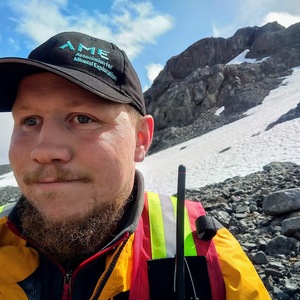
23:26 done a lot more geophysics and understanding from that. So I think we're just going to jump into a little video here of one of our geologists. Good point to ask a very good question. I want to start the video, deal with it after. Hello, my name is Martin Giskell and I work as a geologist here at Rufus Resources. And I will be presenting you the core walkthrough of hole 120069. That headline is at 171 meters at 3 grams per ton.
24:15 So, we start the hole off straight from basic foliage and mineralization. So the hole is in general characterized by a transition from mafic, ultramafic rocks into more felsic sediments at the bottom of the hole. So, as you can see, this mafic, ultramafic rock here, it's very intensely foliated, very intensely altered. We have quartz veining and abundant disseminated sulfides throughout the hole. The more deformation we have, the more grade we have. So for example, this spot here, you can see very intense quartz veining, lots of alteration, and the grade is 16.95 ppm.
25:13 So we keep on going through this really deformed, intensely altered high-grade zone in the ultramafic sediment
25:25 for a while. And then we step up into this a bit less altered, infoliated ultramafic sediment a bit less altered and foliated ultramafic-mafic sediment until we get into this high-grade contact zone to the felsic sediment here. And the more felsic sediments in Ikkari are characterized by this very intense, pervasive albite alteration, this red-brownish mineral. So, this rock has mineral. So this rock has a background value from 0.1 to 1, 1 ppm, and when we get this more brittle fracturing in the rock, the grade gets higher.
26:19 So for instance here you can see these really brittle rock fractured, brecciated, and it has a 3.72 in contrast to a 0.5 here. So this same type of alteration continues. In the same sort of places, we have higher grades, but the background values stay the same throughout the felsic sediments. So here we keep on going through, And again, more fracturing, more grade.
27:04 And also this rock is characterized by disseminated sulfites. We have quite plenty of them, plus we have this sort of hematite veins and hematite breaches visible in our felsic sediments. So we keep on going through these 1.1s to 2s background values and then getting some higher values wherever we get these more brittle fracturing. Basically, the same continues throughout this intercept, which was under 31 metres.
27:53 And maybe a main point as well would be that it cross-cuts lithologies, so the mineralisation isn't bound to 1 lithology. We have several lithologies, and all of them are mineralized. The mineralization might look a bit different in different lithologies, but it's still there. So here again, we're getting into this more brittle, more fractured rock, and the grade starts to get higher. 6, 11, 5.92. Here we continue with the same thing. When we move further down the hole, the alteration gets a bit weaker at some points, but still we have the background values here. 1.2, 1.8 And then we have, again, 6.7 where we have more brittle fracturing.
29:05 So we continue through the background values all the way to the end. And here we have one more 18 ppm, but from this rock you can see that you can actually start seeing the sediment and the pervasiveness of the albite alteration
29:24 gets a bit weaker and so does the grade drop a bit. So this is characteristic for the failsafe sediments. Failsafe sediments at Ikkari. So there's no way of doing a quick video if you've got 170 meter long intercept, I suppose. We had a quick question, I think, in the chat, James, about why we stopped 69 and 70. I guess you get a sense from the call there, you know, I think maybe, you know, it's very early days in our understanding of things. I suppose, you know, maybe the altar dropped off a bit towards the end, but we can certainly go back and extend those holes.
30:09 Yeah, that was the key reason. We just, you know, we're truly based on the other holes which are in alteration. You see, we then drilled 72 and that goes all the way through so actually it eventually gets to these black, this black trail contact on the hangwall I guess we're going to call it, which is mineralized in itself. So yeah there's, you know, we're down at I guess 200-ish meters, 230 meters at the bottom of these holes. So yeah, there's plenty of scope to come in and put a scissor hole to the other direction. So I guess this just summarizes some of those results. Obviously the results today, This same table was in the press release, but obviously these very long intervals, very continuous grades, and also some really nice high grade sections. You can see that on here in hole 61 off to the east, 47 meters at 4 grams.
30:58 That in itself is a fantastic intercept. And you get these high grade, as you saw in the core video, some really nice sections of higher grade within those long intercepts as well. Another picture, we've just seen some of the core for probably more detail here. This is the original Hull 42 and some of the grades in that. But the key thing, and I think Kale presents that well, we see strong coagulation, strong, I guess, some shearing, faulting. And it's just the intensity of the alteration throughout the package. So it's a very broad structural zone. That's been, it's been seen alteration across it. You've got finely disseminated pyrite throughout it. Plus also you see quite a lot of what I call pinheads of visible gold where you see free gold in it as well.
31:46 And yes, it's got everything that you'd be looking for if you were trying to find a orogenic gold system. And so we just, at this point, we should be continuing to push ahead and drill it over the months ahead. So I mentioned CITRE just before, I guess this was, this is about 5 kilometers along this main structure. And I guess this is something that if we wanted to show the comparison here, we're seeing Similar alteration, similar rocks, a very similar geophysical setting here. These are IP resistivity cross sections across it that we use. And so, you know, we did originally drill some holes at Scyta, but they were drilled quite obliquely to this, our current model. They were drilled more identifying, trying to identify something on a northwest structure.
32:37 We will then be going back there obviously and drilling across this main structure that we've identified. So that'll be news to come on that one as well, which is just more more upside. I see there's a question in the box from Paul about metallurgical work. So before I go back to talk about the mine, I'm just going to address that. So, so far, we've done Boforovs versus fire assays and we've been doing screen fire assays and some of the high grades. We see so far we don't see any obvious issues naturally throughout all our discoveries area 1 we do early stage network or initial sub network as we go through them. So we've already completed that on Haynes Central and South. We don't see any issues. And so we're just in the process of running some preliminary work to do other studies about this and look at hardness and abrasions and things like that, as well as what's the most appropriate method of recovery from the rock mass as well as the gold. So, but certainly we don't see it as being, there's no evidence at this page that we have any refractory gold in this deposit.
33:49 So just a quick jump back to the mine, obviously we started off there at the picture on the front. We've been, Rupert's also just exploring a lot of that project and it in itself is a very interesting exploration project and future production sites as well. It's probably taken us in terms of interpreting the data, really trying to understand it. The best part of 2 years really to get our understand this deposit. And that was probably the failing of previous operators. They never really understood the geology. We think we've taken all that historic work, 20 years of operation information and drilling and reinterpreted and we feel there's a lot of upside here still. I'm just going to show you one example. We're going to just show you, it's across a long section through here in T-Vane, one of the areas we've identified outside the old workings.
34:38 So we'll just go to that, just to give you an idea of the opportunity. So the 2 areas I'm going to show you, this is about 200 metres, there's the old open pit. This is the decline here coming down. You can drive down here. It's all dewatered and accessible. The previous operators extracted a small stope up here and a selection of stopes down here at about 200 meters. They never drilled the zone in here. And we started drilling that in the spring of this year. And you see there's a line of holes here, here that we drilled. And we now believe they originally thought the plunge direction was actually to the southwest, which would have been in this orientation. But actually, we worked out that we feel that the pond's direction is oblique to that in this particular zone. So that's opened up huge areas potentially for exploration.
35:30 So this is that zone between those 2 stope areas, about 250 metres. So this is just one area of potential upside we now see at the mine. And so it in itself, as well as being obviously a near term production potential, having that because it is under active care and maintenance, it also provides another great exploration target for the company. And then we have a program looking at near mine opportunities as well, you know, this is the part of our line is just in here, So there is, this is some of the opportunities we see pretty close to that. So I think we've sort of used up the time now, I've just run over a little bit. I just, that's a quick summary of the company. Key things to focus on, continuous drilling from area 1, we have said 3 rigs from next week, the focus is on Icari and obviously the structure of Trans-Tasita, but also then getting back to some of these other discoveries we have made. So that's gonna be about delineating size and scale of these discoveries.
36:30 We continue with our sort of what I call new generation projects, which is a basic tool programs, geophysics, looking to find other things. And on the mine side, say, you know, potentially We see a great opportunity for more resource definition drilling at that T-zone, NFE, Carolina, some of those, as Tom said right at the beginning, we had some fantastic intercepts last winter, like 5 metres at 200 grams and 11.6, I think, like 60 grams, great, some crazy intercepts in the mine. So we've got more work to do there, but overall we, and the company, is well positioned to do that. So I think it's gonna be very exciting next year for the company. Lots of news flow, and we'll try to keep you up to date, and we'll be holding more of these webinars to keep you up to date. Yeah, I think we've reported 13 holes for mickery so far. We've probably drilled well over 13 now.
37:26 So there's lots of lots of essays pending. So yes, expect more of this kind of stuff. So I think if there are any questions, you can have them. Sorry. That's all good. I was about to say the same thing, James. It was really brilliant to go and visit this project a couple of weeks ago. Me and the Spotlight team got to go and see Patavara and Dhikri. Really cool team, really welcoming, really friendly. So we're kind of putting our stamp of approval on it. These are real rocks. So you can see that in the video. You can see there's some high quality photos around as well. So those will be coming out. If anyone's got any questions, there's a Q&A feature on the right. I think we've covered the ones that came in through the show already. So maybe a couple of minutes.
38:13 There we go. When will basal till infill be completed? So, yeah, I'm just going to flick back a couple of slides for you on that. In short, it's never really completed. I think that's the one answer, but certainly describe where we're working. Obviously, this gap in the base-till coverage, we are getting through that at the moment. Initially, we'll be doing it on 400-meter space lines, or tram lines, we call them. So we'll get across there. And then we've also got other programs that we want to run in these areas. So you have, see these 2 high grade base attila anomalies here, we have another one here, and there's plenty of ones that even haven't been followed up with drilling yet. So yeah, we're continuously working with that base attila. We have 1 committed to us full time. So we just, that will be with us easily through to next spring anyway.
39:08 So it will be working both here in this image that you can see now, but also along the corridor as well, going to some of our other opportunities, I guess, to the north east of CITRE there actually. Thanks, James. Thanks, Paul, for the question. And a question here from Angus Campbell, do you expect to provide a resource estimate in the coming year or beyond, beyond being the infinite I suppose? Thanks Angus. Yes ultimately we will be getting to resource estimates. We're not, the approach we are taking to, we take is obviously internally we're doing that, those kind of work all the time, but I'd say in terms of new like maiden resources on things like Icari, Haina South Central, we're certainly well into next year to achieving that.
39:58 But the way we approach the projects, we're trying to define the limits first and then infill later. So, you know, that we get to an inferred resource stage as soon as we can, once we've found the limits of the discoveries. But as a, as a, as a approach, James, you don't believe in, in drilling, drilling infinitely, do you? I mean, you've got to... No, I'm not, you know, we've, you know, I guess I watched enough exploration companies just try and raise 5, $10 million if they could every year, that would be fantastic. But more likely, a few million dollars in the good years and not much in the bad years and they just sort of you know they might find a hanger north which which is great but if our approach is that you know We're not here looking for small things. We're trying to get across the license as quickly as possible. Within 2 years, we've achieved an awful lot. I think our plan corporately is to try and have the part of our project license, the one in the top right-hand corner here, covered by the end of next year in terms of first pass. And then from there, it's moving on to resources and then evaluating the economics of the projects.
41:09 We're not here to be a continuous exploration company forever. That's not the business model. The business model is to demonstrate the economic potential and you can't do that if you just keep on drilling every year. That's not that effective. Yeah, so I suppose the next question, James, so thanks for that, comes from David Shores. Are there any plans for Rupert to open the mine and or mill in the next 2 years? It's a specific time frame. That's a good question, Paul. I think at this stage, we continuously evaluate that, Paul. It's certainly something we look at. I think with the new information we have from the drilling and I guess going back to that slide, maybe for the mine here, from the drilling we did this last winter, and then inter, but I guess it's still ongoing. You can see there's now potential, we see similar potential at Tevain and Carolina, NFE and Harpoon. I think our current plan is to understand that as best we can over this next winter. And then you evaluate that from there and continuously put it into our trade-off study. But certainly it's a low-cost restart, it's a low-cost operation.
42:27 But what we want to do is evaluate it in the context of everything else we're discovering because this currently the scale up part of our it would be quite small, but obviously the scale of what we're discovering the Ikari area 1 could be very large. So it's about demonstrate bringing them all up the curve together so we haven't committed to a timeline, and we're not at this point in time but I think you will see us demonstrate that over the year ahead, that opportunity. Cheers again and something that gets overlooked in a lot of these discussions is the environmental impacts of mining. So having, like I said, having just visited the project, we walked around on the old tailings pile. We could barely tell it was there. Unless you're a trained geologist, you wouldn't actually know what that was. It just looks like a lake dried out and reseeded.
43:15 What are your plans to continue with that and continue mitigating any environmental impacts while you're drilling? I'm just going to put it on the cover slide maybe. So maybe even that one in the back actually, that's the back. So you can see the techniques there in the background there, that's a photo from last summer, that one. What Leo's referring to there is that partifer is quite a unique deposit, it doesn't, it didn't use cyanide, it's 85% recoveries by flotation and gravity, 82% and flotation for another 5% maybe alone. So there's no chemicals used and the rock is not a non-acid generating, there's no sulfides. So last summer, as part of our long-term closure plan, thinking for the site, we trialed a direct seeding of the tailings dam, which basically just literally just tilling it and seeding it and that's been very successful. So it's a trial really and it's to demonstrate to the government that we can, that it's a easily rehabilitable site. So that's what 1 program we're doing.
44:19 So we're continuously looking at smart options like that for long-term closure, but obviously on the environmental side, you're absolutely right, Liam, that the thing that gets a lot of these companies, whether it's new discoveries or existing ones, is making a mistake on that. And that's, I think that's the importance of our Finnish team and understanding all those considerations, continuous monitoring in all our regional exploration areas for water, fauna, and, you know, add to that all our CSR meetings with the local community. This is state forestry for the most part with commercial reindeer herding over the top of it. So it's, I guess it's all quite a commercial area, but we know our community very well and we're sort of working with them directly but certainly and also importantly for part of our whole project site, none of our project site contains any Natura 2000 areas either so we don't face that. So we don't have, whilst we don't have any restrictions about what we do, we're very cautious about how we approach it and manage that side of the business.
45:25 And you mentioned reindeer herding there we've got some exceptional drone footage, which you'll have to release at some point of a big herd of reindeer enjoying your enjoying your tailings ponds because it's so if anything the wildlife isn't helping you. There's a question here from from Harris. Headline results are fantastic But curious why you don't report the entire whole length and grade example 12070 is mineralized all the way down to 279 meters with some strong intervals. So maybe Harris has grabbed some news in advance of you releasing it. There. Or that's next week's. No, no, no, no. I'm showing you how you're focusing into the image there. So we use 1.4 cut off. And really, when we look at the interval, well, 1.4 cut off is a lower cut off and so incremental meters. So if we looked at the end of that intercept for instance at the end of the 143 at 2, you would go into a zone there that you your that the the next meters or the next maybe 10 meters there was not over 0.4. So whilst there is low grade there, it would be counted as waste in a commercial operation. It would be big enough zone for you to isolate out and remove as a waste block if you're mining it. So that's why we don't do it. And there is a, yes, we have some great grades down here, but obviously there, and you could technically drag that across there, but that would be misleading, and we consider
46:56 that to be misleading in terms of a potential extractable, you know, widths and grades. So that's how we approach it. So we, you would get, you know, I think, I guess I've been in this industry a long time and on the fund management side and analyst side, and I see many, You know, you see sometimes people dragging very high grades over long widths, and then you don't get actually when you, that's why we, you know, you see we put the whole of 69 in the back of the release was just to demonstrate the continuity of grade throughout for such a long interval. That obviously helps, but if we put the whole of 70 in it, you'd see there'd be a break there with some low grades that you wouldn't carry into the lacrosse. Hopefully that answers that question. I think I'd also just add as well, I mean, I think, you know, Finland, I guess, has been regarded as, you know, in Sweden as well, there's some very large low-grade deposits.
47:51 I suppose the thing about the thing that strikes us in Icarus is that you do have these epic grade areas that maybe we haven't seen before. So it probably is no different to any other greenstone belt. You do have all sorts, but this certainly sort of stack is up there with anything that you've drilled anywhere else in the world. So I think it's important to show you do have these high grade and large tonnage components to this potential resource. Yeah, it's absolutely average gold grades globally now still like 0.8 or a gram or something crazy in the industry. So when you're looking at mass deposits, so this is still some quite exceptionally higher grades than that. And said this, you know, zones in here where you see, you know, 40, 50 meters around 4 grams, so that those in itself should be great intercepts. So, but that's not 1 meter at 40. It's, you know, series of, you know, lots of meters that sort of between 3 and 6 grams throughout.
48:53 This is a really important point that's coming up a lot recently. Obviously, there's a big run on gold. Lots of new investors coming into the space and not necessarily getting to grips with the reporting standards. So the fact that you guys are applying those when you could be running away wildly is always a good sign. So I think we're coming... Sorry, go ahead, James. No, that's fine. No, it's important, I guess the only point, obviously Mike Satney sits on our board as one of our QPs, a very experienced guy, over a lot of exploration. So is Charlotte Seabrook, who's also done the QPs for us. So, you know, the serious people with their reputations behind it, doing the acting as our QPs. So I think we'll go to 2 more questions. One last one from Paul. What is perceived timing for drilling by partner at Red Lake property, which we haven't mentioned?
49:41 Yeah, so for those who didn't pick it up, Paul's talking about, We have a property next to the Red Lake mine, obviously owned by Evolution Mining these days. And it's a long strike potentially from the mine to the southeast. It's called Gold Centre. We did a joint venture with a group called Trillium Gold Mines. And we're going to spend $10 million over the next 5 years on that project. In terms of timing, we're just working through the transfer of the licensing, so I would I don't know, potentially this winter, it'd be nice to see them during this winter. I haven't got a timeline for them yet. I did see that, you know, their financing went quite well, so I think they're well funded to do it. Yeah, that was important. Good stuff. And then we'll close on a question, the all important question, production in 2022, James and Tom, in a 1 sentence answer.
50:36 I saw that, we're not gonna commit to a production timeline. It's important for us to, you know, we're about, If we continue to have such fantastic success at Icarus, can we find another Icarus? I mean, that's that's wholly important. But I'd say, you know, The important point is to find economic mineralization. Something like Icarus is potentially very economic. And then it's production timeline. Yes, it's important. At the same time, these are deposits that could have something like Icarus. You're trying to find deposits that could be around 20 plus years. And so this is the sort of scale of project we're looking for. We're not looking for a couple of hundred thousand ounces to shove into production to make us, to get cash flow today. These are potentially deposits with a huge amount of potential future value in it. That's what we're looking for.
51:36 So thank you very much, James and Tom, for joining. Thanks to everyone who's asked questions. Really good to get your engagement there. It was a bit quiet in the room until we came to the Q&A. So I was a bit worried we'd have a ghost Q&A. I've prepped a few questions, but nothing as good as you guys managed. So cheers for giving James and Tom a good quiz there. A big thank you again to 6 for hosting us. Really enjoyed using this platform. It's very intuitive, good system. So we'll hopefully be back here and have a really good day, everybody. Look forward to seeing you again. If you'd like to speak to Tom or James, I'm sure they'd be very grateful for emails, calls, texts, 24 7. That's what they love. So we'll send out this presentation and the information and links to the videos for those who miss them after the show.
52:23 Okay, cheers guys. Have a great night. Thank you, Liam. And thank you 6 for hosting. Much appreciated. Thanks for everyone attending. Yeah, Bye. Bye. Cheers.