Automated transcript · Written by software from the replay's audio. It can mishear names and figures; the replay is the record.
6:10 With the drilling that we've done this year, and I'll jump straight to the conclusion here and we'll discuss the details after, This image or this map is from the latest press release that we've published this week, Monday morning. We can see the drill holes that were drilled. As compared to the other proposed holes, there are faint little white balls here in the background. But we couldn't drill all of them this year or this winter due to time, I guess. We were very aggressive in the quantity of holes that we wanted to drill at first.
6:57 And secondly, I guess we'll see in a bit, but Some of the holes we've drilled this past winter were much longer than what was anticipated at first. That ain't the bad news. I'll keep the punch for a little later. So the colored holes here are the ones that were drilled recently. They are colour coded by the availability of the assays. Monday we've released the assays for hole 34 and 41, which are respectively on line A and line K, which are the extremes of our drilling program. Still pending are those remaining 4 that are highlighted in blue.
7:45 These ones here were meant to cover the south portion. And as you can see, we've discovered some new zones there and the extension of the main one, number 3 extension here that we can see in all of these holes down there. And we're yet to receive assays for the blue ones. However, pigmentite content or intersection has been confirmed in all of them holes. So the final 3D view that we have at this time is something like this that we see on screen. So we'll recognize the main 4 pegmatites or the first 4 pegmatites that we had to start with. And then we'll also recognize on that picture the addition of 3 more.
8:40 So we're talking pegmatite 5, number 6, and number 7. And I'll draw your attention on Pegmatite 5, which is quite extensive in terms of footprint, in terms of area covered, and also in terms of thickness, we're talking of a thickness averaging probably around 15 meters for that one. And this one appears to be stacked right on top of pegmatite 3, which is the main one, so it kind of confirms the idea we had at first that all of them pegmatites would be distributed in some sort of an initial distribution with a dip towards the south and the general envelope of them pegmatites dipping towards the south-southeast or east in certain cases.
9:37 So that's the 3D view that we have currently. The last thing to add are those app lights, highlighted in blue. As we can see they are sequent or they cross cut the rest. I do believe that they're slightly later than the pegmatites themselves and they seem to be through going throughout the system. So they would cut across pretty much everything. The last thing I'm going to mention using that figure and then we'll jump in a live 3D session in just a moment, is the fact that I've tried to model many, many things in that project, but I just couldn't resolve the gabbros that are depicted in green along the drillable traces.
10:28 And why is it not possible to design the gabbros in 3D modeling. I do believe it's because they're very very strongly chopped up, segmented by the pegmatites themselves. So now I'm going to introduce here progressively what is our interpretation of them pegmatites, as we don't see them as, let's say, typical extensional features with no motion associated to. We kind of see those pegmatites now as possibly structures with some significant displacement along them. I'll get back to this in just a moment.
11:18 So we've seen a little bit of what the interpretation is and what we've covered so far. I forgot to mention the sizes that we've reached. I'll get to it in the live session. So if you don't mind, let me jump back right now into LeapFrog. So this is the same kind of image that we've seen static. It represents the 3D model we add at the start of this current program, so we can see the 4 zones, 3 that are sub-parallel, 1 to each other, and 1 that seems to have a slightly different geometry from the rest. The projection and interpretation of all the zones was based on the lithology intercepts, so where pegmatites was seen, but also refined later on by where grade was also observed in terms of percentage of Lithium Oxide obviously.
12:26 So now what have we done? Starting this winter, we re-drilled the thing, and what we started to do is to expand on the zones. So, I'll get back to a plan view here. So, we'll recognize the shape and the initial footprint of the zones. And in blue are the actual collars that we've drilled. It's expanding the area quite a bit. So what did we get as results? Well, first of lithology information. I'm just going to display super quick here the mix and match of lithologies that we can see on them holes from 1 section to the other, it is not a gimme that you'll see again the same succession of granodiorite in pink, gabbros in green, granodiorite, gabbro, etc.
13:34 It will vary from 1 hole to the other. What's really good though, is if we load on top of that the intercepts of pegmatite material that we've intercepted with that drilling, then all of a sudden there is something to do with this. And that's how we've expanded them zones, initially using the initial model that we had and just very simply expanding the planes where they should be, it gave us target depths that we wanted to follow and that's why some of them holes we've drilled much deeper than what we were anticipating at first, because the projection was shooting for something much deeper at that time. So If I was to realign them intercepts in 3D space, what we would eventually see, and for that I would ask you guys to use my, I guess the time I've used doing that and my little bit of my expertise here, but what we'll start seeing
21:46 So what I've started to do is a structural analysis of all of that, focusing first on the intersection and the animation of all of them in pegmatite bodies all together. And to give you an example, I'm not gonna spend lots of time, but that's a stereonet that we could draw out of the data that we have. It's a strange looking stereonet because everything's flat. So all of them great circles are lying near the boundary of the graph which is kind of strange but what we are interested in right now with this graph is the intersection lineation between the pegmatites all together So if I'm cleaning this up a bit, and I'm just keeping the pegmatites in play, what we'll see is for the most part, they would intersect around here, which gives us an east plunging vector, very flat, but towards the east.
22:51 And then if I'm adding, say, foliation into this, which is, well, not really foliation but main faulting, That would be the oblique faults that we see in the plan views running from northwest to southeast. Then It's not intersecting east, but rather to the southeast around here. So enough of stereonets. What we want to do with this is to be using that intel, like how it's intersecting with each other to project that intersection line into space and then design zones in and around, I guess, those intersections that are projected into space. So it becomes a really good tool to constrain the 3D interpretation and to constrain any further structural interpretation of the deposit.
23:58 So, With this and all of this in mind, I'll just get back to our PowerPoint here, and then we'll discuss the results, now that we have the 3D model and the structural interpretation in mind. So recently, this past Monday, we've presented that updated table of results. We were presenting them all 34 and 41. Not gonna spend lots of time on them results. You guys can look it up online in our latest press release. What I'm going to be spending a little bit of time on though is discussing what are those results telling us other than the fact that it's mineralized in both lithium and tantalum.
24:49 So first and foremost, a quick view here of the sections, line A for instance, that's the furthest south. As we can see, pending results on that southern line, clearly showing the stacking of pegmatite 5 and 3, 1 on top of each other, with those remaining intercepts down below that perhaps will become another pegmatite 8 very shortly once we push that interpretation a little bit more. The next section is line E in the middle or in the core, literally, of the system.
25:36 And here we can see really good the stacking happening with pegmatite 5 sitting on top that we couldn't see, or maybe just a tiny sniff of it that has been tagged as pigment type 4 here towards the western end of the system, but then to the east clear reappearance I guess of another pigment sitting on top of the main one. And as well, we can keep following pigmentite 2 at the bottom. And finally, to the north, we can still follow pigmentite 3, which is our main zone, and that line actually allowed us to expand by about 100m, 150m, the size of the core of the zone in this area.
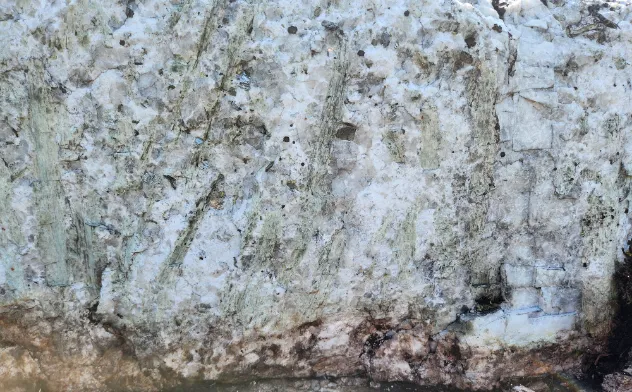
26:33 Some core pictures that were released also Monday, but I tried to get them bigger a bit. I'm sorry for the blurriness, but what I wanted to show is how easy it is to recognize in core. So we drill the thing, we see different types of intrusives, some are applites, some others are pegmatites and when we hit a pegmatite body it's kind of crystal clear, you can see the huge crystals of spodumene and things like that. That here would be for the main zone along our first hole in this area, long line E, and then with the grade of the complete interval here.
27:25 Another example, more recent 1, that's from the south portion of the system, And this interval here is along pigment type 5, which is the new one. We can clearly see, again, the size of the crystals very well developed. And in this particular case, I wanted to highlight the fact that sometimes in the zone we'll see a separation between texture and then accordingly with the ratio of lithium oxide versus tantalum oxide and in this case here what we can see is the whole interval is kind of separated in 2 with a break in the middle here and above that middle break what we'll see is huge crystals that's super rich in Lithium, we're talking close to 2.5% over almost 10 meters long. That's quite significant to me.
28:30 And then the second half portion, and the overall interval grades at 1.5 ish lithium and a tiny bit of tantalum here. What is happening if we look at? The detail of the assays I'll get back to it but in cases and most of the cases where when lithium depletes a bit We'll see an increase in 10,000 Or 10,000. I don't know how to pronounce this in English, sorry guys, but so we'll see like an inverse ratio we would say, but that is not always true.
29:16 Sometimes in this case for instance it's super rich in lithium, the assays would get super high in tantalum as well. So what's happening here? Well, it's not just a matter of this spatial distribution. So one could think, well it's going to be a zonation between high lithium versus and low tantalum and then it's zoning out to low lithium high tantalum, but it's not really the way it works. From what I understand from the literature, in our type of system, which is very high temperature, slow cooling, the way Namaska area is, I guess, in terms of when that happened.
30:04 What's going to happen here is the minerals are going to crystallize in a sequence and it will depend on the availability of the different elements to crystallize particular minerals. So what's going to happen is, if it's super, super rich, then both lithium and tantalum will be super high in terms of grade. And that would happen in the core of the zone. And as we move outward, what we'll start seeing is that range inverting back. So in far away, it should be the usual low lithium ithanthalate. Complex story short, we can use that as a tool to vector towards mineralization, towards the core of DEMZones.
30:58 So we're investigating this right now. This is yet to be transposed into the 3D environment, but I have high hopes that we can actually model this, those transitions between the grain of the different elements, and then vector in towards the core of them zones. So that again work in progress. What else do we see in the core? Just for interest for the geologists out there, I was talking about gabbros, granodiorites, some aptites. Well here they are. I just selected a random interval here in O45 which shows the different features here.
31:48 One thing that we'll note is how intensely the granodiorite is fully heated, which is quite important to notice as it's giving us the a sense of the intensity of deformation that happened in this area. So, to say that the pegmatites are simply like an hydrothermal explosion, an hydrothermal with magmatic fluid just blowing up the system because of that fluid pressure would not be necessarily complete as an explanation. My explanation right now is Yes, fluid pressure is strongly contributed to the system, but I do believe that the main trigger is structural geology here with, you know, a system that was trying to accommodate deformation within a stiff granodiorite, and then it reacted in such a way that once the pegmatite fluid got pumped in the system it broke, cracked open, pegmatites got injected and the the slabs I guess or the blocks moved I believe at that time, explaining why the gabbros are so discontinuous from 1 section to the other.
33:12 That is somewhat confirmed when you pay real close attention to the crystals in the pegmatite, you will very often recognize C-S-type fabrics, little tiny brittle faults getting through the pegmatites themselves, so they've been badly deformed too. A little bit of numbers now, I was talking about relationship between lithium and tantal. I'll just throw in numbers to show you what I meant. So that's from O46, the second one on line E going east, which has intercepted for the first time Pygmatape 5, the new one. So and as we can see throughout the whole interval I've highlighted the high grade lithium versus very high tantalum and we can see that the it's only the top portion of the zone that carries significant lithium, but the zone is still there due to presence of tantalum in the second half of it. So overall, not going to do the economics here, but we got to realize that because it's multi-element, at the end of the day, the economic maths will use both grades, assigned a value, a recovery, et cetera, to end up with, does it pass the economics or not.
34:40 But right now, this is the way we got to do this. So it clearly shows like a separation in grade. In this particular case it's pretty much one-on-one. I grade lithium, super high grade tantalum, which is expected in the core of the zone. So I believe this intercept here would show us that we may be in the core of that new pegmatite body. Just below, pegmatite 3 was intercepted as well And here we can see the inverse relationship. High lithium, very high lithium, Jesus, up to 5% over a meter, that's unbelievable.
35:28 But as you can see, tagged with those super high lithium, very low tantal values. So, it means that we're not in the core any longer, to me. It means that we've progressed probably a little bit sideways, as the timing between the 2 components ain't coincidental no more So very identical though at the in the bottom interval now. I have a few more example. I'll go super quick But again here pegmatite 5 that's a new hole released Monday can see top portion that's the one actually I was showing pictures of earlier, the top portion, super high grade in lithium, Bottom portion, barely no lithium for the most part, but really good values in Tantal.
36:22 So these things we'll be able to use as vectors within a given zone when we'll do the analysis, what's the distribution of that ratio, not necessarily the ratio what's the distribution of those grades then we'll be able I believe to figure out where about are we in the system and then guide drilling using that. Now that's really good, I believe it's fair to say that we've progressed quite a bit in terms of interpreting Rose West, what it is, how it looks like, where does it go. We found new pegmatites, really exciting. Now the question, how does this relate to Rose, our main project, the main flagship? Well, thing is, not surprisingly at all, Rose and Rose West do share lots of similarities, not only in terms of geology, in terms of geometry, in terms of grade, well, 1 exception within bracket, Rose West seems to be slightly higher grade than the Rose right now, just saying.
37:37 But, you know, they do share lots of similarities. So the good question is, could we use what we've learned at Rose West to explore better ROSE? Yeah, indeed. Can we reinterpret ROSE a little bit and then use that new knowledge to push ROSE West better? Probably. There is a sync to be done here between the 2 deposits. Well, 1 is a deposit, the other one is a to be, I guess, but we can compare the 2 together and learn from that comparison. And naturally, if we do that, we'll start thinking, well, there is only 8 kilometers separating Rose West from Rose.
38:25 Is there any potential in between? And then the answer would be absolutely. And the idea here, and how this is based from and on is the fact that from Rose West, it's pretty clear that we see a stacking of the pegmatites. The whole thing seems to be dipping towards the east, towards Rose, but it's stacking. So as it happened with pegmatite 5, which is now on top of the main pegmatite that we had before, which is pegmatite 3, we could anticipate perhaps to see more pegmatites like that appearing as we progress towards the rose.
39:16 When we look at the MAG data, it seems that what we see that is confining Rose West discovery with those north-west, sorry, south-east trending faults that we can see on screen here. That interpretation is from the Ministry but it does illustrate main fracturation or main fault in the area and we do recognize at the smaller scale at Rose West, the same orientation of faults here. So it seems to indicate that what we see at Rose West at that scale, repeats itself at a much larger scale. And there is no reason why at intermediate scale, the thing would not be valid as well.
40:07 But I guess the intention here would be to use all of what we know now and combine all of this together and eventually start drilling like in between Rose West and Rose at the... I don't know what kind of spacing that could be but at a relevant spacing you know close enough to define if there is something there to find it, but far enough to make major steps, you know, that be a maiden discovery. The intention, to be frank here, and I'm not going to mince my word, would be to develop Rose West and Rose as a district.
40:53 Honestly, we kind of see a potential here in between Rose and Rose West, definitely, but that potential is also shows to be there if we consider other showings that we have north of Rose, northeast of Rose. I think it's called GL Zone and I can't recall exactly the name of those different showings, but there are several other sniffs of pegmatite with Lithium in them elsewhere, other than at Rose and Rose West. Maybe, Ken, I will add on it. Let's say if we look at Rose itself, when we start drilling, we start from the west portion of Rose, then we move the drilling through the east portion and that's exactly what we've seen at Rose West.
41:45 As we were going to the East, we were seeing the stacking zone appearing with zone on top of it. So that's pretty similar to what we're getting at Rose West at the moment too. So there's potential to see the same thing in between Rose West and Rose. Exactly. And I guess if 1, someone who would know very, very well the Rose project, would maybe end up with the question, hey, Ken, but the Ostrog is different. Rose is more cinnamon-oasted. As compared to Rose West, it's more granodiorite, gabrose, a mix of both. So, yeah, well, it may explain perhaps why the grade is slightly different at Rose West. Maybe it's a case of competency contrast.
42:36 What happens at the contact between those sediments and that granodiorite? That'd be a good place to be looking for if we want to focus fluid somewhere. That contact seems to be a good contact to me to be exploring. All of that, I believe, with what we've learned from Rose West, it's kind of, it has become an eye-opener. I believe, Jean-Sebastien and his group before had the impression that it's going to be bigger. They had that impression, I believe, with the current drilling program that we've just completed. It kind of confirms those suspicions. You know, now we have an explanation, a geology or geometric explanation for how and why are them pegmatized the way they are. So It becomes possible to make predictions.
43:36 Where will we find others like that, based on what we know at OZ and OZW? I'm really, really excited. I believe we'll continue drilling OZW for sure. I can't wait to see what that will give us. But up and until then, I guess what's on line for me in terms of work right now is to complete the interpretation as we saw, just to give a quick recap here, we've seen a few intercepts that are still floating in the air that needs to be resolved, I'm thinking that at the bottom there's going to be a pegmatite 8 being added very shortly.
44:25 And then all of this good work in prep for an upcoming mineral resource estimate, eventually, once we think we're ready for it. So I don't know I think it it touches pretty much everything. Did I forget something Jean-Sébastien? Well that's good I think you cover everything so I think now we can maybe move to some question. I will say I'm seeing a lot of questions in the chat, but a lot of them are being answered by Ken during his presentation. We can try to answer some of them. I'm seeing a question about if we plan to restart drilling at Rose West. Yes, obviously we plan to restart. We stopped early April in order to let the breakup happen, but the plan is to restart shortly when the break up is done. The objective is to keep drilling, keep growing the zone, do some of the infill drilling that needs to be done in order to get a resource calculation done on the Rose West zone by the end of the year.
45:35 Thank you. Yeah, there's quite a few questions as well as a few upon registration here. Just while it's fresh in everyone's mind from Ken's very thorough presentation, thank you Ken. Do the pegmatites, especially number 3, show any indication of structural deformation along the foot wall of the pegmatite? Has the fractionation trend of the tantalum mineralization been considered as a pegmatite vector? Yeah, I think I did touch base a little bit on that. I would say, generally speaking, all of the pegmatites that I've observed, and I have to admit here and be very very transparent, in core pictures, I'm yet to have a real real look at the core and be able to spin it and things like that but from core pictures all pegmatites are, I would say, for pegmatites, heavily deformed.
46:32 So it's broken up, it's sheared, we can see CS type fabrics inside, you know, the pegmatites themselves. So they got in place but I would say in a sin deformation kind of setting. So, and is the fractionation trend of the tantalum mineralization being considered? We are right now, and I'm probably gonna get my hands on iogas as a tool. So, doing geochemistry with, you know, I was talking lithium tantal, but there are a bunch of other elements that we're assaying for as well. So, we'll find a way to filter out, utilize, interpret, model, all of them ratios, geochemical ratios and stuff. And the idea is to point towards either the core of a zone or pointing towards a potential new zone as well.
47:32 So. Sounds good. There's a few upon registration here too. What is the timeframe for a resource estimate on Rose West with current and potential for further expansion of Rose West and Rose or higher production rates being evaluated? We just mentioned that getting a resource at Rose West, the objective is to get it complete for the end of this year. Then I will say it's a bit too early to start talking about, let's say, projection on capacity or mine operation. Let's get a first resource on it. And another question here, are major mining companies interested in becoming a partner to provide project financing, as well as downstream users of lithium?
48:24 Yeah, I mean, I can take that question. I mean, we are talking to multiple parties being interested in an investment into critical elements along the supply chain, whether it's automotive companies, whether it's battery manufacturers, whether it's cell manufacturers, or whether it's mining companies. All of them have different interests in an investment and accordingly the structures being discussed are varied. So, Stefan, with the current prices of lithium being sustained over 4 months or so, Is that changing any conversations yet in the relation to financing? Yeah, obviously what we are seeing is that, let's say, discussions are getting more intense.
49:13 Multiple parties are getting more active in approaching us and the discussion about a potential supply deficit obviously is pushing some partners, companies, people relatively hard and getting nervous about how the future is looking like. Obviously, let's say the general political environment is not of great support, let's put it that way. So there's 4 holes still have an assays pending correct without getting ahead of the results What should investors be paying attention to when those numbers come in and what would a positive outcome look like for those remaining holes?
50:05 Can you take it? Yeah, I'll take it. That's a good question. I guess the real answer that I, my guts would give you is, well, it's not going to be very surprising in the sense that visually we now know that when it's really good looking, nice crystals, da da da, results will follow. So we're anticipating probably same grade as what we've seen, you know, 1.5%, 2.5%, you know, that type thing. What I'll be looking forward to is not necessarily the, let me call it the intensity of grade, but more the distribution of grade.
50:53 It is becoming more and more interesting and important, as we were discussing earlier, the ratio between the different elements and how can we use that to vector towards one way or the other inside the deposit or inside the mineralized zone itself. So quick answer, we'll receive assays back for the 4 holes. I would be really, really, really surprised that these assays aren't coming back good. Well, only God knows, But that'd be really, really surprising. And again, it's already modeled that way. To me, it's a fill the blank type thing. I'm receiving the results, I'm plugging that in, that's the mineralized zone.
51:46 But again, ratios, vectoring, exploration tools to be developed. That's what we'll be focusing on right now. Yeah. At the end, I think it's fair to say that we're seeing a pretty good homogeneity over the grade, over the citizen. That's maybe something I forgot to comment on, but when we started with the 2024 data, we could see that P3, the main one, its grade is very, very continuous, like very homogeneous. The thickness varies, but the grade inside the zone is like 1.5-ish kind of thing. When we drilled the extension, we kept the same grade. Thickness varies and towards the east as I was mentioning it's getting thinner and thinner up to a point where it pinches out but it's still I agree even if it's pinching out so so grade is really continuous and that's really good for us.
52:52 Gentlemen, I know we're going a little late here. So we'll close things off here. I know there have been a lot of questions that haven't been addressed. I will share them with management, but we are running a little late. Ken, thank you so much for the thorough presentation. I think that covered a lot of the questions that haven't been addressed. But I will share them with management. The replay will be available shortly after we conclude here. I will pass it back to you, John and Sebastian, for any closing remarks before we sign off here. Thank you everyone for joining today. Just to say that we're very excited by the Rose West expansion and results. So keep in touch, keep following the results coming. We're excited to restart drilling shortly on Rose West and move things forward.
53:39 And keep in mind, we're also working hard to get Rose financing in place. So we're pursuing our discussion on it. Thanks everyone.