Automated transcript · Written by software from the replay's audio. It can mishear names and figures; the replay is the record.
29:17 around the opportunity to remove a tailings dam, because there was some real concern, given that the tailings dam is in an area with a lot of water, that what happens if there's ever a tailings dam breach? Well, I think we've changed that now. But this is still not the answer. There's still all of the, I think, the flexibility of us discussing with our communities what their priorities are and being able to tailor the project the right way that's that really is going to have the the buy-in and acceptance. So no, we've got supportive relationships with our communities, but we still have a lot of work to do. Okay, great, thanks. This next question is from John and maybe Ken might have a chance to kind of comment on this.
30:02 It says, Dan, could you please speak to the Seeking Alpha article from yesterday that asserts even with the lowered CAPEX that the upfront costs of finding the financing for Springfield may be difficult. Can you address those assumptions, please? Well, maybe Dan can speak to how it's going to get funded, and I've got my ideas as well. But I don't think for a 30,000 ton per day producer, there's not a lot of mines and a lot of operations that are this inexpensive, I would call it the low cost, low capex for this kind of throughput.
30:48 You start going north of the 30,000, 40,000, 50,000 tons per day, and you're gonna be looking at that billion dollar capex. It's just a matter of the quantum. And also for a facility that's going to be using dry stacked tails, the CAPEX associated with the filter plant is significant. But we were able to offset that with the co-location and the proximity to the pit with lower haulage costs. So, I think we've got a well-structured CapEx and I think it's right in the ballpark there.
31:36 The other way to look at it, John, as we think about CapEx, you have to think about what's the CapEx for a project that can produce 300,000oz a year in that kind of critical strategic asset sphere. And there's a couple of comparables out there that I think have scoped really interesting projects, but it's a kind of a fashion from the holdback over the last 5 years when there was really no capital available, that, you know, this perception of a project, if it's over $500 million of capital, that it's not financeable. The reality is with a payback period like this project would have, there is a lot of capital availability to build projects and largely because there are no projects that are robust like this, of this size in tier 1 jurisdictions to build. So I think as we move the project down the permitting path, we ultimately get it to the point where we can make this construction decision.
32:43 And we'll assess at the time what the metals prices are like and what's the best thing for our shareholders to do. But, you know, we're going to have a number of opportunities. But for us, this is not an impediment right now. This is an opportunity. You look at the life of mine, capital efficiency, and upfront capital and sustaining capital, cause you gotta pay for sustaining capital at some point, expansion capital. I think when you look at what you get for SpringPool for the capital that we would be spending, I think it stands out in the industry as a really, really robust opportunity. Okay, great. Thanks, guys. Here's a question here from Richard. It says, please clarify, you feel currently you're undervalued, but despite acknowledging that assets need further de-risking?
33:37 Well, listen, I would tell you if you go back to the relative valuation slide and look at a number of the other advanced developers, they all need de-risking too, you know, until a project is built and producing, even when it's built and producing, it still has risk. You know, I think you can look at projects that are in varying stages of permitting processes and environmental assessment processes. And we are still multiples below where some of those other projects are trading. So I think, yes, there is still some risk to take out. That's why development projects don't trade at 1 times their net asset value.
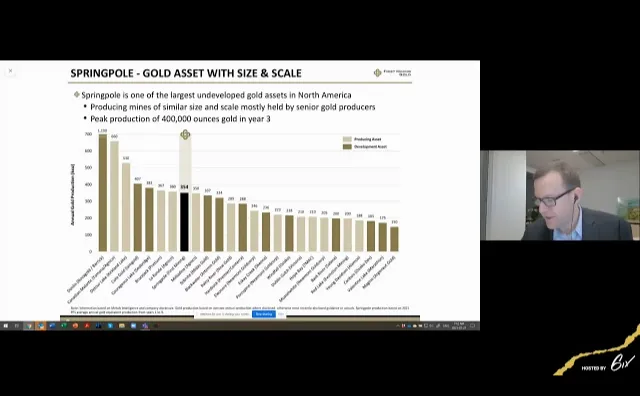
34:23 But for a project that is shaping up as real as Springpole is, and as robust as Springpole is, we don't think that it deserves to be trading at 0.08 times its net asset value either. There's a lot of room for us just in reverting to the mean, which is still going to reflect development risk. It's still going to reflect time value. Reverting to that mean is 5X on the value that we see today. Perfect, okay. Here's a question here from John. It says, What are the 3 biggest takeaways from the pre-feasibility study? I think we can answer that in a couple of different ways. But Ken, why don't you talk about the takeaways from a technical perspective?
35:16 Well, we've had significant design improvements from what we did in the PEA. We didn't do much on the PEA and the mine plan. This time in the PFS, we took a deeper dive on the mine plan and really optimized it this time around. They also, some of the other ones as well, like we talked about the recoveries and Dan mentioned, We did see lower recoveries in the PFS than we saw in the PEA, but we did a better analysis in the PFS with more variability focused metallurgy work. And we have a better, more accurate recovery rate, recovery than we had previously. So we know better now what to expect. And so I think we've identified that really well, but going forward, we've also identified the next phase of MET work.
36:17 And we've got some significant MET programs that we're already started drilling. We're already done with the second hole. We're onto our third MET hole for collecting samples for multiple phases of test work at a pilot scale. So we're pretty excited about doing that. We're testing some new flotation technologies, or somewhat new. They're in operation, but newer in the scale of the mining life. And we're also gonna start taking a deeper dive as well on our transmission line and power to the site and everything and start advancing that work more with some of the stakeholders in the area that we need to engage for that.
37:06 So there's, you know, I think the CAPEX is a significant one. We have a really good, well-scoped out infrastructure, process facilities, understanding of the tails and the co-location of the tails and the waste rock. That is also another area that we wanna take a closer look at, but we do have a good understanding of the scope that we've laid out in the PFS, but we wanna take a closer look at that in 2021 and do some work with some of the equipment vendors and try to understand how we can maybe apply some different technologies on filtration and see if we can reduce it. And I think there's a real opportunity there to really lower the capex even further with that. So, those are some key things that we surfaced during the PFS, but also surfaced ideas for the next level of de-risking and optimizing.
38:02 So, I mean, one of the things that really, I think my biggest takeaways here through all of this work that we've done is we've done an enormous number of trade-off studies, which is a really important part of scoping a project. And very thoughtful and intentional, well-done trade-off studies. But that really gives us, I think, a good understanding and flexibility to move to really understand what's the right project. And we still have a number of discussions, you know, as I said earlier, as we're going into this EA process, we really need to have a number of those discussions with particularly with our communities about, you know, really what are the sensitivities? And what are the things that they like and they don't like, and what are the concerns, and how are those understood and mitigated.
38:52 But we've got a bunch of that work done to be able to understand and assess the impact of what some of those changes might be. So I think we're in a we're in a really good position. The other thing that I think I really took away from this whole process and Ken we've alluded a couple of times to the mind planning but this is an ore body that you know I think really benefited from the level of attention to detail and in some senses creativity in the mine plan that it needed in order to put a more robust production profile up front. And I think a combination of those 2 things, being able to ultimately reduce up front capital, have a really capital efficient project for the number of ounces that we're producing, and an ability to bring higher grade to the plant sooner, reducing that payback period.
39:53 Those are, I think in my mind, really the most significant changes here. Perfect. Thanks, Dan. Thanks, Ken. Mike's got a question. I'm going to slightly tweak Mike's question because I don't think I'm reading it right. Any indications if targets outside the identified resources at SpringPool are of the same type? In other words, are they homogenous to the deposit that we have to the open pit? One of the targets that we are going to be testing is actually the same host of the mineralization of the portage zone. So in Spring Pool let me see if I can bring the model up again here.
40:40 I'll just share my screen again. Here we go. So this is the block model coming in here. Hold on for a second. Probably gonna show up. Let's see. We may be our advanced technology may be taxing the network. Importantly, the Springpole deposit really is 2 different mineral types. There's the bulk of it right here, which is what we call the portage zone, and that's the big bulk target.
41:28 Then there's this the camp zone. The camp zone was actually a traditional kind of Archean high-grade gold target that was really how Springpole was first discovered. And there's a great story about how the portage zone was discovered there. But, You know, I think in the rest of the Greenstone Belt, we think there's a lot more camp zones to be discovered. The kind of curiosity and anomaly was this portage zone, but the portage zones hosted in, we call it a trackite intrusive. And there, you know, even going back a number of years, like back to the 90s, they'd mapped other trachytes in the area, but none of them have really been tested. So that's one of the things that we are going to be testing in reasonable proximity to the plant site is some of this trachyte intrusive, which we think has a decent chance of being mineralised and ultimately has a decent chance of potentially bulking out. So we'll see. It's exploration.
42:40 There's always uncertainty around it, but there are certainly other of the bulk targets like that around. And in addition to the, a little bit further South in Springpole Lake, some of our predecessor companies have drilled down there and they have gold showings, nothing really big or economic, but there certainly is mineralization to the south. I think that's for a discussion in the next phase of the project. I don't think that's something that we're really going to pursue right now. Just logistically, it becomes challenging. Ultimately, there's also mineralization right underneath our pit right now, which a change in economics and potentially a better understanding of geotechnical risk at the south end of the pit could allow us to go a bit deeper and get some more of that.
43:36 There's lots more to find, but a combination of different types of targets, some more like the camp zone, kind of traditional Archean Greenstone hosted load gold, and some more like the bulk tonnage targets that we have at Springpole. Perfect. Actually, that leads to the next question. It says, will you be drilling Springpole? If not, what other projects will you be drilling? We're drilling at Springpole right now. The first few holes are largely collecting an updated metallurgical sample. We're going to do some of the work that Ken had been talking about. Then again, some more geotechnical, some condemnation drilling and some exploration drilling at Spring Pole. So kind of a pretty varied year, but definitely I think getting really for the first time since maybe what, 2013, that we're doing proper exploration drilling at Springpole.
44:37 So that's exciting for us. And we are also gonna be drilling at Cameron this year, working on the assumption that we're gonna scope a drill program. We still need to make sure that we've properly discussed that with a number of our communities around Cameron, because our exploration permits, we'd still need to submit for that. And we're having some really supportive discussions with a few of our communities around Cameron and moving toward exploration agreements and have signed collaboration agreements. So, you know, we're going in the right direction, but we need to make sure we're doing things in a way that we can have the support of our communities moving forward there. But those for our company-owned projects, drill programs, that's the exposure and the game plan this year.
45:33 But our other strategic investments, don't forget about Pickle Crow. They've got a 45,000m drill program on and for any of our shareholders who don't follow it closely, you should bookmark www.oteco.com.au, our partners, and keep track. We sometimes have just due to disclosure requirements and regulations, we can't necessarily just publish what they put out. But they are doing some exceptional work and I think having some really, really exceptional exploration success at Pickle Crow. So I'd keep an eye on that. And then at Treasury Metals, moving forward with Goldlund Goliath, there's going to be a 25,000m drill program there.
46:19 I'm hoping this kicking off this year, I think they've got 1 drill turning and about to hopefully ramp that up as that project continues to advance. I think there's lots of activity When you look at what we have exposure to in terms of drill programs, it's got to be one of the bigger exposures in the mining sector. So we're very excited about it. Okay, perfect. The next question here, actually, before we do this discussion, I've got somebody here that's, oh, here it is. I'm getting questions on my phone as well. So this is from Heiko. Heiko asks, can you talk a little bit more about the longer term outlook at $2,500 gold? Oh, fair enough.
47:08 Well, we haven't run the sensitivities quite that high, Heiko. I've got the model right here if you wanna know the numbers. I appreciate the perspective. Do you have the model right there, Ken, a 2500 model? Post-tax NPV at over 2.3 billion. IRR is 51.4% and payback is 1 and a half years. There we go. What's the pre-tax NPV at 2500? 3.5. That's pretty good. 64% IRR. Yeah, that's a pretty good project for something of that Eisen scale.
47:53 I can't listen to you. Yeah. I mean, my personal view is that the world in which we're seeing $2,500 Gold probably has some cost inflation in it too. I don't know that we'll see the gap up in Gold price not being matched by costs. But I think that just gives a sense of the direction of the optionality inherent in this deposit. Fundamentally, I think optionality of the value of an ounce in the ground is one thing, but the optionality of real economics to a real project like this, I think is something completely different. I know for a lot of our shareholders, that's a really important part of why they, our shareholders are first mining and why we'll encourage them to continue to be shareholders and increase their stakes.
48:46 I increased my stake yesterday. So yeah, we're just as an indication of how excited we are all about this. Perfect. Okay. Next question is from Chris. It goes, have you seen an increase in the institutional investor activity around first mining? I'm really interested in hearing any additional ideas you might have to boost your share price. He's referring to a question here by Howard, which he then asked, saying, great news on the PFS, but what are you going to do in the future to get the stock price up? Yeah. So I guess in terms of first, the institutional investor base, we had grown that pretty significantly last year from a base of sub 5% to above 15%. And in large part, that was one of the rationales for us doing our financing in August. And one of the benefits of us doing the financing was establishing some really capable and supportive long-term institutional shareholders.
49:54 And that's continued to bear out. We've got great relationships. But it's something that I think we are still broadly institutionally unheld. And I think that goes back to perceptions. It goes back to the perceptions of what first mining was when it was first created. It goes back to the perceptions of the company being a mineral bank where we're never really going to do any real work on our projects. At some point, the values are just going to go up. That's not the game plan anymore. We have recognized and I've been here for 2 years, Ken's been here a year and a half, a little bit more than a year and a half. We recognized at the outset that the opportunity here was the fundamental value in these assets.
50:47 It's not in a speculative promote. It's not in trying to move the share price tomorrow. It's in surfacing and advancing the long-term fundamental value of these assets. And I think when you look at how we've continued to shape the team, I think when you look at how we've invested the capital that our shareholders have provided us, and we're very, very thankful for every one of you who have been there for us over the last couple of years when we really, really needed the help. But this is not a process, I think, of trying to raise your share price for the next 2 weeks.
51:34 That's not the game plan here. The game plan is how do we take risk out of this suite of assets? How do we make them better? How do we advance them to a point where that $995 million US NPV is something that people have confidence in and believe this project can be built. And then I think the value will surface on its own. And In the end, I think we will continue to build. And I think this PFS should give institutional investors a sense of the direction that we're going in. The fact that we're very well funded to get this project all the way through to that, you know, through that environmental assessment process. The fact that we've got real strategic flexibility with respect to strategic projects that we hold over the longer term, and the fact that we've got $50 million of cash and securities and investments and other things that can fund all of the work that we need to do to get this project moving forward.
52:39 So listen, we need to get more people looking at the project. We've got all kinds of plans to do that. But I think there are no shortcuts, sadly. Ultimately, we think this share price goes up by us making sure that investors understand the seriousness with which we're advancing the project and they understand the probability of us getting to the finish line is greater than 10%. That's what it reflects right now. That's frustrating for all of us, but I think when you look at the team that we put together, the fact that we've now got the permitting team that permitted the last 30,000t per day mine in Ontario, most of that team is now working for us. These are Steve Lines and his team.
53:31 These are people who have spent the last 6 years permitting projects. You know, Steve's background prior to Greenstone Goldmines and permitting Hard Rock, he worked for De Beers, permitted the Gacho Cue project in the Northwest, Diamond Project in the Northwest Territories, which involved cofferdams and dewatering lakes. And prior to that, as a regulator, he permitted the Meadowbank Project, which involved building cofferdams and dewatering lakes. So from Steve's perspective, it's one thing that, we faced the concern of, and the legacy perception of, it's that deposit under the lake, right? It's different, I think, when you look at the fact that we've now had these cofferdams engineered by a group named Bauer out of Germany, who does nothing but build cofferdams.
54:21 And they've looked at this, we've got pre-feasibility level engineering studies, we've got geotechnical drilling under the footings. Technically, I think we can say it's de-risked. And the cost of it, I think, is all understood and rational. That'll all come through in the study. But I think it's just perception. And so the real question is, how do we change perception? I think we change perception with the people that we have on the team. I think we change perception by ultimately getting a really well thought out and supported project into the environmental assessment process. And if nothing else and people still won't believe, then we'll change perception when ultimately we get the permits to build the project. But there will be a number of steps along the way in that process that I think should be giving investors comfort that, you know, the comparable projects to us that are trading at $600 and $700 million a market cap that we deserve to be, you know, SpringPool deserves to be valued up in that range as well. Yeah, and it's getting all those things that you said, Dan, out to the market. It's having the market understand the message of the company. So by increasing, I guess the, what's the word, The broad, you know, the broad width of the corporate message out there to the public, to the markets in Europe and the United States, all that helps to bring the stock price up.
55:46 Doing all the work is great, but getting that message out just so people understand what you're doing is the real challenge. And I guess that falls on a lot of me and on you as well and everybody. Exactly. Perfect. Then actually, I think I've got time for 2 quick questions here. One is from Warren, just came in right now, it says maybe, Candace, might be for you as well. What could be the job creation numbers for the project during construction and production, especially in regards to the local Indigenous communities? You know, Dan, I've sent you these numbers recently and they've been jumped out of my head here. Yeah, I think in construction, it was about 450 jobs. And multiples of that when you start factoring in contractors and supply, but that would be kind of construction jobs, 450. And in operations, it was 350 or something like that. Do you recall?
56:41 It was in the round 350 for the operations and then it was approaching 500,450,500 for construction. Yeah, it's one of those things, and certainly, I think with the project scoped now at a PFS level, we can really undertake some of those socioeconomic studies and understand not just what the impact of this project would be on, you know, the, on employment opportunities for the local Indigenous communities, but really all of the communities around, you know, communities like Sioux Lookout, which could be really critical supply bases. I mean, a lot of people forget is that Sioux Lookout's got a great railhead, you know, in a place where imagine you're bringing most of what you need, you know, into the project at least within a couple hundred kilometers on rail, right? That can have a really, really big impact on your costs.
57:38 And we've had great support from the community there. So yeah, no, I think that socioeconomic part of it is something that is going to be a real focus of the work we need to do in the next 6 months. Perfect. Great. And this is just the last question here coming in from Tom says, what are your 2021 catalysts? 2021 catalysts. Well, this was a big one. So, you know, might as well start early in the year. I think we've outlined what the game plan is moving forward here. Technically on Springpole, I think we'll have some more metallurgical work that we will get done. We'll have some drill results, hopefully from exploration at Springpole, and then continuing to move the project forward through that environmental assessment process, but ultimately getting that EA document submitted that we're targeting for the end of the year.
58:32 That Spring Poll on Treasury, remember we still own 40% of Treasury metals, they're going to have a PEA on the combined Goldlund-Goliath in hopefully in the not-too-distant future. 25,000m drill program that I think with support might increase. That's both going to be infill and delineating new opportunities at that, which we continue to believe is a 5Moz plus district and a very exciting opportunity at Treasury. Pickle Crow, drill results coming. We'd like to get ourselves to a point where we're drilling at Cameron, have drill results coming at Cameron. And then still, I think a few things for us to think about on the corporate development side going forward, with still continuing to try and surface the value of some of the other assets in the portfolio, which I will tell you we're getting 0 value for, but we've got a royalty portfolio in this company that I think is as good or better than many publicly traded royalty companies. And we get 0 value for that. So there's lots of other assets in the company right now that I think we move from that, it's there, but we're not getting any value for it, Bucket, like we did with Pickle Crow, like we did with Goldlund Goliath, move them toward the visible tangible value segment.
59:52 So I think we're going to be very, very busy this year. It's the biggest budget the company has ever had. And we got a lot of work to do. We're well funded to do it. And we're delighted to have a great group of shareholders to come with us on this journey. So I just want to use that as the opportunity to say thank you to everyone who's joined in and really appreciate and value your engagement with us. And many familiar names and friends on the list of questions here. So really appreciate everyone spending the time. Well, I just want to say thank you so much, Dan, Ken, and Spiros for taking us through the presentation and the Q&A session. I also want to thank everyone who submitted questions. If you did not get a chance to get your question answered or if you sync with 1 after the summit, just remember to please fill out the survey right after the summit and leave your contact details and the First Mining Gold team will reach out to you directly.
1:00:49 And you can also find more information at firstmininggold.com.