Markus Muhlbock
CFO, Polytech Holding AG
Replay available
Polytec Holding (Vienna:PYT) Q2 2026 earnings call, held 2026-08-13. Watch the replay and read the transcript on 6ix.
On 6ix: 6ix.com/event/polytec-holding-ag-0gox-q2-2026-earnings-call
Automated transcript · Written by software from the replay's audio. It can mishear names and figures; the replay is the record.
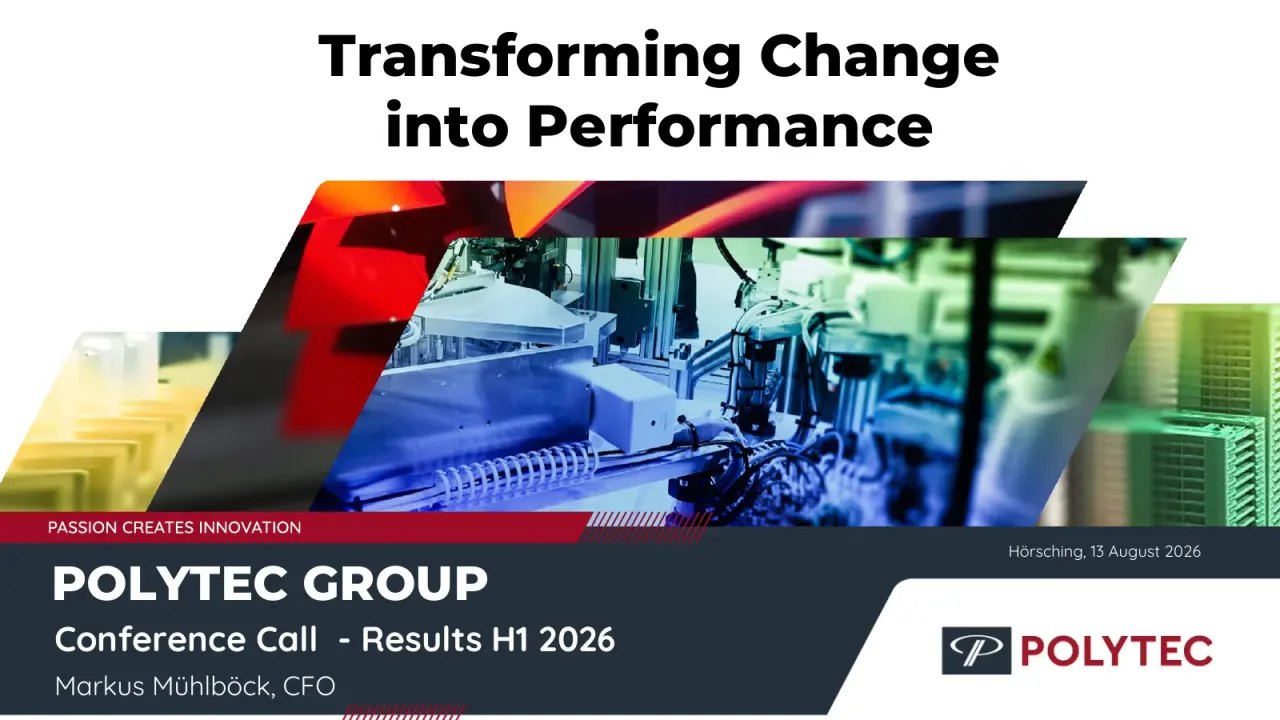
0:00 Ladies and gentlemen, we warmly welcome you to the earnings call regarding the h 1 figures of 2,026 of the Polytec Holding AG. I am pleased to welcome Polytec CFO, Markus Muilburg, and ER manager, Paul Leidenbach, who will guide us through the presentation shortly, after which we will move on to a q and a session with audio line and chat. With that, I'm handing over to you, mister Muilberg.
0:28 Good afternoon, ladies and gentlemen. Thank you for joining us for today's investor and analyst conference call on Polytec's half year results 2020 '26. Let me start with a quick overview of the first half year. Polytec Group is on the right track. We continue to move forward with a clear focus on productivity and profitability. Although group sales are temporarily lower, this is no cause for concern, quite the opposite. We have significantly optimized our product and production portfolio, resulting in an improved profitability in the first half of the year. We also made further progress in strengthening our balance sheet with a higher equity ratio and significantly lower net debt.
1:16 At the same time, we have intensified our efforts to expand and diversify our non automotive business. We are making very good progress in this area and see promising opportunities ahead. Against this backdrop, we confirm our outlook for the current fiscal year. Before I take you through the key figures of the first half year, I would like to briefly outline the strategic positioning of the Polytec Group, as this provides important context for understanding our financial performance.
1:52 Our guiding principle is to apply the right strategic approach to each product area. In automotive, we remain an established Tier one development and production partner with a clear focus on electromobility, disciplined investment and capital preservation. In a largely flat market, we see M and A as our primary option for future growth. In parallel, Polytec is developing smart plastic application as an attractive second growth pillar by leveraging our automotive expertise and transferring it to new markets. The diversified market approach increases our opportunities for success. We enter new markets together with our customers and develop innovative plastic solutions for industrial applications.
2:42 At the same time, we can act as an industrialization and scaling partner for innovative startups, bringing their ideas from concept to industrial scale production. Naturally, one of the questions we frequently receive from our shareholders is, where do we currently stand with the expansion of our non automotive business, and when can we expect this to translate into higher sales? Let me therefore give you an update on where we stand today. The path to market in the non automotive sector differs from what we are used to in the automotive industry. Market testing, for example, plays a particularly important role before a product can move towards full commercialization. Our smart plastics applications pipeline includes a number of promising projects at different stages of maturity, progressing from initial concept through to a market launch.
3:39 With projects ranging from load carriers to applications in constructions, we are pursuing a diversified and capital efficient approach. This includes our own product ideas, co development projects with customers, as well as partnerships. In this way, Polytec can efficiently leverage its existing expertise in materials, product development and industrialization across new markets and applications. We first presented this slide at our Annual General Meeting at the beginning of June. Since then, several of the projects shown here have moved to the right, meaning they have successfully progressed to the next stage of maturity. This demonstrates that our pipeline is moving forward and that we are making tangible progress in building our non automotive business.
4:34 As mentioned, our non automotive business is becoming increasingly important to Polytec's overall value profile. Our goal is to achieve a group revenue share of around 30% in the non automotive sector in the mid term. For us, mid term means the period of two to three years. In principle, this is no longer than in the automotive projects, where the industrialization phase from winning to the order to start of production takes a comparatively time. We are focusing on reusable and industrial returnable containers. These products support efficiency, sustainability and the circular economy, ensuring stable demand and helping our customers to fulfill the European Union regulations.
5:22 A strong example is BOOX IT, an intelligent, connected logistics solutions that combines physical robustness with digital intelligence. Polytec acts as the industrialization partner and exclusive supplier. This project is a good example of how we leverage our core competencies to develop profitable new applications together with innovative partners, always with a clear focus on industrial scalability and serial production. The first products for market testing will be presented to policymakers, military representatives and other potential customers at our plant in Abensee this September. But before we look ahead to September, let me take you back to the first half of the year and our financial performance.
6:17 Let me start with a positive look at the year to date performance of the Polytec share. Based on yesterday's closing price, August 12, our share price has increased by 44.5% since the beginning of the year. In contrast, the stocks Europe 600 automobiles and parts index declined by 14.9%, while the ATX total return index gained 29.8%. Among the 38 prime market stocks on the Vienna Stock Exchange, Polytec ranked fifth in year to date performance. On a personal note, my fellow management board member Martin Rech and I each purchased around 43,000 Polytec shares at an average price of 4.58 at the end of June and beginning of July.
7:08 This clearly reflects our confidence in Polytec's future development. Polytec is currently covered by three research houses, with an average price target of 6.73 Most recently, Montego initiated a coverage with a buy recommendation and a price target of €10 Our current market capitalization is around €107,000,000 approximately half of our equity. Over the coming months, we will further intensify our investor relations activities through conferences and roadshows. We look forward to meeting many of you in person and presenting Polytec's refined equity story to a broader investor audience.
7:57 To remind you briefly, in fiscal year twenty twenty five, Polytec Group clearly achieved its operational turnaround, improving almost every financial KPI. We met and even exceeded our outlook and returned to positive earnings after tax. Tax. Based on this strong performance, the management board proposed a dividend of €0.20 per share, which was anonymously approved by the Annual General Meeting. The total dividend of €4,400,000 was paid on 06/11/2026. Following the positive earnings development reported for the first quarter, our H1 results confirm that we remain on the right track. Let's take a closer look at the financial figures.
8:45 Again, we improved all relevant earning KPIs compared with the first six months of the previous year. Consolidated sales in H1 amounted to €287,400,000 down 19.6% or around €70,000,000 year on year. However, this decline was not unexpected. It mainly reflects the planned optimization of our product and production portfolio over the past few quarters. As already explained in our annual and Q1 reports, sales in 2026 are lower due to the divestment of our UK operations at the end of twenty twenty five and the closure of our Weierbach plant in Germany at the end of April twenty twenty six. As a CFO, I can accept the lower sales if those sales are more profitable, particularly when the decline is temporarily.
9:38 Our focus is clearly on profitable growth and better margin quality. In the medium term, we expect new projects, particularly in the non automotive business to increasingly contribute to sales and support renewed growth and improved profitability. And our earnings figures already demonstrate that we are moving in the right direction. EBITDA increased by 7% to €22,600,000 while the EBITDA margin improved significantly from 5.9% to 7.9%. EBIT increased by 47% to EUR 8,300,000, the EBIT margin rising from 1.6% to 2.9%.
10:26 At the end of June, Polytec Group employed 2,804 FTEs, a reduction of eight zero two employees or 22%. This mainly reflects the divestment of our UK operations, including three forty eight employees, as well as the closure of the Weierbach plant and related workforce reduction in Germany. The improvement is even more visible at the bottom of the P and L. Earnings before tax more than tripled from €1,500,000 to €5,600,000 Earnings after tax increased from €1,400,000 to €4,700,000 This resulted in earnings per share of €0.21 compared to €06 in the first half year of the previous year.
11:13 So the key message is clear. We are operating on a leaner sales pace, but with significantly improved profitability. Our balance sheet remains strong, with the equity ratio now above the 50% mark. As of June 3026, total assets decreased by €33,800,000 to €442,200,000 compared with year end 2025. Despite a dividend payment of around €4,400,000 the equity ratio increased by 3.9 percentage points to 50.1%. Over the past two years, one of our key priorities has been to reduce net debt and strengthen the balance sheet. As of June 2026, net debt stood at €29,600,000 down 43% or €22,500,000 compared with June 2020.
12:13 Debt increased moderately because of the higher working capital. The notional debt repayment period stood at zero point five six years, while the gearing ratio was 0.13. Both indicators remain at a very comfortable level and provide us with financial flexibility for future investments. Average capital employed decreased by almost 7% to two forty nine million euros Combined with higher EBIT, this resulted in a significant improved ROCE from 2.2% to 9%. And finally, as of end of June twenty twenty six, Polytec Group had more than €34,000,000 in cash and cash equivalents.
13:03 So the key message here is a stronger balance sheet, significantly lower net debt year on year and substantially improved capital efficiency. Let's have a quick look on the turnover split. Sales in the commercial vehicle market area accounting for around 18% of the group sales were slightly above the previous year's level at 51,400,000. Sales in smart plastics applications amounted to 20,700,000 in the first half twenty twenty six. This market area is subject to fluctuating callers from a major customer. However, this volatility is part of the nature of the business and does not change our positive view of the customer relationship.
13:48 We have been a reliable partner for many years and look forward to continuing this cooperation on new projects. Having reviewed the first half of twenty twenty six, let's now turn our attention to the future. The outlook for 2026 remains unchanged and we can summarize in the following sentence: stable earnings situation despite lower sales revenues. From today's perspective, the management of Polytec Holding AG expects planned consolidated sales revenues in the range of €560,000,000 to €590,000,000 for the 2026 financial year.
14:28 The Polytec Group's lower total sales compared to the previous year are due to the divestment of the operational business in The UK as of December 2025 and the closure of the Weierbach plant as of end of April twenty twenty six. With regard to the margin development, the company expects a stable or slightly improved earnings situation despite the lower sales, and is aiming for an EBIT margin of around 3% for the 2026 financial year. And the company intends to pay an annual dividend again in the future. Polytec stands for a solid balance sheet, strong cash generation and a reliable dividend policy. Our strong market position, broad technology portfolio and clear strategic direction support our financial performance even in challenging market conditions.
15:21 Demand for high quality plastic solutions remains strong across industries.
15:26 Bjorn established Tier one partner to leading European OEMs, while smart plastics application is development into an attractive second pillar beyond the automotive business, sorry. In short, Polytec combines strategic focus, operational excellence and sustainable value creation, providing a strong foundation for long term growth. Finally, we would like to thank our shareholders for their continued trust and confidence in Polytec Holding AG. This concludes our presentation of the results for the first half year twenty twenty six. Thank you very much for your attention. Now it's time to hand back to the operator to quick kick off the q and a session.
16:13 Yes. Thank you very much. We just stopped the recording and we are among ourselves now as we are opening the Q and A session. Ladies and gentlemen, now it's your turn. Please note that only analysts and investors are allowed to ask the question via audio line for that. For that, please click on the raise hand button below. Or if you are dialing in by phone, please press star key 9 to raise your hand and star key 6 to unmute yourself. We would like our media representatives to only ask their questions in our chat
16:44 box, and I will read those questions out loud for you. On another note, we would like to continue the q and a session in German language. Should anyone object this request, please let us know in our chat box right now. If there are no objections, I would continue this q and a session in German. I just got the message in our chat box that we should please continue in English, so we will do so. I have two risen hands, one by Marcus Reni. You may unmute yourself now. I just sent you a request to do so.
17:32 Mister Demi, can you hear us? Yeah. Yeah. It just takes a couple of seconds to for the signal to reach and to unmute. That's alright. Yeah. Thanks for the presentation. Can I touch upon the growth opportunities in the non auto business? And just to set the stage, the 30% revenue share in two to three years, what's kind of the base scenario for the non auto sorry, for the automotive
18:11 business? And and maybe we can talk about absolute numbers. What is the 30%, which absolute number is kind of in on the back of it? So it would be same base as today. So let's say approximately that the 30% would would make €200,000,000. Okay. Okay. That's very clear. I mean, that requires quite a steep adoption curve.
18:43 I mean thank you for the very helpful chart where you show the value chain from product to market launch. I mean, what makes you so confident that kind of the products that are currently in the product process design, if I kind of look at the chart, will take, whatever, twelve months, sixteen months, eighteen months for those products to reach the market launch. And then as I said, to me, the adoption rate that is applied to the 200,000,000 is extremely punchy. That's a good question. Thanks for that one. So, actually, first answer is because I'm convinced and I have full trust in in the products we develop together with our partners. Yeah? These are great products and creating creating additional value to our customers.
19:39 And I do always believe when a product creates a value for a customer and an advantage for a customer, then this will be successful. That's number one. Number two, we have the new regulations in the European Union taking place, I would say, first January twenty twenty thirty. So therefore, they must change something. Yeah? And therefore, we are so confident that we can manage that and that we are able to increase our non automotive business to 30%.
20:16 Okay. On the plant tray trajectory, can you help us with some revenue figures for 2026 and kind of an indicating indication of the growth for for for '27? Yeah. I mean, I I don't wanna say, let's say, specific numbers for for one specific product, but I can can tell you it's a it's a one digit million amount. And, yeah, this is I would call it an early adapter because they here, there is deadline as well, end of twenty twenty nine. They are starting to fill the market.
20:58 This year, it was, let's say, below our expectations. You see there are some, let's say, challenges because, let's say, the the retailer, they they have to have some store. They need to implement the processes, etcetera. So it's not not so super easygoing, but there is a deadline, end of twenty twenty nine. I do expect for the next year, let's say, double the revenue, what we what we have 2026. So this is on a on a solid base, I would say. Okay. Thank you. And then turning to the automotive part. I mean, there's recently been another wave of profit warnings in the industry.
21:44 We had some by the OEMs, the Volkswagen new flow that was, say, at least controversial regarding closures of German plants. Can you give us an idea, given that Volkswagen is your most important customers, how much exposure you have to the German plants of Volkswagen, and if there has been any talks with with you on on on the matter of relocation of production, etcetera?
22:16 I mean, first of all, the basis is there is overcapacity in the market. Yeah? We as Polytec Group, we adjusted our capacities in the past couple of years. So that's very important. Volkswagen did not do that. But as I don't wanna, let's say, comment on on Volkswagen's strategy, they they did in the last couple of years. Just let me let me say that very straight. The capacity is too high from the Volkswagen Group. But, by the way, CEO of Volkswagen Group as well found out and told, okay. Now they wanna build 1,000,000 less cars.
22:59 Has this a direct impact on us? No. Because it's the same situation as it as it was the year before and same situation we we see now. I do see some chances here. Yeah? For sure, they they are asking all the time for for price declines, etcetera. But if you have good products, if you have a good process, then you can convince them. And that's what we what we did, by the way. And we got a couple of new couple of new projects from Volkswagen Group as well projects who prior were at some competitive competitors from us. Yeah? So therefore, I would
23:45 I see it as as I said. So I see it with chances. I see as well that Volkswagen needs to adjust its capacity. Okay. Understood. And then last question before I get back into the line would be on the organic sales development in the first half. So stripping out the disposals and divestments, what would be the organic growth rate, please? I mean, that's hard to say, and it's hard to to see, let's say, our reports, know, because of the divestment of The UK activities and the the closure of the Beyerbach plant. But I would say that there is a growth in the automotive sector if you exclude UK business, if you exclude and if you exclude the sale of our small plant in in Belgium. Yeah. So there is a small increase
24:44 in automotive sales because of, let's say, new projects we've won in the past. Okay. Thank you very much. Thank you very much. We have another risen hand by mister Hidir. I just sent you an invite to unmute yourself. You may do so now. Mister Hidir, can you can you hear us? Yes. Now we can hear you. Hello. Welcome. Okay. Perfect. Thank you so much. Good afternoon, ladies and gentlemen. First question first of all, congrats on the strong margin developments. My first question is regarding the SPA business.
25:33 As we have seen that Q2 sales in that business area were already back above q one. Is it fair to say that we have some kind of button outs in that in that area? Yeah. I think you can say that. And but I I have to I have to comment as well. In q two, we did a lot of stock buildup for that customer, which you don't see in the turnover, but we will see in q three in the turnover. So I would say from a production point of view, it was not too bad. But from turnover point of view, it was, as you said, it's it's like the bottom, I would call it. Okay. Perfect. And with respect to your 30% target in that business area, I know that many questions regarding that topic has already been has already been asked. But can you give us some flavor on the timeline when you expect the major well, like, orders from from several other customers above that key customer that you have at the moment?
26:42 Yeah. I would say next year, we we do see some some increase. Yeah. That's that's our expectation. But let's say the main topic will then be 2028, 2029. Yeah. 2029 for for a full extent, but significantly in 2028. That's our expectation. Okay. And my last question would be regarding capital allocation. As you have dramatically optimized your balance sheet, and do you see some market opportunities on the m and a side, both on the automotive and also on the nonautomotive business? I mean, here and there, we do have discussions.
27:29 We already had a closer look on on some potential targets, but it's it never came to to the point that we say, okay. This fits. This makes sense. But we do feel that there is, let's say, increasing activities. So we are watching that very closely, but I can't say any anything specific about that. Okay. Thank you so much. Yeah. That's from my side. Thank you. Thank you very much, mister. We have another a recent hand by mister. You may unmute yourself now. I just send you an invite. Yes. Thank you. I hope you can hear me well. Yes. Absolutely. Hello. Yes. Perfect.
28:18 Yes. Hello together. Many thanks for the opportunity to ask questions. My first question goes a bit deeper in your Products business. I'm wondering if you can share some insights about your breakdown of the materials you are using. We have learned from the chemical industry that prices are going up. So I remember that you are using polypropylene and polyamide and class fibers as, let's say, the top three materials. Which price indications do you have for us? And are you able to mitigate those price increases from the chemicals industries?
29:03 That would be my first question. Thanks for the question. So first of all, you're right. Yeah. So that's definitely the the major, let's say, base materials we we use. And, yes, there were some significant price increases. But let's say based on our contracts, based on negotiation power, yeah, okay, we we felt it, but not in a super strong way as of now. Yeah? So prices went up, but prices went down again, and now they went up again. But at the end, we do have agreements with our customers that we can part partially forward that prices to our customers.
29:50 So you see in quarter two, you you see a small effect, yeah, from price increases. This is a timing timing topic, for example, when we when we then forward the prices to our customers in q three, for example, because that takes some time. These prices are adjusted, etcetera. But the numbers are not not too high what you see in our our result. Perfect. Thank you. By by the way, there was never a shortage of of materials. Yeah? If if you pay the price, there is never a shortage. Yeah? And that's in the beginning, the prices went up dramatically dramatically. Every supplier said, oh, I don't get anything. But at the end, it was not it was not so bad.
30:39 Mhmm. Understood. That's what I've heard also from the chemicals industry. My second question maybe needs a bit more explanation. If you can go back to Page five of your presentation, which was in the slide, it's very helpful to me. Can you walk us through the slide a bit with regard to profitability of those projects? So my understanding is if you're the, let's say, the owner of not the owner of the idea, but the owner of the production and all the engineering and tooling you're doing and later the production, you should be this project should be more profitable for you rather than when the person comes with a ready idea and you just have to make some kind of tooling and the production. Am I right? So you have used these three different colors, yellow, blue and green.
31:46 So would be helpful to understand where do you see the highest profitability in those three kind of projects? Thank you. Yeah. Good question. Yeah. I guess it's clear that if we do develop a product by our own, yeah, that at the end, the margin should be should be higher than if we we are, let's say, the industrialization partner and the scaling partner with with somebody. Yeah? But as these products, let's say, at the current time, not on the market, and therefore, it's it's it's hard to hard to judge. But my expectation would be that if the products we develop by ourselves have the highest margin here, That's the expectation.
32:40 Okay. Thank you. Looking at this yes, looking again on this chart, we can found something which is, yes, I would say, not that filiggrain when it comes to the usage. We have something in the construction area. We have load carriers and stuff like this. Have you ever elaborated on moving into areas which need more filigrane or less heavy stuff? So for example, into the medtech industry, for example. In in what kind in what kind of industry? Sorry.
33:26 Medtech. Medica Medica Medica Medica Medica Okay. Medica. MedTech. Yeah. Yeah. Got it. Sorry. Was just for audience. No worries. I mean, of our products you see here you see here on that slide, and this is the product I can talk about because it was already published is Book Seat. And Book Seat, here we see a big big potential in the in the med medical industry. Yeah? So this will be definitely a use in in that industry. And, yeah, we are trying, let's say, a lot of things. Yeah? And this is just, let's say, an extract from from what we are doing, what you can see on that page or on the slide. So there is more. But we we do not, let's say, develop products together.
34:18 Let's say, very small products. So so our our goal or our our focus is more on, let's say, bigger products. Yeah? So Bookset will be one example where we go in the in the med industry, but all the other ones, they are not super small products. Okay. No. No. No. You're not looking at at a single use product in in any kind of industry. Yep. Okay. Yep. Thank you. I step back. Thank you. Thank you. Thank you very much. We have not received any further questions in the meantime, not in our chat box or per hours in hand. So I would say we therefore come to the end of oh, and with that said, there is a question that just came in into our chat box.
35:13 It says, what are the requirements on the m and a front in terms of product fit size of the deal profitability? Sorry. Can you repeat the question, please? Of course. Okay. It says, what are the requirements on the m and a front in terms of product fit, size of the deal, and profitability? Okay. Got it. So it should be plastic products. Right? It should be, let's say or it can be in the same size as as a group right now, so we we are not afraid about that. It must be a company, let's say, in critical financial situation, and then we would we would have a closer look.
36:04 Yeah. So there is not that much constraints about the size. Definitely not there. Because I would say, as a Polytec, we have very different kind of products and and therefore kind of complex portfolio. And sometimes you see competitors, they they make more turnover than than we with just one or two products or the same product family. Alright. Thank you so much. There is one more question that just came in. It says profitability in q two was slightly lower compared to q one. What are the reasons for that concerning EBITDA, EBIT and net results?
36:51 First of all, I need to correct correct that because in Q1, there was a special effect included what we reported as well in Q1. So there was the sale of our Belgium business. I guess, especially affecting Q1 was €1,700,000 1,800,000 If you exclude that, profitability in Q2 was higher. Second, what I already mentioned, there is a small price increase in the raw material side. So these are, let's say, two reasons to explain the question. Alright. Thank you. On another note, there is one more question left. It says, how about the influence of increased mineral oil prices on material costs?
37:37 It's basically the same as we as the question we we already took. So the mineral prices, they they go to our products as a base base product, and therefore, yeah, there were some price increases. And, we see increased material expenses, but on a, let's say, very small amounts in the in the q through q two. Yeah. So it's it's not not a material heavy effect in in our balance sheet or in our PNM. Alright. Thank you very much. So ladies and gentlemen, no risen hands and no questions in our chat box anymore. I would say we do it a second time, and we come to the end of today's earnings call.
38:28 Thank you so much for your interest in Polytec Holding AG. And if you have any further questions at a later time, please feel free to contact Paul Rattenbacher at Investor Relations. A big thank you also to you, Markus and Paul, for your presentation and your time. I wish you all a successful day, and I'm handing over to you, Mr. Muilburg, once again for your closing remarks. Thank you. Thanks to all of you on the call for taking the time. And I wish you all of you a nice day and look forward to welcoming you again on our next conference call to be held on November 13 when we will present the figures of Q2. Until then, all the best. Have a relaxing summer break, and goodbye.
Follow Polytec Holding AG into a list and get an email when it puts out news.
CFO, Polytech Holding AG
Analyst
Analyst
Analyst