Manolo Zuniga
President and CEO
Replay available
PetroTal (TSX:TAL) Q3 2026 earnings call, held 2026-11-09. Watch the replay and read the transcript on 6ix.
On 6ix: 6ix.com/event/petrotal-corp-tal-q3-2026-earnings-call
Automated transcript · Written by software from the replay's audio. It can mishear names and figures; the replay is the record.
0:00 Hello, thank you for joining the PetroTal Q3 2026 webcast. Your speakers today are Manolo Zuniga, President and CEO, and Camilo McAllister, CFO. There will be a question and answer session after the presentation, as usual, so if you'd like to submit a question, please use the platform. We'll do our best to answer them in the allotted time. Without any further ado, I'll hand over to Manolo and Camilo. Thank you.
0:27 Thank you, Mark. and good morning everyone and thank you for joining PetroTal's Q3 2026 webcast where we are going to discuss the financial and operational results we released today. My name is Manolo Zuniga and I am the President and CEO of PetroTal. I am joined today by Camilo McAllister, our Chief Financial Officer. If you have clicked on the link in this morning's press release, you should hopefully see our slide presentation on your screen. But before I begin, I should mention that there are some disclaimers towards the end of the main presentation on our website, which I encourage you to read after our prepared comments. On slide two, before we get into the quarter results, I want to step back and remind everyone why we believe PetroTal represents a compelling investment.
1:21 Starting with the asset itself, FederalTal is the largest oil producer in Peru. We have 110 million barrels of remaining 2P reserves, representing $1.2 billion of NPV10 value, against 34 million barrels produced to date. So we're still in the early innings of developing this field. Our track record speaks for itself. Since inception, we have invested $675 million in Peru, generated over $1 billion of EBITDA, and returned more than $150 million to shareholders. Turning to the categories ahead of us, we're excited to have restarted our development drilling program in September, as we target a return to our previous production levels of more than 20,000 barrels per day. We expect to show significant growth in production over the next six months as the new producing wells come on stream.
2:20 It is also pleasing that our production for the first nine months of the year has tracked 3% ahead of budget at 13,076 barrels per day. On the right-hand side of the slide, you can see our current production, financial, and capital markets snapshots. We now also include a corporate responsibility highlight each quarter, reflecting our commitment to safe operations and to improving outcomes within our host communities, an important part of how we seek to create lasting value. We are proud to have committed nearly $39 million since inception to our innovative 2.5% social trust fund, empowering the local communities to address social disparities in our host district.
3:09 Moving on to the third slide. As I mentioned, year-to-date production is tracking 3% ahead of our budget. At 13,100 barrels a day, it averaged 11,800 barrels a day in the third quarter. Down 6% from the second quarter of this year and down 36% from the third quarter of 2025. This reflects the natural decline in our production base during our pause in developing drilling and the need for added water handling facilities, so it's a trend we hope to reverse shortly. In the quarter, we completed a pulling campaign at Betania, replacing production tubing and electro-mersible pumps in five wells. This work improved our production durability, helping to partly mitigate production declines. We also stimulated two water injection wells and injected 187,000 barrels a day of water in September, at 6% month-on-month.
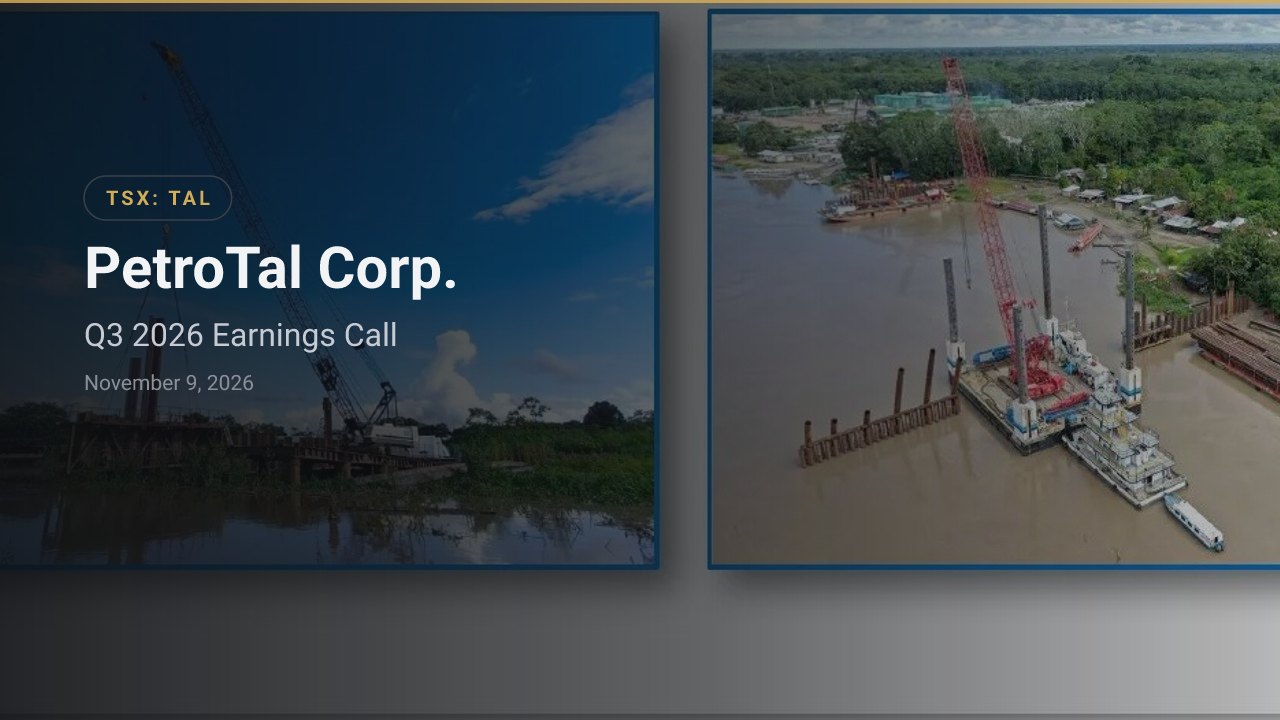
4:11 This has assisted oil recovery from our existing production. In September, we started our new development well, the 25H, the first in our campaign to restore production to over 20,000 barrels a day by the end of this first quarter of 2027. You can see the Estrella rig on site here on this page, which we have contracted for a minimum of eight oil wells. Finally, after the end of the quarter, we were pleased to be awarded a technical evaluation agreement over Area 117. This gives us exclusive low-cost access to evaluate two structures where legacy wells have tested oil, on trend with other major fields in the Marañón Basin, including Bretaña.
5:02 We look forward to not defying the market once Wealth25H has completed and we remain focused on returning PetroTal to sustainable production growth in 2023. With that, I will now hand the call over to Camilo to discuss our financial results.
5:19 Thank you, Manolo. And turning to slide four, where we have laid out PetroTal's financial performance for the third quarter, compared both to the prior quarter and to the same period last year. The average rent price in the quarter for PetroTal was $86.45 per barrel and our production volumes were down 6% quarter on quarter. Our operating expenses in the third quarter were essentially flat year on year at $13.7 million, but as you can see, increased on a unit basis due to declining production volumes. As a result, our net operating income was $44.9 million, which is down 18% compared to the second quarter.
6:10 Third quarter adjusted EBITDA of $33.7 million fell 23%, For the first nine months of the year, our Just Rebita was $112.3 million, which is already within the full year guidance of $110 to $120 million we had shared back in May. We reported a net loss for the quarter of $5.5 million, and this really reflects the impact of total commodity price derivative loss of $14.9 million. It's important to note that this reflects unrealized fair value losses of hedging of $10.6 million and realized losses of $4.8 million, which are partially offset by a $0.5 million gain on outstanding embedded derivatives.
7:09 As you may recall, this is our oil in the pipeline. I must emphasize that these unrealized derivative losses do not affect our operating cash flows, liquidity, or any other cash metric. Capital expenditures in the third quarter was $11.8 million, rising 48% quarter-on-quarter, reflecting our returns to development drilling as expected. Total cash at quarter end was $151.4 million, including approximately $36 million of restricted cash. After the end of the quarter, we were pleased to repay the $36.6 million balance of our Van Vief Cofide syndicate loan facility from our own existing resources.
8:00 This has allowed us to eliminate about $3.9 million of future interest costs.
8:10 So, going back to slide five, this final slide is our full year in 2026 guidance summary, which you have seen before. I won't spend too much time walking through every line, particularly because we are now in November and some metrics such as the Brent oil price are clearly stronger than we're expecting when guidance was set. That said, we're pleased with our operational and financial performance this year to date. This reflects the hard work of the entire PetroTal team and the support of all of our stakeholders, for which we are grateful. Being back breathing is a huge step forward in our return to growth.
8:55 I'm looking forward to sharing the results of WELL25H with you once available. With that, I will turn the call back over to the operator. Please let us know if you have any questions. Thank you, Manolo. Okay, first question. How many wells a year should we expect you to be drilling going forward? When will you give guidance on this? Given your success in negotiating royalties on BROT 131, when might we see a well there?
9:32 You know, in Britannia, when we announced Well 25H, we mentioned that the well should take about two months to drill. So at that pace, we should be able to drill in Britannia six wells per year. As we optimize the drilling campaign, keep in mind that it's been two years since we drilled the last well, so we could do better than that. But usually six wells per year in Britannia. As we have mentioned in prior releases, we have 22 total 2P wells. In Los Angeles, we were, as mentioned here, successful in reducing royalties.
10:20 The government is very supportive of adding investments in the Amazon jungle of Peru. And there is a timetable that we need to meet, which is drill two wells in the next two years. So we're working to achieve The final investment decision to go back to drilling in Los Angeles. As I have mentioned in the past, there were two of the four oil producing wells in Los Angeles went down into the deeper formations that they showed pain, but they were never tested. So the idea is to drill a well that will not only produce the Cushabatay formation, but also test the lower Inouye and Copacabana which then could add reserves and production and have a profitable second oil field for PetroTal.
11:21 So, we have two years. Hopefully, we can get the FID next year. Thank you. Can you please discuss your hedging strategy, particularly in light of having repaid the Bambi Cofide loan? Is it necessary to hedge at
11:43 all? Manolo, let me take this one. Okay, please. So, our hedging strategy is there to basically ensure our minimum liquidity is available to the company under stressed oil prices or downturn situations. as you might recall we have a minimum liquidity policy of 60 million dollars and currently we have hedged through December you know from October 26 to December 27 approximately 1.7 million barrels and we we always hedge only on our base production so we don't we don't hedge on incremental production Thank you, Camilo. Did you provide any further update of the erosion control project?
12:54 When should we expect work to begin again and how much is left to be spent?
12:59 Camilo, how do you take that one also?
13:01 Okay, so we might recall erosion control project when it was introduced last year. We mentioned it was a project that was cost approximately 65 to 75 million dollars. and we had selected our consortium to undertake it. That project was stopped in March of this year and until March we executed about $34 million of that program. So if you take the upper range that we have disclosed, we still have about $42 million to go. And that will be done during 2027. We're still in the final stages of selecting the construction company that will do the filings of the groins. All the other critical equipment has already been secured and is available to us. So as soon as that project is ready to be announced to restart and completed, we will be making that announcement.
14:02 Thank you. Regarding the OMP pipeline, Have you any update on when it might come back online and any update on payments for your oil which remains inside it?
14:14 You know, there is some update that I would like to provide related to the O&P. A couple of weeks ago, PetroPeru, the state oil company that owns the pipeline, the O&P, as it is known, signed a joint venture agreement with Cairo Energy, an Egyptian company, I understand, based on conversation with the government, that the idea will be for KDON to start oil production by April of 2028. So the importance of that is that that block 192 depends on the O&P.
15:09 So once oil starts flowing again into the pipeline, that should be a very good sign that oil is going to be moving. And therefore, some of the oil that is in the pipeline trap that has a derivative versus oil that we sold in the past to PetroPeru, will finally be settled. But timing exactly is difficult to say. And if we go back into the pipeline, also it's going to depend how well Kayron does producing Block 192. But as I have always said, I believe the company should go back to the O&P to diversify its markets. So we're looking at potentially April 2028.
16:00 Why did you choose to repay your debt facility ahead of schedule and are you seeking to add a new long-term debt facility?
16:08 Camilo, let's go.
16:11 So we paid it ahead of schedule because, as you might remember, this loan was directly linked to the Emotion Co-Project and the loan was basically a restricted cash that could only be used The project got executed. We stopped executing the project, as I just mentioned earlier, in March of 2026, whilst we replaced the contractor. So we did not have access to those funds. So they were sitting in restricted cash. They were, of course, creating an expense to the company. So it made no sense to continue to have that facility. and given the oil prices and the current environment, we had enough liquidity to remove that facility. Now, are we seeking to add a new one?
17:00 We are in the process of finalizing next year's budget and we always look at those financing opportunities in the context of our development program and investments. So that is a possibility. Is World 25H drilling according to plan? Please remind us of how long you guided it would take.
17:23 We guided for two months and we should be reaching total depth very soon and the wells should be on production in about the same amount of time that we guided, two months. Just to remind our investors, we've been very consistent. Once the wells clean out, we provide a first week Thank you very much. What are your thoughts regarding capital returns to shareholders next year?
18:18 Camilo, do you want to answer that one as well?
18:22 Yes, yes. Well, capital returns, as you well know, is something we review every quarter. We review it in the context of our growth opportunities, in the context of our cash flow generation. Thank you very much. Your unchanged full-year 26 capex guidance of £85 million implies a significant increase in spending during Q4. How likely is some of that capital expenditure to slip into 2027, and would that be erosion control related?
19:19 The capital expenditure guidance was left unchanged, but you're right in pointing out that because of the erosion control project execution, there will be some slippage into next year. and therefore the pace of our investment in the fourth quarter will be high but 85 million will be a stretch and some of that will have to be transferred to erosion control. Have you got any plans to extend your water handling capabilities and how much could this cost?
19:55 We have to. We have to extend the water handling capabilities I have always said, since I set up this company, initially our three PKs were supposed to have a total of 20 wells. At 10,000 bars per well, we needed to manage 200,000 bars of fluid per day. Right now, we're managing about 210,000 bars of fluid. Our two PKs have now a total of 46 wells. So, we're going to need to manage about, you know, 460,000 barrels to 500,000 barrels per day. So, that's key. In our corporate presentation, you can see that we have mentioned the idea of going from the 210 that we have now to 340 or 350 by the end of 28.
20:46 and then we may need to do the extra jump to the $500,000. That's key. And I think we're going to leave it like that. I've been mentioning to some investors that in our current certified reserves, the 2P case assumes a higher volume of water treatment. And I don't feel that that's going to be needed. especially the contracts term are extended as the government is announcing that they plan to do, which will be fantastic for everyone. Okay. Merle, can I hand back to you if you've got any concluding remarks, please?
21:34 Well, as always, I want to thank all of our investors. I know that my team members are also listening to this webcast. I want to thank them. and I look forward to providing our 2027 guidance in the very near future so the investors get a sense of how we indeed are going to drill all of the wells that we plan to drill and increase the plant capacity so we can produce 20,000 cars per day for the next few years. Thank you so much.
Follow PetroTal Corp. into a list and get an email when it puts out news.
President and CEO
Chief Financial Officer