Transcript
Automated transcript · Written by software from the replay's audio. It can mishear names and figures; the replay is the record.
0:08 Hello everyone and thank you for joining us today. I'm pleased to welcome Paul Wiebel, CEO of 5e Advanced Materials, to discuss the company's recent developments. As this is a live event, please feel free to submit your questions using the chat box in the bottom right corner of your screen. I'll do my best to incorporate them into our conversation. For any questions we don't have time for to address, I'll make sure Paul and his team receive them after the event so they can respond to you as soon as possible.
0:33 For those of you that need to catch up later, the session is being recorded and the replay will be available shortly. Paul, thank you for joining us today. We're going to be touching on the recent news. Kenneth Hull, appointment appears to be a significant addition to your commercial team. Could you walk us through what particularly impressed you about his background and why this was the right time to bring someone of his caliber on board? Thanks Kyle. Yeah, for Kenneth, you know, once we hired Mark and we brought Mark in, asked Mark what are the resources he needs just from as we build out our sales and operating plan. And Mark's first and kind of only request has been that, I need, 1, we need to target Asia.
1:21 60% of Borei demand comes out of Asia. We need to have someone on the team that ultimately is working while we're sleeping over here. And I got the right guy for the job and that's Kenneth. I had the chance to correspond with and speak with Kenneth. Technically, very sound, understands the market and has the relationships similar to how Mark has the relationships in the US. And between Mark's skill set and experience and now teamed up with Kenneth, we now cover 80% of kind of global Borat's demand. And as we look towards paper and up, I'll take it from us. Excellent. Now, correct me if I'm wrong, but the APAC region, particularly China, has historically been dominated by state owned enterprises in the Borat sector, correct? So how does Chemex experience a network position 5E to effectively compete and differentiate itself in this market?
2:20 Yeah, I don't think it's just China. I think, you know, you need to look at the entire APAC region. And that that goes to Japan, where there's, you know, LCD manufacturing of the specialty glass, that's Taiwan as well in addition to China and India. So it's really the region. And if you just look at the Cagers, you're in like mid teens growth rates there. And as that grows, it's just a really big market. And we needed to have a presence, which is why we brought on Kenneth. Excellent. So Borat has various applications. You specifically highlighted the specialty glass market in this latest press release. What makes this segment particularly attractive for 5e?
3:11 Great question. With the glass, right, whether it's LCD or Gorilla Glass that's going into phones, they're going into consumer products that are of high value, right? And you need a quality glass product. And so as you think about it, we're kind of getting it real specific on customer segmentation. We have 90,000 tons to sell at the first commercial phase, 270 for the second. And we can be pretty selective about who we do business with. And I kind of use the old adage, there's about 2 pennies, 3 pennies of boron in every iPhone, right? It's still a $1,200 iPhone regardless, right? So there's an it's critical to the phone. So I think we want to be, you know, we want to be have customers that are making those high-end products, and they're also bankable customers.
4:06 That's where the focus is. First release also mentions targeting regions that represent the greatest returns. Can you share your perspective on the pricing dynamics and margin potential in the APAC specialty class market compared to other regions? Like you just touched on a couple pennies per thing, so per screen. Yeah, you broke up a little bit on my side. But I think the question... You want me to repeat?
4:36 Yeah, if you could. I can repeat. No problem. Let me. Yeah. So the press release mentioned targeting regions that represent the greatest returns. Can you share your perspective on the price and dynamics and margin potential in the APAC specialty glass market compared to other regions? Yeah, definitely. Okay, I follow now. The obviously it's driven by the Cagers, right?
5:01 Asia is the market that's growing that region. And if you look at forage demand in the US, that's growing 4 to 5% consistently. And then when you start to look at Europe as well as South America, Europe's kind of flat down. The 2 larger Bore players are fighting, have been fighting kind of for market share there. It's not growing as robust as we see Asia and the US. And then South America is really driven by the crop space, micronutrient, you have Q Borax down there, and that's kind of, there's high barriers to entry. And so for us, where we are, we sit on the West Coast of the United States. We have a competitive advantage to be into Asia, or at least similar to our other producing peers on the West Coast.
5:48 And with those caggers and those growth rates, it just makes synergistic sense to be putting
5:56 trucks on rail down to Port of LA and Long Beach onto a boat across the Pacific to Asia. So, I think when you look at that compared to some of, if you go to Europe, you gotta go across the United States or down all the way around South America, and then still gotta go across the Atlantic Ocean. There's higher barriers to entry than to go into South America. That's the US as well as the APAC regions where we need to focus. Can you provide more color on the types of offtake agreements you're pursuing in the APAC region? Are these likely to differ structurally from agreements in other markets? No, wouldn't structure from other markets. Listen, we're going after the take or pay because that's what we need for bankability. And we're going after great customers, customers that we, Mark and Kenneth, both have in their Rolodex.
6:54 And I think we gotta be mindful, we ask for a floor, but it's really much a take or pay. It's out of the gate. You know, we kind of have our templates. They've been legally vetted. And that's where we're we're focusing next. Oh, you also released some news last week, announced some important operational updates. Could you highlight the key improvements you're seeing at your small scale facility? Yeah, I, that was an exciting release and it's really exciting what we're doing. So with that release went out October 21st, and I think we're consistently at 1 ton a day and where we are from specifications perspective, you know, we've gotten the feedback from customers.
7:39 We look good. Chlorides and sulfates are ultimately what matter in addition to moisture content and particle size.
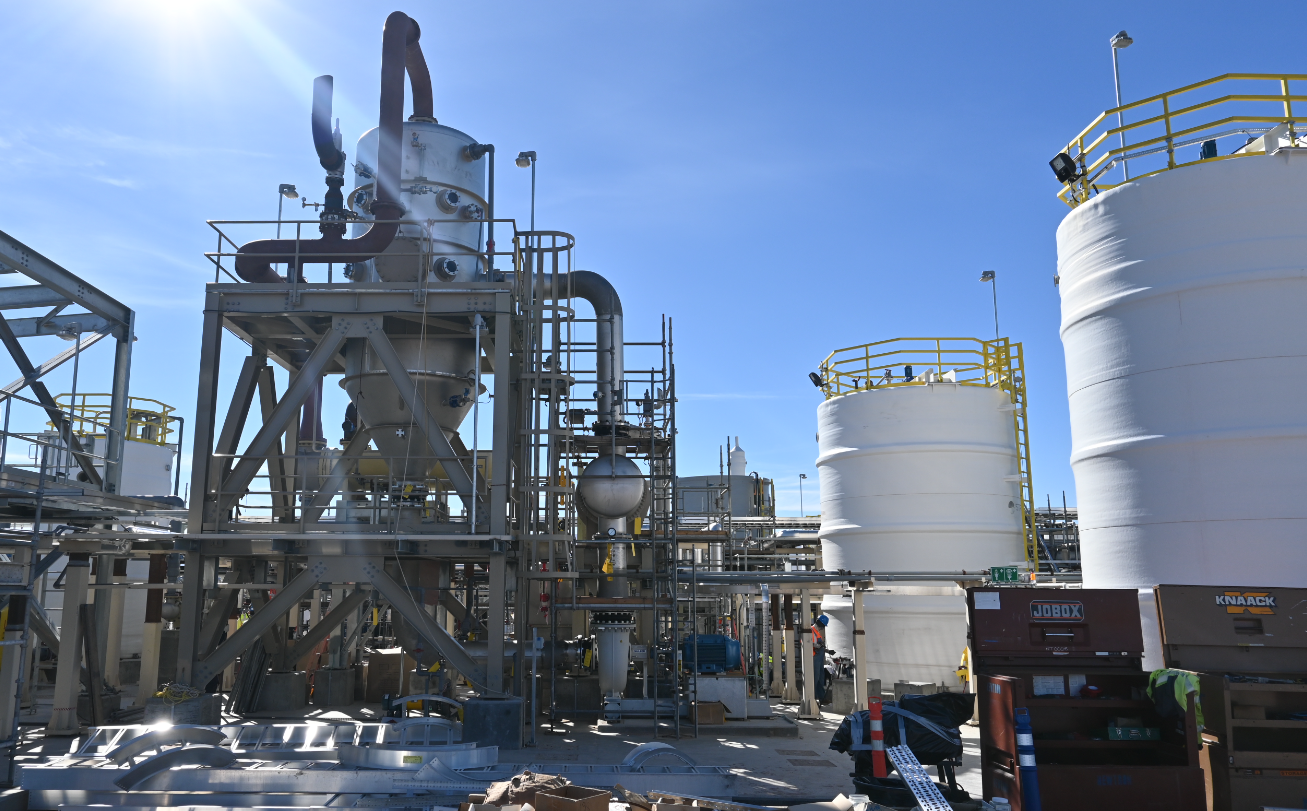
7:48 We, In late August, we installed a sifter so we can get the, you know, all particle size are now everyone's on spec. Anything that doesn't, there's a reject bag. If for that reject bag, we then work that back into process and continue to produce. So I think we want to go to market now consistently 1 ton a day. That makes sense from a liquidity perspective and a burn. And continue to accumulate inventory right now. And, you know, the other kind of exciting aspect was that we're a culminate deposit. So it's a calcium based boron deposit.
8:31 And what we've seen is actually the boron comes out right away, which is fantastic because that's the high value commodity we're going after. Highly leachable. And what we've now seen is the calcium, which is also kind of intermingled with the boron, has kind of lagged. But it's now gotten to a point where we're ready for, we need to produce gypsum and we need to remove the metal salts. And then as we do that, we will go back down the hall with fresh HCl. And so, you know, 1, as we kind of assess calcium chloride as well as gypsum,
9:08 we now have good samples of representative calcium that we can kind of use for our assessment of gypsum and calcium chloride. And it just demonstrates that process expertise now and kind of that next phase up. It also is encouraging to see that the calcium did lag and does lag the boron because ultimately there's an additional cost attributable to processing the calcium. So as if we could, we just be mining boron all day long, but that's not what we're gonna be working with. We have calcium we gotta work with as well as metal salts. And so all that information is being fed into the trade-off analysis we do. We are kind of running a... We are very much on a parallel path right now between... We know what we're going to do with boric acid, it's called crystallization.
9:58 And then We also continue to assess, okay, what's the best way we get down to the lowest cash cost?
10:08 Right now, actually, both gypsum and calcium chloride yield a cash cost right around low $600 to $500 per ton on a BA basis. And the trade-off is gonna be CapEx. The decision's gonna come down to, hey, what's more expensive? And so continue to work with Floor, our EPC firm on that, and feel good. We have optionality here, and this'll just be, we're looking at phase 1, but then we know we have phase 2 and we can kind of always be, once we've done this homework now, we can obviously be assessing the market as we then go up and go up to 270,000 tons of boric acid. So really exciting,
10:51 starting to build some inventory here and it was, you know, wanted to let the market know on that. Yeah, well, it mentioned in that update about improvements in production rates and quality, is that rather important, these metrics, when you're looking to secure further offtake agreements? Yeah, no question about it. And listen, I think with, you know, and this is where Mark's the expert, but for specialty glass, the chlorides need to really be... Sulfates need to be low, but chlorides also need to be low, because the chlorides ultimately will impact the equipment of the tanks that make all specialty glass. So getting them down was just really critical.
11:38 And so feel really good where we're at right now. And we've dialed it in. So it's good. Last question on that press release. It also mentioned securing a tax exclusion agreement for lithium-related capital equipment. Can you explain the significance of this? I believe it was $900,000 in potential savings? Yeah. So this will save us, and I kind of tie into here, right?
12:09 The focus to date for at least pre-feed engineering has really been on the boron and the calcium side. If we were going to produce gypsum, we're kind of like a one-to-one, maybe a little bit less to calcium chloride, but the calcium chloride market is ultimately 38%. We would look to offtake into 38% solution. And so that's probably about 197,000 tons of 38% calcium chloride. And so we know we're at like low 600s on like the 5 to high 500s on a cash cost basis right now.
12:45 And so as we think about like, we will be doing additional homework on the lithium side here. It's in solution. We know it's there. And we really do want to figure out how we can monetize that because that ultimately gets us down to a mid to low 500s cash cost. So it's that next layer down. And so that's, it's a smaller component. And so what we'll do is we'll actually look at, you know, as we think about any CapEx attributable to there, this is, this is, helps us save some money. And I think it just demonstrates the state of California is really, really supportive. You know, they have a program where they basically use tax in California 7.75%, which is high. And, you know, if you have to buy $10 million of capital equipment, you know, 7.75% of that is use tax. And so we now qualify that we get a full exclusion and I think California's been doing a great job of really, them and Nevada, as really that critical mineral hotbed here and I think it's a program they offered and we applied, worked through
13:48 and got the final agreement and got an award. So excited. Nice. I see questions in the chat parlour. And individuals that came in a little late, we are taking questions here, but upon registration, many of you have submitted questions. So I'm going to start firing off some of those. An individual is wondering, what is Mr. Stefan M. Selig's current involvement or position, if any, with the organization?
14:18 So Stefan rolled off the board. That was, he was on a 6 month term. That was part of the restructuring support agreement. That's in kind of the rear view mirror. Stefan came on board as part of that process and was a great value add to the board, but rolled off and now kind of board, we had a couple changes, you know, where we then brought on Barry and Bryn and both of them are have, you know, already added tremendous value. So yeah, that's he's, we wish that the best. Another individual is wondering if you could outline the company's plans and potential opportunities within the nuclear power sector supply chain. And maybe I'll add on to this because I didn't know we're talking about boron here. So maybe tie in why is that nuclear power sector important for boron?
15:07 Yeah, so boric acid actually is used in nuclear power, and they care about the B10 isotopes. And There's actually some studies that show that you have B10 and B11 isotopes. And Colmanite specifically, which is the deposit we have, has a higher B10 isotope. And so there's companies out there like 3M that'll buy boric acid and then spin that, isolate the B10 isotopes, and then sell that for like Boku bucks premium. I think
15:37 we've talked about it internally. The focus is like, let's get those 90,000 tons of an offtake and let's get 270. And then that actually becomes more of a bit of a, you could say it's a specialty for sure. And so, once we like it's on the, it's on the radar and it's something we w we will look at down the road. Did you provide the projected timeline for commencing commercial grade product delivery to potential customers?
16:05 So, and I'll kind of parse this question out. So we were accumulating some inventory now. And I think this, you know, there's also a question in the chat about catalysts, right? So I think catalysts on the horizon, Mark's already kind of established lots of good customer touch points. We need to do some tank testing over in Asia. That'll happen soon. Once that happens, we'll put that out. I think that's a big milestone because at that point we put 18 super-stacks of boric acid on a boat and it's going for tank testing in the specialty glass market to a large Asian glass manufacturer or large company that manufactures glass in the APEC region.
17:00 The other one is there's a customer in the Southwest region that we've identified that will look to any excess product we have, they'll procure. So as we kind of build inventory, there's 2 kind of goals in place. The first is like, hey, let's sell a truck and then let's get that product off to APAC. And I think for us, that's really exciting because I have 2 kids, they're now 7 and 9, but when they take that first steps, as a dad, that's a super awesome moment. And for us to get 25 tons on pallets in super sacks on a trailer loaded with the forklift and say goodbye. That's like those first steps, right? That means we've got something coming in the bank. And it's small out of the gate, but I think it's just from a what that does to team mentality.
17:55 And like, yeah, we're here, we're gonna be here, this project is gonna go. It's just a big, big accomplishment. I think that it'll be celebrated. And I think that those are 2 catalysts that are gonna happen. Next slide. Now, you touched on product line expansion a few times already, but I'm just going to ask the question the individual asked just to tie it up in a nice bowl here. What is the company's strategy for product line expansion, particularly regarding specialty products such as boric oxide?
18:34 You really broke up, but I think you asked, are we going to produce boric oxide. Apologies. What is the company's strategy for product line expansion, particularly regarding specialty products such as boric oxide? Boric oxide will be the first downstream derivative we go after. Technologies evolve such that we can take our boric acid and through minimal capex go after an oxide. And so that would be, that was like first on Mark's list, but I think Mark needs to, he's working on getting the off take agreements in place for the boric acid. And then we take a look at what's out there in the market then and it would be oxide is where we're thinking we go first. Thank you. Graham asks, as a shareholder interested in sustainable growth, could you outline the company's strategy for expanding market presence and potential timeline for dividend considerations?
19:37 Dividend considerations, we're a bit away, right? Because we're pre-revenue and we need to get to cash flow generation. I think if you think about the commercial phase, we need to get to 90,000, which is why we're focused on pre-feed engineering,
19:58 because that's where 100 EBITDA becomes in the realm of possibilities. That's when we're making distribution, but where we would consider and you're toggling and you're assessing a strategy at that point on like, well, we want to go to 270, right? So That's really the thought behind that. And I think from a sustainable growth, listen, we're going to put offtake agreements in place here quickly. And that will demonstrate sustainable growth. There's going to be customers that are signed an agreement. They want product by X date and in size. And that's where, that's the plan to be sustainable.
20:46 Thank you, Paul. This question I have kind of ties into our tires question in the chat here. But given the recent share price decline from historical highs, could you address the company strategy for rebuilding shareholder value and arguably more importantly, market confidence? Yeah. If I look at the share price, it's not fun. But I think we could focus on continuing to execute, demonstrating that we're real, we're producing. I think the market's viewing us as a speculative development company now, which is wrong. There's a lot of really good progress being made. And as we start to put offtakes in place, I think the market will be proven wrong. And so what I can control on a day-by-day basis is get out there, tell the story, and work with the team here. We've got a really good team and really just continue to execute.
21:42 Now, things that are not in your control, but something that Adrian is interested in the chat here is if there's any update on boron inclusion in 2025 critical mineral list. Yeah, I listen, this is had a little session on this today talking with the group at ADC and and it's it is front and center and we have spoken to USGS And I think if you look at criteria for USGS, a single point of failure is essentially one of their criteria. And today, The market's controlled by 2 large players, of which 60% is over on the other side of the Atlantic, and then 20% is in California. There is a single point of failure today.
22:32 You have 5E, and then you have Ioneer, who has 170,000 tons of boric acid. And you ultimately, and kudos to Ioneer, they got it over the line, they got their permit, which is no fun. Permitting in the US is hard. We saw that firsthand. And so if you think about boron and its criticality, like the United States needs 5e and 9ir to both come up and get online
22:58 to basically remove that single point of failure risk. And so, you know, I think that like, I'm biased, but you know, I believe boron should be on that critical minerals list. It should definitely, it's already on the Defense Logistics Agency's critical materials list. And they get it because they know that boron and its multiple derivatives are pervasive for defense applications. And so as you think about it today, as USGS evaluates that criteria today, ultimately there is that single point of failure. That list ultimately does drive capital funding in this country and easier, cheaper capital. Ultimately, if the US is serious about reducing their single point of failure and having a fully secure domestic boron supply chain, until 5E and Ionia both come online, boron has a place on that list. At least that's my opinion. And we've been adamant about
23:59 sharing and pushing that story out into Washington. So, man, I don't know if it'll end up on the list, but, you know, in my case, I'm pushing for a convincing argument on why it does need to be there. Thank you for that thorough response. There's a question in the chat here regarding community relations The individual says they are aware that you might not have any immediate neighbors, but would appreciate some further color on the matter Yeah listen, it's the closest real like Metro centers bar. So, or, you know, and that's even not, it's, it's more of a big town. But there's, we've, we do a sponsorship of scholarships every year for one of the local high schools.
24:45 We do employ a lot of people out of the Victorville, Barstow region. And so, you know, we're not a huge employer yet. I think when we get to that commercial scale, we will be a more sizable
24:59 employer in the region and, you know, looking, you know, we have a neighboring mine and then our other, we're surrounded by BLM land and then ultimately our neighbor is the 29 Palmas Marine Base which owns like a massive chunk of California. So we don't, it's not like we're taking pies to our neighbors where we are. A lot of questions fired your way today. Really appreciate you answering them straightforwardly. Is there any closing remarks before we sign off here today?
25:33 Yeah, I did. I know we're pushing up on time. I'm just kind of... Or did I miss 1? Looking in the chat, there's 1 about the 400 million in EBITDA. And so I think, so listen, that's, we still today, and our technical report outlines 90,000 times to 270, and then we'll assess the market, and if it's there, maybe we go to 450. And I think when, if you get to that scale, that size EBITDA is in the realm of possibility. The business changed a little bit and that is not the Mannheim process anymore. And that's because we ultimately have a culminate deposit and we can regenerate HCl with that calcium and sulfuric acid. And sulfuric acid is about $40 a ton cheaper than HCl.
26:23 So that in turn made the Anheim process not, from an MPV perspective, a home run. As we assess calcium chloride, calcium chloride requires more HCl. So down the road with additional phases, we can assess that. So I think that's it here in the chat. I appreciate everyone's time.
26:50 You know, we'll look for the... There's a lot of good things on the horizon here from a catalyst perspective. There's, you know, draft offtake agreements are kind of being circulated. Product on going across the Pacific sometime in the near term. And we have, as we kind of pass in and talking about offtake agreements with customers, there's customers that are inquiring, hey, is there anything you have available today? So I think there's, share price has been challenging, no question about that, but we continue to focus on the business, execute and deliver day by day.
27:30 Excellent. And thank you everyone that addressed questions. If we didn't get to them, please we'll make sure we send all the questions to Paul's team just in case let us know. But Paul, thank you