Transcript
Automated transcript · Written by software from the replay's audio. It can mishear names and figures; the replay is the record.
0:05 Hi, everyone, and welcome to Oriel Resources Live Investment Summit today, hosted by 6. We're joined today by Tim Livesy, Chief Executive Officer, and Bob Steaton, Chief Financial Officer. Tim and Bob are going to walk you through a corporate presentation, and then we're going to be accepting questions.
0:26 As a reminder, you can submit your questions on the right-hand side in the Q&A panel. Today's presentation can also be downloaded in the handout section. Without further ado, I'm going to hand it over to Tim to kick things off. Thanks very much. Well, Good morning, good afternoon, good evening, everybody, depending on your time zone. Thanks for joining us and giving us a bit of your time for us to introduce Aureal Resources to you all. We are a small UK-listed, AIM-listed junior explorer with a focus in Africa. Most of what I'm going to talk about today is a big push into Cameroon, which is our new frontier as we consider it for Gold exploration.
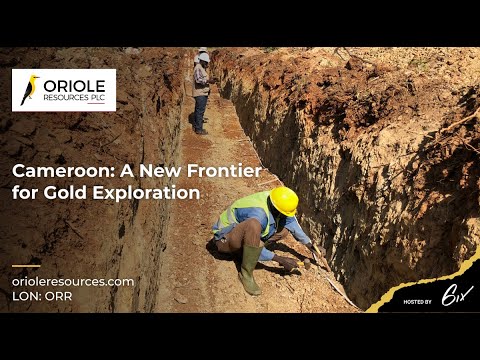
1:16 Then a little bit of time on some of our legacy assets, historical assets in the company, which I'll run through and Bob will run through, and then we'll wrap it up and open up for questions later. So to kick off, we've just got an opening slide here. This is a trench on one of our Cameroonian licenses at Bibimi, north of the country. Just get my cursor in the right place.
1:47 So we are, as I said, a junior explorer listed in the UK. We've been listed in the AIM market for about 15, 16 years now, but we've recently, in the last 2 or 3-years with Bob and I, we've changed the branding of the company, changed the name of the company, the focus and had a bit of a revamp of our strategy and got back to real grassroots exploration. We are strategically partnered with a Canadian mining company, Iron Gold in Senegal. We have a license in Senegal that has some really prospective ground, 5 targets on it, which I'll be talking about in a bit.
2:35 And Irongold are currently earning in on that license, part of an initial four-year earning deal. They're in year 3 of that earning right now. We have first mover advantage in Cameroon, and we really are leveraging on the experience and capacity of our management team and board, all of which are new to the company since I was the first one to join in March 2018, and then everyone else has come on since then. We have a real technical focus in the border management team, but with also extensive experience in the AIM markets and also in discovering and developing African gold assets in West Africa.
3:26 The Cameroonian push came about on the back of some licences that I was aware of from a previous company I worked for, Reservoir Minerals. We came into this area with an open mind that Cameroon had a great opportunity to host Gold, particularly Orogenic Gold type deposits. Cameroon had been very much overlooked by the big explorers in the last 10 to 20 years. There has been a lot of focus obviously for the West, Ghana, Mali, Senegal, Burkina Faso, and a lot of that focus has come on the back of work that those countries did in the 1990s with funding from the World bank to really help them open up their investment environment for exploration and mining.
4:21 Now, that is a process which Cameroon is undertaking right now with World Bank funding. About 5 years ago, they started a program of Cameroon-wide prospectivity work using BRGM, the French Geological Survey, GTK, the Finnish Geological Survey, to develop a data set for Cameroon, which can be used to attract investors in. So we're looking at Cameroon. We have 2 licenses which are active, and we have a bunch of licenses in the central area of Cameroon. The reason we've gone in there, you know, Cameroon is stuck between the Congo Craton and the West African Craton. There's a little inset image on the top left of this main image here.
5:10 It's effectively an area of really deep-seated crustal structures. These things that are carrying mineralising fluids up through them from depth and into the host rocks, which are typical metavolcanic, metastedimentary, greenstone, fasces, metamorphosed rocks between the Congo Craton and the West African Craton. So this area is, there's extensive evidence of Gold in this area historically, some bits of pieces of artisanal mining, but also extensive alluvial mining, dredging of the rivers effectively on the eastern border of Cameroon, which is, we believe, downstream from where we're looking at this potential for new targets in central Cameroon.
6:03 So if we look at Orogenic Gold as a concept, one of the things that large companies like to do when they're trying to identify new areas to invest in and new areas to explore in is they try to get a feel for how the deposit styles, how the deposit sizes are distributed through in certain deposit styles. So this, we did a very quick and easy calculation here. We took a bunch of publicly available data from most of the typical greenstone terrains in West Africa and we put them into a histogram And the buckets of this histogram are based on the bottom axis, the x-axis on size of resources.
6:51 So you'll see the numbers across the bottom. This is in hundreds of thousands of millions of ounces gold contained. And you get a pretty common distribution. You get a lot of deposits with a small amount of Gold and then the giant and super giant deposits, the 5 to 10 to 20 million ounce deposits, you obviously get a lot less of them and you get a tail off across to the right hand side of the graph. This is a first step in trying to understand if you're chasing a particular deposit style in an area, what's already there, what's been discovered, what's been worked on. And if we break that down into the main countries in West Africa, you'll see that that cumulative distribution, it's not going to reflect perfectly because obviously country borders and geological borders aren't the same, but you can get a sense of the trend. Quite a few lower end, smaller type deposits, you know, 100,000 ounces, 500,000 ounces, 1 million ounces perhaps, and then 1 or 2, quite a few lower-end, smaller-type deposits, 100,000oz, 500,000oz, 1Moz perhaps, and then 1oz or 2oz or perhaps no large 5Moz plus and supergiant deposits.
8:02 Now, This is something you can use to, really, it's a rough tool, but it gives you a feel for, okay, I'm going into a new terrain, what am I going to expect to find in that sort of terrain? If we apply that curve, the shape of that curve to Cameroon, you'll see exactly why we are so excited about Cameroon. Currently, in this greenstone terrain with fantastic geology, all of the right criteria for hosting mineralisation, evidence of Gold mineralisation, which is, let's face it, one of the best indicators, no announced resources at all. So we looked at this and we said that the slate is completely open for us in this area to explore and to find new targets and new deposits.
8:53 So that's why we're in Cameroon. Let's zoom in a little bit and talk about the projects we actually have. The 2 existing licenses are up in the north of Cameroon. I'm going to try and annotate this for you just to make it a little bit easier. We have Bibimi up here and we have Wapusi just to the north of it. They're about 20 kilometers apart, those 2 licenses. Then in the center of Cameroon here, we have a collection of 8 licenses under application. Those licenses were target, that was a target area that we'd identified in early summer last year. It's an area that we felt was really interesting as a splay here coming off this central Cameroonian shear zone.
9:39 Now the central Cameroonian shear zone is obviously a major continental wide structure and these splays that come off it, this is a very gross scale map, but you get the sense that these splays come up off it. There's another one that comes up, trends up through here. Those splays are where you have the potential, the possibility for structurally rotating and opening up the rocks and That allows you the opportunity to get a volume of fluid in there, Gold-bearing fluid, which then leads to the deposition of these types of Gold occurrences. This is why we're interested and this is what we're working on. We had identified about 7 key target areas in Cameroon and it just so happens that the central zone was open, nobody had pegged it. So that was our primary target anyway and we had the ability to go in.
10:34 But before we go on to those, let's have a look at the existing licenses, Bibbamy and Wapusi, some of the work that we've done to date and also the work that we're planning to do over the coming season. Now, This was an area that had been a gold discovery for a previous company I worked with, Reservoir Minerals, back in 2012. Really, they'd done some very first-pass geological mapping. They'd identified a whole lot of quartz veins sticking out of the ground, sampled those veins, done some hand dug trenches across them and been able to identify a series of Gold anomalies in this area. They identified mineralized trends potentially up to about 20 kilometers long. When we came in and signed up into this joint venture with BEIG3, the local partner, we really wanted to focus on what would be the best part of that 20 kilometers.
11:33 We went into this central zone, which we've called the Bokashi zone. Now, here we have 2 trends. Again, I'm going to just try and annotate this for you. We have what we call a zone 1 trend running up here with these dotted pink lines. This is about 5 kilometres long and trends in a sort of north-east, south-west direction. And then we have a zone 2, which is a narrower trend and seems to come in on a slight angle with the potential that these 2 things are going to meet up in the north, just off this map. So we went in, our initial first pass work in 2018 going into 2019 was to do some rock chip sampling and we picked up some real bonanza grades, multi-ounce rock chip samples.
12:27 The highest grade I think was 134.5g a ton in a rock chip sample, so that's 4oz material almost. It really encouraged us to come in and do a trenching programme, mechanical trenching using a backhoe digger to cut across the trend, this North-East, South-West trend. The main mineralised trend is going this way and we put in a series of trenches cutting perpendicular to it to give us maximum exposure to those vein systems. The best intersection we had in that first program was 9m at 3.14g.
13:10 The important thing about this being 9m is a mineable width. In an area like this, you ideally want to try to identify mineralisation that is giving you a volume close to surface for obviously first pass for visible resources. We had some great results from that, but obviously, the main thing with any successful mining company and the main thing for the investors is to get proof of that. The only way to really prove it to people is to put a hole into it and drill it. And that's exactly what we're doing now. We've just put a news release out last week.
13:56 We are mobilising the drill rig from capital drilling to come in and to start putting some fences of holes across some of these better mineralised areas. Again, you can see in here there's already been a little bit of pre-definition of interesting gold zones. It seems like we have a number of these things developing in zone 1, where we're getting cohesive mineralisation over an area. Again, in zone 2, we're getting a similar sort of thing as well. This is typical of orogenic systems, you get a linear trend and along that linear trend you see a series of often structurally influenced blowouts of mineralisation.
14:47 That's what we think we have here, but as I said, we have to get in there and drill it. There's a schematic here on the left, drill fence line to test trench BT005. This is just to give you an indication. Again, the idea here is we're going to be putting in fences of drill holes to chase the mineralisation that we're seeing in the trenches on the surface vertically down. We can see the plan is to put a number of these drill holes down here, scissor holes as we call them, coming in to chase up on that mineralisation and to give it a verticality and a volume, which is obviously your early steps towards creating the resource. That programme is going to kick off over the final quarter of the year Q4.
15:38 As I said, we have a rig mobilising on that. But that's not the whole story for Bibbimy. It's obviously very exciting to be kicking off a maiden drill program. And we have the first 17 holes are already pegged. We already know exactly where we're gonna drill them. But there's the potential to extend these. I mentioned earlier zone 1 and zone 2 seem to come together in the north. And if you look on this image, the image on the left here, again, shows the top of Zone 1 and Zone 2. And you can see that the trends do actually start to come together somewhere in this area. And what we are looking for is, is there a junction point between zone 1 and zone 2 somewhere up in the north? Now the yellow blocks on this image on the left are areas that have been mapped in the last program.
16:29 So we have some additional work to do here to map to define some drill targets. But the reality is, as well as the 5km trend on zone 1, the 2-3km trend on zone 2, with existing targets which we've already sampled, we have new targets again, undercover up here in the north. So that's part of the program again, whilst we're drilling those fences of lines, we'll be doing some additional work on this area too, so the rig has somewhere to move on to. Now I mentioned we had 2 licences in the north, Bibbimy and Wapuzi. Wapuzi is just a little bit along trend to the northeast of Bibbimy. This one isn't quite as advanced as Bibbamy. We had seen gold mineralisation in veins before, again, back from the reservoir work in 2012.
17:21 But there hadn't been a really systematic soil sampling programme. That's really one of the beauties of this work in Cameroon at the moment. It's early stage work. It's a very, very simple programme. You can do a certain amount of geophysical surveying and sort of remote sensing techniques, but it's really amenable to just some very simple boots on the ground, mapping and sampling. So, what we did in Wapusi in
17:47 2018-2019, rather, was we put in a soil sampling grid over the known extent of, and expected extent of the mineralised vein systems. We came back with a pretty cohesive trend. We initially went in on a 400m spacing by 100m spacing sample pattern and then when we started to get the results back, we infilled on a 200 by 100 to really tighten up that mineralisation to better understand exactly what's going on. And you can see straight away, we've marked on here 3 trends. We've got this 8km long trend of anomalous gold. You can see the outline, this red line outlining contiguous gold in soils anomalies. We have a shorter trend down here, 2.8km, and then another trend in the southeast here, 2.2km.
18:39 Interestingly, where you get this sort of stacking of subparallel trends like this, it's a great indication for an area where you could potentially get a blow of mineralisation. If you look at the spots here, obviously the brighter colours, the hotter colours are indicating higher grades and you'll see that we're getting a real cluster of good grades in this area down here.
19:07 The sampling finishes on the border of the boundary of the licence here, the reason being this is a granodioritic intrusive here and there's no Gold hosted in it, but it could be forming a reason why we're getting this structural complexity in this area, which is really what we're looking for when we're trying to target these areas. So with Poozie, we've not done any trenching here yet, so we've got the potential to do some of that. Or if the mapping that we'll follow on from this work, mapping in Q4 this year and Q1 next year, if that lends itself, then we might even be able to get a drill rig straight on the ground there and follow up directly with drilling once the first phase of BIMME has been done.
19:55 So great excitement on these 2 licenses, lots of Gold. Take your time after the presentation, this is available on the website, It's available as a handout through this website as well. Take your time to have a look at some of the results that we've had to date. Obviously, the very, very high-grade samples are potentially biasing a little because they're collected by geologists to grab sampling, but they are a key indicator that there is gold in the system and the trenching results are showing us that we have some volume. It's mainly a sub-vertical vein system, but we are seeing areas of stacked sub-horizontal veins as well on both the northern and southern ends of the Bacassi zone on Bibimi licence. So these are areas where you could get volume increases. So geologically, a really exciting place to be.
20:48 And we'll be getting results out of that as we drill over the coming months. Now going into Central Cameroon to those new licenses, we've got a package here of 8 licenses under application. Now, 3 of the licenses on the left here, these were applied for with our partner, our existing partner, BEIG3. You're allowed to have 5 licenses under any single company in Cameroon. That's the new mining law that the Ministry developed over the last few years. So we had space, we got 2 licenses already, Biv and Me with Buzi. We had space for another 3 licenses. So we applied for these 3 licenses under the existing JV.
21:36 And then we also had the opportunity to create our own subsidiary, Oriel Cameroon Limited, and we applied for another 5 licenses contiguous to these. So this gives us a package of 8 licenses, 3500 square kilometers of prospective ground in central Cameroon. And this is, I mean, it really is central. This is the main North-South road through the country here, so we've got great access. This really gives us an opportunity to chase after some targets that were identified in the 1960s by a mapping program where gold anomalism was discovered in this area but wasn't really followed up on because in the east of the country, it was easier to get the gold out of the rivers.
22:28 We're sitting here in central Cameroon. Most of the gold activity at the moment is along this border in the east here, where there's big river systems carrying alluvial gold. You can just dig out the gravels and wash it. So this is harder rock, much more challenging for local companies to come in and explore and extract from. But for a company like us, it's a great opportunity. This is a brand new, what we call a district, 3500 square k's is a massive footprint to have at this early stage in central Cameroon. And those licenses, as I say, they're under application. We're expecting that to be coming through pretty quickly, the paperwork to be coming through pretty quickly. We have had obviously a delay with COVID.
23:13 The last batch of licensing before COVID was granted in, I think it was around about December, January, and then there's been nothing since. But you can go on to the mining cadastre website. Cameron has a website with all of the licenses pegged on it. And you can look at these applications, our names on it, we've paid our taxes, we put our paperwork in, it's just, you know, our foothold is on that ground and we're just waiting for the paperwork before we go in and do the next phase of work. And The next phase of work is really quite simple. Effectively, what we are doing is going in and following up on those stream sediment samples and those surface samples from the 1960s programmes with our own stream sediment sampling program. This is, again, very simple geology, very simple program.
24:10 Local geologists and a couple of helpers, boots on the ground, getting into the river systems and following each of the tributaries of these main river systems, following them upstream and taking stream sediment samples as you go upstream to define exactly where the gold you're seeing is coming from. So, very straightforward, very quick program, at very low cost. And again, that's something that we would hope to be doing as we move into Q4 this year, and through the dry season into the middle of next year. So Cameroon, for us, it really is an exciting place to be. We call it a new frontier because we believe it is a new frontier. We've seen these things in Africa before, we've seen it in Senegal and Mali in the 90s, I saw it in Tanzania in the 1990s where the country opens up for whatever reason and the mining companies are allowed the opportunity to come in and start working. Before you know it, I think in Tanzania within 10 years there were 5 new open pit gold mines in operation.
25:19 Massively prospective area and a huge opportunity for a company like us to be on the ground early and to be the first movers in that. There are other companies with licensing in Cameroon. We're the only ones that we know of that have been active over the last 2-years in Cameroon and are significantly investing. We've spent $1.5M already on the licensing work and work up at Bibbimi and Wapusi with the trenching and sampling. That's gained us our 51% ownership of Bivermere and Wapusey. We've got the plan there with the drilling at Bivermere to increase our overall ownership in that package up to 90% in the next year and a half. Now, what else have we got in the stable? I mentioned legacy projects and a lot of the underlying value in the company is really tied to historical projects, things that were around before Bob and I and the new board came in and joined.
26:20 And perhaps the most immediately visible and valuable right now is what we call the Sonala license in Senegal. Now, Senegal has a very, very well endowed area called the, we call it the KK Inlaya, the Kadugu Keneba Inlaya, in the eastern part of Senegal on the border with Mali and Guinea. Here you can see this area here, you've got Mali, you've got Guinea to the south, Mali to the east. In this area here, which by the way is about twice the size of our central Cameroonian licence package, so if you cut it in 0.5 you can imagine the Cameroonian licence package sits over that piece there. This is an area of existing mineralisation. There's a lot of existing mining in here.
27:06 There's over 40Moz, I think this is probably closer to 50Moz of known, published endowment in this area right now. And slap bang in the middle of it
27:17 is the Sonala license, which is our 472 square kilometer package right in here. Now, we zoom across and do a zoom in on that. You can see our license shaded in red. You can see some of our neighbours, Barrick, Chesser, Iron Gold, to name a few, really focused in this area, this main structural trend in the east of the KK Inline. Now, on this license, this was originally under the previous incarnation of the company. This license was called Elephant. Last year, we had the opportunity to relinquish the license. It was coming up to the end of its tenure, we had the opportunity to relinquish it and reapply for the entire footprint. So we didn't have to lose any ground.
28:08 And this was important to us because within this license, we have 5 existing gold targets, which we had identified or rather our previous predecessors, Claire, our exploration VP and predecessors in the company had identified in 2012, 13, 14, 15, 16. As Bob and I were joining the company in 2018, this license had just been signed into a joint venture with Iron Gold.
28:37 The reason Iron Gold was so interested is really because of their license down here and this little mine development project they've got called Boto. This is a 2.5Moz mine development project. They've completed the feasibility, it's been permitted and they've already started recruiting some key positions for that project. They've started a commitment this year, I think it was a $25M investment commitment on basic infrastructure, access roads and so on and so forth to the mine area. Now, with Boto, the key thing here is that we have on our license, we have a lot of prospects down here called Medina Barfe and another one called Cerudia. And these are both within 15 kilometers trucking distance of Boto.
29:24 So when IM Gold signed the JV, they spent the first 2 years really focused in that southern part of the license area.
29:33 And They've only just moved up to the northern area to a place called Farae, which I'll highlight to you on this image here. So Medina Balfe and Cerrudea down here, Farae is up in this area here. Some of you who follow this company, other companies working in this area, will probably have heard of Chesser Resources. They've been recently drilling some nice targets in their Dianba Sud target, that's up in here. Chesa has a license that's about 0.1 of the size of ours. They don't have any other projects and they've been drilling some targets in here which seem to be associated with a structure that's running across the main structural trend.
30:21 Our mineralisation at Farae is again associated with a parallel structure. We believe what we have here is a corridor of cross-cutting structures which are giving intersection points and where you get the intersection points, you're getting mineralisation. We believe that's what we've got up at Farae. So this is where Iron Gold have moved to this year in their third year of investment. The idea being that we believe Faray has the potential to be a standalone deposit. It's too far away from Boto to truck the ore down.
31:00 Medina Barfe and Cerrudia could form obviously satellite deposits. They could either offset or add additional tonnage to Boto as a mine development project. But here in Farae, we're looking at something that could be standalone. If we zoom in on the historical work which Stratex have done, our predecessors have done in drilling this area, you'll notice that there are some really significant results coming out of here. If you were to do a comparison between the recently published Chesa results and the results here from 2015, 14, 15, 16, you'll see that the grades and lengths are very, very similar. We've got multiple hits over 10m, 20m, 50m, 90m and we've got multiple hits in the typical range for these open pit type mines, 1 to 3g plus.
31:57 You can see that main trend, you've got the main mineralisation trend and then you've got this cross-cutting structural trend of firing, and that's literally X marks the spot. We believe this is what we're seeing. We're on the western side of this gold corridor and Chester's on the eastern side of it. So This is a potential standalone deposit. This is a 6.5km long trend through here of mineralisation, just to give you an idea of scale. Obviously, that has the potential for multiple pits along that area. If you look at the current program that Iron Gold are doing, they've got a 10,000 meter air core program planned for this third year of their investment. You can see the little dark dots on here are the targets.
32:46 And you can see that long trend through here. You can see these zones of far north, far south, and far south extension, where we have outlined already mineralization from our program and from our drilling. And You can see that Iron Gold's programme is looking to extend the footprint of those and potentially to see if they join up. We'll be looking to get results out of that, obviously, as we go through the next dry season. Now, what do we, as a company, what do we do? You know, our projects are really early stage focused. So, you know, we are really, really focused on the low end, the bottom end of the value curve and the idea being that we would like to see our projects in Cameroon at the beginning on the left-hand side here, potential for new discoveries, Birmingham, Wapusi and then moving across into Sinala
33:51 and then also some assets we have in Djibouti and Egypt, we have a shareholding in rather. Early stage stuff, this is where you can quickly turn with a very small capital investment on the ground exploration, you can turn a discovery and you can transfer that discovery up into a resource, an inferred resource, indicated resource with drilling. That's where you get a massive value add. The angle of attack of that value add starts to tail off after that, and the work starts to get a lot more expensive, developing your feasibility study, construction, mine development. That's a much more expensive game, and the profit margins start to tail off as you move up.
34:37 So from an immediate point of view, value point of view, we're looking at that early stage hit the ground, identify new target areas, which we've done in Cameroon, identify new opportunities to add value, and then develop them and develop those targets, those new discoveries to a point where we maximize the return to the investor. And then, you know, that we're probably a couple of years away from that, 18 months or so, but you'll start to see progress as we get the news flow out from the drilling which we're kicking off now. In addition to all of that, we've got some legacy value in the company tied into some historical resources and historical projects. And I'll just hand over to Bob to run you through some of those other assets.
35:24 Okay, thanks Tim, thanks for that. As Tim mentioned very much at the start of his presentation, this company's actually got a 15-year legacy. We're very much focused on our early stage work in Cameroon and the work in Senegal, but this company's had a legacy, a history going back 15 years, started in Turkey and made some big gold discoveries in Turkey. Actually, 2 operating gold mines came out of the work Stratex did, long before Tim and I got on board. And there's still actually, because of that legacy, there's, there's lots of pots of value, I like to call them, through in Turkey and through East Africa, where the company also had an interest.
36:11 And we're gradually realizing that, obviously as a junior cash is king. And we're working through the portfolio, gradually realizing that we realized 250,000 pounds already this year from asset realization. And this slide really just talks about some of the more important legacy assets and some of the other stuff we've done to conserve our cash as tightly as we can, at least from a G&A point of view, because we're obviously spending money on exploration. So from a legacy asset point of view, the most important is the Muradaya copper gold quality system in Turkey which is we partnered out a few years ago and has been progressing towards EIA stage.
36:57 It's a pretty big system, it's got a gross metal value of about $400 million, according to our partners' estimates. And we've got a 1.2% royalty on that asset. So a pretty sizable royalty once that mine comes on stream. Elsewhere in Turkey, we actually completed on 2 small royalty sales, bringing in $80,000 and $470,000 of deferred consideration, which we'll access as those projects progress. And as one of those projects progress, there's also a success-based fee. Once we define a resource and move through EIA, we would receive 500,000 dollars from that project, Hassan Chalabi.
37:44 So Between them, those 2 projects would give us 1 million dollars as they progressed towards mine development. We took the conscious decision to sell the royalties and bring forward those cash payments to aid with our exploration plans in Cameroon. Elsewhere in Turkey, we've got a long and occasionally colourful history in Turkey, but we've got 1.4 million dollars that we're pursuing through the courts, disputes with former partners. We are very confident that we will win these disputes once the cases reach court. Turkish justice moves a lot more slowly than we would like it to, but in both cases, contractually the law is on our side and morally the law is on our side.
38:37 So we will continue to push those forward. Turkey is actually a profit center. It's turned into a profit center over the last year. The Turkish team very entrepreneurially set up a consultancy business and actually made a profit in the first 6 months of this year. So it's gone from a net cost when we first joined to a net profit, a small net profit, very welcome to us as well. So in other parts of value, Tim briefly touched upon, we've got 26 percent holding in an Egyptian gold explorer, which holds a license with a jock and a non-jock resource, a total resources of 700,000 ounces of gold and coming out of that same vehicle we've got a 10% interest or 11% interest in the vehicle in Djibouti, a very well-funded vehicle which is undergoing an extensive drill program.
39:40 We published some drill results not too long ago and there'll be more to come. They're in a full drill program at the moment and we receive regular updates. So that's a pretty exciting project, both of which we would consider realizing value from should an appropriate offer come along. And we have numerous conversations all the time on any of these assets. You know all early stage at the moment, an active stream of value realisation that we try and balance, try and balance asset realisation with fundraisers, with cost saving measures all the time. So one of the things we've done is, we're pretty much the 1st UK junior explorer to latch onto the fact that in our tax system we can get cash back for research and development work. We actually get a tax credit for the work that our geologists do And over the 2 years I've been involved, we've actually brought in 300,000 pounds worth tax credits as actual cash, covering 4 years of exploration.
40:56 And it's an increasing amount as we've got busier and busier in exploring Cameroon. And it's all been very much part of the fiscal management strategy we implemented. In 2018, when Tim and I joined, the company had come off a pretty horrific 2017 where whatever could go wrong did go wrong. And they made limits of 6 million loss. We've taken out all the kind of one-off items and strange and usual accounting items, we've actually reduced our net operating costs over the 3 years from 2017 to 2019. We've reduced our run rate of costs by 48%.
41:45 And we recently announced our interims for 2020, and we've managed to get that cost down again by another 45% based on 2019. So we've managed to, when we went into the COVID lockdown, we significantly reduced salaries, we accepted that it was going to be a time when what we needed to do was conserve cash. We couldn't work on the ground in Cameroon, so we all went on part-time salary. I leaned on all of our advisors to give us fee reductions. And yeah, we basically got that loss that a few years ago had been 6 million down to a small profit in our interest this year, which was pretty unprecedented. So fiscal management has been very key.
42:33 We've tried to be lean, but we've also tried to be busy. And we've spent – in that period, we've spent something like 1.5 million pounds in Cameroon exploring on the ground. So we've got leaner and we've got busier. That's very much the way of the company now. Just moving on to, I think this is pretty much the last slide before I hand back to Tim. This is just a corporate profile and the main things to watch out for on here are the directors are quite new to the business, we've all been in it about 2 years, and we all did a salary sacrifice scheme November to February 2019 to February 2020 and put £120,000 of salary back into the company in exchange for equity instruments effectively.
43:27 So on a fully diluted basis, the directors hold 7%, although on a non-diluted basis, that's only 1%. But there's been significant investment by the directors in the future of the company. And we've talked a lot about all the blue sky potential in Cameroon, the great position we've got in Senegal, and obvious and apparent value for our Sonala license. All of that money we've got to access in Turkey and in East Africa. Yet we come to you with a market cap of sub 4 million pounds. So Tim and I always, would always say we believe we're grossly undervalued.
44:13 And On that, I will hand back to Tim. Thanks, Bob. Yeah, undervalued and a great investment opportunity. That's the way we see it anyway, which is exactly why the directors were so happy to do that sacrifice and to increase our own shareholding up to 7%. What news flow are we going to get in the next 6-12 months? Well, obviously, it's going to be focused on Bivermey. It's going to be the centre of the drilling programme there. Pushing that programme forward is really the key to proving to the markets what we have. Derisking Cameroon, derisking the license by putting some holes in the ground.
44:59 The grant of the new licenses will have a big impact as well. It's a step forward for the Cameroonian mining system and allows, again, de-risking of the concept of Cameroon as an investment destination for exploration and mining. In Senegal, we have Iron Gold beavering away on our license at Sonala. Who knows what may come out of Farae? We believe it's a great opportunity to be a standalone deposit and we believe that it's certainly equal to the results that have driven Chess's share price up into stellar levels recently. So it'd be good to see something come out of that. And also Boto, you know, the Boto project is awaiting approval.
45:46 So we'll see that may happen, we just don't know. We'll continue to generate cash where we can internally. Obviously, we want to try to fund as much work as we can ourselves. That gives us the best option to return value to shareholders in the long run. And we've got a lot of potential for income and cash flow, as Bob's already pointed out, mainly from those legacy assets. And that also allows us to get rid of some of the administrative burden on some of these assets, which again helps us focus on what we're doing in Africa. New opportunities, we're always looking at new opportunities, people who know us as a management team and as individuals come to us and bring us projects, we're chasing projects. So, we keep an open ear to what's happening in the industry and we keep an open eye on potential in the Gold and base metal space where our expertise lies.
46:47 So, that's really it. The summary is there, The paperwork is available to download. So I'll hand back over to Jane and I think we have some potentially some questions coming in. Great, first of all, thank you very much, Tim and Bob, for taking us through the presentation. We do have time for a few questions. Our first question comes from Nathan. He asks, has Oriel had any interest from majors or mid-tier companies concerning your activity in-country? I think it's fair to say that there are a lot of people watching our progress. I'll give you an example of how this typically works. I used to work for Barrick Gold. I'd spent 14-years with them. I was the exploration manager in Europe and the Middle East.
47:44 So, when the shoe was on the other foot for me, I would be looking at companies like Oriel and I'd be looking at if they were in an area I found to be or Barrick found to be geologically interesting, then I'd be watching them very carefully. The trigger point is always, okay, proof of concept is a drill hole. I would expect that we have, obviously, over a beer or 2 back at Andaba and stuff with various friends and colleagues in the industry. People have brought up their interest in Cameroon and their interest in it from a hypothetical new frontier, new district, but it always comes down to that first thing.
48:31 I'll be watching you, Call me when you've got a drill hole. So that's exactly what we're going to do. So hopefully, we'll see some interest once we get some drilling done. But you know, the key thing is not to not to jump too quickly. We want to advance these projects as much as we can on our own. That's where we get the most value. All right, thank you very much Tim. The next question is from Michael and perhaps it's for Bob. How long will your current cash last before you need to raise more funds? Yeah, I mean, it's a question we always get asked and it's not a question we can talk openly about. We balance our fundraising with our asset disposals, with our cash conservation.
49:20 That's what we do. And in many ways, it depends what we do in Cameroon. We've got the G&A ship as lean as we possibly can be. Where the money goes is into Cameroon, which is, you know, effectively our reason for being a gold exploration in that country at the moment. All right, thank you, Bob. Our next question is from Keaton. He asks, have you done a thorough review of your legacy assets in light of the increased gold prices since you've joined to ensure you're not prematurely discounting shareholder value before selling? Yeah, we have.
50:07 I'll just perhaps clarify that the majority of the projects which are up on the program for asset realization, These are royalty positions. So we don't actually have control of those licences. They're held by mainly Turkish companies that are looking at progressing those projects forward. And obviously, we do monitor that There is the opportunity to do a deal if somebody wants to buy the Royalty out. Obviously with the rising prices, the value of the Royalty's increased. Or there's the option to sit and do nothing and wait for the project to be built and then recoup your royalty that way. We look at, we constantly, it's a dynamic discussion as to which is the best value on each license, each royalty package.
51:00 But yeah, essentially we are paying very close attention to what is the best way to get the value back into Oriel so we can best utilize that cash, whether it's now in a year, in 5 years. Excellent. Thanks, Tim. The next question is from Nathan. He was looking at the IM Gold website and noticed that they rarely report on drilling activity in and around Boto. And as far as he could see, they have not publicly commented about Oriel's license. And he is asking whether there's any reason for this and whether that would be detrimental to Aurel since news flow is usually what drives value and investor interest. Yeah, it's all about news flow at the junior end of the market, obviously.
51:53 From Iron Gold's perspective they are meeting the letter of the agreement, which was signed before Bob and I joined the company. The letter of the agreement is they will share the data with us. We have technical committee meetings every 3-months to review the work that they're doing, but they're paying for the work, they're deciding what work to do and other than giving us the results from that work, they're obviously, you know, this is a multi billion dollar Canadian mining company, they're not going to share the strategy with us. That's, you know, that would be, we would be a little bit too inflating our own importance to expect them to do that. But if you take a step back and think about it logically, there's been a lot of M&A activity in the KKM layer in the last year or so.
52:42 Projects have been changing hands for hundreds of millions of dollars. The value at Sonala, if Iron Gold went out to promote the value at Sonala, then it would be wonderful for us, but ultimately they have an option only to get to 70% ownership. The other 30% stays with us and our partner in Senegal. So it means that if they wanted to try to take that position up to 100%, it would be a lot more expensive for them. So there's really no reason for them to publish what they're doing. They are active, they're in year 3, they've met all the expenditure commitments. They're also active in the rest of the region. They're active in Guinea, they're active in Mali.
53:33 It's probably fair to say that they are probably in a position of considering, okay, what is the next step for Boto and how does that next step affect all of their other investments in the area, where's the centre of gravity going to be? And what's best for them to do with the various JVs they've got running? But that discussion will all be happening in Toronto. And we, Unfortunately, we're not privy to it. We believe they will come to a decision that will materially be of value at some point anyway. So, we're happy to hang on. But you are right, it is undervaluing us. If we were able to promote, if we were able to dictate the program, we would do things perhaps differently.
54:20 But this is the world we live in. That's the agreement we've signed. We have to roll with it and respect the agreement and respect our partners. All right. Thank you very much. The next question is from Anthony. He asks, has Rangold been approached or has Rangold approached you, sorry, for the Senegal license area? Well, no, the license is already in joint venture with Iron Guild. So, you know, the opportunity for them to replace Iron Guild is not there. It's not in the terms of the agreement we have with Iron Guild. Got it. The next question is from Nathan. He asks, what is the projected spend in Cameroon over the next 24 months, assuming that the new central licences are granted?
55:09 As a junior company, finance is often hard to come by without material dilution to existing and prospective new shareholders. So is there a plan to bring in a JV partner in Cameroon to cover some of the costs of operations? Okay, so predicted spend is absolutely driven by success. So it's very difficult to put a number on that. Obviously, the programmes on the new licence package, when we get on the ground there, the programmes there will be quite cheap to begin with. The drilling at Bibbimi will obviously be more expensive, the drill programmes are more expensive and we have to mobilise and service that program. So these are, you know, 1 reasonable program.
55:56 It's only one drill rig we're mobilising in, so it's not like we're bringing in a whole fleet, but there'll be a cost component there. The new licence package, when it's granted, is obviously a cheaper component. So let's roll forward in 12 months and say we've had some success, then obviously, potentially, we'd want to expand the drill programme. We want to expand from the stream sediment sampling and the new licences up to mapping and more detailed, maybe some soils, grids and so on. So yes, there's an expenditure component, but as Bob mentioned earlier on, we are constantly balancing our expenditure with our own internal ability to identify value from asset sales to minimise dilution as much as we can.
56:42 But at the end of the day, people have to realise that we are a junior explorer and the business is all about spending money to progress projects. As a shareholder with 1,000 shares, if there was a raise and somebody else bought more shares, you still have your thousand shares. And the idea is we progress the projects successfully, that means the share price rises, so your thousand shares are worth more. So Unless you're in the mindset of doing a hostile takeover on the company, any potential dilution from public raises shouldn't really be that material to you, as long as the main thing is the money is spent wisely and the money that is spent advances the projects that we have.
57:38 You know, Bibbamy obviously will do that with the drill program now, there's the money that gets spent at Bibbamy will materially advance that project. And hopefully, we'll see some reflection in the results in the share price movement over the next 12 months. All right, thank you very much, Tim. I'm Just looking at the time here, and I think we are coming to the end of the hour that we have together, I recognize that we weren't able to get to all of the questions, but I'd like to thank you for everyone that have submitted questions. If you didn't get your questions answered, or if you come up with a new question after the end of our summit, please reach out to Orio Resources at info at orioresources.co.uk, and the team will be happy to answer your questions.
58:31 Remember, you can also download the presentation today in the handouts tab and also you can go to oreoresources.com to find out more information about what's happening with the team. After the close of this summit there's going to be a short survey where you can provide some feedback about how we did today and your contact details if you want the team to reach out directly to you. Remember, Aureal Resources, Trades and the London Stock Exchange under the ticker ORR. Now I'm going to hand it back over to Tim and Bob for the final word. Well, thanks very much, Jane. And thanks, everybody, for dialing in and for listening to us drone on about Aureal Resources for the last hour. We are very excited to be here and we're very excited to be exploring in Cameroon and we are also very excited to be able to progress this company.
59:28 We've done a big turnaround on it in the last couple of years. We believe we are materially in a solid place now and we look forward to ongoing success. So please do get in touch, check out the website, sign up for updates through the GDPR stuff, all the usual caveats apply and best of luck. All right, thank you everyone. Bye, take care. Bye-bye.