Craig Foster
CEO at ONDO INSURTECH PLC
Replay available
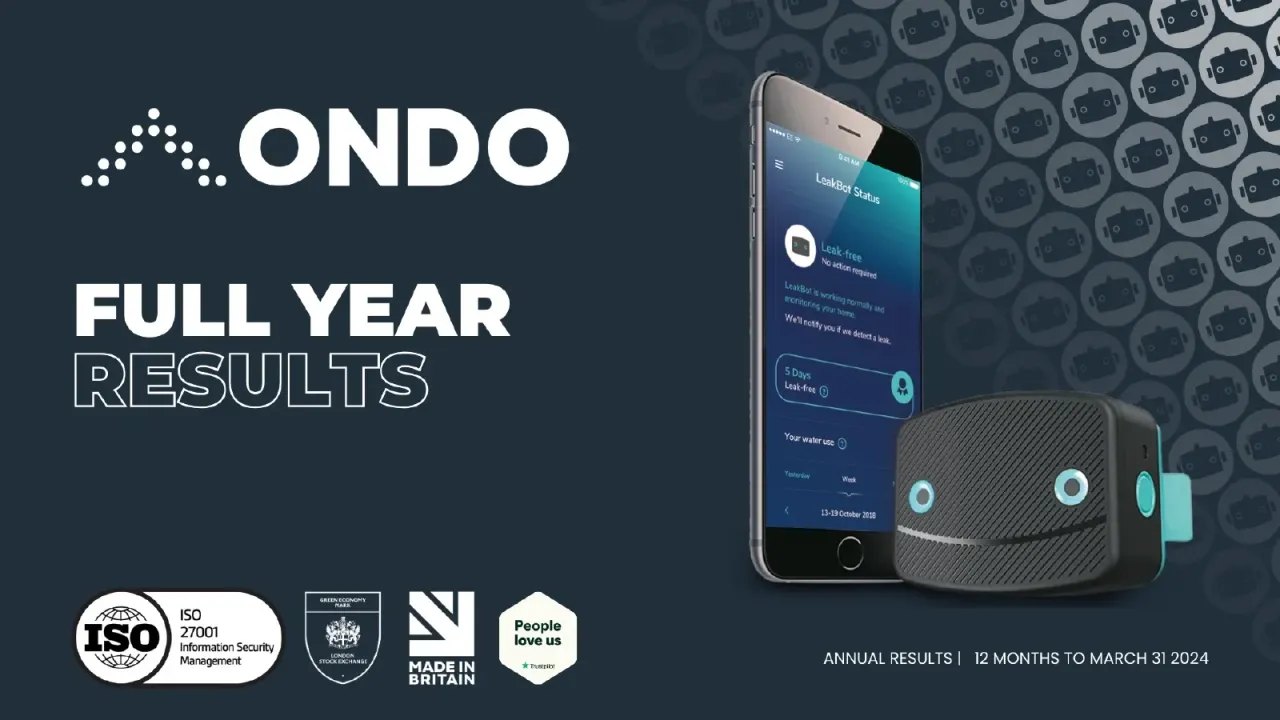
Full year results hosted by Ondo Insur Tech (LSE:ONDO) on Investor Meet Company, held 2024-07-30.
On 6ix: 6ix.com/event/ondo-insurtech-plc-ondo-full-year-results-1
Automated transcript · Written by software from the replay's audio. It can mishear names and figures; the replay is the record.
0:01 Good morning, ladies and gentlemen, and welcome to the ONDO INSURTECH PLC full year results investor presentation. Situated on the right hand corner of your screen. Please just simply type in your questions and press send. The company may not be in a position to answer every question it receives during the meeting itself. However, the company can review all questions submitted today, and we'll publish those responses where appropriate to do so on the Investor Meet company platform. Before we begin, we would just like to
0:33 submit the following poll. And if you'd give that your kind attention, I'm sure the company would be most grateful. And I would now like to hand you over to CEO, Craig Foster. Craig, good morning, sir. Good morning. Thank you, Jake. Morning, everyone. Thank you for joining us. Whether this is on on live or you're watching the the recording later in the day, thank you for taking the time to have a look at our full year results for the year ended, 03/31/2024. So, I'm joined today by, our CFO, Kevin Withington. And on audio, we have, Mark Wood, our chairman. So we'll spend some time today answering your questions. Thank you for the presubmitted questions. It's not late. If you've got questions you'd like to submit, we will see them on the platform, and we can pick them up at the end of the call.
1:20 But what we'll first do is just run through an investor presentation to, price some updates and and run through the the the numbers. So our mission, you will be pleased to know, has not changed. Our aim is to become a world leader in claim prevention technology for the home insurance industry. And our vision is a world where the Internet of Things is used to protect every home, reduce waste, and help the planet. And, that vision is increasingly becoming a reality, especially in the last year, as we've seen, some analogous products in in The United States really, hit that exponential, curve of growth where IoT is becoming more accepted, and more ubiquitous in homes as a way of protecting homes, and reducing that waste and and having that environmental benefit as well.
2:13 So to take our results, the highlights, our revenue, is up to 2,700,000. That's 29% growth year on year, as consistent with our previous, results where we talked about our shift of strategy towards recurring revenues. Now the majority, of our revenues are recurring. Recurring revenues are up by 41% to 1,400,000, and the exit rate at March was 1.7. Losses have reduced to 3,200,000. We obviously executed a successful capital raise earlier in the year, raised £4,200,000. That was post this reporting period, by the way. So when you look at the balance sheet numbers, that's prior to that fundraise having an impact. Addressable households, via existing contracts. So as a reminder, this is the number of households we can potentially get into, through the contracts that we've already signed is up to 5,200,000.
3:08 So that's a 2.2 times increase on the same time a year ago, mostly driven by, some breakthrough success in The United States specifically. Registered customers grew 37%. As of a couple of days ago, we hit a 111,000 homes that LeapBot is in. 71% of new registered customer growth in the last year has come from The Nordics. And I'll talk about the connection between that and the addressable households where whereas you can really see the addressable households as a leading indicator of where the business is headed. For the first time, what we've done is we've split out our registered customer base by vintage or customer cohort, and it really, explains, how we're building up the customer base year on year and how this really is a recurring revenue, business.
4:04 And our annual renewal rate we're disclosing for the first time is 94%. Interestingly, although the majority of the growth this year came from Scandinavia, the real breakthrough in addressable households was from The United States. So there's a lag effect on that hitting the the numbers and and us driving that, those shipments and that penetration. However, you can start to see the impact on the numbers. For the new accounts that we've signed in in The United States with the new five dollars per month pricing, they only account for 3% of our registered customers, but already account for 12% of the recurring revenues of the business, which just shows how valuable those US customers can be and the leverage that that US growth is gonna have on our bottom line over the next couple of years.
4:52 We've also started measuring net promoter score and customer satisfaction across lots of touch points. So previously, we've talked about Trustpilot and the reviews on the app stores, which really explains the quality of the customer service. But this gives a more granular view that we can break out by partner, by geography. And what we've proven in this last, period is how we can deliver the same kind of consistency of results in The United States as what we've managed to in Europe. We've been able to demonstrate that to insurance partners as well. We've got a 63 net promoter score already in The United States despite that being a a newer business. And that's really been the key to the success of these four launches we've done with four different US partners in The US, during this report reporting period.
5:40 So they're the highlights. Let's get into to to those results here in a bit more detail in a moment. I'm not going to go through the full overview of the business. If you're new to ONDO and this is the first time you're hearing the story, I would suggest looking back on some of the previous presentations where we do a longer introduction to the problem that we're solving, which is water damage in in homes for the insurance industry, and a bit more detail around what our value proposition is and how the technology works. Today, I'm only gonna cover this briefly on the assumption that most people know that already. But the quick introduction is our flagship product is called LeakBot. It's a water damage prevention system that's designed to prevent the, damage to properties caused by water leaks. And these cost the insurance industry, $16,000,000,000 of damage a year just in The United States and in The UK.
6:39 So we have a unique proposition. We have a unique sense of technology that we invented. It's entirely proprietary. There's nothing else like it in the world, and it's the only known way of detecting small leaks on a mains water system without cutting a pipe. Insurers offer this for free, and then we connect them through an app to in home service technicians should they have a leak, and all of that's provided to the homeowner for free. This is, used by, as of today, 18 insurers around the world to prevent these costly water damage claims. I say 18 rather than 17 because this morning we announced a new partnership, our fifth partner in the last year in The United States. We're launching into the the state of New Jersey. So we work with 18 insurers around the world as well as number of water companies, and our core markets are in The United States, The UK, and Scandinavia.
7:35 So, Leakbot, our team, invented this back in 2017. We launched the commercial product in 2019. We ONDO was created through a reverse takeover transaction in March 2022, where we, entered the the the main market, the London Stock Exchange. And since then, the business has grown quickly. You can see the growth in registered customers here. A couple of the landmark events since then has been signing a a rollout contract with London Shopping Garden Sweden, signing one of the largest home insurers in The United States nationwide, and as of a couple of days ago, hitting a 111,000 homes that LeapBot is is registered in. So let's go straight into the results in in a bit more detail.
8:23 If we look at revenue growth, over the last three years, it's gone from 700,000, to 2.1 to 2.7. And we've made a very definite strategy to shift away from one off device revenue towards recurring revenue. If we split the recurring revenue out, you can see, from three years ago, it was only point 2,000,000 going to 1,000,000, 1,400,000, 41 percent growth year on year, and the exit rate of 1.7, by, by March. But interestingly, not all of our customers are of equal value when you look at the recurring revenue. We've adjusted the pricing, and we've, optimized this as we've gone along. So you can see today, if you split the registered customers, out by territory, which is a view we haven't previously provided, you can see almost half of our customers are in Scandinavia.
9:14 44% are in The UK,
9:18 and, until and and six, and, 9% are in The States. Now 3% of that registered customer base are the new customers that we've recently recruited on the new $5 per month pricing. You can see when you break down the exit rate of recurring revenue that those customers are already contributing 12 of the recurring revenue. So it just shows how, you know, helpful those customers are and how helpful they're going to be in terms of our long run profitability and how, why we believe that's the right model. And this really, underlines why we think that focusing on The United States is the right strategy. It's not that just that. It's a big market, which it obviously is. It's the fact that in America, people pay a lot more for home insurance on a per policy basis.
10:06 They're paying, 11 or $1,200 per home on average in in The US compared to 250 to £300 in The UK on average. And US insurers are paying out much more on a per policy basis for water damage claims, which means that pricing works on a mass market basis across the whole of The United States. If you then look at addressable households, so again, this is the number of households that we can get into with the existing contracts.
10:39 When we were reporting the results this time last year, we had this big jump from half a million to over 2,000,000 as a result primarily of new contracts in Scandinavia, most notably the rollout deal with Lancer Schaffingar.
10:54 That once we sign the contract, we kind of account for these addressable households in in these numbers. So I think of this more like a leading indicator of where the business is headed. Now we don't penetrate those new accounts over time. It it takes, it takes time. It depends on the, insurers' activities and the frequency of the different campaigns that they're doing as to how quickly we can penetrate the customer base. In the case of Lance Schaffengaert, it went slower than what we originally hoped for, as a result of some some work that they did, creating their own app that the that their customers could use to install the product. But nevertheless, if you look a year on at our results, over 70% of the growth has come from The Nordics.
11:40 So what's interesting this year is we've had a similarly big jump, 2.2 times growth in the addressable households because of the new accounts we've taken on in The United States. Again, most notably, Nationwide, which is one of the largest insurers in The US. So, again, that hasn't had an immediate impact on our numbers. It's 9% of our growth has come from The US. But I would imagine, again, that's a leading indicator of where things are headed, when you look out certainly to the the next year and the year after. So this is a a view we haven't shared, with you before, which shows, the registered, customer base by Vintage going all the way back to the very first, I think, 200 devices that we shipped or something like that in the very first, very first year.
12:32 And this, shows the retention of those, those units. So what this basically shows is how the current registered customer base is built up and really underpins the fact that this is a very sticky, model, and why, every year when we ship, a load of these devices, why they can contribute to those recurring revenues, into the future.
12:59 So this is also a new level of detail to what we've provided before. The reason why this is, particularly, interesting, I think, is, when you think of it from the point of view of our insurance partners, there's two two things that they really care about. One is, can we deliver a return on investment and save them cost on their claim savings? And does that deliver an immediate return on investment? However, that doesn't work on its own if their customers are unhappy with the level of customer service. They need to like the user experience. They need to like the in home visit. When we were first meeting US insurers, one of the questions we would get asked is, well, you know, you seem to be okay at doing this in Europe, but the plumbing's different in The United States. It's a different market, different customer expectations.
13:49 Will you be able to deliver a level of customer service that's gonna be good enough for us in The United States? So we've proven in this last year that we can do that. So we've been measuring, net promoter score. Anyone who's not familiar with this, it's a kind of standard metric that's used, and it's quite a harsh metric. You ask, the specific question is, would you recommend this product or service to your friends and family, out of 10? If you score at nine or 10, you're classed as a promoter. If you score at zero to six, you're classed as a detractor. And the percent of promoters is then, measured off against the percentage of detractors to give the score. Anything over 30 is considered an excellent score. There's some benchmarks here on the slide of Amazon at 69, obviously, world class, Apple at 61.
14:44 The average net promoter score, across the geographies for LeapBot is 81. In The UK, we currently get 91 net promoter score. And already in The United States, it's our newest market, we've got a net promoter score of 63. So two points higher than Apple. This has been really key for us in the traction that we've got in The United States beyond the claim savings, beyond showing the insurers what we're actually fixing in in the home, this is a really important step forward being able to demonstrate that we can do this. And the in home status customer satisfaction score is level in The United States on five out of five in line with all of our other markets. So there's a summary, and this presentation will be available for you to download after the meeting. There's a summary of the KPIs.
15:34 I think we've covered most of these points already within the presentation. The reduction in gross margin, is also not something to be concerned about. And to be clear, that's not a sign that our per unit costs have increased, in the period. It's more of as a a result of us switching to the recurring revenue model. So the more we grow, the more it impacts that p and l, p and l gross margin in the short term, but with higher gross margins as we build out the the year two plus, customer base as those devices renew. In terms of the financial overview, I think we've covered these numbers already in the in the results. From a balance sheet point of view, Kevin, is there anything you would like to add?
16:23 Obviously, numbers are are prefundraise. Yeah. Yeah. Good morning, everybody. Yeah. Just as Craig said, these are prefundraise numbers. So as investors will be aware, we raised $4.44200000 from the issue with 30,000,000 shares at 14p earlier on in the year.
16:45 Obviously, that cash comes into the business and bolstered the balance sheet. The the only other the only other sort of bigger items on the balance sheet are the loan note that's due to that's due to home serve. I think it's probably important to stress to stress that the 6,400,000 doesn't absorb any operating cash, until March 25 when we start to make quarterly interest payments. And the first repayment is March 20 March 26. And, and, obviously, as the business is also is also sitting, considering considering, when that, when that loan note is due to be repaid. I think the other key point for investors to note that as at the March 31, we've got, 26,000,000 share warrants that are, to an average price of 22 p, and 22,000,000 of them accounted for about £5,000,000 are due to expire by, July July twenty five. So it's yeah. With the with some positive share price movement in good time in good time before any sort of loan note is due to, due to be loan note repayment is due to due to be made.
18:06 The other the other point that probably doesn't leap out of this within the trade payables,
18:12 and, yeah, I'm sure the eagle eyed insurers eagle eyed investors can see in the in the accounts. We talk about getting advances from insurance partners. As at the balance sheet date, there was $1,400,000 of deferred revenue, which is the outstanding balance of advances that we've had that haven't haven't been, haven't hit the p and l, as yet. So but yeah. And other than that, the
18:42 the only other thing probably to stress is that, obviously, from the half year, stock has come down as we've been deploying more and more devices, as you can see with the registered customer growth. But and and on this comparative, I think this comparative cash at the March 31, it's just under 400,000. It's obviously, post fund raise a lot more now. That's that's it, really. Alright. Thanks, Kevin. So, what we've also done this time is give you a breakdown by geography, to talk a bit more about some of the the nuances and the differences between the different territories that we're in. So I'll start with The United States, which is really the new story. So, in in this reporting period, we signed four different insurers, Nationwide Pure, Selective, and Mutual of Eden Corp. We launched in four different markets, in New Jersey, in New York, in Washington, and Ohio.
19:39 We've consistently managed to deliver that customer service. We've done partner review with all of these insurers where we, after the initial deployment, we go in and we talk to them in some detail about the installation rates, the the take up rates, the the customer satisfaction, but critically about what we've been fixing in the home. And we show them the case studies of the damage causing leaks that we've caught early and prevented.
20:02 And this is really key at building advocacy with the with the partner. And consistently, all of the re these reviews have had the same outcome where they've galvanized the partner, want made them want to do much more activity and expand expand the program. In the review that we did with Moe, they were happy for us to share this. They calculated they've seen a $150,000 of claims savings, and at the time, they'd spent $15,000 with us on on the recurring fees.
20:31 So so like I already mentioned, the new US accounts account for 3% of our live registered customer base, but already make up 12% of, of our recurring revenues. And just this morning, we announced a new partner. The name of the partner was was kept confidential, but it's a new significant sized insurer with $2.02 2,000,000,000 sized super regionally insurance company.
20:59 And they've got a particularly large customer base in a number of states in in the Northeast. We've launched with them or we are launching with them in in New Jersey. And this is a good demonstration of our business development strategy in The US. There are 300 odd different insurance companies in The US, and it's a big place. And so our strategy is to expand on a state by state basis. We're targeting, the biggest insurers in The US, the the insurers in the top 10, top 20 that have got millions of customers, and hundreds of thousands in every state. In addition, we're also targeted, have have aiming at particular insurers that have got customers in The States that we're already in. The recent signing is a is a good example of this. We're in New Jersey already. We've now signed another partner that's gonna deploy more volume because they've got significant customer base. And they're faster deals to sign.
21:56 The bigger the insurer, the longer the deals tend tend to do. We've got a kinda
22:00 two speed approach on the business development pipeline. And then with existing partners, what we're doing is once we've got a lead insurer to back us to go into a specific state, we then invite the existing partners and say, well, there's no minimum volume commitments anymore for you if you would like to launch into into this state. So that's, kind of, exemplified by what we did in Washington Mutual. I mean, Ian Claw committed to the mill minimum volume requirements that we needed to be able to
22:27 cash flow positive, enter the, enter the state without any further funding requirements. And then Pure and Nationwide quickly followed them and started deploying devices into the state as well. So that strategy appears to be, appears to be working well. So it's an exciting time in in The US. It's an exciting time, also by what's going on external to to us. I've talked previously, to you about, an analogous product called Ting that prevents household fires. They broke through the 100,000 household mark, two years ago, and they're now in 800,000 homes in The United States.
23:06 And State Farm and Nationwide have really got behind the deployment of that into their customers' homes. And it's really galvanized The US industry that, okay, after quite a few years of people testing these things and trying to figure out, can you use Internet of Things and connected home technologies to reduce risk? There's an example of something that's really, making a big breakthrough in The United States, and it's very helpful for us to follow in, in their wake.
23:36 So turning to Scandinavia, remains a really, a solid territory for us. Registered customers have grown by 79%. Recurring revenue has grown by a 160% year on year.
23:48 The key thing here has been the rollout with Lancashire and Gar. Like I mentioned, you know, it was disappointing that, this didn't get off to a quicker start. We initially thought that the rollout would go a lot quicker than it did. It was for a good reason. It was because Lancashire wanted to load this app, which they've now completed. It took a bit longer than we would have liked, but, it makes us, even more strategically bound to them, over the next few years.
24:14 What's really great about Lance and Schaffingar is normally our partners, are really, cagey about showing their results because if they've gone to the effort of testing something and generated some scores, they don't really wanna, help out their competitors by telling them what they learned. With Lanza Schaffengard, they've got an exclusive deal with us in Sweden, and and they only operate in Sweden. So they were the first insurer that's been happy for us to disclose the results. So, that's why a few weeks ago, we shared a stage with them at a major in insurance event, and they disclosed that through the deployment of LeapBot, they've reduced their water damage claims by 40%. Now this is an incredibly useful statistic because it's actually from the horse's mouth. So when we can now that we can tell US insurers that number, if they plug that number directly into their own ROI models, it's very easy for them
25:08 to, see the potential returns from deploying LeapBot into their customer base. It's not all been about LF. We signed a new contract with with LB Forsakring in Denmark. We've done a load of new activity with, TopDenmark, and it remains a good, a good market for us, and more in the pipeline in Scandinavia as well. Finally, in The UK, registered customers up 13%, recurring revenue up 12%. We signed a new contract recently with, with AGS, a new contract with Southwest Water as we've been experimenting with a number of water companies in The UK. We've delivered consistently high customer service, in The UK. The UK, for for tactical reasons, we focus more on The United States and on Scandinavia for a particular reason. The claims cost per household is a lot higher
26:02 in those markets. So it's a more attractive market for us on a unit economic basis than The UK. That said, the inflationary pressures in The UK market are driving claims costs up, which makes our solution increasingly attractive in The UK too. So more in the pipeline as well, to come from from The UK.
26:28 So in summary, our strategy, you would be pleased to know, is is, remains consistent. The vision is to become a world leader in claim prevention technology for the insurance industry. And our vision that the Internet of Things will be increasingly used to protect every home, reduce waste, and help the planet is increasingly becoming a reality, in in the industry.
26:52 Our strategy remains tight, so our primary b to b customer is is the the home insurer. We're sticking to our core markets of The UK, The Nordics, and The United States. There's obviously potential across the whole world for our solution, but there's so much, growth potential already where we we are. Being realistic about what is possible to achieve in the short term, we think the best strategy is to be hyper focused on these core geographies. We sell the water damage claims mitigation solution as an end to end solution directly to the insurer. That's consistent across all of our markets, and we do that as a way to drive those, recurring revenues into the business through the registered customer base. How we'll win is that we've got a competitive advantage.
27:39 The sensor technology is unique. It's differentiated. That hasn't changed since we spoke, did our results a year ago. There's still nothing else like it on the market, and we've got 29 patents around the world on that core technology. And also the way that we integrate it with the plumbing service is differentiated and and unique. And crucially, we can demonstrate the return on investment consistently to our, now 18 insurance partners, and we deliver high homeowner satisfaction. So the policyholders that receive this for free, they think, think it's great. So our priorities are actually quite simple. Drive top line growth, particular focus on The US where we've made a breakthrough this year, and we really want to capitalize, on that and then, drive the business to cash flow, breakeven.
28:28 And that is our focus. So there's the summary of the results. I think that took exactly half an hour, which was the plan. So I think at this point, we'll, we'll open it up to, to the q and a, Jake. Perfect. Craig, Kevin, Mark, thank you very much indeed for your presentation this morning. Ladies and gentlemen, please do continue to submit your questions just by using the q and a tab that's situated on the right hand corner of your screen. But just while the company take a few moments to review those questions that were submitted already, I'd just like to remind you that a recording of this presentation along with a copy of the
29:02 slides and the published q and a can all be accessed via your investor dashboard. Guys, we obviously received a number of presubmitted questions ahead of today's event. And as you can see there in the q and a tab, we've also received a number of questions throughout your presentation this morning as well. So firstly, thank you to all of those on the call for taking the time to submit their questions. And, guys, at this point, if I may just hand back to you to read out those questions and give your responses where it's appropriate to do so, and then I'll pick up from you at the end. Thank you.
29:31 Very good. Thank thank you, Jake. Okay. So there was a few pre submitted, and I see a load of, since arrived in in the inbox. So we'll take these in no no particular, no particular order. Any that we don't get through now, we'll we'll submit written questions, written answers on on the platform afterwards.
29:55 So, one of the presubmitted questions, assuming the target remains to deploy LeapBot to at least 10% of the target addressable, market of signed clients, how do you plan to accomplish this? And over what time scale will you require further funding to achieve it? So there's quite there's quite a bit packed into that question. So, I think, when when you see I'll just refer back to the chart that shows the addressable households on here. So, obviously, the addressable households doesn't stay static as we sign more, accounts, but you can see the registered customer number on the light blue line here. So on that first chart, we were at 8% penetration, when you roll the clock back two years.
30:47 So, and I think I previously stated before we signed Lance for Schaffringar, we were at 10% penetration of that customer base. So you would assume, therefore, that getting to at least 10%, seems entirely, achievable. Now I obviously don't want to say, on what time scale will will we get to that because I would be, put putting out a new forecast into the market, which I'm I'm not allowed to do. But what I can say is, when we've looked historically back at individual partners, how long has it taken us to get to that level of penetration on a particular on a partner by partner basis? And and we did that analysis recently, and it is quite interesting. And and the answer is it ranges quite a lot. There's been some partners where we've got to 10% penetration in a year. There's been others where it's taken four years.
31:37 So, I think what we've learned is every partner's different. It depends on how are they going to distribute the device, what's the mechanism for doing that. And as we've gone along, we've got better, better at doing it. So now we've got a lot of best practice about how to offer the device to customers. What's the exact messaging that, because it's an opt in and say, hey. This is free. Would you like one? You click the link and it You get one delivered. And you would think, well, it's free. Why would not everybody click the link? But, there's still a lot of techniques involved in in maximizing those those take up rates. So really, the key variables are what's that initial take up rate, and then what's the installation rate, and how much ongoing activity does the partner, do. The will we require further funding to achieve this?
32:27 I think it's it's a that's a different, a different question. We've been very, careful to design the model in such a way that growing the business quicker doesn't require more funding. So, the reason that we the the the way that we've built that when you look at the recurring revenue model, typically, a recurring revenue model is strains working capital as you grow the business because especially in our business where you've got upfront costs for the device, we do more repairs in the first year. The the way that we've squared that circle, with all the new deals on that recurring revenue pricing, we ask for a lump of cash from our partner upfront. So for example, if if there's a first order for 10,000 units of $5 a a month, $60 a year, we ask for the full first year fees upfront as a cash payment, and then we'll invoice them and draw down on the cash payment over time.
33:23 If we do it that way, it means that even that initial deployment is cash flow positive, so it doesn't create a big working capital strain to to grow the business. Kevin or Mark, is there anything else you would you would add to that? I know you've both been intimately involved in in in designing that model and getting that right. Well I think you've I think you've expressed you've expressed that well, very well. I think I think the only thing the only two things that two things I'd add to that would would be in terms of the the published accounts, you can see the balance of that deferred advance. So advances we've received in cash in the financial statements in note 19. And the other point that I'd also think is important to stress about is that you'll notice in these accounts, there's no going concern.
34:12 In the going concern that there's no material uncertainty in the going concern. So the auditors all this is part of the audit, we're comfortable that the business can trade trade in line with its in line with its existing resources post the fundraise that we've done for at least twelve months for them from the date of signing, whereas, obviously, last year, we did have a material uncertainty. So so just to give some comfort on the funding question that was asked. Good. Thanks, Kevin. So the next question, is it your intention to launch other complementary IoT solutions or products alongside the lead bot to new, and existing clients? Are you considering way to capitalize on the expanding, customer base?
34:59 So in terms of complementary products, complementary IoT products, the most complementary product, that I am aware of is something that's not not ours, and I've already mentioned it. It's the Ting fire sensor in The US. It's complementary because it's very analogous to our solution. It's a small IoT sensor, that you send in the post. The homeowner can install this, very easily themselves. It connects to an app, and if there's a problem, they connect you with a technician, and, it's, solves, an expensive peril for insurers. In their case, it prevents household fires in The United States. In our case, we prevent, water damage.
35:45 The other way that that's analogous is what we've seen in The United States is it comes back to the previous answer around this being opt in. So if you message a 100 people and then 15 or 20 people say, oh, yeah. I would like one of them, and we send it in the post. There's obviously, you know, 80 odd people who who didn't open the email or never never saw it or is in their junk folder. One thing we've seen in The United States is what if you just send the device unsolicited to people who have, for example, already got a Ting fire sensor. So they're already kind of interested in this type of technology. What we've seen when that happens is we get an 80% installation rate. So it's very well received, and and the vast majority of them end up installed and and on the pipe. So in that another regard, it's very analogous.
36:36 It's obviously that's not our solution, and they're ahead of us in terms of the number of households that we're in. But we're building up a relationship with with them. I speak to them fairly regularly, and, so I think at the moment, we see each other as a, you know, kinda helpful helpful partners. And, Craig, I guess just the other, the other element of the comparison that you make with Ting, is that the unit cost, of our device, LeakBot, and the Ting device are both, on a unit basis very small relative to the level of claims mitigation that the devices achieve. So from the insurer's perspective, they're they're they're a similar route to solving a major problem, which is to mitigate claims losses.
37:24 Yeah. The the the other way that I would answer the question as well is are we considering other ways to capitalize on the expanding customer base? Our the the the way that we market the LeapBot solution to insurers is straight on the claim savings. So you install this. We reduce your water damage claims, and we reduce them by a greater amount than what it's cost you to deploy this solution. I think one direction where we're headed is over the over the years, we've built up a huge repository, as you can imagine, of data. And what we're increasingly doing is insurers are telling us when they've still had a claim, a water damage claim, even though the customer was either sent a leak bot or had a leak bot installed.
38:15 What this is enabling us to do is to analyze that data and say, well, what did we know ahead of that claim about that customer? Maybe they just hadn't installed the device or maybe they had installed it and we'd alerted them about a leak and they didn't take any action. And we know quite a lot of other information about about that customer. Well, that's very valuable information to an insurance company. It's the type of data that they can use to price future renewals and things like that. So it could be that there's a a future data product that can add, increase value. So I think that's the that's the other way that we can increasingly add value to to, to our insurance partners. But I guess it's worth just, underscoring, Craig. We have, have, as you've explained, worldwide unique patented technology and we're at something like a 2% penetration rate on the available market from the insurers that we've already contracted with. Yep. So our absolute resolute immediate focus is to increase that penetration of the application of LeapPot to the to those available households. And of course, we've invested in technology, all of that capital is done.
39:34 It's now a case of really rolling out the the execution. Mhmm. Yep. Very good. Thanks, Mark. So another question. At what stage is the product development of the exterior leak bot initiative in Australia? So just to recap, this is a project that we did with with a partner, a large insurer in Australia, where in Australia, the this rising main supply comes out of the garden into the exterior of the property. Our device is designed to be located on the stop tap, where the rising main comes into the property. And in Europe, that tends to be inside the house. So this insurer kind of contacted us and said, oh, great news. We've chosen LeapBot to be our solution. We said, well, it it won't work in Australia for for this reason.
40:27 So they actually backed us on a project to see if we could re redesign the product to work in that instance. So we've been we've been quietly, in the background working on that, with with with them. And, I can't go into too much detail because the results are that confidential, but what I can say is it's gone well. We've figured out that solution. We've found a way to do it. It's a it's a variation on how the current product works, but we think it's probably got broader applicability than certainly than than Australia and probably in other use cases as well. So more more news to come on that in the future. But for the time being, as we're kinda still in the r and d phase, there's not too much I can say about it other than it's going well.
41:20 What efforts are you taking to broaden shareholder register away from retail? Having achieved the LSE green economy mark, is there a reason that green investment funds haven't picked us up? So so, the recent I don't actually have the the the the exact numbers off the top of my head. Maybe we can I'll I'll I'll put this on a written answer afterwards with the exact numbers. But the recent fundraiser that Kevin mentioned was both the placing and open offer to existing shareholders. So the placing was with institutions. We had a couple of institutions on our books already such as Premier MITREN, and we brought some new institutions into the shareholder register as a result of of that fundraising brought broadened that institution institutional base for the first time. With the second question, I mean, I can't speak to what exactly what the investment criteria are for the green funds. I if I had to guess, I don't know, Mark, if you've got a view. If I had to guess, it's probably just a a straight market cap threshold question.
42:19 Yeah. Just jogging that to the institutional point, I think half of the take up on the most recent offer was institutional, so that's that's a point of note. On the green mark, I think the I mean, clearly, the interest in environmental issues in general is the underlying motivation for the introduction of the green mark. The green mark set a minimum capitalized capitalization for eligible investments. We're below that at the moment. As the number of funds expand, it would be reasonable to expect the threshold to come down. As we grow, we'll come into that threshold. So it'll open up an opportunity for investors to come in who are currently prohibited by the rules of their funds.
43:04 Mhmm. Yep. Thanks, Mark. What happens with the leak bots that are sent out free to insurers but not installed? Presumably, they don't count as registered customers, for instance. Do we get paid for them in any way? So good question. So correct. They do not count as registered customers. So like I say, typically, it's about an 80% installation rate. So when we send the devices out, 20 odd percent won't end up won't make it out of the box and on onto the pipe. In terms of what we do with them, so they're not counters registered customers. We ask the customer to send them back to us in a good percentage. It differs by market, but a good percentage of the of them send them back so we can repurpose the the devices.
43:52 In terms of whether we get paid, it that actually depends on this particular deal that we've done with the insurer. So sometimes, they pay on shipment, and the installation risk essentially sits with the insurer. Sometimes we price it differently and build it into our economics and charge for installed devices, which works quite well as a value proposition because we're very good at predicting what the installation rate will be. We know in advance what it's gonna be. Whereas a new insurer is often nervous about that. They're worried that, oh, what if I pay and only half of the men are on on a pipe? And we know that's not gonna happen. So we can just build the pricing, build the the loss for the devices that aren't installed or returned, build that into the economics, and just give them a kind a of guaranteed price of what an installed unit will will cost. So it's a it's a it's a bit of a mixed bag.
44:45 And, Craig, it's worth just reminding everybody of the cash flow on The US deals where, in general, we're getting paid in advance. Exactly. Yeah. So we can we can get that cash flow advantage. Yep. Yeah. Exactly. So recurring recurring this is quite a long question, so I'll just try and summarize it in. Okay. So the question is saying, in our results just now, I talk about the exit recurring revenue rate being 1,700,000. But in our September interims, we also said the exit rate then was 1,700,000. So how has the registered customer base grown, but the recur the exit rate recurring revenue hasn't? So that's a bit of a an an accounting nuance, I think, Kevin, isn't it? Do you wanna answer that one? Yeah.
45:36 So in terms of as part of doing the the the full audit, we tightened up the classification of what we consider to be recurring revenue to to get the exit rate of 1.7. If you if we need to apply that back to what the half year, the actual truth the the revised position on the recurring revenue for the half year will be just that just under 1,600,000 exit rate. So it would grow about 9%, effectively, on a comparative basis, which is, I think, just a bit a little bit less than the 13% growing on the the registered registered device base. So it is sort of consistent. I mean, when you calculate when you we obviously when we calculate return revenue, you take the exit months and and annualize it based on what the going forward position is. So it does it does it does flex. And, actually, when you're rounding to millions, it's very easy.
46:35 But I think we've got an established method that's been through the audit been through the audit, and we will apply that consistently going forward. So I think that way, it, you know, it will it will remove any anomalies like this. Thanks, Kevin. So a question a question from Ian. Having recommended ONDO to my share club at twenty nine p, how much longer do you think I will need to remain in hiding? Well, I don't yeah. I mean, I haven't got a good answer to that question. I mean, you know, it's a You haven't got the opportunity to be high in hiding, have you? Yeah. It could be in hiding. Yeah. It's a well, Ian, it's a light a lighthearted question, but, you know, a serious topic for us and investors and for for myself and my fellow executives as as, you know, significant investors in the company. So, yeah, the share price decline has been really frustrating.
47:36 I think the market anticipated that we were gonna raise raise raise raise some money. The you know, far bit for me to predict what what might happen next, but, I mean, the fact that myself and and Mark, we both bought shares recently at the at the current share price more or less It tells you what tells you all you need to know about where we think the share price is at the moment and the prospect Well, think that yeah. And I think even building on that, Craig, I mean, the real strength of this investment proposition in my mind and why I've personally invested hundreds of thousands of pounds in the company is that as every time we install a unit, create an annuity. We create an income, that flows for a significant period of time. And so there's an embedded value, that each unit installed creates, which is the the revenue that we earn from mitigating claims on behalf of insurers.
48:40 And over and above that, when we secure a contract as we've announced this morning with a new insurer, our our efforts in making the sale is the sale to the insurer. We then get access to the whole of the insurer's, insured book of household. So unusually with a device of this type, we don't need to put effort into every individual installation. Our job is to sell to the insurer. And so the the the effort in terms of acquiring installed units, which then generate revenue is really remarkably low. It's really the effort of securing the contract with the insurer. And all of that I think is reflected in the business model, which underpins the analyst report, which yesterday came out and refreshed the analysis that targeted a 50 p share price. So what I'd say to Ian is I'd go back to the bar with the analyst report and put your finger on the 50 p and get everybody to buy you a round of drinks because that's certainly what the analysts are expecting the share price to build to.
49:58 Very good. Thank you, Mark. I think also the rest of the management team also invested in their business as well. Okay. So Sorry. I was just scanning down the questions and looking at how much time we've got left. So there there's there's no way in the world we're gonna get through all all of these questions in time. So I do apologize in advance, but let's, we'll try and get through as many as we can in in the in the last eight minutes of the call. What do you think installation penetration of available, households will be? Do you foresee any different penetration rates between the geographical, territories? That's a yeah. It's a good question. The so, yeah. The ins Let me me just jump in on this one, Craig, just to make a very quick observation.
50:51 Langershaft are reporting 40% claims, mitigation. No household insurer would insure a house that didn't have a lock on the front door. The cost of Leakbot is less than the cost of a security lock. There's no reason at all why this shouldn't become a ubiquitous obligation for policyholders under insurance, under the insurance terms. And indeed, in The US, we've got an insurer who's experimenting with making the installation of LeapBlock bot, obligatory. So, you know, in my mind, this just becomes a a normal thing for an insurer to provide to an insured, and it's relevant to every household. Now we we won't get a 100% penetration, but we'll get a lot more than 2%.
51:44 Yep. Yeah. Thanks, Mark. I mean, yeah, the other thing I would add is, yeah, the the the penetration has differed by partner. Yeah. It's and through quite a different bunch of reasons depending on what's the what's the deployment like. But, you know, we we, you know, we do do consistently penetrate the customer base, you know, over over a couple of years. Will it be different by geographical territory? Not especially. I mean, the model is remarkably consistent. I guess the difference the nuance in The US is the the split across lots of different states. So but, yeah, the model is remarkably consistent across the territories. What are the reason for the 6% that we're not renewing another insurance provider? Yeah. That's right. So, basically, if you cancel your insurance, the, the insurer will tell us, and then we we basically cancel down, that, off the off the tenant and they stop paying the fees.
52:51 There's quite a few questions, by the way, on asking what's our forecast for numbers of deployed devices, which is is not something that we publish. Our broker, Dowgate, have published a for a financial forecast. I understand there's some frustration from retail investors around not being able to access that if they're not professional investors. So I'm not sure there's any solution to to that. There's a question in here about are we do we plan to publish it on our website? If I could do, I would, But I I think legally, we're not we're not we're not allowed to. Let's have a look. Some similar repeat questions again.
53:41 How quickly can you ramp up deployment? Addressable addressable market is huge, but real progress in customer numbers seems less than it might. And I saw another question here about what what are the kind of barriers. So in terms of how quickly we can ramp up deployment, from a manufacturing point of view, that's not really a handbrake. We've got significant headroom in the manufacturing facilities where once we start to approach that headroom, we've got a plan with the manufacturer to to open a second facility when we need to. So that's not really a restriction. When we go into new territories, the thing that we need to make sure we get right is making sure we've got the right plumbing services in place to be able to offer the full end to end value proposition.
54:31 So that's something we need to think a bit more more carefully about. But, really, the thing that dictates the pace is really the insurance partners. So insurers are naturally cautious by by nature. If it's a new partner, they tend to want to relearn themselves what's the result going to be. Although having that 40% stat from Lancashire Schaffingar is helpful. So really our job is about finding different ways to kind of pick up momentum and pick up pace. So the question that none of us really know is will this be a straight line or will it be an exponential curve? It's really interesting looking at the growth at Ting because that has been exponential over the next few years. And it's been exponential because it's started to become accepted as a industry standard solution in The United States.
55:25 And once the insurers start to accept something as this is something that the insurance industry is doing, you start to hit a faster adoption rate. So I think that's really our job, certainly in The US over the next few years. Can we convince US insurers that this is an industry standard solution? And we're already a good step in that direction by signing the likes of of Nationwide. Okay. We've got two minutes left. Just thinking what else can we cover quickly in the last two minutes. There's a question there's a question on there about deployed device splits of device deployment in the in the period. I think that chart the chart that you've got on the on the screen at the moment that's got the percentage split to registered customers is a probably a fair reflection of how devices were deployed.
56:25 So sort of 70% to The Nordics in the year that we just finished. Yeah. There's a question. Are you investing further in in a top quality US sales team? We've already deployed some of the funding that we raised recently to to hire a lady called Wendy Leibovitz. So she was a sales and partner facing account management at SimpliSafe, a connected alarm system, facing into b to b partners, specifically insurance companies. So she's joined us. She's now running all of our account management and and, client success in North America. She knows a lot of the insurers already, so the team at Nationwide already knew her from when she worked at SimpliSafe.
57:10 She's got a lot of new contacts that, also, Jim didn't have. So what it's enabled us to do is Jim Strickland, who is our general manager in North America, he's a sat out and out sales guy. He was getting involved in all kinds of different things because he's our one main man over there. Now we've brought Wendy on board as another senior hire. It's enabled Jim just to focus on on new business. And as you can see with the deal that we announced this morning, that's already starting to pay dividends because he can just focus, focus on that. So I'm sorry that we didn't manage to cover cover off all of the questions. So what we'll do is we'll answer any that we didn't go through. We'll provide written answers on on the investment company platform. But, Jake, I think we should we'll wrap this up because we're we're on the hour.
57:56 Perfect. Craig, Kevin, Mark, thank you very much indeed for being so generous of your time and addressing all of those questions that came in from investors. And, of course, we will give you back all of the questions that were submitted today just for you to review and then add, any additional response, of course, where it's appropriate to do so. And we'll publish all those responses out on the platform. But, Craig, perhaps, before really just looking to redirect those on the call to provide you with their feedback, which I know is particularly important to yourself and the company, if I could please just ask you for a few closing comments to wrap up with, that'd be great. Yeah. So I think, you know, the the the most uncomfortable question for me of all of that is is is the the chap who asked about his, share group and when he's gonna come out of hiding. So, I know that's a frustration, for investors. It's a frustration for me. And it's a frustration for me when we've worked so hard and made so much progress in a year, and the business is growing.
58:46 And we've signed, made material progress over the late year, and we're in much healthier position than we were a year ago. And this is a fast growing technology business, that we founded here in The UK. We're really making breakthroughs, especially in the in The United States. And the future from where we're sitting looks really good, but that's why myself and Mark have been buying stock at the current share price. And I think our job over over the next six months to a year is keep signing those deals, evidence that progress in The United States, look forward to a good set of interims. And, I think, you know, hopefully, will this will be be be be the bottom from a share price point of view. But thanks thanks for everyone's engagement and for everyone's continued support. We do, we do appreciate it.
59:33 Perfect, Craig. That's great. And thank you once again for updating, investors this morning. Could I please ask investors not to close this session as you will now be automatically redirected, for the opportunity to provide your feedback in order that management team can really better understand your views and expectations? This will only take a few moments to complete, but I'm sure it'll be greatly valued by the company. On behalf of the management team of ONDO INSURTECH PLC, we would like to thank you for attending today's presentation. That now concludes today's session. So good afternoon to you all.
Follow Ondo Insur Tech PLC into a list and get an email when it puts out news.
CEO at ONDO INSURTECH PLC
CFO at ONDO INSURTECH PLC
EXECUTIVE CHAIRMAN at ONDO INSURTECH PLC