Replay available
Ola Electric Mobility (NSE:OLAELEC) Q2 2027 Earnings Call
Ola Electric Mobility (NSE:OLAELEC) Q2 2027 earnings call, held 2026-11-12. Watch the replay and read the transcript on 6ix.
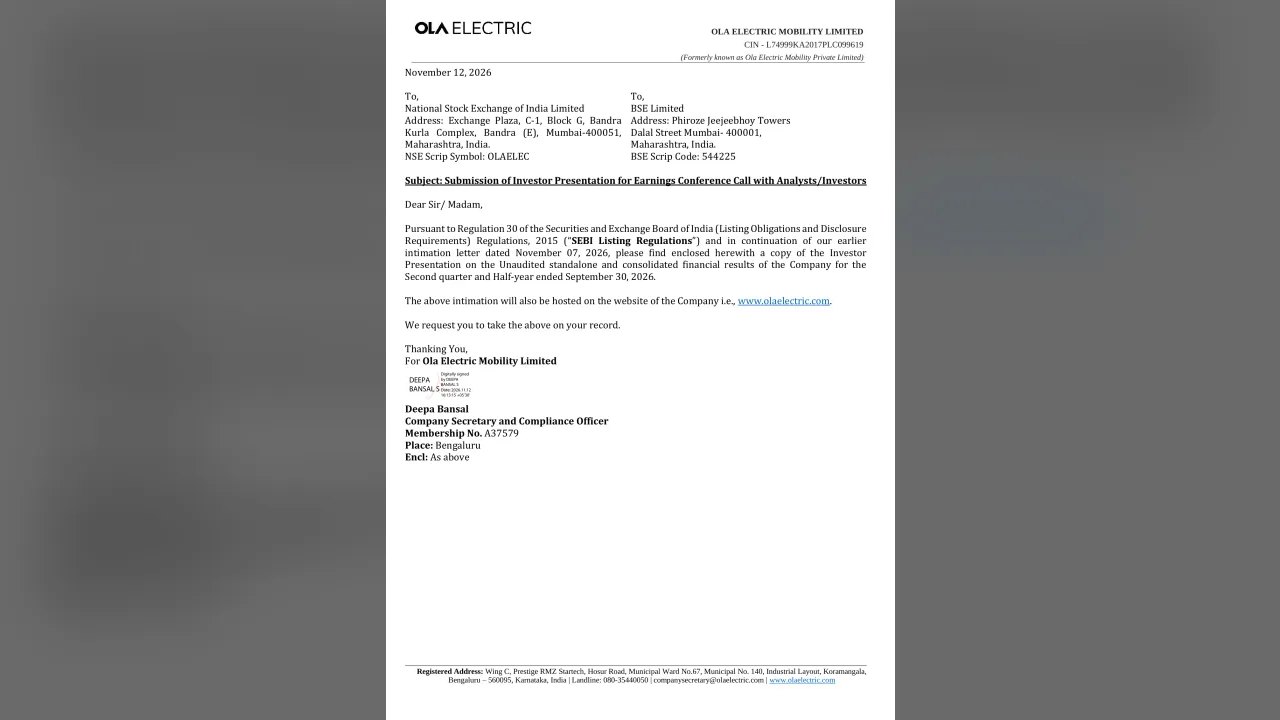
- Company
- Ola Electric Mobility Limited (NSE:OLAELEC)
- Period
- Q2 2027 earnings call
- Date
- Thu, Nov 12, 2026, 8:31 AM ET
- Replay
- Watch the replay on this page · 35 min
On 6ix: 6ix.com/event/ola-electric-mobility-limited-olaelec-q2-2027-earnings-call
Replay
Transcript
Automated transcript · Written by software from the replay's audio. It can mishear names and figures; the replay is the record.
1:01 Hi, everyone. Hi, everyone. Good day, and welcome to Ola Electric's q two FY twenty seven earnings conference call. As a reminder, all participants will be in listen only mode, and there'll be an opportunity for you to ask questions after the opening remarks conclude. Please note that this conference is being recorded. Before we begin, a few quick announcements for the attendees. Anything said on this call which reflects our outlook for the future or which could be construed as a forward looking statement, may involve risks and uncertainties. Such statements or comments are not guarantees of future performance, and actual results may differ from these statements. Now I'd like to request Shri Pavishagarwal, chairman and managing director and Shri Deepak Rostogi, CFO Ola Electric, to begin the conference.
1:49 To start with, I would request Deepak to start with the opening remarks. Thank you, Anal, and good afternoon, everyone. Thank you for joining us. I'm Deepak Rosh Togi, CFO of Ola Electric. Today's discussion may include forward looking statement and non GAAP measures, so please refer to the disclaimer in in our shareholders letter. Over the last few quarters, you know, we have been transitioning our business to rebuild it in a more sustainable model for growth. If there is one headline, you know, for q two or, you know, even going going forward. It is demand is no longer our constraint. What sets our pace now is the ramp up of our supply chain, and we are scaling that rapidly.
2:39 Let me start with the numbers. But before that, I just also wanted to tell you that, you know, in q two, we actually transitioned our company stores to dealership model, and our first dealer went live on September 4. Jan Marshmee, Deepak. Jan Marshmee. Yes. Absolutely right, Bhavesh. You know, revenues for the quarter from operations was 421 crores versus 455 in q one of the last year... Sorry, of, you know, of this year. The gross margin was 126 crores, which is around 30 percent compared to a 139 crores, which is around 30.5%.
3:27 So the margins actually held stable despite higher commodity cost. Operating expenses were 369 crores, worth 330 crores in q one. However, there was a one time positive adjustment in q one, which approximately 57 crores. So if I were to add that back, overall, we will be comparing, you know, 369 versus 390 crores. So there was a meaningful improvement in terms of top rating cost. Adjusted operating EBITDA was negative 246 crores against a negative of 195 crores in q one. And similarly, the PAT was a loss of 362 crores against 336 crores.
4:18 Cash flow from the operations was 100... Negative 188 crores, which is obviously an improvement over the negative 215 crores in q one. Right? So turning to the balance sheet, as you are aware that, you know, we completed our QIP in q one and rights issue recently, which has actually strengthened our liquidity and deleveraged our financials. I would actually want to tell you that, you know, over the period of time, which is, like, the total consolidated borrowings have come down from 3,132 crores, which was in December 2024 to 1,800 crores, which is September 2026.
5:04 So effectively, you know, we have actually reduced close to almost $131,400 crores. But I would also tell you that we had two cycles, you know, wherein we have actually reduced the auto and OEM debt purely from a sales perspective because it was actually, you know, getting into the implementation phase. The borrowings have actually gone up from 714 to 1,482. So I just wanted... And, you know, most of the, you know, cash which we basically have got also, you know, you can see very clearly, has gone either into adding the capacities or actually paying down the debt during this period.
5:52 Any any comments you have, Babish, in this? Yeah. Will just on the remote. Okay. So which brings me to the dealer transition, which I just started. You know? And and this has actually progressed strongly. As on the November 8, we had 255 dealer partners and 319 stores, and we plan to reach 450 stores by December, which will again gallop to around almost close to 700 plus by March 2027. We stopped orders from our d two c stores from November 1, and they are largely... They will be largely closed by, you know, December except a few which we continue to operate. As we shut down our company's store network, operating expenses will further reduce meaningfully going forward.
6:46 The early signs are encouraging. Channel inventory is only about fifteen days. And in money markets where our dealers opened early and have stabilized, we have actually experienced market share going up well above where we were before the transition. Moving to the cell business, we achieved a COD on September 23 during this year wherein, you know, we have actually added 3.5 gigawatt capacity totaling to six gigawatt hours. The government has extended our ACC PLI until twenty to thirty one. As we are already ahead of our PLI milestones, we expect PLI incentives to start coming in from next quarter.
7:36 Let me come back to the headline again. You know, demand is ahead of supply, and we can sell every vehicle we produce. In September, about 5,000 vehicles with paid orders had their deliveries delayed by a week into October because of charge unavailability. We are now running a paid order backlog, which we intend to quickly extinguish as we ramp production. The constraint I think, you know, if I can come here, Deepak, your... What I want to underline for all of of you you is, you know, obviously, in the last few quarters, company has gone through a bunch of evolution and transition transformation. This quarter now, actually, a lot of those things have come together. You can see our our OpEx, which we've been working on for the last year or so, has stabilized.
8:27 Gross margin has also been around the 30% mark. Most importantly, dealer ramp up has been very, very encouraging. In two months alone, 300 plus dealers. So overall, demand is no longer a constraint. We are running an order backlog with the dealers. And even though our factory has a large manufacturing capacity, we are now working with our suppliers to ramp up their supply chains to supply to us. So we are looking looking at a very optimistic scenario now for our auto business. Dealer feedback, dealer experience, and dealer sell through also is very strong. In the shareholder letter, you will see some some data on that. Inventory in the dealer channel is also very, very, minimal right now, only fifteen days. And, you know, the dealers who went on early, inventory is below a week. And dealer ordering is also... Reordering also is now, ramping up.
9:19 So overall, focus of the company now on the auto business is on the supply side to scale it up. In this period of last one year, like Deepak said, we've also really transformed the balance sheet of the auto business. Right? So the debt has pretty much come down to, very low levels. And, we do expect with the the demand pull in now, with the gross margin stability, cost structure, meaningfully reduced and stabilizing and further reducing with shutdown of our own company stores. And the working capital cycle with the dealer model also inflecting from a... You know, we used to have our own inventory on our books in our own store... Stores. Now with the dealer model, all of you are aware that working capital becomes negative. With that also, the auto business is actually looking to a near to midterm free cash flow generation scenario.
10:11 On on sell, like Deepak said, last quarter was an important quarter. We achieved commissioning Deepak on time. It's gigawatt hour. In the middle of all the transformation going on in the auto business, the cell team did a great job to commission it. And as you know, this is the only Gigafactory that has been commissioned in the country at this scale. So it's it's a very meaningful achievement. Government was also supportive in extending the PLI timeline. So we are in in time for the milestones now, and we should be getting the benefits next quarter onwards. I think the other broader point I wanna make is that both the businesses now, the EV business, the EV industry, and the cell industry, both are are seeing very strong macro pull in and tailwinds. And we are in both and we are... In both now, business has stabilized, balance sheet has stabilized, operations have stabilized, and we're looking, very optimistically into the next, year to see, to really ramp up growth in a in a very sustainable, margin accretive way.
11:16 I think the... That's it. We've... You know, there's a shareholder letter in which there are a little bit more details, but we will let you guys ask your questions. Yeah. Politika? Yeah. Okay. Yes. I think, you know, I will just sum up them, Bhavish. You know, think we can just get rid of this thing. So I'll just hand it over to the moderator now and for the... You know, to floor to open to get the questions on that. Thank you, Deepak and Bhavish. We'll now begin the question and answer session. Anyone who wishes to ask a question may use the raise hand option. If you wish to remove yourself from the question queue, you may select the raise hand option once again. Participants are requested to unmute themselves before asking a question. Asking your question, please introduce yourself with your full name and organization.
12:05 We'll wait for a moment while the question queue assembles. We will take the first question from Mr. Arun Sharma of Citi. Hi. Good evening, sir, and thank you for taking my question.
12:50 Hi, Arun. Hi. Hi. Hi, Bhavesh. Hi. On the volumes front, I I unfortunately could not see that in the shareholders letter or the release. Could you just share what are the volumes that we sold this quarter? So, see, revenue was around $4.21 crores. Volumes were around 35, 36,000. They were about four, 5,000 vehicles, which could not be booked as revenue because, like we said, we had vehicles ready to be delivered, but charges would not come in. So, otherwise, volumes would have been around $4,041,000, which got booked in the first week of October. So in this quarter, you will find a little extra volume for that in q three, but that's where the volumes were. Got it. And on a quarter on quarter basis, has been a slight decline in the contribution margin.
13:42 Yes. Is that almost entirely due to commodities, or there's a mix effect here as well? Say the the con... You mean the gross margin. The Right? Thirty point nine point nine percent. Correct. Yes. So that is largely due to commodities. In fact, commodity effect was slightly higher than that. We also were able to raise prices a little bit so that we sort of nullified it. Now Now going forward, what we will see also is we put that in the shareholders letter that the gross margin will actually come down a bit in q three and q four because the business model transitions to the dealer, and dealers take a certain commission. But our operating margin will meaningfully improve, two, three, and, onwards. So, so while commodities have stabilized, our gross margin will come down a bit, but operating margin will meaningfully.
14:32 Got it. Just one more clarification. It's more on numerical clarification. The latest QIP that happened after the quarter, there was this partially paid up share, rupee 6. Yes. I know it's it's very numerical, but will the remaining four come later? I just want to realize what would be the diluted share count. Okay. So I don't know the... Think, Nick, I'll give bit, but I'll give you the broader point. Rights issue, you mean, not the right thing. Yeah. Yeah. Yeah. Happened in June. This was the right issue Correct. Earlier this month. So just sixty forty. 60% came in. 40% will come in when we call in next. You know, not told the date yet. So the share count, I don't know how accounting treats that.
15:18 But this is a separately traded pricing. Right? Yes. Right. So the fort... The rest of 40% would come. I mean, that is there or... Can there be a scenario where you don't really require that 40? No. We will we will take it. Got it. We will take it at the right time. Yeah. Sure. That's all from my side. Thank you so much for answering my questions. Thank you, Arvind. But on that note, Arvind, the... Our cash flows are definitely stabilizing and improving. If you see consolidated operating cash flows also are only about one eighty eight negative. And the note, the operating to free cash flow, the delta is largely the Gigafactory CapEx, which is finishing due to it commissioned and then maybe a few more months of just tail ended payments.
16:05 So... And all that is backed by the project finance from SPI. So the operating cash flows are stabilizing and improving every quarter. Got it, Bob. Thank you. Thanks for clarification. That's all, mate. Thanks, Arvind. The next question, we will take from mister Chintan Jain of Southern Capital. Chintan, can you please unmute yourself? Hi, sir. Thank you for taking my question.
16:50 I'm from Southern Capital. So my first question would be regarding the two to three gigawatt hours of cell consumption which you guided for f five twenty eight, what are the auto numbers you're looking at? Like, what is the average battery pack capacity? And, like, what would what would be the delivery numbers based on the two to three gigawatt hours of cell production in our own vehicles? So, Chintan, for FY '28, you should assume average of about five kilowatt hour per vehicle. Right now, for us, it's about 3.8 also because our our vehicles are higher battery capacity and higher range. And as we are bringing in the, forty six eighty vehicles, you know, those are higher capacity and customer are flocking to that also.
17:37 So expect of, you know, for your calculation to a five kilowatt hour. And if it's two to three, it can be four to five hundred k kind of, orders for FY '28. Okay? Thank you, Chetan. Up next, we'll have Akshay Satish of Alpha Invesco. Akshay, can you please unmute yourselves? Yeah. Hi. Thank you for the opportunity, and congratulations for a quick ramp up on the dealer side. Babish, so quickly, what I wanted to understand is if I look at bill of materials for us, it ranges somewhere around 80 to 85,000 per vehicle. Now if I look at what the competitors' numbers show, this number goes pretty high around what... Around our average selling price.
18:29 So I just wanted to understand what is the gap between this or No. Actually, you're saying others are higher below material? Yes. Yes. I could see, I I think, it is around $1.20 k versus us at 80 k. So what what... So a 50% gap is used. Yes. Ours are not at 80 k. It's slightly higher than that. But, yeah, there is a meaningful gap still. I would say the the gap is our our bill of materials would be maybe 15, 20% lower. And the reason for that is... And then despite higher functionality and spec and battery and range in our vehicle. And the reason is our, you know, strong technology and vertical integration in manufacturing.
19:14 So as a result, our vehicle has lesser components, more integrated across components. We do much more engineering of all components in house instead of buying them from tier one, suppliers, and that helps us, have a higher gross margin, structure and and a lower BOM, actually. Gross margin is also a function of price for the lower BOM. But I'm actually very glad, actually, that you noticed this. And, you know, as our supply... Now that the demand and the dealer volume is ramping up, demand is ramping up, as we fulfill, this is going to be one of the core differentiators... Sustained differentiators for us where where we have a better product at a lower, bill of material cost. And Okay. We have that is because of our technology and manufacturing work.
20:01 Okay. And And if I can add one more point, Akshay Please. Yes. Letter. But going forward, this bill of material, while there is a a cyclical upswing of commodities for the whole industry, structurally, we will be further bringing it down by the LFP cell integration and our Gen four platform, which comes in slowly, you know, q four onwards of of the coming Okay. Okay. And one clarification I was looking for. So as per my inquiries, it tells me that we're offering dealers roughly around 11,000 per vehicle. So this will be directly subtracted from a gross margin per vehicle of 35,000. Is this how we should look at it? I'll not corroborate the 11,000, actually. But whatever we offer will be subtracted from the gross margin.
20:51 Okay. So our margins should slightly lower for margins will come down a bit, but operating margins will meaningfully increase... Improve. Also, what we're giving dealers right now is a more of a introductory, like, a a commission or a margin structure, which will also reduce as dealers stabilize over the next two, three quarters. Okay. Okay. Okay. The next question, Bobby, from the cell business, there's been... So I... As per my sources, I wanted to understand, is the facility fully running at the moment? And second, you've mentioned the targets of achieving 90% yields. I just wanted to understand what gives us the confidence that we could achieve it in such short time because Tesla took three years, Korean players took couple of years. So I wanted to understand what confidence it gives us that we'll be able to ramp it up in six months, eight months in a year's time.
21:45 So we're not saying six months, eight months, sorry, years time, Akshay. We've been at it for actually six years. We... The cell business started when this company started in 2021... 2020, actually. So we've been at it. We know what we are doing here. We're the only ones who've been able to do it in India. And, you know, these are very fair questions. That's why in my commentary in the shareholders letter, you can see the the FAQ on this being answered. We are already at a very reasonable yields, mid seventies for our NMC our NMC production. And we have a very clear itemized road map going up to 90. We know exactly this machine. Know exactly what kind of quality tests are helping us track and then how to improve it. All of that is very, very clear and disappear.
22:32 It's not a a focus focus kind of a... Or it's not a hand waving in in the in the dark. The very clear road map of yield improvement, right, backed by proper engineering and proper technical manufacturing details. So so the NMC part will go up to the mid eighties over the next couple of months. And this is not... It's not like six months or something. Right? Like I said, we've been at it for for many years. Right. Last year also, we were we were working on our yields at lower capacities, and the whole plant was not commissioned. Only, you know, one third of the plant was commissioned. So that's all. Capacity utilization, see, the the way this goes... And, again, there's a full power of this conversation in the sales section.
23:18 We have commissioned everything, and now we are ramping up the production. Capacity utilization will ramp up as we integrate sales into different products. One is our own auto business, and second is Shakti portfolio. These are our two priorities in that sequence. Right. Right. It's gonna start with NMC integrations of this quarter. Q three, you will see a meaningful jump in our cell production. So when I report the q three results in January, meaning, cell production and a meaningful increase in cell company revenue, although it will be coming from our auto business itself. Because the NMC production will ramp going into the NMC... Going into our auto products. Next quarter, we will start ramping up LFP cell production of our own LFP cells, which will, towards the end of q four or early q one, come into our our vehicles. And roughly in our own auto business, 30% of our auto business will use our NMC cells, and 70 will use our NFC sales.
24:14 Okay? Okay. The capacity utilization will grow step by step into that... Into this road map app later. So we have to we have to scale utilization, yield, and input RM cost reduction together as we scale the Gigafactory. So... But now that the auto business is stabilizing, the next... Through the next year, actually, will be the cell business ramp and and the whole flywheel of manufacturing and supply chain. Great. Great. So another final question that I had was, so you mentioned that with the dealer network expanding, we should reduce our working capital. Yes. I was actually, interested to understand that the recent GST announcement that was... That happened by the the input credit difference can be now refunded.
25:07 I actually wanted to understand what impact it could have for us because I believe we have a significant receivable from the government as GST refunds. Yes. Akshay, you're asking all the right questions. No. No. Very, very valid questions. GST used to be a bigger challenge for us than the rest of the industry because of our own b two c channel also. Now... Because in b two c, inventory used to stand, and then till I sell the inventory, I couldn't, you know, get a GST refund. So inventory was a working capital issue, and the potential GST on that was all subsequent working working capital issue. So what has happened is, actually, just through our own internal operational excellence and improvements, we've, anyway, started growing GST receivables from the government over the last quarter or two. And now from the... From November 1 onwards, there are two good things that have happened.
25:57 One is the... Earlier, we could only get a... In what it refund for the... Our end part of the costs, not the the services. Yes. You know, that is coming in. So that'll be a big deal of project. And second is there's a 90% auto approval. So, hopefully, that'll reduce the timing from three to four months to one to two months. So, so it's a very meaningful, positive that you will start seeing in our, in our, cash flows in the auto business. And this is, one is just the government policy help, and second is also just the transition from d two c to the dealership will, will also improve our GST receivables. Correct. So anything on... We could receive for the previous two announcements happened? So anything receivable that was...
26:46 I think it was some thousand crores that we were supposed to receive. So See, the whole thousand, not all of it is... I wouldn't call all of it as a quote unquote liquid receivables. There are there are some which are... Which will have to be consumed in the future, you know, as we do more business. But some is part of the inverter duty structure. You know, the... I would say roughly, you should assume 30, 40% is part of the inverter duty structure. Suraj, is that correct? Yeah. And then the remaining is more of... You know, we'll have to consume it as future business as that access. So out of the 30, 40, we are working with different state governments. So our typical automotive companies, since they have dealers, they will only be working with one state government on the GST receivable. So is that correct? Correct. Right? But since we had a b two c business, we had to work with every state government for our GST receivable and then all the challenges of working with all of these.
27:38 So the past will slowly, slowly get reduced. But going forward, there's a meaningful cash flow benefit. Got it. Got it. Thank you so much, Harish. That's that's all the questions, and good luck to you and the team. Thank you. Thank you, Ouchai. Next up, we have Siddhan Dan from Goodwill. Siddhan, please unmute yourself. Hello. Hi. What is the total equity raised by Ola till date? So, Dan, we don't have it off the top of our head. We'll have to see. What's the approx... Okay. Any approximate number? I don't want to hazard a guess on a public, you know, sweet call minus. Yeah.
28:24 Okay. Okay. You don't want the equity that you raised till date. Okay. Thank you. Yeah. I mean, it's very easy for me to add it up for you. You know, pre IPO, we had, let's say, 2,500 or so. IPO was around 5,000 or so, and then now we've placed the QIP. These are the only... QIP and just the rights, which was last week. So these are the main equity events. But I don't want to be 20% off on this number. Yeah. Thank you, Sudan. We take the next question from Ola Electricity Capital. Olafesh, can you please unmute yourself? Hi, Harish.
29:11 Hi, Olafesh. Congratulations, and thank you for an opportunity. S one delivery will be on time, or should I anticipate any delays due to better integration, testing, or regulatory approvals? We mentioned it'll be in q four. A lot of the testing is underway, So we will take a call when to put it out in q four. Our focus right now is not really to accelerate deliveries of every new... Because we've not really taken orders for these. It's only 500 rupee reservations or so... A thousand rupee reservations. But the focus right now, we're not... We're actually seeing an excess of demand. The focus is firstly to scale up supply chain to meet the demand, and we're we're adding dealerships so there's a lot more demand coming in. So our our whole and sole focus is to meet the demand of the current products. This product will get ready.
30:03 Whether we'll launch it on January, March, there might be another month or so here and there. We will take a call as it as it evolves the context on our demand scenario evolves. And, can you quantify the expected cost advantage of using in house manufactured battery cell compared with the current used twenty one seventy cells? Meaningful what the current battery pack cost per kilowatt using twenty one seventy and in house manufacture daily fuel cells? Yes. So there's a meaningful advantage, of cost, on using our own cells. You should assume if I'm, making my own cells, I will be able to get a, at the right scale of production of my cells, about a 20% advantage on cost.
30:51 Okay. And how many cell I get... Will need for making a one kilo of battery pack using forty six one sixty electric cells? Depends on the size of the battery pack, Purvesh, but forty six one sixty will be much lower than even forty six eighty in the cell because it's only one module in the batch. Okay. Thank you, Purvesh. Thank you so much. Thank you. With this, we I need one more or two final questions. We can probably take One more question? Couple of questions if you have any more. Chetan, you had raised your hand again. We're happy to come back to you if you have a follow-up question. Hi, Bhavish. Thank you for taking my question once again.
31:45 So just one more clarification. In the previous quarter, we had spoken about once we commissioned the six gigawatt of cell capacity, we would like to further take it up to 20 gigawatt hours and also the partnership tie up with Access Energy. So I... So what is the what is the guidance on that? Like, are we looking at expanding to 20 gigawatt hours, or do we want to first stabilize six gigawatt hours? We wanna first stabilize the six gigawatt hour. But in our road map, let's say, slightly mid to long term road map, going to 20 is absolutely on the cards. We, anyway, have PLI up to 20. So once we stabilize six, which is over the next couple of quarters, we will definitely be looking to go to 20, and we will do that by getting external equity into the cell company.
32:33 Now the good thing is our factory... The cell Gigafactory is already designed for 20 gigawatt hours. The building, etcetera, is already set up for 20 gigawatt hours. So the CapEx we need to do to go from six to 20 is going to be a much smaller amount than what we did to get from zero to six. So so in that sense, we are we are... At some point, we will do it, not in the next couple of hours. Just to follow-up on that, what would be the average, per gigawatt hours of CapEx we'll be looking at since you have said that the major CapEx has been done already? See, when I look at, let's say, a fully capacitized plant of ours at 20 gigawatt hour, our CapEx per gigawatt hour would be below 400 crores at that point because many of the things have been built for the 20 gigawatt hour scale already.
33:23 Understood. And if you could just talk a bit more about the Access Energy partnership. What is it exactly about? That's a, you know, a partnership because we are coming up with the product also. It's not out there yet, but it's a partnership. As we bring that product out, they have been very keen on using it. And, you know, the broader strategic perspective there actually is that if you see even last week, the government came with a a policy that for domestic grid scale battery installations, you need 40% domestic value add. So at some point, the only way you can meet that is with Indian cells. So we will be making the Mahesh Feet with our own Indian cells, and we expect not just access, but the whole industry deploying battery and grid solutions to be, considering our products.
34:10 Understood. Thank you so much. Thank you, Chintan. With this, we come to the conclusion of the session. We appreciate your time and all your questions during the call today. Thank you for joining us, and we look forward to meeting all of you during our next earnings conference call. You may now log off the conference call evening.
Follow Ola Electric Mobility Limited into a list and get an email when it puts out news.
Latest news releases
- NSE:OLAELEC — Ola Electric Mobility Limited Press Release Sep 04 2026 · Fri, Sep 4, 2026
- NSE:OLAELEC — Ola Electric Mobility Limited Press Release Aug 28 2026 · Fri, Aug 28, 2026