Michael Bonte-Friedheim
CEO at NEXTENERGY SOLAR FUND LIMITED
Replay available
Private Investor Call hosted by NextEnergy Solar Fund (LSE:NESF) on Investor Meet Company, held 2022-06-29.
On 6ix: 6ix.com/event/nextenergy-solar-fund-limited-nesf-private-investor-call
Automated transcript · Written by software from the replay's audio. It can mishear names and figures; the replay is the record.
0:02 Good afternoon, ladies and gentlemen, and welcome to the NEXTENERGY SOLAR FUND LIMITED investor presentation. Throughout this recorded presentation, investors will be in listen only mode. Questions are encouraged and could be submitted at any time via the Q and A tab. It's just situated on the right hand corner of your screen. Please just simply type in your questions and press send. The company may not be in a position to answer every question it receives during the meeting itself. However, the quest... The company will review all questions submitted today and publish responses where it is appropriate to do so. These
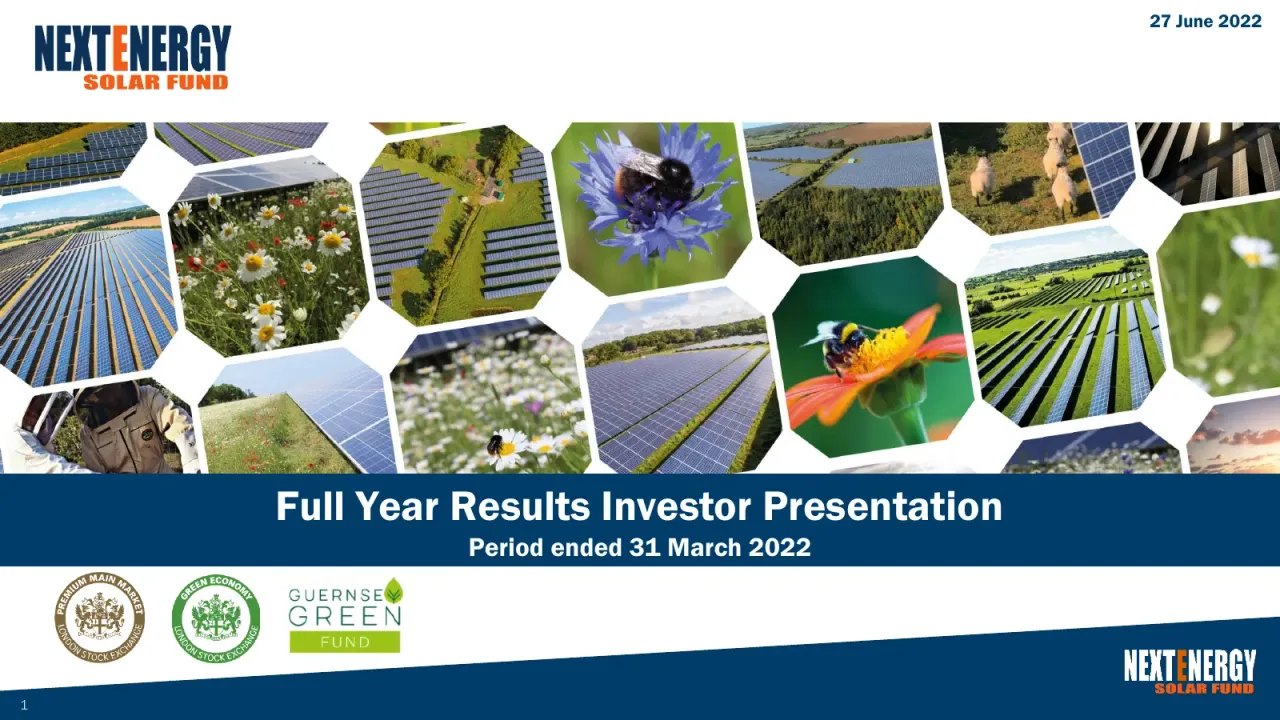
0:33 will be available via your investor meet company dashboard, and we will notify you by email once these are ready for your review. Before we begin, I would like to submit the following poll. And if you could give that your kind attention, I'm sure the company would be most grateful. I'd now like to hand you over to CEO, Michael Bonta Friedheim. Good afternoon, sir. Good afternoon. Thanks. Thanks for that intro, and welcome all to a overview of NEXTENERGY SOLAR FUND. If I could take you to the next presentation, sorry, the next two pages. Skip over. Thank you. As an introduction to NEXTENERGY SOLAR FUND, as you can see on the right hand side, we are a specialist renewable energy company focused on the solar sector. We have a portfolio of 100 individual operating solar projects.
1:25 That is attractive because it it diversifies the investment base by geographic location, by operating counterparts, by distribution network operator, by technical components, by regulatory structure for our international investments. And that, of course, leads to a risk mitigation for investors in the fund. The capacity installed is approaching 900 megawatts, which makes it either the first or second largest owner of solar projects in The UK at present. You can see that the dividend target that the board has approved for the current financial year, which started on the April 1, is a healthy 7.52 p per share with a share trading at about a 110 p that provides investors at the current share price with a very attractive nearly 7% dividend yield on an annualized basis.
2:28 We increased that dividend by 5% versus last year, where RPI in that previous year was 4.1%. And so we increased that well above the RPI increase that we have been pursuing since the IPO of the company in 2014. Because we are focused on the solar sector, because we build and operate solar projects across geographies, of course, we generate renewable energy, and that has a positive impact from a climate change perspective contributing to the net zero ambitions of each of the countries that we're active in. It has positive ESG impacts, biodiversity impacts, and we are certainly contributing significantly to the transition to a clean energy base of power supply in each of the markets that we are active in.
3:24 Talking to you today is Ross and and myself. We are representatives of the investment adviser and investment manager of the fund. NEXTENERGY Capital, as I was saying earlier, is a specialist solar market participant. We only focus on solar. We have about 220 professionals in our team exclusively focusing on this sector. That gives us an expertise and experience, a track record second to no one in our sector. As you look at the historical performance of NEXTENERGY SOLAR FUND, you can see that that expertise has led to superior outperformance from a technical, a financial, and an operational perspective.
4:12 As a fund, you can see some of the other key aspects which we outlined on this page. As I said, a very attractive dividend with a long term RPI focused dividend growth strategy. Our connection to inflation is very strong. As inflation increases, a large percentage of our revenues are are correlating and directly connected to RPI, and so we have an increasing revenue base as inflation increases. We have a very strong asset base, but on top of that, we also have a very attractive growth pipeline in front of us over the next twelve, eighteen, twenty four months. And Ross will tell you more about that in in just a short moment.
5:02 And then finally, what we're seeing as increasingly important for many investors as they classify this kind of ESG sector on the... In the listed market, we are classified as an article nine fund under the EU, SFDR, and taxonomy. So certainly classified at the highest level from an ESG perspective. Next page, please. Some of the highlights for the year that ended 03/31/2022, but also looking forward. You can see that the gearing, the bottom left box there in orange, is 42% of gross asset value. The fund has a maximum target...
5:48 Sorry, a maximum limit of 50%. So we are well below the gearing limit of the fund. Our dividend cover last year was 1.2 times. The excess cash that we generate above and beyond the dividend is reinvested into the business to finance further growth, to finance the improvement of existing assets.
6:13 The gross asset value of the fund is approaching 1,200,000,000 sterling as at March 2022, a quite significant increase as you can see pushing 15% from the previous year. As we look forward, I mentioned our increased dividend, but equally, our dividend cover is expected to be in the order of 1.3 to 1.5 times, significantly above the 1.2 times of the previous year, even with a dividend increased by 5%. Again, those excess cash flows will be reinvested in the business in the growth in the existing asset base to generate further NAV accretive growth for investors.
7:03 Some of our key valuation assumptions, very briefly, we portray very transparently all of the valuation assumptions that we use to derive the net asset value of our portfolio. This helps investors form their own view on whether our valuation is conservative or is not conservative or less conservative. We are the most transparent company in our sector in terms of sharing our valuation assumptions with investors on an ongoing basis. I won't go through all these numbers, but perhaps in terms of the the highlights are the changes in the inflation assumptions given everything that we all know is happening in the market.
7:49 We have... On the... On that bottom table, you can see that for 2022, we have an inflation assumption. This is the year ending, last year of 4.1%. We increased the dividend, as I said, by 5%. For the current financial year, we're expecting an 8% inflation. And then over the next years, higher than we had previously estimated, but then from 2030 onwards, we're expecting a slightly lower long term inflation. The... This data, these assumptions are taken from HMT. They are not our subjective assumptions as to the future, course of inflation, but we source those objectively, consistently from the same source, and we update those valuation assumptions as those are updated by those third parties.
8:44 One of the key drivers of the net asset value of the valuation of our assets and of the fund is, of course, the forward power curve. So we achieve... We receive about 45% of our revenues from the sale of power under short, medium, and, in some cases, long term power sales agreements. The forward curve that we source is also from third party external market consultants. We use three. We take an average of those three, and you can see how conservative these market consultants are on the future evolution of the power price in The UK. Today, power prices are approaching depending on what season, what year between a 150 and £200 for the next year, you can see that the market consultants expect that to come down very significantly.
9:45 What that means for our valuation and for our dividend cover is that if power prices stay above these forecasts, higher for longer or even higher over a particular year, that market development will have a positive effect on our dividend cover and or a positive effect on the net asset value per share of the fund. So if you believe these assumptions to be conservative, there are significant value upside in the in the net asset value of the fund depending on where power prices actually turn out to be in the future.
10:27 I'll hand over to Ross to take us through some of the upside, some of the tailwinds that the sector is facing, some of the headwinds, I think, in summary, we have a very attractive market opportunity in front of us. But, Ross, over to you. Yeah. Thanks. Thanks, Mike. So current operating environment, for NESF, as Mike has said, has has a series of important tailwinds. COP twenty six has created a significant drive for renewable energy and decarbonization of our society. Recent focus on energy security has created a drive for energy to be homegrown, and recent power pricing is driving both returns for existing generators and a need for additional renewable energy growth to reduce reliance on imported hydrocarbons.
11:14 As Mike has said already, NESF's sizable portfolio of generating assets continues to deliver strong and robust performance, and that gives us maximum opportunity to sell power into those attractively priced energy markets. That in turn allows us to drive revenue and dividend cover for the coming years. The portfolio also benefits from inflation linkage in its long term contracts, so its long term government subsidies and its long term power purchase agreements with corporates, and it generates really strong EBITDAs in in each of the SPVs. And we have really well controlled and low OpEx as well. So we really do survive in high levels of inflation very well in NESF and and generate additional incremental revenue opportunity throughout.
12:04 And we also see plenty of reasons to be positive on power price over the midterms. So not only the short end of the curve going up the way, but but those those midterms of that forecast, we see as as being on the negative side. So we we obviously, as a society, are migrating away from internal combustion engine vehicles to electric vehicles. We're seeing already the start of the decarbonization of of domestic heating by the drive towards, things like heat pumps in our houses, and we also see an overforecast in in those, those forecasters' plans of oncoming generation for things like offshore wind and nuclear, which we know are very challenging things to realize in short order, all of which will have a positive impact on ex... Anticipated power prices over that midterm, which is all great news for NEXTENERGY.
12:56 Combine that with our active investment and asset management approach, and it really does create an environment for NESF to go from strength to strength. Having said that, there are, of course, some headwinds when you're operating in an environment that that has very strong tailwinds. Power price has been strong, but volatility has also increased. One of the key reasons why we have been investing in battery storage is because the additional revenue that those assets can generate can be derived from that volatility. And especially over the long term, as we see more renewables come online, we expect that volatility to maintain and therefore a really robust battery storage case out into the future. So important that we're bringing that diversification to bear to mitigate any of that downside risk associated with volatility.
13:42 There's been a fair amount of of press coverage of late around, the risk of a windfall tax in the sector. You may well have read the Feet article from, I think, last night and Times one from from yesterday morning, that now suggests that that Rishi and the the the the team are now moving away from any thinking around a windfall tax. There are material challenges in our view around the implementation of such a tax, especially given the government's net zero strategy and recently published energy security strategy. However, we we believe also that the the the revenue that we derive from those long term subsidies and the way in which we sell our power will also dampen the impact of of any such attacks on the platform as well.
14:29 As we've said, we also benefit from from the inflation linkage. That does hurt us, of course, in the supply chain for new assets where we see the installation cost and cost of components increasing, but we also see that paired with this increased power price that it means we're still able to realize those attractive new opportunities. And the existing asset base, which is so key to the NEXTENERGY SOLAR FUND, is already in existence, and we're therefore not reliant on that growth to be successful out into the future. Moving on to talk briefly around, how the fund has grown over the last year. So this this year has really closed out a very successful period for us. We've delivered a 14.6p, which is a 15% increase in the company's net asset value, bringing us in a little bit under 670,000,000 in in valuation.
15:21 Main drivers of this increase are what we've spoken about already. So those power price forecasts have increased out into the future along with the expectations of inflation, both of which we source from external advisers as Mike has suggested. We also had a large solar asset called South Lofield reach commercial operation and begin to sell its power to the Budweiser Brewing operation in The UK. At the point of commercial operation, we switch from holding assets at cost to their fair value.
15:49 So this also constitutes part of that fair value change in, change in fair value of investments, but you can see on the slide. The NAV growth for NESF combined with the continued dividend growth and exceptional dividend rate that Mike's already spoken to really does create a compelling case for NESF. We always shoot for transparency in in NEXTENERGY. So one of the things that we provide to all of our investors is as much, visibility as possible on key NAV drivers. And and what we've provided here is a usual set of sensitivities that allow you to really get comfortable with how upside and downside, in in some of those key, aspects may impact the overall performance of the fund. As you can see, things like inflation where we are... Have have significant upside potential, we benefit extremely well from inflation over the long term as well.
16:42 One of the key final bits that Mike spoke to as well, but it's it's it's worth, again, just looking at it is the exceptional outperformance of the FUND's assets. So year on year, I'm looking at the right hand side of this slide here, year on year since the FUND's inception, we have generated more power than our forecasts. And that's key because that is down to the way in which our team dedicates, love, time, and effort on the ground for each one of our assets to ensure they're available as much as possible to generate that incremental revenue. For this financial year, we generated 1.8% additional power relative to forecast, and that's about 2,000,000 of additional revenue for the platform within the period.
17:30 When we talk about future cash flows, I know this is a key, component of how investors think about their portfolios. And and, again, it's an important part of what NESF delivers. So as Mike has said already, a huge proportion, around 50% of our revenue is sourced from those long term government incentives, which critically are inflation linked. The other 50%, we sell forward
17:55 the power that we're going to generate into the power markets in the future. What that allows us to do conceptually is to fix the price for the power we're gonna generate out into those future seasons. So as we start to talk around our expectations of dividend cover out into the future, it's to the backdrop of us having understood the revenue that we are intending to generate from the power that is forecast from the platform as well. So as you can see, for example, in 2223, 85% of the power that we intend to generate has already been fixed in the price that it's gonna achieve. So we add that 85% of 50 to the existing 50% from subsidies, we end up with more than 90% of the revenue from the platform fully understood. Key benefits of the way that we sell power are that it mitigates downside risk in the short term. So any front end volatility is removed because we fixed that price, but it also allows the in house energy sales desk to look at how markets are evolving, to track markets up the way, and to lock higher weighted average power prices for the portfolio out into the future.
19:01 Quick word on on the portfolio. Really been an exciting year for us. We have really matured the portfolio throughout this year. We brought our 100 solar asset online a little bit after year end, which is an incredible milestone. Alongside this, we've been realizing platform diversification through the addition of international assets through our investment into an OECD focused private solar fund and also by coinvesting into assets in both Spain and Portugal within the period as well. We brought forward two domestic utility scale solar assets, and we've brought 36 megawatts of that into construction at the moment and are prepping a further 50 megawatts for construction as part of our exciting pipeline of growth opportunities for the future. And it's really good to be able to to bring these assets online when power pricing is so attractive.
19:52 Finally, we've been driving forward our energy storage strategy, putting our first 50 megawatt utility connected battery into construction and securing development permits for the first battery asset that's colocated and retrofit to one of those existing solar assets on the ground as well. That's, again, a key part of what NEXTENERGY brings to the table is really looking at our asset base and driving value by creating the optionality around those existing assets. As we've demonstrated from these results, the existing portfolio is delivering, you know, exceptional, returns and exceptional performance. We pair this with the exciting growth press... Prospects of a pipeline that amounts to more
20:33 than 315,000,000,000 sterling in value. And it really is split across those various pots that I've outlined of of of of new incremental growth that brings diversification into the platform. So stand alone battery assets in in exclusivity and due to dealers in The UK environment, further development of assets for our colocated retrofit program, entering construction on new UK based subsidy free solar, and also further international assets, are under review in that pipeline as well. So a really exciting growth picture out into the future for us as well. Finally, I'll just pause on on ESG. Again, I know Mike has already mentioned the article nine dark green compliance under the SFDR. That's important from our perspective, but we also look to bring that same level of transparency and clarity that you expect from us on the operational and financial side of the business to our ESG credentials as well. So we work with the Green Investment Group, a third party auditor, to look at our underlying metrics and to provide us the independent audit of the positive impacts that we're having on society.
21:41 As you can see, we've avoided a significant amount of c o two being emitted to the environment through the production of the assets and generated enough clean green power to power more than 200,000 homes in this season as well. We also do some really cool societal things on the ground alongside the generation of that green green clean power,
22:04 and they focus on biodiversity and social enhancement as well. We continue to push forward with the dual land use of our assets. We create biodiversity protected hubs, and that allows us to provide vital ecosystem services to the communities neighboring our assets, which is key in the context of the the critical loss in biodiversity that we're experiencing as a planet. We have led the industry in the implementation of these measures. We continue to drive forward our work in this
22:31 regard. We've also recently extended and enlarged our education program. It's needed to be on hold for the last few years due to COVID, but this brings the next generation of STEM students to site to inspire them around both energy production and biodiversity. So NESF delivers tangible social outcomes paired with clear governance to support the outstanding contribution to the environment and country's decarbonization goals. It does all of this whilst consistently providing strong financial performance for our shareholders. So I appreciate I've covered an awful lot of ground quite quickly there, so there may well be detailed q and a to follow.
23:07 But, Michael, I'll hand back to you for a, a sum up then. Yeah. Thank you. Before we we wrap up and open for for q and a, summary of NEXTENERGY SOLAR FUND. As we've explained, a very strong with, operating asset base diversified by location, by geography, by counterparties, an asset base that has performed exceptionally well year in, year out. And that, of course, gives us a high degree of comfort as to the future technical and operational performance of that portfolio going forward. A portfolio that has delivered and continues to deliver exceptionally high dividend yields for investors.
23:51 On top of that, we have a growth opportunity, as Ross was saying, which is incredibly exciting. Naturally, as we look at growth opportunities, we look at them also from a financial perspective. We want each growth opportunity to be NAV accretive, to be dividend cover enhancing. And so we only look at them if they meet those financial criteria as well. We don't need to grow to continue paying a very healthy and attractive dividend. We grow only if it makes financial sense, strategic sense, and where we can take onboard additional assets to generate higher revenues, diversify the risks, and and so on. So you have the the combination of a very strong asset base and a very exciting growth profile.
24:41 We'll hand it back to... Thank you to the moderators to run us through the q and a. Michael. So, Michael, Ross, thank you very much indeed, for your presentation this afternoon, and we will now move on to q and a. But ladies and gentlemen, please do continue to submit your questions, just by using the q and a tab that's situated on the right hand corner of your screen. But just while Michael and Ross take a few moments to review those questions submitted already, I would like to remind you that recording of this presentation along with a copy of the slides and the published q and a can be accessed via your investor dashboard. Ross, Michael, as you can see on the right hand side, we have received a number of questions throughout today's presentation. Thank you to all the investors for submitting their questions. If I could please just hand back to you to run through that q and a tab and where appropriate to do so, if you could please just read out the questions and give your response, and then I'll pick up from you at the end. Thank you. Sure. Absolutely.
25:33 So I'll take the lead on that, and I'll share share some of the answers with Ross. So the first question is what are your views on the likelihood that renewable companies will be subject to a windfall tax? And if it is implemented in a similar way to oil and gas companies, what effect would you expect on net asset value? So Ross answered that earlier. We think that it would be nonsensical for the government to implement a windfall tax on the renewable energy generation companies. We think the recent statements by the chancellor indicate that that is a very low probability outcome. We have run a scenario where if taxes were 10% higher than they are currently forecast in our models, which means 25 to 35% tax burden, that would have an impact of about three and a half to four p on our net asset value per share.
26:31 So quite a limited impact. The next question I'll ask Ross to answer, what areas excite you in energy storage? Is gravity storage something you're looking at? So all all aspects of energy storage, excite me somewhat, sadly, I suppose, but but it's, part of the the the job. Look. As we see renewables becoming a really fundamental part of The UK's energy mix and growing out in the future, storage is a natural bedfellow with it. So that's short and longer duration storage because they provide very different sources of revenue and very different benefits to to the wider generating ecosystem. So what we're looking at at the moment and what we what we see as investable at the moment is those shorter duration technologies, so that's why we're investing in that space heavily at the moment and have significant growth prospects there. We are, of course, looking at longer duration storage and more flexibility, more flexible kind of storage solutions, which include things like green hydrogen, but they're a little bit further off for NESF at the moment. So what's key for us at the moment is is capitalizing on the shorter duration opportunities, which are ahead of us, and and that's exactly what we've been doing.
27:44 Thanks, Ross. The next question is around growth. Can growth be financed from existing cash, or will capital raises be required in the future? We will certainly require future capital raises to fund the growth portfolio that we have in front of us. The interesting angle for shareholders today is a rule that drives capital raises for investment trusts. They have to be done at at least net asset value or above. Now those of you that know this... The the stock a little bit better can see that we are at a very small discount to net asset value at present. So before we can raise further capital to fund that growth strategy, our share price has to rise and rise above net asset value.
28:36 That means that we will be raising capital at a share price above where it is today, certainly not below because that's where NAV... We we could not do that in line with the rules and regulations governing investment trusts. So from today's perspective, it is more interesting to buy shares today rather than wait for capital increases down down the road. The second quest... The next question is what levels of gearing are you comfortable with, and how does a rising interest rate environment impact you?
29:12 So we are comfortable with a gearing ratio where we are today between, I would say, 4045%. We don't wanna get too close to 50%. We might do that in the short term to take advantage of certain growth opportunities before we issue equity and then rebalance the the level of gearing. In terms of our exposure to, interest rates, we can say that it is de minimis because we have the vast majority of our funding... Of our debt funding locked in for for long... For the long term where there is, where there are inflation hedges in place, interest rate hedges in place. And so it really is only the short term that the RCFs that have a certain level of, interest rate exposure. We do not and have not issued any bonds where there would be a refinancing sometime in the future of that entire outstanding amount, our long term debt financing is all fully amortizing project finance structures.
30:18 And so we... By the end of those debt products, we have repaid the outstanding principal. The next question, Ross, over to you. What risks do you see around rocks and your revenue?
30:33 It's quite quite a broad question. So rocks rocks and feeding tariffs constitute a a good proportion of how we generate revenue as a business. They are a well understood long term government backed revenue stream for us, so they're an important part of the mix.
30:53 We, obviously, have brought a lot of diversification into the platform of late, which takes us away from being very heavily reliant on on those for future growth prospects as well. So I think it's it's, you know, obviously, formed part of of how we day to day continue to look after the assets. We've got around fourteen, I think, years left of subsidies and long term corporate power purchase agreements within the portfolio. So it does does create that long term stability, we also, as I've said, really like the the incremental NAV growth and and and Divvy cover growth potential of of assets that are that are outside of the the ROC and feed and tariff regimes. Yeah. I... I'd agree with that. From my perspective, to add on, the the likelihood of the government retroactively changing the rock regime, we see as approaching zero.
31:45 The... Our revenue, of course, the the the non rock revenue that the fund generates, of course, is exposed to market forces. But as Ross was explaining earlier, we spend a lot of time with our dedicated electricity sales desk in reducing our exposure to the medium term markets by locking in those future power prices on expected generation. So we take away the volatility, the risk in as much as possible in our future years from the percentage of revenue that comes from the market price of power. And, again, that reduces the volatility of of the trust's revenues, OpEx, EBITDA, and therefore, also the volatility on on the dividend cover and dividend yields that we've we've mentioned now several times.
32:40 The next question, Ross, for you. Please, can you talk through the economics of battery storage?
32:46 Yeah. At at 50,000 feet, what what matters to me in the energy storage space is how much the sector has matured quickly. And and and, critically, that is how organizations like the National Grid forecast the use of energy storage in bringing stability to the grid out into the future and the volumes of battery storage that they that they believe are required to bring about that stability into the future. What that means on the ground is you're now able to layer a whole load of complementary
33:19 revenue streams within your battery together to create what we call a revenue stack. So it's providing short term stability support to the grid. It's providing arbitrage so we're able to buy low and sell high, and we're also able to benefit from some localized grid products as well where we are geographically located in a in a very energy densely populated from a generation perspective environment as well. So, yeah, that that critical component for me is is the the stacking of revenue streams
33:52 as well. The second part of the economics that... That's interesting from my perspective is that volatility that's brought around by increased renewable penetration on the grid as well. So as we look at these attractive revenue generating stacks in the short term we pair that with increased volatility out into the future, you really do get an exciting economic picture for battery storage.
34:13 The next question is around the size of the pipeline, which is at an advanced stage, and how we are expecting to fund this. I'll pass on to Ross in a second, but but let me say, we never are overexposed financially. So as we lock in projects that we are committed to investing in, we only do that where we have secured capital, available capital to fund that. So we are never exposed on a
34:43 growth opportunity that we've committed to, but we don't have the funding for. But, Ross, over to you. Yeah. So we're we're in the process of of refreshing one of the RCFs in the business. At the moment, it's one of the revolving credit facilities, which will give us around 50,000,000 of dry powder to dedicate to the to the short end opportunities that we see.
35:05 The majority of what we're looking at in that £350,000,000 is either stuff that is secure, so we retain the optionality about bringing it forward or is in advanced stages of due diligence. So we see a very attractive, profile of of those assets, which we can bring online subject, of course, to, incremental fundraising when the timing is right in the future for us, as we said already to date in the presentation. And, Ross, next question for you as well. What percentage of opportunities are you passing based on pricing competition over, say, the last six months, and what is the trend showing? So we are obviously wired into the market transactions that are going on day day in, day out in in the the market.
35:53 What we historically have not done is is chase to the bottom. So when we saw the very last subsidized assets being traded on the market, we weren't willing to pay as much as some of our peers were for those assets because we didn't see them as being accretive to NAV.
36:12 But we have subsequently found, as you've seen from the momentum we've created this year and with that pipeline, a whole host of opportunities that are NAV accretive, super interesting, and also bring that diversification diversification to to the the the picture as well. What we definitely see is the industry maturing. So I don't think anybody can now argue that that that renewables as an as an asset class fit firmly within the infrastructure space and that solar has demonstrated, especially in The UK environment, that it's a fundamental part of today's energy mix and a growing part of the energy mix out into the future. So we remain very positive about our ability to continue to find those deals, which we are very selective of, but we continue to find the ones we want, and we will continue to bring them into the platform on an average basis.
36:59 And adding to that, we can say that we have continued with a very rigorous financial process to determine what values we are willing to bid for assets. And in many cases, in very many cases, over the last six months, twelve months, even twenty four months, we have been unsuccessful because there are other market participants that are willing to to pay more. So we we do not let ourselves get put in a position where it's, as as Ross was saying, a race to the bottom or to the highest price. We we put our price on the table, which works for us from a NAF perspective, from a dividend cover perspective, from a valuation perspective. And if the seller finds someone that is willing to pay more, good luck to them. We'll move on to to the next opportunity.
37:47 The final question that that we have on screen here is whether there are inflation caps on private electricity sales arrangements. No. There there are not.
38:03 Over to the moderators. Are we taking any question... Other questions live? Are there any other questions that have come through that that we have not seen? Michael, Ross, that's great. And that is all the questions that have been submitted so far. So thank you very much indeed for addressing addressing all all of of those those questions that came in from investors. And of course, if there are any further questions submitted today, we'll make these available to you immediately after the presentation has ended for you to review. And ladies and gentlemen, we'll publish all those responses where it's appropriate to do so on the investment company platform, and you'll be notified when they're ready for your review. Michael, perhaps we're redirecting those on the call to provide you with their feedback, which I know is particularly important to yourself and the company. If I could please just ask you for a few closing comments to wrap up with, that'd be great. Absolutely. Well, first of all, thank you all for for participating in in this session.
38:50 It's always very interesting to expand the contacts that we make as the investment manager of this fund to really go through all of the advantages that we bring both from an ESG perspective, from a local community, from a biodiversity perspective, from decarbonizing the power sector, but combining that with a very strong asset base that offers investors very attractive financial returns. And so as you hopefully will have gathered from our presentation, we are able to secure very attractive financial returns by doing the good thing for the local communities, for the country, for the decarbonization of of the power sector and, of course, participating in the race to to net zero. So, again, thank you for your time. Hopefully, you found it interesting. And, naturally, as the moderators were saying, any further questions, we're happy to take those also after this call. Thanks again.
39:48 Thanks, everyone. Michael, Ross, that's great, and thank you very much indeed for taking the time to update investors today. Could I please ask investors not to close this session as you'll now be automatically redirected for the opportunity to provide your feedback in order that the management team can better understand your views and expectations. This will only take a few moments to complete, and I'm sure will be greatly valued by the company. On behalf of the management team of NEXTENERGY SOLAR FUND LIMITED, we would like to thank you for attending today's presentation. That now concludes today's session. So good afternoon to you all.
Follow NextEnergy Solar Fund Ltd into a list and get an email when it puts out news.
CEO at NEXTENERGY SOLAR FUND LIMITED
COO & Head of UK Investments NextEnergy Capital at NEXTENERGY SOLAR FUND LIMITED
IR at NEXTENERGY SOLAR FUND LIMITED
PA at NEXTENERGY SOLAR FUND LIMITED