Peter Hasley-Chaplin
Chairman
Replay available
M.P. Evans Group (LSE:MPE) Q1 2026 earnings call, held 2026-09-15. Watch the replay and read the transcript on 6ix.
On 6ix: 6ix.com/event/mp-evans-group-plc-mpe-q1-2026-earnings-call
Automated transcript · Written by software from the replay's audio. It can mishear names and figures; the replay is the record.
0:00 Good afternoon and welcome to the MP Evans Group PLC interim results investor presentation. Throughout this recorded presentation investors will be in listen only mode. Questions are encouraged and they can be submitted at any time using the Q&A tab situated on the right hand corner of your screen. Just simply type in your questions and press send. Before we begin I would like to submit the following poll and I would now like to hand you over to Chairman Peter Hasley-Chaplin. Good afternoon to you sir.
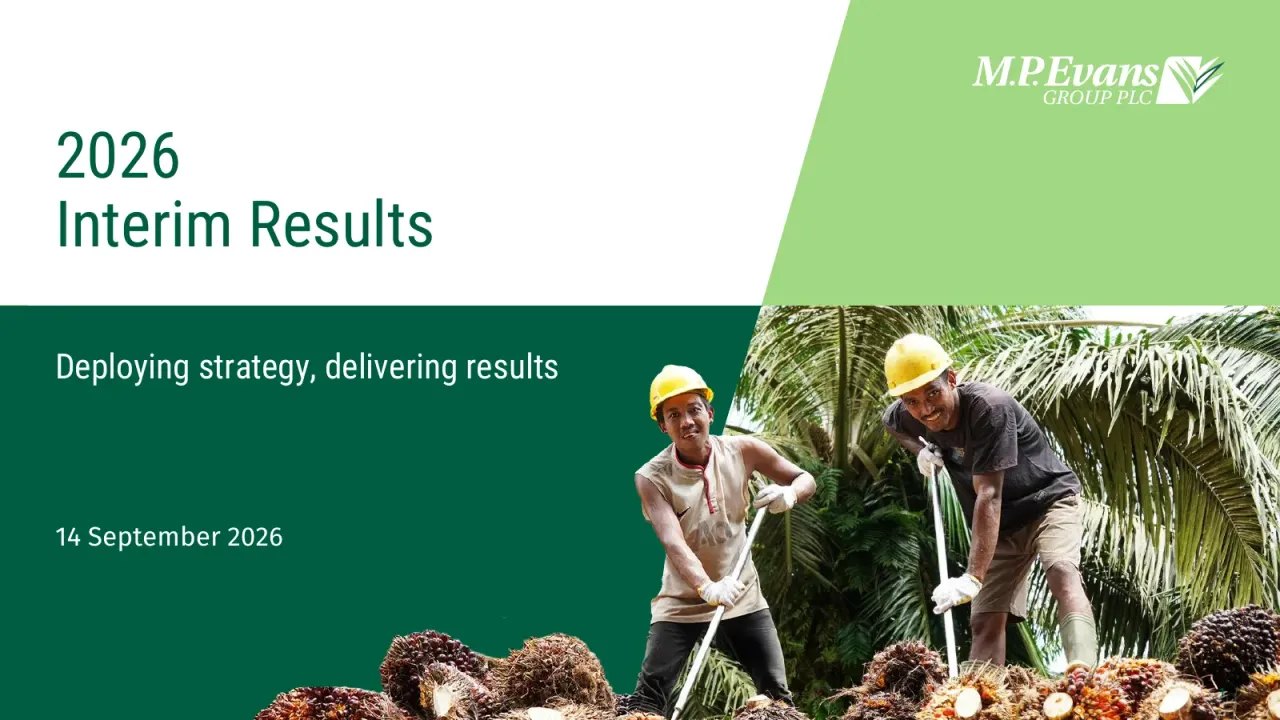
0:27 Thank you, Alex, and thank you all very much for joining us today for our presentation of our 2026 interim results, which were announced to the market yesterday, of which we're very proud. These are record breaking results once again. And I have to say a credit to our team from the UK to our twelve and a half thousand employees in Indonesia. As many of you will know, we're a UK aim listed company with a history of 150 years with a focus in the last 20 to 30 years exclusively on sustainable Indonesian palm oil.
1:17 We have now 70,000 hectares under our management. We have six zero waste mills. and as I mentioned, we employ 12,500 people. I'd just like to introduce you to my colleagues, Matthew Coulson, our Chief Executive, and Luke Shaw, our Chief Financial Officer, and I will kick off by providing an overview of the results. We'll talk for probably not even quite half an hour on the presentation, and then we'd be delighted to receive any questions, but the cutoff will be 1 o'clock.
2:05 We may well be done by then.
2:09 So to kick things off, we're delighted that our own harvest from our own majority-held crops was up 14% up on last year, 705,400 tonnes, whilst the purchases from independent suppliers was quite significantly reduced, which has helped towards a better crop mix. Our total crude palm oil production was up by 11% to 192,300 tonnes, and very pleasingly, and I have to say impressively, our oil extraction rate is up also significantly to 24.2%, which is very high and creditable by any industry standards.
3:05 Our crude palm oil millgate price was actually only a smidge up on last year at the continuing robust level of 873 The palm kernel price was up by a little bit more. But our gross profit was up by 25% to just under 79 million. And this is due to a number of things, which my colleagues will elaborate on. Improving extraction rates, stronger pricing, particularly on palm kernels, a more favorable crop mix, of the better performance following our significant acquisitions over the last two or three years, and indeed a favorable foreign exchange variation.
3:56 Earnings per share were up by 21% to 86.5 pence. And we're delighted that the board has agreed an interim dividend up by 39% to 25 pence per share. We are looking to balance a little bit the ratio of interim to final dividends. It's not necessarily an indication of what will follow by way of the final dividend, but obviously a decision will be taken on that closer to the time of our results for the year. So on that note, I will hand over to Matthew initially.
4:42 That's great. Thank you very much, Peter. The next slide here is one that will be familiar to many of you who've been with us in these presentations previously. What this seeks to do very simply is illustrate the balance of inputs and outputs when we think about the crop that we process and the CPO that then is indeed produced. The key thing here really is to notice, as Peter has already indicated, the reduction in the proportion that comes into our mills from outside suppliers. You can see there that in 2026 now, that only accounts for 12% of what gets processed in our mills.
5:33 88% now comes from our own areas that we manage. both from areas under our direct ownership and areas we manage on behalf of our associated scheme smallholders so a continuing change in that crop mix and that really does help then that increase in the oil extraction rate up now to 24.2% overall as an average across the six mills that we operate in our locations and it also that really helps with improving the amount of output we're able to certify as sustainable output, up now to almost 80%.
6:19 And this is a journey we're very much on and we continue to focus on as we push forward, changing that dynamic, changing the mix. and indeed will continue to do so. Looking then now to the market dynamics and indeed the pricing environment, a quick word from me on this and then I'll hand over to Luke. You may remember that we were commenting on this back in May when there was some indications from the government in Indonesia about potential changes for Palm and indeed for several other key commodities in Indonesia.
7:17 There was some indication from the government in Indonesia that they wanted to play a more active role in exporting of these commodities, potentially even to the extent of being the exporter. of some of these commodities. That caused some concern in the sector and in the wider marketplace, certainly for a short period of time. Things have become a lot clearer since then, and actually what has become a lot clearer is that it seems that isn't the government's intention. What they want to do is actually monitor what's going on in the export environment to be very clear about how things are being exported what prices things being are exported at just to be reassured as a government that things are being done properly things are being priced appropriately when they leave the shores of indonesia and that's the approach that they are taking as we sell everything domestically to local refiners, we've been unaffected by this. We've carried on producing in exactly the same way and actually we've carried on selling at the same way throughout the period and indeed for very consistent pricing. And I think that's been borne out by the results that we're announcing now and showing to
8:51 the market. So I think that's just very important. to take a moment on that before we then get into the pricing environment in a bit more of a thorough way, and I'll pass it to comments on that. Thanks, Matthew.
9:06 So you touched on the price high right at the start with Peter, that the CPO price for the year was up 1%, so pretty static compared to the same period in 25. The main message here on this slide was to introduce a new external benchmark for pricing. Historically, we've always referenced SIF Rotterdam as a third party external or widely available benchmark pricing data that you can usually use to try and work out what we're receiving at Millgate.
9:51 What we've realised over the last six to nine months is that the SIF Rotterdam price that was published and is on our website daily has ventured away from really what we're receiving at Millgate. The gap has altered. and other palm oil companies do use this as well as their benchmarking tool for price and I've put there a little reconciliation which I won't go through in detail but a lot of the reconciling items there and that's meant to be an illustrative table to help guide are similar to what you would have used in your bridge from Ian Ziff Rotterdam anyway. So we will continue to show the Ziff Rotterdam data on our website for historical purposes but we will introduce this BMD chart on our website moving forward and that will be updated daily as well.
10:55 So a slight shift there but we think that this is a better guide to show how we are doing at Millgate. In terms of the results themselves, so just starting with revenues, so we saw a 9% increase in turnover and whilst we did have that PK pricing benefit, this time around it's really nice to explain that real boost in that top line and then also profitability wise was increased volumes both of PK and CPO. That came from that increased harvest that we were talking about earlier but also that better extraction rate created more PLC PLC PLC PLC We have had some FX benefit. Peter touched on that.
12:08 The Indonesian rupiah continued to weaken through the first half of the year against the dollar. So that 409, if you were to make a constant currency number, would be closer to 420. So we've still seen a and that's really a result of really good diligence from the guys on the ground managing the cost but also that increased volume. Increased volume really allows us to drive down unit costs. We hope for that to continue as we move through the year and in future years as well. We have seen a slight increase in fertilizer costs. You'll see that a portion of costs for fertilizers come up slightly. We did say in March when we were last talking to investors that we were generally protected from the sort of high fertilizer price environment that we've seen after the events in the Middle East in March. And that's still true.
13:02 So 2026 P&L is protected. But we did start to see pricing creep up a little bit towards 2025. So that's just some of that feeding into the P&L through the first half. In terms We saw that go down 7% to $514 per tonne. If you do a weighted average, that just shows that when we buy in crop, that costs us around about PLC PLC PLC Most people will know that we have to give a little bit of price back to those people that we buy from. It's quite a static margin.
14:17 If the CPI price goes up, we have to pay more for that product that comes in from the third parties. So we saw a net price benefit of 3.9, predominantly driven by PK pricing. That gets you to 67 million. And then you can see the result of that extra volume from that improved harvest, coming through into the P&L. And in the next block, 3.7 million of acquisition We made an acquisition in July last year, SBS and SKMA, which is at our Beat Me Mass facility. That wasn't there in 2025. So that is a true bridge item for 2026.
15:02 But it's worth calling out that the 3.7 million plus the profit that was generated in the first five months of ownership last year was totaled together around about 7 million of gross profit in the first 11 months of ownership. And that's an asset that we paid 35 million P. Evans Group PLC P. Evans Group PLC Wage Inflation Dose Moving from profit to cash, again, on that cost per tonne slide, the $409 that we talk about is an all-in cost. So that includes a reasonable amount of depreciation.
16:35 So if you take that out, the cash cost per tonne has generated just under 92 million from operations. We came into the year with a significant cash balance on the balance sheet. At the end of last year, we paid off our debts. We have a debt-free balance sheet. And we've spent a fair amount of it over the past half, paying our taxes. And then in the orange bar on the second line, you can see where we've just been balancing the capital allocation. So that's the final dividend from last year going out, which was paid in June. And then also continuing to invest in the group, just under 11 million on CapEx projects, some of which is planting and replanting, but also some projects that we're working on which can help drive operational efficiencies in the future, which is a really good use of cash in terms of returns. And then a little bit of share buyback as well, certainly through the second quarter in the year.
17:42 We spent just over $3 million buying back some of our shares. So we spent some but we still ended the period with more than we went in with and we had a closing cash balance at the end of the first half of $113.5 million which we fully intend to try and use and Matthew will touch on in a minute a little bit of how we spent that on a new acquisition which we announced last week. On dividends Peter said right at the start, delighted to announce a 39% increase in the interim dividend up to 25p, an element that is rebalancing between final and interim, but nonetheless really delighted to be able to give that return to shareholders. It continues our progression in terms of upping the dividend, particularly
18:46 focusing on strategy again many of you will be familiar with what's on this slide this just allows us a chance to reflect back on our strategic priorities under the four key headings we've set out now for several years around responsibility excellence growth and yield and important for us to demonstrate we continue to make progress against all of these strategic priorities during the course of 2026 and we are continuing to be very, very focused on each and every one of these as we push forward with all aspects of the business. I think perhaps rather than lingering here, it's more important to give you specific examples and demonstrate what this looks like in more detail and and look at an area we acquired a few years ago.
19:50 We go back and you'll remember in 2023 we acquired some further hectareage in East Kalimantan close to our Cotter Bannon project. This area was one called, one park called ABK and another park called NAS in total around 8,000 We knew on acquisition that this was an area that required some rehabilitation by our agronomic team and we also knew that this was going to take some time to work through that rehabilitation project.
20:38 Now hopefully as always with these things it's easier to demonstrate pictorially to show the work that has been done and hopefully the pictures do provide some clear indication that's the same area pictured twice a couple of years apart and you get a sense there of the difference that can be made by our teams over that time span and if that's not illustration enough on the left of the slide You can see the difference has been made in terms of yield per mature hectare during that period of time. In the first full year of ownership of this new area, we were seeing a yield of less than 10 tonnes of crop per hectare, which is not great. But we knew that it was going to be that way on the way in.
21:35 We're now looking at something approaching doubling that over the course of the last couple of years with more still to come I hasten to add that's not the end of the journey but we're making some substantial strides forward as we work through improving the quality of this area and this is all very very much consistent in terms of focusing on increasing the harvest from our own areas, therefore reducing the reliance on outside suppliers, improving the quality of the crop that therefore comes into our mills and enabling us to improve the extraction rates that we deliver in the mills that we run for ourselves. And you can see that specifically.
22:29 Look at the history over the last few years. of the extraction rates we're delivering in our Cotabangan mills. A lot of this crop has been going into, there are two mills that we have in Cotabangan, one called Bumi Pamai, one called Rahayu. A lot of this crop has been going into our Rahayu mill and it wouldn't hurt to look back at the extraction rates that the Rahayu mill has been delivering over the last few years. They have been increasing and one of the reasons is because of the increased And this nicely brings us on to what's just happened. As announced last week, we've acquired some further land, again, close to Kotterbangen.
23:19 So two adjacent parcels, one called KWB, one called Longnar. At the moment, there isn't very much planted land, only around 700 hectares currently planted, also requiring some rehabilitation. That's reflected in the relatively low initial amount invested. But excitingly, what we have in this combined area is the opportunity to do more planting for future growth. We estimate that there is the opportunity to end up with 3,000 or 3,000 plus P. Evans Group PLC results that we've been delivering for the first six months of this year and of course as we sit here in September we could of course give you a quick update on first eight months look like through
24:53 to the end of August and that's what this slide does Peter mentioned at the very start the crop for the first six months was up 14% from the areas under our own management as we roll forward to the end of August The first eight months was 965,000 tons. Then we add on the independent crop and we've processed almost 1.1 million tons in the first eight months of this year. On pricing, pricing for the first eight months is actually very similar to the pricing of the first six months, which is very encouraging.
25:42 So hopefully you get a good sense with two thirds of the year now under our belts that we're moving ahead with great confidence into the second half of the year. And the final slide just tries to draw it all together to give you a summary of where we stand in terms of the first half. But as I say, looking further forward as well. Again, as Peter said at the outset, we're very pleased, we're very proud of what's been achieved in the first half, what everybody across our Indonesian teams have been able to deliver, and we look forward with much confidence into the second half of the year as well.
26:30 I think perhaps at this point, with our half hour for presenting to you pretty much up, now is a good point to pause and turn it over Great. Thank you very much indeed for your presentation. Ladies and gentlemen, please do continue to submit your questions using the Q&A tab situated in the top right corner of your screen. While the company take a few moments to review those questions submitted today, I would like to remind you that a recording of this presentation, along with a copy of the slides and the published Q&A, can be accessed via our investor dashboard. And Peter, at this point, if I may now hand back to you to chair the Q&A, kindly ask you to read out the questions where appropriate to do so, and I'll pick up from you at the end. Thank you.
27:13 Thank you very much again, Alex. Well, thank you so much for submitting the questions that you have. And indeed, one or two of you very kindly congratulated us on our results, which we appreciate very much. Thank you. I think we can just take them as they came in chronological order, because each one is a little different. The first one is quite a long one, so I might just sort of summarise. I think essentially it is asking about the threat from synthetic vegetables, synthetic palm oil specifically, which has received a certain amount of press in the UK.
27:59 which is very interesting and whether this does represent a threat to palm oil and indeed to respects for importing palm oil into the UK and Matthew perhaps you might like to comment on that
28:18 I'm very happy to do so. I think embedded in the question actually as I read what's been written there is a very good answer too actually which is to sort of provide the context for everybody here with some observations saying that it tends to be the case at the moment that it seems that that the scale of ambition from synthetic producers seems to be relatively small, seems also to be focused very much on higher value added products, and that given the overall scale of the vegetable oil market, which is some 200 plus million tonnes per annum, We don't particularly see this as a threat as such given the way in which we go about doing what we're doing.
29:23 So whilst we all seem to get complacent about these things, we will continue to monitor what's going on in that
29:40 Right next question, with the new acquisition how many new employees will be joining us and of the planted land what is the level of maturity and how long will it take the acquisition to reach its full potential? Do you want to tackle that one again Matthew?
29:58 Of course yeah absolutely so taking each part there's a relatively small number of people joining us as I'm sure And indeed, of that planted land, not all is being actively harvested right now. As I say, some of it needs a very high degree of rehabilitation. In terms of maturity and reaching full potential, encouragingly, the majority of the planted land is still relatively young. which is exciting for the future and in terms of the full potential for us our ambition is to do the planting of the available area as quickly as we can.
30:55 3,000 hectares is not going to be planted tomorrow clearly but nonetheless we're excited about the opportunity What income and for how much longer will the Bertone properties project deliver?
31:19 Just to give a tiny bit of background for those shareholders or those people joining us who aren't familiar with P. Evans Group PLC P. Evans Group PLC But we did keep a 40% share of the Bertone Properties Project, Bertone being a former estate owned by the group.
32:18 And that has been developed from essentially a rubber and alpine plantation over the last 30 years into a new mixed development project of housing, shops, industrial areas, golf course, etc. We have never had to put a single cent into it. We've only taken money out by way of dividends. The original land area was some 2,000 hectares. It's now less than 200 hectares. So it is being developed out, and we take the income by way of dividend, which is relatively modest these days.
33:03 . Next question. Independent crop has already fallen from 16% to 12% of mill throughput as your own crop has grown. Correct. Once that remaining independent crop has largely been displaced, how much genuine spare processing capacity remains across the six mills for the additional production coming from immature acreage and kotterbangen before further Do you want to answer that one, Luke?
34:12 Yeah, so I mean, I think, as you say, that there is a sort of pathway that's being followed at the moment around that independent crop. But roughly, we think there's about anywhere between 15,000 to 20,000 additional hectares worth of land that could go into our existing mills before we'd have to think about another one. So that gives you an idea, roughly. is there and that's of course what we're looking to do as we move forward strategically is to kind of bring that own crop into our mill. So it's somewhere in the region of 15,000 to 20,000 hectares that could be processed without having to build another mill.
34:56 And of course the only area where we don't have a mill is at St Pancaria where we have about 4,500 hectares and it would be good one day to be able to process Purchase of shares for cancellation has been modest in the half year. Is there any reason for this? It's a balance. I don't know whether you want to comment, Matthew, in terms of the specifics of the share buyback.
35:46 Precisely as Peter says, it's a question of finding the right balance for capital allocation. As we've sought to indicate, we're extremely enthusiastic about seeking to continue on our growth pathway and focusing our attention there. Of course, we continue to be very much committed to our progressive approach to shareholder returns by way of dividends. We of course absolutely recognise the value in buybacks and want to do that as well but as always with these things it's about striking the right balance and it's simply the case there of seeking to try and make sure we have the right mixture of these things in terms of deploying capital.
36:42 Next one is, how do the extraction rates vary across the six mills?
36:46 Yeah, I mean, we have one mill at the top end of the range, our Missouralis mill. All of the extraction rates for each mill, I should say, are available in the interim report, but we have one mill that's doing more than 25% at Missouralis. and that's the mill where we process the most independent fruit so we do point to some of the extraction rates at one or two of our mills where you can really see again the size of the prize where when we're processing our own fruit we can really see improvements in that extraction rate towards 24 25 levels and sometimes how much that independent food can sometimes bring that level down and it's a range between 25 to 22 across the six miles.
37:46 The next question is regarding the possibility of our acquiring, merging with another UK listed plantation company as a viable route to increasing production. We are asked this question from time to time about whether we would look to merge with Well, there really are two other listed palm oil companies in the UK. There are a couple of others in Europe and this idea has moved from time to time. It's something one would consider, but it's all about shareholder value and certainly we believe that paddling our own canoe represents the best shareholder value. and is the right way to proceed for now. We're looking at other ways of growing through acquisition, through share buybacks, through other means.
38:52 Next one, I think you have no intention of using BMD, which is the Malaysian Commodities Exchange futures market, Palmore Futures. But will you enshrine this so a change of this wise policy will require an agreement by the shareholders to give comfort in the years ahead when inevitably there will be different management? Well, interesting one. We've always made clear that we have a natural hedge in the fact that oil palm is harvested every day of the year and that by not selling forward we obtain the average over time by selling on a sometimes daily, weekly, monthly basis, rather than looking to fix forward sell, try to sort of second-guess the market. And whoever happens to be at the top of the time, I would imagine, will look to the benefits that this policy
40:23 has brought about in the past. The increase in sustainably produced palm oil is impressive. However, what percentage of sustainable palm oil is a realistic target if it is not 100%? And what is the time scale to get to that point? Matthew, do you want to answer? Yeah, of course. We've deliberately not bound ourselves with a numerical or time-bound target for
40:58 Again, it's all entirely interlinked with what we're seeking to achieve with the mixed change of inputs to our mills. As we work through this process of reducing and indeed ideally eliminating on a mill by mill basis, and it is a mill by mill process, Do you expect Super El Nino to have any impact on your yields? Of course, there's been a lot of coverage of what's been going on with global weather patterns this year. We have experienced some abnormally dry conditions in some of our locations, not all, but some of our locations during the last few months.
42:31 PLC PLC PLC PLC PLC 2015 into 2016. We saw a reduction in our crop by about 6% just to give you a flavour. The last time we saw a smaller El Nino, which is 23 into 24, our crop was rather going up.
43:21 A lot of our crop in affected areas was level. So again, that gives you a sort of parameters of these things. also what you quite often see if there is an El Nino effect where supply is restricted not just for our areas but of course it affects far more broadly within the key producing areas in Indonesia and Malaysia is if there is that restriction in supply you can quite often see a compensatory impact on pricing so from a net impact perspective may find financially you end up not that affected overall. That's great, Peter, Matthew, Luke from Hstrum, and thank you for addressing all those questions from investors today. But Peter, before I redirect investors to provide you with their feedback, which I know is particularly important to yourself and the company, could I please just ask you for a few closing comments?
44:29 Well really just to say thank you so much for joining us and thank you for your excellent questions and we look forward to seeing you again either in person or online before two long so thank you very much. Fantastic thank you once again for updating investors today gonna please ask investors not to close the session as you now be automatically redirected to provide your feedback which will help the company better understand your views and expectations On behalf of the management team, we would like to thank you for attending today's presentation and good afternoon
Follow M.P. Evans Group PLC into a list and get an email when it puts out news.
Chairman
Chief Executive Officer
Chief Financial Officer