Paul Pindar
Chairman at LITERACY CAPITAL PLC
Replay available
Q3 results hosted by Literacy Capital (LSE:BOOK) on Investor Meet Company, held 2026-10-26.
Automated transcript · Written by software from the replay's audio. It can mishear names and figures; the replay is the record.
0:00 Good afternoon, and welcome to the LITERACY CAPITAL PLC investor presentation. Throughout this recorded presentation, investors will be in listen only mode. Questions are encouraged and could be submitted at any time via the Q and A tab situated on the right hand corner of your screen. Simply type in your questions and press end. The company may not be in a position to answer every question it receives during the meeting itself. However, the company can review all questions submitted today and publish responses where it's appropriate to do so. Before we begin, I'd like to submit the following poll. I'd now like to hand you over to the management team. Paul, good afternoon, sir.
0:32 Good afternoon, and good afternoon, everybody. Thank you very much indeed for, taking the time to join us today. As many of you will hopefully have seen, there's actually been three announcements from us this morning. So the first one is we've announced our q three NAV, and this presentation will go through... Provide a little bit more color on that. Secondly, we've also formalized our capital allocation policy. During the presentation, Richard will talk through some of the detail of that. And then thirdly and coincidentally, you may also have noted that the chair of LITERACY CAPITAL has also made quite substantial share purchase today. So that was also on the r and s this morning. I'm conscious on the call.
1:19 We have got both quite long term existing shareholders, but we've also got people that are new to LITERACY CAPITAL. And therefore, if you just forgive us for three or four minutes, if we just provide a little bit of the background to what it is that we're looking to do. So by way of background, we are a UK listed investment trust. Our aim is to invest in the smaller end of The UK private company market. So, typically, we're looking for founder led businesses, usually with an EV of somewhere in a range of somewhere from 10,000,000, typically perhaps to 30,000,000, with a view of seeing if we can build out those businesses and add value in a whole range of ways, which we can touch on, but to build larger and more successful businesses.
2:08 By way of background, we've been doing this now since September 2017. We started with initial capital of £54,000,000, and our NAV today is just in excess of £270,000,000. Essentially, all of that growth has been through investment gain, both realized and unrealized. Richard's gonna talk to you a little bit more about the portfolio that we have. Today, we have 17 businesses. So we run a reasonably concentrated portfolio, which hopefully means that we can put time and attention to each of the businesses and to try and maximize value. An unusual feature of what LITERACY CAPITAL does is we're the only listed investment fund where we also have a charitable purpose.
2:57 So whereas many private equity funds will typically charge 2% management fee and 20% performance fee, actually only charge a one and a half percent management fee, but we give the balance of half a percent of net assets every year to UK literacy charities to try and help disadvantaged children learn to read. I'll say for completeness at this point, the other unusual feature to us is the fact that we do not charge any form of performance fee. So whereas with typical private equity, the returns have the down note of 20 carry, In our instance, we charge no carried interest whatsoever. So in terms of why we think that this is an interesting segment, Obviously, the great bulk of UK businesses are privately owned, and there are some fantastic businesses across The UK.
3:53 If you look at the smaller company sector, very typically, the entry prices that you're able to achieve are materially lower than they are with some large businesses, and that's obviously attractive to us and provides much greater potential for outperformance. By virtue of the structure that we have, we have a high degree of influence influence over major decisions that are made within those companies. So unlike, if you like, an example with an investment trust, which has a listed portfolio of shares, in that situation, the investor has a relatively limited degree of influence over the management team. In our case, we've got quite a high degree of influence over the management team, and that effectively means that we can have a direct impact on performance. As I alluded to just now, we charge no performance fees and no carried interest.
4:44 I guess the other comment that I would make for completeness is the the the alignment that we have, and particularly Richard and I that you can see in front of you, is that between between Richard and I, we own nearly 40% of the fund ourselves. So we effectively eat our own cooking. And if we make money for shareholders, then we benefit from it. And equally, if we don't make money, we suffer from it. So, again, slightly unusually in the private equity industry, but our alignment between ourselves as a investor and shareholders is very strong indeed. The benefit of why we've created the structure that we have and not being the more typical limited life GPPs... LP structure is the investment trust structure allows us to have a very long term view so we can effectively own businesses for what we believe is the optimum period to create value. And, again, the thinking behind that is we don't really go into investments with the view of trying to make two or three times our money, but we're trying to make many great...
5:44 Greater multiples of that, and the closed end structure allows us have to patience to do so. If we look at performance, it's an interesting graph that you see in front of you. Effectively, our first full year of operation was 2018. We listed on the LSE in 2021. And then, as you say, you can see the performance in the five year period since that time. Shareholder return since our listing in 2021 has been a 106%, and our NAV growth since formation in 2017 has been just in excess of five times. So investment returns over the period have been strong. But equally, if you look at the graph, you'll see also that investment returns since 2024 have been materially less strong.
6:38 And, again, we can touch on that. There are some both company specific issues, which we're very happy to talk about. But, also, it's probably fair to say that the macro environment in the back end of 2024 and '25 has been harder. The taxation regime, for example, particularly implementation of employers, national insurance has been unhelpful, and the inflationary environment has been unhelpful. But notwithstanding that, we fully recognize ourselves that investment performance over the last two and a half years or so has not been at the same level that we historically produced in the earlier years, and that's something that we're working really hard to rectify as of now. The other interesting slide or part of the slide is is the bottom half, and that's essentially the relationship between NAV growth and also the discount on our shares.
7:30 So, again, if you look at the graphs, you'll see that for a significant proportion of the time that LITERACY CAPITAL has been a listed business, our shares have actually traded at a relatively lowly discount. Indeed, the average discount over that period has been around 3.9. If you look today or you look at the September 30, the discount was sitting at 29%. And today, discount is sitting at 37%. And, again, as shareholders ourselves and also as custodians of your money, we are acutely conscious that that is unacceptable. And so we have already taken a number of steps to see what we can do to make the shares more attractive and more tradable. And, again, as part of those steps, you would have noted that we, in the last month or so, moved LITERACY CAPITAL onto the main market, hopefully, to improve liquidity.
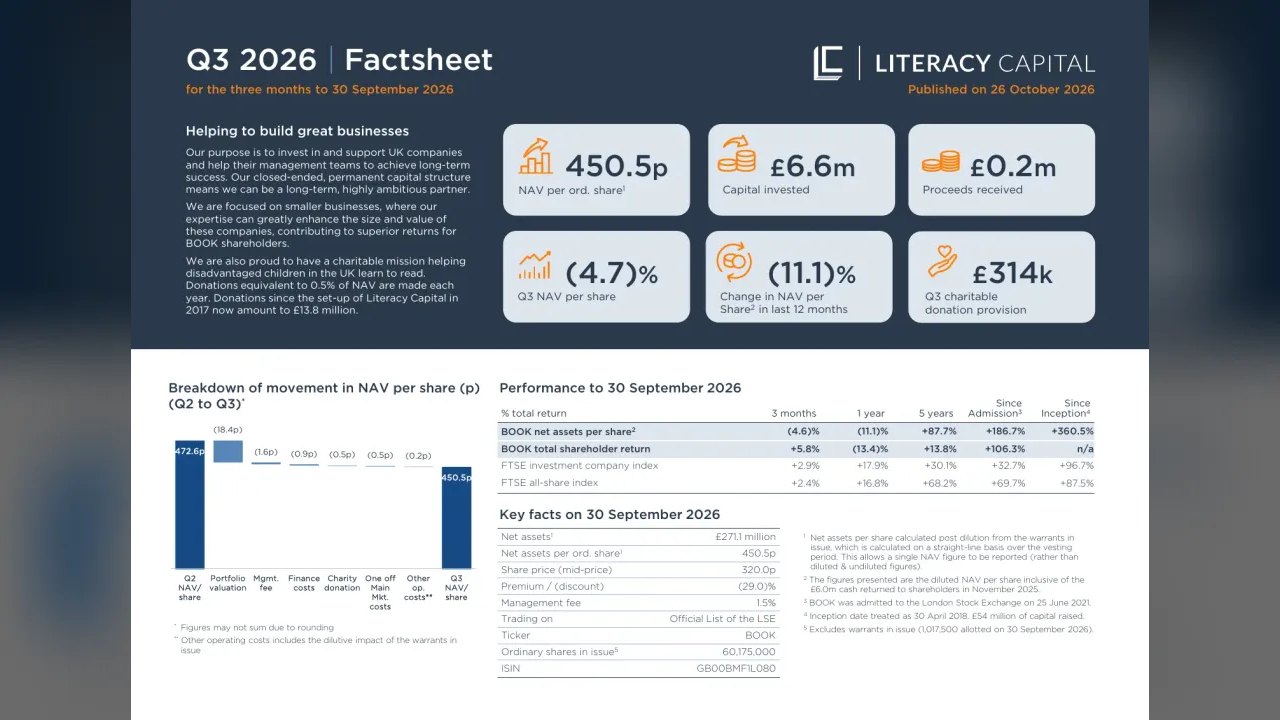
8:18 And we've got other steps that we're also looking to take to increase the attractiveness of the shares, and that includes the capital allocation policy that Richard will talk about. So to to touch on the portfolio and its condition as at the end of q three in the fact sheet that we announced earlier this morning. Many of these companies have been in the portfolio for a reasonably long period of time given we've invested in many of them, particularly some of the larger ones five, six, seven, eight years ago. Some of the key KPIs that we report on a quarterly basis are are presented there along along the top of this page.
9:04 I guess most positively, and it's it's mentioned in the fact sheet, the commentary, the kind of year on year sales and and earnings growth is is the highest it's been for several years.
9:17 And then you can also see the kind of average margins, the the weighted leverage and the weighted multiple that that these top 10 holdings then deliver. We did have a question that was submitted before this presentation started. And I'll I'll I'll answer some of those questions as we go rather than just kind of running through a a litany of questions towards the end. But if there are more questions that people think of, please do feel free to add them, and we'll we'll respond to those at the end. But there is a question about how maintainable EBITDA is determined and whether or not this is higher or lower than actual EBITDA. So I'll try and explain the approach. So I guess maintainable is, I guess, deliberately subjective in that we need to assess each business and work out what we think the business is underlying and maintainable level of earnings is.
10:17 And this can be both higher or lower than than the reported earnings of of any individual company. So to give you an example of where maintainable earnings may be lower than reported earnings, a good example would be q four last year when we wrote down RCI relatively materially. The reason given at the time was RCI had had been told and informed it had, with very little notice, had a contract canceled or terminated that we'd expect it to continue. And as a result, the level of maintainable earnings that we ascribe to RCI at the end of q four was reduced to exclude the level of earnings from this contract because it wasn't going to be maintained going forward. So I guess that's one example where the level of maintainable earnings was lower than the reported earnings by that business.
11:08 And then there might be other instances where the maintainable earnings figure is higher than the businesses has reported. The the most obvious way in which this might be the case is if the business has completed an acquisition and has not owned that acquired business for at least twelve months, and therefore, a full twelve months of earnings from that acquired business will not be included within the consolidated earnings of that group. And so we then obviously need to make an adjustment to ensure we're reflecting twelve months worth of earnings from that acquired business and reflect that within the valuation of of the portfolio company at the at the measurement date. So I guess that hopefully helps to explain how the the figure is is derived at.
11:54 And you can see there in in the last few quarters, think the last three quarters, it's it's different between nine point two and nine point one times EBITDA. So it's it's remained relatively consistent.
12:10 If we move on to the the next page, I guess, you know, as alluded to in the q two fact sheet, we went into q three reasonably optimistic. A lot of hard work had gone into improving performance, which is then reflected in the higher revenue and earnings growth as reported in q three. But unfortunately, and regrettably, the announcement earlier this month where we said we would provide in full for the value of the investment in QBO. And then a fortnight later, we disclosed that we had disposed of that stake. Obviously, has made quite a significant dent and reduced NAV in q three to the extent that the overall performance was down 4.7%.
12:59 Without this and sort of Cuba, all things being equal, which unfortunately obviously isn't the case, the the NAV increase in q three would have been positive to the extent of 3.2% after all costs and after all expenses.
13:14 And then a couple of businesses kind of mentioned in the fact sheet and on this page where they've continued to perform well. One would be Red Sky, which is an investment I'll touch on later, which was our most recent investment in 2025. And then also TechPoint, which has been a sort of a consistently positive performer so far this year. It moved into a new manufacturing facility in August of last year And actually, in September, on the September 30 at the end of the quarter, it also completed its most recent acquisition of Esprit Electronics. There's also... There was a modest write down of Bright Ventures, but this was just related to the way in which the valuation methodology, the mechanics work, and there was just some seasonal movements in working capital that we're expecting to unwind over the next quarter or two.
14:07 But otherwise, apart from obviously the quite significant impairments at Cubo relating to that disposal and the sort of specific issues with that business, the portfolio in q three was in relatively reasonable condition.
14:24 As Paul alluded to, and there's a couple of questions on this, so I'll spend a bit of time on this page. We did, this this morning, announce a formal capital allocation policy. And I guess I just would like to summarize the, I guess, the key points that are contained within that. So I guess the the overriding objective for the trust remains the same. So we want to grow net asset per share, and we want to generate a strongly positive we want to generate strongly positive returns for shareholders as well both over the long term. A key overriding factor or consideration quite obviously is ensuring that the trust has sufficient cash to meet its needs.
15:12 So that is the overriding concern, obviously, to making sure that there's sufficient cash and liquidity available for for BOOK to meet its day to day needs. Linked to this is ensuring that there's sufficient capital and liquidity available to support the existing portfolio companies. So in the vast majority of of instances, we're the sort of sole external shareholder to the businesses. And so more often than not, the the requirement for capital is... And and the most meaningful requirements are relating some some big strategic capital investment or it might be some acquisitions that the business might want to do. So we've obviously got the discretion as to whether we want to embark on those initiatives that require capital.
16:07 And we're obviously focused on making sure that the initiatives or the uses of that capital are going to generate the the the most strongly positive return to shareholders on... That that that can possibly be achieved. There's been sort of a focus in recent fact sheets that we've mentioned where... And I guess as time goes on, the more you learn, just to focus our time and effort on the portfolio companies that can generate the the most strongly positive return that we can. And so we've sold several businesses in the past twelve months, and I would say the two the two businesses we sold in January were businesses that we had owned for for a reasonable period of time, and they were considered to have less upside potential than than other businesses.
17:03 And so I guess we're continuing to make that appraisal of... You know, we're a relatively narrow team, and the number of assets we have, the team size we have, it's it's a relatively large number. And actually, we think we can deliver outsized returns by devoting more time, more effort on certain businesses. And this is something we saw with the experience with Velocity in the last couple of years, and then we're able to deliver a really successful exit in July 2025. That business had, for for a long time been outside of our top 10 holdings. It was valued at probably one and a half times multiple of money as and when we made some changes to management.
17:49 And the team there within eleven months or within twelve months of the CEO, the new CEO joining delivered a nearly 15 times money return. And so I think, again, you know, one of... Sort of you have to learn from from experience, and we want to make sure that we devote all of the time and all of the effort we can to maximize the potential that sits within the portfolio. So I guess linked to that, we we want to reduce the number of holdings down to make sure that we do have the time and the capital to focus on the... Where the potential is greatest. And as a result of that, we want to have a a smaller number of holdings and also ensure that we have flexibility in the balance sheet to return further capital to shareholders and how we might want to do that.
18:38 So, again, in the capital allocate... Capital allocation policy announced this morning, we have said that opportunistic share buybacks are on the cards. There's a question earlier around buybacks. The board and the policy has stated that the current discount is considered to be excessive. And so if we have comfort around the liquidity position and the cash position of the trust, then we can use some cash from the trust to buy back shares, mindful of the kind of overriding priority that I mentioned before. But then also as and when we have disposals of of larger assets and without wanting to use debt facilities to fund these returns of capital, there are multiple other sort of larger forms of of cash returns we could do. So larger share buybacks, tender offers, or, again, another usage of the BSHARE scheme.
19:39 There was also a question presubmitted around new investments. I'll I'll touch I'll touch on that on a sort of later slide. So, again, in in recent fact sheets and, I guess, commentary we've provided to the market, we have consistently said that bolt on m and a will be a focus and a priority. And, again, sort of the learnings and the experience we've had is that this has been a really good use of capital. And so all of the top four holdings that LITERACY has by kind of value of stake, you could see them listed on that slide in front, RCI, TechPoint, Velocity, and Red Sky, all of those have completed m and a within the last six months.
20:28 And in RCI's case, including the platform acquisition that we completed in September 2018, we're now up to 11 acquisitions. TechPoint is up to six. Velocity is at five, and Red Sky is on three. So we can see that the the businesses where it makes sense for them to do bolt on m and a, it often can make sense for them to do it multiple times just because of the compounding effects of the the uplifts that we can then experience. And this slide also mentions the amount of capital that we provided, which is relatively modest, but then the incremental earnings that we've been able to acquire with these platform businesses. So we've spent £8,750,000 of of shareholder funding, and that's bought us over £15,000,000 of incremental earnings from those bolt ons, those those five bolt ons listed that we've completed in the last six months.
21:24 And I guess the other thing that's important that's linked to that is it builds the scale of these businesses. And scale... There's a there's a positive correlation between scale of businesses and ease and size of exit that we're able to achieve. Larger businesses, there's... There tends to be more institutional and more private equity and trade interest. And the other thing, the businesses that do complete bolt on m and a are able to position themselves as buy and build platforms, which again, for private equity investors is often highly attractive and makes them more inclined to pay higher prices for these types of investments. And I'm pleased to say, I mean, it's it's early days on on some of them, but all of these these businesses have gone off to good... To very good starts. And so, again, they they all at the moment look like they all look like good investments.
22:23 There has... There's been a couple of questions around the sort of number of new deals that we've done recently, and I'll just touch on the two most recent investments that we have completed, Trinitates and Red Sky. Both of these were completed in 2025. They were both considered to have similar in many ways, but also slightly different characteristics in that they were in very different sectors. One is a software business and services business working with businesses that trade energy. So working with financial services firms and working with energy producers and sort of businesses related to to that sort of activity. And then Red Sky, the initial businesses were primarily sausage manufacturing businesses, but also most recently the acquisition they completed at McKeon Fine Foods in Northern Ireland predominantly produces foods involving poultry, chicken and turkey, and and products primarily consisting of of of that meat.
23:26 The the similarities with those two investments are that in each case, the founders... They both had two founders. The original business for Red Sky was called Langfords. Langfords and Trinidad and had two fifty fifty shareholders. In each case, retirement and a wish to retire was the driver for the sale. In both cases, the businesses had pretty repeatable revenue, were pretty stable in terms of their financial performance. The return on capital was attractive. The cash flow that the two businesses produced were very attractive. And it... And in both cases, we had a plan either immediately or in the short term to add experienced relevant people into those businesses to to give those businesses the the bandwidth and the caliber of team that those businesses needed to to take them sort of into the future as as positively as possible.
24:36 And so, I guess, without going into too much detail, I guess if we look at the the performance of those two businesses and the discipline we had around capital allocation, I think it's highly unlikely that Trinitatum will look to do m and a given the nature of what it does and given the niche offer... Offering of its software products. But the organic growth in that business has been has been very, very good. And there was a megabyte article actually published, I think, over the weekend where there's, again, some some metrics were mentioned where... I mean, when we initially invested in that business eighteen months ago, it had two customers. It had 12 employees.
25:23 As of today, it's got about 15 customers. It's got 50 employees. The strength of the cash generation is extremely good. So it's it's generated very strong cash flows since we've invested in it. And the team that is now managing that business since one of the two founders has retired, the second founder wants and will stay with the business. But we brought in a new CEO, a new CFO, a new CMO. We brought in multiple hires into The US for the first time because we feel there's a large sales opportunity over in North America. That that business has has traded strongly, and we think, again, next year ought to be a very good period of of trading for the business based on contract wins that they've had this year.
26:13 Thus far this year, ARR growth has been in excess of 200%. So again, the the strength of the revenue growth has been has been very, very good. And we've we've shifted the business away from kind of the lower margin activities that the business was more focused on historically on to this kind of provision of software and related services. As a result of the kind of structure of the deal on the way in and the pricing on the way in and also the cash generation and the trading of the business, we actually refinanced out 80% of the capital that we invested to buy our stake in that business within four months of doing the deal. So again, in terms of IRR, in terms of return on capital, we've had the upside from the from the equity uplift in that business, but we've also had around 80% of our capital deployed into that business back, which obviously is is highly attractive.
27:07 The other business, Red Sky, has, as I mentioned, very recently completed its third acquisition. Acquisition. So it completed the original business purchase of Langford's in April. It completed an acquisition of a business called Delanco, a sausage manufacturer in East London in November of last year. And then earlier this month, October 2026, we completed the purchase of McKeon Fine Foods. The... Again, the trading performance of the group has been very solid since since we invested. The cash generation of the business has been fantastic. The management of the business has been extremely strong. It's been very, very tight.
27:53 And that has resulted in a in a very, very strong uplift in less than eighteen months since we invested, whereby we're up to just over seven times our money in terms of return that we've generated from Red Sky. And the momentum there remains remains very strong. So I think, you know, there was a question around the fact that we haven't completed a new investment this year. I think it's reasonable to say, given everything else that we've said, we want to be very, very confident that new investments that we're bringing into the portfolio have the same downside protection, have the same upside. We have the same level of confidence in the management teams that we're often bringing in to these portfolio companies.
28:42 We have made offers in the last twelve months to new platforms. In both cases, we've made proposals. We've been blown out of the water on price where others are prepared to pay more, which is which is fine from our perspective. We want to retain discipline and we want to sort of... We we won't we won't pay more than we're prepared to pay in order to generate the returns that we want to generate. But but, yeah, these these are kind of a bit more detail on the two two investments that we have completed since the beginning of twenty five. Just two final slides for me. The first one is just a summary of realizations that we have achieved since listing in June 2021. Obviously, as I introduced, our objective here is to find great platform investments that we can build at the scale over time and then exit, hopefully, have some prices.
29:35 I should say, again, for completeness that this table does not include the sale that we made of Cubo in somewhat more distressed conditions because I don't wanna mislead you. But of the five businesses where we have been through what I would call formal proper and competitive sale sale process, process. These are the results. So, again, you'll see in terms of money on money that's been achieved, we're at roughly 10 times, 10 times, 15 times, two and a half times, and 5.2 times. So So the model where we have good quality businesses and we're able to scale them has proven to be pretty effective. The other comment that I would make is if you look at the three disposals that have made over the last fifteen months or so, the average premium to carrying value is 39%.
30:21 So we often get asked questions around valuation and how do we value. And I guess the two things that we would say in response to that is, one is that our valuation methodology tends to be about the most conservative of any of the listed private equity funds if you look at the actual multiple of EBITDA that we apply. But secondly, the real proof of the pudding is what do we actually achieve on the sale in terms of valuation relative to the previous carrying value in the game. Metrics in that instance are quite attractive. Again, as Rich will have alluded to in his comments about capital allocation policy, we are very conscious about streamlining the portfolio into into those businesses that we think can add meaningful NAV going forward. And we're also very conscious about generating strong cash inflows for the fund and so on the back of that.
31:10 Again, you won't be surprised to know that across our top 10 investments, there are advisers appointed today on a couple of those where we will be looking over the next twelve to fifteen months to achieve some kind of exit event. And then just finally, by way of summary, I'm not gonna through go this in detail because, hopefully, we've covered much of this. We are looking to build a portfolio of excellent long term investments where we believe we can add value. We have added a lot of value to date in what we've achieved. But, we are acutely conscious that we've not done enough of that over the last two and a half years, and we're gonna work hard to rectify that. We're very, very well aligned with shareholders. So if we do well, then hopefully shareholders will do well. Our fee structure is the most conservative or the most inexpensive across the industry.
32:01 And where we are successful, then hopefully, it also allows us to help a huge number of disadvantaged children across The UK
32:09 in terms of building their futures for them. So that's the conclusion of our presentation, but we are more than happy to help with any of the questions that are coming through, which I can see that Richard is scrolling through as I speak. That's great. Thank you very much for your presentation this afternoon. Ladies and gentlemen, please do continue to submit your questions just by using the q and a tab situated on the right hand corner of your screen. Just while the company take a few moments to review those questions submitted today, I'd like to remind you that recording of this presentation, along with a copy of the slides and the published Q and A, can be accessed via our investor dashboard. As you can see, we have received a number of questions throughout today's presentation. So please ask you to read out the questions and give responses where appropriate to do so, and I'll pick up from you at the end. Thank you, Lily.
32:55 So there... There's a there's a couple of questions that have come in on QBO, perhaps unsurprisingly. So I guess as you can probably imagine, it's slightly tricky for us to be too explicit on what has gone on there given sort of the previous statements that we've made. But obviously, it's... It was a surprise, a disappointment to us. It wasn't the outcome we wanted or expected.
33:24 We are very confident that the issues that affected QBO will not bleed into other portfolio companies and don't affect any other holdings that we have. There are obvious learnings that we'll we'll take from this and and and we'll be, you know, improving on what we do going forward. So I think, again, part of that is, you know, impacting on how we do consciously want to deploy capital and how rigid and how narrow we are being and how disciplined we are being on that. I mean, one or two of the questions, again, quite recently asked for what the lessons are, and I think there are lessons here. So, obviously, when we go into any new investment, we try to be as thorough as we possibly can be. We do do quite a lot of referencing on the people that we're engaging with. I think with the benefit of hindsight, the level of referencing that we did on the people that we're engaging with on Cuba was not thorough enough.
34:26 And I think there's a learning from that. I think if you look at where Rich has talked about where our most successful investments are, generally speaking, I guess the bedrock is having fundamentally really solid businesses that we buy on as attractive terms as possible, but where we have also most professional and most capable management teams. In many instances, even where we've had businesses which have hit headwinds, so for example, if you look at RCI and TechPoint at Grace, which all of those businesses through the period of ownership that we've had, we've had some challenges and we've had headwinds, but we have had the ability and the freedom to make management changes. Think the greatest obstacle that we had at Cubo was we went into a situation where we were backing a founder, and that founder retained control after the investment, and we were a minority investor. It was a mistake from our part
35:21 because we went into it on the basis that there were obvious changes which needed to be made, and either we met resistance or we were unable to make those changes. And so if you look right across the rest of the LITCAP portfolio, in all of the other situations, we have not had a founder led controlling situation or a situation where we haven't had the freedom or the ability to make change wherever we wanted to. Even, for example, if you look at the only other vaguely comparable situation, which was colonel, the colonel today has the founder of the steel and the controlling situation. At the point where we made the investment, he actually wasn't in a controlling situation. We also referenced the guy extensively. And, actually, in that instance, we made... We're still a residual shareholder in colonel, I should add, but we made 10 times our money. But I think the learning from Cuba is...
36:14 And it's one of the reasons why we have been so selective over the last eighteen months where we have got ourselves looking at new opportunities is that all of those ingredients of excellent company, excellent price, and excellent team or our ability to build an excellent team have to be in place and regrettably won't take Cuba, and it was a mistake from us. There's a few... There's a couple of questions around timing of, you know, repayment on the RCF. It's obviously quite difficult to to be too explicit or, you know, on that. But, I mean, you know, we're we're doing whatever we can to sensibly generate cash from the portfolio. So, again, there's a question around, you know, how do we decide what appropriate time frames are for selling assets.
37:11 You know, we'll go back to the the overriding objective, which we think also will improve the discount situation because, you know, while we were performing extremely strongly in twenty one, twenty two, twenty three, We sat for a long time on a premium in DC Trusts where performance is strong. There's there's lots more column inches and headlines that are much, you know, sort of gaining people's attention. It does tend to bring inflows and it does tend to bring demand for the shares, which is what we wrote. The overriding focus is is to generate the best possible return we can. That being said, where there are portfolio companies where we think the the potential returns are just more limited, then obviously that that is where we want to... We would prefer to generate cash.
38:02 It would be silly to to to focus on realizing assets where there's still considerable potential and then hand those businesses over to somebody else that can benefit from that upside. So it's obviously a a balance. And the the nature of the assets we've got, they are illiquid. It's often difficult to generate cash in the immediate term. But but we, you know, we want to do so in a way that's that's best for shareholders and best for long term returns. But there is the stated objective to repay borrowings where they currently are, and we should be in a position to do that certainly in '27. There's a question on do you think The UK is still a good place to do business, and, what what would be, the best environment for us to be in?
38:50 I think the simple answer is yes. We are actually still pretty positive about The UK. I think there is no doubt without seeking to apportion too much blame that damage was unnecessarily done to the economy in the early period of the Labour government. So, again, it's very interesting. If you look at the graph of LITCAP's performance, our share price actually peaked two or three days before the general election, and also our discount was nonexistent a few days before the general election. And we had the unfortunate instance really of two budgets in a row. So with the first budget, first of all, it was delayed for a very long period of time until it actually happened. And there was also... It... There was allowed to be an awful lot of speculation and uncertainty was created about what might happen, and that undoubtedly damaged confidence.
39:38 When we did have the budget, we had the relatively criminal decision to increase employers' national insurance, which, to be perfectly honest with you, was a tax on jobs, and it also was inflationary. So that was pretty unhelpful. We then had a second budget where it was not as bad as the first one, but, again, we had a prolonged period of uncertainty, which, is not helpful to the kind of companies we invest in. I guess we should wait and see and see what Wednesday brings, but one of the more encouraging features, I think, in recent times is a lot of the speculation that there had been historically has not been allowed to build up up this this time, time, where there have been big issues which have created uncertainty. So in the two previous budgets, there was a huge amount of uncertainty as to what might happen with capital gains tax, which, as you can imagine, is quite a big point for a lot of the people that we back.
40:27 That uncertainty has been removed reasonably early, which I think is helpful. So to answer your question, all we really want is consistency and stability and also not making decisions around taxation, are damaging to the economy and to growth. And, you know, if I can paint a picture, and I think I think we've illustrated it today with the announcement that we've made this morning, and Richard alluded to it, have had a period where we have been having to battle a fair few headwinds both largely economically. And yet if you look at the data we've released this morning, with our revenue growth across the portfolio of 37% and our EBITDA growth across the portfolio of 32, that's actually the strongest data that we have released for years.
41:12 So it's one of the reasons why we're very frustrated by the situation at Cubo because essentially, that has taken away a lot of what we otherwise think would be upside we could have reported this quarter, but hopefully also upside that we're hoping we'll be reporting going forward. Just having touched on Cuba, again, one of the other questions that came up, and, again, it's a very good question, was not allowing the situation at Cuba to become a distraction to the work that we're doing elsewhere in the portfolio. It's a very astute question because, to be frank, it's why we made the decision that we made to cut off the situation and to agree a deal with the founder and get away from the problem because the situation otherwise was we would be ending up using a disproportionate amount of our time on that one investment when in reality, we've got 17 other investments that fully merit our time and where we think there is very significant upside potential.
42:07 And it's why with gritty teeth, we moved away from the Cuba situation and decided to move on with life and get some closure.
42:16 Yeah. I mean, the only thing I'd add, I think, on is The UK still a good place to invest would be... I think you obviously have to adapt to conditions you see at the time. But, again, it's it's... It it it does help to focus the minds on what types of activities and business models you want to deploy capital into. And I think to be honest with you, every investor, every private equity fund is thinking in a similar way, and they're thinking about what businesses are going to be robust and also particularly for larger funds where they've got more software exposure that they're probably feeling a bit more nervous about than they were a couple of years ago.
43:04 It's not just disruption from a kind of political sense, but also a kind of technological sense as well given the sort of advancements with AI in the in the past sort of twelve to
43:14 twenty four months or so. But there's also some questions that people have asked around what's the percentage of the portfolio where we're the majority shareholder or how many holdings we have a majority stake in. So I guess if I if I go back to the page that shows our top 10 holdings, in seven of those top 10, we are the majority shareholder. And then and then in the remaining three, so that would be Velocity, Red Sky, and Hanmir. We are effectively an investor alongside a co investor where collectively we own a majority of the business.
44:02 So again, unlike Cuba where we were a single minority holder, in velocity, we were the majority shareholder until we brought on board a new private equity partner, and they've got all the controls and all the protections that you'd expect to... Albeit they are also a minority investor, a slightly larger minority investor than us. But effectively, the the deal is structured as a majority p investment. So it has all of the protections. It has, you know, been through all the DD, etcetera. And the team there is is very, very sensible. Red Sky is effectively a joint venture between us and another investor. And the kind of... The main principle there is the exec chairman of Red Sky. So again, it has the same protections we'd expect. It's got the same setup that we would expect, and he invested alongside us as an as an incoming investor.
44:51 And then the other one at the bottom of that list is Hanmi, which is obviously a much smaller investment. But again, it's not... It's... It was it was our first ever investment. It's actually managed by a third party. We are the single largest shareholder. But again, there isn't there isn't a founder there or anything where they're they're a sort of outsized shareholder.
45:16 So questions around, like, rise in interest rates and the impacts on invest... Investee sort of portfolio companies. I guess it hasn't had a... Rising interest rates have not had a major impact on the portfolio because the the level of leverage even at three times is relatively modest compared to sort of typical private equity firms. I mean, the the one obvious impact it has had is interest costs are a bit higher, so less cash generated by the portfolio companies is free cash or available cash for either of them to reinvest or to redistribute back to LITERACY. So inevitably, it does have a bit of a drag on returns. But it it hasn't necessarily massively changed the behavior in terms of, you know, decision making around balance sheet.
46:07 There is now more fixed rate debt within the portfolio companies that we've had in the past. I wouldn't say that's necessarily deliberate or or an intention on our part, but it is a fact. And it does also mean that if there are future rises, then the portfolio companies that have got fixed rate debt are immune to that for the foreseeable. And the term on that debt is several years from now, so it's unlikely to need refinancing. So, yeah, it hasn't... Higher interest rates versus a few years ago hasn't had a sort of direct impact, I would say, on the balance sheets or the way we've managed businesses. But there was also a question around the exit environment. Obviously, higher interest rates now versus a few years ago, these additional interest costs do factor into what buyers are able to pay for portfolio companies.
47:03 And it does factor into their decisions around capital structures and leverage. So it it will inevitably have an impact on on on appetites and expectations around what buyers can pay. I guess that being said, the exit environment isn't isn't terrible. It's still very possible to sell well presented businesses, growing businesses, which again is partly why we've been doing what we've been doing around more bolt on activity, more scale, focusing on making sure the teams are as strong and as complete as they can be because all of that makes it much easier for private equity acquirers or trade acquirers to get comfort that, you know, one of our businesses is is the business that they want to take to investment committee and get through investment committee.
47:59 So, yeah, I I would say, you know, despite challenges, you know, we do and we do expect to get inbound interest in in the holdings that we've got.
48:18 Just seeing if there's anything else that we haven't touched on. There's a question about Antler. And it's it's it's a been bit tricky kind of given sort of current timing, but, I mean, more should become apparent. But there there there will be some changes being made to Antler and the kind of the the team and the way in which that that business is managed and run and what its focus is. But I'm I'm hopeful we might be able to say a bit more potentially in in the next quarter update. I think that's...
49:08 It's a question on investment committee and structure of that. So I guess the approach the approach for both both new investments and for bolt on investments is fairly similar.
49:27 So every... Everyone in the team at at LITTLE at LITTLE CAPITAL PLC a responsibility to to generate ideas. The the slight difference between new investments and and bolt ons is I'm just gonna flip back to to to this page. Most most bolt on acquisitions of the ideas are probably generated internally. And by internally, I mean, in collaboration between the LITERACY team members that work with a specific portfolio company and that portfolio company themselves. And so RCI, for instance, has a commercial director where and a is their responsibility. The CEO is also involved in all m and a kind of conversations.
50:14 The chair as well is involved in m and a conversations. TechPoint has one of the founders or the the original founder of the original deal we did. He is also responsible for m and a, Dan. Red Sky is slightly different, but again, it's it's a joint effort between LITERACY and the exec chat that I mentioned before. And in that instance, we've actually reached out, and we've we've got probably a list of maybe several dozen, maybe maybe close to a 100 or so businesses that we've discussed and appraised, and then we've reached out to maybe 30 or so. And that was how we have completed the the two deals we've completed in the last twelve months where it was effectively a cold approach from the exec chair to the owner of of the business.
51:04 And we agreed a deal with the owner, with the shareholder without there being advisers involved and got that deal through to completion relatively swiftly. The the the approach in terms of them whether or not that's something we want to do on a fortnightly basis, all potential investments are sent to the whole board. The board has visibility over anything that the that the capital may be deployed or spent on. And then, I mean, another good example is probably the time frames that are in... Are contained on on this on this slide relating to the two new investments that we completed in 2025, where effectively exclusivity starts with the signing of heads of terms.
51:57 Prior to agreeing heads of terms, All of the terms are discussed internally within the investment team and also those terms and the deal structure is shared with the board. And then there's there's a prolonged period of due diligence that takes place where kind of everything is is looked at in terms of the financials, the legals. And then as part of that, a lot of conversation goes into what does the ideal team structure look like. Often, invariably, there are gaps whether or not who wants to stay, who wants to leave, that open conversation is had. And you can see from those time frames, I guess, the the level of kind of time and the amount of, I guess, care that goes into that to make sure that we're not missing anything, to make sure we're not rushing anything.
52:45 So there is quite a prolonged phase of getting to know, you know, shareholders, members of management, what motivates them, what's going to be a potential issue. And so there is... There's a prolonged period of... And then any issues, any any findings are then reported back. But, again, the the team we have is is relatively small. It's... We all sit in the same room. Anything is discussed on an ad hoc basis. So it's... That's that's the way in which the sort of investment process works for sort of new things.
53:26 Yeah. There's a question around my comment before that. Being blown up. We've been... We... Yeah. Bids... Other bids have been significantly higher than what we'd be prepared to pay for assets.
53:41 The two... I'd say there's I'd say there's a couple of factors behind that. I would say the two businesses, in particularly the most recent one, it was it was a larger business in terms of level of profitability and enterprise value than than we would normally look at. And I guess what we have seen is that many private equity investors are behind on their rates of deployment. What does that mean is they struggle to invest in new businesses. And as a result, they're feeling pressure from their investors to spend the money that they've been given or money they've had committed to them.
54:26 And so we have seen at the top end of our range some investors that we should not be competing with and wouldn't ordinarily compete with dipping down into smaller businesses because they quite like the business. But it's probably a bit small for them, but they will back themselves to find other businesses to bolt on, and that would be their way of deploying the amount of money that they would want to to spend on a specific asset because they still... For, you know, size and portfolio construction reasons, they don't probably want to have more than 10 or 12 holdings. But they're having to start a bit smaller than they ordinarily would, and those bigger funds do tend to pay more. They're used to paying more. They're used to paying up for for businesses that go through competitive auctions that that are better run than the types of processes that we would normally look at.
55:18 So, yeah, I think there's definitely been an element of of that. There's been an element of us looking at some slightly more well established businesses than we might have done a few years back. And I think also in in those two instances, whilst we did get sort of outbid by private equity, it was actually interesting in both cases, we ended up being majorly outbid by trade buyers. And so I I wouldn't read too much into that, but there are some trade buyers out there that just think that specific platforms have strategically much more value to them than than would have to us on a stand alone basis. So, yes, in part, I think we can read something into it, in part potentially not. But, yeah, mean, I there's there's certainly still good levels of volumes of of deals completing, we're not expecting that to change. There's still lots of of capital that private equity managers have that needs to be deployed, and they have, you know, the reasons alluded to before where they've been a bit reluctant to spend on certain things.
56:25 But but, yeah, that that there shouldn't be difficulties in selling some of our assets as and when we we want to or when we need to. Lucy, I'm conscious that I think our questions are coming to a halt. So I don't know what you feel or whether this is an opportune time to conclude. Yeah. Of course. Thank you for answering those questions you can from investors. And, course, the company can review all questions submitted and we'll publish those responses on the investor meet company platform. But just before redirecting investors to provide with their feedback, which is particularly important to yourself and the company, Paul, could I please ask you for some closing comments? Yeah. Of course. I mean, hopefully,
57:03 investors feel that they've had good transparency of where we are today. Obviously, we have major to a degree on the situation at Cubo, which we try to answer as honestly as we can, and it has been a mistake on our part, and it's a learning on our part. But I guess aside from that, we would like to leave investors with a view that says we're actually pretty positive about the future. The vast majority of our portfolio is trading pretty positively. If you look at the metrics around revenue growth and profit growth, they're as healthy as they've been for a long time. We're very conscious that the best way of us eliminating the discount aside from our capital allocation policy is by delivering and generating strong NAV growth. Richard and I have got about 23,000,000 good reasons between us as to why we want to do that, but we also want to deliver it for everybody else who's a shareholder as well. And we're quite confident that over the next twelve months, we will do that.
58:00 That's great. Thank you for updating investors today. So please ask investors not to close this session as you'll now be automatically redirected to provide your feedback in order that the management team can better understand your views and expectations. This may only take a few moments to complete, and I'm sure be greatly valued by the company. On behalf of the management team, we'd like to thank you for attending today's presentation, and good afternoon to you all.
Follow Literacy Capital PLC into a list and get an email when it puts out news.
Chairman at LITERACY CAPITAL PLC
CEO at LITERACY CAPITAL PLC