Xiang Li
Chairman and CEO
Replay available
Li Auto (HKEX:2015) Q2 2026 earnings call, held 2026-08-26. Watch the replay and read the transcript on 6ix.
Automated transcript · Written by software from the replay's audio. It can mishear names and figures; the replay is the record.
0:00 Hello, ladies and gentlemen. Thank you for standing by for Li Auto's Second Quarter twenty twenty six Earnings Conference Call. At this time, all participants are in listen only mode. Today's conference call is being recorded. I will now turn the call over to your host, Ms. Janet Zhang, Investor Relations Director of Li Auto. Please go ahead, Janet.
0:22 Thank you, operator. Good evening, and good morning, everyone. Welcome to Li Auto's second quarter twenty twenty six earnings conference call. The company's financial and operating results were published in a press release earlier today and were posted on the company's IR website. On today's call, we will have our Chairman and CEO, Mr. Xiang Li and our CFO, Mr. Johnny Tier Li, to begin with prepared remarks. Our President, Mr. Zhong Hui Ma and our CPO, Mr. Yan Hie, will join for the Q and A discussion. Before we continue, please be reminded that today's discussion will contain forward looking statements made under the Safe Harbor provisions of The U. S. Private Securities Litigation Reform Act of 1995. Forward looking statements involve inherent risks and uncertainties.
1:10 As such, the company's actual results may be materially different from the views expressed today. Further information regarding risks and uncertainties is included in certain company filings with the SEC and the Stock Exchange of Hong Kong Limited. The company does not assume any obligation to update any forward looking statements except as required under applicable law. Please also note that Li Auto's earnings press release and this conference call include discussions of unaudited GAAP financial information as well as unaudited non GAAP financial measures. Please refer to Li Auto's disclosure documents on the IR section of our website, which contains a reconciliation of the unaudited non GAAP measures to comparable GAAP measures.
1:59 Our CEO will start his remarks in Chinese. There will be English translation after he finishes all his remarks. With that, I will now turn the call over to our CEO, Mr. Xiang Li. Please go ahead.
7:00 Hi, everyone. This is Li Xiang, and thank you for joining our earnings conference call today. In the first half of this year, in the midst of intense market competition and a complete product refresh, Li Auto has remained the top selling Chinese automotive brand in the RMB 200,000 and above NEV market. The continued rollout of our dual energy strategy has resulted in a healthy product mix with eREFs and BEPFs each accounting for 50% of total sales. Since Q2, we have updated the entire Li L Series showcasing our latest technologies. Key updates include our in house Mach 100, M100 chip running Mach VLA model, 800 volt active suspension and drive by wire chassis and our third generation range extender with 5C supercharging battery.
7:53 The hardware and software upgrades set new standards for the technology and user experience once again. Turning over to our fab lineup, the Li I6 has been one of our top three selling models priced over RMB200000 for six consecutive months. Li I6 and the L6 are the top sellers in their respective segments, further solidifying our leadership in the RMB200000 to RMB300000 SUV market. Upgrades to our BEV lineup is also underway. In late July, we launched the rear wheel drive long range version of the i8. Based on user feedback, we added features such as power frunk and zero gravity driver and passenger seats.
8:41 These updates bolstered our product competitiveness and translated to a notable sales uplift. The new generation Li Mega is scheduled for launch on September 2. We further polished its pioneering design and completely revamped the interior, the cabin experience, intelligent platform and ride quality. Additionally, the all new flagship fab SUV Li I9 will also be launched in mid September, further enriching Li Auto's fab product lineup. We anticipate that model to account for an even larger share of total sales over time. With new models launching and ramping up in the second half of this year, we're confident in maintaining a top three position among all brands in China's passenger vehicle market priced above RMB200000.
9:36 By developing core technologies in house, we're continuously deepening our competitive moat, steadily translating these technological advancements into tangible user value and commercial efficiency. FIC supercharging has become a prerequisite in user purchase decisions and a proprietary supercharging network stand as one of our key competitive advantages. On batteries, we're able to develop cell, BMS and PAC fully in house, completing the final piece of the electric powertrain puzzle following electric motors and control units.
10:12 Through integrated design with the overall vehicle system, combined with the technology and experience we have accumulated in 5C supercharging, we're confident that Li Auto's in house battery will deliver industry leading performance.
11:07 Pardon me, this is the operator. Please hold and the conference will recommence shortly. The conference is reconnected. Please go ahead. Apologies for the breakup. To continue with the CEO's remarks. Through integrated design with the overall vehicle system, combined with the technology and experience we have accumulated in 5C supercharging, we're confident that Li Auto's in house battery will deliver industry leading performance in quality, safety and service life.
12:08 Our in house batteries are already deployed on our all new Li L8, the new Li L6 and the Li I8. Within the next few months, all of our models will be equipped with our proprietary batteries. We firmly believe that batteries and chips are going to be the most critical technological barriers in the embodied AI industry. In May, we started shipping our full stack ADAS solution based on the Mach M100 chip. Today, shipments of the Mach M100 chips have exceeded 50,000 units, maintaining excellent quality track record. Beyond chips, we're also making R and D breakthroughs across models, controllers and software.
12:54 These achievements have steadily translated into product experience. In late July, with OTA 9.1, overall Mach VLA performance improved by 20% and user mileage penetration nearly doubled compared to the previous generation computing platform. In September, we will also roll out Mach VLE to cars with Nvidia, Thor and Oranex chips. Building on the data we have accumulated, we will accelerate model training and iterations to fully leverage the compute advantage on our chips. The July OTA 9.1 update allows VLA to match and surpass human drivers in reaction stage. The October OTA 9.2 update will enable VLA to fully adopt three d vision transformer, providing long range and better precision.
13:49 And the year end OTA 9.3 update will see VLA model parameters scale exponentially, significantly enhancing task comprehension and reasoning capabilities in complex scenarios. Faster reactions, sharper vision and stronger reasoning are the three most crucial upgrades for the Mach M100 and Mach VLA this year.
14:13 Going forward, building embodied AI vehicles will remain at the core of our strategy. Through full stack in house development across hardware and software with continuous iteration, our vision is that vehicles will become true intelligent agents that can not only look after human beings, but also complete tasks independently more efficiently than human beings. With that, I'll turn the call over to our CFO, Johnny, to walk you through our financial performance.
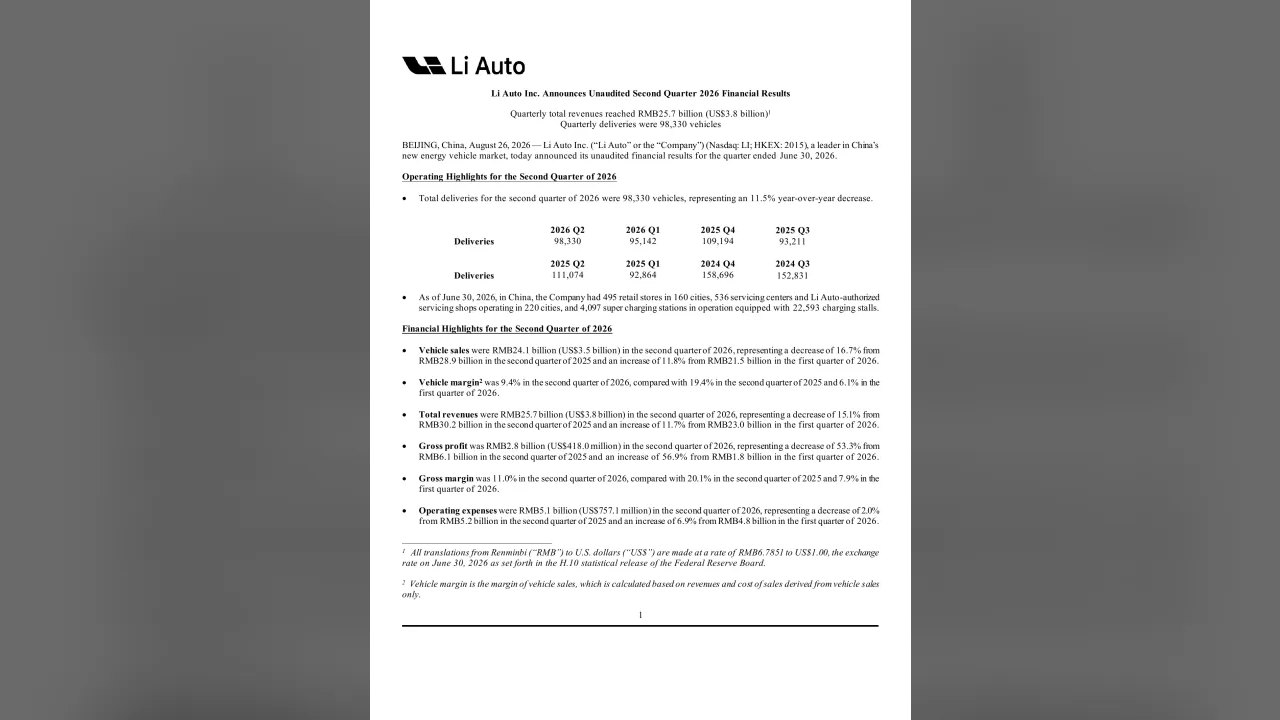
14:46 Thank you, Li. Hello, everyone. Given time constraints, my remarks today will be limited to our second quarter financial highlights. All figures will be quoted in RMB, unless otherwise stated. For further details, including the corresponding U. S. Dollar amount, we encourage you to refer to our earnings press release. Total revenues in the second quarter were RMB 25,700,000,000, down 15.1% year over year and up 11.7% quarter over quarter. This included $4,100,000,000 from vehicle sales, down 15.7% year over year and up 11.8% quarter over quarter.
15:39 The year over year decrease was mainly driven by reduced vehicle deliveries and a lower average selling price due to different product mix. The sequential increase was mainly attributable to a higher average selling price due to different product mix and increased vehicle deliveries.
16:02 Cost of sales in the second quarter was RMB22.8 billion, down 5.6% year over year and up 7.8% quarter over quarter. Gross profit in the second quarter was RMB2.8 billion, down 53.3% year over year and up 56.9% quarter over quarter. Vehicle margin in the second quarter was 9.4% versus 19.4% in the same period last year and 6.1% in the prior quarter. The year over year and sequential changes were mainly due to different product mix.
16:50 Gross margin in the second quarter was 11% versus 20.1% in the same period last year and 7.9% in the prior quarter. Operating expenses in the second quarter was RMB 5,100,000,000, down 2% year over year and up 6.9% quarter over quarter.
17:19 R and D expenses in the second quarter were 2,800,000,000, down 1.2% year over year and up 2% quarter over quarter. SG and A expenses in the second quarter were billion, down 16.2% year over year, mainly on lower employee compensation and up 11.2% quarter over quarter, mainly on higher marketing and promotion spending. Loss from operations in the second quarter was RMB2.3 billion versus million income from operations in the same period last year and RMB3 billion loss from operations in the prior quarter.
18:10 Operating margin in the second quarter was negative 9% versus 2.7% in the same period last year and negative 13% in the prior quarter. Net loss in the second quarter was RMB1.7 billion
18:29 versus RMB1.1 billion net income in the same period last year and RMB2.3 billion net loss in the prior quarter. Diluted net loss per ADS attributable to ordinary shareholders was RMB1.69 in the second quarter versus diluted net earnings of RMB1.03
18:54 in the same period last year and diluted net loss of 2.26 in the prior quarter. And now turning to our cash flow and balance sheet. Net cash provided by operating activities in the second quarter was RMB15 million versus 3,000,000,000 used in the same period last year and 6,100,000,000 used in the prior quarter. Free cash flow was negative RMB 1,300,000,000 in the second quarter versus negative 3,800,000,000 in the same period last year and negative 7,400,000,000 in the prior quarter. Our quarter end cash position remained robust at
19:46 billion. This solid cash position gave us the flexibility to invest in product and technology innovation, while also returning value to our shareholders through share repurchase. To date, we have repurchased a total of 91,700,000 Class A ordinary shares, including 23,700,000 ADS for a total consideration of about
20:21 million dollars And now for our business outlook. For third quarter of twenty twenty six, the company expects to deliver to be between 95,100 vehicles and quarterly total revenue will be between $26,600,000,000 and $28,000,000,000 This business outlook reflects the company's current and preliminary view on its business situation and the market conditions, which is subject to change. That concludes our prepared remarks. I will now turn the call over to the operator to start our Q and A session. Thank you. Thank
21:22 you. If you are a Mandarin speaker, please ask your questions in Chinese first, then follow with English translation. Your first question comes from Tim Hejio with Morgan Stanley.
21:59 I have two questions. The first question is about L Series. With the model year updates for the L lead L Series now completed, Could the management provide an update on its market performance so far since launch? That's my first question.
26:02 This year we have completed the full refresh of the L series from L9, L8, L6 have all transitioned to the latest platform, which includes the Mach M100 chip, 5C range extension and other core technologies. And on LiVeS models, we also carry our latest fully drive by wire chassis. With these, we have completed coverage of the RMB200 range extended SUV market. Since we started delivery, we have seen a few trends. First of all, our high end models have exceeded users and our expectations. Models Since launch, the L9 LiBiT accounts the LiBiT's version of the L9 accounts for over 85% of all sales.
26:53 Many users are willing to pay for this fully drive by wire chassis as well as high end
27:00 ADAS systems as well as other core technologies. This also solidified our leadership in the RMB400000 to RMB500000 of home and family SUV market. And since the launch of the L8, ultra version has been the key sales driver and the conversion ratios in our storefront have been performing very well. Secondly, the new generation L6 has successfully retained the user base from the previous generation with the previous generation laying a very good foundation by delivering almost 400,000 units. And the new generation have addressed key user feedback such as EV range, charging speed,
27:42 key intelligent platforms and also completed the offering with true zero gravity seats in the front row and a 29 inches panoramic screen, which also enhanced user experience. So since launch, we have seen very good reception on ALLO-six and we're hopeful that there will be a
28:05 10,000 unit per month demand level steadily going forward. So this is a poor pillar for our sales in the 200,000 to 300,000 market. In the meantime, we have honestly seen some temporary disruptions caused by the model refresh cycle, including clear old inventory, ramping up new models and sales policy transitions have all created short term operational headwinds. We're currently working very hard to optimize our processes and address these challenges.
28:43 Going forward, we will focus on two things. The first is to further enhance product value through OTAs. The all new L series have a very robust and industry leading hardware as a basis. So moving forward, we'll continue to unlock these hardware capabilities and AI features through OTA updates. Secondly, we will continue to build out our 5C supercharging network, increasing both density and coverage. As of the end of July, we have already 4,141 charging stations in operations and over two hundred and twenty eight thousand two hundred twenty two thousand eight hundred charging stalls.
29:28 We have now a nine by nine grid covering 18 national level highways and covering more than 300 cities. So
29:37 our in house charging network as well as 5C charging capability have become a prerequisite for many of our users in their car purchase decisions. So with the L series refresh completed, it is now it will now complement our I series BEV to jointly drive overall business growth. Currently ERAB and BEV each account for half of our total sales and we expect BEV share to rise further as we launch more BEV models later this year. Thank you.
30:23 My second question is about Omega. Following today's release of the preview video for the new Li Mega, could you share the key highlights of this refresh and to your sales expectation? Thank you. As many of you have noted, we have
32:53 today officially released the first batch of PISA information on our new generation mega. This new generation is really based on user feedback, real user feedback from the previous generation mega and to address the important feedback and product shortcomings of the previous generation. And they mainly fall into three categories. The first is improvements in the chassis and handling experience. Many view MPVs as very large and cumbersome in cities. So the new generation mega will have will be equipped with rear wheel steering, drive by wire system and as well as active anti roll bar, which will greatly reduce the turning radius and reduce body roll in cornering and also make the car more flexible and agile in cities.
33:47 And second is upgrade to the intelligent platform. We improved the entire autonomous driving system with our in house Mach M100 chips. We've also completed the lateral and rare sensors into improved city and LA and handling complex intersections and auto parking. On the cabin side, we've also been upgrading to the latest Qualcomm chips to bring better interactive and entertainment experience. And thirdly, it's improvements in the cabin and details. To further drive the positioning as a family MPV, we've made significant upgrades to the second and third row, including the interior atmosphere interactions to better serve the needs of large families.
34:38 Mega has been clearly positioned as the flagship SUV over RMB500000. So this new generation has really addressed user feedback and have completely revamped the product and improved the product. I'd say the sales performance will depend on many things, including sales conversion, including product ramp up, as well as changes in the market. But we will make sure to
35:08 focus on delivery, store experience, as well as user operations. And we'll keep updating everyone on the sales performance as we launch the product. Thank you. Your
35:27 next question comes from Paul Gong with UBS. So my first question is regarding the impact of commodity cost inflation. How much can you quantify in terms of the impact in Q2 and moving towards Q3? And what would be your strategy to counter for such cost inflation challenge, the margin pressure? Thank you.
39:29 This year, we've seen cyclical fluctuations in upstream raw materials and core components, which has created temporary cost pressures for both the industry and our company, which has been further impacted our gross margin. To look at this in more detail on the AI side because of the developments in the AI sector has driven demand for chips and PCBs pushing prices up. On the memory side, memory chips price have also risen. But with our early volume commitments and long term procurement agreements, the price impact on us is less than the industry average. And on the battery front, lithium carbonate prices also experienced cyclical fluctuations this year.
40:18 And to navigate these cyclical cost fluctuations, we're taking a two pronged approach. On the one hand, we're continuously driving cost reductions through more efficient operations. And on the other hand, we're leveraging our full stack in house technology and proprietary supply chain to build for long term structural cost advantage. So specifically, first on the electric drive train front, we will continue to be committed to owning and driving the R and D and supply chain of the three key electric systems to solidify our dual modes in technology and costs. On the electric drive side, we have achieved in house development and manufacturing of motors, controllers and silicon carbide chip modules, which ensures our control over the critical components.
41:15 By leveraging our integrated architecture, we're continuously optimizing energy consumption and iterating on our technological solutions, which has steadily amortized the hardware cost per vehicle. And in terms of battery system, we developed in tandem and deeply integrated battery packs with the overall vehicle architecture, which allows us to achieve the best possible balance between energy consumption, thermal management, safety and packaging efficiency, which further develops delivers an exceptional user experience while maintaining strict cost control. We have established the in house R and D capabilities in core areas, which include cell pack, thermal management and BMS algorithms.
42:12 We're accelerating the deployment of our proprietary battery systems across a broader range of models, establishing a strong competitive edge in quality, performance and cost. And secondly is in house developed chips. We're building a strong competitive advantage across technology and costs. Again, the proprietary Mach M100 chip is built on an innovative data flow structure, which would integrate a hardware and software customization and delivers a structural advantage in computer performance and also costs. So overall, in the short term, we're trying to smooth out the temporary cost fluctuations and pressures on our business through volume commitments and refined operations.
43:01 And in the medium to long term, we're relying on scale deployment of our in house technologies to stabilize the gross margin and support the company's high quality sustainable growth. Thank you. So if we're considering the raw material costs as well as the commoditized competition, what would be our latest gross margin target? Thank you. As we can observe this year, we have
45:05 seen a very big increase in the cost of batteries and memory chips. This which is a common challenge for everyone in the industry. And because Li Auto's products are more intelligent, which makes them consume more memory and semiconductor, so we're more impacted. And apart from the impact on BOM, we're also experiencing amortization and depreciation on our tooling and production equipment. We've been following more strict rules as well as the treatment to end of production items. As we launch new products this year over time, we already are seeing improvements in gross margin, but we must also face the increase in chip and PCB as well as other semiconductor, the cost increase. We must face this as well. We have made a decision not to pass these price increase over to our customers, but instead we will continue to leverage our integrated design and supply chain such as deepening our in house R and D and deployment of our batteries to make our system more self sufficient.
46:16 And secondly, we will build a better cost control, cost management capabilities. And thirdly, on the sales front, we have through our sales partner program, we have benefited from lower sales costs, better operational mindset and increase in efficiency. So all of these lower prices at low cost will be transformed to actual benefits that our users can receive. In the long term, my view is that the company healthy margin for the company will be somewhere between 15% to 20% gross margin with the main driver here being the raw material costs. Thank you. Thank you very much.
47:04 Your next question comes from Wen Zhu Kua with Citex. So my first question is about I9. What information could you please share about the upcoming Li Auto I9? There are three things about the i9 that
49:51 I would like to share. First of all, product positioning. I9 is designed for large families as a flagship six seater SUV, which continues our core DNA to build products for large families. In terms of product matrix, i9 will complement Omega, one being a flagship SUV, the other being the flagship MTB that will both together satisfy the needs of large families who wants to buy an electric vehicle. As I9 lands, I9 will also be an important addition to our EV flagship, EV product line as well as it will also complement the L Series with our independent rain extended and bad product lines.
50:38 So these all will complete our coverage of the RMB200000 to RMB500000 high end of new energy vehicle market. Second thing I'd like to share is the technological foundation. I9 will be equipped with 800 volt, 5C high voltage charging platform powered by our latest generation in house developed electric motors, which also relies on our overall national five C charging network to provide a very good charging experience for our users. On the intelligence front, i9 will carry the Mach M100 ADAS chip to power not only autonomous driving, but also embodied AI capabilities going forward.
51:26 On the cabin front, we've also carried the latest Qualcomm high performance cabin chip as well to support multitask parallel processing as well as AI intelligent agents. And thirdly, in terms of users, i9 will be focusing on large families, on our large families trying to travel together. So our focus will be on the interior experience, comfort for each family member as well as a spatial interactive experience. So in order to provide a flagship level experience for every member of the family. In terms of release timeline, the Li I9 will be launched in mid September. Unfortunately, due to disclosure regulations, I can't say too much about pricing and specific trim levels. We will be releasing the complete information in the product official launch event. Please stay tuned. Thank you.
52:49 So my second question is about the autonomous driving. So could you please update us on the progress of your co optimization between M100 chip and autonomous driving models? And what are the key milestones and quantitative metrics for autonomous driving algorithm upgrades in the second half of the year? This is Yan. And let me answer your question. Our in house smart M100 chip began mass production with the all new L9 in Q2 and is now deployed across the all new L9, L8 and L6. Currently, chip production capacity is sufficient to meet market demand.
53:35 Our ADAS system powered by our in house Mach M100 chip has been delivered to customers with the new all new Li L9 since May, leveraging the strong capabilities of MAC platform. We expect it to continue making significant improvement to our models. OTA 9.1 began rolling out at the end of July, further reducing end to end latency. We also introduced the two new speed preference mode for our MAC VRA model, efficient and the comfort, improving responsiveness across a broad range of driving scenarios. The upcoming OTA 9.1 will represent a major architectural upgrade.
54:25 And on the model side, we are evolving toward a full three d vision transformer architecture with three times the parameter count and 4.6 times the compute. This upgrade will deliver systematic improvements across key dimensions of ADAS, including safety, comfort, efficiency and navigation. In Q4, our goal is to further enhance perception and decision making capabilities of Mach VRA. Specifically, firstly, longer range perception, The effective perception range will exceed two fifty meters, enabling early speed adjustment and a path planning.
55:13 We expect this to reduce undesirable behavior such as heartbreaking, hesitation and unnecessary lane change by more than 30%. Secondly, higher perception accuracy. Three d spatial perception accuracy for key objects will improve to within five centimeter, increasing success rates in challenging scenarios such as narrow road driving, passing through gates and other tight clearance maneuvers by 50%. Thirdly, a stronger scene understanding rather than simply recognizing individual objects, the system will be able to infer intent based on the broader traffic context.
56:01 In scenarios such as yielding on narrow roads and navigating around the construction zones and making unprotected turns, it will make more decisive yet or proceed decisions, reducing unnecessary standstill and habitations by more than 20%. Additionally, Mach VRA 2.0 for NVIDIA O ring and Thor platforms will launch in early September. The share of driving mileage completed with ADAS engaged is a key metric for us at this stage. On the Mach platform, ADAS mileage penetration in urban scenarios has nearly doubled from previous levels.
56:51 As deliveries of Mach powered vehicles continue to ramp up, our all scenarios NPI has increased by 25% in recent months. Thank you. Your next question comes from Jing Cheng with CICC. So my only question is about the cash flow.
57:45 We see the operating cash flow nearly turned positive in the second quarter, but free cash flow remain negative. And also, we see some cash position to decline. So, can you share your outlook on the second half, whether our free cash flow will turn positive and our over it will be off the cash position. Thank you, Tony. This is Johnny, I will take this question from the third quarter with the delivery of our new models, we expected to maintain a stable operating cash flow on a quarterly basis. At present, we have ample cash on hand, which provides strong support for our product innovation, technology breakthroughs and global expansion.
58:37 This year, we remain committed to R and D investments and CapEx, including our supercharging network. We expect our full year CapEx to be around billion. For the full year, achieving positive operating cash flow and free cash flow will largely depend on our fourth quarter deliveries. One thing is certain that our overall cash flow performance this year will be stronger than last year. Thank you. Thank you. So my following question is about the intelligent driving.
59:38 What the key contributions do you think is our self developed chips and also software and hardware integrated integration can deliver to advancing our intelligent driving capabilities? Thank you. This is Yan, let me answer this question. The rapid progress we have made in intelligent driving, both in terms of performance and speed of delivery is driven by the close integration of our in house chip and full stack system capabilities. Firstly, we have streamlined our organizational structure, so that the chip and the model teams can work more much more closely together, jointly designing model architectures that can fully leverage the computing capabilities of Mach M100.
1:00:33 From a hardware interface perspective, Mach M100 gives our model algorithm and operating system significant design flexibility, allowing the chip algorithm and the system software to be optimized together for the best overall performance. And secondly, optimization of data and training with our in house chip as the foundation, we are able to explore and optimize the training process at much deeper level. In particular, our reinforcement learning approach built around the platform has significantly enhanced the model capabilities within our world model framework. In addition, the data management and a shadow data system built on the MAG platform enabled faster model iteration and improvement.
1:01:29 Thirdly, system level optimization through our in house HALO OS. HALO OS enables deep integration between up layer applications and the underlying chip, improving both resource utilization and overall system performance. At the system level, this also helps improving engineering quality and accelerates development cycles. Together, the chip model and OS form a tightly integrated full stack architecture, creating a complete technology loop for our intelligence driving system. The value of our in house chip is now extending beyond intelligent driving into embodied intelligence, Our vehicle equipped with dual M100 chips, we are able to run a full multi model, fully multi model, foundation model entirely on device, supporting inputs across voice, language and video.
1:02:35 The model is capable of general purpose problem understanding, environmental understanding and a task planning. And this means the vehicle is no longer limited to executing predefined functions. It can increasingly understand the user intention and the physical world, then plan and execute task toward a given object. We believe this will significantly expand the capability boundary of the vehicle as an embodied intelligent agent, and it represents an important new direction enabled by our integrated hardware software architecture. Thank you. Your next question comes from Ming Sun Li with BofA.
1:03:52 So my first question, could you update your overseas markets development strategy and also the progress? And the second question is to develop your embodied humanoid robot product, will you continue to invest high R and D amid the current competition background? Yes. Thank you. Overseas expansion has been our long term strategy,
1:06:33 and we have made some steady progress in market expansion and product deployment. Overall, the progress has been on track and within our expectations. In terms of regional strategy for Middle East and Central Asia, we will be focusing on our L series range extended models as the key offering. In July, we have launched the all new Li L9 in Kazakhstan and Uzbekistan. In September, we're planning to launch in Dubai and to kick off our sales in the Middle Eastern market. In the meantime, we have already formed a strategic partnership with Allure, a leading local car group in Kazakhstan to drive our the local assembly of our vehicles.
1:07:25 By pushing forward the local adaptation and the local assembly of our current models, we're steadily building out a complete global presence across R and D products, manufacturing, sales and service. In Europe, we will be prioritizing that model. So the i6 will be launching at the October Paris Motor Show and officially start selling in the European market in Q4. For right hand drive markets, in addition to launching Li Mega in Hong Kong SAR and Singapore by the end of this year, we'll also be rolling out the right hand drive version of the i6 to complete our model lineup in the right hand drive markets.
1:08:11 With all that being said, expanding oversea comes with its own set of challenges, particularly uncertainties around the geopolitical environment and market regulations. We aim to position Li Auto as a premium brand in overseas markets as well, and we will carefully manage our pace, tailoring our approach to our strengths and the unique dynamics of each market. And at the same time, ensure the products are compliant, build after sales service networks and continue to build our brand. Thank you. Next, I'll answer the question on R and
1:10:39 D. If you look at the history of Li Auto, the first ten years is really our startup phase. And going forward, the next stage is going to be continued investment in R and D to build our competitive barrier. And among all of this, developing chips in house is a core strategy, long term strategy that we have established from a very long time ago. And we will remain committed to keep investing and to improve and iterate on our in house chips over time. So if we look at chips as a core competitive advantage, AI is going to be the model is going to be the competitiveness. Other than chips or AI, we have also been investing in the core components of the electric powertrain.
1:11:27 Taking batteries as an example, we have in house developed our sales pack, BMS and even including thermal management system, this entire offering, including its pairing and adaptation to our actual vehicle products. With an integrated R and D approach, we have accumulated a ton of experience around 5C charging and technologies. So which makes us confident in terms of our in house batteries quality, safety and life expectancy. So starting from the second half of this year, we will be rolling out Li Auto branded batteries across all of our vehicles. And I need to emphasize by choosing to develop these components in house doesn't mean that our suppliers' products aren't great.
1:12:19 We develop our in house Mach 100 chips. That doesn't make NVIDIA any less respectable as the best chip company in the world. As we develop our in house batteries, that doesn't make CATL any less respectable as the best battery companies, well, CATL as well as many other brands, which all great battery brands. That doesn't make them any less respectable. We believe that in the era of embodied AI, chips and batteries are going to be the most important competitive advantage. And electric powertrain and great products will be the key to our competitiveness, our product competitiveness. So choosing to develop these technologies in house only shows that we want to be like companies like Apple and Huawei to really hold the key components of our competitiveness in our own hands. Thank you.
1:13:23 As we are reaching the end of our conference call now, I'd like to turn the call back over to the company for closing remarks. Ms. Janet Zhang, please go ahead. Thank you once again for joining us today. If you have further questions, please feel free to contact Li Auto's Investor Relations team. This concludes this conference call. You may now disconnect your lines.
Follow Li Auto, Inc. into a list and get an email when it puts out news.
Chairman and CEO
Investor Relations Director
CFO
President
CTO
Analyst, Morgan Stanley
Analyst, UBS
Analyst, CICC
Analyst, Bank of America