Deepak Bhair
Managing Director at Laxmi India Finance Limited
Replay available
Laxmi India Finance (NSE:LAXMIINDIA) Q2 2027 earnings call, held 2026-11-13. Watch the replay and read the transcript on 6ix.
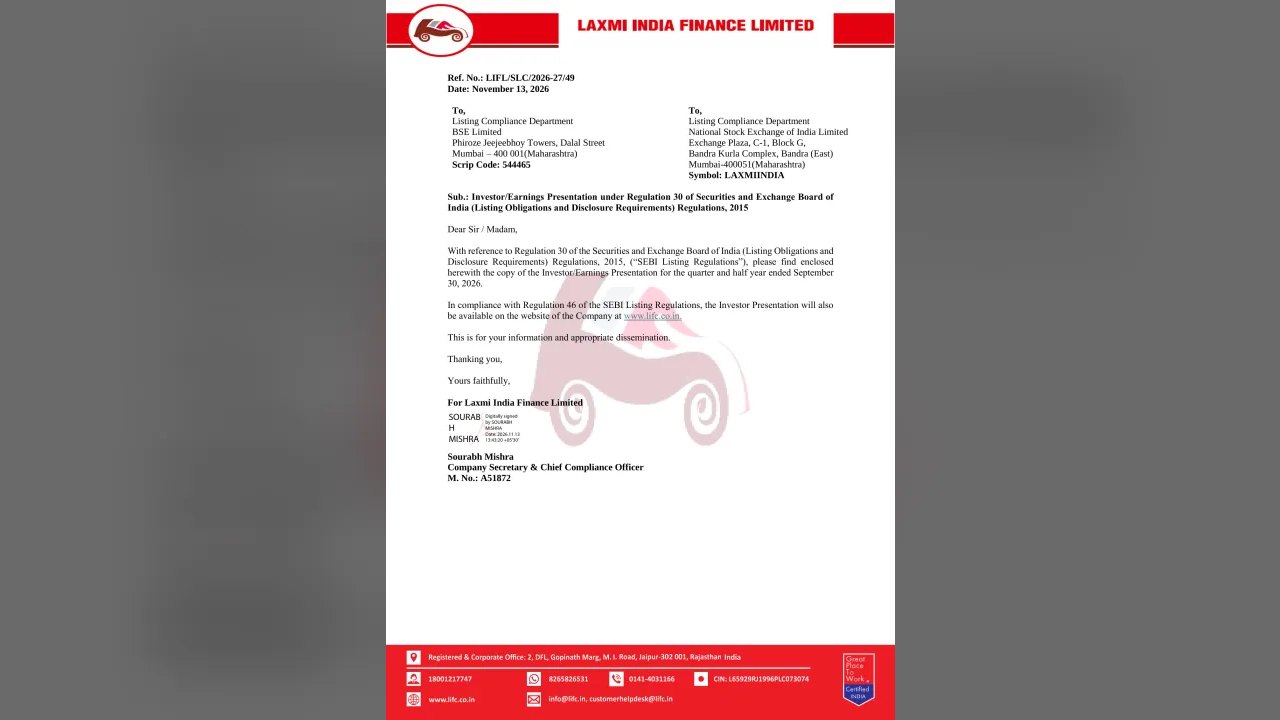
On 6ix: 6ix.com/event/laxmi-india-finance-limited-laxmiindia-q2-2027-earnings-call
Automated transcript · Written by software from the replay's audio. It can mishear names and figures; the replay is the record.
0:00 Ladies and gentlemen, good day, and welcome to Laxmi India Finance Limited Q2 FY 'twenty seven Earnings Conference Call. As a reminder, all participant lines will be in a listen only mode, and there will be an opportunity for you to ask questions after the presentation concludes.
0:27 Please note that this conference is being recorded. I now hand the conference over to Mr. Deepak Bhair, Managing Director. Thank you, and over to you, sir. Yes. Thank you, ma'am. Good evening, everyone, and thank you for joining us for LAXMIINDIA Finance Limited Quarter two and H1 FY 'twenty seven Earnings Conference Call. A warm welcome to all our investors, analysts, lending partners and stakeholders. Joining me today are Mr. Gopal Krishan Sain our Chief Finance Officer, Mr. Piyush Somani our Chief Treasury Officer and Mr. Kuldeep Singh, our Chief Business Officer. Before we discuss the financial performance, I would like to share how we are looking at business at this stage of our journey.
1:19 Over the years, LAXMIINDIA Finance has grown by identifying opportunities in market where access to formal credit remains limited despite the presence of established business and entrepreneur with genuine financing requirements. We started by building relationship with customers, understanding their businesses and developing a strong presence in our home market of Rajasthan. Gradually, we expanded into adjacent state, strengthening our product offerings and build the distribution and operating infrastructure needed to serve a much larger customer base. Today, we crossed INR $18.40 crores in AUM and expanded our presence to more than 200 branches.
2:15 We are entering an important phase in this journey. The opportunity ahead is no longer only about how much we can expand. It is also about how effectively we can use the platform we have already built. This is an important distinction for us. We have invested in branches, people, technology, credit infrastructure and institutional funding relationship over the past several years. As the business grows, our focus is increasingly on improving productivity, strengthening operating efficiency and ensuring that every stage of expansion contributes to sustainable profitability.
3:03 And when I look at our performing during this half first half year of 2027, I see encouraging progress in this direction. Our asset under management stood for $18.44 crores as of 09/30/2026, representing growth of approx 33% year on year. More importantly, the growth has been accompanied by an improvement in our earning performance. Net interest income increased by approx 35% year on year, while profit after tax, including other comprehensive income grew by over 66% during the first half.
3:53 Our return on asset improved to 3.18 compared with 2.56% in the corresponding period last year. For us, these numbers reflect the benefit of large earning asset base, improving funding economics and operating investment we have made over time. At the same time, we recognize that the business is still in an investment phase. New branches required time to mature, new market requires consistent execution and credit quality must remain a priority as the portfolio expands. We are therefore approaching this space with a clear focus of balancing growth with profitability and risk.
4:44 Let me brief discuss four areas that I believe are particularly important for our business going forward. The first is the opportunity with our core secured MSME franchisee. India smaller towns and semi urban market continues to have a large population of entrepreneurs
5:06 and self employed individuals who are underserved by conventional lending channels. Many of these customers have established businesses, regular cash flows and collateral, but may not always fit the standard credit assessment framework of large financial institution. Our business model has been developed understanding these customer segment. We combined local market knowledge and relationship driven sourcing with centralized underwriting, quality assessment and structured credit process. This allows us to serve customers who record timely and appropriate financial while maintaining control over the quality of our lending decision.
5:56 Our secured MSME portfolio now stands at approx $14.93 crores and continues to represent the largest part of our business. We believe this segment will remain central for to our growth strategy over the coming years. Building on this franchisee, we are also preparing to launch a new product line under which we will offer credit line to our customers. Many of our MSME borrowers have recurring working capital needs and a revolving credit facility. Let them draw and repay funds at their business required.
6:41 We believe this will deepen our relationship with existing customers and open a new avenue of growth. We will share more detail of this product as it goes live. The second area is the evaluation of our distribution network. We ended September 2026 with two zero nine branches across six states compared with 164 branches a year ago. Over the last few years, we have made significant investment in establishing our presence beyond Rajasthan, particularly in Madhya Pradesh, Gujarat, Chhattisgarh, Uttar Pradesh and Maharashtra.
7:27 As these branches mature, we expect an increasing contribution from the network already in place. We believe there is a meaningful potential to improve business volumes, customer acquisition and branch level profitability without a proportionate increase in operating infrastructure. This is where our focus and productivity becomes particularly important. We will continue to evaluate opportunities for new branches, but expansion will remain selective and aligned with our ability to replicate our underwriting collection and operating model.
8:14 The third area is the strengthening of our financial position and institution relationship for any growing NBFC. The ability to access capital at competitive rate is fundamental to long term success. We have made steady progress in diversifying our lender base, increasing access to bank funding and improving our borrowing cost.
8:42 Our average cost of borrowing has declined by 51 basis point year to year to 10.59%. Our external credit rating has been upgraded from A minus to A with stable outlook. We believe these developments reflect the progresses made in strengthening our financial profile and building credibility with institutional lenders. As we scale, this will remain an important area of focus because a stronger liability franchisee provides greater flexibility in pricing, liquidity management and future business expansion.
9:29 The fourth area is technology. As the use of artificial intelligence, we upscale across more than 200 branches and six states, strong controls and consistency processes become even more important, and we are using technology to strengthening both. At LAXMIINDIA FINANCE, we have begun deploying AI based solution in many departments like sales, collection, HR, admin, credit. These are early steps, but they reflect our intent to make AI as working part of our operating model, improving controls, collection efficiency and productivity, while keeping our customer relationship at the center.
10:21 Now I would like to touch upon the asset quality. In the lending business, growth is meaningful only when the underlying portfolio continues to perform when we see sequentially improvement in our heading asset quality indicator with gross NPA declined to 1.75 and net NPA improving to 0.49 as of September 2026. This is encouraging, although we remain cautious of the need of continued monitoring, particularly in certain parts of our vehicle financing portfolio. Our credit and collection team remain focused on
11:07 identifying stress early, maintaining close customer engagement and strengthening underwriting standards where required. We will continue to take a calibrate approach to growth rather than a compromise on portfolio quality. Looking ahead, we remain constructive on the opportunity in our own market. Our medium term ambition continues to be AUM growth to approx 30% to 35% annually, supported by the expansion and maturation of the branch network. For FY 'twenty seven, we expect to close this year with AUM of more than INR 2,000 crores, representing the growth of around 25% and over March 2026, with net interest income growth of around 35 to 40% and profit after tax growth of around 35% to 40%.
12:13 At the same time, our focus is on translating this growth into better operating efficiency, stronger profitability and improved capital productivity, we are working towards our medium term return on asset aspiration to 3.5% to 3.75%, while continuing to maintain prudential capital and risk management practice. To summarize,
12:41 the first half of twenty twenty seven has been encouraging, not simply because the business has grown, but because we have seen progress in several capabilities that has been determined in the quality of our growth in the year ahead. Our ambition is to build Laxmi India Finance into an institution that can serve more customers, operate more efficiently and deliver sustainable return without losing the local understanding and customer relationship that have always been center of our business. We believe we have attractive opportunity ahead for us, and our focus will remain on executing this opportunity with discipline.
13:33 With that, I would now request to take you through the financial performance and explain key drivers behind our first half results. Over to you. Thank you, Deepak sir, and good afternoon, everyone. I will take you through our financial performance for Q2 and H1 financial year twenty twenty seven. Rather than looking at the financial numbers individually, I would like to explain how the different elements of our business are contributing to profitability and how we are approaching financial efficiency as the balance sheet expands. The first half of financial year 'twenty seven has seen healthy growth in our earnings supported by three important factors: expansion in our loan portfolio, improvement in funding cost and larger income base, against which we are absorbing our operating investment.
14:26 Let me begin with the income statement. Net interest income increased INR $2.97 crore from INR 2 crore in corresponding period last year, reflecting growth of approximately 35%. This growth reflects the expansion in our earning assets supported by improved funding economics, while profit before tax for financial year forty seven H1 increased to INR 42.4 crore compared with INR 25.5 crore in corresponding period last year, representing growth of approximately 66%. Profit after tax increased to INR 31.7 crore from INR 19.1 crore, also reflecting growth of approximately 66%. Our operating expenses for H1 financial year 'twenty seven stood at INR 62 crore compared with INR 49 crore in H1 financial year 'twenty six.
15:22 The increase reflects our expanding branch network, employee base and investment in technology and operating infrastructure.
15:30 These investments are necessary to support the growth of business. However, as we scale, we are focused on improving the efficiency if these resources are utilized. Moving to margin. Our net interest margin improved to 11.28% in H1 financial year 'twenty seven compared with 10.88 in the corresponding period last year. Our average portfolio yield stood at 21.59%, while our average cost of borrowing declined to 10.59%. The improvement in borrowing cost has been important contributor to our margin performance. Our profitability ratio, our return on assets improved to 3.18% compared with 2.56% in H1 financial twenty six.
16:15 Our return on equity stood at 13.16% compared with 9% in corresponding period last year. While we are encouraged by this improvement, we recognize that there is further opportunity to improve capital productivity as the business scale. The company equity base was significantly strengthened following the IPO, and we are progressively deploying the capital to support loan book expansion. Operating income increased to INR $18.43 crore compared with INR $13.86 crore in September 'twenty five. Our net worth stood at INR $4.99 crore, while our capital adequacy ratio was 22.95%, including Tier one capital adequacy of 22.54%.
17:00 Our gross debt equity ratio stood at 3.31x compared with 2.87x
17:07 in March 'twenty six. As the business expense, we are carefully evaluating the balance sheet balance between capital development and leverage. Turning to asset quality. You have seen sequential improvement in our NPA ratio. Gross NPA declined to 1.75% and net NPA point 49% in September 26. Our provision coverage ratio stood at approximately 72%. In terms of statewide assets, Stage one, loans stood at INR $16.64 crore, Stage two loans at INR 48 crore and Stage three loans at INR 30 crore. Our overall credit cost for H1 Financial twenty seven stood at INR 12.82 crore, equivalent to 0.96% of average gross loss.
17:55 We continue to closely monitor for performance of vehicle finance portfolio. Our approach is to maintain appropriate closing and continuously assess the recoverability of stress exposure.
18:07 On liquidity, we maintained a balance of INR $2.92 crore at the end of financial year at the end of September twenty six. Our ALLO profile continued to reflect cumulative surplus across the reported maturity assets. This provides an important buffer as we pursue our growth plan. Looking ahead, our financial priorities are centered on improving the efficiency of the balance sheet. We see opportunities to enhance profitability through a combination of continued portfolio growth and funding cost optimization. We recognize that these outcomes will depend on how efficiency we manage margins, operating leverage, credit cost. Overall, we believe our H1 performance demonstrates progress towards a more scalable earning model, while also highlighting the area where we continue to focus on improvement.
19:01 At this point, I would like to highlight the provisioning made toward the UpMoney direct assignment transaction, which we had already communicated during the our earnings earnings calls. We had made a provision of 60% of financial year 'twenty five'twenty six, which was duly charged to tender. Further during H1 financial year 'twenty six'twenty seven, we have made an additional provision of 30%, amounting to approximately INR 6 crore, which has also been charged to the pandas.
19:32 Accordingly, we have cumulatively provided for 90% of the exposure as of the date. If we exclude the impact of the specific transaction or adjusted PAT standard INR 36.34 crores, representing a robust 91% year on year growth. On this adjusted basis, our key financial indicator would also reflect an improvement. Our ROA would be 3.65%, ROE 15.01%, gross G and P, 0.61% and credit cost, 024%. This clearly demonstrates the underlying strength of our business performance, profitability and asset quality after excluding the impact of the specific transaction. With that, I would now request Mr. Piyush to discuss how our funding strategy is evolving and opportunity we see on the liability side.
20:24 Piyush, now over to you. Thank you, Gopal, and good afternoon, everyone. I would like to discuss an important aspect of our business that has been evolving steadily over the past few years, our ability to assess funding from a broader range of institutions and increasingly competitive sources. For an NBFC, the liability side of the balance sheet is just as important as the asset side. The cost tenure and availability of funding greatly influence our ability to compete, manage liquidity and generate sustainable returns. As our business has grown, our trading strategy has evolved from primarily ensuring adequate availability of funds to build a more diversified cost efficient and resilient funding structure.
21:16 And we will we have continued to make progress in this direction during the first half of FY 'twenty seven. Our average cost of borrowing stood at 10.59% as of 09/30/2026, compared with 11.10% a year ago. This represents a reduction of 51 basis points year on year. On a sequential basis, the cost of borrowing improved from 10.66% in June 2026 to 10.59% in September 2026. This improvement has been supported by a combination of the strong banking relationships, competitive pricing on incremental facilities and continued negotiation with our existing lenders.
22:03 During H1 FY 'twenty seven, we have raised approximately $6.11 crores through various borrowing arrangements. An important part of our strategy has been to deepen relationship with public sector and private sector banks. We also added ICIC Bank and City Union Bank as a new lending partner during the first half. These relationships are important because they expanded or assessed to the funding and provide opportunities to optimize both pricing and maturity structures. Another development during the quarter was mobilization of INR 100 crores through a NCDs transaction. We believe access to the capital market instrument provide an additional source of funding flexibility and reduces dependence on a single category of lenders.
22:54 As of September 2026, PANSS accounted for approximately 65% of overall borrowing mix. Just to give a perspective on the rate hike cycle is that around 80% to 87% of our borrowings is either fixed or NCLR linked, majority being linked to six months to twelve months NCLR. So there will not be an immediate rise in the borrowing cost on the part of the borrowing. Even on the repo rate based borrowings, we take a reset every three months. So we also get some time to readjust our borrowing there also. Another important development that has been there, that is upgradation in our external credit rating from A minus to A with a stable outlook.
23:45 We view that this is an important milestone in the evolution of our liability franchise, a strong credit profile help us engage with a wider pool of institutional lenders and create opportunities for better funding terms as relationship matures. We have also actively working with our existing lenders to reduce our pricing on the outstanding facilities. Our incremental cost of borrowing over the past twelve months stood at approximately 10.42% compared with a blended cost of 10.59%. We believe this provides an opportunity for further optimization as existing liabilities mature or becomes eligible for repricing. We also had approximately around INR 117 crores of undrawn facilities available at the end of the quarter.
24:38 Our ALM profile continued to reflect cumulative surpluses across the reported maturity bucket. We believe maintaining this liquidity and maturity discipline is essential, particularly as our lending portfolio continue to expand.
24:53 Looking ahead, our treasury strategy will focus on the three major areas: first, keeping relationship with the existing banking partners and selectively onboarding new lenders secondly, evaluating alternative funding instruments, including capital market issuances and direct assignment opportunities wherever the commercially appropriate and thirdly, continuously optimizing our liability maturity profile and funding cost while maintaining sufficient liquidity buffer. We believe the progress made in our funding profile over the past several quarters is creating a strong platform for the next growth of business. With that, I will request Uldeep to share his perspective on the business over the distribution network and the opportunities we are pursuing. Pundeep, over to you.
25:48 Thank you, Piyush, and good evening, everyone. I would like to briefly discuss how we are approaching the next phase of growth with key focus on making our existing and distribution network increasingly productive. Today, we have presence at six states with two zero nine branches, serving more than 45,500 customers. This network is one of the key assets. And going forward, our focus will be not only to expand in the selective, but also to generate greater business with infrastructure already in place. Our model remains focused on relationship led, secured lending, MSME, traders, self employed borrowers and other customers in semi urban and underserved markets.
26:37 Our local market understanding physical verification structures, credit process continue to be important strengths of the business. During H1 financial year 'twenty seven, we disbursed approximately five zero six compared with the last year H1 INR311 crores, which is around 63% growth approximately. Q2 disbursement stood at approximately INR274 crores compared with the INR $2.31 crores in Q1. Secured MSME lending remains our core focus. As of September 2026, MSME AUM stood at approximately INR $14.93 crores or around 81% of the total AUM.
27:25 We continue to see opportunities across small traders, shop owners, service providers and self employed borrowers. Our branch network has gone from 164 branches in September 2025 to two zero nine branches in September 26. Rajasthan remains our largest market, while newer markets such as Uttar Pradesh, Maharashtra provide further opportunities as branches matured in these states. If I calculate the numbers, there is a 45 branches we have opened in the last financial year. So if we precise it, there is a branch opening in every week. A key priority is improving branch level productivity with branches typically reaching breakeven within seven to nine months. The branches opened over the past twelve to twenty four months are matured now and support incremental AUM growth and operating leverage.
28:25 Technology will also play an increasingly important role. We are using digital process across sourcing, onboarding, underwriting, servicing and collections, helping us improving turnaround time, standardize the process and manage their larger network more efficiently. Looking ahead, our strategy remains centered around three priorities: deepening our secured MSME franchisee, improving productivity across the existing branch network and selectively expanding into markets where our underwriting and collection capabilities can be effectively replicated. Our objective is not simply to grow number of branches or the size of the portfolio, but to ensure that every branch and customer relationship contributes to building a stronger and more profitable business.
29:17 With that, I would request the moderator to open the floor for questions and answers. Thank you. Thank you very much. We will now begin the question and answer session. The first question is from the line of Dipesh Sanjeeti fromanya Finance. Please proceed. Hi, am I audible? Yes, Okay. Since you mentioned that your branch network has improved from 164 to two nineteen, what is the breakeven of a new branch?
30:10 So as I explained, that around nine months is the breakeven where we calculate the branch expenses like the capital expenditures. No, I'm saying what is the AUM at which the AUM? AUM typically at around INR 1.5 crore to INR 2 crore is the AUM because we have divided our branches into three categories. So category one, two and three. Category one is having around INR 2 crore of AUM breakeven. Category two is having around INR 1.75 and category three is at around INR 1.5 crore of AUM. Okay. So basically, I can say safely say that INR 1.75 crores of AUM, the branch should breakeven?
30:50 Yes. Where the expenses of the regular expenses of branches, branch as well as the income of branch can set up either. Right. Okay. And now the industry reports has said that there is stressed loans in tractors, commercial vehicles and rural MSME portfolios. It cannot be ruled out. That's what the report says. About 81% of our AUM is in MSME in semi urban and rural accounts. How much of that is rural, first of all? And how is the collection efficiency in those branches? And are you seeing any stress right now? See, for stress and collection details, I'll hand over to Mr. Sanjay, who will be handling who is handling the collection part. But as far as the comparison between the MSME segment and the rural segment as well, so there is a bit difference between the unsecured and the secured part. So R is actually a secured part, which is always having as over the unsecured, if you compare about the microfinance industry where the loans are unsecured.
31:56 So typically, there might be a stress over there. But yes, there is an improvement in microfinance industry also. There is an improvement in the credit rating of the industry. ICRA has recently announced the from negative to stable. So there is an improvement in terms of the overall collection efficiency. Over to Sanjay for the R collection efficiency about the numbers. Rupesh, this is Sanjay. Overall collection efficiency is improved compared to September 25. As in September 25, overall collection agency was 93%. But now in September 26, we have closed more than 98%.
32:43 So we don't see any stress in our portfolio as we are having cohorts with the multiple income source. We are not dependent only on single income source. That is the reason our portfolio is not currently not in stress and performing well. How is the collection efficiency? I'm not going to agree. Collection efficiency overall in September 2026 is 98.68 precisely. INR 98.68%. Okay. Also, how do you deal with evergreening of accounts? See, we don't do the evergreening of the accounts. I don't know, But there is a tendency of the employees or the the branch has to perform.
33:34 There is there tends to be an evergreening of accounts. So how do how does the bank sitting in its head office I mean, sorry, how does this how does the company sitting in its head office manage evergreening of accounts that there is no evergreening of accounts? What checks and balances do you have? That is what I want to answer. So we have the robust underwriting process where we are every case passed through the LOS, and LOS is having a deduced system. So whenever there is a repeat customers coming into the LOS, so there is a deduced system where the credit manager can file the existing detail of the customer. So where it can be covered and straightforward, it can be said no. No, no. What about giving loans to the same family members?
34:20 How does that... So actually, we are taking the complete family member into the deal. And in rural and semi urban areas, what is happening, the family is having one property. So we have already taken that property into security against our loan. So there's a very few chances where the other member will come. But if other member will come, that also can be phased out through the D2 facility. So you're not using any technology as such for avoiding this, is it right? Yes. Yes. What are you saying? Can you repeat? Are you using any particular technology for that? Yes. Yes. That's a technology only. So there's a dedupe system. This actually works like whenever there's a repeat mobile number, whenever there is a repeat KYC, it can fetch out the existing details.
35:14 So that is the system only. That is an entirely automated system. Right. Okay. And also, your yield has fallen about 59 basis points and the borrowing fell 51 basis points, yet the NIM rose 40 bps. What drove the NIM gain? So the cost of borrowing has also reduced as compared to the last financial year and vis a vis the NIM also have increased from the last financial year. That is the reason. Okay. But where do you see the cost of borrowing going, especially with the RDI increasing rates? And especially after those recent rate increase, what has what is the average cost of borrowing gone to in this as of today, we are talking?
36:05 Yes. This is Siyush. So as of now, I can say that the cost of borrowing is not increased. Most of that repo rate has been increased by 25 bps because since my opening speech where I had addressed that around 80% to 87% of our borrowing is either fixed or ancillary based. So six to twelve months ancillary based, it is linked. Only a municipal portfolio that is INR 200 or INR $2.13 crores, 14 crores, that is 13% of my entire borrowing is linked to a repo, where the reset is on three months basis. So on a holistic view or on an overall view of the borrowings, as of now, it will not ease down.
36:51 Okay. And just my last question is that how much of your AUM is actually on fixed rate of interest? And how much is on floating? The reason I'm asking is that if there is any violent increase in your costs of borrowing, how can you pass on to the customers? That is my main concern. Firstly, our entire portfolio is on fixed rate of interest. Secondly, in case of any rate increases, then definitely, we will be passing on subsequent disbursements only. That is the only option that we are having Right, right. Fine. I'll focus in the queue if there's any other questions. Thank you so much, guys. Thanks. Thank you. The next question is from the line of Yash Gautam from Laxmi India Capital. Please go ahead.
37:43 Hi. Thanks for the opportunity. I just had two questions. First, on your Slide 11, I think it has been mentioned that your capital adequacy ratio would have been higher with FDs instead of corporate bonds. So why are we taking this like credit risk on on our liquidity buffer? And what is exactly the rating profile of these bonds, if I may ask? So basically, they are above A minus. So put together, I can say that major of the bonds are being passed in AA category, AA minus to AA. Got it. Got it. In our Slide thirteen fourteen, sorry, our ALM showed surplus in sort of every time sort of bracket. But I just want to ask how much of the next twelve months borrowing has been already sanctioned? And is there any concentration among our top lenders?
38:39 So basically, it's a positive signal that the ALM is positive in all the buckets. Basically, I can say for the next three, four months, we are filed up with undrawn lines. Though we are having a liquidity of INR $2.92 crores as on September with an undrawn pension of INR 117 crores. There are a couple of tranches and the direct assignment transaction so far, that is an imprincipal franchise in the subsequent, I can say, two months only, that is October and November as well. And we are decently pleased with the, I can say, the liability franchise because we are having a lender base of 53 lenders, around 29 banks are there put together. So we are decently placed in this control of the liability. Yes. Okay.
39:24 That was from my call from the side. Thank you. Thanks. Thank you. The next question is from the line of Rishav Ghaura from AB Advisor. Please proceed. Hello, Am I audible? Yes, you are audible. Yes. So my first question is disbursements rose 63%, but AUM grew only 33%. How much of the book is repaying or closing early? So basically so there are I can say, on a month on month basis, there is a prepayment on an annual basis, there is a prepayment of around 14% of our opening book. That is one.
40:20 Secondly, our average loan book is somewhere around forty eight to fifty two months. Okay. Okay, okay. Got it. So, yeah, I have a I have a couple of questions, but I'll come back in queue. You can move on to the next. Sure. Sure. Thank you. The next question is from the line of Paras from Purple One Vertex Ventures. Please proceed. Yeah. Thank you, sir, for this opportunity. So your Q2 PAT was 15.4% versus our Q1 in about 16.6% despite continued AUM growth.
41:08 What explains this sequential decline? And I guess you've lowered your pad growth guidance to 35% to 40% for FY 'twenty seven. So what is your expectation for pad growth in FY 'twenty eight now, sir? Can you please pardon your question? Sir, your Q2 PAT was lower than Q1 PAT despite continued AUM growth. What explains the sequential decline? Sir, the main reason regarding it, upon additional provisioning, in Q1, we have we offered provisioning only 10. And in Q2, we additionally provide progeny 20%. That is why sequential basis was flat year showing 10% decrease.
41:58 Okay. And sir, what is your growth guidance for I mean, prior to growth guidance for FY 'twenty seven and FY '8 Fresh? So I guess initially your FY 'twenty seven PAD growth guidance was about 40% to 45%. So what is your revised now? I guess 35% to 40% for FY 'twenty seven and for FY 'twenty eight, if any? Yes. So we are not revising it. So we will because seeing the business and seeing the market, we believe we will be achieving the target the guidance what we have given on the disbursement side and proper pad side and all. So because this Upani incident has happened once a year back. So but we are seeing that market is now getting better. And we are expecting some collection also on Upani side also. So we believe the guidance will be we will perform what we have
42:50 we have... So what is our guidance for FY 'twenty seven and FY 'twenty eight, PAD growth?
42:56 Same similarly, what we have given around almost 40% growth. That's for FY 'twenty seven and FY 'twenty eight, if any? 'twenty eight, we'll be giving it later on. But yes, so company is growing and AUM is growing, so of course, the PAT will also grow similarly. Right. Sir, you've already provided 90% against money assignment exposure. How much money has actually been recorded in cash so far? And how much remains outstanding?
43:26 And what is the expected time line for recovery?
43:28 So total INR 19 crore was a total quantum. So we have made a 90% provision. Now 10% is only left, that is INR 1.90. And so
43:39 INR 1.90 is only left, and rest all we have... But how much money has been actually recorded in cash so far? No. So we have done a transaction of this. This transaction was of around INR 26 crore. So INR 26 crore, let's say, 19 crore got called. Rakib rest, 7 crore we have received earlier. Okay. So INR 19.6 crore defaulted basically? Yes, exactly. You want to add anything, Rumohan? Yes. And 10% is pending because you provided 90? Yes. Okay. And there are no further basically such exposures in the portfolio as of now? No. So this was also a DA purchase. So this was very unexpected.
44:28 You can say in India, there's believe no DA transaction has got default like this. There's a slightly 1%, 2% or 3% NPA that is, but this is exceptional. And I believe many NBFCs and banks have got this lost their money in this money. It is exceptional, you can say, exceptional case.
44:52 Sir, our H1 FY 'twenty seven impairment expenses have increased by 81% odd and the absolute Stage three loan balance has risen from INR12 crores to about INR30 crores. So what is driving this increase? And what is your expected full year FY 'twenty seven credit cost?
45:13 Our impairment is increasing despite of our G and P is improving. That is, I mean, our collection efficiency is stable. So there is no particular improvement in the Stage three. Stage three is moderate, okay? And we are increasing our impairment cost due to default of the money transaction. That is why our impairment cost is high. And secondly, for further guidance, it is difficult to certain a particular number because it depends several points. In the NPL number, we have a better
45:44 collection efficiency and the portfolio. But we can range bound it, it would be float between 1% to 1.25% in coming quarters and entire year. So for the full year FY 'twenty seven, credit cost would be?
45:58 1% to 1.25%. Okay. And sir, just last query, Maher, your credit I mean, sorry, capital adequacy ratio has declined to 22.95% and debt to equity has increased to 3.31 And previously, you had indicated potential INR $3.50 crore capital raise when leverage reaches 44.5%. So are you expecting any equity dilution? And what level of AUM growth can you sustain without raising fresh equity? So firstly, the CRAR position is there, where the liquidity, which is considered into the picture is INR $2.92 crore is there. We have put into the bonds where the risk weight is INR 100. So that's why the CRAR has been reduced for that portion.
46:47 Crossing of that, if in case that it has the amount has not been put into the bonds, it has been put into the FD, then the CRAR ratio will stood to 26.92%. I can say 27% will be the CRAR portion, firstly. Secondly, I can say from 27 of CRAR, we can go for another one point five year from here. And Q1 of FY eight, we can predict that the subsequent round of equity, we can see so. Okay. So until Q so what level of AUM growth can you sustain without raising fresh equity, I mean, in terms of quantum? So we can maintain a growth of around 25% to 30% year on year. 25% to 30% without raising fresh equity?
47:33 Yes.
47:35 Post that, we will once we will be attaining a leverage of, let's say, 4,500,000,000 to INR 4,750,000,000, any which is we will be raising of funds subsequently to preferential of IPOs. Right. And sir, if I may be allowed just last slip in. About 80% of your AUM is concentrated in MSML lending and significant proportion of the borrowers are first time borrowers. Now since you target about 25 to 35% AUM growth,
48:06 how will you maintain the underwriting standards? I mean, what are the again, the current collection efficiency, early stage delinquency and vintage wise credit performance?
48:20 Because most of your borrowers are first time borrowers. So how are you ensuring yes, please. Yes, definitely, significant amount is a first time borrower. But earlier also, I have quoted that the secured part is actually having access over the unsecured portion. As far as the underwriting standard is concerned, so this growth has been started since last three years. And before that, we were actually generating the resources. So we have complete onboarding on the digital onboarding, where we are the customer information, customer KYC, customer banking, everything is being
49:06 verified through the application, through integration. Then after there is a VRE model, which runs and gives the credit score. Then after, there will be a manual intervention of the credit manager and senior person because the underwriting process is centrally located. So we have
49:25 a natural credit manager who is taking care the underwriting portion, he will be he's decisioning the cases as well as there is a complete deviation metrics. So while even whenever we are moving to newer states, newer locations, we always go with the local policies, local processes, local what kind of property papers we are getting in Maharashtra, what kind of property papers we are getting in MP in Gujarat. So we have
49:53 touched upon the local flavor where what kind of property, what kind of security we are getting. And then after we are preparing the policy. So as of now, I can say we are 100% full proof resource availability we are having with the complete digital process as well as now we have moved to the esigning of the agreement. So the complete digital process as well as the human intervention structured credit with policy, I can say we can move to any we can scale to any level.
50:24 Right. So as one of the earlier yes, please go ahead. With Pudee, so I would like to say, we are taking the complete family in the deal. So that is also a very interesting policy what we are having is that so that everyone in the family is liable to pay. And we are taking and generally, in the rural and urban areas where we have a presence, there we have a joint family system. So people are they are working they have a number of working hands, who all have contributes towards EMI. So that is a very interesting and at last stage, business purpose. So we are giving a loan for a business expansion and business purpose. So that makes us comfortable for a repayment on time and all, maintaining the portfolio.
51:15 Makes sense. Sir, what proportion of your book is secured? So it is 1% is the secured. Otherwise, the rest is also vehicle and everything is secured. Around 22% to 3% is unsecured. Overall, 8789% is almost secured. About 89%? Yes. Okay. And sir, as just one of the participants asked on evergreening of loans. Now from the head office, what is the control mechanism you have in place in terms of ensuring or that you don't face any at the branch level because these are rural regional branches.
52:02 What control mechanism do you have in place as you're growing now? I already told that the complete onboarding journey is digital, and we are taking the complete family members. So if one person is already on loan and definitely the family will also be on loan. Any other person from the family will come, then there's a dedupe process, which is also automated. Any KYC entered, repeat KYC entered into the system, it will be a pop up for the guide manager. He will he can analyze the past history, past relationship with us. And then after if there is a kind of ever gaining is there, then he can he will definitely decline that loan. Automatedly, that loan will be declined. Thank you so much, sir.
52:48 Thank you sir. Thank you. The next question is from the line of Rishabh Bora from AB Advisers. Please proceed. Hello sir. So I have some more questions. So first is ROE is 3.18% and ROE is 13.6%. I guess targets of 3.5% to 3.7513.513.5% to 14%, respectively. What is the time line? And what lever moves it most? See, we are working on it. So we are coming at some more product also.
53:33 The as we are growing, so our branches are also getting mature. So I believe coming by this year, we should touch to somewhere around 3.50 what we have given on earning calls. So by this financial year, we should be nearby this number. Okay. Okay. So that's it from my side. Thank you. Thank you. The next question is from the line of Janardan, an individual investor. Please go ahead. Hello. Thank you for the opportunity. My question is how does the promoter group see its ownership evolving over the next five to ten years?
54:25 Is the intention to maintain a meaningful ownership stake as the company grows? And what is management's philosophy regarding related party transactions and protecting minority shareholder interest? See, promoter is having almost 60%, 61% shareholding overall right now. And company and as this NBFC is a capital oriented business, so as and when capital required, Promotor is ready to get funds and infuse funds and to raise funds from the market. So at that time, of course, promoter is also ready to infuse more his own capital
55:14 as and when required, and he can get some more capital from the market side also. So I believe, Madhav, overall, we are getting a good returns, good return on network. So promoter is interested in putting more money in future also whenever the fund raise happens and ready to dilute also because this is a capital oriented business. So both are sided, promoter is open. Yes. And the second question is, while the company has growth ambitions, how does management define its risk appetite as in the lending business, it's pretty easy to grow, but it's pretty it's kind of hard to manage the risk. So are there any loan segments, geographies, customer categories where the company would consciously avoid expanding even if the opportunity offers attractive growth?
56:13 And what are the circumstances that would make management deliberately slow down disbursements to protect the balance sheet?
56:25 See, this risk is always there in lending business, you're right. But yes, managing that risk, focusing on that risk and evaluating that risk on timely basis, which is very important and healthy for the growth. So we have a complete risk team with us who evaluate, who keep on evaluating on early delinquency on FinCode. But that's so deeply we evaluate that our FinCode side also we evaluate our customer
56:53 position, the customer delinquency or if any early delinquency signals he wants to forward it to the credit team, the sales team. So that is what we are having. Plus, we have robust system who is giving us auto
57:13 generated mails where the delinquency is moving ahead or where the early delinquency is moving ahead so that only warning systems, we start getting it from the things and from the system side. And third is, see, this is very natural that sometimes when you open some branches, you open you have you're not able to get a proper business, you're not able to get a quality business, then you have to wind up also. So we have taken such calls also that we have wind up a few branches also in a year where we are not getting the good performance or the great quality and all. So it is like we are very cautious on a portfolio side, and you can see the numbers also. So we don't mind getting a back also sometimes where the business is not adequate.
58:02 So this is an ongoing process in a lending business.
58:07 And here, we are taking care of this early delinquency and all side. So that is where we are protecting ourselves for future. Do you want to add anything, Kundi? Yes. I want to add into it. While opening the branches, going into the new territory, there's a robust mechanism where credit risk and collection takes cumulative decision to open any branch, any territory. Even they find out what are the negative cases, what are the negative profiles where no go rules are applicable and what are the negative PIN codes impact. Even after, if any case in any case, if there is a wrong decision to open a branch, we take decision immediately and we close down that branch, definitely.
58:57 That's helpful management. Thank you so much and all the best for the future. Thank you. Thank you, sir. Thank you. Ladies and gentlemen, due to time constraints, that was the last question for today. I now hand the conference over to the management for closing comments. Thank you. Thank you, everyone, for your questions and for the engaging discussion today. We appreciate the time you have taken to understand our business, our performance and the priorities we are pursuing. Before we conclude, I would like to leave you with one thought. For us, the objective is not simply to become the larger NBFC. It is to become a better and strong NBFC with every stage of growth.
59:45 We believe the combination of our experienced team, established distribution network, improving institution relationship and technology enabled operating model position us well to pursue this ambition. I would like to thank our employees, customers, lending partners, shareholders for their continued trust and support. And once again, thank you to all the investors and analysts who have joined us today. We look forward to sharing further progress with you in the coming quarters. Thank you, and have a wonderful day. And Happy Diwali to all. Thank you very much. On behalf of Go India Advisors, that concludes this conference. Thank you for joining us, and you may now disconnect your lines. Thank you, everyone.
Follow Laxmi India Finance Limited into a list and get an email when it puts out news.
Managing Director at Laxmi India Finance Limited
Chief Finance Officer at Laxmi India Finance Limited
Chief Treasury Officer at Laxmi India Finance Limited
Chief Business Officer at Laxmi India Finance Limited
at fromanya Finance
at Laxmi India Capital
at AB Advisor
at AB Advisers