Replay available
Hinduja Global Solutions (NSE:HGS) Q2 2027 Earnings Call
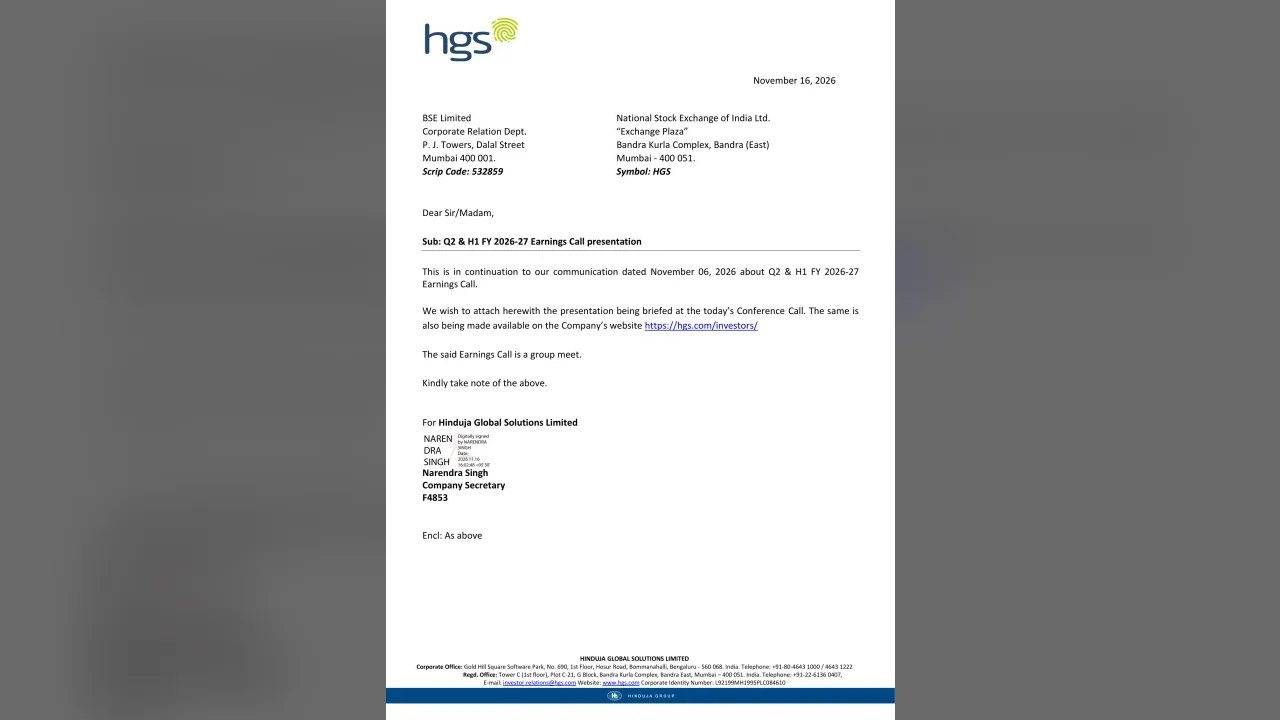
Hinduja Global Solutions (NSE:HGS) Q2 2027 earnings call, held 2026-11-16. Watch the replay and read the transcript on 6ix.
- Company
- Hinduja Global Solutions Limited (NSE:HGS)
- Period
- Q2 2027 earnings call
- Date
- Mon, Nov 16, 2026, 9:17 AM ET
- Replay
- Watch the replay on this page · 1 h 9 min
On 6ix: 6ix.com/event/hinduja-global-solutions-limited-hgs-q2-2027-earnings-call
Replay
Transcript
Automated transcript · Written by software from the replay's audio. It can mishear names and figures; the replay is the record.
0:01 Good evening, ladies and gentlemen. A very warm welcome to the Q2 and H1 FY twenty twenty seven Earnings Conference Call of Hinduja Global Solutions Limited. From the senior management, we have with us today Mr. Venkatesh Kurla, Global Chief Executive Officer, HGS Mr. Vincey Fernandez, Hold Time Director, HGS and CEO of NXT Digital Media Business and Mr. Mahesh Kuman Nitalopati, Global Chief Financial Officer, Please note that this conference is being recorded.
0:52 I now hand the conference over to Mr. Anand Venugopal from AdFactors PR. Thank you and over to you Mr. Anand. Thank you, Rutuja. Good evening, everyone. We welcome you to the Q2 and H1 FY twenty twenty seven earnings call of Hinduja Global Solutions Limited. Before we begin, I would like to highlight that some of the statements made during today's call may be forward looking in nature. These statements involve risks and uncertainties, including those related to the company's future financial and operational performance. Additionally, in the unlikely event of a call drop during the conference, we will ensure the call is reconnected at the earliest. I now invite Venkatesh sir to deliver the opening remarks. Over to you, Venkat sir.
1:44 Good evening, everyone. Thank you for joining us. I hope you had a wonderful Diwali. I will spend the next few minutes on our performance this quarter and some of the changes we are beginning to see underneath the numbers. HGS has been through a period of significant transition. What is encouraging today is that we are seeing progress in three areas. The underlying business is showing healthy momentum. The profile of opportunities we are pursuing is becoming more strategic and the capabilities we are building are beginning to show up in real client engagements. I'm on Slide four snapshots of HGS financial performance. So let me start off with the Q2 FY 'twenty seven performance.
2:31 We saw sequential improvement across the key metrics. Revenue from operations increased 2.5% quarter on quarter to 1,076.2 crores. Total income grew 1.1% to INR 1,214.5 crores, while total EBITDA, which includes other income, increased 36.5% to INR158.8 crores. Total EBITDA margin improved by three thirty nine basis points sequentially to 13.1%. Our reported performance continues to reflect the portfolio transitions we have discussed previously. The more important indicator for me is the underlying business itself.
3:20 On a comparable basis, the continuing business delivered high single digit growth with newer engagements ramping up and we continue to improve our delivery efficiency. There's more work to do though, but the direction is encouraging. The business we are taking forward is healthier and gives us a stronger base to build on. On the next slide, the opportunity profile. The opportunity profile itself is shifting. Beyond the quarterly numbers, we are seeing an important change in the profile of work coming into HGS.
4:07 Our pipeline is at historically strong levels, but it's not simply its size. It is the nature of the work. We are increasingly participating in large pursuits, more technology and transformation programs and mandates that bring together multiple HGS capabilities. Clients are not necessarily looking for one service or one platform. They're increasingly looking for a client partner who can understand the business problem, bring together the right capabilities and remain accountable through delivery. It's all about outcomes. We are also seeing broader conversation within our existing relationships. Opportunities that may have started around CX are increasingly opening into digital transformation needs and vice versa.
4:58 This matters because some of our best growth opportunities are with clients who already know us and trust our ability to deliver. We established our Middle East business in Dubai last quarter. UAE is an $8,200,000,000 DPOIT market, expected to grow 12 a year until 2030. We see a lot of potential for HGS in this market. We have already won our first digital operations client and are seeing healthy early interest in the market. We are also strengthening across various regions access to public sector opportunities through established procurement frameworks, including The U. K. G Cloud 15 and Canada's Kenu procurement group, making it easier for government organizations to engage with GIS across cloud, AI, enterprise platforms and digital transformation.
6:04 So this is not simply about having more opportunities. It's about having larger, more strategic mandates that are increasingly becoming part of HGS' growth mix. Moving on to the next slide, which is recent wins that provide proof of the shift. So let me make this change more tangible with a few examples. Earlier today, we announced a multiyear, multimillion dollar engagement with Rackspace Technology, a global cloud and AI infrastructure company. The mandate spans site reliability engineering, cybersecurity and product development. It is a good example of how HGS is taking on complex global technology delivery well beyond the traditional single service engagement.
6:59 In Canada, we have been selected for an embedded consulting and FD engagement within a long standing participle relationship. This brings adjacent to clients' change journey at an earlier stage, helping shape the solution by combining operational knowledge, digital capabilities and on the ground execution. We have also been appointed as an approved supplier under a leading Canadian Public Sector Procurement Framework, KENO, for ERP implementation services. The framework provides municipalities and other eligible public sector organizations with a simpler route to engage HGS while creating opportunities for us to support broader transformation needs.
7:49 For the global packaging manufacturer, we have expanded an existing technology initiative into a commercial AI agent initiative that helps teams access trusted business information and insights more easily. Importantly, this is designed as more than a single use case. It creates a foundation for an AI factory style model where we can progressively build, govern and scale traditional AI solutions across enterprise. For a major government digital identity service, we have developed and deployed a self hosted knowledge grounded AI assistant within a high volume citizen support operation. The solution automates appropriate account access and identity queries while retaining human escalation for more complex interactions.
8:45 In a heli government engagement supporting regulated cross border trade, we have embedded intelligent self-service and agent support capabilities into the operating environment. The solution helps businesses access relevant policy guidelines and get guidance more quickly while retaining human escalation because the environment is regulated and the cost of getting an answer wrong is higher. These six examples are different types of engagements, but the common thread is key. HGS is participating more deeply in technology delivery, client transformation and AI enabled operations. And as we look to the future, we seem to see this more and more often, where both operational and AI excellence and technology integration capability are coming together.
9:42 Now looking at the next slide, which is AI is changing how HGS delivers. So the examples I talked before lead naturally into how we think about AI at HGS. Our view is quite simple, automate the transaction and humanize the interaction. There is significant amount of work in customer operations that does not need a person to perform it manually every time. Routine inquiries, information retrieval, transaction processing and repetitive tasks can increasingly be handled through intelligent automation. This can improve productivity, reduce resolution time and deliver greater consistency.
10:28 But not every interaction is simply a transaction. When customers need judgment, empathy, context or an exception to be handled, the human role becomes more important, not less. That is why our model is not AI only. We combine agentic AI with the domain knowledge and human relute. The balance may vary by process, but the principle remains the same: apply automation where it creates economic and operational value and use human expertise where it improves the experience or makes the decision more reliable. This is also consistent with what we heard directly from our clients at a recent Build for the Future event in Chicago.
11:22 There's clear appetite for using AI systems, but trust, transparency and the ability to retain human control become more important as the complexities and stakes increase. This is what we mean by intelligent experience and practice. Moving on to the next. How are we investing to build HGS with new growth engines? Supporting this shift requires us to be quite deliberate about where we invest. The first area we're investing is domain and delivery expertise. As client requirements become more complex, technology skills alone are not enough.
12:08 We need teams that understand the industry, the underlying business processes and the client's operating environment. That is why we are strengthening our consulting and solution capabilities and building more embedded, forward deployed ways of working across CX and digital. Now the second area is solutions and IP. We already have multiple solutions deployed in client environments with additional solutions in development. Our focus is increasingly on building reusable capability around real client problems so that we can take what works in one environment, refine it and deploy it more quickly elsewhere. This allows us to shorten solution development cycles and then build a more scalable portfolio that has potential for nonlinear growth.
13:06 The third area is our strategic headquarter ecosystem. Many of our enterprise clients already operate on platforms from companies such as Microsoft and Databricks. We are investing in deeper capabilities around these technologies so that we can support clients across cloud, data and AI as they undertake broader digital transformation programs. Especially the Rackspace relationship is interesting as we have been able to bring their infrastructure capabilities of AI to provide sovereign AI capability for our customers. At the same time, we are also building relationships with specialist AI native tech companies. The objective is not to build every component ourselves but to work with them in areas where they can help us solve a client problem faster or better.
13:57 We bring their technology together with HGS' domain knowledge and deliver experience to create the right solution for the client. Moving to the next, our priorities for sustainable growth. So what are our priorities for the next few quarters? That's a big question everybody has. First, we need to ramp newer client engagements. Winning business is only the first step. The value comes from those engagements. And as those engagements move through implementation, stabilize and begin contributing at scale. Second, we need to deepen our existing client relationships. We have made progress on cross sell, but there is still significant headroom.
14:47 Where we have earned trust in one part of the business, we should be able to bring a broader set of HGS capabilities to our client. Third, margin improvement remains a clear priority for us. As newer engagements ramp and the business mix evolves, we need this growth to translate into stronger profitability. Finally, we need to continue building an AI native workforce. This isn't simply about learning individual tools, it means strengthening domain knowledge, AI fluency, consulting and solutioning skills and creating a mindset that combines technology with operational rigor and understanding. So to summarize, we have spent the last few quarters reshaping HGS.
15:36 We are seen as a different kind of company today. We believe the company is in a better place today with a healthier underlying business, newer engagements ramping and access to larger, more strategic opportunities. Our priority from here is straightforward, convert pipeline into revenue, stronger client relationships and improve margins. This is how we intend to rebuild the growth and profitability profile of HGS and make it more resilient. Before I hand over to Vince, a quick word on digital media business. Broadband continues to show good momentum across retail and enterprise, while Project Ganga is beginning to scale and expand our reach into Ottomanish.
16:26 On DTV, we combine we continue to navigate the structural changes in the industry with a strong focus on cost optimization and managing the business responsibly. Vince will now take you through the progress across the media business in more detail. Thank you, and over to you, Vince. Yes. Thank you, Venk, and thank you, everyone, and hope you all had a wonderful Diwali, and wishing all the best for the New Year to you and your families. I'm on Slide 11, which is the management commentary that Venk was alluding to in terms of where we stand today. And if you look at it, we're quite happy with the progress that the broadband vertical has made.
17:13 Broadband, as you know, is pretty much a sunrise industry. And as digital inclusion increases, broadband penetration will continue to grow significantly because even as you know, with over 300,000,000 households, very about just over 50,000,000 households still connected with wired broadband. So we've already seen traction of about 8% growth in revenues in H1 of this year. And the subscriber base has grown by 6% during the same period, which shows clearly that there is a focus on high ARPU customers. Project Ganga, which you'll all know is a project that we are executing on behalf of the State Transformation Commission of the Government of Uttar Pradesh and is a digital inclusion and as well as the social transformation project.
18:06 It just it was signed in June and in barely any time we've already operationalized 16 networks and I'll talk about it a little more on the next slide. The challenge, there is no doubt, the media business continues to face profitability pressures because traditional digital cable TV is, in fact, a declining industry globally, not just in India, experiencing a much broader shift. If you look at it, just you yourself as consumers move towards online streaming, a reality where every single industry player is facing significant subscriber churn and headwinds. But we have strategies to address that. Cost optimization is just one of those strategies.
18:52 Broadband inclusion of broadband upselling and cross selling has become a critical part because there is a significant base of digital television customers that can be connected with broadband. And of course, more importantly, the industry, we are looking to compensate it with the significant growth in broadband as we're continuing to see. So with that, I'll go through Slide 12, which talks about Project Ganga, and this is an update as of November 14. It keeps changing every day, so I've had to stop it at November 14. It's quite incredible. If you recall the last Board meet the last investor call, we were still on the training modules, training operators to become entrepreneurs, to become digital service providers.
19:44 As of date, we've trained over twelve twenty one applicants, and we've got over 4,000 applicants today. And three fifty five of these trained applicants have filed their application with CMUL for securing their loan, which is, as you know, it's an interest free collateral free loan from the government of Uttar Pradesh in its endeavor to ensure digital inclusion and social transformation of creating a new breed of entrepreneurs to connect all of Uttar Pradesh, including urban, semi urban and rural areas. And 40 such loans have already been approved with 16 digital service providers are already live. And that is significant because in no time literally they've been these are first time entrepreneurs, all these, the right from the twelve twenty one train to the 16 that have gone live are completely first generation digital service entrepreneurs and they've already secured 200 paying customers, which we are seeing significant momentum.
20:56 If you look at the achievement, what's really interesting is that 85% of these evaluated applicants qualify. So that shows the strong demand for becoming a digital service provider. And if you look at the momentum, we already have, even as we sit today eight thirty five document ready applicants ready to go through the next process for securing loans and moving on to become a DSP, while 2,500 have qualified for training. If I go to Slide 13, you'll see the marketing activity that's already taken off and the branding. The product is that we are marketing to customers with the DSPs is called Ganga Fiber.
21:42 It is there is a plan that has been tailored basis significant research for every single customer need. So if you look at Ganga first, it is to ensure that households that may that require connections with reliable connectivity as well as entertainment levels, sign in for Ganga first. There's a product called Ganga Pro. If you look at the fourth block, it's to help small and medium businesses as well as if you look at Ganga Elite, which is a larger sized business as well, small to medium businesses, but more at the medium end of the spectrum. And prices start from $3.99 per month, which includes GST. And it's very interesting, and this is where I talk about the cross selling of digital television as well.
22:32 100 television channels are available to customers on every single plan. In addition to that, they can opt for other packages as well of television networks, which will pay television channels, which will start shortly. So that's on Project Ganga, which has seen a lot of traction in the last couple of months itself. With that, I go to the broadband KPIs, which I thought will be very interesting. As I mentioned, the revenues are up by about 8% year on year in H1 of this year. But the best part about it is all the lines of business, retail, strategic alliance partners, Celeritix, which you know is the enterprise business unit even our subsidiary, One Seven Star, have registered growth.
23:17 And that bodes very well for us. And the three blocks the three graphs indicate the change in share of base. So if you look at it, the positive aspect is the entry pack, which is zero to 30 Mbps, is now down by about 4.9%, which is a good thing because it means customers are now opting for the higher end packs. If you look at the adds that have happened or the customer conversion and you simply look at the 101 the greater than 100 Mbps pack, that has risen to about 13.5% of the base from about 10.4% last year. And the entry level has been brought down significantly from 23.7% to about 18.8.
24:08 And the tenure as well is really important for us. We're focusing more and more on long duration recharge. What does that mean? It means simply that we're encouraging customers to opt for longer duration packs, and that is the reflection of the quality of service where they're happy with the service, happy with the pricing and willing to stay on longer. And the last graph is that the churn has been controlled significantly. Churn is the customer base that you lose for a whole bunch of reasons. We've kept on bringing that down quarter after quarter. And if you look at Q2, very, very clearly, there's a much stronger subscriber base. And to summarize, customers are buying faster plans.
24:54 They're sticking with their plan tenure and they're churning less. So there's a lot of upgrading we're seeing. There's a lot of commitment. In fact, these are the three KPIs that we look at, which is upgrading. If you look at the bottom of the just below the graphic, we're upgrading the commitment where long duration recharge is up 5% year on year for three months back. And if you look at their staying of their customer experience with us, there's a significant, significant reduction in churn, which obviously gives us a significant level of comfort. With that, I'm happy to hand the charge to my colleague, Mahesh Kumar Nathalapati, who's our Global CFO. Mahesh, over to you, please. Thank you. Thank you, Vince, and good evening, everyone.
25:43 I hope all of you had a wonderful Ditali, and wishing you all and your family a very happy New Year. I'll walk you all through the financials for the quarter and the half year. And just to relate to what both Venk and Vince has mentioned so far. I think this quarter is showing a sequential improvement with healthy underlying momentum and continuing business growing high single digit on a comparable basis. Your engagement is ramping and delivery efficiency is improving and as also Vince just mentioned about broadband revenue up by around 8% in H1 on a 6% larger subscription base. And the project Ganga is live with 16 networks and definitely the focused cost discipline on the DTD side. These are all measures what's just ranked and wins as mentioned will be reflecting on our financials. The underlying message or the theme of the presentation is that we are on the path of sequential recovery.
26:44 Expansion in total EBITDA margins, which includes other income, moved from 9.7% in Q1 to 13.1% in Q2. We will be covering that in detail in the subsequent slides. And H1 still carries, if you look at the H1 financials, that still carries the portfolio transition that we have discussed. Balance sheet is steady and operating cash flows remained healthy. We have generation from operations of cash of around INR108 million crores in H1. And just as a recollection, as we said in FY 2026 was our best year of new signings, I think 79 new logos across PPM and digital and HR operations, which has set us up for a better FY 2027. And Q1, we have added additional 27 new logos. So Q2 is the step towards gaining momentum.
27:33 Now let me walk you all as to how all of that comes through in the numbers, the balance sheet and the cash. So moving on to Slide 16. Revenue from operations is at crores, up 2.5% sequentially and down 1.4 against year on year basis. And as Venk said or mentioned in his presentation, the continuing business grew high single digit on a comparable basis. The reported year on year number is lower because of the portfolio transition that we discussed earlier and which is still flowing through. And from a cost and efficiency perspective, the operating expenses came down to INR1055.7 crore from INR1084.9 crore in Q1, a reduction of about INR29 crore, while revenue went up by INR26 crore. So that is the delivery efficiency which we just referred to and the DTV cost optimizations which Vince also described is consistent with this trend.
28:37 Though we had some non recurring expenses in Q2 owing to the client transitions and run offs that we mentioned in our business segment by WANK and which we expect not to be recurring at the current levels in the coming quarters thus helping us to better the course. And moving on other income and the total income and EBITDA line items. So total other income was at INR138.3 crores lower than Q1 of INR150.8 crores and higher than last year's of INR131.9 crores. Total income, which is revenue from operations plus other income put together, is INR1214.5 crores, up 1% around 1% quarter on quarter and total EBITDA including other income is at INR 158.8 crore, up 36.5% quarter on quarter and 5% year on year. The margin is at 13.1%, which is up three thirty nine basis points from 9.7% in Q1 and ahead of 12.9% a year ago for similar period of Q2 FY 'twenty six.
29:43 And if you look at the below EBITDA line items, depreciation is at INR117.5 crores, down from INR123.6 crores. Interest expense is at INR50.9 crores, up from INR45.5 crores in Q1 and below INR53.8 crores of last year. Loss before tax narrowed sharply, and I think we are now looking at a loss of INR 9.6 crores from INR 52.8 crores in Q1 and INR 14.1 crore a year ago. That is a loss of INR12.4 crores against the loss of INR66.3 crores in Q1 and INR27 crores in Q2 last year. In Q1, we said that we would be staying disciplined on execution. Think this quarter's EBITDA step up comes from lower operating cost on a higher revenue.
30:30 So moving on to next slide, which is Slide 17, which gives us a comparison of half year of FY 'twenty seven versus half year of FY 'twenty six. And for the half year of FY 'twenty seven, revenue from operations is at 2,126.5 crores against INR 2,147.3 crores last year, down 1%. And total income is at INR2415.6 crores, which remain more or less flat. Total EBITDA is crores against INR317.7 crores, down 13.4%, and margin is 11.4% as against 13.2%. This is almost entirely an effect of Q1. Think in Q1, we were at 9.7% EBITDA and Q2 recovered to 13.1%.
31:18 So if you look at Q2 on its own, we are at 13.1% which is closer to 13.2% what we delivered in H1 of last year and which is the direction that we would like to carry into H2. Looking at line item wise, operating expenses rose to INR2140.5 crore from INR292.5 crore. We had non recurring expenses in H1 owing to the client transitions and run offs that Bank has mentioned and which we expect not to be recurring at current levels in H2 and thus helping us to better the course. Depreciation is at INR241.1 crores against INR246.5 crores. Interest expenses fell to INR96.5 crores from INR111.7 crores. Total other income grew 10% to INR289.1 crore from INR262.9 crores.
32:08 And loss before taxes was at INR62.4 crores, again INR40.6 crores and taxes at INR16.3 crores against INR32.8 crores. Apart from continuing operations was a loss of INR78.7 crores against a loss of INR73.3 crores. One important point to notice is last year's H1 includes INR57.5 crores of profit from discontinued operations and that is why the total PAT moves from a loss of INR15.8 crores last year to a loss of INR78.7 crores this year. On a like for like continuing basis, the difference is much smaller, looking at INR73.3 crore second, INR78.7 crore. And as both Venk and Vincent mentioned, I think broadband grew revenue 8% H1, which supports the base and H2 levers are the ones which Venk has listed in his presentation. This ramped newer client engagements, deepening existing accounts and improving margins through a healthier business mix.
33:04 This is the view of H1, that's the part that we have outlined in our earlier calls as well. And moving on to the next slide, which is slide number 18, which gives us a snapshot of the balance sheet for HGS as of 09/30/2026. Total assets are INR11582.5 crore against INR11563.6 crore in March. Balance sheet is very much stable and healthy and total equity is INR8447.3 crore against INR8436.1 crores. On an equity base, that is about 73% of the total assets. Fixed assets and leases are at 31.1 crore from moved from INR $13.92.1 crore, which is depreciation. I can say that depreciation is outpacing additions. So this is a result of the prudent CapEx management without compromising on any of our growth levers.
34:03 Intangibles are at INR1506.8 crores against INR1521.6 crores. Financial assets, which includes investments, loans given and bank balances, which are split into two categories, noncurrent and current. So noncurrent financial assets are at INR 81. Crores and current financial assets and others includes are at INR 6,445.5 crores against the balance of INR 6,177.5 crores. Cash and bank balances are at INR 528.1 crore against INR 568.9 crore. Trade receivables have come down to INR 800 crore from INR $8.71 crore in March. Moving on to the liability side, total borrowings are $140.06 crore between both non current and current against INR $12.94 crores in March.
34:50 Trade payables are at INR 398.6 crores against INR 351.2 crores and other current liabilities are INR $8.19 crores against INR $9.80 crores. DSO is at sixty days against sixty one days in Q2 FY 'twenty six. We'll be covering a bit more detail in subsequent slides to follow. And other equity includes non controlling interest of INR 102.4 crores as of September 26. Moving on, the next slide is the cash flow statements for 09/30/2026. So one thing that we need to be on this particular slide is that the first column is for six months up to 09/30/2026, and the second column is for full year, thirty first March 'twenty six. So these two are not like to like, but we can look at it from a direction perspective and not from a size perspective.
35:37 So cash from operating activities was an inflow of INR108.4 crores in H1. And for the full year FY 'twenty six, it was an inflow of INR412 crores. So operations are generating cash in both the periods. Profit before taxes was a loss of INR68.4 crores in H1 against profit of INR75.7 crores in FY 'twenty six. And non operating adjustments mainly non cash items as depreciations and others were INR 149.4 crores in H1 against INR 631.1 crore in FY 'twenty six. And change in operating assets and liabilities was a small inflow of INR 5.7 crores against an outflow of INR 256.8 crores in FY 'twenty six. And working capital absorbed cash and income taxes or net income taxes or a net inflow of INR 15.7 crores in FY 'twenty six. Net cash used in investing was INR31.5 crores against INR137.1 crores in FY 'twenty six and CapEx at INR81.9 crores, partly offset by INR50.4 crores of net inflow from treasury investments.
36:38 Financing outflow was INR169.5 crores, interest paid INR84 crores and lease liabilities and borrowings at INR65.3 crores and dividend of INR20.2 crores. The dividend follows the final dividend recommended at our June results. Net position, there is a decrease in the cash of INR 92.6 crores in H1 against INR $2.35 crores in FY 'twenty six after a positive exchange rate effect of INR 51.8 crores on opening cash of INR 68.9 crores. I think we have closing cash balance equivalents of 528.1 crore. And this ties back to the cash and bank balances that is presented in the balance sheet. So the key message that we looked at is that operations definitely generated cash in H1, even with the pretax loss. CapEx was measured and the cash outflow for the half year was driven by financing, interest, lease and borrowing repayments and maintenance.
37:25 So as mentioned by both Vince and Venk, I think the self funded operations and measured CapEx gives us room to invest in growth engines, domain and delivery solutions and IP and the partner ecosystems and also supporting the expansions in broadband and project Ganga. Moving on, the next slide is the operating revenue composition by source and vertical. CX services contributed 54% of revenue and digital and media services at 46%. There's a good balance between our traditional strength and customer experience and the digital and media businesses, which includes the digital media business. And looking at by vertical, TMT remains the largest vertical at 45%, CD and retail is at 21%, BFSI is 15%, public sector at 10%, health and life sciences 3%, and others are 5%.
38:13 Public sector at 10% connects to the increasing public sector access theme and the Canadian Public Services approved supplier framework that bank has highlighted. BFSI is where several of the package solutions we introduced in June fit, such as Aim Lens, KYC Vision or loan flow. And the larger much multi tower technology led mandates, which Frank described, should deepen in the mix in the coming quarters as engagement ramps up. And moving on, the next slide is operating revenue composition by origination and delivery. So the origination India is at 39%, U. S. At 29%, U. K. 17%, Australia 7%, Canada is 3% and others 5%. And by delivery location, India is at 46% Philippines 15% U. S. At 15% U. K. 14% Canada 3% others at 6%.
39:07 And on the market, which I think what Venk has mentioned in his presentation, The Middle East build out and our presence in established markets in Q1, have incorporated as HGS Mina IT Consulting LLC in Dubai to build technology and consulting capability, but it is now part of the others bucket for now. Canada is small today at 10%, but the crude supply framework for Canadian Public Services is a meaningful door opener. And the Indian Originations includes the broadband and the media business that Vines has described, including project and Uttar Pradesh. And as we mentioned earlier in our Q4 and Q1 calls that there is a shift towards multi tower outcome based deals and the broad delivery footprints across India, Philippines and The West is what allows us to price and deliver those deals competitively.
39:56 So moving on, DSO is at sixty eight days in Q2 FY 'twenty seven. As I can sixty one days in Q2 FY 'twenty six, as I just read in the balance sheet, the receivables have come down to INR800 crores from INR771.8 crores in March. So the DSL computation are increasing the DSL is more of a ratio effect than not a buildup on the balance sheets of the receivable balances. So collections remain a priority, we are ensuring that none of the collections remain overdue than a reasonable time that we agree with the customers and due more than over time. And on client concentrations, I think our top customer is 4.6% of revenue, the top five are 17.1% and top 10 are 26.1%. Well defined, well diversified base with no single client dependency. To summarize, sequential recovery in total EBITDA to 13.1%, lower costs and higher revenue, a steady balance sheet and a positive operating cash flow for the half year. H1 numbers still reflect the transition that we discussed. In H2, will focus on the four priorities that Venkat has outlined.
40:56 Ramp up new engagements, deepen existing clients, improve margins through a healthier mix and enable an AI and IT workforce. Thank you and over to the moderator. Thank you very much. Ladies and gentlemen, we will now begin the question and answer session. First question is from the line of Amit Mehta from Meta Investments.
41:41 Go ahead. Hi, sir. Good evening. Am I audible? Yes, you are. Yes. Yes. Thanks. Okay, sir. Thank you for this opportunity. So my first question is on technology. So as HGS increases its focus on technology led and higher value engagements, does the management expect the overall business mix to become more favorable from an earnings quality and profitability perspective? I can take that, Mahesh. So the answer is yes. It's going to take some time. Right now, we are investing heavily into the technology side, meaning building organic skills and internal skills and capability.
42:32 But as time progresses and we gain the customer trust in our technology transformation and deployment abilities over the next upcoming quarters, over the next few quarters and the next financial year, we expect the mix to change, and that should definitely improve profitability and revenue also. Okay, sir. Understood. That's it from my side. Thank you. Thank you. Thank you. Next question is from the line of Manan Dalal from Dalal Family Office. Please go ahead. Hi. Thank you for the opportunity. So sir, my question is regarding like HGS has delivered a higher single digit comparable growth in this quarter despite the ongoing portfolio transitions.
43:23 So what are the key business areas contributing to this performance? And how does management see these opportunities evolving in the further quarters and years? Mahesh, I'll take that and you can jump in. Yes. So you see, the we have if you all remember in the last quarter, I talked about in the prior year, we had closed around 70 plus new logos, 79 new logos to be precise. And anytime you start off in a new customer, especially in the new service area, which HGS has not typically been a player of in the past, which is in the technology and digital services and AI services space, It takes time to gain the trust of the customer to drive expanded growth.
44:23 Typically, it starts off with smaller footprint revenue. And over time, we expect it to be. That is what is starting to show now. And although it may not be a straight line, in the long term, we expect that it will continue to drive growth because those existing customers are starting to see the results and the value that HGS is able to create as compared to the other service providers they have. And as long as we deliver high quality and high precise solutions for them and provide thought leadership. We expect them to continue to deliver higher value. And therefore, we are investing in the right type of talent to grow it organically within the company and hiring them to bring it to the organization.
45:24 Next question is from the line of Mandira A from Investo. Thank you for the opportunity, sir. So a couple of questions. So I believe that you have announced a three year strategic collaboration with Rackspace Technology. So just wanted to know like how significant is this partnership in strengthening your presence in the global digital engineering and enterprise technology? So Rackspace is somebody who's playing in the space of providing infrastructure to companies or enterprises to run their own sovereign AI models.
46:15 As you've seen, there have been challenges with concerns and trust issues with using AI models because the concerns about data privacy, sovereignty, ability for enterprises to manage their own and control the visibility of their data to foundational external models. Therefore, they can deploy public cloud. Given Rackspace's ability to run this on physical servers that are dedicated to clients, it gives us sovereignty for those clients. What we are doing with Rackspace is providing the site reliability engineering and the migration as well as management of this infrastructure for those customers. So it is significant, and we expect that to continue to grow as the industry adopts and starts maturing from the standpoint of using models that are available through labs, through API to models that are run on their server infrastructure that they have.
47:22 It, Did I answer your question? Yes. Got it, sir. And just a follow-up thing on that. So does the collaboration cover the cloud modernization, site reliability, data and security engineering, migration, engineering and product development? And which of this area will offer the greatest opportunity to build a long term capability and drive growth? I believe out of that different categories, site reliability engineering and managed services will be recurring revenue and drive long term. Okay, sir. Got it. Sir, lastly, if you could help me, like I can see that the EBITDA margin has improved.
48:09 So what were the key factors behind this improvement? And which operational initiatives are expected to support the further margin expansion? So primary lever related there are two levers that resulted in the EBITDA margin improvement. Number one, the revenue mix itself is slowly but steadily changing. Albeit the fact that we are actually continuing to invest in organic growth and talent improvement. Even with that initiatives, EBITDA has been able to, the margins have expanded. And as we are also increasing cross selling within existing customers, we are being more efficient in how we are deploying our talent, how we are utilizing our talent, how effectively we are working with the customers.
49:03 So I think both operational discipline as well as the type of revenue is enhancing the EBITDA margins. And I expect that to continue to exist in the future as we continue to progress. Got it, sir. That was really helpful. Thank you for answering the question and all the best for the coming quarters. Thank you. Thank you. Next question is from the line of Dhanraj Sultani from Cooper Advisors. Please go ahead. Yes. I have a question on the growth side. So considering we have a strong cash flows of more than INR100 crores in H1 twenty seven, So considering our key like what will be our key strategic growth priorities, simultaneously, we are approaching a positive cash generation and working capital discipline.
50:02 So how are we going to prioritize this among the? Rohit, do you want to take that first and then I'll come in and answer? Yes, Venk. See, think Venk will cover on the growth side of the story. And from a cash generation perspective, as we mentioned that in our presentation, the four themes that we are looking for our future quarters like deepening our existing clients are improving margins through a healthier mix, enable AI native work courses. That's where that will be redeploying the cash that we're generating from operations so that we are geared up and well prepared for the coming quarters.
50:51 And also we'll be looking at as we are in an expansion stage, as you might be aware that there will be a lot more working capital which is required. Most of the cash that we'll be generating will be getting back into the business to support the growth levers that we're looking at in the future. Does that answer your question? Yes, yes. And beyond I would say beyond FY '27, so among the traditional VPN business, digital, AI led services and technology solutions, do you see any significant growth opportunities other than this? So the reality is, I think it has come out I think the market has over time realizing that not everything is AI related, right? This is the whole hype curve that we talk about, the industry talks about, where you have a significant hype and then there's a trough and then you'll go through a stable growth.
51:57 I think we are going through the cycle on the BPO side and also on the technology services for that matter. If you all remember a few quarters ago, the whole hype was around how AI is going to take away all the work on the BPO side. Now, we have always believed that it's not one or the other, it's going to be always an augmented scenario. I think more and more the requirement is going to be in domain specific knowledge that is combined with AI based technology to drive efficiency, to improve the speed of transaction, the quality of transaction execution and human judgment in the loop.
52:44 And I think that we are calling it digital operations or we are calling it cognitive operations. We're trying to give it different names. But fundamentally, what it is, is it's combining AI, systems integration and people to whether it's answering calls or executing processes in the back end. I believe that there's a significant opportunity as more and more enterprises try to figure out how to extract the value of this new technology. And I think the intersection of the traditional BPO and the technology services is where the value and growth is going to be. And that is where we are trying to stay focused on and we are trying to see and we are starting to see results there. Hope that answered your question for you. Yes, yes, sir. It was really informative.
53:29 Thank you, sir. That's all from my side. Thank you. Next question is from the line of Jignesh Patel from North Star Investment. Please go ahead. Hello and good evening everybody and thanks for the opportunity. Sir, so just I have just one single question from my side. So your project Ganga, I believe it is in the phase of almost launching it and the Ganga fiber. So just I want to know, sir, what are the key priorities for the next phase of implementation? And where do you see the growth kicking in, in this particular space? Jigneshwar, good evening to you, Vince. You for your question. So if you look at any typical project, it has multiple phases. So the very first phase and if you look at Slide 12 for instance, the very first phase of the business is basically being able to attract potential entrepreneurs.
54:26 They go through an application process. There is a algorithm that selects them multiple criteria, some criteria provided by the government, some criteria on the basis of technology, like it can't be more than five kilometers from the nearest base transceiver station, etcetera. That's the first process. The second process is training the qualified candidates, the final candidates to qualify for training. And there we've trained already, as I mentioned, about 1,220 Yeah. Yeah. And then the third phase, Jigneshma, is where we actually file the applications of the trained, you know, the trained... Of the trained entrepreneurs with the CMYUHA, which is the government scheme under the honorable chief minister, where they can apply for a loan up to 5 lakhs, interest free, collateral free, and we help them then. Once they get their loan, we help them roll out their technology, and we train them also to market to customers, etcetera. So we've already completed all the phases. Right? As I mentioned, the first 16 digital service providers are already live with 200 customers. Now that means, and each digital service provider has the capability and the technology to go up to close to about three fifty customers with his first initial CapEx. And of course, he can keep on expanding thereafter as his cash...
55:49 As his business grows. So from a perspective of growth, the momentum is really, really interesting where we've seen already over 4,000 applicants. The idea is over the next two years to have about 8,000 to 10,000 such digital service providers. The momentum has already crossed 4,000 in just barely, you know, five... Four to five five months actually of launching the scheme on June 9. We'll see significant traction. For example, the target is to have close to eventually to do anywhere between 50 to 100 digital service providers literally in a month while growing significant number of customers. Because eventually, the project over the next two to three years is support is not is aimed at connecting nearly 20 lakh households, 2,000,000 households with high speed broadband and layering that with all the other services.
56:47 So there's a lot of traction that's there, but the good news to answer your question is that all four phases have been completed and now it's it's it's like literally an assembly line process. Application comes in, person goes to training. We have invested in a learning management system online. We also have a training center in Lucknow for physical training and LMS because, obviously, people in far flung places in Uttar Pradesh won't be able to travel to the cities, etcetera, and may not be able to afford it for whatever reason. So to be able to be flexible, we've built even an online training program. So there's... We're seeing a lot of connections, and there's been tremendous amount of support from the state transformation commission and, of course, transformation commission, and, of course, the honorable chief minister himself in ensuring that digital inclusion is ubiquitous and is rapidly happening. I hope that answered your question, Jumeesh. I hope Yes, that exactly, sir. It's very clear to me. Lovely speaking to you, sir. Thank you again, sir.
57:51 Thank you. You. Thank you so much, Jumeesh. Thank you. Next question is from the line of Ariant, an individual investor. Please go ahead. Yes. Mr. Venkatesh, I hope you can hear me. Yes. You can hear me, right? Yes. I just wanted to lay out a few facts before I come to the questions, Girish. Around 2021, HGS had sold its Healthcare division for about INR8000 crores net proceeds. And from that about INR2000 crores was used for buybacks, dividends, acquisitions. Right now, I think about INR6000 crores is still there in cash surpluses, which is sitting in about in RPTQuasi RPT loans earning about the equivalent of an Indian government bond.
58:45 After that, the management has merged NXT Digital, a loss making company that has resulted in a GAR tax dispute of about INR $2.80 crores. And right now, the business that you sold, Mr. Venkatesh, which is of Agility India, is worth about INR 20,000 crores, whereas HGS itself is worth only about INR 1,500 crores. I'm just my question to you is just this, Mr. Venkatesh, since the healthcare sales, can you name like one capital allocation decision that generally genuinely benefited the minority shareholders and how do we continue to place trust in the management team? So I understand the question, right? Also since 2021, if you notice what has been happening to the market, you continue to see that the market has lots of uncertainty with lots of hype and not sure where the world is going.
59:42 There was a belief system on the direction of the world, the BPO ending was one type of a belief system. And then there's a belief system around the idea of technology services businesses are going to disappear, all the services tech services world is going to disappear. So there's a lot of anxiety in the market. So what we thought was prudent and what we have invested in is actually towards the organic growth of the organization and inorganic growth. In fact, if you remember, we have done a we have actively pursued and done a acquisition of TechLink International, which was a data and analytics company. Our thesis or hypothesis was that eventually the market gyrations are going stop and it's going to get to a point where the need for applying technology into operational delivery, meaning business process execution, will become significantly important. Now, we didn't have the full blueprint to know exactly what is going to happen in the future. No hindsight is fantastic, but at the time, that was our hypothesis.
1:00:55 And through that hypothesis, what we have said was the core problem the companies will face to apply intelligent automation across their organization. And today what we call as agentic AI or hardnesses and all that stuff that the market is talking about. The core problem that they will have is data engineering. And therefore, we went and acquired the data and analytics company called TechEd. We continue to now invest into retraining the talent. We have built a bunch of solutions. In fact, a number of those opportunities that we close with public sector and private sector companies that I talk about, if you notice, are all technology services related. And it does take time for the market to recognize and trust any company as a technology services provider.
1:01:44 And that is where our investment has gone. While still protecting the cash that we have available because at the right opportunistic moment, we want to use that to drive an acquisition that can drive significant economic growth for the shareholders. That is what we believe has been done for the minority shareholder interest. In addition to that, I'll let Mahesh jump in and talk through how we've done dividend distributions and stuff like that. Go ahead, Mahesh. Hey, thanks, Venk. Just to continue on what Venk said and also just to clarify, there are RPTs, but there is nothing like a quasi RPT. So whatever is required in line with accounting standards, we are disclosing that as RPT transactions.
1:02:32 Now on the capital allocation part that you touched upon, as Venk mentioned the hypothesis that we have followed on and on hindsight we can say the decisions are good or bad, but that was the direction that we have taken to ensure or to optimize the share of the wealth, not only minority, but all the share of the wealth. Definitely minorities will be of preference for us. And on the margins as you look at it, currently the investments that we have are yielding around 9% to 9.5% in India and that's sort of around 6% for our overseas placement. And what we have done as a thought through process is that first we should set our house in order. Post healthcare divestiture, we were left with a lot of hangover of the cost and we started working on cost optimization initiatives to ensure that our EBITDA reaches a level which is much better income generation from the investments that we're having and then we'll be looking at redeploying the cash into those strategic acquisitions that we're doing. So two things that we are doing parallel. One, are evaluating any kind of an acquisitions where cash can be deployed.
1:03:41 And second, we are looking at optimizing the cost structure, which you have seen the benefit that is coming up with the change in the revenue mix and with the disciplined execution. So these are the two premises from a financial perspective is what I'm saying, is that we are looking at. Yes. I mean that gives me some sort of clarity, but I still hope that the concerns of minority shareholders are heard and given serious consideration. Yes, absolutely. I mean, we understand the concerns that you're saying. I think it is because of the transition phase that we are in post the healthcare divestiture. And then you can see that upward momentum is catching up. And also during this phase where we were in the phase of transition and performance was not reflective of what is the true potential of the company, but we still continue to make dividends.
1:04:33 And we will look into those aspects as we go further. But definitely the foremost priority for all of us is to ensure the company gets back from the growth trajectory and EBITDA margins that we were having pre divestiture. So that is where the focus is of all of us now. Okay. Thank you. Thank you. Ladies and gentlemen, we will take that as a last question for today. I will now hand the conference over to management for closing comments. Mahesh and Vince, why don't you go ahead and then I'll conclude with that. Yes. Let me go first. And specifically, I would like to thank every shareholders of the company for their continuing support and trust in us. And I understand that we are in a phase of transition.
1:05:30 And we see that finally, think we are gaining momentum and we should be in a position to turn it around. So my special thanks to all the shareholders for their continuing support and trust on us. Thanks, Mahesh. This is Vinh Sayer. Thank you very much. Again, I echo what Maish just said. There are no doubts that there will remain headwinds that and I talked probably specifically about the media business, but I think we've got our strategy well in place. And while it takes a long time for an ocean liner to really stop there and turn around, we've been able to do that. And broadband is now on a growth trajectory to be able to support the challenges of the BTV business.
1:06:17 We're also seeing Project Gunda, as I mentioned to you and Jigeshwai, we're seeing significant traction there. And well, in the now next quarterly call, I'm sure I'll be able to report on the significant growth that happens there. Thank you, everyone, for taking time to join this call today. Truly appreciate it. And with that, I will hand over to Venk. Thank you, Vince. And again, I want to take a minute to wish all of you upcoming Happy New Year and thank each and every one of you for taking the time for being on the call and the trust you have placed in this management team.
1:07:03 I also want to indicate to you that I think part of growing and transforming your business is about leading with conviction. And we have stayed steadfast in our idea of human augmented or AI augmented human delivery as a service, which we have stayed on top of that. We have continued to stick to it as the time has progressed. And I think we're starting to see the fruits of that conversion. I also believe that as the market is changing and nowadays the market because there's a new technology coming out every literally every few weeks, new capability being released, the pace at which change is happening is so dramatic and significant.
1:07:51 But it's very hard to stay focused on the transformation that you need to stay focused on because there's always something new that can be disruptive. I think through our convictions, through our focus on the growth pattern that we have looked at, we have used the available cash as an asset to create resilience in the company to drive and manage through the change. And as things stabilize in the market, as things get to a state of maturity in this new technology, I think we will be very well positioned for growth in the future. We are seeing early signs of the success as you saw today in the margin improvement, and we expect to see that as we look to the future in the next few years.
1:08:36 I appreciate your time. Thank you. You very much. Ladies and gentlemen thank you very much, sir. On behalf of Hinduja Global Solutions, that concludes this conference. Thank you for joining us and you may now disconnect your lines. Thank you.
Follow Hinduja Global Solutions Limited into a list and get an email when it puts out news.
Latest news releases
- NSE:HGS — Hinduja Global Solutions Limited has informed the Exchange regarding a press release dated November 16, 2026, titled "Rackspace Technology selects HGS to expand global engineering and… · Sun, Nov 15, 2026
- NSE:HGS — Hinduja Global Solutions Limited has informed the Exchange regarding a press release dated November 12, 2026, titled "Press release pertaining to HGS Q2 FY 2026-27 results attached.". · Thu, Nov 12, 2026