Lynda Shillaw
CEO at HARWORTH GROUP PLC
Replay available
Investor Presentation hosted by Harworth Group (LSE:HWG) on Investor Meet Company, held 2024-03-26.
On 6ix: 6ix.com/event/harworth-group-plc-hwg-investor-presentation
Automated transcript · Written by software from the replay's audio. It can mishear names and figures; the replay is the record.
0:01 Good afternoon, and welcome to the HARWORTH GROUP PLC full year results investor presentation. Throughout this recorded presentation, investors will be in listen only mode. Questions are encouraged and can be submitted at any time by the q and a tab situated in the right hand corner of your screen. Just simply type in your questions and press send. The company may not be in a position to answer every question received in the meeting itself. Have the company camera view all the questions submitted today and publish responses where it is appropriate to do so. Before we begin, I'd like to submit the following poll. That's now I'd like to hand you over to Linda Shillor, CEO. Good afternoon to you. Hi. Thank you, Alessandro, and good afternoon, everybody. And I would normally be saying thank you for joining us, but it it is just me this afternoon. Kitty sends her apologies, our CFO. She's had a bit of a medical emergency with her her young son, overnight, which has run through into today.
0:51 So please be kind. I will attempt to answer as many of the questions that would come to the CFO as possible at the end. But as Alexandra highlighted, you know, we might not be able to do all of those, so we'll come back to you, in writing afterwards. But I suppose sort of, just to kick off really, and present to you, you know, sort of, what HARWORTH has actually achieved during the year. So from a 2023, perspective, this slide actually shows the highlights, and you will see that actually we delivered an EPRA NDV of 205.1p a share, so that was up 4.4%. Total return of 5.1%, so up on '22, which in itself, although
1:31 it doesn't look terribly shiny, '22 was also a market leading year. So 5.1% is a market leading return for the business, in a year where, you know, there were sort of many challenges, some of which I will sort of talk through as, as I present the rest of the deck. We closed the year with a really low LTV. That was below where we exited December 22. So retaining that really strong balance sheet, as actually sort of we work our assets through the cycle. And you can see if we work across the bottom of this slide that we managed also to, bring some, additional sort of supply into our industrial logistics pipeline, taking that up now to 37,700,000 square feet. And our residential sort of pipeline is now sitting at 27,190 plots. So that's down a little bit on '22, but that is largely because during 2022, we actually accelerated some of the sales that we had planned for 2023 into the first half of that year. Those of you who may remember, it feels like a long time ago now, but the but the market was actually sort of been pretty pretty strong.
2:39 And so we wanted to take advantage of that market in the first half of twenty two and actually sort of push residential sales through. The, other stat that we're reporting on here for the first time, which is in the bottom right box, is, the reduction in our operational carbon emissions. So, when we published our annual report on accounts in May last year, we also published our net zero carbon pathway. And basically sort of that that's is highlighting that we have seen a 24% reduction year on year in our operational carbon emissions. So those are the emissions that we make and and control as a business, which is actually a pretty big step change. And that was largely achieved by switching to hydrogenated vegetable oil in plant Ironbridge where we had an awful lot of on-site remediation works ongoing, but also a bigger move towards electric vehicles and changing some of our energy contracts within our investment portfolio.
3:31 And then the other stat, which is sort of on that on that in that bottom right hand corner, shows the potential growth value out of our portfolio to regional economies. We we believe we're important to the regions in terms of the investment that we make, but also the homes and the jobs that we create. And you can see that that stands at 4,800,000,000 if we built out our portfolio in terms of regional value add, to the economy. So moving on to the next slide. This just illustrates over the last five years that we've consistently outperformed the sector. You can see sort of flagged, above 2021 when we actually launched the growth strategy, and you can see those sort of jaws widen as we've gone through '22, and into '23. But quite staggeringly, you know, HARWORTH has basically delivered, 40.6%, of total returns sort of, in since since, 2019 against MSCI or property index, which has delivered around 4.9%.
4:29 And if you look at that in terms of, weightings to industrial and logistics and residential sectors in the regions that we operate in, there's still a significant delta of something like 13% in terms of HARWORTH outperformance. So, if we look at the sort of, at the strategy, and this slide gives you an update against our strategic drivers, which is sort of the, the dark blue sort of arrows down the left hand side of the chart. And then what you'll see is our performance in 2023, the ambition on the far right column as to where we want to be by the end of twenty twenty seven. And actually, we've added sort of some detail in here in terms of how we're gonna reach that ambition as we work through the sort of remaining years of our strategic plan. I'll probably sort of say upfront that, you know, we are on track to deliver that 1,000,000,000 of EPRA NDV by the end of twenty twenty seven.
5:22 You'll see looking at this eagle eye amongst you, we'll spot it. It's gonna be a bit lumpy, year to year as our sites are at different stages of production, and we're actually gearing up to bring some of the big industrial and logistics sites, on stream. So in 2023, we only developed a 193,000 square foot, you know, sort of during the year, Albeit we were on-site we're now on-site with already to start a further 208,000 square feet. But importantly, you know, the enabling works were underway during 2023 for one and a half million square feet. So that's largest at Chastleigh Valley site, but there's other sites such as Gateway 36 and Droitwich sitting in that number as well. And that is a critical component and and I'll bring it to life, in a slide later in the day. But that is an absolutely critical component of basically how we drive this portfolio forward to basically sort of step up and go through the gears to reach that billion by the 12/31/2027.
6:20 You'll see we sold fuel plots in 2023 than we had in in 2022. So we're at eleven seventy plots. But we continue to make really strong progress with our residential site sales. So that number's lower year on year because as I've previously said, we accelerated some of the 2023 sales into 2022. But also, we have not completed the build to rent portfolio sale in 2023 for reasons I'll I'll I'll talk later in the deck. But that was a really respectable sort of performance in a market that was actually quite challenging. And we, sold those plots through nine transactions to six different house builders, in the first half of the year, mainly regional house builders in the market. In the second half of the year, it was the the national sort of came back in for selected purchases.
7:09 But all of those plot sales were sort of at or above 2022, book valuations. And actually, we also saw a really healthy seven to eight bids for each of the phases that we brought to market. So we were really pleased, you know, sort of with with where we got to. I'll talk a little bit more about mixed tenure, products in a later slide. But just to pull out sort of on this slide, that, you know, we we in looking at that residential portfolio that we hold today, we think that around 20% of of plots sold as we work through the remainder of the strategic plan will be to those mixed ten year products. And as we continue to sort of get those first portfolios away, we'll we'll refill that mixed ten year sort of hopper as part of our our, residential land delivery.
7:57 And then the final point on this slide, because I've talked about the land supply, is, about is is how that investment portfolio is actually repositioning itself towards grade a. Some of that is because we sold, about 70,000,000 of assets during 2023 in the first half. So that will have taken out more secondary stock where we do not feel it is viable to upgrade them to EPCA. And we saw no redevelopment potential, so we took the opportunity to churn some of that stock out of the portfolio. And they and then they are being replaced, those assets, with the ones that we sort of developed last year, about 193,000 square foot and the 208,000 square foot that's actually in the pipeline that you can see, in the top left of this slide.
8:46 And then if we move to if we move to the to the financials, if Kitty was here, she would be walking you through this slide. So this is the income statement. We've tried a slightly different format this this year to just try and explain the key movements. But during 2023, we made total property sales of 125,900,000. That's slightly down on where we were in 2022, and it is a different mix. So there were more of the investment portfolio sort of sales in there than we had in previous years where it was very skewed to resi and that accelerated, and that acceleration of residential sales. But actually that 125,900,000 is actually ahead of our five year average. From a income generation perspective, revenue from our income generation portfolio was lower during the year, reflecting that successful sale of properties from the investment portfolio.
9:42 But we also saw reduced income from areas such as coal fines and royalties. We're pretty much now finished with any coal fine revenue that will come into that will come into HARWORTH going forward. But this combined with fees gave us an underlying revenue of 151,600,000 and a statutory revenue as you can see if you move from that bottom left hand chart up to sort of the the sort of the the big chart in the middle of 72,400,000. The letting of vacant space on recently completed developments plus letting from vertical building to start this year, further 5,000,000 of annualized headline rent into the portfolio as we move through '24 and into early twenty five. And that will make up for more than the difference of the rent that we've lost from the assets that we sold during 2023 and the one in early twenty twenty four.
10:38 And if we look forward, what you can see is we've got 72.1% of our budgeted sales for 2024 are now completed, exchanged or in heads of terms. And this is pretty consistent with where we were at this point last year. I think it's really symptomatic of HWG being this long term through the cycle business. Not everything sort of neatly fits into a financial year, and we tend to be looking in any year at actually what we've got to line up for the year ahead and in some instances, the the year beyond that. And I know because we had a question on this next point that, administrative expenses increased by 5,300,000 last year. So again, some of you, if you've heard us present before, we'll, you know, we'll talk about how we basically have invested in additional headcount, to scale up the business in order to be able to deliver that growth and that billion of EPRA NDV.
11:30 So that 5,300,000 was principally due to higher salary expenses from the full year impact of increased employee numbers. There's some cost inflation in there as we actually sort of basically scale the business up and also sort of begin and maintain progressing those strategic objectives. So from a fair value perspective, increases in the fair value of assets held for sale and investment properties through the revaluation exercise resulted in other gains. So you can see that about halfway down the sort of the main chart in the middle, increasing to £69,300,000 And all of these factors combined resulted in a profit after tax of £38,000,000 which is a 37% increase on the prior year.
12:16 And and finally, just to sort of point out to investors, the board has decided on a final dividend of 1 point naught 2p per share, which brings the total dividend to 1.466p per share. And again, this is a 10% increase on last year's dividend, which has now increased by 10% for seven consecutive years. So if we look at sort of, the the next slide and the and the and the increase in in EPRA NDV. It increased by 4%, as I said at the top, to 205.1p per share, which means the underlying EPRA NDV of the business is now at 662,900,000, which as I say is continuing sort of to to enable us to deliver that billion target by the end of twenty twenty seven.
13:05 And actually was largely driven as I'll show in a couple of slides, next, you know, by increases in valuations following planning progress and asset management activities by the team, unlocking some high value uses on the site. Our our net debt is lower due to land and property sales, and as that's more than offset the development expenditure and acquisitions. And the EPRA NDV per share growth when you combine it with the dividend has resulted in this market leading 5.1% total return. So, valuation gains driven by management actions. If we start with industrial and logistics, what you can see here is the in the in the bridges. And again, we're trying to sort of bring this to life with some sort of new charts. So hopefully, they're they're working for you guys as well.
13:51 As driven revaluation gains of 60,600,000 during 2023, representing a like for like growth of 29.3%. And this has been across our strategic land and major developments. So it's both. So strategic land is pre planning. And then once we get planning and we've made an active sort of start on-site, assets flip into major developments. And what's been driving this? So in the main sites that are listed listed here, so Amsty, Benley, Wingates and Skelton Grange. Amsty is a site that we have, a contract for sale on, but it's subject to planning. And that site has now progressed into planning and is in is making pretty sort of healthy progress as we go through as we come into 2024.
14:39 But we're hoping we'll have a determination on that site by the end of twenty four, which will enable us to conclude that transaction. So there's some planning progress there and the valuation has moved up to reflect your sort of progress through planning. Benelux is a site which we've held in the portfolio for quite a long time, which we now have a draft allocation on and we're actually moving that forward in the planning process. And then Wingates, which is one that many of you will have heard us talk about before, is a site that we have a planning consent on. We went back for a revised road layout, which we got a revised consent on, but it enables us to not just open the phase that we have consent for today of about a million square feet, but a subsequent million and a half square feet that sort of sits behind it. So it's a much better, outcome for that Wingate site. So again, you know, sort of the evaluation of that site moved on to reflect both planning progress, but also an enhanced And then Skelton Grange, is the fourth site on here, is a site on the edge of Leeds where we got a plan during 2023, which again has enabled us to really sort of move that site into the marketing phase.
15:48 And we'll be on-site doing enabling works as we go through 2024. So, just from a from a, you know, from the from a HARWORTH perspective, like I say, what you're seeing here is that dynamic of management actions in a market that really sort of didn't do very much, you know, sort of largely sort of stood still with from a capital growth perspective, because yields continued to move out ever so slightly in the first, in in the latter stages of the year, and that really offset the rental growth that people were seeing across their portfolios. What you see here is the management actions and the things that we do to progress the sites are actually independent sort of that value generation. From an investment portfolio perspective, this slide is illustrating the fact that we have disposed of around 70,000,000 of assets.
16:39 And actually, what you can see though is that the new leases that we have put in place and renewals and rent reviews that have taken place during the course of the year have added £2,100,000 per annum of rent to to our income, but have also actually sort of added around just over 6,000,000 of value to that portfolio. So that portfolio, like I say, is smaller than it was at this time last year. And we will see that as we work through our strategy. We always we we all sort of sell when we feel it's the right time to sell and then grow and rebuild. But underlying, we're seeing sort of healthy growth in rents both in terms of new leases on new stock, but also renewals and rent reviews. And we saw about a 16 or 17% increase in rents against passing or ERVs on those transactions that we completed during the year.
17:29 Residential is a slightly different story, and you will see sort of, you know, with the two of these charts combined that there are two things going on here. From a strategic land perspective, we actually saw some revaluation increases in that land portfolio. So this is pre planning but sites that sort of were making sort of progress against nonetheless. But actually in a market where residential house prices declined by about 1.8% over the year, it was a bit of a tougher market. We still saw healthy demands for our land product and we were still making sales in line with our December 2022 book valuations.
18:14 But if you the if you look at the major developments, bridge, you know, in the bottom right, what you'll see there is a small revaluation loss. And that really sort of reflects two things. One is transaction cost because your book valuations do not actually include transaction costs. But the other one was actually an adjustment to our cost plans. You know, we've had eighteen months now of sort of quite a lot of cost inflation feeding through. We're not sort of quite out of the woods yet. We've seen it come costs come in on vertical build, but actually on on civils, on the sort of infrastructure and the stuff in the ground, they've proved to be a bit stickier. And the way that we appraise our sites is on a residual valuation basis. You know, what we do is allocate some some of the costs associated with later phases, particularly for amenity space. You know, actually, we are basically sort of budgeted for, you know, sort of right the way through the development of the site. That means because we've taken lots of profit out of earlier phases of the site, but actually there's an element of that is basically released to sort of, fund some of the amenity as we work through the later later phases of the site. We've had to update the cost plans to reflect what's been going on in the market. So you'll see an element of cost inflation that we weren't looking at, a year ago is actually reflected in those in those in those valuations that we, undertook during 2023.
19:39 In the scheme of things, it's actually sort of quite a small number, but actually, you know, that's the reason that the resi portfolio actually sort of moved back ever so slightly. And this slide again, you know, sort of some of you will have seen this before, you know, sort of shows the, you know, the the makeup of our portfolio maybe sort of a bit more graphically and does two things. Left hand side, the doughnut shows that around two thirds of our portfolio is industrial and logistics, whether it is in the investment portfolio in the dark green in the sort of top right. And then working through industrial logistics, major development land, and then through into industrial logistics, strategic land. And then on the sort of the blue colors are our residential major development lands and strategic strategic land plots.
20:26 What's probably important to draw out on this slide if we look at the, at the table on the right, as a couple of things. We're we're trying to show here how we progress as we progress sites, we generate value. So strategic land per plot, is worth around £5,000 a plot sitting in that sort of very pale blue color sort of at around 11:00. When it when it's got planning and it's transferred into major developments and we're investing in infrastructure, what you're seeing there is actually the valuation shift to an average around £34,000 a plot. And actually, you know, sort of when we sell it, we're achieving sales prices of around £53,000 a plot. Eagle eyed amongst you will realise that that 53,000 a plot is probably lower than it was last year, it's just a different mix of sites basically, you know, this time around. So you will see some of those that average fluctuate depending on the mix of sites that are being that are being sold in any year.
21:23 And if you flip into industrial and logistics, it's really a similar story. Know, strategic land is sitting at around £7 a square foot. As we move it into major developments, it's progressed through the planning process. We're starting to put infrastructure in on-site. It moves up to £29 a square foot. In the investment portfolio, the average is sitting at around £89 a square foot for a built asset that's income producing, But the grade a, stock is is closer to a 130. So these are averages, and that investment portfolio is less mature than the residential portfolio. So as we produce this slide from year to year, you should start to see those averages sort of on on, from an industrial logistics perspective actually continue to to kick up.
22:12 From a debt perspective, what this slide shows is, you know, sort of, as I've mentioned at the top, our debt is very low. It's lowest in the sector. We've got significant headroom with a 165,000,000 facilities and 27 and a bit million of cash at this point in time. And that headroom, you know, sort of gets recycled to basically sort of drive our investments, in in both future sites, but also the sites that we own today in terms of infrastructure and vertical and vertical build. But we're in a good strong balance sheet position as we sit here today. From a bank club perspective, we've got three really supportive banks in terms of NatWest Santander and HSBC. We have no refinance requirements until March 2027.
23:01 We've got a blended a weighted average cost of debt is around 6.9%. And you'll see from the bottom of of line of these two tables that we've got some site specific infrastructure loans that we put against the the cycle loans we put against vertical development, will need refinancing in 2024, but we'll refinance those from our RCF. And the reason we've kept them for as long as we have is because they're actually slightly cheaper than the than the blended rates on our on our RCF. So it's made made commercial sense to do that.
23:39 And then if I probably get on safer territory, is back to the operational review as chief exec. What I'm hoping with the next few slides is that I actually just bring to life with you the momentum that's in the pipeline and actually the the things that we will be doing to drive us to that billion. And again, this is a format of slides that we've used for the last sort of few presentations and we hopefully find this sort of works for investors as as well as it does for us. But this slide shows you our industrial and logistics portfolio. This 37,700,000 square feet of space, which sounds absolutely enormous. But actually, we've added a bar which is that planning status bar sort of at the bottom on the left hand side to show investors that actually two thirds of that portfolio is in the planning system at some point.
24:30 So whether it is a draft allocation, so a local plan that's being consulted on before it's adopted. An allocation, which is the local plan that has been adopted and therefore you put your plan in application in in line with that local plan. Or the £10,100,000 that's in the planning system with an application. So that's sites such as ANSTE as I've talked about earlier and Gasco and WORTH. And then we've got the £6,100,000 of consented sites at the front end. So the way to sort of think about this slide is the dark green blocks one to five are all sites that have a planning consent and that are at various stages now of either delivery. So the advanced manufacturing part we're building on, we're building the next phases on. Same for Gateway 36.
25:16 We've got the planning consent to build the next phases of Gateway 36 and we're marketing that now. And then Chatterley Valley, as I've mentioned earlier, we're on-site doing the infrastructure works which enable us to open that site up. It's about a million, so over a million square feet to go up there. And then Wingates and Skelton Grange are the two of us that have got consent that we will move on to site this year to do those enabling works. And it's really important that you know, sort of when you think about us growing to that 800,000 square foot per annum on average, we can't do it from the Advanced Manufacturing Park and Gateway 36 alone. So over the last couple of years, we've been working really hard basically sort of broaden that industrial and logistics pipeline so that we've got sites like Chatterley, Wingates and Skeleton sort of coming on stream.
26:04 But also not terribly far behind them sites like Gascon Wood, which is still in the planning system, hopefully will come out soon. Planning application in for a site at Cinder Hill and we'll be going in for planning on sites like Rothwell and Junction 15 and Northern Gateway as we go through 2024 and into 2025. So the more sites we have in production, the more volume that actually will sort of pushing through and that is actually how we're scaling this business up to get to that billion pounds of EPRA NDV. The other thing to probably just pull out on this slide is that Wingate and Northern Gateway. So Northern Gateway is a site that you probably will not have heard us talk about before, but we put it on this slide because it got allocated in the Greater Manchester places for everyone strategic plan, in the middle of our investor road show last week actually.
27:00 So, and that gives us two and a half million square feet of allocated space. That's half our half of a 5,000,000 square foot joint venture to work into planning in early twenty twenty five and then get on-site and develop as we get towards the end of our strategic plan period. Wingates, I flagged earlier that we had a million square foot with a consent, but actually we've got another million and half again as part of that places for everyone's strategic plan. So the reconfiguration of the road enables us to get into not just the front land where we have the consent, but the back land as well, which gives us far more flexibility in terms of the product that we deliver. And these sites are all gonna start to come on stream, as we work through the next few years in terms of delivery.
27:47 Front end of the plan, we've got about 800,000,000 of gross development value, up to $20.28. So there's a huge amount for us to go at. Some of which we'll build ourselves and we'll own, some of which we'll build, we'll forward fund and we'll build for institutional investors, some of which we'll build for occupiers, some of which we may sell a phase or sell a plot to basically sort of drive the site forward. But it's that mix of things that will, which will enable us to drive returns, but also sort of drive the growth of the business. And then from a, investment portfolio perspective, just putting the metrics up here. So we've sold 70,000,000 last year, and and another site at the beginning of this year. But what this slide is really showing you is that the metrics all remain really robust.
28:37 You'll see we're driving weighted average rents on year to year, and then that's that new stock and the impacts of that as well as the rent reviews that we're, that we've been progressing. You'll see the Waltz is, again, improved as that newer stock comes into the portfolio. Vacancy is really low at 1.2% across anything that hasn't been PC'd in the last twelve months. But the stuff that has been, completed in the last twelve months is actually letting up quite nicely. And if any of you you listened to us last year, we talked about the remaining plot at Barden that was let, during the sort of second half of last year. So that site is now fully let. And we've got one unit at Gateway 36 to let and then sort of more of the newer stock that's come that's come through at the Advanced Manufacturing Park.
29:25 But I think it's also fair to say that occupier interest is has really sort of ticked up since after the summer last year. So we've got some really strong interest and we're seeing rents still push on from previous highs at all of these sites.
29:44 And then this is the sort of residential version of the industrial and logistics slide that I talked to earlier. What you see with this is you've got an awful lot more sort of dark blue sort of numbers down the left hand side in that table. And that's because this is a much more mature portfolio and we've got a lot more sites with planning consents. And so therefore we've got a lot more sites in production. As we move forward over the next couple of years, you'll see a similar sort of picture start to come through on that industrial and logistics site. The one thing I would say again is in terms of sort of what's the difference looking at between the two is you'll see on the residential planning status pipeline that we have a much higher proportion that's unallocated than in industrial and logistics.
30:33 That's a function of the planning system. Residential consents are pretty much weaponized politically, locally. And it's slower and it's harder to sort of work some of these things through. That said, we have some acquisitions in legals which should change the sort of weightings as we move through 2024. So a couple of really exciting strategic partnerships, both of which already have an allocation, and also, a former brownfield site, which actually unusually for us has has an outline consent, that we'll actually sort of be bringing into our portfolio as we work through 2024. Last couple of slides really now. From a, a planet and an ESG perspective, I've touched on what we've been doing on net zero carbon pathway and the carbon reductions.
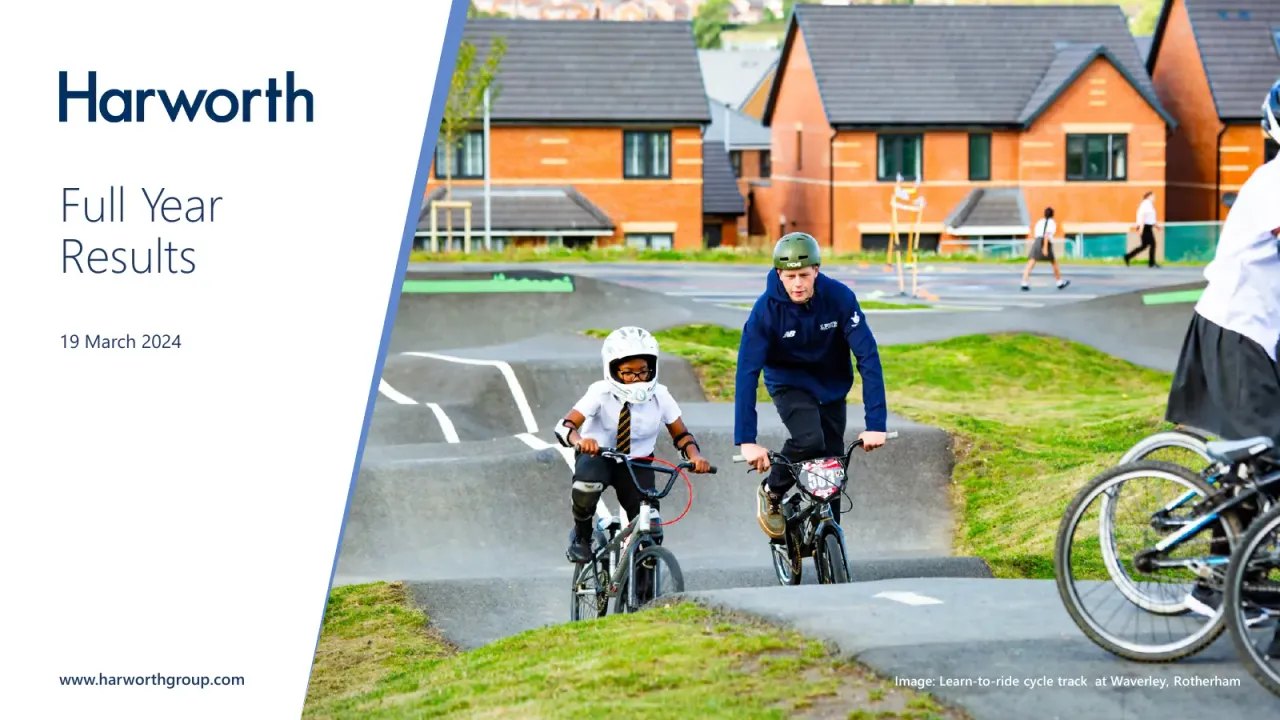
31:26 But, you know, in terms of HARWORTH and how we bring our sites forward, there is a really big focus on basically the sort of local communities and the communities that we create. And we've opened up a significant amount of acreage of new green space across our sites. We've opened up a ride learn to ride cycle track at Waverley in sort of the heart of the what's of the amenity. We're on-site with the with the school at Coville and Olive Lane, is also at Waverley. We've actually sort of now starting to build the health centre, a lot of local shops, some offices and some of the housing that sits around that central hub in the middle of the site. We're important, as I said before, to our regions. You know, our portfolio can actually deliver, you know, over 76,000 jobs into the regions and 85,200,000 of business rates. And we work really hard with local authorities to make sure that we're delivering the right schemes and the right sort of products, you know, sort of for them and what they want to grow in terms of employment and industry as well as housing.
32:31 And then from a people perspective, we've had a busy year across a range of things, but looking at values, culture, behaviours, but also actually making sure that we're training and developing our people through through their careers. So to conclude, you know, where we sit today, we're really enthusiastic and massively optimistic about actually this business's ability to continue to drive on and deliver against the strategic targets that we've set and to reach that billion target by the end of twenty twenty seven. I hope I've shown you in the presentation that we can self propel that through the land bank that we own and control and the skills that we have across our teams to unlock the best uses and the best values from those sites. We have got a proven track record of delivering, through the cycle and actually more importantly, consistently delivering above market returns through the cycle, particularly in periods you can see in the last couple of years where virtually everybody else has gone backwards and we've managed to stand still and move forwards, which I think is a testament to that long term through the cycle approach, but our ability to take land and actually sort of work it through the system.
33:40 And that low leverage and strong balance sheet are really well positioned to drive value from the markets and actually fund our growth as we go forward. So that's the presentation. I'd like to hand back to Alessandro to just brief you all on how to submit questions. I will start with a couple that we have submitted in advance actually but I will do my best to answer as many as I can in terms of what have been coming through on the queue. Thank you. Perfect. Linda, thank you very much for your presentation. Ladies and gentlemen, please do continue to submit your questions just by using the q and a tab which is situated on the top right hand corner of your screen. We just follow-up to take a few moments to view those questions that have been submitted today. I'd like to remind you that the recording of this presentation along with a copy of the slides and the published q and a can be accessed via your investor dashboard.
34:30 You can see, we have received questions throughout today's presentation. And as you did mention, we have received a few ahead of time as well. Linda, if I could just hand back to you just to maybe start with those pre submitted questions, and then I'll pick up from you at the end. Okay. So I'll just read the question out that's been submitted and then and then sort of talk you through it. So the first question that we had, was with the launch of both the affordable housing and net zero home strategies in 2023, can you discuss the anticipated return profile and return on equity for these strategies and how they compare with HARWORTH's traditional land sale model? So that was the first question. So I think just to sort of, recap a little bit, both the, affordable homes, built to rent, net zero carbon homes, senior living actually when it comes, were all part of our strategy to provide resilience, to our product range and open access up to new growth markets.
35:26 And that means that they reduce our dependency as we work through the cycle just on that traditional sell to service land to house builders, which actually when the housing market is really strained is quite an important sort of strength to have to our bow. But they're also about the velocity at which we work through our sites. So, actually the more phases we can get on-site together and as long as they're not sort of contaminating each other, enables us to drive lamp prices on, but actually enables us to basically drive returns because we're not holding a site for too long and actually sort of ultimately seeing that potentially start to drag on returns. In terms of the service land that is related to these products, we're actually sort of selling it in exactly the same way as we would to house builders.
36:14 So, you know, sort of we are selling sort of land, you know, sort of at book value at book value at valuations. So if we're selling land, today, we would be looking at December 23 valuations. If we were selling land into one of these portfolios last year, we would have been looking at December 22 valuations. And then on top of that, we take a development management fee. So there's an extra sort of slice of return, for us as HARWORTH. The really important thing about this and why we sort of phase them so and yes, we're very focused on actually bringing them forward together is because we want to maintain control of our sites and we want to maintain control of our master plans. But actually, as we can accelerate and actually create really quite diverse communities, we can bring amenity forward like schools earlier.
37:00 We can bring, you know, sort of all the sort of convenience stores and parks forward earlier and that place making piece earlier, which does have a halo effect on the valuations of later phases of the site. So it's not something that we're doing at a discount. We're selling it. It could be a sale to a house builder or affordable homes or BTR because actually we're getting that land value out, which is really important to us. And then on top of that, there's an extra slice of return which comes from the development management fees. So that was the first question. The second question is looking at, the industrial and logistics space. And after developing 432,000 square foot of industrial and logistics in 2022, the 193,000 square foot developed in '23 and the 208,000 started or about to start on-site in '24 reflects a reduction in growth, which is well below this 800,000 per annum.
37:58 Yes, that is right. It's for a number of reasons. And the question goes on to say, you know, what is the barrier to scaling industrial and logistics? Are development economics unattractive? Market risk too high, or is it timing and planning? There is a little bit of everything in there. We took a decision. We were on-site with spec as we exited 2022 at the Advanced Manufacturing Park. They're smaller units ranging from sort of 5,000 square foot to 40,000 square foot. So product we're really familiar with. We pressed on and then completed that, and we're in the process of letting those units up. But we took a decision not to start any more spec in 2023, but instead to focus because of the stage our sites were at on the infrastructure works to open up these sites such as Chatterley, the next site at Gate the next phase at Gateway 36.
38:51 And we've got, some land down at Droitwich, which was a former investment portfolio asset which we plan to redevelop. So actually, we always knew when '24 will be very similar that we might be building less physical buildings as we went through '23 and '24, but we've been really focused on opening up these big sites that I've described earlier with, and site enabling works and infrastructure. And we'll be marketing them as we go to secure the pre lets to sort of kick into that next stage of building. And that should scale up relatively quickly if we've unlocked and opened those sites up and got them ready for production. Market risk is is is I would say in industrial and logistics, the market's pretty stable.
39:39 You know, sort of institutional investors are back looking at product, but they're skewed to the grade a, so the sort of stuff that we're building. Occupiers are back looking at product, and again, it's skewed to grade a, the stuff that we're building. And in our markets, we've probably got less than a year's supply of stock. And obviously, like not a huge number of people have been building any any spec at any scale as we have actually as we went through 2023. So there is a real opportunity as this as as hopefully we go through 2024 and market conditions continue to improve that we'll actually have sort of quite a lot of firepower to go into '25 and through 2627 from the sites that we have. Planning is still painful though. Having said that, we've had some glimmers of optimism in, more recent weeks with a lot of local authorities actually producing their draft plans, and we've got quite a lot of sites now with draft allocations in the industrial and logistics space.
40:38 So it feels like it's moving, but actually the whole process of a planning application, as we've seen with Gascon Wood, is pretty slow. With a portfolio our size, we've got all sorts of things moving all sorts of different speeds. Hence, we've got ourselves into a position where we can sort of kick on, and start to build on some of these big signs. And then the next question is around, admin expenses. So, again, I've alluded to this earlier that they increased significantly in '23 versus '22, as we've invested in the team. And the question is is, do we have the team and the infrastructure in place now to support scaling the business, or will we be adding more? So 2022 was a big year for us. The reason you've seen the number jump so much in '23 is that's the first year where we've had the full year effect of the hiring activity that went on in '22.
41:32 And we really did scale the business to basically sort of get us into a position to sort of drive forward. We will have to hire continue to hire selectively in areas such as project management and development and planning because our portfolio is growing. But also the number of sites that we will be active on will also be growing. So there will be some selective hiring in areas like that as we go forward. But we think the big jump, you know, sort of was the one that we saw between 2022 and 2023. Let me just have a look on this. Sorry, I'm having to I've got no one to read the questions in advance so just bear with me. So the, there's a question here which is the 5,100,000 of annualized rent roll that will be added through the sites that are either, where we've got vacancy.
42:27 The new sites have been built are still vacant, so we're letting them up. The stuff we're on-site with this year or the stuff we're about to go on-site with, and it's saying, is that going to land this year? And which sites and how many square feet are being transferred into the investment portfolio to deliver these increased rents? Okay. So I can do this one. So, that 5,100,000 will probably sum this year. So we've already got about 2,100,000 of that 5,100,000 sort of sitting, yeah, waiting to come in. And some I think I suspect will sort of trip into 2025. When we underwrite the development, we have void period, to let them up. And generally, all of this stuff that we're doing is sort of is coming in within that underwrite period. So it's quite hard, you know, sort of to build a building in the year and get it let an income producing in the year. We try really hard to do that. But actually, we're marketing buildings as we build them to secure that pre let so that we get that income coming in as early as possible. So the 5.1 should ramp up as we we should ramp up towards that as we go through 2024, but some of that will come into 2025.
43:34 The sites that we're talking about sort of in that are the one unit is a letter Gateway 36 at Barnsley, which is around 50,000 square foot, and we've got heads of terms out, you know, sort of on that and some pretty serious interest. We've got, a number of units from the speculative development to the advanced manufacturing part, we're in the process of of marketing and, again, letting up. And we've got good interest, healthy level of interest there actually. We've got two units which are pre let, which were on-site with buildings. So the income from those at the advanced manufacturing part will come and those units will transfer in and that will sort of come through. And we've got a build to suit unit for an occupier who basically bought the land and we're building them a unit. So that is that's theirs and it's off the books.
44:23 And the other sites that fit in that are some some that we will start opening up at Chatterley in terms of the sort of smaller multi unit phase and also potentially Droitwich. So we've got a number of sites that will that will feed into that 5,100,000 and potentially beyond that depending on how much we can get on-site as we go through 2025. And then we've got comparing, industrial major developments portfolio from the half year results to the full year results, a material uplift per square foot. That eight from 18 to 29. Just let me see if I can go back to that slide. So you can see oh, there you go.
45:13 So you can see. And it's basically saying, can we explain this large movement? So as I as I said earlier, strategic land is land that does not have a planning consent. It might be have a draft allocation, or even be allocated, but we hold it as strategic land until the point that we have a planning consent and we've made a meaningful start on-site. And the big movers between sort of, strategic land of major developments on industrial and logistics last year, were, Skelton Grange where we got a consent during the year, Ansty, which has significantly sort of, which significantly progressed during the course of the year, although that will largely still be sitting in in in strategic land.
46:03 Benley and what have I missed? Wing and Wingate. So the big the big two really on that are are are probably sort of Skelton and Wingate actually. So that planning consent and that progress through planning, which derisked the site has really sort of started to sort of shift the valuations on. And as I said, when I talked about this slide earlier, that industrial and logistics portfolio is quite immature in terms of the number of big sites you know, that are in production and that we're building vertically on at the moment. You will see that to really start to ramp up as I sort of talked about on slide 16, as we get more sites with the consent and we get more sites where we're putting infrastructure works in. Chattel is infrastructure works will have been in that in that number as well. So that's what's really sort of moving it. It's planning consent and it's actually sort of, it's infrastructure works where we're where we're sort of spending on that.
47:03 And then I've got a question around, how are we looking to balance the business going forward with home buyer demand and protracted negotiations in industrial potentially being a drag? It's an interesting question, actually. So so we like the fact that we do both both homes and jobs and that we do them both at scale. As I said earlier, we think we're really important to our regions, and and they think we're important to them in terms of of what we deliver. Those more mature resi sites are really a key part of how we fund ourselves. So actually the cash that they throw off and sort of, you know, is basically recycled back into the business in terms of acquisitions, in terms of paying down our debt. So it comes in really nice and low at the end of the year.
47:52 And in terms of basically sort of putting cash into infrastructure investment and development. So we see the sort of two sort of work to a slightly out of sort of think cycle, but they're both important to what we do. And we're continuing to build both portfolios to give us as we scale to the billion, you know, sort of that, you know, sort of the cash that we need and the opportunities at scale that we need across the regions. So that's let's say we like both and our acquisitions team target both. We might target slightly different mix in terms of like maturities of sites depending on sort of if, you know, what what we think we need to sort of drive in a particular year of our plan as we look forward. But generally, sort of, we are focusing our attention on still on both markets.
48:41 From an industrial perspective, and logistics perspective, it's slow at the moment in terms of like, you know, sort of time taken to get a deal done, everything takes longer. But as the market sort of moves more into that growth mode, everything starts to happen faster. I mean, we're only like twenty four months in the rearview mirror from speculative buildings being pre let, you know, sort of, a matter of months into construction or actually not even being started to spec because a build to suit deal had been agreed because nobody could wait for the stock. So when the market turns, it turns quite quickly. But as we as we look at our portfolio and we look at the sites, whether they're residential or industrial and logistics and the phasing of when they're in production, the two together basically enable us to continue to push forward and and drive drive the returns.
49:35 So I hope that answers the question. You know, we've balanced the two and we're on top of it at a portfolio level in terms of pulling the levers that we need to pull if something's going slower, like what what can we we look at what we can speed up elsewhere. And then I've got a question on how can you accelerate the residential pipeline? It's a very good strategy question. We spent a lot of time looking at this back in early twenty twenty one. And we basically analysed the portfolio, we analysed the absorption rates for build to sell homes in the markets that all of our sites sat in. And we realised that some sites maybe you could get a phase away every other year because market absorption wouldn't take 200 new homes like in a year being delivered on a site or even a 100.
50:30 Other sites, so the Colvilles, the Waverleys, the Ironbridge is actually with an excellent that does this, are quite capable of having several different house builders on at the same time producing product into the market. So that's where the mixed tenure piece comes in. What we realised was in markets where you might only be able to do one phase of sales every other year, was actually you could do a build to rent portfolio in that market and it doesn't compete with the build to sell product and you can actually build it at the same time. So that's actually how you start to accelerate your way through that residential pipeline. And you basically sort of drive returns by getting more sites out of the front more phases out of the front door earlier. But also, you're putting all your amenity in earlier, which is basically making it, you know, a more valuable place to come in terms of sort of land sales later on. So it is that mix of, both housing product. So if you've got three different house builders, they'll be tending to build slightly different things at different price points. Mixture then of 10, so that rental affordable senior living, net zero carbon sort of all come into the mix on that.
51:45 Then I've got a question on with the upgrade support further increasing grade a assets to 37%, what's the target by the year end? So we don't actually set ourselves an annual target with this. What we've got is a target to get to a 100% modern grade A by the end of our strategic plan period, which is the end of twenty twenty seven. Because actually that will that's all determined by the phasing at which we develop assets and and those assets that we choose to hold. But you'll see that that will sort of shift up by another 208,000 square feet as we work through 2024, which I think is probably somewhere around 5% I think of the portfolio. I can't remember the top of my head actually the scale of portfolio having sold some out. So you'll see if all that stock is transferred in and of a meaningful stock is let, you'll actually see that number tick up. But we're only gonna be on-site with 208,000 square feet as we go through 2024 as I as I flagged earlier. So that's basically, you know, sort of the maximum we can shift it up other than where where we are working with tenants and we're using, a a lease opportunity to basically sort of invest into some of the buildings. So we have done creme assessments on all of our,
53:16 sort of existing stock. That's not the new stuff that's been going in over the last couple of years. And that gives us a pathway to actually upgrade should we choose to, which we would only do if it's economically viable and sensible to do. But the portfolio is not in bad shape. 75% of the stock is at EPC c or better already. So it's not that big a leap, you know, with some of the existing stock that's not new, actually, to sort of, to move it up. So, I say you'll see it move with the new stock coming in, but we don't set a specific target because you'll should see it really ramp up as we go through the the later years of the strategy. Okay. So, so Northern Gateway is the next question. So I've got, is it possible to give a little more information on the approximate residential and industrial split?
54:12 It's so she it's actually two sites. There's about 1,200 residential units on one of the sites, on the resi site. And then on the industrial and logistics site, it's up to about 11,000,000 square feet. So we own or control in joint venture, you know, sort of, a significant proportion of that already, in and and actually access to the land sort of, around it. So that's the, it's the key employment growth node for Greater Manchester out till 2040. So there's quite a lot to go at actually, in relation to that site. And then I've got a question that says, in terms of those sites or plots included in draft allocation and allocation currently, what is the assumption that these sites and plots are successfully granted planning and moved to consented?
55:08 It's a really good question. All I'd say is we're really good at planning and we always get there eventually. So our assumption and when we underwrite a site and work in terms of acquisitions, we're looking at both acquiring and assembling sites that we believe have a very strong chance of being allocated and being able to brought forward be brought forward, at some point, you know, in the future. And at some point, we tend to think, two planning cycles out. So if it misses the current five year planning period, it could possibly miss the ten the next five year planning period, but it will be in the one after that. So the maximum sort of time period we're generally thinking about is somewhere between sort of, you know, nought and fifteen years.
55:54 And if you took a site like Northern Gateway actually, which is a great example, we have been assembling places for everyone has been going through the process for a decade. So this the spatial strategy, you know, sort of across Greater Manchester. And we have been assembling that site for probably the best part of sort of seven years. And I would say the same with Cinder Hill and the same with a number of our other sites. So that's really sort of one of our real skills is assembling the right land in the right place at the right price and then actually sort of walking it through the planning system successfully. You know, it doesn't always work to plan. At the moment, we've got some stuff going faster than we underwrote. There'll always be some that go a bit slower. But again, with a portfolio of our scale, we sort of are managing that at a portfolio level so we can take your sort of websites doing different things to to what we assumed when necessary.
56:52 So given the planning backlog slowdown backlog slash slowdown is a key focus, what are the historic levels of planning success across the residential and industrial portfolios? It's a 100%, you know, it just takes time. You know, we we can't think of one that we have not got planning on eventually or we've just given up on. But like I say, I think it's really important to think about, you know, sort of what HARWORTH is. We're a strategic land and regeneration business. And as I've said, we assemble land today that we might not actually get allocated for ten years And then we might not be building on for about fifteen. And that look at the portfolio that you can see on slide sixteen and eighteen shows you actually sort of how much has got a consent, you know, sort of what's the next stuff in the flume because we've got an application in and basically sort of then what's to come in the future. And it's about having a portfolio that is big enough to have enough sites in production and then continue to sort of work the other ones through sort of in the background.
57:58 And that's what HARWORTH does. That's how we create value and that's how you generate this market outperformance that we've been talking about. And the last question that's on here says, is there any specific reason you feel why the stock market doesn't appear to recognise the potential current future value here as the share price still continues to trade at a significant discount to NAV? It is very frustrating. My simple view as chief exec of what I think is an amazing business with amazing potential is we just need to keep delivering consistently. We've had five years of consistently delivering market outperformance. Sort of we've been growing our dividend by 10% for seven. We'll continue to do that, you know, dividend aristocrats twenty years in the making. So we're continuing to consistently do that. We're showing that we're executing really well on our strategy and, you know, sort of we just need to sort of keep going and keep growing that underlying sort of asset value in the company. And eventually, you know, sort of the market will behave in a in a much more, I don't know, sort of sensible way in relation to a stock like us.
59:16 Know, management are doing everything they can and actually, you know, sort of, there is an issue with The UK equity markets and our sector at the moment that's beyond HARWORTH or management. You know, we've seen lots of institutional outflows that have not been, you know, sort of made up with the same quantum of institutional inflows. And there is a bit of a sort of pause, you know, in terms of inward investors looking at The UK and thinking like, should I go? Should I go? But, you know, the whole of the sector is actually sort of looking pretty cheap at the moment. And, you know, sort of I think interest rates are key. I think as we start to get some, you know, the interest rates coming in, maybe a little bit more and a little bit faster than people were anticipating. If inflation keeps sort of coming down the way it has been, then actually you should get some more momentum in the market. But, you know, I'm focused on long term value growth, you know, sort of with this company just the great things that I think we can do with that.
1:00:16 Perfect. Perfect, Linda. Thanks very much for answering all of those questions. You actually managed to answer every single one. We are at the hour, and I know we you've got to go at the hour. But just before maybe redirecting investors for their feedback, could I just ask you for a few closing comments? Okay. So I think, like I say, just to really reinforce, you know, where I ended then, we believe we're on track to deliver that billion of EPRA NDV by the end of our strategic plan period. We can self propel. I hope as I've shown you through the land bank and the stage that some of our sites are now coming to enables us to really kick on and scale up that volume in industrial logistics in particular. The skill set, you know, we've hired in a really challenging market through 2022. We've hired some fantastic people. That's absolutely critical to us continuing to be able to perform in the way that we are.
1:01:05 This proven track record of driving and delivering above market returns is really important and we're very focused on continuing to do that. And that low leverage, that really strong balance sheet, a number of investors over the last sort of eighteen months have said to Kitty and I, whatever you do, don't muck it up. We've worked really hard and we've been really deliberate at actually getting ourselves into a great place so that as things start to improve as we go through 2024, we can actually sort of unlock that firepower and actually sort of fund our growth basically. So exciting time, exciting years ahead and I'd just like to thank everybody for joining. And I hope the CFO version of the CFO's or CEO's version of the CFO's slides hasn't put any of you off. But if there's anything you think we missed, like I say, just submit questions to us in writing and actually we'll try and come back to you. But thank you for your time this afternoon.
1:01:59 Perfect, Linda. Thank you once again for updating investors today. Could I please ask investors not to close this session as you'll now be automatically redirected to provide your feedback in order that the management team can better understand your views and expectations? This will only take a few moments to complete, but I'm sure it'll be greatly valued by the company. On behalf of the management team of HARWORTH GROUP PLC, we'd like to thank you for attending today's presentation, and good afternoon to you all.
Follow Harworth Group PLC into a list and get an email when it puts out news.
CEO at HARWORTH GROUP PLC