Devkinandan Rumta
Chief Financial Officer
Replay available
Gufic Biosciences (NSE:GUFICBIO) Q1 2027 earnings call, held 2026-08-17. Watch the replay and read the transcript on 6ix.
On 6ix: 6ix.com/event/gufic-biosciences-limited-guficbio-q1-2027-earnings-call
Automated transcript · Written by software from the replay's audio. It can mishear names and figures; the replay is the record.
0:01 Ladies and gentlemen, good day, and welcome to Gufic Biosciences Limited Q1 FY 'twenty seven Earnings Conference Call. As a reminder, all participants' lines will be in listen only mode, and there will be an opportunity for you to ask question after the presentation concludes. Please note that this conference is being recorded. I now hand over the conference to miss from Gufic Biosciences Limited. Thank you, and over to you, ma'am. Thank you so much. Good afternoon, everyone. Hi, company secretary. Welcome you all to the investor call of Gufic Biosciences Limited financial results for first quarter of FY six'twenty seven.
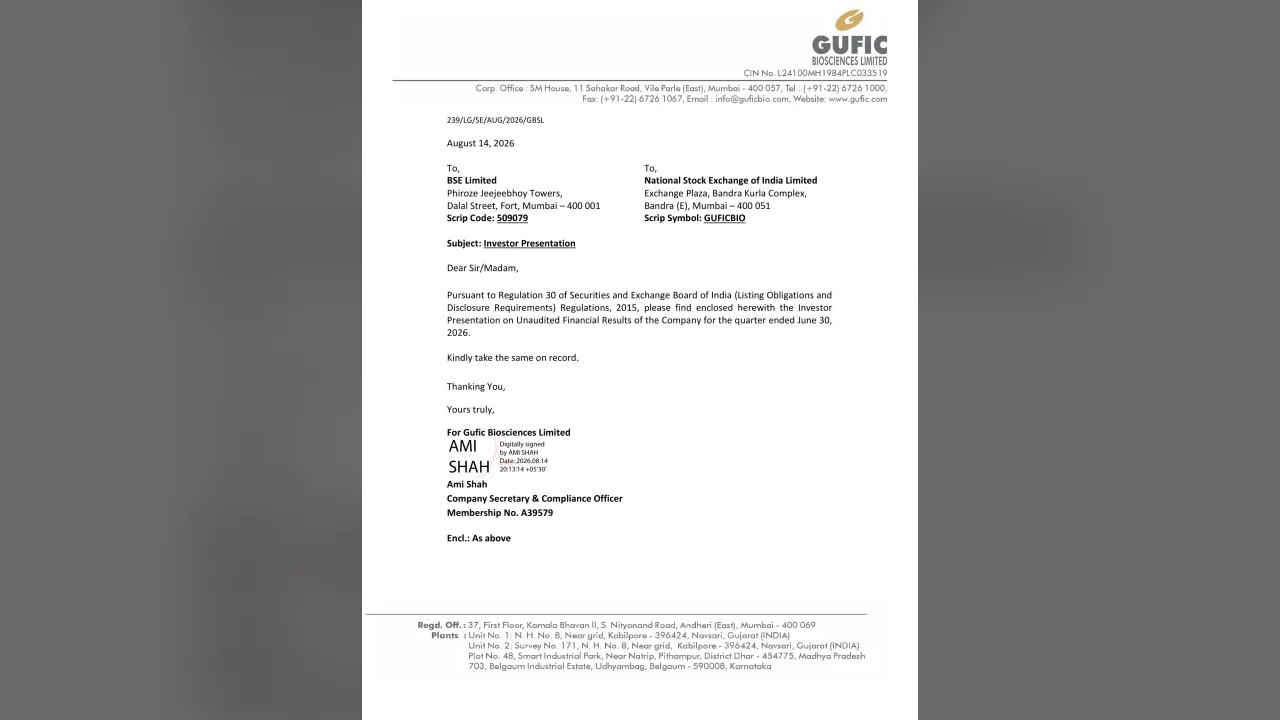
0:48 The press release and investor presentation relating to today's to the result has been submitted to the stock exchange on Friday and are also available on company's website. Let me begin by by introducing the management team joining us on today's call. We have with us mister, CEO and hold time director, Mr. Devkinandan Rumta, Chief Financial Officer and Mr. Avik Tas, Investor Relations Head. Before we begin, I would like to remind everyone of the safe harbor statement. Certain comments made during this call may contain forward looking statements. These statements are based on management's current expectations and are subject to various risks and uncertainties that could cause actual results, performance, or achievements to differ materially from those expressed or implied in such statements. Participants are advised to review the relevant disclosure and risk factors available in the public filings. With that, I would now like to hand over the call to Mr. Avik for his opening remarks. Thank you.
1:44 Thank you. Thank you, Ami, and good evening, everyone. Thank you for joining us. Starting with Indore, the plant is running to plan. Qualification and validations are behind us. Product tech transfers are progressing on calendar we have set out, and our contract clients continue to migrate across from Navsari. What is new this quarter is capability. The depot and microsphere suite are nearing completion. So during this year, we will manufacture long acting depot presentations in house at InLore itself. We have also begun setting up a lipid based antifungal by both an alternate approach over and above the conventional route.
2:29 Very few sites in India run either, and both are targeted to be operational during this year. In critical care, we launched our monobactam and beta lactamase inhibitor combination immediately on expiry of the innovator patent, and it is now introduced across corporate, tertiary and secondary care networks. Early acceptance in large institutions has been encouraging. The division's focus this year is depth widening and coverage within the hospital groups we already serve rather than handling portfolio with. Sparsh has completed a full quarter on the rebuild channel. Outstanding days are within standard trade terms.
3:14 Hospital onboarding has resumed at scale and coverage is now balanced between nursing homes and corporate chains. Two points worth noting, I. Our focus has moved towards our own manufactured brands, which help both margin and supply reliability, and the dual chamber bag is gaining acceptance in major institutions. The division also entered Northeast and Jammu and Kashmir, applying the new channel architecture from the outset. Its launch pipeline for the year is the widest it has ever carried. In the women's health, FortiCare retains its leadership in recurrent implantation failure. The PureGrave Group secured entry into major corporate IVF chains this quarter.
4:03 The investigator led studies with senior Indian clinicians have begun. ZENOVA continues its planned shift away from injectables towards prescription led chronic therapies. The antioxidant range we introduced is now a meaningful growth layer. And the two first mover launches are ahead, one in osteoarthritis and one addressing a metabolic ovarian segment. On botulinum toxin, we remain the number two brand in India in toxin type A manufactured from our own strain. The in licensed filler and biostimulator portfolio is progressing through its supply and regulatory steps for launch during this financial year with no significant capital expenditure from us. On the therapeutic side, the franchise continues its expansion beyond the core neurology into urology, ophthalmology, pain management as well as neurosurgery.
5:05 In the nutraceutical and Ayurveda division, our lead joint care range outperformed its relevant product market this quarter. Our acid blocker continues to build gastrointestinal therapy into second pillar alongside pain, and the division has prepared its first entry into an allopathic pain management segment, which launches during the year. In the international front, the model change is now producing fee income alongside supply revenue. During the quarter, we progressed licensing in Europe, executed a contract manufacturing and licensing arrangement with a North American counterparty and received first contract manufacturing orders in Australia. On our registrations front, we secured approvals across eight countries during the quarter and in one of them five presentations in a single therapy area cleared on the same day, which is exactly what the therapy basket approach was built to do.
6:05 So the platform is in place and the pieces are moving to schedule. Our medium term expectations, which Pranav and Rumta, sir, have set out in previous calls are unchanged. With that, I'll hand over to Gupta, sir, for the finance update. Thank you, Abhi. I am going to highlight... Give the highlights of q one of twenty six, twenty seven versus q one of twenty five, twenty six. Total revenue from the operation in '20... Q one of twenty five twenty six was $2.26.9 crores compared to q q one of twenty six twenty seven, 260.8 crores. The EBITDA for q one of twenty five, twenty six was 33.2 crores, whereas the q one of twenty six, twenty seven is 47.2%, $2.02 crores. EBITDA margin in q one q one of twenty five, twenty six was 14.6%, whereas q one of twenty six, twenty seven is 18.09%.
7:04 Profit before tax in q one was 16.3, whereas q one of twenty six, twenty seven is 30.1 crores. The PAT margin in q one, twenty five, twenty six was 7.1%. In Q1 twenty six twenty seven is 2011.56%. The profit after tax in Q1 of twenty five twenty six was 12.1 crores. In q one, twenty six, twenty seven is 22.46 crore. The PAP margin in q one was twenty 05/20/2526 was 5.3%, whereas in q one, twenty six, twenty seven was 8.61%. Now I'm giving you financial highlights of q one twenty six twenty seven versus q one... Q four of twenty six twenty five twenty six. The total revenue for q four of twenty five twenty six was $2.52.1 crore, q one of twenty six twenty five... 2627 is $2.60.8 crores. The EBITDA margin in q four of purchase service was 44.7 crores.
8:06 Q one of twenty six twenty seven is 47.2 crores. EBITDA margin in Q4 of INR 25.26 crores was 17.74%. Q1 of INR 26.27 crores is 18.9%. PAT margin profit before tax in Q4 of 25%, 26% was INR 27.6 crores, whereas Q1 of INR 26.27 is INR 30.1 crores. The PAT margin in Q4 for INR 20 five-twenty 6.10%. Q1 of 26%, 27% is 11.56%. The profit after tax in Q4 of twenty five percent, 26% was INR 20.6 crores, whereas Q1 of 26%, 27% is INR 22.46 crores. Thank you.
8:56 Thank you. We can now proceed for the q and a session. Thank you very much. We will now begin with the question and answer session. Participants begin are requested to use handsets while asking a question. Ladies and gentlemen, we will wait for a moment while the question to assemble. The first question is from the line of from Samasta Capital. Please proceed with your question. Thank you. Am I audible?
9:43 Yes. You're audible. Yeah. Congratulations on the number. Just a couple of questions. This first one, just wanted to know two things on GLT. Are we also participating in terms of our own brand? And also has the third party GLT manufacturing started kind of coming into our revenues? Yes. Hi,. It's Pranav here. So in terms of GLP one specifically,, as we have mentioned in the calls before, we are part... Partnered up with Hetero. So Hetero got their permission in May 2026. So our traction of their revenues was residual in the q one.
10:29 But, yes, to answer your question, we have started the CMO operations, which will, I would say, take some steam in q two, but have further steam in q three. In objective would be CMO in the domestic space on a maybe 30% level, but 70% we hope at the end of the year would be capacity used for the international market where Hetero and Gufic as a single channel has filed in more than 22 countries. But, of course, our revenues would be purely as a CMO. Again, I'm reiterating. We are not going to do any front end neither in India, neither abroad. We will be using this as a CMO opportunity to support Hetero like we did in the past with Remdesivir, and they will be front ending the product internationally as well as doing CMO in India.
11:24 Understood. And and also the international market, there was a change in model from a distributor led to IT. And so, I mean, if if possible, can you just explain how how that changes things and how that kind of benefits us? Sorry. Can you can you repeat your question again? We... I lost your voice in the middle. No. I was saying in the presentation, you you had special model special for international from distributor led to IP led. So can you just Yeah. I'm Okay. So I think I I got your question correctly if I understood. So your question is that, basically, in our presentation, we have mentioned we are going from a b to b as well as to a B2C. In other words, that earlier we used to just manufacture products and give it to certain distributors in the emerging markets. Now our strategy is specifically for markets like Africa, Southeast Asia as well as South Asia, that is where we have a front end, I would say, ambition. So just to add up on that, so we have just recruited around a team which is based in Mexico. One person was based in, I mean, Africa recruiting for the people. One person was based in Philippines, and two more people who have an African and a Southeast Asian, I would say, legacy in in in Mumbai. They will be seated in Mumbai, but, of course, traveling fifteen days of the month. So, gradually, what we are
12:55 trying is, you know, as we have done it in Europe in the past by trying to get our own subsidies made in Ireland and UK, where the marketing authorizations remain with us. In these markets also now... Actually, not now, but since the last two and a half years, we have been always saying that we are trying to get our registrations in. So some of our registrations have started coming in, we hope in this coming year and next year, we should have more registrations in place. So right now would be the best time for us to actually have a separate team. Of course, in some countries, maybe start off with the distributor field force till we reach economic of scale. Wherever we have enough registration and economic of scale, we would like to deploy our own, I would say, field experts, which help us to get a better pricing. So, you know, in somewhere, if we are getting, let's say, a fifty fifty... I mean, maybe anything around 40 to 50% margins, we hope we can push them hours upwards of 15, 20% more when we have our own workforce.
13:51 At the same time, also, the IP and the trademark belongs to us. It's also creating our creating our own IP and in... You know, intangible assets going forward. So that's the strategy which we have started doing since March once doctor Raja started coming in last year. He started first in Europe and then this year in emerging markets. So this recruitment has happened in the q one. Okay. That was only helpful. I have a few more questions. I'll get back in queue. Thank you. Sure. Thank you. The next question is from the line of, an individual investor. Please proceed with your question. Hello, am I audible? Yes, you're audible. Yes, sir. I actually wanted to ask... First of all, congratulations on the quarter. I wanted to ask if you are expecting certificate for the Europe export.
14:46 Any update on that? So, yeah, I think in Navsari, we already have a EU certification, which we already continue the exports. The EU certificate, I think, what we are referring in a presentation would be for indoor. So the indoor certificate would... I mean, we are just waiting for the feedback from the authority. There were some complaints which we already have replied since the last two, three months, and even the time this data also has gone. So, hopefully, in the next, you know, maybe a month or two, we should be hearing something from them. Okay. And, sir, about the indoor factories, it was unused. It was only used, sir, 30% capacity. Right? Are we expecting a jump on that? Yeah. Of course. So if you see quarter by quarter, the capacity utilization is going up as more and more products for the domestic or for CMO or for our own branch or for that matter, wherever certain two, three countries which we have... We've been able to go for the transition and, I would say, site addition. We have already started that. Apart from that, we have taken validation batches. So in terms of pure capacity expansion, yes, the amount has gone from 18 to 22% last year, 20 to 25 last year, then this year close to 30%, 35% and hopefully, like I said, we should end up the year on around 40%, 45% capacity utilization.
16:08 So we are on course for that. Margin expansion using the indoor facility would of course come once we have, what do you call, our, you know, EU in place. EU market... EU certification really opens a lot of markets for us, so we are just waiting for that. And also, from that, one of our, I would say, partners have also triggered their, I would say, submission for US from our site. So we expect them also in the next, you know, I would say, quarter or two to visit us as per the goal period. So, yes, we are looking for all these movement of export markets, which would help us to not only utilize the capacity, but help us in our margins also. Yes, sir. Regarding the margins, we... From June 2023 to, I think, September 2024, we had an operating margin of 18%, but it dropped after that. But now it is 18%. So is 18% the new normal margin for the year coming?
17:10 Yes. And I... I'm sure Gufic has explained this in the last two calls also because in the period which you have mentioned, at that time, the total expense of Indore as well as the depreciation and the interest were being capitalized. So hence, all those factors were till, I believe, October 2024 or the... That q three twenty five were part of capitalization, and that's why after that, you saw a drop post q three, q four twenty twenty five. But now with capacity utilization, with natural business progression as well as exports margin expansion along with domestic business also, So what you are seeing as you write, this is, I would say, the start of the improvement of margins going forward. Yes.
18:01 Okay. So thank you so much. That clear. You. Yeah. Thank you. The next question is from the line of, an investor. Please proceed with your question. Yes. So two questions. One, if you can, you know, is... Maybe it's still early, but can you elaborate on the botoxin tire, which we did last quarter with the Canada fillers thing. How how can it scale up this year in terms of revenue and going ahead? And on the one more question on the GLP one. You said you are doing the CMO route in a partnership. So how much revenue and how much growth can it come this year?
18:53 So so the first question being about our aesthetic division, where I think we have done the tie up last year for the pillars. So the pillars, as a category, complement our botulinum toxin products because toxin and fillers are two important tools in the hand of aesthetics practitioners for their therapy. So the filler market in India is around 200 crores. I think this is as per the import data and data which we have which we have derived from. So we feel that this filler market is much bigger than the toxin market as of now in India. And anywhere we used to go to meet our doctors, they always, you know, expected a same company to have a a toxin and a filler. So, you know, this just helps us in our practice. It it helps us in our training. It helps in the knowledge This same patient, and I really just didn't want to tie up with any other filler provider. So we are fortunate enough and, you know, and and my team did a great job that revenue is prolinium from Canada who is number two in US and also more present in more than 32, 33 countries in the world, they have selected us to partner with them for India. So we feel that the revenue would be captured maybe by post December because we have started the registration process in q one... I'm sorry, q four last year.
20:13 So we feel that maybe by q two or mid of q three, we should get the registration. And we hope at least December... If not December, maybe January, we should launch the pillar in the Indian market. So first year projections are decent, but let's... Again, let... Instead of me giving you numbers, I've given you total market numbers. And we hope that with the help of these pillars, we can also not only strengthen our number two position, but very close to... You know, very close, we can grab the number one position in terms of toxin and fillers in the next, you know, three to five years in India. So that answers, I think, part one of your question. Part two of your question is about GLP one. So, yes, in GLP one, again, I reiterate that our focus is purely on CMO.
21:00 In the q one also, we had a ten to fifteen day plan shutdown because we were introducing the new machine, assuming that in March, Hetero would get the permission. And Hetero got some part of the, I would say, strengths of simaglutide approved in May and some other strengths also. I am the person of getting approved or have been approved last month. I'll check and get back to you. So we hope that the traction will pick up from q two. Some traction will happen in the month of July, much more we see in August. We hope there's some, again, media fills in void by which, again, the plant will be closed for five days and there are visits. And q three is when we will see the actual traction happen. So, again, in terms of numbers, they would be part of our 15% year over year growth, which we always tell to people, and they're already embedded in this. And, I'm seeing our role is purely as a CMO. We have no front end plans or revenue forecast for the GLP one on our own.
22:03 Who talks also? And are you being conservative when you say you're gonna grow by 15%? You mean quite 15% year over year as a company? Yes. I'm not being conservative because there are some product mix we are also leaving out, and we'll be getting a little low yielding. So I would say 15 to 20% is what we say we should grow year on year as overall as a company. Yeah. So so so so is it that maybe from next year, you will be reaching that infection to grow grow beyond 20%? Or the business that said that we'll be growing only at 15, 20%? So the thing I'm trying to understand is, is it somewhere or is it something I mean, can we push the pedal and, you know, grow beyond 20%? The scale we are, it does look like, you know, 20% was.
22:52 Alright. So I I think I would love to give you any other comment right now on the call otherwise, but our efforts are on to grow much beyond. But 15 to 20% is what we commit to you that would be a bare minimum. Okay. Okay. Okay. And, Butox, are we launching in export markets? We have started the procedure process of registering the Stunox. Again, Butox is not our brand name. That's Allergan. So Stunox is our brand name. So our botanox and Stanox and Zargod, we are in the process of registering in some countries. It take around twelve to eighteen months depending on the different geographies. But the limitation would be our facility. Our current facility is only WHO phase one with limited capacity. So we are right now looking to register them only in the Southeast Asian market, African markets to start off with. For the other global market, we have a strategy maybe post next year once we see further cash flow coming.
23:48 Okay. Okay. And as a indoor, all the capabilities are now operation or something is yet to come in q two? No. Indore as a unit is completely operational. What I think, Amit, from his call that there are different product lines which we'll keep on introducing. So earlier, lyoplized liquid were introduced in the form of small molecules. There were some GLP and validation batch taken last year, last two quarters. And this year in q one, we have initiated the, I would say, the installation and qualification of the depot as well as the liposomal inject... Injection. So these are just new new product lines which will keep on being added to the indoor facility. It's not that any new infrastructure or equipment or anything of that sort is the... Any major CapEx is being done. In the existing CapEx, we are just adding product lines, nothing else.
24:43 Okay. Okay. Yeah. Got it. Thanks. I'll join in the queue. Thank you. Ladies and gentlemen, anyone who wishes to ask a question, please press star and 1 on their touch tone telephone. To ask a question, please press star and 1 at this time. The next question is from the line of from Wealth Management. Please proceed with your question. Oh, hi. Congrats on a good set of numbers. So I saw in the presentation that there was a a mention of tie up with the global health organization. So could you please expand a little bit more on that? What is the opportunity here as you get access to a 109 countries?
25:37 Actually, Abhi, can you refresh me? What was this tie up about? Is it in which sector? This was with respect to some of our anti fungal antibiotics with CHI. Okay. Okay. So... Yeah. So, yeah, the global type inwards and outwards, so I had to ask this question. Please pardon me. So in terms of the special type which you're referring is that for the European markets and apart from the European markets, there are these special markets for the liposomal product where we have signed up with the Child Foundation for liposomal amphotericin b, and they will help us to access more than 100 markets of the molecule of liposomal amines and potassium. Before that, there are certain bioequivalent studies which will be done. So we initiated this already last year, and I believe by August or September, we should have the study ready, and then we'll be filing it for the further submission to WHO PQ as well as the other countries. So this is a relationship, and we hope that this molecule then be taken up. And this molecule is from in... In Nausari itself, and now we are in the process of introducing the same to Indore also.
26:49 Okay. Understood. Yeah. That's it from my end. Just wanted clarification on this. Thank you. Yeah. Thank you. The next question is from the line of Arvind Arora from A Square Capital. Please proceed with your question. Hi. Thank you for the opportunity. So with the current capacity, what what could be the peak revenue without any further CapEx? Is it near to INR2700 crores across? So I think before I ask Roonta sir to answer this question, just to tell you that the revenue would be depend on the number of while the product mix and all the sudden several combination is there. However, considering the current, I would say, revenue per while, what we already have as per legacy, sir, will reply to your question.
27:46 Basically, if you see the expected revenue from our side part, 2627 will be in the range of around 1,100 crores. And you multiply it by every 15% increase over a year, two years, you'll able to get the revenue because 1,100 into 15%, twelve fifty, then fourteen fifty, then it can go up to... Maximum, it can transfer up to 1,600 crore with the existing content. Okay. Because in the one answer, I think it mentioned that we will be closing our capacity utilization by the year end would be 40% to 45%, correct? And if I extrapolate that, then the number would come near to 2,700.
28:36 2,700. Actually, that's okay. Yeah. Sorry. Go ahead, Gupta. Then I'll answer this question. 27? I don't understand. 2,700 means? So I think what... I'll come back to what we are referring to. If you see 40 to 45% can be of a ten ml vial for a pantoprazole, which might be giving us a revenue of around 60 to 80 rupees per vial. However, we are also trying to improve the, what do you call, the product mix by which we come up with molecules which are costing maybe, you know, anything around 300 to maximum to a thousand 1,500 rupees per vial. And that's why the introduction of, you know, depot long acting injectables as well as liposubmers. So it'll never be a single category. Always the product mix up all these things. So what is trying to say that, you know, now had mostly capped off at around 800 as the total capacity maximum extraction, which was possible. Of course, toxin and ten ms are the only two blocks which were not saturated, so we should... We could go to around maybe 900, nine fifty. Of course, in toxin, there is no limitation. It's more about market creation. Otherwise, without toxin, would be around 800 to 900 growth maximum where the capacity maxed out. So in Indore, anything around INR800 crores to a max of around INR1200 crores depending on the product mix, that's the maximum, I would say, capacity extraction, I mean, I would say revenue extraction possible from the current investment what we have done without any CapEx.
29:59 So the total CapEx is around INR 300 odd crores. I think exact is again mentioned in the balance sheet. But we feel that anything around INR 800 to 2,000 or INR 800 to INR 1,200, again, depending on the product mix, the different geographies and the improvement in product basket, what will be... That is possible from indoor. So totally, when I add both of them up, 800 plus... Around 800 plus thousand, it comes to around 1,600 to 2,000 crores is the maximum CapEx... I mean, maximum revenue, which is possible with current product basket and current legacy. If you also refer to our presentation, that's what also we mentioned that we... What we were doing as b two b, we are trying to also now change it to b two c. So wherever possible, what we were getting maybe an x price, you're now with us going with our front end into certain markets, hopefully, in the next one year, two years, three years, four years, we can get at least two x, three x depending on having our own field force and our own penetration.
30:51 That will be another natural progression which adds and also then, you know, in in licensing product mix, new product addition, all that adds furthermore. So answering your specific question that with no CapEx, keeping in mind the current product mix, keeping in the current realization per value, then we are looking at anything around 1,600 to 1,800 going forward. But, however, efforts are on that with the same infrastructure, we can do a product basket changes by which we can extract that revenue further. So that is how the operation happens. And the capacity, what I mentioned, again, I'll repeat that, that 40 to 45% is where the capacity utilization would be on current product mix, which are mostly 80 to 100 rupees level. We hope that going forward with the product mix changing, we go to around $304,100 rupees and eventually then do an average, you know, 500 rupee per while model, then another, you know, price benefit or revenue extraction is possible. So this is why I hope I've given a long answer, but I hope it gives you a good understanding how the revenue projects. Yeah. Yes. Yes. Fair enough. Yeah. Thank you. Thank you so much, and all the best.
31:53 Yeah. Thank you. Before we take the next question, we would like to remind participants that you may press star and 1 to ask a question. To ask a question, please press star and 1 now. The next question is from the line of from Value Equity. Please proceed with your question. Hi. Am I audible? Yes, sir. You're audible. So my first question is in reference to your annual report, I've seen that the company has seen substantial employee addition. So I wanted to know what is the strategy here? Is it more linked to indoor or as you had initially highlighted on the export side, you are taking in multiple folks. So what is the kind of targets that are setting in with this kind of employee addition?
32:47 So, yes, a a majority of it would be with the in board edition as the capacity, I would say, is going up and also as product basket are being added. That would definitely be one of the things. The other things also what we are adding is when in international market, which we go, but international market would not be more than, like, in, I would say, 25. There are other operational, I think, team members, regulatory team members also comes up. But I would say the majority chunk would be... It would be indoor as well as maybe just, like, say, around 50 to 60 people, which will be added on a domestic business side in terms of domestic expansion. Okay. And what are the specifics, like... Because it's the kind of addition. Do we have in place some kind of metrics that we measure productivity from these incremental employee additions? Because it's quite a large number for if I if I take in context to the previous year's additions. Right? So one of the reason it also might be that in certain core areas where we had a strategy in Indore that, you know, we had certain core areas where people were put in on training first and they were first part of contract, and then they were taken on board. So you must have seen that transition also happening in terms of the people coming on payroll.
34:01 So it's not something which is just added as such on a big way. Because if you see, our employee cost is still growing at the same percentage. We're just adding the certain people on contract, not only in enroll, but as a strategy in also which for earlier for, you know, visual inspection or would be part of our packaging or would be part of maybe a core, you know, which is linked to quality and efficiency. Those people have just been decided to be taken on board to ensure that consistency as well as, you know, the output, both in terms of quality management systems and as well as in terms of quantity is consistent. So that is one step which we took, which might... You might have seen that increase last year. But that would be a last year phenomenon. This year, you would not feel such a huge addition happening on, but that was a onetime thing.
34:47 Okay. And my second question is on on the indoor utilization. How do we look at, like, in your mind, what would be the ideal production mix? Maybe over the next three, four years, what's the kind of ideal mix that you're targeting to get a better operating leverage from Indore? So if you see now, we have around four lines there. The fourth line is of ampoule, which I'll talk separately. The third line is of suspension and liquid while, which we feel that with certain contracts and certain projects, we should have suspensions and liquid formulation, which would... I hope in the next three years, that would come close to 80% capacity utilization. The first two lines are basically lyophilization, which is our core business. So there we have... Right now, we have small molecules. Now we are introducing the depot and the liposomal products also from outside to do capacity expansion there. So there also, since we have...
35:41 You know, out out of the two lines, we have total six lyophilizers where four lyophilizers have 100,000 mile capacity and two lyophilizers are 44,000 mile capacity. The two lyophilizer which are 44,000 mile capacity will be one which will be for more high value complex injectables as well as, you know, even small volume products in anti infective or any other critical care space, which are very unique in their offerings. And in the four lyophilizer, which are quite big in terms of output, we aim to do also those basic commodity, but at the same time, essential products also from a PPI, from a large selling antibiotic to an antifungal and so on and so forth. At the same time, there will be these depot products and these liposomal products, which also will be added on one of those big lyophilizers for capacity expansion, which is where the current validation batches are happening. So we see a product mix of around, you know, like a liquid would be 20% in indoor, lyophilization would still be around 50, 60%, but the remaining 20% would come 20, 30% would come from the, you know, the complex injectables all.
36:50 Okay. So would it be fair to say that from a mix point of view, maybe midpoint of FY '28, they would be starting serial operating leverage gains? I hope before that because there are other things also coming in. So I hope before that we can see something. But you mentioned mid twenty eight. Right? Yeah. Mid twenty eight. Maybe maybe a year out from now for that. Oh, yeah. Yeah. You meant you meant mid twenty twenty eight financial year. Sorry. 2728 financial. So, yes, you can say by mid twenty seven, twenty eight financial, the leverage should start kicking in your eye. Yes. Alright. Thank you. Thank you so much. Yeah. Thank you. Ladies and gentlemen, that was the last question from the participants. I now hand over the conference over to miss for closing comments. Thank you, and over to you, ma'am.
37:39 Thank you. Thank you, and thank you everyone for joining us today. If you have any additional questions or you would like to have any further information with regards to this call, please feel free to get in touch with the IR team. We will happy to assist you. Thank you once again for your participation, and have a great day. Thank you. Thank you. On behalf of Gufic Biosciences Limited, that concludes this conference. Thank you for joining us, and you may now disconnect your lines. Thank you.
Follow Gufic Biosciences Limited into a list and get an email when it puts out news.
Chief Financial Officer
Investor Relations Head
at A Square Capital