Transcript
Automated transcript · Written by software from the replay's audio. It can mishear names and figures; the replay is the record.
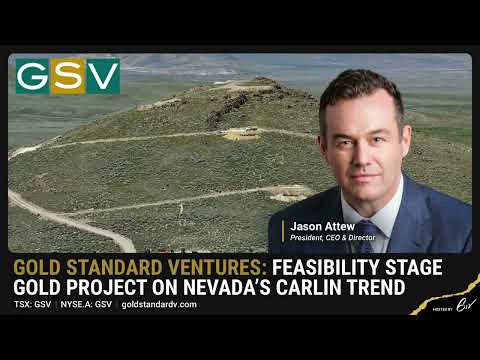
0:08 Well, hello, everyone, and welcome to Gold Standard Ventures Live Summit today, hosted by 6. I'm very pleased to introduce the President and CEO, Jason Etu. Jason was going to walk us through a company presentation and then we will be accepting questions live. As a reminder, you can submit your questions at any time on the right-hand side of the screen under the Q&A panel.
0:29 I will try to get them out to the presentation is over. As always, the summit is being recorded and available to watch afterwards on six.com. Without any further ado I'm going to hand it over to you Jason to kick it off. Thank you Dasha and welcome to the gold standard ventures 6 webinar presentation. I would like to direct you to our cautionary notes on slide 2 here, as I will be making some forward-looking statements today. So why Gold Standard Ventures?
0:57 Gold Standard Ventures is a Nevada-based gold developer that is listed both on the Toronto Stock Exchange as well as the New York Stock Exchange with a market capitalization of about Canadian dollars 250 million. The company has been around for about 10 years and I was brought in as the president and CEO 18 months ago. What attracted me to this company was threefold. First, low capital, high return projects in Nevada's carland trend are truly very rare. Our investors get exposure to a mineral endowment of 3 million Nevada Carlin Tran ounces. And for context, I've been aware of GSV gold standard for some time dating back to when I was the CFO of Goldcorp and chair of our investment committee, which made the strategic investment in GSV a number of years ago.
1:57 Second, I knew I'd be able to reconstitute and reshape the leadership team to 1 that possesses mind-building expertise, and that's exactly what I've done. To be clear, this has been a strategic reset for the company. The strategy at Gold standard has evolved away from the higher risk exploration to now being singularly focused on taking the necessary steps of becoming a producer without of course forgetting the roots of the company.
2:31 In that we have the most prospective land package for which we can explore and add ounces to an already enviable 10 plus year operating mine life. Our mission is to become the low cost producer of choice in Nevada. Third, timing can be everything in our business and I believe the new team has advanced their project to an inflection point whereby the value creation is now embedded in a re-rating that will follow as we de-risk a railroad project. This year, we will be advancing our permitting, securing construction capital, as well we'll have another field season to drill out both near mine extensions, as well as some very prospective targets on our land package that haven't been drilled in some 4 or 5 years.
3:21 In short, there are no shortage of catalysts for a company over the next few months. Quickly, if you weren't familiar, the Carlin trend. It is one of the most prolific and profitable jurisdictions globally for gold miners. The most significant player being Nevada Gold Mines, the Barrick Newmont joint venture, whose carbon complex has over 20 million ounces in reserves and which is just north of our land package. As I mentioned previously, but it does require repeating, our mineral endowment in all categories is roughly 3 million ounces and growing. From an investor point of view, you get 100% exposure to this prolific Karlin trend. Not only that, but our land package is large and extensive, second only to that of Nevada Gold Mines on trend, and for the most part, it's unexplored.
4:16 South Railroad is just 10 kilometers south of Nevada Goldmines operations and located approximately 15 kilometers south of Elko if you've been there just off Interstate 80. With excellent access and all-weather roads, A railroad project is a technically straightforward, open pit, heat bleach mine with very low capital intensity. In fact, I would challenge you to find any other project in development right now that has the same production and operating cost profile that has capital this low, even in the inflationary environment we're all seeing as an industry today. The $190 million bill, the initial capital, is a very manageable capital number, which we believe is our differentiator.
5:06 Turning to the highlights of the feasibility study that we released, I guess, 6 weeks ago, the rates of returns are truly exceptional in the single asset development universe. At what I would consider a very conservative 1,650 per ounce gold, the project offers an internal rate of return of 44%, a net present value of US $350 million, and a less than two-year period to pay back our initial capital. If I were to plug in, if we were to plug in the current gold spot price, that internal rate of return jumps to 65%. The net present value is over 500,000 dollars and the payback period drops just under a year and a half.
5:55 It is important to note that this study, our feasibility study, is a point-in-time estimate, meaning it was developed with recent quotes for capital and operating expenditures that reflect today's current inflationary environment. Additionally, the 44 and 65 percent returns, the IRRs that I mentioned, are unlevered returns. If we were to include a financing assumption of 75% of capital from non-equity sources, that internal rate of return gets into triple digits or north of 100%. We don't know of any undeveloped gold projects that offer a greater than 100% rate of return, especially in this capital headwinds environment that we are facing today, let alone a project, a gold project in a world-class jurisdiction like Nevada.
6:45 Compared to the pre-feasibility that was released in February of 2020, the after-tax net present value, the internal rate of returns, and the life-of-mine free cash flows have grown by an impressive 19%, 11%, and 13% respectively.
7:04 Moving to our corporate overview, you can see by our capital structure, we have no debt. We have a strong balance sheet for a developer. At year end, we had a cash balance of approximately $23 million, which is plenty to carry out all the required activities this year. Additionally, we have an enviable shareholder registry, as you can see with our top 10 shareholders, including a significant holding by Newmont, the largest gold company in the world and part of the joint venture I mentioned earlier, Nevada Gold Mines. These institutions and strategic investor are long-term investors that understand both commodity cycles and the nuances associated with building mining projects. Furthermore, this is not a situation whereby management doesn't have skin in the game.
7:54 Collectively, I would point out that management are the 6th largest holder, for the most part, being purchased through at-market transactions. The point being, there is very strong alignment with shareholders to seeing this company succeed. Management, every day, thinks like owners, which is a critical ingredient, in my opinion, of creating shareholder wealth. One of the most attractive features of our project that frankly brought myself and the rest of the new GSB team a little over a year ago is that Railroad is a technically straightforward project. That's not to say it isn't without risks as every development project has certain risk factors to consider.
8:39 Well we believe that with our mine operations team at Oak Standard an open pit run-of-mine heap leach project in Nevada is about as straightforward as you can get. The project itself will have a compact operating footprint in the center of a property package and the run-of-mine aspect limits some of the complexity of introducing a crushing facility. And as I think you'd be aware, avoids a lot of rehandle costs. Being a former CFO, what really stands out for me is the robust free cash flows that are produced, in particular in the first 4 years due to the mine scheduling commencing with the extraction of ore from the dark star pit. We do have 2 pits, dark star pit, pinion pit sequences first with the dark star pit.
9:29 This leads to a very rapid payback of the initial capital, which enhances our flexibility that we'll have with respect to the construction financing structures. The average free cash flow over the first 4 years, that 1650 gold, as you can see here, is almost 100 million per annum. And at spot gold prices, we've jumped to nearly 150 million per annum, truly exceptional, given our current market capitalization is a little under 170 million U.S. Dollars. Our project will produce over 1 million ounces at an average grade of 0.8 grams per ton, which is high grade for a run-of-mine operation in Nevada. And for comparison, people may know SSR as Miragold, which has been operating for over 30 years as a form of Gold Corp asset, in fact, and is one of the most successful run-of-mine gold operations in Nevada.
10:28 It's a current gold reserve grade of under 0.5 grams per ton, and still generates considerable margins. So the point being, we've got significantly better grade than most, not all of the heap leach run-of-mine operations or projects in Nevada. Another highlight of the study is the mineral reserve growth versus the pre-feasibility study. The total gold ounces in reserves jumped approximately 30% in just 2 years. We really believe we will continue to grow our reserves and extend my life even further as we drill out the many targets across a prospective land package. Which brings us to the further project upside. While we feel this study is very robust and offers industry-leading returns for a gold development project. We see further areas to improve our economics.
11:22 And like many of our peers that will need to complete additional technical studies as well as start and complete their permitting process, Our development timeline outlines a production or a free cash flow generation in just a little over 2 years. It's been proven recently in the capital markets that as assets get de-risked and approach their first cash flow, there is a significant re-rating opportunity. We believe we have a high-quality asset with the right team in place to execute and deliver the type of successful returns that companies like Orla Mining, Orzone, Victoria Gold, among others, have produced for their shareholders as they enter the phase that we are currently in. In addition, our construction funding has been significantly de-risked.
12:11 Orion Mine Finance, if you recall, is our third largest shareholder, and they're a very world-renowned mining project financier that has funded many successful development projects, has committed to write terms for construction capital facility of up to US $200 million.
12:32 Slide 6, this slide outlines some of the changes in the feasibility study versus the 2020 pre-feasibility study. Some key ones are that the current initial capital, which is 40% higher than the 2020, but again, we're in this inflationary environment that I talked about. It includes scope that was not included in the pre-feasibility study, but we believe they're necessary to support an operation that is world-class in its environmental stewardship. In addition, the current capital and operating cost estimates, they said, reflect quotes that were obtained in this inflationary environment, something that I would argue we are at very close
13:19 to the high watermark. So I would guess we may see some de-escalation as we put the mine into operation. The initial capital, as I mentioned before, is $190 million US, and the total sustaining capital over the 10 1⁄2 years, including closure costs and salvage, is estimated at 197 million US. Mining equipment in the feasibility study is purchased as a lease to own with limited expenditure up front and annual payments made over a number of years. Mine equipment sustaining capital expenditures for reference make up over 50% of the life of mine sustaining capital estimate. In the feasibility study, we have removed the crushing circuit that was included in the pre-feasibility study.
14:10 The reduction in capital from our trade-off study outweighs the loss of gold recovery. Although the pre-feasibility crushing circuit did include an agglomeration step. The step was more of a precaution than a necessity. The ore in both pits is generally low in clay content. The run of mine concept has wide adoption in Nevada and California as with as I mentioned the Marigold Mine, Long Canyon, Rounded, Bald Mountain, Mesquite and Castle Mountain Mines. The anticipated difference in recovery between crushed or run of mine is most notable in the second pit, the pinion pit, and the pinion pit is mined last. And the option of installing a crushing circuit or contracting a portable crusher is available as we mine the Darkstar pit in the first 3, 4 years.
15:07 That option to contract portable crusher for the pinion pit is under study. I think most importantly, first of all, we'll have some operational history. Second, given that the opinion is essentially at surface, we can actually conduct some test heaps to really understand the recovery cost benefit of putting a crushing facility or keeping it as part of mine.
15:34 An important point in this study that is only a snapshot in time, based on the drilling the company had completed until 2021. As outlined on the right side of this graph, we believe there remains tremendous potential to extend mine light beyond what is outlined here. As we not only continue to explore the many prospective oxide targets across our property, but as we test for extensions via lower risk step out grilling at both Dark Star and Pinion. Another area that stands out for our investors, as you can see in this graphic here, is the smooth production profile, especially in the later years of operation.
16:22 This has been accomplished through a coordinated expansion of the pinion pit, and we believe further growth is possible. It is rare for an open pit operation in that the best years are in the early years of the mine life, which is integral to generating the peer-leading returns I referenced earlier.
16:41 For the most part, a lot of open pit operations have their best years near the end of the mine life. And gold standard is quite fortunate that both Darkstar and Pinon mineralization off crops on surface. The mine sequences, as you can see, at the Darkstar pit, which has the lowest strip ratio, the highest grade and the highest recovery or is mined in the first few years.
17:07 We see numerous avenues to further enhance our project economics. At Pinion in 2022, we will continue to step out drilling, which we believe has the potential to extend and expand the pinion pit further to the south and the southeast. We anticipate releasing an updated resource estimate that will incorporate this step out drilling by year end. Another avenue to generate additional value is pull processing of the sulfide ore. In the feasibility study mine plan, just over 32,000 ounces contained in a transitional sulfide orgamain is assumed to be mined in the Dark Star Pit but not processed.
17:55 That means all those ounces will be sitting at surface and we fully expect that by that time we'll have a toll processing agreement with one of the processing facilities in Nevada to provide this incremental value to shareholders.
18:09 One of the assumptions made in the pre-feasibility study was that water would be returned to the local aquifer through what's called a rapid infiltration basin or a rib. This is not the assumption the new management team took. We made the assumption in the feasibility that we'd require water treatment and therefore this remains an opportunity. We'll continue to look for suitable geology for such a rib or rapid infiltration basin. And this would eliminate certain capital and operating expenditures and how specifically we treat the water that is a product of the mine dewatering. Moving to slide 9, covering or permitting, in terms of the regulatory regime in Nevada, as I think most of you would know, Nevada has a well-known tried and tested path to get mining projects approved. And it all starts with the submission, what's called the plan of operations to the Bureau of Land Management.
19:10 Our plan of operations was deemed complete over a year ago, and we anticipate the notice of intent will be filed in the federal registry this quarter. This is an important step that will allow us to be in our public scoping meetings which will guide the development of the environmental impact statement.
19:31 To date we can tell you we've had very good engagement with the BLM, the other cooperating agencies and the consultants that have been engaged by the BLM to move our permitting process forward. Based on the work streams and the schedules set out by the agencies, we expect we could receive a record of decision, the most important permit for us, in H1 of 2023 or 12 to 15 months from now. We will need other permits, including air quality, water pollution control, water discharge permits. People know Nevada, there's sage-grouse habitat mitigation that we have to obtain. But I can tell you that these are advancing at a pace that we're very comfortable with to get to first door in 2024.
20:23 In summary, we couldn't be more pleased with the results of South Railroad Feasibility Study. The technical parameters, the solid production profile, and peer-leading returns would make this an attractive project anywhere in the world. We are very fortunate to have this project in a Tier 1 jurisdiction like Nevada, where we have access to a world-class labour force, modern infrastructure, and a supportive mining regulatory regime. As we look forward to the rest of 2022, we will be focused on 4 key areas. We have kicked off our construction financing process, which will include our strategic partner, Ryan Mine Finance, I mentioned earlier. This cut field led process will ensure that we, for our shareholders, get the most competitive financing package possible for a high quality project like railroad.
21:20 Second, we are excited to get the drills turning again. The initial focus of our exploration program will be on the pinion pit step outs, as well as we have 2 separate sulfide targets, as I mentioned the first time in a number of years, the ranch target, which is
21:40 situated just north of Darkstar. And also, if you're familiar with their property package, what an area called the North Bullion area where historical sulfide intercepts have seen goal grades of above 10 grams per 10 over multiple meters. Third, we will continue to advance our permitting application with the goal of receiving all the necessary construction permits by early 2023. And finally we will award the EPCM contract for the South Railroad project in 0.25 2 of this year at which time the detailed engineering design will commence to be ready for a construction decision next year. The last thought I'll leave with you is obviously GSB has gone through a pretty frenetic pace of change over the past 16 months.
22:34 The company's strategy is being reset. The company is being reconstituted, a group of very like-minded individuals focused on a common vision. They're all focused on getting railroad into production. As we see this as the path to generating alpha for our investors. So there is no better time to get invested in DSV. I believe everyone should have a little DSV in their portfolio. Thank you for your time. Great, Thank you so much, Jason, for taking us to the presentation. There are quite a few questions here from attendees, but if you do have a question, feel free to submit them now. Jason, the Gold Standard Ventured Property package is quite large with a lot of prospective targets.
23:19 How does your team prioritize where to drill in the near term versus in the long term? Yeah, excellent question. Thank you for that question. So for context, As I mentioned, we did re-prostitute our team, including our whole geology team. They've had the benefit of essentially taking all the information and data sets over the last 12 months, really coming up with what we call an expiration plan, which focuses on, again, as I said, the mine life extensions all the way down to generator expiration, so we always have targets. I think what's evidence in what we'll be doing this year in terms of the field is, again, we're going to be going back for the first time in 4 or 5 years and testing some targets that haven't been tested in some time based on new interpretation, based on, again, taking a lot of the data layers and doing new interpretations.
24:16 So We've got a very solid team on the geology. Again, the low-hanging fruit here is essentially to start drilling off the oxides, specifically at Pinon, because that's what would stand our mine light. What we're really excited about is, as I mentioned, this ranch target, which it was drilled a number of years ago, but it lost the whole use of some geotechnical issues, essentially, just before we think significant Karlin-type mineralization. The Karlin-type fingerprint or pathfinder elements, specifically antimony and arsenic were essentially off the charts. So, you know, you're going to appreciate just a couple of holes like that.
25:01 Karlin type discoveries could really change the complexity of the company. So there's been a lot of, again, data that's being reinterpreted, all the structural work's being done from a geology perspective. What we do do, which is different than before, is we gate our exploration capital, so the initial tranche of exploration capital that have been approved by our board to go out and, as I said, test some of these targets, including, again, the lower risk stuff, which is the infill and the step-out, but for the pure exploration, it will be results-based. So if we actually hit something pretty significant, I'll get a bigger budget to go up and finish in this year. But it's an excellent question. Again, why I came and quite excited is this is a very perspective on Carlin trend just south of essentially Nevada gold mines property.
25:57 All our land packages essentially contiguous. We think there's just a number of targets that we just have to be very methodical and can go and test over time. And clearly when we were in that cash flow situation 24 months, 2 years from now, we'll be recycling that cash flow to really ramp up our exploration program. Because as you can appreciate, the little junior of just over 200 million Canadian, some of our capital is certainly restrained and we've got capital obviously to deploy and to ensure that we are advancing this project and getting to, and de-risking and getting to this railroad project into production in 24 months, as I mentioned, but excellent question.
26:43 Great, thank you so much. James is asking, do you have secured access to the water resources you need for this promising project? Thank you for the question, James. So we put applications in. We have a three-pronged approach with respect to the water rights. If you're familiar with Nevada, you can get water rights from the state, which we've got an application and we've secured some what are called senior water rights. But that doesn't fulfill the full complement of water rights that we will need and we bought this off. Or at least some of the ranchers in the area, we're continuing to have conversations with a number of the ranchers in the area with respect to water rights. And I would say lastly, there's some existing mines, specifically again, the North of Nevada gold mines, that their operation to the north of us, Emirate and Reign are no longer in operation, but they do have water rights that they're not using. So we're in conversations with them to come up with some sort of commercial deal to secure the water rights.
27:42 We think this is all solvable and we've got many paths to get there, but it's something that we don't have fully secured as of yet, but we certainly will before we obviously get into production. Great, thank you. Michael is asking, why is it that the company has not been acquired, considering its economics and the thirst for reserves and from the majors, what is the company's approach to be acquired? Yeah, another really good question. So I'll just talk from a major perspective. Yes, the economics are really good. And so again, I'll step back to the vision that I have with this company. When I joined and I put the new management team in, I think you can build a mid-tier based on open pit, run open pit, keep leach assets. And clearly we've got a company maker in railroad.
28:35 If we're not acquired here, we're actually gonna be again, very likely 2 years from now, we're gonna be a consolidator in the industry, specifically around Great Basin assets, because we know that there's a number of really high quality, great basin assets that could become available once we're up and we can prove that we've delivered a mine. With respect to the majors, again, 150,000oz of production doesn't necessarily move the needle for a bigger tier. And I'm specifically talking about Nevada Goldmines, Barrick and Newmont. All that said is, again, we are very aware, if you weren't aware, I was an investment banker for many years in my life.
29:20 And so we're very aware of the fiduciary responsibilities that we have. We wish we would own more of the company. But if, for example, a larger producer came and suggested they'd like to take a look at our data. We are open to that. And so it could lead to a potential transaction. But that would obviously require something that would be a significant premium to where we are given, again, we're trading at about 30% of our net asset value. So I think the point is, our focus right now is to get this asset in production. If something interrupts that in the interim, meaning that there's someone that puts a bid, we'll deal with it. We've got a very sophisticated board that understands these processes.
30:12 But right now, this management team is focused on putting this asset in production. Great. Thank you. Another question here. Given the recent additional upward pressure on your input costs, looking ahead 2 years, could this upset your feasibility? Another really good question, something that's top of mind for our whole team. And so, as I said, our, even our feasibility numbers that we released 6 weeks ago, getting the vendor quotes, you know, 2 weeks into before we published, they were changing and the inflationary factors were pretty significant. As I said, our capital is up both on sustaining and the initial capital versus the study that was done 2 years ago.
30:57 We are certainly in an environment where there's inflationary components. What I would say to that though is, you know, our project, which is a run-of-mine heap leach, really all we need is an LNG facility, a small LNG facility for power, it's an ADR plant or a plant and mobile equipment. So there's not a lot again that we're not talking about that ton of steel and it's not a complex operation. So that's 1 good mitigant. Secondly, what we're attempting to do this year is both from a timing perspective to de-risk it is putting deposits down, which we will understand, again, the commercial terms for a lot of the facilities that we do have to build. But it is an environment that, again, as we all know, there's supply chain challenges.
31:46 We're arguably, as I said, at a high watermark with respect to inflation. What I would say and argue if we continue as we move to construction in the next 16 to 18 months, if we continue to be in an environment of significant capital headwinds, my argument would be we'd probably be in an environment of pretty significant tailwinds for the commodity price, specifically gold. So the margins that I talked about that generate those returns, I think we're pretty safe. It's just, and this team has built numerous mines before, we've been in through numerous cycles, so we know how to mitigate some of this risk. We just have to be very thoughtful in how we're dealing with the vendors to, again, get our ADR plant or processing plant, our power plant, and the small power plant, and some of the steel that's required for things such as a truck shop and this and that. But it's not a huge footprint, as you would see.
32:48 Again, we're not building a mill. It's a very simple run of mine, keep leach operations. So less subject to, again, some of the inflationary pressures that you would see with some of our peers that have mills and more complex operating environment. Great, thank you so much. Yeah, Gold Star Venture has another property in Nevada on the Battle Mountain trend. What is the strategy with that asset? Thank you. I think I have a slide on it here. So this is called the Lewis project. And so it is on the Battle Mountain trend. This is not on the Carlin trend. This is what I would say is a strategic asset, because if the audience can see the the outline the gold outline here the Nevada gold mines operation Phoenix such as a Phoenix and fortitude pit this is an open pit operation that sits in the joint venture Nevada gold mines joint venture it's actually their most profitable mine mainly because there's a lot of copper associated, and copper price, like people would know, is appreciated significantly.
33:57 It's not their largest mine. I think it produces somewhere around 200,000 ounces. The point would be we've got all the land that you can see in the magenta or purple, and you can see the conical shape of what's called the Virgin deposit. This was a deposit that was drilled off a number of years ago, and it's approximately 250,000 ounces at surface in gold equivalent ounces. And so If you can also see the plan of operation, the boundary for which at that time, Newmont put in in 2017 crosses right across our property boundary. So this, as I said, is a strategic asset.
34:44 There is no question in my mind when Nevada Gold Mines needs to do their next push back of this pit. They'll need a layback agreement with ourselves. Not only is a layback agreement, but as I mentioned, it's mineralized. We believe there's a scarn underneath the property package that we do see here. We're open to monetizing this property because this is not core to us right now, but it is a strategic asset, but we're not going to monetize it for nothing. We obviously need some cash to build a railroad project. In my mind, if we did come to a deal with Nevada Gold Mines, it would look like some complement of a structured transaction, which would include cash.
35:30 I'm always a big believer in getting some schmuck insurance, I call it schmuck insurance, that if there was a tiger or something significant around this property package, we'd at least be protected with an NSR. We definitely want some sort of NSR so the value could accrue to standard shareholders. And I think the last opportunity is around kind of the first question people talked about around our water rights. If we could secure in 1 transaction, the water rights in the Dixie Basin where we're located, which the Nevada gold mine says significant rights that they're not using right now through a strategic transaction with respect to, again, something that's not recorded, we'd be very open to it. So I'll leave it at that.
36:18 But as I say, when investors ask about who is, it's not something we focus on. I believe all paths for Nevada gold mines come to little GSV, whether they need this laid back, you know, an hour or 5 years, they're gonna need it at some point. And that's just value that's going to accrue to DSP shareholders. Great. Well, Jason, thank you so much for taking us through the presentation and the Q&A. I do want to remind everyone, there's a question here about the recording. It will be available to watch afterwards on SIX.com. I also want to remind everyone that in the handouts tab you can actually download a copy of this presentation for your own reference if you want to go over it in your own time. And thank you so much for everyone who joined us today and asked questions. If you do think of another question following the summit, feel free to reach out directly to the Gold Standard Venture team, and I'm sure they'll be happy to follow up with you. You can also find your information on their website, goldstandardv.com.
37:13 But I'll pass it back to you, Jason, for the final word if you want to close out with anything. Great, thank you Dasha. Just thank you for your time and as I said this is a complete strategic reset with a new team and I do think that everyone should have a little GSV in their portfolio. So thank you for your time and your interest in our company. As Dasha said, we're open for any questions or follow up with respect to our assets. Thank you very much.