Liam Burke
BeReilly Analyst
Replay available
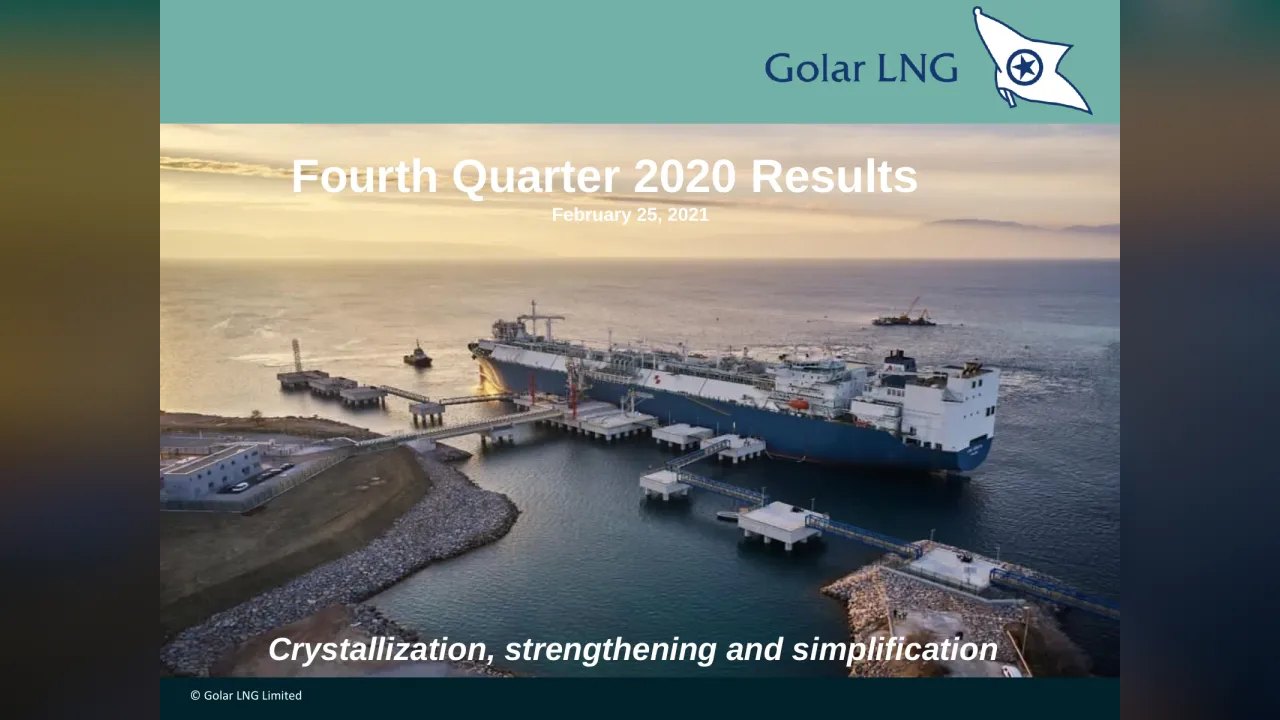
Golar LNG (NASDAQ:GLNG) Q4 2020 earnings call, held 2021-02-25. Watch the replay and read the transcript on 6ix.
On 6ix: 6ix.com/event/golar-lng-limited-glng-q4-2020-earnings-call
Automated transcript · Written by software from the replay's audio. It can mishear names and figures; the replay is the record.
0:00 Ladies and gentlemen, thank you for standing by and welcome to Goro LNG Limited 4Q 2020 results presentation. At this time, all participants are in a listen-only mode. After the speaker presentation, there will be a question and answer session. To ask a question during the session, you will need to press star and 1 on your telephone. I must advise you that this conference has been recorded today, and I would now like to hand the conference over to your speaker, Ian Ross, CEO. Please go ahead.
0:35 Thank you, operator. Good morning, good afternoon, everyone, and welcome to the GOLOR LNG Q4 2020 results presentation. My name is Ian Ross, and I'm the CEO of GOLOR LNG. Today, I'm joined on the line by CFO Karl Staubo. We're also pleased to have Tor Olav Troim, Chairman of Golar LNG, with us today, and Stuart Buchanan, Head of Investor Relations. Before we start, I'd like to draw your attention to a forward-looking statement on slide one. And clearly, there's a lot to cover this quarter, including the transformative deals with NFE for the sale of 100% of Hygo and Golar's share of the Golar Partners business, which incidentally was approved by the MLP unit holders yesterday. Let me kick off by giving you some outcomes for GOLA from these deals and some quarterly highlights before Karl takes you through the numbers in more detail.
1:27 I'd like to explain three related themes. Firstly, why the Hygo deal crystallizes value for GOLA. Secondly, how these transactions will financially strengthen the company. And thirdly, that this is the first major step along our journey to simplify the group. If we turn to slide four and look at the value created for shareholders, It's a good story. In 2016, GOLA invested $290 million into the Hygo JV, known as GOLA Power in those days. The company built Latin America's largest combined cycle gas-fired power station at Sergipe, supplied by gas from the GOLA Nanook, and then built a repeatable downstream business around that structure. When the deal with New Fortress completes, GOLA will book a profitable gain of $760 million based on today's closing price of NFE shares.
2:17 which translates to 3.2 times the invested equity. Turning to slide five and looking at our strength and financial position and just going through the recent activities. We successfully completed the public offering of 12 million shares, raising just over $100 million in December last year. Also in December, our FSRU LNG Croatia conversion project was commissioned, accepted and subsequently sold to our customer LNG Hrvatska releasing total liquidity of $51.7 million after repayment of $113 million in debt. To bring this project in on time and within budget during 2020 is a strong performance and I'd like to acknowledge the effort of everyone involved.
3:04 We repaid the $150 million bilateral facility and the $30 million margin loan and then executed a new $100 million credit facility. and the agreements to sell both Hygo and our shareholding and goaler partners to New Fortress Energy will deliver a further $131 million in cash together with 18.6 million shares in New Fortress. So the summary of all of that is that post both NFE deal closings, we will add 204 million in cash to the company and that's after paying down a total of $193 million in debt. The third element is simplification. and you can see from slide six that the ownership structure is more streamlined. We will continue to provide operations and maintenance services to the NFE floating assets that they've acquired and we are left with three well-defined business activities.
3:59 On slide seven, post-transaction, we will have an FLNG business with a contracted adjusted EBITDA run rate that clearly ramps up to $224 million when FLNG GIMI comes online in 2024, a shipping business with an adjusted EBITDA run rate over the last 12 months of $123 million, representing an average TCE of around $50,000 per day, and the ownership of 8.9% of New Fortress Energy, which is focused on the downstream part of the gas value chain. With the adjusted EBITDA, book value and net debt of each segment laid out this clearly, we feel that the underlying equity value becomes more apparent. Turning now to page 9 and a run-through of our Q4 2020 highlights.
4:47 Today we report an adjusted EBITDA of $78 million on revenue of $118 million for the quarter, which is driven by a further solid FLNG performance and an improved result from shipping. In shipping, we achieved adjusted time charter earnings of $52,000 per day, which is in line with guidance, with the TFDEs earning just under $54,000 per day after adjustments. We ended the quarter with a shipping revenue backlog of $193 million compared to $172 at the end of Q4 2019. Our FLNG operations maintain 100% commercial uptime through the quarter, with an additional $8 million in revenue recognized as a result of overproduction on Haley up to the end of 2020.
5:33 And a conditional agreement has been entered into with Perenco, which may pave the way for drilling to commence this quarter. FLNG GIMI remains on budget and tracking to the new schedule. Heigl generated $38 million of adjusted EBITDA during the quarter, which, as you can see from the graphic, is largely in line with the last couple of quarters. So more detail on the business segments to follow. Let me now hand you over to Karl to take you through the numbers and more detail on financing. Thank you, Ian.
6:03 Turning to slide 10 and the fourth quarter 2020 financial results, we report operating revenue of $118 million for the quarter, up from $96 million in Q3, driven by a seasonal increase in our achieved shipping TTE, which came in at $52,000 for the quarter, a $12,700 increase from Q3. The FLNG Hilly continued its solid and stable operations with the mentioned 100% utilization. Following the Q3 announced revised agreement with Perenco, where we removed the 500 VCF production cap, we have billed Perenco $8 million of incremental revenue for overproduction on the Hilly during 2019 and 2020.
6:53 Adjusted EBITDA for the quarter came in at $78 million, a beat against consensus of $70.7 million, driven by the mentioned higher shipping rates and the Healey overproduction invoice. We report positive net income for the quarter at $9 million. Our net debt position was reduced by $243 million to $2.06 billion as a result of repayment of $80 million under corporate debt facilities secured against Hygo and MLP shareholdings. a repayment of $112 million on the LNG Croatia and an increase in our cash position of $101 million from our December equity offering.
7:39 This was only offset by $75 million of debt drawn on the GIMI project. Our cash position at quarter end was $254 million, of which $128 million in unrestricted cash and $126 million in restricted cash. The increase in restricted cash relates to receivables in conjunction with delivery of the LNG Croatia, which will be received during Q1. We expect a further strengthening of our cash position following the closing of the NEP transactions. Turning to slide 11, Golar is transitioning from capex to cash flow as our infrastructure assets on long-term contracts are delivered from the yards. This is coupled with improving shipping rates and reduced shipping spot exposure through our revised shipping charting strategy.
8:33 We have seen a clear trend in our EBITDA over the last five years, moving from negative in 2016 and 2017 to a stable growth of EBITDA performance during 2018 to 2020. We expect our EBITDA development to continue to build as we take delivery of the GIMI in 2023 as well as potential increased utilization and oil link related revenue from the FLND Hille. Turning to the NFE transactions and explaining them on slide 13. On January the 13th, Golar announced two transactions where we're selling both Hygo and GMLP to New Fortress Energy. The two transactions are independent of each other, but was announced on the same date involving the same counterpart.
9:25 Starting with the Hygo transaction on the left, Stonepeak and Golar have agreed to sell Hygo. Golar will receive $50 million in cash and 18.6 million shares in New Fortress Energy for its 50% shareholding in Hygo. Based on the closing price of NFV yesterday, this represents a $760 million book gain to Golar. and 3.2 times equity return over the five years we've been invested in Hygo as earlier described by Ian. On the GMOP transaction, Golar agreed to sell its 30.8% common unit interest in GMOP as well as its 2% general partner interest for $3.55 per unit. The bid price represented a 27% premium to the closing price of GMOP on January 12th and a 37.5% premium to the 20-day VVAP pre-announcement.
10:26 Golar will receive $81 million in cash proceeds for its common and general partner units. Yesterday, the common unit holders of GMLP voted in favor of the transaction. Both transactions are scheduled to close during first half of 2021 and all parties are working to close as efficiently as possible within that time window. Turning to slide 14 and a bit of rationale as to why we decided to do the transaction or both transactions. Again, starting on the left with Hygo. NFE and Hygo share a vision of delivering cheaper and cleaner energy to emerging markets. Once we filed our F1 and later retracted the IPO, we had several suitors around the company, but for us it's important to team up with someone that shares our vision, especially given that we maintain equity exposure in the combined entity.
11:22 We think the price that was achieved was attractive both from a price and execution risk versus an IPO alternative. The transaction crystallizes the value of Heigl to the LNG shareholders while maintaining exposure to the attractive LNG downstream rollouts. We believe in industry consolidation and this will create the leading LNG downstream company globally. We also see significant advantages in a larger entity with better access to growth capital and a more diversified geographical exposure. Turning to MLP on the right-hand side, we believe the price as mentioned represents an immediate uplift to equity holders, but also saw significant benefit to other stakeholders, including unsecured bondholders in the MLP.
12:17 By selling MLP, we remove the refinancing and the recontracting risk of the MLP asset portfolio. This is execution of the announced strategic alternatives where we were looking to better find strategic alternatives for the MLP contract backlog and asset base. We had a unanimous board representation for the bid and we also had recommendations from independent investment bank as well as proxy advisors. With that, I'll turn it back over to you, Ian, to run through shipping.
12:56 Thanks, Karl. And if we turn to shipping on slide 16, the quarter commenced with JKM at around $5.15 per MMBTU and quoted TFDE headline spot rates of around $59,000 a day. A combination of rapid resumption of U.S. cargo, strong winter demand from Asia, and then some unplanned plant outages pushed JKM up to $15. which in turn drove TFD e-sport rates to around 160 per day by the end of the quarter. The cold winter conditions saw JKM break $30 per MMBTU and lack of promptly available ships created a further spike in the rates north of 250,000 a day in early January before dropping back below 100,000 per day by the end of the month. By end of last week, the TFD e-rates had dropped back into the 40s.
13:48 Our Q4 utilization of 77% was disappointingly low due to increased commercial waiting time between two-spot charters, a mechanical failure, and the residual dry dock time on Tundra that we mentioned last quarter. But despite those challenges and the fact that we fixed the majority of the TFDEs on term business, we did manage to enjoy a couple of higher-priced charters that will also help lift the Q1 TCE. Our shipping strategy continues to prioritize long-term utilization over short-term opportunities, and you can see from the table on the bottom right of the slide that our annual TCE continues to improve. The TFDE fleet achieved a 2020 full-year figure of 50,000 per day for the first time, with a similar annual high of 90% fleet utilization.
14:36 And on slide 17, you can see that we expect utilization to rebound to around 90% in Q1, 21, which with the backlog of 193 million in place at the start of this year and the fixtures that we have in place to date, it's indicating a TFDETCE of around 60,000 per day for the next quarter. The higher LNG pricing over the last few months has moved the industry momentum back to upstream, so let's have a look at floating LNG production and slide 19. As we've mentioned, Hilly performed well, 100% commercial uptime and recently offloaded the 52nd cargo. As Karl mentioned, with Brent currently above $60 per barrel, the oil linkage kicks in. And if you remember, that means that for every $1 above $60, this equates to $3 million in additional profit over the course of the year.
15:29 Our discussions with Perenco on a potential LNG production volume increase within the remaining term of the contract are progressing positively. Should we conclude these discussions successfully, there's likely to be a new risk-aligned tariff payment for the additional volumes. The next step is to finalise the agreement between GOLAR, Perenco, SNH and the current Trades 1 and 2 off-taker, which would allow a drilling and testing campaign to commence in the next few months. Any change to the production agreement will likely see the increased volumes in 2022. Turning to slide 20 in the GIMI project in Singapore, where we're engaging a construction workforce of around 2,500 people on a fairly consistent basis per day, that is. We've worked over 7 million man hours on the project to date with a strong safety record. The fourth dry dock was completed without incident, and you can see from the pictures we've now attached the sternmost sponsons to the hull.
16:26 Work continues on outfitting the remaining sponsors, which will be attached at the fifth dry dock, planned to commence around the end of this quarter. On SLNG business development, we continue to respond to new tolling inquiries and are developing the most perspective of these with customers. We're carrying out some more engineering work in order to tune our pricing and delivery for the larger capacity new build, 5 million tonnes per annum Mark III, concurrent with examining possible redeployment of HILI post-2026 or a potential marked conversion of Gandria. We are reinvestigating both integrated upstream solutions and also the potential to use smaller units with a shorter production lead time to access associated gas that's being reinjected or flared. Turning West African undeveloped gas into useful power via LNG is very much part of the energy transition and we think is also good business.
17:22 By example, if you look at the graph at the bottom left of slide 21, which shows price spread between West Africa and FOB LNG delivered at, say, $3, and the forecast LNG pricing at $6, then the important thing here is that every $1 gas price spread translates to about $250 million in operating margins sold. For a 5 billion ton per annum facility, a $3 spread as shown here equates to an illustrative operating margin of $750 million per year. So that's three different development fronts, Mark 1 conversion, Mark 3 new build, and taking another look at integrated solutions with lots of potential across all of these fronts. Moving to slide 23, here we summarise some of the initiatives being considered to capture the value spread between our share price and the book value.
18:15 I'll leave it to Tor to comment on share buybacks and distribution of NFB shares as they are board matters, but let me highlight that we do intend improving debt financing of FLNG GIMI project as we approach COD. We believe we can get debt financing at 5 to 6 times EBITDA, which is between 1 and 1.3 billion. We will examine the potential to crystallize value in FLNG assets through one or more structural transactions, and we plan to refinance the convertible bond during the second half of this year, and we'll consider using exchangeable bonds against New Fortress shares rather than GLNG. So, summarizing our key initiatives to create value on slide 24.
19:00 On shipping, we'll continue to maximize full-year TCE and we'll continue to explore separation of the assets. On FLNG, we'll focus on completing the GIMI project safely on time and on budget. We'll continue to progress the heli volume expansion and to develop our Mark 3 new build and seat deployment for both the Mark 3 and the Mark 1 conversions. Finally, on FLNG, we'll work on integrated upstream LNG developments. We already have a good relationship with New Fortress and will work to create revenue synergies and collaboration in downstream. And of course, we will continue to examine the various pathways towards further group simplification, specifically through splitting the shipping and LF LNG businesses.
19:48 I'm pleased to now hand you over to JLNG Chairman Torolab Troim to take you through his thoughts prior to Q&A.
19:56 I think maybe Karl, you're the best one to take the two next slides, and then I'll come back with some comments on the LNG. Okay, if you've done that, I'll go straight into the risk. I'm sorry for this little confusion. What we have learned over the last seven years is that this business is pretty unpredictable. You don't know where prices go. I think we've been through In the last seven years, we have seen oil prices above 100. We've seen them under 37. Just in the last year, we have seen gas prices, and they're $175 per mm BTU, and we've seen them above 35. So unexpected, however, it's pretty hard to plan for it. The boss of Total, Patrick Boyard, went out this week and said that hydrogen market looks like the LNG market looked 40 years ago.
20:50 Promising, but it's going to take time. I felt the pain of waiting 15 years for LNG. Gullar entered into this market 20 years ago and I was probably 15 years too early since the major controlled the production and kept LNG prices linked to Brent burn parity in equal 16% of Brent. When the big volume came from Qatar, Australia and the US, the majors couldn't any longer control the prices. The prices went from parity to around 10% of Brent today. So effectively, gas is today 30% cheaper than crude, and around 50% cheaper than diesel. And not only is it cheaper, but it's also cleaner. CO2 reduction is one thing, but SOX, NOX, and at least Particle has probably killed more people than CO2 for the time being.
21:37 We started work on an integrated model in 2015 when oil price collapsed. We did two efforts, we started one LNG, and we started Golar Power. Sadly enough, our partner in 1LND, Schlumberger, withdrew and we didn't have the capital to do it alone. It was tough times to make money in the upstream business. Since that time, we have developed downstream activities where we, together with Stone Peak, invested approximately $600 million and we built the biggest power station in Latin America, which was underpinned with a very good PPA. We developed some super attractive terminal permits, which are now coming into play. and we have now put this company into NFE with making three and a half times money in what has been a very tough energy market.
22:25 But the merger of Hygo into NFE is not a sale. What we're doing as a large shareholder in NFE is to create a real powerhouse for downstream LNG activities. While all the majors talk about electrons and what they're going to do, New Fortress is not only talking, they're doing it. So if you can't beat them, join them, and that's what we decided to do. We share a clear vision with the management and board of NFE to deliver cheaper and cleaner energy to the emerging market. Gas and LNG is due to the cost structure and the amount of research likely to trade at significant discount odds for the foreseeable future. However, in order to feed these downstream activities, we need molecules. If you're going to buy from the majors, we are going to give them the money.
23:11 Let's look a little bit for the gas market that developed over the last six months. And then you will see on the next slide, you effectively see we came from a price, which is the blue line, of around a little bit less than five, five and a half dollars. We went all the way down to two, and now we're up in more than six again. The scratched black line is the curve for Brent and similar. So there you see effectively the price measured in MMBTU in the spread between Brent and gas. So you see in the summer there was tremendous downstream margin, but negative upstream margin. When you look forward for the next years, we have then put the forward curve for Brent and we put the forward curve for oil. and you will see oil price indicates a gas parity of around 11, going down to around nine, nine and a half over time.
24:10 The gas curve for LNG is flat around $6. So there you see effectively the profit. And just to tell you how these different colors are stacked up, the $1 is what you need in order to develop the upstream reserves in Africa, going into an FLND vessel, including return. The $2 is what it takes to liquefy with a decent return. The green dollar is the spread you have up to the sales browser of LNG. The light blue on top of that, which is a dollar, is effectively a shipping cost to bring it around the world. And the light green is what you then can take out in the downstream market just to burst parity of crude. There is more to be taken out on that market because diesel is of course much more expensive than crude and diesel is to a large extent what we're competing with with LNG.
25:10 So what you also can see on this curve is the curve is pretty flat around $6, which is an interesting observation. And if you follow the market, you saw that last week or two weeks ago, The Qataris decided to go ahead with the biggest investment of an LNG train ever in the world in order to produce. And it seems like their target is to deliver LNG around $6 and effectively thereby make all development in the U.S. more or less uneconomical. It's a very interesting strategy, very different from Saudi who let the oil price rise and effectively open up for sale. I think it looks like the Qataris have done and said we can supply this market with a very, very healthy profit at the level where U.S. cannot be developed.
25:58 If you look at the summer, there was, as I said, a negative profit in producing LNG and the real money was upstream. Now it's bounced out again, as you can see on the second graph today. You see that the theoretical spread in the upstream today is around $3.80, while the spread is today $3.20, just up to kind of crude, and then there's an additional top on that. So how can we take out this spread? Let me go on to the next page. We in Gola have spent 10 years working with a Korean shipyard to develop a 5 million ton vessel. We are now at the stage where the design is more or less completed. You see a drawing over there. And we also now have received a proposal for a turnkey contract from the order.
26:45 Such a vessel is likely to cost around $500 million per production ton, so effectively altogether $2.5 billion already installed. And in order to fill such a vessel, you need a reserve based on approximately 5 TCF for 20 years, and you can stay there for 20 years. It's my opinion that proven gas reserves are some of the most underpriced assets in the world's market. You can buy them for cents per barrel, and gas is so far from most operators' problem. It's either flared, re-injected, or left in the ground because no one has the technology to develop it. Shell has spent $15 billion to build Prelude, and it has so far just delivered a handful of cargo. It's been a catastrophe.
27:30 Goulart and Goulart's fantastic people have cracked the nut. With a vessel cost of $1.3 billion, we have now delivered 52 cargoes, even if we only produce 50% of our capacity. I'm proud to say that Ian and the team have delivered 100% commercial uptime since we started this thing. We have not been deducted $1 in offer. It's a very different story. If you look at the numbers, what we can take out with such a 5 million ton vessel today, you will effectively see that if you use that and take out the spread on 3.8, that vessel can make a super profit of $950 million. Then you have already included the return for the vessel itself and the upstream activity.
28:15 If you then pump that into the NFE pipeline and take off the $3.02 in profit, there is another $800 million to be taken out. So effectively, $1.750 billion can be made in one year by taking off the spread against the real production cost and what you can sell this for in the market today. I think both West Eden, who runs New Fortress, and the Board of Goulart are extremely excited about this thing and we want to move fast. We want to leverage the unique position we have and in many ways we are in process of putting together the one LNG ID which we had when the oil price was high last time and make the company more integrated. That doesn't mean that all this has to happen in one company.
29:02 I think we already have the downstream activity in NFE. We might see an FLNG company separated out, and we might see a shipping company together out. But we will work together to take out these spreads on a jointly basis. And we might do it in the way we do it with Perenco, where we effectively have oil price kicker upside. So we effectively make more money the higher the prices go. or we can do it on a split-tariff basis where we effectively share risk with the producers. It's been a challenging year we have behind us, but I'm looking forward and I'm excited. And I'm excited when I see the results which kind of Ian presented there from 2015. You see the trend in the EBITDA, which is increasing dramatically, and you also see that that trend will continue in the years to come.
29:52 We have now fixed the balance sheet with two transactions, both equity rates and the sale to NFE. There are clear signs that the LNG carrier market is strengthening in the years to come, with very limited deliveries coming in 2022 and 2023, and no longer trades. We have, together with NFE, created what is the leading platform for distribution of LNG. We have LNG GIMI coming in two years' time, and there are effectively... In addition to that, we have Hilly, where we are talking about additional production coming from Train Tree, and we also have the oil derivatives coming in, which will give us money at current prices. At 67, which we are today, that's another $21 million if it stays like that. There are interests, as Ian said, every day almost, for people who want to utilize or proven LNG technology to either fix long-term contracts, or for us to take up-time risk and participate in that $1.7 billion of super profit which clearly are there. I again apologize to our shareholders in a most humble way for the performance the last years. It's been a tough market and in this tough market we have not been delivered share price. However, we have, as expressed in the new NFE transaction, created significant value for shareholders and I think we built a unique platform for making money in this energy transition we now see.
31:25 We don't have to wait, as the guy in Total says, 40 years for hydrogen to happen. Gas is the natural substitute to a grid filled with more and more renewable energy. I mean, we can talk about making cash tomorrow instead of in 40 years. I hope the simplification which we now have gone through is appreciated and it can help us take out that value gap which effectively Ian's talking about. To see a share price trading around 11 and to see a book value of 22 with significant extra value in the FLND side triggered the board to start the buyback program. So we start effectively with 50 million just after the completion of the NFE transaction.
32:13 But most of all, we want to build a company Thank you very much. A significant increase in EBITDA just based on the order backlog we have today and the contracts coming on. I'm excited and I hope that you again can look at GULAR as a positive investment, one which is very well positioned for the energy transition which we're going through. Backed by hard cash, not by illusion and ideas.
33:01 Thank you. Thanks to all of us.
33:03 I'd like to now hand back to the operator for questions, please. Ladies and gentlemen, we will now begin the question and answer session. As a reminder, if you wish to ask a question, please press star and 1 on your telephone and wait for your name to be announced. Please limit yourself to two questions each. If you wish to cancel your request, please press the hash key. Once again, ladies and gentlemen, please press star and 1 if you wish to ask a question. Your first question comes from the line of Ken Hoekstra from Bank of America. Please go ahead. Your line is open.
33:48 Hey, great. Good morning. Thank you for the great details. A lot to unpack. So, Ian, maybe I can start off with just the general. You kind of talked about the three new breakdowns in looking at the flings. Thank you very much.
34:27 I mean, the way to think about it, first of all, is our investment thesis right now is there's this fundamental disconnect between the current equity value of the company and the sum of the parts of the business. So we're still on this journey to simplify the business and realize value from these individual parts of the business that should create overall value for shareholders. I think what we try to lay out today is the fact that we've got simplification in three businesses and that exposure. With FLNG, we've got our Mark 1, our Mark 2, and as Tor said, very enthusiastically outlined for us. We're revisiting this integrated operations because of the spreads that are available. It was something that when I joined the company nearly four years ago, I was very excited about and sad to see that part of the business go and I'm very enthused at the potential for that to come back. So that's FLNG.
35:17 In shipping, what we've done is we've stabilized the downside. If you look back over the previous years, We kind of hung out for the big numbers as they came through, but at the cost of utilization during the leaner months. And what we've put in place is a shipping strategy that will allow us to put a floor on the loss, if you like, from ships, depending on how you look at it, and allow us to play on the upside through two avenues. One is we have some index-linked contracts, so when the rates go up, we can participate there. And we do have a couple of ships available to play in the sport markets. Now in shipping, we're pretty well covered for the course of this year. Depending on who you listen to, 2022 can be a very interesting year for shipping in terms of the relative tightness. And I think we're extremely well positioned to make a call on that, you know, halfway to three quarters of the way through this year as we look to our shipping strategy for the years coming.
36:14 So that shipping, and I think that flexibility of the shipping strategy will give us choices on what we do with ships, whether they're in the company or out of the company. Because I don't think we're in a position to comment at all on how we do that split, because FLNG could seek external investments, and as Tor said, we may set up FLNG Co, in which case shipping's left, or we could do it the other way around. I think what we're trying to outline is the flexibility. In downstream, what we have is a collaboration with New Fortress. We will be operating and maintaining the vessels that they've got. And if you think about two things, one is that currently we have a shareholding of 9% of New Fortress, so we really want them to do well. We're encouraging them that. But secondly, as that business grows and they want to take on new vessels, there's an opportunity for us to participate in providing some of those vessels.
37:09 So I think what Tor was explaining is that as you look at that spread, there's enough business and work around there for it to be shared around people that are prepared to go after it and realize that value. And that's where we're focused without being particularly definitive on this stage and what it will actually look like. It's a bit of a long answer, Ken, but hopefully that kind of got the point across.
37:33 No, it's helpful, especially given how much you have going on and what you've just accomplished. And congrats on getting the high go and GMLP sales. I guess for my follow-up and final question, you talked a lot about the FLNG developments. Maybe talk about what happens after the next one, right? What's the timing or are you still in discussions or progress on the third one? and given, you know, without LNG rates have tracked. What are your thoughts on the timeframe for that?
38:06 So my thoughts are that things progress well. We're in active work with various people in various stages of development. And this is, if you think, I guess the point I'm trying to make, we've got two parallel strategies. We've got our tried and tested strategy that on the back of Hilly, we realized we had to have a counterparty for tolling FLNG That really has to be a super major with decent balance sheet that can support the financing and offtake. They're the two critical things. The technical part is, for me, the straightforward bit. It's getting the project up from an offtake and finance point of view. So that requires a super major. What we're talking about now is going back to not necessarily tolling, but participating more actively in the integrated environment, as we were trying to do in the one LNG days, and work out a position whereby we can participate in that which will move faster and it won't require necessarily the same degree of complexity around offtake and therefore finance. So without being more specific than that, we've got two active areas. We've got the Mark I and Mark III in our tolling arena. and then with the same time, we've got this integrated idea that we're reinvestigating right now.
39:30 Wonderful. Thanks, Ian. Your next question comes from the line of Sean Morgan from Evercore. Please go ahead. Your line is open.
39:43 Hey, Ian. How's it going? So we think about Parenko It's a little bit black box for us as to how they're making their decisions in terms of increasing development at that field. You have the overproduction cap removed. So I guess one question is, how much higher can you go in terms of overproduction on the existing two trains? And then also, what sense do you get in terms of what Perenco's reservations are? What kind of Oil prices they're looking at to sort of make that investment and activate the other two trains. Just what other information do you have that you could share?
40:22 So on your first question, the $8 million that we've invoiced for overproduction, that's from the commencement of operations to December of last year. And that's just a simple factor of dynamics and production. What I would say is that the relationship we've got with Parenco from the operational point of view is very good. and if they've got excess gas or we want to meet a cargo and the timing changes, we end up going up and down a little bit. I think it's just nice acknowledgement of the overproduction. We're now getting paid for it, which I think in the absence of any other agreement, we'd continue something in the order of the same amount. But in terms of They deal with Perenco. There's a couple of things to understand. One, it's Perenco and SNH in Cameroon that we have to seek agreement on. These discussions do take time.
41:14 Secondly, I think the momentum has changed. If you look back a year at the gas pricing and the ability to get an off-take agreement structured that's attractive, it's very hard to do that on the lower gas pricing. I think time is... and the pricing is with us now to get that done and these discussions just take a bit of time and all I can report is positive progress and when the deal is done we will be the first to let everybody know and we'll be very happy about that but until that deal is done there's not really an awful lot more I can say.
41:51 Yeah, I think what we can add on is that there are now some conditional agreements within several of the parties as stated in the report which might be There is a good likelihood that we will see drilling in the reservoir pretty quickly in order to drill up and effectively drill the production well needed to bring more capacity over hilly. Nothing is set in stone, but at least I think we have made significant progress over the last weeks.
42:20 Yeah. So my second question also sort of relates to the hilly and the FLNG business. I actually like that slide 23 where you kind of point out what I think a lot of people are thinking. It's the valuation gap. And so one of the things that people are trying to get their head around as we talk to investors is the value on the existing assets. So the HILI, what are the outs that Perenco would have at the end of the life of the contract? It's obviously not in most people's models, but people kind of view it in terms of the of the underlying value of that business that already exists. So what would have to happen for you to either move the asset or recontract with Perenco and maybe just a little bit of visibility on what the end life of that contract looks like?
43:11 So that contract expires in the middle of 2026. It's an eight-year 500 BCF gas contract, which if you remember, we took the volume cap off it because of the overproduction. It's now an eight-year contract. So that contract will end at that stage. We've got plenty of these other opportunities that we've been talking about or looking at, and particularly the integrated opportunities that would be an ideal fit for Hilly. We're not focused necessarily on extending that contract with Perenco at this stage, but what we are focused on is maximizing the value of deploying hilly, wherever that may be. So for it to stay in Cameroon, it would obviously have to be a pretty decent deal for us to consider doing that.
43:58 We have informed Perenco that we are leaving in July 2026, and we're not willing to extend the contract. because we think we have a much better alternative elsewhere. So if they have more gas, then they have to come back to us. They have no contractual right whatsoever, either an option or contractual to extend the stay up to July 26th. Okay.
44:22 So if you were going to move it, you'd probably announce a new location maybe 24 months or before the deadline?
44:35 Yeah, it takes two, three years to develop. But I think we know, that vessel is almost the same delivery time as a new building right now. And it has a proven direct record, so from that point of view, it's probably more valuable than a new building. So I think we are, this vessel is, in many ways, a spot LNG vessel as of today. That's the lead time it takes.
44:59 Okay, thanks Stuart. Thanks Sean. Your next question comes from the line of Craig Sear from Terry Brothers. Please go ahead. Your line is open.
45:12 Good morning. Thanks for the disclosures and congratulations on the progress. I've got kind of three quick ones here. Should the Parenko upsizing come to pass for the remainder of the eight-year contract, what are prospects for favorably refinancing Hilly and can you elaborate on potential for securing improved shipyard and financing terms should you go down the route of cookie cutter two and a half billion dollar mark three projects versus you know hilly and gimme style conversions and and finally if if you do go down the route of the integrated FLNG model you've shared how do you think about the debt equity mix there?
45:59 Karl do you want to have a go at that first please?
46:02 Yes, sir. So when it comes to potential refi of HILI, you're right, Greg, that obviously we have a quite steep amortization under the existing financing. And we think if you increase the EBITDA on the unit and the backlog itself, we should be able to improve the financing to more favorable terms. I also think the more clarity we can give to any potential financiers about alternatives for Hidli post the Perenko contract that Thor hinted to, will help us in terming out the amortization profile. So to try to answer your quick answer shortly, yes, we think we can refinance the unit if we up the One thing is, of course, the EBITDA generation for the reminder of the Perenco contract.
46:55 But equally important is de-risking alternatives after the existing Perenco contract. And with the gas, the current gas price and the gas forward price, we see a lot of support for such de-risking. And that should help us in turning out the facility. I think, Ian, do you want to comment on GIME and yard financing?
47:19 I think, and I'm just repeating what I said in the prepared remarks, I mean, we believe as GIMI heads towards COD, there is an opportunity to refinance that vessel at five to six times EBITDA, and at 215 million EBITDA, that's one to 1.3 billion, at favorable terms. And we'll, you know, I think we'll progress our work on that. Again, these things take time to put in place. But I think that would then put us in a good position with GIMI, certainly around COD, maybe before or maybe slightly after, but we think that that's perfectly viable.
47:59 When it comes to the new buildings, and the whole reason why we've gone to Korea instead of Singapore, is that the Korean government are much keener to support their army than the Singaporean, so if you do a turnkey contract In Korea, I think you can probably end up with payment terms not far from what the ship builders get for shipping things, which means 3 times 10 and 70 by delivery. And that, of course, will change your cash flow dramatically compared to where we are today.
48:31 And I guess to the last question, when it comes to integrated projects and the capital structure on how we're looking, I think we'll review that on a case-by-case basis. Some of the early discussions we're in on that front involves partners, so it has to do with the specific project, the geography, and the interest of the partners that we would develop with. In some of these instances, we are also talking about liquefying associated gas. and in such projects you obviously have other partners that are willing to take the oil bit and you're basically taking care of a problem for them because today they're either flaring or re-injecting the gas without being able to monetize it. So this is very much back to the sort of one LNG thought process and what we want to try to utilize.
49:25 Great, thank you. Your next question comes from the line of Randy Givers from Jefferies. Please go ahead. Your line is open.
49:36 Thank you, operator. Howdy, gentlemen. How's it going?
49:39 Hey, Randy.
49:41 Hi, Ronda. Good. Hey, now, following the completion of the sale of Hygo to NFE, you know, I guess assuming the deal closes in April, let's call it, when does your lockup period expire and when Can you give a little more details or timeline for decisions on what to do with the NFE shares, selling them, taking a margin loan against them, kind of in a larger block, divining them out? What are some options there? Hey, Randall.
50:11 So this is Karl. Yes, we have a 90-day lockup from the closing of the transaction. So whenever it closes, plus 90 days, and then we are free to do whatever we want to do after those 90 days. We are exploring alternatives, and I think it's fair to say that we receive a lot of inbound proposals from investment banks and other financiers. Alternatives for that ownership block, which is worth around $1 billion, or close to $10 per GOLAR share, we could either margin lend against it. On margin loans, you can typically see proceeds of at least 50% LTV, We are looking at alternatives to refinancing the CB involving the NFE shares, which may or may not include an exchangeable.
51:05 So instead of doing a convertible to DLNG shares, we do an exchangeable to NFE shares. We are also looking at other alternatives, but a primary focus for us is what we have outlined on slide 23, Closing the Valuation Gap, and we will push forward initiatives to close the gap, and that will very likely include distribution of parts of our NFE holding to DL&D shareholders.
51:34 Got it. And then a quick kind of detailed question. If you were to sell the shares prior to, let's call it next April, Would there be any kind of short-term capital gains on that? Or how would that work in terms of your ownership of the shares? Is it once you collect them? Or have you had them historically?
51:57 How would that work? With our structure in Bermuda, there will be no tax on the sale of those. But I think it's important to say that we intend to be partners with and a few long-term. NFE is an important part in order to build that integrated model we have. We will, either directly or indirectly, be long-term shareholders in NFE. We're not there to cash in that billion. We really believe in what NFE is doing, particularly with a kind of close to $500 million we have injected into the company in EBITDA now, on the yearly EBITDA. They have a fantastic platform to continue the work we do. I think the access to financing with NFE now with unsecured debt and with a market cap of $10 billion deduct a little bit, but I know that Eden's dream is to make this into a $100 billion energy company.
52:56 but deduct a little bit from it, but we really believe that we have a unique position together with them and we want to be partners. So you will not see a block sale of a billion dollars after 91 days if that's what you're really asking for.
53:11 Not as directly, but okay, noted. And then last question, slide 24, you mentioned you are seeking industry consolidation for the LNG carriers. Now, clearly there are buyers for LNG carriers, as most recently seen with the BlackRock taking Gaslog Private. So, I guess, what are your plans for the LNG carriers? Is the spin-off still on the table in the near term, or are you pivoting to maybe be a buyer to further consolidate the industry?
53:43 I can kick it off, and then Ian can chime in as we go along. As we have communicated to the market previously, we have been looking at alternatives to consolidate the market. From an operational standpoint, we've previously seen the industrial benefits of having a larger fleet through the cool pool, which we have together with Gaslog and DynaGas. And as you can have seen from the shipping press, we've also been involved with different sort of consolidation efforts that has not yet materialized. We are happy to see the start of some consolidation with BlackRock stepping into Gaslug. And I think the combination of that transaction and the NFE and Gola transactions, there's now some movement in what's been a very rigid corporate platform within the different LNG shipping companies.
54:37 And we are looking and discussing with potential partners. We don't rule out any alternatives. For us, what we believe is that over time, shipping and FLNG most likely does not belong in the same entity, and we would look to further simplify our corporate structure, number one, to create pure exposures to shareholders, and again, with the key motivation to unlock the valuation gap.
55:04 Nice. You covered it well, Karl. I have nothing more to add to that, so that's good.
55:10 Noted. Nicely done. Well, thanks again. Good quarter. Cheers, Randy. Your next question comes from the line of Ben Nolan from Stifel. Please go ahead. Your line is open.
55:23 Thanks. I wanted to dig in a little bit more on the potential for incremental FLNG. The Mark 1, the Mark 3, now you've also sort of outlined the possibility of doing a smaller, maybe more expedited version. Sort of two parts of this. First of all, In terms of either the integrated model or the tolling model, does there seem to be... A favorite or something that is most interesting at the moment to your counterparts? And then secondarily, especially maybe with the integrated model or the smaller scale model, you're looking to do it more on an expedited basis.
56:12 How quickly can you – is it realistic to think that something could get off the ground in a more speedy way there?
56:22 So maybe I'll take the second one first. The secret with the integrated or the smaller model is to get a hold of long lead equipment. And if we can see a string of opportunities ahead of us, it allows us to engage with the supply chain directly and put production slots in place for the main equipment such as the main cryogenic heat exchangers, the refrigerant compressor strings, and the like. So I think that's one of the things that we're looking at. The second thing is what type of facility do you put it on? So we're examining different models around that. And I think as we put all that together, for me it's a case of Going ahead with that supply chain management and ordering or pre-ordering or getting a position where we can get a slot without necessarily putting down a lot of money and showing the supply chain about that sort of string of opportunities going forward.
57:19 So that's how you do that in a shorter period of time. The actual construction time will depend on the thing that it's sitting on and so we're not kind of concluded on that yet but certainly adopting that cookie cutter approach and doing repeat orders allows us to advance, do the design once repeated and then not have to go through that protracted procurement process, put in place supply agreements and sort of repeat. So that's how you do that. And then on the second one, I don't think I'm going to comment on favorites, but what I would say on the Mark 1 and Mark 3, and we keep saying it, is that the amount of interest coming through the door is increasing. And we've been saying for the last probably 18 months now that as LNG prices increase, we will get further increased interest for our products.
58:12 because A, they're proven, and B, they are cheapest and fastest to market. And importantly, their carbon footprint is proving to be very competitive. So without answering your question directly, we've got more. And the interesting thing is that this number that we're looking at, it changes and rotates. As customer... processes ebb and flow in time. And I think we've got to, to some extent, go at their pace, which is why Tor's frustration with that is one being one of the other reasons we're kind of relaunching the integrated idea when we can set our own pace.
58:51 Right. Okay, and then just to pivot a little bit to the downstream side, obviously with the Hygo and NFE consolidation and everything, you're sort of still involved but less directly. Although you still have the Tundra, and that's really where my question lies, how should we think about that going forward? Are you likely to be participating in tenders for FSRU contracts, or is that sort of available or sort of spoken for as it relates to the consolidated Hygo NFE, or what are your plans for Tundra, I guess?
59:36 So Tundra, as you know, is operating the cool pool right now as a carrier. My view of Tundra is that, and again, this is very consistent with what we've been saying for the last months, if not years, the value in FSRU to us is not to just put her out onto charter as an FSRU earning a marginal return. The value for us is to somehow get her into that integrated downstream environment Gas Value Chain, and that's what we look to do. We haven't really made any progress on that yet. I think we'll let the two deals with NFE consolidate, close, and then we can sort of take our heads up and start to think about some of the other things, and what we do with Tundra will obviously be one of those.
1:00:24 Okay, thank you. I think what's important to know here, of course, the relationship to NFE goes further back. We were the people who delivered effectively the We are the people who also do the freeze for them in Jamaica today. In the last couple of months after this deal has happened, I'm sure we are on the phone to these guys kind of a couple of times a day, and half of it is of course to close the transaction, but the rest of it is to develop business together. We want to do business together, and I think if they see an opportunity to put Tundra somewhere, We've worked together with them on that, and that's for us a smarter way. We own 10% of the company than to just put it away on the charter rate, which some of our competitors are offering these days, which doesn't give us a good return at all.
1:01:11 Right. Okay. Thanks. Our next question comes from the line of Liam Burke from BeReilly. Please go ahead. Your line is open.
1:01:23 The execution on HILI in terms of performance has been very strong. You've got GIMI coming through, plus the two MARC projects. Have you seen any competitive response in terms of other alternatives to some of your proposed projects as you go forward?
1:01:43 No.
1:01:50 We talked to the biggest player in the FPSO side yesterday, and they have plans for FLNG, but I think they've pretty much given up on it, and that was probably the most serious competitor we have.
1:02:04 I think there are plenty of people that are looking to do it, and I think there's one thing There's another thing, building it and safely and reliably operating it for two or three years. And the knowledge that we've gained in that operations phase is quite unique and I think very valuable from Golos' point of view.
1:02:29 Okay. You have monetized your assets or harvested them at nice returns. Gilley is a nice example of high return projects. How do you map out the balance between harvesting and reinvesting at high returns as the company unfolds over the next few years?
1:02:54 I think one of the challenges with FLNG that we've talked about is the time it takes from the FID, the final investment decision, to actually generating cash. and so what we've been doing with the downstream businesses is looking at ways to supplement that and with FLNG what we're trying to do is you know so let me fast forward where we have several of these projects on tolling agreements with super majors on 20 or 25 year contracts generating hundreds of millions of dollars of EBITDA that's a very very attractive investment proposition for infrastructure funds and other people it's you know it's very steady turns that are generally completely ambivalent to commodity prices because they're linked on tolling.
1:03:40 In order to get there, you have to go through that cycle. So what we're looking at is how we can supplement that with some of, if you like, our own business rather than tolling business where we can participate more directly and more quickly. So if you take the long-term view, then I would see this company as having a tolling business and supplementing that with an integrated business and, you know, we've got to take the opportunities as they come. And I don't know which one goes faster or longer, but essentially that's how I see the FLNG business unfolding.
1:04:15 Great. Thank you very much. Your next question comes from the line of Greg Lewis from BTIG. Please go ahead. Your line is open.
1:04:26 Yes, good morning and good afternoon, everybody. A lot has been covered on strategy, so I guess I'll just ask. Clearly, there's a long-term partnership in the making with New Fortress Energy. It seems like they're going to be, with their infrastructure network, I guess, combined with what you have, it seems like they're going to be an active player in the LNG bunkering market. I believe you still have that small minority stake in Avenir. How do we kind of square those? How should we think about that?
1:05:06 In terms of what?
1:05:10 Yeah, sure. Is Avenir going to be kind of competing with New Fortress? Is that two different bonkering companies? Is there any issue around that or not really?
1:05:22 No, I wouldn't think so. I think the whole thing is likely to be highly collaborative. And the Avenir has got small vessels, which, if you remember, Goaler Power, Hygo, has contracted one of the Avenir's 7,500 cube vessels. And so that vessel contract will flip over to New Fortress. So there's already a working relationship in the making there. And the way to think about moving these cargoes around is that it's going to be done by lots of different ways. New Fortress have got some other ideas on moving ISO containers directly on barges. There will be Avenir-type small vessels. I think the way to think about it is as that business grows, the need for different and innovative ways to move LNG around the coasts of the various countries they're in will probably be driving the production of those vessels rather than the other way around.
1:06:18 So I think it's a pull rather than a push.
1:06:22 Okay, perfect for me. Thank you very much. Super helpful.
1:06:26 Thanks. I think we have time for one last question, operator. Yeah, our next question comes from the line of Lucas Doll from APG. Please go ahead, your line is open.
1:06:36 Thank you. Hi, guys. I was just wondering, last time on the quarterly call you mentioned you were sort of looking into ammonia and hydrogen, doing some preliminary studies there. Today, it seems to me that you are back to your roots, which is LNG. Is that correctly interpreted?
1:06:58 I think they're quite parallel, really. I think Stuart talked about he was into LNG 15 years ago, and he doesn't want to wait 15 years for hydrogen. I think there's a couple of things. The first is that... We are an LNG company for sure, and we're going to develop and push. We try to lay out a little bit more of the strategy as we sort of deconsolidate some of the assets under the group structure and focus on LNG and shipping and what to do with that. Again, primarily to create value for shareholders through bridging that gap that we've discussed quite a bit today. In terms of ammonia and carbon, there are two things that we're focusing on. The first is LNG as a process is quite carbon intensive and we already have a bit of an advantage with the way we use heat recovery on our floating LNG units and we have a relatively strong carbon footprint as in it's a good carbon footprint and it's highly competitive against many of the onshore facilities.
1:08:00 So one of the things that we're looking at through technology is how we can bring additional carbon sequestration into our LNG facilities, particularly the Mark III with its big deck space. It's got room for modular CO2 sequestration from the main cryogenic to the turbine strings, the compressor strings. That's the biggest source of CO2. So that's one area we're looking at. Linked to that and looking at the hydrogen economy, We're doing some studies in the background that says, okay, we can do floating LNG. Our view and my personal view is that the way that the world will move hydrogen around for the hydrogen economy is in the form of ammonia because it's got a higher energy density, it's easier to move, and there's already a proven industry in moving it around.
1:08:49 So all we're looking at there is saying, okay, if you can do FLNG, can you do floating ammonia production? and look at the supply chain there. Again, look at what New Fortress are saying in their downstream. They have a commitment through time to progressively change the fuel that their facilities are burning to hydrogen. He hasn't said what form that hydrogen will be in. It could well be ammonia. and I think we'll find again as a personal view that many of these engines and turbines will be convertible to ammonia as a fuel. So we can't ignore it. It's important for the world and society in looking at hydrogen. I think we've got some of the capability to do it, but it's a long way out and it's not going to turn cash tomorrow, but we still have to talk about the fact that we're progressing it. So, yes, we're an LNG company.
1:09:42 We can improve the carbon footprint of CO2 and the natural successor to LNG and energy transition is ammonia.
1:09:51 Then I see sort of the rationale for you cooperating with the NFE and the antique sort of cooperation and projects. But do you sort of see that dependent on you owning a big stake in that company?
1:10:08 Not necessarily. I just think it creates perfect alignment if you own a shareholding in a company. Not necessarily a massive one, but if you have a shareholding in a company and you share future, you share alignment, then you're... You know, in my experience, the best relationships in business work when both companies benefit from the co-creation of something that individually, you know, is bigger than two parties working on their own, is working together. And I think that's all we're trying to say is that we've got a good relationship with New Fortress. We want to develop it and look for revenue synergies along the way and to keep us aligned As our chairman has said, we intend to keep some form of stake in that company.
1:10:53 It's good for us as well. We'll benefit as they grow and are successful.
1:10:59 In terms of TOR's big picture vision on the LNG, I guess it's well received in industry circles. But I guess towards the investors, he would immediately be funded off with the methane slip issue. I was just wondering what is sort of your thought around this topic that is definitely on the mind of investors.
1:11:29 So the methane slip is something that we're looking at and we'll talk a little bit about that when we publish our ESG report around about the same time as 20F or slightly after that later in the year. The thing with methane slip is you've got to get collaboration with the... In LNG carriers, for example, it's the engines that create most methane. What industry is learning is that there's a relationship between the amount of methane slip and how hard the engines are working. And there's a direct correlation then between how much CO2 is emitted, so this is getting more complicated, how much CO2 is emitted depending on how fast your engines are going. So there's a sweet spot and an optimum position in there where we minimize CO2 and we minimize methane slip through speed.
1:12:20 The industry, I believe, needs to work on this collectively and we're participating in that and through discussions with the manufacturers and doing what we can. So we're actively involved but I think it's an industry collective problem to solve and I think the industry will get there.
1:12:36 If you want to change the world of CO2, and we're talking about hydrogen, you should have in mind that for each kilo of hydrogen, the hydrogen market today is actually bigger than the LNG market, and it all goes into the refinery industry. For each kilo of hydrogen you produce today, you produce 8.2 kilos of CO2. So if you just start to clean up the world, it's nice to start with the hydrogen industry. It's one of the worst polluters on CO2. But we take your point, and I think we're going after everything from slipping of engines to, and that was also the comment from Total in the weekend when he had the speech where he talked about 40 years too early, that their main focus is not to reduce the meat and slippage on LNG. Meat and slippage and carbon capturing and those kind of things are probably more sensible short-term than kind of the long-term trend we're talking. You have to focus I know one thing from having built Goulard over the last 20 years. Nobody bothers about earnings coming five, ten years out.
1:13:39 Everybody wants earnings tomorrow or the day after.
1:13:45 I agree. It's just that it seems to be an important issue in the capital market. So I guess having an address would be sort of a good strategy from your side. That's all. Thank you.
1:14:00 Inna also now producing papers together with Black & Wheat, which you can find on our homepage. I think the first paper is already out and there will be more papers coming. It will be a bit part of what you're now talking about as well.
1:14:14 We take our contribution to this, the whole environmental and emissions side of it very seriously. And that's why we embarked on our ESG publication journey some 18, 24 months ago. I don't mean to cut you off, but we are absolutely out of time. So thank you for listening, everybody, and for your questions. Please stay safe, and we look forward to sharing our progress with you next quarter. We'll end it there. I'll hand it back to you, operator. Thanks and goodbye.
Follow Golar LNG Limited into a list and get an email when it puts out news.
BeReilly Analyst
CFO
APG Analyst
Stifel Analyst
BTIG Analyst
Evercore Analyst
Terry Brothers Analyst
Jefferies Analyst
Bank of America Analyst
CEO
Chairman