Karl Fredrik Staubo
Chief Executive Officer
Replay available
Golar LNG (NASDAQ:GLNG) Q2 2023 earnings call, held 2023-08-10. Watch the replay and read the transcript on 6ix.
On 6ix: 6ix.com/event/golar-lng-limited-glng-q2-2023-earnings-call
Automated transcript · Written by software from the replay's audio. It can mishear names and figures; the replay is the record.
0:00 Welcome to the GOLAR LNG Limited Q2 2023 results presentation. After the slide presentation by the CEO Karl Fredrik Staubo and the CFO Eduardo Maranhao, there will be a question and answer session. Information on how to ask a question will be provided then. At this time all participants are in a listen only mode. I will now pass you over to Karl Fredrik Staubo. Karl, please go ahead.
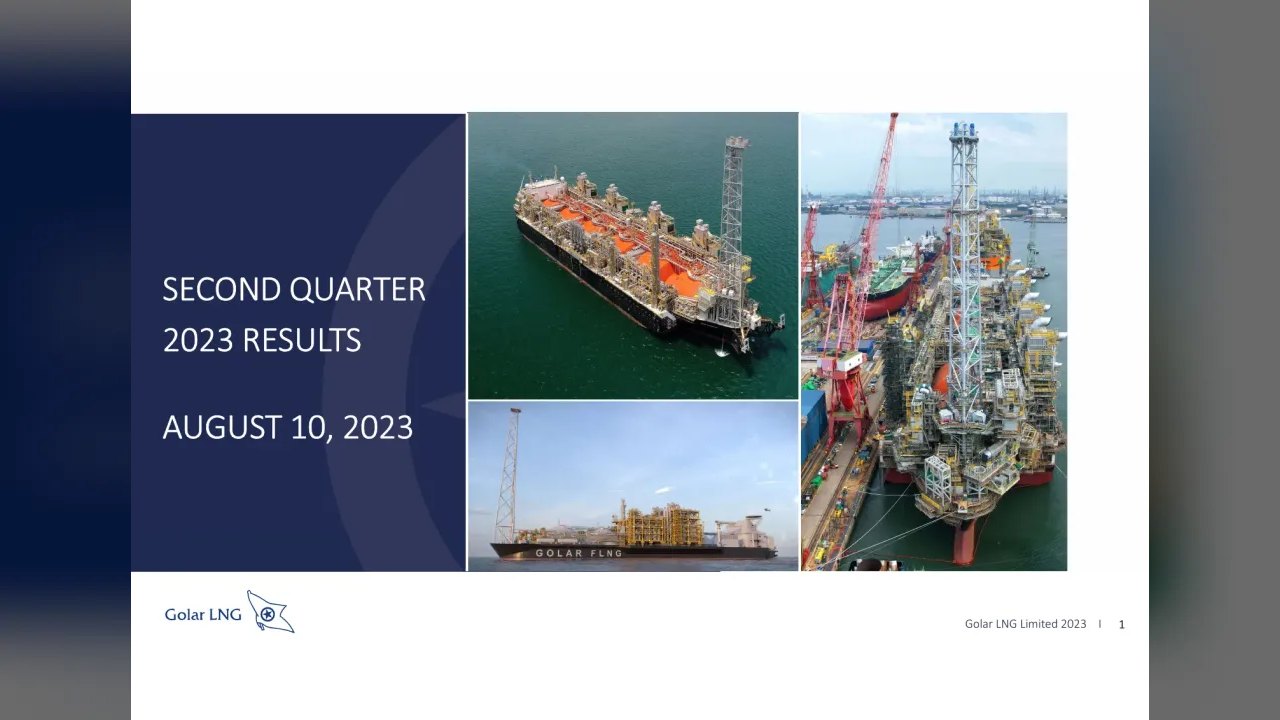
0:28 Hi everyone, and welcome to Goal RLNG's Q2 2023 earnings results presentation. My name is Karl Fredrik Staubo, CEO of Goal RLNG, and I'm accompanied today by our CFO, Eduardo. Before we get into the presentation, please note the forward-looking statements on slide two. On slide three, we present our company overview. We are a focused FLNG player with two FLNGs, Hille, operating in Cameroon, and Gimmi about to deliver and start a 20-year contract for BP. The key changes to our asset portfolio in the quarter was high grading of our FLNG conversion candidate, selling the LNG carrier Gondria and acquiring the LNG carrier Fuji.
1:15 Fuji has significantly more storage capacity, younger age and lower boil-off and is therefore more suitable for our intended Mark 2 3.5 5 MTPA FLNG conversion. SNAM of Italy had an option to convert the Golar Arctic into an FSRU. This option lapsed in July, and we are now reviewing alternatives for her, including long-term charter or asset sale. Our investments include Avenir LNG, a small-scale LNG carrier business, and Macao Energies, a company founded with Golar as sponsor, targeting small-scale land-based liquefaction and gas monetization through proprietary technology currently under construction.
2:06 Golar is the world's only independent proven FLNG company. Turning to slide four to illustrate our near-term cash flow growth and further earnings upside in re-contracting of the Hilly and potentially a Mark II FLNG. Hilly continues its market leading operational off time with another quarter of 100% economic utilization. The vessel will operate for Perenco in Cameroon until July 26, and we see strong earnings generation supported by the increasingly attractive commodity exposed earnings for the unit. However, the vessel is currently only 58% utilized versus nameplate capacity. and we see significant potential for increased capacity utilization combined with higher earnings for a recharter of Hilly.
3:00 The current contract was entered into when our FLNG technology was unproven and Hilly's position as the earliest available FLNG globally continues to increase customer interest in the vessel beyond the current contract. Our second FLNG, Gimi, is about to deliver from Citrium in Singapore to start a 20-year contract for BP. Gimi's shift from capex to earnings will significantly strengthen our free cash flow generation, and we also see significant potential in optimizing the debt facility on Gimi once she is delivered. Our contemplated third FLNG would be a Mark II 3.5 MTPA vessel.
3:49 If ordered within 2023, the vessel will deliver late 26 and be ready for operations from early 27. A Mark II would increase our total liquefaction capacity from about 5.5 million tons per annum to 9 million tons, or about a 70% increase. Hence, we see three cash flow triggers for the company. Delivery and startup of GIMMI during second half of this year, shifting the vessel cash flow from capex to earnings. Number two, re-contracting of HILI at increased capacity utilization and operational margin. And number three, ordering and chartering of a Mark II FLNG.
4:37 As you can see on the bottom part of the table, Illustratively, we will have up to 322 MMBTU available for charter from early 2027 onwards. Tariffs in line with the current competitive US export market suggest earnings of about $1 billion from this available capacity. However, our FLNG technology enabled monetization of stranded gas reserves that would otherwise remain undeveloped Hence, we believe significantly higher liquefaction margins should be obtainable. We are currently in discussion with more than six different gas resource owners at various geographical locations focused around West Africa for potential FLNG deployment, all of which with significantly better economic terms than current charters.
5:39 Turning to slide 5 and highlights for the quarter. Hilly continued its 100% economic uptime, and we now have offloaded our 97th cargo. We're pleased to confirm that we have finalized improved terms for the Hilly financing, reducing the debt margin and extending amortization profile and facility duration. GIMMI is now 97% technically complete, and we expect sale away during September this year. On business development, we have further expanded the MOU we entered into with NNPC in April to now be further developed through a heads of terms, setting out a contractual framework for a joint development of specific gas fields towards potential FLNG deployment.
6:32 Development of commercial opportunities also continues outside of Nigeria. including commercial term negotiations with gas resource owners and government interaction in potential countries of operation. It should be highlighted that the complexity of offshore gas development drives the timeline for potential announcements of any binding terms for incremental FLNG work. Under corporate and other, Eduardo will cover most of that later in the presentation. But as per our guiding in first quarter, we have declared a quarterly dividend of 25 cents also for Q2. During the quarter, we've also spent about 30 million of our $150 million buyback program announced in May, and we have acquired and canceled about 1.4 million shares.
7:25 We remain committed to enhancing shareholder returns as our earnings continue to grow. We will now turn to a business update starting with GIMMI on slide 7. As already mentioned, the vessel is now 97% complete and we expect sail away from the shipyard during September. System handover is underway and final testing ongoing. The arbitration process regarding certain pre-commissioning contractual cash flows continue but is not expected to have a wider impact on the 20-year contract with BP. Moving to slide 8, and with the delivery of GIMMI, we are now transitioning cash outflows to earnings for the vessel.
8:19 The construction of GIMMI commenced in 2019 and has been delayed due to COVID effects at the shipyard and for sub-suppliers. Given that Golar is a company with two key assets, we have currently had around half of the balance sheet not generating cash flow. With GIMI going from capex to cash flow and the increasing commodity earnings from Hili, we see continued earnings growth in the coming years. This is all before a potential FID of a Mark II, which would further boost earnings in the years to come. Turning to slide 9, we have expanded our working relationship with NMPC to include a heads of terms signed in Abuja on August 1st.
9:14 The heads of terms set out a commercial framework for development of identified gas resources in Nigeria. In addition to the discussions with NMPC, We're also progressing potential FLNG deployment with four independent gas resource owners in Nigeria. In addition to the developments in Nigeria, we see similar developments of more than five potential FLNG deployment opportunities in other West African countries, where we are currently having commercial negotiations with gas resource owners and government interaction in potential countries of operation.
10:01 Our priority remains to first recharter Hilly before FIDing a Mark II FLNG and then secure the charter for search vessel. Moving to slide 10 and the developments we've done on a Mark II in the quarter. As announced and earlier mentioned on the call, we have high-graded our FLNG conversion candidate, acquiring Fuji and disposing of the LNG carrier Gandra. We've made significant progress with Chinese financing houses for a debt facility of up to $1.5 billion, not contingent on a charter. We'll continue to work with the shipyard to further de-risk construction timeline and pricing.
10:53 We have increased our pre-FID commitments to about 400 million through a combination of long lead items, engineering work, and the mentioned acquisition of Fuji. And as alluded to, if we FID that project this year, we will deliver within N26. Turning to slide 11. We see robust long-term fundamentals in support of LNG prices. From a macro perspective, the normalization of gas prices has not stopped the strong interest in securing future position. Asian importers are active in entering into long-term SPAs.
11:39 And as you can see from the left-hand graph, 2023 is lining up to become close to 2022 in terms of total volume contracted. and in 2022 we saw the highest level on record. The consequence of this continued buying interest is a rising price environment. And what we show in the middle graph is the Brent-linked pricing of long-term deals, which is currently ranging between 12.5% to 13.5% of Brent. However, there have been shorter-term deals reportedly done between 16 and 20% of Brent parity. Hence, we share the view of major players such as Shell and BP that LNG demand will remain robust in the long term as it is offering a solution to the energy trilemma the world is currently facing.
12:36 Balancing energy security, access to affordable energy, and doing so in a sustainable manner. That's part of what we are trying to capture on land through Macau energies, which we'll elaborate on on slide 12. Macau is progressing according to plan, targeting first operations in 2024. Commercial and technical development is ongoing alongside building commercial momentum with clients in the US and South America. Additionally, the company is already positioning to access gas for its liquefaction technology, with several discussions ongoing from gas suppliers.
13:23 In order to capitalize on the market opportunity that Macau represents, we are evaluating alternatives to facilitate growth above and beyond the commitment already provided by Golar. I'll now hand the call over to Eduardo to take us through the Q2 results.
13:44 Thanks, Karl, and good morning, everyone. I'm very pleased to provide an update on our group results for the second quarter of 2023. So turning over to slide number 14, I wanted to show some of the financial highlights of this quarter. We had total operating revenues of $78 million, up 5% versus Q1 2023. As a result of softer Brent and TTF prices in Q2, We had total FLNG tariffs of $99 million, down 10% compared to the previous quarter. FLNG tariff is a key non-GAAP metric comprised of total revenues from liquefaction services, including realized gains on oil and gas derivatives. We expect to see a positive reverse of this item this quarter on the back of higher Brent and TTF prices.
14:33 We also recorded an adjusted EBITDA of $83 million, Pretty much in line with Q1, despite lower contributions from commodity-linked fees, as I mentioned before. However, reduced costs associated with the Tundra Development Agreement, which has been concluded in May, contributed to improvement in corporate and other adjusted EBITDA. This quarter, we had net income of $7 million, a significant improvement compared to Q1. This figure is inclusive of a total of 72 million non-cash items, such as $77 million unrealized losses from oil and gas derivatives, $10 million unrealized gains in our interest rate swaps, as well as a $5 million impairment upon the sale of Gendra.
15:19 Our liquidity position remains strong with close to a billion dollars of liquidity. That includes cash on hand and other receivables from the unwinding of our TTF hedges earlier this year. Our total contractual debt stood just shy of $1.2 billion, leaving us with a net debt position of $190 million. Turning over to slide 15, I would like to provide a recap from our historical earnings from Healy. This graph shows our net share of Healy's adjusted EBITDA. And as you can see, the tariff can be broken down into three main components. A fixed tolling tariff of $34 million, which has been in line with the previous quarter. a Brent-linked fee of $15 million this quarter, down from 18 in Q1, and also a TTF-linked fee of $30 million, which is also down from $37 million last quarter.
16:17 As I mentioned before, we expect that higher oil and gas prices should support increased tariffs for the rest of 2023. Turning over to slide 16, We can see that we remain exposed to TTF prices for the remainder of 2023 between August until December. So to give an idea of how this can improve our earnings, for every dollar per million BTU change in TTF prices, we expect to make an additional $1.4 million in 2023. From 2024 until 2026, this will increase to $3.2 million for every dollar of TTF prices. So just for example, If TTF prices average $15 per million BTU next year, we should make around $48 million just from this tariff alone. In addition to that, when it comes to Brent, the incremental contribution is $2.7 million for every dollar per barrel change above $60 per barrel.
17:16 As discussed on our last call in May, we managed to negotiate and complete the amendment of the Haley debt facility with improved terms, including a margin reduction and extension of tenor and amortization profile. These changes are expected to release additional free cash flow of approximately $75 million until the end of the current contract in mid-2026. Those new terms are already in place and have become effective since the end of June. Now turning over to slide 17. Our balance sheet remains strong and we have a great level of flexibility to allow for progressive shareholder returns and at the same time to fund our FLNG growth program. Current liquidity, including cash receivables from TTF hedges, amounts to close to a billion dollars and fully supports the development and equity requirements for the construction of the Mark II FLNG. In addition to that, we have several alternatives that could further enhance liquidity in order to fund further growth.
18:17 including potentially a refinancing of existing debt facilities for both Healy and Gimi that could unlock significant amount of equity should we be required to do so. As discussed on the previous slide, Healy's free cash flow generation of more than $200 million per year fully supports the current dividend and buyback program. These will increase even further upon Gimi's startup, creating room for increasing shareholder returns in the future. This quarter we have declared a dividend of 25 cents a share with a record date of August 21st and payment on or about August 29th. Following the announcement of our $150 million buyback program in May, we have spent $30 million repurchasing 1.4 million shares at an average price of around $21. After that, we had at the end of June 160 million shares outstanding.
19:14 I'll now hand over the call to Karl for some closing remarks.
19:19 Thank you, Eduardo. And turning to slide 19 for summary. Starting off on the left-hand side, we see significant earnings growth from the existing asset portfolio, with GIMI moving from CapEx to cash flow, and increased future contribution from our commodity-linked earnings from Healy. So you can see from the graphs All of the bars above the green line, which represents total debt service, equates to free cash flow to equity. Turning to bottom left, we have an attractive pricing on EV over a million tons of annual liquefaction capacity, currently standing at around $680 million per ton, which is around half of what current shore-based liquefaction projects would cost to develop, in the US.
20:12 Turning to top right, we have a balance sheet that enables us to continue to grow the company. Current cash sits at around $1 billion, total net debt at just shy of 200. We have initiated shareholder returns through quarterly dividends and $150 million buyback program, of which 30 has been spent during Q2. We plan on distributing an increasing amount of the free cash flow to equity to our shareholders while using our balance sheet capacity for FLNG growth project, namely through a Mark II FLNG with 3.5 MTPA of capacity.
20:59 On the bottom right, we have an illustrative capex to EBITDA multiple subject to margin per MMBTU on the x-axis. versus what the capex to EBITDA multiple would be if we deploy at various different rates. We believe with more than 300 MMBTU available of liquefaction capacity from 2027 onwards that we're well positioned to capture monetization of stranded gas reserves in particular in West Africa, but also in other geographical areas in discussion.
21:39 This concludes our Q2 earnings presentation.
21:41 Thank you for listening in and we'll now hand the call over to the operator for any questions. Ladies and gentlemen, we now begin the question and answer session. If you wish to ask a question, please press star 1 1 on your telephone and wait for your name to be announced. We are now taking the first question. Please stand by. The first question from Ben Nolan from Stifo.
22:15 Please go ahead. Hi, thank you. Hello, Eduardo and Karl. I have two. Hopefully that's okay. The first is when you move the or the transition on the with Nigeria moving from a memorandum of understanding to a heads of terms, I'm trying to understand how big of a change that is and how close to a final contract do you think Heads of Terms is? Are we moving meaningfully closer to a definitive agreement in your opinion or is it just, I don't know, maybe frame that in for me.
23:02 Hi Glenn, thanks for the question. There is no recipe on how to fix an FLNG. The only independent provider of FLNG in the world is Golar, and we have done two contracts, one with Perenco and one with BP, and they were different in nature. However, the way it works on the ongoing discussions with NMPC is first you sign an MOU to unlock resources, in particular on the NMPC side. Following the unlocking of these resources in late April and over a series of meetings in London and in Nigeria, we have together developed a commercial framework for how to develop named resources.
23:52 We have then agreed that commercial framework, and that's what's been signed up to through the heads of terms. By signing the heads of terms, We unlock another set of work, in particular then for NNPC to allocate further resources to further develop these projects. Given that all the FLND projects are different in nature, it's difficult to guide on exactly when or how or how material, but it's certainly developing in the right direction.
24:26 Okay, that's helpful. And then for my second question, You talk about the Mark II. If you're able to secure a contract on that asset before the end of the year, it would be available in 2027. And at the same time, you talk about the Hilly sort of being first in line. I'm just curious if you think it is possible. It is reasonable to think that you could get a Mark II contract before the end of the year and stay on that sort of 2027 timeframe.
25:04 So just to clarify, if we contract or recharter Hilly, we will proceed with Mark II without the contract. So you don't need to see both Hilly and Mark II contracted. I think with all of the projects we have in the pipeline, we... We see ourselves increasingly confident both on the rechartering of Hilly and an attractive charter for Mark II. It's just a matter of having a balanced risk-reward before we add on close to $2 billion worth of capex.
25:38 Okay, but I guess the implication is that you don't think that by the end of this year that would be Unreasonable, etc.
25:54 That's what we're working towards, yes.
25:56 Okay. All right. I appreciate it. Thank you, guys. Thanks, Ben. Thank you for your question. We are now taking the next question. Please stand by. And the next question from Chris Robertson from Deutsche Bank. Please go ahead.
26:19 Good morning and good afternoon, Karl. My question is a follow-up to Ben's. Just looking at the scope of work that might be done with NNPC, is there potential to deploy HILI as well as the Mark II asset with NNPC?
26:39 They have more than enough gas to deploy multiple FLNGs in-country.
26:45 Yes. Okay. Yep, that answers my question. All right, thanks. And then looking at the five other countries or entities that you're kind of in negotiation or conversations with now, do all of those, I guess, involve an NOC or are there any IOCs involved in the resources that are being looked at?
27:06 Yes, but it's mainly focused on NOCs, but some of them also include IOCs.
27:12 Okay, great. Thank you very much. I'll turn it over. Thank you for your question. We are now taking the next question. And the next question is from Chris Tsung from WebResearch Advisory. Please go ahead.
27:35 Hey, good afternoon, Karl and Eduardo. How are you?
27:39 Good, thanks.
27:41 Just following up on these NNPC questions. and your other projects in West Africa. Will those all be tolling or integrated? And just as a follow up to that, how should we expect, how much ownership should we expect Golar to have? Will it be like 100% or could we see some NOCs or IOC partners coming on board?
28:05 Okay, so none of the projects we're pursuing is a fixed tariff or like that of GIMI. They are either fully integrated or a fixed tariff with commodity exposure more like HILI but even more exposed to commodity. The reason why we look to structure the charters in that way is that we see that it's a lot easier to get a better economics in the project if you have some upside and downside sharing with the IOCs. As long as that is done with linkage to highly liquid international price indices such as Brent, TTF, JKM or similar, we can always de-risk such pricing movements in the paper market and that's what we're targeting.
29:10 In terms of ownership, it depends from project to project. Most of them, Gola remains the owner of the FLNG. The NOC remains the owner of the upstream and gas treatment. We both work to have as slim economics on that side as possible. And then we share in the gas offtake pricing. And then you basically achieve the same. In some of them, it's being discussed to have... shared economics across the value chain as well. If that is to be the case, the resource certainly need to be big enough to charter the vessel for remaining life, whether it's HILI or MR2.
29:56 Okay, great. Thank you. And to confirm, the contract with BP for GIMI starts up in Q1 next year when the vessel arrives on site, or is it contingent on producing for some of your commissioning cargoes? Just seeing what's going on from like BP and Cosmos is earning calls.
30:14 When it comes to that project, I think Golar's focus is to deliver the FLNG and to deliver it safely on site into the hub. And then we are not taking risk or responsibility for other parts of the infrastructure. And the contract mechanisms work so that there will be cash flow to Golar once we arrive at the site, irrespective of the status of other parts of the infrastructure. It is, however, fair to say that everybody around the table is incentivized to have the project up and running as soon as possible, but we are not actively part of any other parts of the project than delivering the FLNG.
31:08 Yeah, that makes sense. Thanks for that and I'll turn it over. Thank you for your question. There are no further questions. I will hand back the conference to Mr. Staubo for closing remarks.
31:28 Thank you all for dialing in. I hope you have a good day and hope to speak to all of you very, very soon. Thank you. That concludes the conference for today. Thank you for participating. You may hold this connect.
Follow Golar LNG Limited into a list and get an email when it puts out news.
Chief Executive Officer
Chief Financial Officer
Analyst, WebResearch Advisory
Analyst, Deutsche Bank
Analyst, Stifo