Karl Fredrik Staubo
Chief Executive Officer
Replay available
Golar LNG (NASDAQ:GLNG) Q1 2025 earnings call, held 2025-05-27. Watch the replay and read the transcript on 6ix.
On 6ix: 6ix.com/event/golar-lng-limited-glng-q1-2025-earnings-call
Automated transcript · Written by software from the replay's audio. It can mishear names and figures; the replay is the record.
0:00 Welcome to the GOLOR LNG Limited First Quarter 2025 presentation. After the slide presentation by the CEO, Karl Fredrik Staubo, CFO, Eduardo Maranhao, CTO, Morten Skjong, and Chairman, Tor Olav Triom, there will be a question and answer session. Information on how to ask a question will be provided then. At this time, all participants are in a listen-only mode. I will now post you over to Karl Fredrik Staubo. Karl, please go ahead.
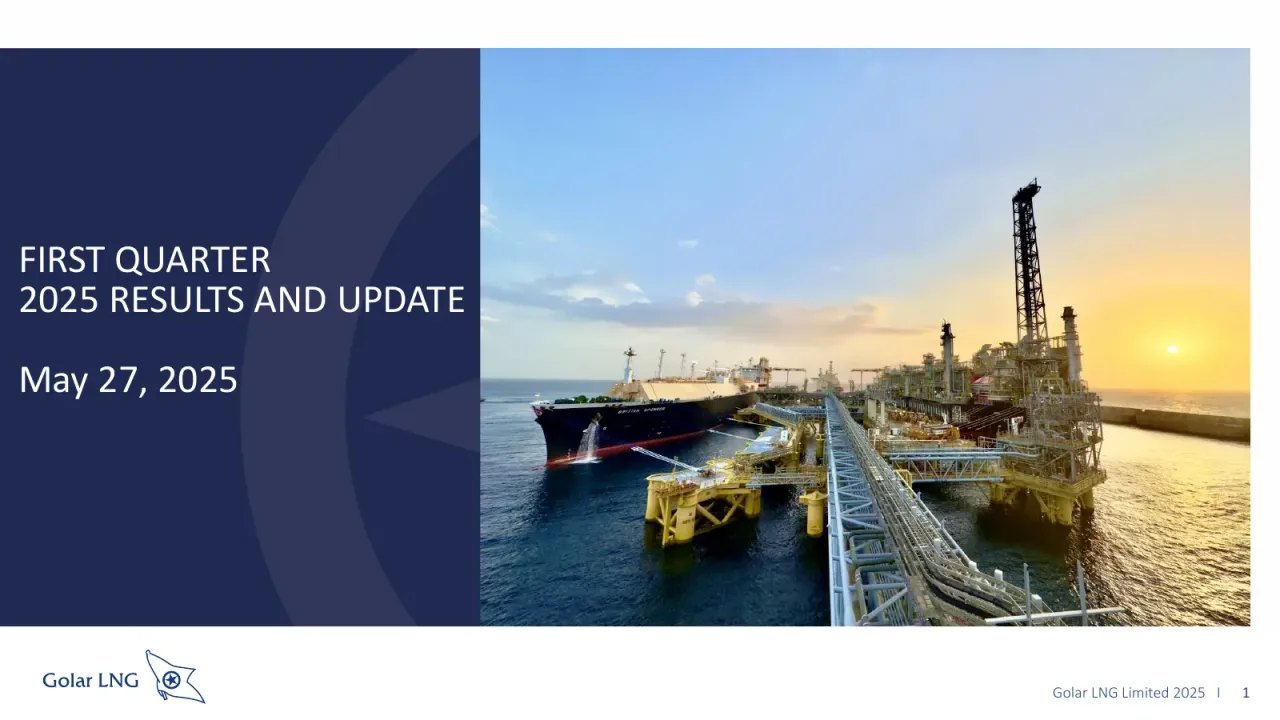
0:33 Thank you, operator, and welcome to Goal RLNG's Q1 2025 earnings results presentation. My name is Karl Fredrik Staubo, CEO of Goal RLNG, and I'm very pleased to be accompanied today by our chairman, Mr. Tor Olav Tre, our CFO, Eduardo Maranhao, and our chief technical officer, Mr. Morten Skjong, to present this quarter's results. Before we get into the presentation, please note the forward-looking statements on slide two. As normal, we start on slide three with an overview of Golar today. Golar is now a focused FLNG company. We own three units, of which two is underwater and one is under conversion. The key event of the quarter was securing of two 20-year charters one for our FLNG Hilly, following the end of our current charter in Cameroon in July next year, as well as entering into definitive agreements for a 20-year charter for our Mark 2 FLNG under construction.
1:38 As announced on our Q4 call, we have now fully exited LNG shipping with the sale of the Golar Arctic and our sale of the equity stake in Avenir LNG. We currently have a market cap of around $4 billion, a total net debt of shy of $800 million, and a fully delivered net debt to EBITDA of around 2.8 times. Our strong cash flow visibility, solid balance sheet, and market leading position as the only proven provider of FLNG as a service sets the company up for continued attractive FLNG growth. We have three FLNG designs available for growth and we will elaborate on our growth ambitions as we go through today's presentation.
2:25 Turning to slide four and a focus on Hilly, which is still the best performing FLNG globally. Hilly continued her market leading 100% operational uptime during the quarter. Hilly has now delivered 132 cargoes since contract commencement in 2018 or more than 9.2 million tons of LNG produced. On May 2nd, all CPs for her 20-year redeployment in Argentina was concluded and final investment decision was given. This secures $5.7 billion of EBITDA backlog before commodity upside. We have now designated a dedicated team of project and operations people to the redeployment scope for HILI's planned vessel upgrades and transit from Cameroon to Argentina to facilitate for 20 years of on-site operations.
3:24 On slide five, we focus on our second FLNG, the GIMMI, which is in her final stage of commissioning and to start her 20-year charter for BP, offshore Mauritania and Senegal. The commencement of operations date will activate the vessel on our P&L statement. Golar's share of the contractual EBITDA is $151 million based on 90% capacity utilization. Any production above such level will translate into a pro-rata increase in Golar's shares of EBITDA generation by GIMI. Following the commercial reset announced in August last year, Golar has invoiced $196 million in pre-COD payments from the GTA upstream partners.
4:14 This amount is recognized on our balance sheet and will be amortized over the contract duration. We have now successfully offloaded two LNG cargoes and expect COD to remain on track within this quarter. That should mark the start of the 20-year contract period. The picture on the bottom left is from Thursday last week, where we attended an official state visit by the presidents of Senegal and Mauritania to the GTA hub, together with senior management from BP, Cosmos, SMH and Petrosen, marking the introduction of Senegal and Mauritania as LNG exporting countries. Turning to slide six for an update on our Mark II FLNG conversion.
5:04 The conversion of the LNG carrier Fuji into a 3.5 million tons per annum Mark II FLNG is well into construction. During Q1, the Fuji arrived at the shipyard in China. The vessel has now been divided in two and skidded onshore. The liquefaction plant that will be built on a new midship section is well underway and a significant portion of our long lead items have arrived at the shipyard ready for installation. The project remains on schedule for delivery by year end 2027. On May 2nd, simultaneous with the final investment decision for the FLMG Hilly Charter in Argentina, We entered into definitive agreements for a 20-year charter for the Mark II to operate alongside Hilly in Argentina.
6:00 The contract is subject to the same CPs as for the Hilly when we entered into her definitive agreements in July last year. These CPs include environmental assessment, export license, RIGI protection, and final investment decision by the partners. All the CPs are expected to be lifted within 2025, and we expect the relevant approvals to benefit from the recent HILI process. The capex to EBITDA for the Mark II is around 5.5 times before commodity upside for a 20-year charter period, with a further 5-year extension option in the Charter's favor.
6:48 On slide seven, we have visualized these substantial charter developments on a slide. Our contract backlog now stands at more than 60 years of combined contract backlog across our three FLNGs. Or in dollar terms, we have an EBITDA backlog of approximately $17 billion before commodity exposure. The existing fleet is now fully contracted and we are progressing towards our express target to transform into a market leading infrastructure company with attractive commodity offsites. In the next section, we will elaborate further on the key attributes of our FLNG charters in Argentina.
7:36 Turning to the next section and slide number nine. We illustrate the LNG value chain and Southern Energy's role in introducing Argentina as an LNG exporting nation. As part of the Argentina deal, Southern Energy has secured fixed price gas sales agreements for 20 years from the upstream partners of CESA to provide the project with natural gas sourced from the Vaca Muerte onshore field in Argentina. CESA will be responsible to facilitate for a dedicated pipeline to bring the natural gas from the Vakamvarte to the FLNG location in the Gulf of San Matias, a distance of about 500 kilometers.
8:25 This will equate into a fixed pipeline fee to CESA. CESA will then be responsible for chartering and operating the FLNGs, as well as marketing of the gas. Hence CESA's responsibilities include all activities to be taken from the Vakamvarte until LNG is produced and ready for export. The export point price is referred to as free on board. The difference between free on board prices and the LNG prices you typically recognize on your screen is the shipping costs from the production site to its destination of consumption. The destination price is referred to as delivery X ship or death pricing as highlighted on the slide.
9:17 As part of the charters, Golar will receive 25% of all achieved LNG prices above $8 per MMBTU in FOB price. Hence, when considering the upside element, the applicable methodology is to consider death prices less $1 to $2 per MMBTU in shipping costs. In the current market, TTF and JKM spot prices are trading around $12. Hence today, there's a $2 to $3 upside above the $8 threshold if the project was producing today. Turning to slide 10 and some of the contract highlights.
10:03 Both vessels have a 20-year contract term. Healy will have an annual EBITDA of $285 million and $400 million for the Mark II. OPEX is passed through for both vessels. Both EBITDA tariffs are subject to a CPI adjustment equivalent to 30% of US CPI from year 6. Both vessels have the same upside element of 25% above $8 FOB. and combined the two contracts provide GOLAR with an EBITDA backlog of $13.7 billion before the mentioned CPI adjustment and the commodity upside. Turning to slide 11 and further elaborating on the commodity upside element of the charters.
10:57 As explained, GOLAR will have a 25% upside above 8. For every dollar above, we have an annual EBITDA of around $70 million. Over the contract lifetime, that would equivalent to $1.4 billion of EBITDA backlog for every dollar achieved pricing is above it. Importantly, this calculation is based on monthly achieved prices. We have also introduced a limited downside element where Golar give a temporary discount should annual average FOB prices be below seven and a half and down to six dollars.
11:53 This is capped at a total exposure of 105 million dollars over two years which is equivalent of 210 million dollars. Hence the total commodity exposure for the contract has a maximum downside of $210 million in return for no cap on the upside. If this contract was in place over the course of the last five years, you can see in the table on the bottom right that we would have meaningful additional EBITDA above the contracted amounts. If you take the extreme example of 2022, the commodity element alone would contribute $1.7 to $2.1 billion of additional EBITDA to Golar if the contracts were in place at that time.
12:53 Even today, if the contracts were operational today, we would see an additional contribution above the contracted amount of an additional $250 million. So to summarize this simplistically, for every dollar FOB prices are above eight, GOLAR makes an additional $70 million of annual EBITDA. Turning to slide 12 and the further commodity exposure that's inbuilt into the contracts. GOLAR is a 10% shareholder in Southern Energy alongside our upstream partners, Pan American YPF, Pampa Energia, and Harbor Energy.
13:42 Hence, Golar makes an additional 10% of commodity exposure. This has no downside cap or upside cap, so the true, fully aligned shareholder, where a $1 change in the gas price impacts Golar's EBITDA generation by around $28 million. Hence, if you combine the $70 million upside tariff and the $28 million equity ownership, one dollar change provides Golar with approximately $100 million of EBITDA upside. This is further illustrated on page 13, where you can see our EBITDA build-up.
14:28 Hilly has a base tariff of 285, Mark II of 400, Combined, that's 685. The downside element we have is linked to our equity ownership in CESA, and the rest is upside. Every dollar above eight equates to around $100 million. Every dollar below is a downside of around 28. We see this as a highly attractive risk reward, and also in light of current and future LNG prices, we expect meaningful additional EBITDA contribution from the commodity element. Turning to slide 14, contracting in Argentina has historically not been fully without risk and we have have gone to great extent to look at risk mitigation both regulatory and legally in the framework supporting the charters.
15:35 Some of the highlights include English law for all charters. All payments are made in US dollars. The Millet-led government of Argentina has introduced several regulatory frameworks to boost domestic investment in Argentina and we are pleased to have received the support of both the state and local authorities to achieve the first ever 30-year non-interruptible LNG export license in the case of FLNG Hilly. and we have also been accepted to the large investment incentive scheme under the Rigi protection which was a law introduced last year.
16:24 The important highlights of the Rigi includes certainty and regulatory stability for the duration of the project. We cannot be subject to any new national, provincial or municipal taxes. and we have full freedom to repatriate profits, dividends and capital during the life of the contract term. These are the same protections that are the CPs that we will meet for the Mark II Charter. Turning to slide 15 and looking at the global LNG market and how our CESA contracts are placed in the wider scheme of the market.
17:09 When entering this year, the LNG market stood at around 430 million tons, where the USA is the largest current producer with a 23% market share. More importantly, the significant expected growth in the coming years is driven by volumes out of the US. Hence, we want to identify ourselves with projects that are highly competitive versus US exports. as the marginal producer. If you look on the cost curve on the right-hand side, you can see that the delivered price of U.S. export projects is north of $10 per MMBTU. If we then further elaborate on slide 16, how the recently announced Argentina GOLAR contracts stack up versus U.S.
18:02 liquefaction projects, there are some interesting data points to note. First and foremost, the gross tariff that we have achieved is significantly higher than that of recently entered into U.S. liquefaction projects. The EBITDA tariff you typically see in the U.S. is net of OPEX and maintenance costs hovering around $2, whilst we have secured around $2.45. The capex per ton is currently sitting of around $1 billion for U.S. liquefaction projects versus $600 million in the case of the Mark II. Inflation adjustment is typically hovering between 20 and 30% in the U.S., 30% for our contract in Argentina.
18:55 In addition, there's no commodity upside for U.S. liquefaction tolling arrangements, whilst we have the mentioned 25% above $8 of FOB. Hence, what does these characteristics mean? Well, if you have a higher EBITDA tariff and a lower capex per ton, you have a higher return on capital employed. Our commodity upside within the tariff provides us with strong upside participation without spot cargo risk. The fixed price gas sales agreement for 20 years provides CESA with a call option on international LNG off-take prices for 20 years. I think no one knows exactly where the gas price is, but you know it will be volatile and we are there to capture 25% of monthly volatility.
19:48 The OPEX pass-through combined with our 30% CPI adjustment provide for improved inflation protection versus U.S. liquefaction projects. Hence, all in all, we believe we compare very favorably to the alternative infrastructure investments within LNG liquefaction. This is further illustrated on slide 17. Starting off with the graph on the far left, you want to have as low as possible capex per ton and as high as possible average tariff in dollars per MMBTU basis. And compared to some of the listed US liquefaction alternatives, we compare favorable on both measures.
20:34 Then you want long-term cash flow visibility. We now have 20-year across all of our three assets, hence that's the remaining average life of our contract. Lastly, to the far right, we've looked at capital markets pricing on a liquefaction capacity basis. If you take total EV and divide over liquefaction capacity in operation, you can see that Golar is trading at just north of a billion dollars per ton, whilst our US colleagues are trading more favorably. If you were to include a fairly significant You can see that the capital markets pricing further reduces in the case of Golar to shy of 900 million dollars per ton whilst comparing to our US listed pairs have a significantly higher pricing.
21:37 If you were to put that pricing into Golar share price that would be a very meaningful pickup from our current capital markets pricing. Moving on and turning to business updates on slide 19. The highlights of the quarter across the BD department is obviously the final investment decision for Hilly, the definitive agreements for the Mark II. However, we continue to see strong progress on further FLNG commercial development. There are very few yard slots that can deliver within the 2020s. and we now see increased attention from the projects that lost out on the Hille and the Mark II.
22:26 We continue to target opportunities with competitive wellhead gas to secure an attractive base tariff with commodity upside participation. We are in detailed commercial conversations across our different vessels designs, Mark I, II and III, and some of these discussions include projects where the Charter may want an equity participation in the FLNG. I'll now hand the call over to our Chief Technical Officer, Mr. Morten Skjong, to further elaborate on our service offering and the different designs available for growth.
23:11 Good morning, good afternoon. In GOLAR, we have three different FLNG designs, the Mark 1, the Mark 2 and the Mark 3. These range in LNG liquefaction capacity from around 2 million tonnes per annum up to a maximum of 5.4 million tonnes per annum. This depends on FLNG configuration, feed gas properties and ambient conditions at the site. The Mark 1 at Seatrum is a highly successful design with two units on the water and a stellar track record for the hilly during its contract in Cameroon for Perenco. Meanwhile, our first Mark II conversion is progressing well at CMC Raffles, and the EPC contract contains an option agreement for a second vessel. Our Mark III reflects years of innovative engineering and Samsung's world-leading FLNG track record.
24:03 Common to all three designs is Black & Veatch Preco liquefaction technology, enabling Golar to harvest vital lessons learned between FLNG designs. The most important commonality is however the input and leadership from GOLAR's world-class projects and operations teams. With HILI's FID and the signing of definitive agreements for the Mk2 in Argentina, we are now advancing work with our contractors to confirm updated price and schedule for our LNG designs. We have also completed ship inspections for potential donor vessels for either a Mk1 or a Mk2 and we are confident that we can secure a conversion candidate with Fuji's LNG storage capacity or higher at an attractive price. Furthermore, we are in discussions with long lead equipment suppliers for slot reservations or pre-orders to ensure that lead times for critical equipment will support the overall schedule for our next project.
24:59 The work we are doing now will enable us to proceed with at least one FLNG EPC award this year and whatever design we choose within the 2020s. With that, I'll hand over to our CFO, Mr. Eduardo Maranhao, for the Q1 group results.
25:20 Thank you, Morten, and good morning, everyone. I'm pleased to provide an overview of Golar's financial performance for the first quarter of 2025. Moving to slide 22, let's go through some of the key financial highlights of the quarter. We achieved total operating revenues of $63 million, FLNG tariffs reaching $73 million in the quarter. Total FLNG tariff in the last 12 months, ended in Q1, reached $336 million. We refer to total FLNG tariff to illustrate the total revenues generated from FLNG Healy, including realized gains from TTF brand linked fees. In addition to this, GIMI has started to contribute to our cash flows. and as of May 2025, we have invoiced around $196 million of pre-COD fees under the Commercial Reset Agreement, most of which has already been received. This amount is not shown in our P&L and is currently being recognized on the balance sheet until COD.
26:23 Total EBITDA reached $41 million in Q1, largely driven by lower Brent and TTF prices. Total EBITDA for the last 12 months ended in Q1, was $218 million. This quarter will report a net income of $13 million, in line with the previous quarter. This figure is inclusive of a total of $32 million of non-cash items, such as adjustments in the value of embedded TTF and Brent derivatives within the Healy contract, as well as changes in our interest rate swaps. Our liquidity remains strong, with approximately $680 million of cash on hand at quarter end. I'll talk more about these and other initiatives on the financing front in the next slide.
27:08 Lastly, we're pleased to declare a dividend of 25 cents per share this quarter with a record date of June the 3rd and payment scheduled for June the 10th. So this equates to around $105 million per year on a run rate basis. Now turning to slide 23. We now take a closer look on our debt position. At the end of Q1, we had just under $1.5 billion of gross debt when adjusted for our 70% stake on GIMI. When an asset level basis based on the existing $17 billion EBITDA backlog that Karl spoke about before, our units are still significantly under leveraged, considering the cash flow visibility beyond 2045, with further growth from increased capacity utilization as well as commodity exposure.
27:57 Last March, we signed a $1.2 billion debt facility to refinance the FLNG gaming with a consortium of leading Chinese leasing companies. This facility features a tenor of 12 years and a 17-year amortization profile. Upon closing a repayment of the existing debt facility, we expect to generate net proceeds of approximately $530 million, of which 70% of these proceeds or an amount equivalent to $370 million will be released to us. We are currently working on the remaining closing conditions which includes third-party stakeholder approvals and we expect that closing could take place around summer. In addition to this initiative and to further evaluate Ladies and gentlemen, please continue to stand by.
29:23 Your conference will resume shortly. Thank you. Ladies and gentlemen, please continue to stand by.
30:27 Your conference will resume shortly. Thank you for your patience.
31:00 Okay, I think you may now hear me back. So if we go back to slide 23, we now take a closer look on our debt position. At the end of Q1, we had just under $1.5 billion of gross debt and adjusted for our 70% stake on Gini. On an asset level basis, based on the existing $17 billion backlog that Karl mentioned before, our units are still significantly under levered, considering the cash flow visibility beyond 2045, with further growth from increased capacity utilization and commodity exposure. On March, we signed a $1.2 billion debt facility to refinance FLNG Gimi with a consortium of leading Chinese companies.
31:45 This facility features a tenure of 12 years, and a 17-year amortization profile. Upon closing and repayment of the existing debt facility, we expect to generate net proceeds of approximately $530 million, of which 70% of these proceeds or equivalent to $370 million will be released to us. We are currently working on the remaining closing conditions, including third-party stakeholder approvals, and expect to close around the summer. In addition to this initiative and to further evaluate debt optimization alternatives, we have completed the rating process of the company with key rating agencies, allowing us to tap the capital markets in a more efficient way in the future. If we look at Healy, for example, we have an EBITDA backlog of more than $6 billion, which gives us plenty of room to optimize its financing from the current levels of around half a billion dollars. In addition to that, Mark Chu remains fully unencumbered, and so far we have invested around $700 million of equity in each construction.
32:49 So moving to slide 24, we currently maintain a net debt position of around $800 million, which is projected to increase to approximately $2.3 billion upon completion of the Mark Chu remaining CapEx. By 2028, with Mark II fully operational, our anticipated fully delivered run rate EBITDA is expected to reach $835 million before any further commodity upside. This positions us with a robust leverage ratio of 2.8 times net debt to EBITDA supported by clear earnings visibility extending through 2045. Assuming a conservative five times net debt to EBITDA ratio and leveraging on our secured long-term contracts The refinancing of our existing debt under optimized terms could potentially unlock over $1.9 billion of equity.
33:43 This move aims to release additional equity, accelerating our growth initiatives, including the funding of additional FLNG units. Once these units are contracted, financing at similar leverage ratios of around five times EBITDA becomes viable. This approach allows us to efficiently recycle capital facilitating sustainable and self-funded expansion. That concludes my update. I'll now hand the call back to our chairman, Thor-Olof Troynsson.
34:15 Thor-Olof Troynsson Hi. I'm not going to bother you for a long time. It's probably 10 years since I've been on one of these calls, but I thought it was useful to just give a little recap on what has happened in these 25 years since we took over and also give some credit to the people who have effectively created this company over the last years. I think Sea Tankers took over Osprey as a conglomerate in 1999-2000. We then turned it into an LNG growth vehicle. We had the ambition that LNG was a high commodity growth and it seems like we were right because at that time it was around 130 ships. I think today we have more than 600. Also the number of journals has increased dramatically in appearance at that time.
35:04 So you are correct, but we were probably 15 years too early in many ways. And that was part of the problem. In 2001, we decided to go for shipping. People, we went to conference and we would change the market. We will do commodity shipping with spot tonnage. People thought we were crazy, but in three, four years, we effectively had a situation where people followed us and we were effectively 30 people in the same kind of group and the return went down so we said we had to do something else we then had some good technical experts in the company developed LNG terminals carriers into terminals and we met with President Lula in Brazil and he wanted to be independent of Bolivian gas and then suddenly we became an FSRU company Good return in the beginning, same thing happened, Accelerate BB, Livanos, Berg, everybody came after it, and there was no money there either. So when we came to 2014, a major transformation was necessary. We then worked on the FN&D concepts from 2010.
36:20 However, there was a big dispute between Mr. Fredriksson and myself, and that led to my departure from Sea Tankers. We then arranged a buy-off. of the 1.8 billion stake from Sea Tankers, with good support from institutional holders, and then went ahead with the first F&D order. It was a challenging start, but when oil market tipped in 2014, but we got the contract with Perenco on the first vessel, and we also hired the chairman from BP, no, from BG, Frank Schapman, It was helpful in setting up the second contract, which we then got with Cosmos initially, but which was later concluded with BP. Then, as prices fell in 2014, we also kind of went into the power cycle with Eduardo Antonello and the 25-year power purchase contracts. We were actually pretty widely spread at that time, including the FSRU business, the carrier business, the power business, everything.
37:23 Then we said, if you're going to achieve something in this world, we have to focus. So we then decided to focus. We divested the Kool company. We divested the power station when LNG prices came up again because the business was not that good any longer. And we also divested the carriers in Kool when the market was strong, we sold it. So we were stuck with some LNG assets. and we had already at that time, with what we now have done in the last year, built the largest FLND company in the world. I'm also proud to say that Perenco, who are the people who have known us in the LND business longest, which I consider to be the best oil company in the world when it comes to how they run their business, they've known us from 2012, I think.
38:17 and I think they've done business with us on the site since 2018. I know they're also our larger shareholder, and they also, as of last week, we have sent it on the board. So then, when Karl and the team conclude a backlog of $17 billion spanning over 20 years, is then the board disappointed that the latest deal hasn't resulted in a higher share price? Yeah. To some extent, we probably are. But it's the same board who are there today who bravely rejected private equity offers pretty close to where we are today. At the time when the order book in this company was only 25% of what it is today. Because we knew at that time that we could deliver more value to shareholders over time.
39:12 That said, if you want to run the growth company, you need over time and effectively priced equity exclusion to continue the growth. If public investors are unwilling to wait two years before the strong cash flow comes in, the board is convinced that alternative strategy exists for this company. One possibility, which I think we're well into with Eduardo and his team, is to look at the bond financing structure, which clearly will enhance the equity return in this company. Another one is to look at what came in coming last time. And I think we see some interest rate for it already. The interest private equity having a buying in order backlog of 17 billion. As I said last time, they were close to paying what the share price is today.
40:00 This time the order backlog is four times bigger, so I assume the number is significantly higher. But this is not what the board really wants. I think the board wants to continue to build this company. We have confirmation of the March 2 later on this year, which has been told to investors. We also have the possibility of concluding the commitment for Vessel 4 and 5 within four and also maybe five within this year. We'll see what we have. We're certainly going to build more. We are undoubtedly having the yellow leader shirt in a business set for massive, massive growth. And I think to put it in cycling terms, we are in a pretty strong breakout.
40:49 I don't see any competition behind us. And I think if you look into what happened in the FPSO industry, it grew effectively from two units to 250 units in 40 years. I think we'll see a very similar track here and the reason is the same. It's a lower cost economics to build floating units than it is to build this massive structure we build in the old days on the land-based LNG termite and it provides significant more flexibility when you can move things around. You can also take higher political risk by going to countries you couldn't go to with a fixed installation. My former boss Torstein Hagen, he told me when I was 13 Don't focus solely on money. If you bring the right people together and you have a good business idea, money will ultimately come to you big time.
41:42 He started in Viking Cruises 25 years ago, and today the company is worth 20 billion. He started it from scratch and probably have a fortune of more than 10 billion. It was all because he had a good idea and he had great people. It's exciting to have an earning secured of two and a half million dollars a day for the next 20 years, starting in 27, 28. But what is truly motivating me as a chairman in this thing is the massive, massive opportunities we have to grow this company, along with some of the best people at least I ever worked together with. And I think some of them are extraordinary. If you think, for instance, about the chief executive we have in this company. I would say that it's probably by far up in, I think I've probably worked with 40, 50 different people, and it's clearly among the top two, three guys I ever worked with as a chief executive. Fantastic guy.
42:40 I think Maranhao, great financial mastermind, working strongly on the financing. Morten is a brilliant CTO. continuously putting borders and trying to come up with innovation. We have Marcus Brown, who was the guy who created the whole Argentinian file together with Cassiandro and Antonello. Unbelievable people. We have Ragnar, a guy who operates the Hilly and also the Gimmi, who have perfect record. We have Tedion Victor, who delivered to BP better than any people can do. We have processing engineers. We have a fantastic team, as you see on the picture here. which describes the whole Godard team. I think it's unbelievable. And I think this in many ways, forget the $17 billion in assets.
43:26 We have the smartest people. We have the same people when the FBSO company, SPM, said that we were going after FLND. They made a slide and they put a cross over it. It will never happen. That's the same unit who in seven years have delivered every day production according to schedule and not had any downtime. I'm super excited by what to come here, but I'm super excited because of the opportunities and the team we have together. But the reason why the opportunity is so much better now is the fact that we have $17 billion in backlog. We have close to a billion to finance the growth going forward. I think when you can find a business, everybody hates the kind of I think the latest statistic from EO shows that the electric consumption in this world went up with around 4% year-on-year.
44:23 Out of that, effectively, 11% is fossil fuel and renewables down 2.1%. Gas is a major driver with 8%. I think if you are in the gas business, we have a massive growth area ahead of us. I think we can really do something monumental here. I think if we build assets for 20-year contracts at five times, five times plus EBITDA, and add on top of that, you have an upside on the equity, which in this case, Argentina, it goes to 30%. If gas price takes up, I think you have created something absolutely unique. I don't expect people to see this from day to day. But I think as you go along this story, it will unravel for most of the people. It took us 25 years to get there.
45:14 I'm sure it will take 25 years for us to have any serious competition in this business as well. I think when major oil companies, one of the three major oil companies in the world comes to us and say, we can't do this ourselves. Are you willing to do it for us? And we just said, no, we're going to do it for ourselves. I'm proud of what we have created. So I leave the world back to Karl and I said, Good luck. Look at the situation. Don't judge us day by day. But the company who effectively over the last years have built $10-15 billion in order backlog, at least give us some credit. Thank you.
45:53 Thank you, Thor. Much appreciated for kind words. I fully echo especially the words around the organization. And it's also nice to know that I can stretch a bit further to... further increase the stake with versus the other CEOs that you've previously encountered. So we will keep working hard on our side. Thank you. So to the final remarks turning to slide 32, we now have 20-year plus charter on each asset. Obviously, Hille concluding her contract in July next year and then repositioning to Argentina. Gimi to just about to start up her 20-year contract for BP offshore Mauritania and Senegal. and Mark to conclude her conversion and sail straight to her 20-hour charter in Argentina again. So to highlight, we have more than $17 billion of EBITDA backlog with significant commodity upside as explained.
46:50 So for the final slide of the prepared remarks, turning to slide 33 and some of the key milestones and focus that you should expect to see for the rest of the year. Jimmy has now concluded her two first LNG cargoes. The third cargo is underway and COD is expected within Q2. We've concluded the FID of the 20-year charter with Southern Energy for Hilly with an adjusted EBITDA backlog of 5.7 billion. We fully sold out of the shipping related assets including Avenir and Golar Arctic and delivered Arctic to her new owners. Some of the remaining actions that you should anticipate and is our target for the reminder of the year is to conclude the refinancing on GIMI, as Eduardo has explained, to conclude the conditions precedent for the 20-year charter for the Mark II, which are the same CPs as we have recently completed for the HILI, to further target balance sheet optimization on the back of 20-year charters and recycle the capital for attractive FLNG growth units.
47:58 This concludes our prepared remarks for our Q1 call and I'll now turn the call over to the operator for any questions. Thank you. As a reminder to ask a question, please press star 1 and 1 on your telephone and wait for your name to be announced. To withdraw your question, please press star 1 and 1 again. Once again, please press star 1 and 1 on your telephone and wait for your name to be announced. To withdraw your question, please press star 1 and 1 again. For the benefit of all the participants on today's call, please limit yourself to two questions per person. Thank you. We are now going to proceed with our first question. The questions come from the line of Alexander Bidwell from Weber Research and Advisory.
48:47 Please ask your question.
48:50 Good afternoon. I appreciate the time. Could you touch on the overall commercial strategy for offtake on the Argentina projects? Is there a target mix of merchant and contracted volumes that you guys are aiming for?
49:04 Sure. So that work will be led by Southern Energy, where we are obviously a shareholder and will assist. The target is to have a basket offtake, probably between a basket between Brent, JKM and TTF linked, and then some volume left for spot. The interesting part is that there are no LNG exports in this region of the world. And there are some high paying countries very close to Argentina that could boost earnings further. So the idea is to have a combination, yes.
49:41 Alrighty, thank you for the color. And I guess a quick one again on the Argentina contracts. Is there any sort of, I guess, additional upside on that base charter rate for excess production similar to the GIMI contract?
50:01 No, so they have chartered the full capacity. So the 685 is for the full capacity. Similar to the GIMI, we only guarantee 90% of nameplates. and we capture any excess earnings above the 90% through our shareholding in Southern Energy.
50:20 All righty. Thank you. I'll turn it back over. Thank you. Thank you. We are now going to proceed with our next question. The questions come from the line of Sherif El Maghabi from BTIG. Please answer your question.
50:38 Hey, good afternoon. Thanks for taking my questions. Maybe starting with potential future units, if we're thinking about ordering one by year end, when do we start thinking about ordering the long lead items for another new build? And if we order one this year, what's the delivery timeline look like?
51:00 For the Mark 1 and 2, which are both based on conversions, the conversion time is approximately three years. For the Mark 3, because we start from scratch, you need to add another year, so approximately four years. The reason why we're ramping up the shipyard activity at the moment is to safeguard that three-year construction time. And at some point, you should expect to see long leads also being included in such preparations.
51:35 Got it. And then for the Southern Energy JV, just a couple of related questions. First, how do we think about the JV's break-even price for the commodity exposure? And do you give through your 10% stake, do you have any CapEx obligations for the onshore infrastructure they need to put together?
51:56 So we haven't I think it's fair to assume that the downside participation starts at seven and a half and the upside from eight. So within that region should be a very fair assumption. Keep in mind that both the gas sales agreements and the anticipated pipeline fee will be fixed for the 20-year term. So I don't expect significant changes to that break even over time. And yes, Golar is liable for 10% of the required investments by CESA. However, it's important to highlight that that does not include any of the upstream work. That's only the infrastructure required to facilitate exports. So that's mainly port-to-port infrastructure in Gulf of San Matias. The relatively short pipeline connection of 19 kilometers and the mooring system for the FLNGs where we are applicable for our Prorata share.
52:59 Thanks Karl. I'll turn it over.
53:01 Thanks. We are now going to proceed with our next question. And the questions come from the line of Chris Robertson from Deutsche Bank. This is also a question.
53:14 Hey, good morning. Thank you for taking my questions. Guys, obviously the company just made a major announcement with the FID of the Hilly and entering into a definitive agreement for the Fuji. I think Tor hit on this, but just wanted to clarify if the share price kind of stays here at current levels, you know, is the company currently considering strategic alternatives and would that process be made public if that's the direction that the board chose to go down?
53:46 I'll kick it up from management and then Tore can add if he wants. In terms of management, we are running the business to the best of our ability and trying to make the best possible decisions. It is our responsibility to also find out where the best bid for the company is. That said, our focus is on running the day-to-day business. And then we're obviously open for any outside investors, but we are not actively facing any such bids in terms of management. Our focus is to run the business. When it comes to any strategic alternatives, that's a board matter and should be commented on by the board to the extent that they see that necessary.
54:32 I don't know, Tori, if you have anything to add.
54:35 I think the board has a pretty good idea about what the current value of our backlog is. We also have a current good idea about the future opportunities we have ahead of us. We think there is significant value here. But if the stock market doesn't appreciate that value over time, I think we need to do something. We are here to create value for shareholders. We are not here for running a company. So from that point of view, but I wouldn't judge that based on one month's trading or two months trading. I think we need to see a structure over time. And I think we need to see the end coming in on the contracts on March 2, which will then be in the second part of the year.
55:24 And if you don't move the share price in that time, I think the board needs to come together and discuss what to do. We are shareholder friendly. We are big shareholders, a lot of the people in the board and we think like shareholders. I think you do what is necessary. But I also say that we redacted the bid last time because we thought it was better to run the company. But a process like that normally starts with some incoming letters. You don't go out and sell the company. But I think there is enough interest in the company today from people who see value in backlog. But my situation is just that I think that the real company value here today is not necessarily $70 billion in backlog, if that's nice. It's what we can build with our basis and the people we have and the market position we have. But to answer very clearly, if valuation stays low over time, we will do something.
56:22 Thank you, Thor. I appreciate the comments there. A little bit more mundane question here from my follow-up. Can you guys clarify around any remaining CapEx associated with GIMME that you spent during the first quarter and second quarter here ahead of COD? And do you expect, going back to a previous question, do you expect any CapEx related to CESA to be deployed this year?
56:48 Eduardo, do you want to cover that one? Yeah, sure. So when it comes to the remaining capex on GIMI, we don't expect any material payments in the second quarter. So I think as alluded to on the call, all revenues that we have received pre-COD, they have been accounted for in our balance sheet. And this equates to around just under $200 million. We are nearing COD. And once we start operations, we will start to see contributions in our P&L from revenues on the debt contracts.
57:23 Got it. Thank you. We are now going to proceed with our next question. The questions come from the line of Frederic Taibwad from Fernley Securities. Please answer your question.
57:39 Thank you so much, and thank you for a great earnings call so far. My question revolves around the potential additional units to be ordered in this year or potentially next year. You comment that you consider Mark 1, Mark 2 or potentially also Mark 3. So just for me to get a feel or for us to get a feel of the differences of the sizes, can you get a high level overview of the prospective suitable fields? For example, how many contract opportunities does a Mark 1 have compared to a Mark 2? I would assume that a Mark 1 is much more flexible.
58:13 Yeah, that's a relevant question. So first and foremost, all three designs are based on a generic design. It's the same liquefaction methodology, which means that we will not tailor-made for one specific field. And they can all be redeployed at various different opportunities. But to your point, the larger you go, the more gas reserves and gas flow is required to fully utilize the vessel. Therefore, there are by number more commercial opportunities for the smaller sizes and then somewhat fewer for the larger. However, for some of these larger opportunities, you may also need this level of size to make the development economic.
59:03 So what you should expect to see is that we are right now progressing conversations or negotiations for all three different designs. And you could see us progressing with more than one ship this year. I think it's also fair to say that there are several people that we have advanced stages of commercial negotiations with that are now left without a liquefier as the Argentinian contract took both the Hitler and the Mark II and as such there's no available FLNG and those are obviously the counterparts that we are concentrating on from the commercial side right now.
59:48 Thank you. And just one small follow-up on that. You have previously said that you want to just have one unit, call it on speculative order, that is one unit without a contract. Do you have the same stance now, or are you open to potentially ordering two new vessels without the contract, as you did on the Fuji?
1:00:08 So what we've said is that as long as we have visibility for charter, we will only have one open. The way we see it now, we think it's extremely likely that the Mark II will be fixed in Argentina. There's no coincidence that the definitive agreement on the Mark II was signed simultaneous with the final FID on the Hilly. It's economical for them to utilize both ships in the same area. There are significant operational synergies and further advantages in transporting the gas from the Vaca Marte II site, which benefits from the two ships. Hence, in our view, we believe we can proceed with unit number four without changing our expressed strategy of maximum one open ship.
1:00:55 And even if we plan to or could order up to two vessels this year, we will still commit to our stated strategy of maximum one open ship. That means that one of those ships would effectively be built against contracts, if not both.
1:01:12 Perfect. Thank you so much.
1:01:14 Thank you. We are now going to proceed with our next question. And the questions come from the line of Peter Hogen from ABG, Sandal Collier. Please answer your question.
1:01:28 Good afternoon, guys. A quick clarification to begin with. In terms of the CPI adjustments, I read it as if it's applicable to both, of course, the base EBTA and to the upside CPI. Thank you so much. And if I may, as we have the chairman on the line here, We've already touched upon this, but is it possible to say something about what the board would now perceive to be fair valuation of the business as it both stands and knowing about the growth opportunities ahead?
1:02:31 I don't think it's... I think we have obviously... In board documents, we kind of go through evaluations in the different scenarios, but I don't think it's fair to speculate on it. The only thing I would say is, I think that should go for anybody who can do accounting, should be significantly higher than 37. But I don't think we'd like to give any kind of guidance on value, other than saying that if the valuation we have today persists over time, the board will be forced to to find ways to unlock that value. It could take all kinds of forms. I think we have had earlier bids for part of the assets at good prices.
1:03:18 It can be selling the company, it can be growing the company with different capital structures. But we're not going to sit and see an undervaluation over time. We can sit on the valuation for a month or two or three that we are patient enough to that. I think everybody now talks about the two years we have of pain until we effectively get the cash flow turned on. But I think I've had 25 years of pain until I'm here. So another two years doesn't take me that long, actually. And I think investors in this case should see that what we're trying to do is to build significant value over time. We are now going to proceed with our next question.
1:04:19 And the questions come from the line of Michael Weber from Weber Research. Please answer your question.
1:04:25 Hey, good morning, guys. How are you? Good, thanks. I just wanted to follow up on CESA and specifically the gas that's heading to both the hilly and another unit. I know the hilly's teed up to utilize latent capacity from an existing pipeline network and then they're looking to build a dedicated pipe for the other asset. Is that gas already treated and or does there need to be treatment built for either the hilly or subsequent assets onshore?
1:04:58 That will be done as part of onshore, but Vakamarte gas is extremely lean, so it's almost very, very little treatment needed, and the necessary treatment facilities more or less in place existing, so that's not an issue.
1:05:14 So the existing treatment is already in place for the hilly, or is there enough excess treatment capacity to handle additional assets too?
1:05:22 The gas specification of the Vakamarte, what we're talking about here is producing lean gas They will obviously require upstream investment, meaning wells that need to be drilled in Vakamarte to increase flow. Extremely limited treatment that's required of that gas, and that's part of the attraction to use Vakamarte for exports.
1:05:41 Okay, so specifically, I'm thinking about the timing of any treatment capacity that needs to be built in conjunction with when those charters would start. So do you see that as a significant risk factor for the commencement of those charters?
1:05:53 The pipeline and any associated infrastructure has a construction period of significantly less than two years. We've already spent together with CESA more than a year on all the planning. So I think we're very well on track to facilitate that infrastructure.
1:06:13 Great. That's helpful, guys. Thanks for the time. Thank you. Thank you. In the interest of time, we have time for one last question. And the questions come from the line of Eric Boesel from Fenley's. Please ask your question.
1:06:30 Hey guys, congrats on a great quarter. Just quickly on the capital structure, you mentioned that you're engaging with rating agencies to get a rating and that you could look at the bond financing. Should we expect a rating to benchmark bonds coming out of you guys soon? Also, just to follow up on that, you indicate an asset level financing around five times. Is that something you can look at the corporate level as well? Eduardo, do you want to start?
1:07:04 Yeah, sure. So, you're right. So, we have started an exercise with rating agencies to pursue a rating. That exercise has been completed. However, any outcome of that rating is still confidential. We could potentially be looking at transactions at the corporate level or alternatively at an asset level basis as well. So I think we're using that five times as a guidance, which takes as a proxy the same leads-back financing that we have signed for GIMI. which was done just under six times. So I think we view five times as a leverage ratio, as a conservative assumption of what can be done on the back of this 20-year agreement.
1:07:50 Great, thanks. This concludes the question and answer session. I want to hand back to Mr. Charles Staubo for closing remarks.
1:08:02 Thank you all for dialing in and listening to our Q1 presentation. Much appreciated and we look forward to reconnect during our Q2 presentation. Thanks again and have a great day. This concludes today's conference call. Thank you all for participating. You may now disconnect your lines. Thank you and have a great day.
Follow Golar LNG Limited into a list and get an email when it puts out news.
Chief Executive Officer
Chief Technical Officer
Chief Financial Officer
Chairman
Analyst, Weber Research and Advisory
Analyst, BTIG
Analyst, Deutsche Bank
Analyst, Fernley Securities
Analyst, ABG Sandal Collier
Analyst, Weber Research and Advisory
Analyst, Fenley Securities