Karl Fredrik Staubo
CEO
Replay available
Golar LNG (NASDAQ:GLNG) Q1 2024 earnings call, held 2024-05-28. Watch the replay and read the transcript on 6ix.
On 6ix: 6ix.com/event/golar-lng-limited-glng-q1-2024-earnings-call
Automated transcript · Written by software from the replay's audio. It can mishear names and figures; the replay is the record.
0:00 Welcome to the GOLA LNG Limited Q1 2024 presentation. After the slide presentation by CEO Karl Fredrik Staubo and CFO Eduardo Maranhao, there will be a question and answer session. Information on how to ask a question will be provided then. At this time, all participants are in listen-only mode. I will now pass you over to Karl Fredrik Staubo Karl, please go ahead.
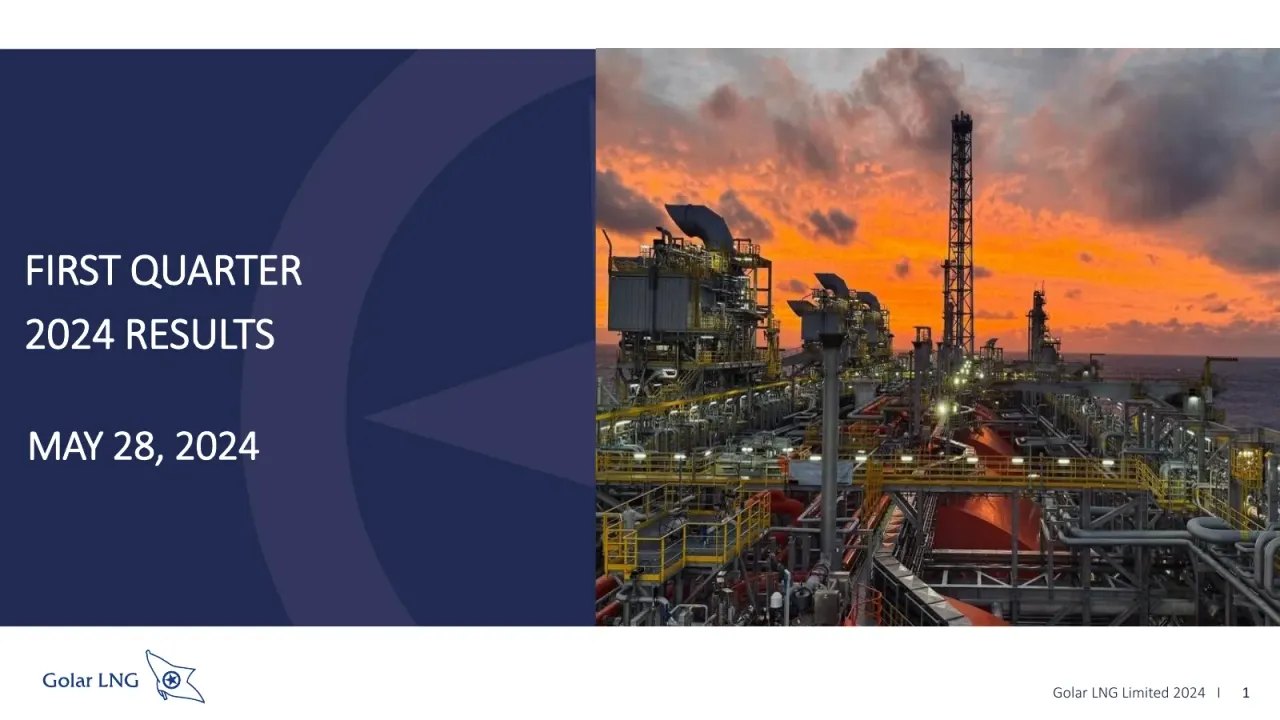
0:32 Thank you, operator, and welcome to Goal RLNG's Q1 2024 earnings results presentation. My name is Karl Fredrik Staubo, CEO of Goal RLNG, and I'm accompanied today by our CFO, Eduardo Maranhao, to present this quarter's results. Before we get into the presentation, please note the forward-looking statements on slide two. We start at slide three and an overview of Goal R today. We own two FLNG assets, Hili, the world's first FLNG with a market-leading operational track record of 100% economic uptime since operations started in 2018, and the FLNG GIMMI recently delivered to the GTA Hub offshore Senegal and Mauritania to start a 20-year contract for BP.
1:25 We are contemplating to order our third FLNG, a Mark II, with an annual liquefaction capacity of 3.5 MTPA. During the first quarter, we took delivery of the FLNG conversion candidate, the LNG carrier Fuji LNG. We also own a legacy shipping LNG carrier, the Golar Arctic, which we are now considering for long-term charter or an opportunistic sale of the vessel. We have two financial investments, Macao Energies, a small-scale land-based solution for capturing and monetization of flare gas, as well as a small-scale LNG carrier company called Avenir LNG, where Golar was a founding shareholder together with Stolten Nielsen and Hög LNG.
2:17 On the right-hand side of the slide, we've summarized some of the key stats of Golar. We have a strong financial position, with a market cap of 2.8 billion, a cash position of approximately 700 million, net debt of 550 million, and significant financial flexibility in debt optimization of existing assets. For 2023, we had an EBITDA of 356 million, and this is before the startup of Gimi under her 20-year charter with BP. expected to add approximately 150 million dollars of EBITDA to GOLAR on an annual basis. We have meaningful cash flow visibility with an EBITDA backlog standing at about 5 billion dollars with further upside once we re-contract HILI and move ahead with a contemplated FID on our Mark 2 FLNG project.
3:13 We have a strong focus on shareholder returns Last year, we reintroduced a quarterly dividend and accelerated a share buyback program. We're very enthusiastic about the state of the business and the progress made on attractive FLNG growth prospects during the quarter. Turning to slide four, Golar remains the only provider of FLNG as a service, and we own the largest FLNG fleet by production capacity. This is relevant as gas resource owners of proven reserves, either stranded, reinjected or flared gas, look to monetize proven reserves whilst maintaining meaningful ownership and exposure to these resources.
3:59 GOLAR's position as the only proven service provider of maritime liquefaction enables us to offer a unique value proposition to these gas resource owners and governments. We own and operate the largest fleet by number of units at par with ENI and Petronas, and largest in the world by liquefaction capacity. Golar pioneered the FLNG concept with the construction and delivery of Hilly, and we've also demonstrated the lowest capex per ton of liquefaction capacity and market-leading operational track record. Based on current yard discussion for the contemplated Mark 2 FLNG project, we expect to maintain this attractive capex per ton of around $600 million per MTPA of production capacity.
4:56 Turning to slide 5, demand for LNG remains strong with a healthy outlook. We continue to be constructive on the LNG market as demand outlook remains robust with an expectation of close to 70% growth in traded volumes between 2023 and 2040. LNG is the second fastest growing source of energy after renewables. From a geographical perspective, Asian nations drive LNG demand and make up more than 85% of expected demand growth through 2040. LNG demand is driven by decarbonization efforts in energy-intensive industries such as steel, cement and fertilizer.
5:43 LNG is favored due to its emission and flexibility benefits over other fossil fuels. And coal and oil switch to LNG and natural gas is an important driver of the target reduction in energy-related emissions towards 2050. This supports long-term offtake demand for our FLNG unit. Moreover, the focus on data centers and AI is increasing, pushing energy demand in both the eastern and western hemisphere and offsetting some of the reduced energy demand from increased efficiency of other energy consumers. We also see an overall growth in power consumption in developing nations, witnessing expansion in industrial production as outsourced overseas productions moves from China to other low-cost regions.
6:37 Countries such as Thailand and Bangladesh rapidly boost LNG consumption. We anticipate the demand growth from 20 to 60 million tons through 2040. Turning to slide seven and the highlight for the quarter. Hilly continued her operational excellence, having now delivered 112 cargoes in startup and more than 7 million tons of LNG produced. GIMMI is moored to the GTA hub and ready to commence operations. The GTA FPSO remains on critical path for LNG production on this mega project. We have progressed the contemplated Mark II growth project closer to FID with strong progress across the three parameters for FID to be fulfilled.
7:31 Those three are a final yard EPC contract, construction financing that Eduardo will elaborate on later on, and commercial opportunities for FLNG deployments. If we FID the Mark II within 2024, we expect to take delivery of the FLNG within the second half of 2027. The framework agreement for potential FLNG deployment announced during Q4 has now progressed to detailed document negotiations for an up to 20-year potential FLNG charter with a 2027 startup. We'll elaborate on that later on in the presentation. On corporate and other, I'll let Eduardo cover the quarterly results later on.
8:20 For Macao Energies, we've now successfully developed the pilot and LNG production unit named F2X. The F2X unit has already produced LNG during testing and is currently being mobilized to a flare gas site in Texas for live testing and commercial use. Once the Macau technology is fully proven, we will evaluate alternatives to separate list Macau into a separate entity and build up a portfolio of F2X units. Turning to slide 8 and an update on the FLNG GIMI. On the right-hand side of the slide, you can see GIMI moored to the GTA hub.
9:10 The vessel sits behind a 1.2-kilometer breakwater and is moored to the steel infrastructure, which makes up the hub itself. On the right-hand side, you can see the BP-owned FPSO departing Tenerife on her way to her offshore location. The hookup and commissioning of the FPSO are now on critical path to first gas and expected to occur in Q3 2024. Whilst we wait for first gas, Golar has now started to receive standby day rate. We're also pleased to announce that we made positive progress with the GTA operators BP and Cosmos to resolve the disputed pre-COD contractual mechanisms, as well as the aligned interest and cooperation to work up alternatives to shorten the scheduled six-month commissioning period.
10:10 We continue to build on the constructive cooperation between the partners to optimize time to COD. Slide 9 further highlights the key steps for GIMMI and the GTA field to reach COD. As you can see, the first two milestones have been concluded and we're waiting to embark on LNG production. As explained, the commissioning period is expected to be approximately six months with commercial operations anticipated thereafter. As explained, we now receive a standby day rate and daily commissioning payments ahead of COD. COD triggers the start of a 20-year lease and operate agreement that unlocks the equivalent of around 3 billion of adjusted EBITDA backlog to Golar, or about $150 million per year.
11:10 Changing to slide 10 and Healy. Healy continued her market-leading operational performance with another quarter of 100% economic uptime. In addition to the economic benefits to HILI stakeholders, including the host government, upstream partners and GOLAR shareholders, our FLNG operations have significant environmental benefits to the areas we operate in, especially if the source gas is being flared. We also serve the communities where we operate through a series of initiatives, including local purchasing, hiring of domestic staff, On HILI today we have 90% of onshore support staff and 40% of offshore staff being Cameroonians.
12:03 We have local education programs and infrastructure support projects such as water wells, street slides and other initiatives that benefit the communities we operate in far beyond the contract duration of FLNG operations. Healy enabled Cameroon to become the world's 20th LNG exporting country upon startup of operations in 2018 and remains the only LNG facility in the country. Today, there are several nations with proven or associated gas reserves that would like to access these benefits and currently drive demand for Healy recontracting at the end of our current charter in July 2026. Turning to slide 11 and mark 2.
12:55 We continue to develop mark 2 towards FID. As previously guided, we have committed more than $400 million to our planned next FLNG vessel, where $266 million have been spent to date, all of which is currently covered by equity. Long lead items are now 58% complete, During the quarter, we have continued to work with the topside provider and the shipyard to reconfirm the yard slot and pricing. We still expect an all-in FLNG price to be in the industry-leading range of around $600 million per MTPA of production capacity.
13:46 Should we order the vessel within the summer of 24, we expect sail away in the second half of 2027. Turning to slide 12 and business development updates. Our focus remains on redeploying the FLNG Hilly following the end of our current charter in July 26. and thereafter order and secure commercial terms for a contemplated Mark II FLNG. We are very positive to the developments of the framework agreement announced in our Q4 23 earnings release that has now progressed to detailed contract negotiations for an up to 20-year FLNG deployment.
14:36 We see strong alignment with the potential charter, host government and site for the deployment of FLNG production. In addition to that specific opportunity, we continue to advance additional FLNG developments where most of the activity remains in West Africa and South America, but we're also pleased to see other geographies actively pursuing FLNG development. On the back of this increased FLNG business development activity, we have now recruited a chief commercial officer, Federico Petersen, and the further two highly experienced maritime and upstream development colleagues.
15:27 And combined, the three of them have more than 70 years of business development experience. and we're very pleased to have them on the team and we already see benefits in terms of building the FLNG pipeline. We expect to continue to update the market once we have material news on this front. On page 13, switching gears to Macau energies. On the top right, you can see the F2X units mounted outside of the factory where the unit is constructed in Texas, US. This is a modularized system that enables capturing and monetization of flare gas for land wealth, specifically targeting markets in the US, South America, and Middle East.
16:27 We're pleased to say that the first unit was delivered on time and budget and has proven to already produce LNG from natural gas inputs. The unit is currently being mobilized to a site in Texas for commercial demonstration of the technology. We see the business opportunity as very attractive time from capex to cash flow. We're approximately 10 to 12 months to build one unit. Based on the current planned commercial model, we see a capex to EBITDA of around three to four times based on the existing commercial opportunities that we have identified.
17:12 We currently have several large potential clients of Macau and the F2X technology doing due diligence on the company, and some of them have expressed interest for offtake of multiple units. As explained earlier in the presentation, we will consider to separate out Macau in a standalone entity during 2024 to roll out the business model and build a portfolio of F2X units. Turning to slide 14, earlier today, GOLA released its 2023 ESG report.
17:57 The ESG report highlights some of the key achievements conducted over the course of the last 12 months, including the completion of GIMMI with 38 million man hours worked without any lost time incidents, the de-risking of Golar from a single asset FLNG company to two FLNGs in operation with a further third unit contemplated. We elaborate on the benefits of the F2X system in Macau and some of the developments We expand on some of the initiatives already mentioned under the HILI section that we have conducted in Cameroon.
18:43 And we would encourage all of you to enter our website to further learn about the Goldar's ESG performance over the course of the last 12 months. I'll now hand it over to Eduardo to take us through the Q1 group results.
18:59 Good morning, everyone, and thanks, Karl. I'm pleased to share an overview on GOLOR's financial performance during Q1. Turning over to slide 16, I wanted to show some of the highlights of this quarter. Total operating revenues amounted to $65 million, with total FLNG tariffs reaching $86 million, down from $110 million recorded in the same quarter last year. This reduction can be attributed to lower realized Brent and TTF linked earnings, when compared to last year. We always look at FLNG tariff as the appropriate metric, which reflects all realized liquefaction revenues, including gains on our oil and gas linked fees. We had a net income of $66 million in Q1. This figure represents a significant improvement on a year-on-year basis.
19:48 Adjusted EBITDA came in at $64 million, down 24% when compared to the same quarter in 2023. as a result of lower Brent and TTF prices, which ultimately impacted Healy's earnings. Our liquidity position remains strong with approximately $700 million of cash on hand and expected receivables from our closed TTF hedges. Based on that, our net debt at the quarter end stood at $550 million. We continue to execute on our share buyback program this quarter, which reduces the number of outstanding shares to 104 million at the end of the quarter. So now moving on to slide 17. Healy maintained 100% economic uptime in its market-leading operational track record.
20:38 Here we can see the evolution of Healy's EBITDA contribution over the last quarter. When looking on a year-on-year basis, Healy generated $64 million in Q1. This number includes $31 million from base doling fees. Brent and TTF linked fees were down to $15 and 18 million dollars respectively. We retain exposure to Brent and TTF, so should prices continue to improve in the coming quarters, we should expect increased distributions from Healy until the end of its current contract. Moving on to slide 18, you can see that we remain exposed to oil and gas prices for the remainder of 2024, while at the same time expect to benefit from lock-in gains from our previous TTF swaps.
21:25 Based on current forward prices, Feely is expected to generate approximately $274 million this year, while debt service, including principal amortization, is expected to come down to $87 million in 2024, resulting in total free cash flow to equity of just under $200 million per year. So moving on to slide 19, we remain committed to shareholder returns and executing on our share buyback program. As you can see, in 2023, we paid over $168 million in dividends and share buybacks. With the recently announced dividend of 25 cents this quarter, the total amount of dividends and buybacks in 2024 will exceed $40 million.
22:11 We've bought back approximately 0.7 million shares this quarter, leaving 104 million shares outstanding at the end of the quarter. Out of the $150 million which was approved last year, $74 million remain available for further repurchases, which we will continue to opportunistically pursue. This quarter, we are declaring a dividend of $0.25 a share, with a record date on the 10th of June and payment on the 17th of June. Now turning over to slide 20. As we approach the start-up of the 20-year GIME contract with BP, we have the opportunity to improve our current debt structure and release a significant amount of equity which is tied to that project. We have been in close dialogue with various lenders and have recently executed term sheets for refinancing alternatives ranging from around $1 to up to $1.4 billion.
23:06 As of today, we have drawn $630 million under the existing $700 million facility So when running the numbers based on our 70% stake, a potential refinancing could unlock more than half a billion dollars net to Golar. This is another stepping stone towards our funding plan for the Mark II project. We have been actively negotiating a new long-term financing package for the Mark II of approximately $1.2 billion. So when considering the expected net proceeds from a potential GIMI refinancing, plus around $300 million which Karl mentioned earlier today, which has been fully equity funded until now, which includes the purchases of long lead equipment and the acquisition of the donor vessel, the LNGC Fuji. This proposed financing will support our funding strategy to move ahead with the Mark II project FID in the coming quarters.
24:02 I'll now hand over the call to Karl for some closing remarks.
24:06 Thanks, Eduardo. I'll now turn to slide 22 to outline the summary and the next steps. So on Hilly, our utmost focus is to maintain the market-leading operational track record and focus on re-contracting the vessel at the end of current charter. We're very pleased with the developments of the potential 20-year charter, which we are currently in detailed negotiations for. On GIMI, our ambition is to conclude the pre-COD cash flow mechanisms with BP and continue the very positive progress to COD. As Eduardo just explained, we are also focusing on the debt optimization through a potential refinancing of this vessel.
24:58 Turning to Mark 2, we have spent $270 million to date. We target FID. subject to final yard contract, a construction facility being available, and charter visibility on either Hilly or the Mark II. As explained earlier in the presentation, we have gotten reconfirmation of a capex per ton of 600 million per MTPA and a target 2027 delivery if ordered this summer. Under Corporate and Investments, we are targeting a separate listing of Macau Energies, a sale or long-term charter of Golar Arctic, and we remain committed to strong shareholder returns, supported by current strong cash flow generation, with significant upside, both from re-contracting of Hilly and ordering and contracting of Mark II.
26:01 We have significant financial flexibility in debt optimization and continued capacity under the existing share buyback program. That concludes the prepared remarks. We're happy to open up for any questions. Thank you. If you wish to ask a question, you need to press star 1 and 1 on your telephone and wait for your name to be announced. Please note, we ask you to limit your questions to two per person. To withdraw your question, please press star 1 and 1 again. We will take our first question. Your first question comes from the line of Ben Nolan from Skyfell.
26:46 Please go ahead. Your line is open.
26:49 Thank you. And good morning, afternoon, Karl, Eduardo. So my first question, as you've made progress on this framework agreement, and there's A little bit left to be done, but it seems like it's likely to move forward. Hopefully that's not an overstatement. I was hoping that you maybe could give a little bit more color on a few things. First of all, is it for Mark II? Is that how we should think about it? And then along with that, could it potentially encompass more than one unit?
27:28 Hi, Ben. Yes, it could potentially encompass more than one unit over time. And initially, both us and the client are working on whether Hilly or Mark II should be the first one out.
27:45 Okay. All right. I appreciate that. And then on the Hilly, it comes off contract in the middle of 2026. Is there any potential or is there a way at which it could start a new contract that same year or does there need to be a little downtime for upgrades and so forth?
28:08 That's 100% dependent on the location in which we re-contract. Of course, if we were to stay on site in Cameroon, we obviously do not need to go to a shipyard. If we go to one of the neighboring countries subject to water depth, we might not need to go for any vessel upgrades. But it's also linked to the duration of recontracting and if you're looking for close to 20-year operations, we believe it would be beneficial to have a relatively short yard stay to ensure continuous operation in the 20-year period and don't have any Thank you.
28:58 We will take our next question. And your next question comes from the line of Alexander Bidwell from Weber Research and Advisory. Please go ahead. Your line is open.
29:11 Good morning, this is Alex on for Greg Wasikowski this quarter. Thank you for taking my questions. Just a quick one here on HILI. So what, could you give us a sense of the, I guess the general timeline you'd be looking at for redeployment? I'd like a little bit more color on when she comes off in July. What's the, I guess, the path to first gas at whatever the new project is? You mentioned before that you're looking at potentially bringing her into a yard to do some maintenance and some refit work.
29:57 But are we expecting sort of a similar type commissioning timeline once she gets on site that you'd see on GIMI?
30:05 Hi, Alex. Provided she does not stay in country, what you would have to do is to decommission the vessel from its existing site. We would likely then sail to a yard. We do not need to go to a dry dock at all. So that is most likely to be either Dubai dry docks, Tenerife or similar. The primary reason to do it is life extension for a longer term contract. We expect the yard state to take plus minus three months and then you then sail down to location of operation. We do not expect a six month commissioning period once we're on site.
30:50 We had a significantly shorter than six months commissioning period of HILI when we first started operation in Cameroon. And given that the vessel has been producing for eight years, we know that all of the systems, pumps, generators and so forth are working well. So we expect a significantly shorter commissioning period. We would expect more in the tune of one to two months. But through commissioning period, you are producing LNG. So it's not like commissioning period is without revenue.
31:21 All right. Thank you very much. And one quick question on Mark 2. So what sort of lessons learned have you guys been applying from your Mark 1 designs on this new design? And do you guys expect to see, say, an optimized design for ease of maintenance or lowering your maintenance costs on the facility?
31:50 That's a very good question. So dependent on how detailed we should go in this call, I suggest we keep it relatively high level. But the key benefit of Mark 2 over Mark 1 is that the entire liquefaction plant is built on an entire new midsection. So if you look at the illustrations here, you can see that all of the liquefaction is built on a new unit, which is 80 meters long and 60 meters wide. That means that we could modularize the whole construction of the liquefaction plant and then add the storage, being the ship. That's the benefit of Mark 2. On Mark 1, we have the liquefaction on one side of the ship and support vessels on the other.
32:37 That means that it's far more stick building in a Mark 1 than a Mark 2. Hence, on Mark 2, it's Quicker, easier to operate, less space restriction, and enables modularized build, which is, to a larger extent than Mark 1, repeatable. So yes, there are significant learning effects, more space, but the same technology.
33:03 Alrighty. Thank you very much. That's all from my side. Thanks, Alex. Thank you. We will take our next question. and your next question comes from the line of Chris Robertson from Deutsche Bank. Please go ahead. Your line is open.
33:21 Hey, thank you for taking my questions. Good morning or afternoon, Karl and Eduardo. My question is just centered maybe around more theoretical scenarios here in terms of how you're looking at ideal contract terms, let's say, for a recontracting of the HILI. I mean, it's a given that you would potentially want the full utilization of the asset, but As we're thinking here about the choices with the pricing outlook for LNG here, how much would in your mind to be ideal for the base tolling arrangement versus commodity price exposure as it relates to just capacity?
34:04 Chris, that's an interesting trade-off. So I think it's fair to say that the higher base you ask for, obviously the less Kari, you get on the upside and vice versa. What we tend to see is that the potential charter or upstream partners are far more open to share on the upside as opposed to cover on the downside. So on the balance, what we want to cover is debt service and sort of a minimal return to equity. on the fixed tolling and then have an attractive break even on where we share the upside from.
34:46 Okay, that's fair. I guess, Karl, you had mentioned some other geographies pursuing FLNG beyond the two focus regions that you've typically looked at in West Africa and South America. Can you go into a little bit more detail on where you're seeing that?
35:03 Other geographies includes... Further North in the Americas and Middle East.
35:13 Okay, got it. And then last question, follow-up. As you brought in your new commercial officer here, as well as development personnel, you said that you've realized some gains so far or at least some help there. Can you go into a little bit more detail on exactly the... either what they bring to the table in terms of their network or expertise or how are they driving the process forward from a day-to-day perspective?
35:44 So with reference to your question on sort of the upside sharing people with in-depth experience from upstream business development is very helpful to our commercial team because we have further insights into where and how much we can share of the upstream. And obviously with a combined 70 years of successful industry experience, they have significant relationships to potential upstream partners. So it's both the benefits of in-depth knowledge of the upstream part of the value chain and the relationships.
36:28 Got it. That's great, Kalle. Thank you very much for the time. I'll turn it over. Thank you. Thank you. We will take our next question. And your next question comes from the line of Liam Burke from B Reilly Financial. Please go ahead. Your line is open.
36:45 Thank you. Hi, Karl. Hi, Eduardo. How are you? Well, Liam.
36:50 Karl, in your discussions or in the negotiations on the Mark II, are you talking with multiple parties or is this competition on the other side for the access to the first Mark II? or is it one potential charterer looking at multiple projects?
37:11 From the chartering side, it's more than one for sure. There are several different we're talking to on Mark 2. What we see both across Hyli and Mark 2 and in this market in general is time to cash flow is important and therefore we think it's important to safeguard delivery Obviously, it's clear to the whole market from when HILI is available. That's from July 26 onwards. And we think it's important to safeguard a 27 delivery for Mark 2 because that's far ahead of where we think others could introduce liquefaction capacity. We also see a constraint on yard availability in general for maritime assets. And locking in the yard slot, we think, is an important step in also securing attractive commercial results.
37:59 Great, thank you. And on Avenir, I mean, you mentioned it, but are you satisfied with the progress there, or is that a source of cash that you can reinvest in other projects?
38:11 It's fair to say that Avenir was more core to us when we owned Golar Power, or later renamed Hygo, but we liked the investment. Avenir recently added another two New builds to the fleet, so we currently have a fleet of five vessels on the water and two new builds under construction. We see that the supply-demand balance for small-scale LNG ships is highly attractive, with a large part of the commercial fleet ranging from cruise liners, container vessels, drivable carriers, tankers, and so forth, now being ordered with LNG dual fuel, but very limited LNG bunkering infrastructure.
38:58 That combined with small-scale distribution of LNG, we think provides a very attractive backdrop for small-scale LNG. But you're right to say that the investment is less strategic to us than what it used to be when we were more involved on the downstream side.
39:15 Great. Thank you, Karl. Thank you. Thank you. Once again, if you wish to ask a question, please press star 1 and 1 on your telephone. We will take our next question. Your next question comes from the line of Greg Lewis from BTIG. Please go ahead. Your line is open.
39:36 Hey, thanks. Good afternoon, everybody. Hey, Karl. I was hoping to get a little bit more clarity on the, you know, in the press release or in the prepared remarks in the presentation you talked about the advanced negotiations. Realizing when we did the Heli, I guess about a decade ago, we really just wanted proof of concept and therefore, hey, we had a unit that maybe only had two trains working. Obviously, you did a great job and scaled it up to three. Is there any way to kind of think about, from lessons learned, if we're going to move forward with a new project, Would we even contemplate doing something where the vessel maybe wasn't fully utilized, like the heli, making sure that that fourth train was up and running?
40:34 Obviously, if we build more units, the plan is to fully utilize them, for sure. But at the end of the day, as long as the client pays for it, we can utilize whatever they want to use. But for sure the target is to fully utilize. I think part of the reason for the current contract structure of Hylli was that it's the first FLNG deployment in the world and it was a proof of concept. And at the time of entering into the facility the gas reserve and the flow rates from the existing wells did not allow for a higher production. Obviously we are targeting full utilization of all of our units on all commercial discussions.
41:15 Okay, and then I know it's kind of been touched on between the puts and takes between, you know, in any negotiation, you know, do you want a higher base rate? Do you want a higher tolling? You know, what kind of upside? Is there any reason why, you know, just given that the unit is basically, you know, we can borrow against it. As we think about maybe borrowing against it, is there any kind of, and the floor levels we should be thinking about in terms of EBITDA generation for the heli if we think about being able to borrow against it to then go after the next project.
42:05 Our focus is obviously to maximize economic returns based on the resources available to us and that's our target for all of our projects. We recognize that with a higher firm base, you get more attractive debt financing versus a lower base and more variable earnings. So we're obviously looking at equity returns in what we think are likely gas price scenarios. And that's how we manage that side. When you say guiding on base, we have a base today which is based on 57 or 58% utilization. We wouldn't talk to a new contract if it was less than at least 90% utilization.
42:55 So I think it's fair to assume that you will have at least a pro-rata increase in the base rates that you see today.
43:02 Great to hear. Thank you very much for the thoughts.
43:06 Thanks, Greg. Thank you. There are no further questions. I would like to hand back for closing remarks.
43:15 Thank you all for dialing in. We hope you found the update interesting. We're certainly very pleased with the developments of the company. We look forward to speak to you all soon and have a great day. Thank you. This concludes today's conference call. Thank you for participating. You may now disconnect.
Follow Golar LNG Limited into a list and get an email when it puts out news.
CEO
CFO
Analyst, Skyfell
Analyst, Weber Research & Advisory
Analyst, Deutsche Bank
Analyst, B. Riley Financial
Analyst, BTIG