Eduardo Maranhao
CFO
Replay available
Golar LNG (NASDAQ:GLNG) Q1 2023 earnings call, held 2023-05-30. Watch the replay and read the transcript on 6ix.
On 6ix: 6ix.com/event/golar-lng-limited-glng-q1-2023-earnings-call
Automated transcript · Written by software from the replay's audio. It can mishear names and figures; the replay is the record.
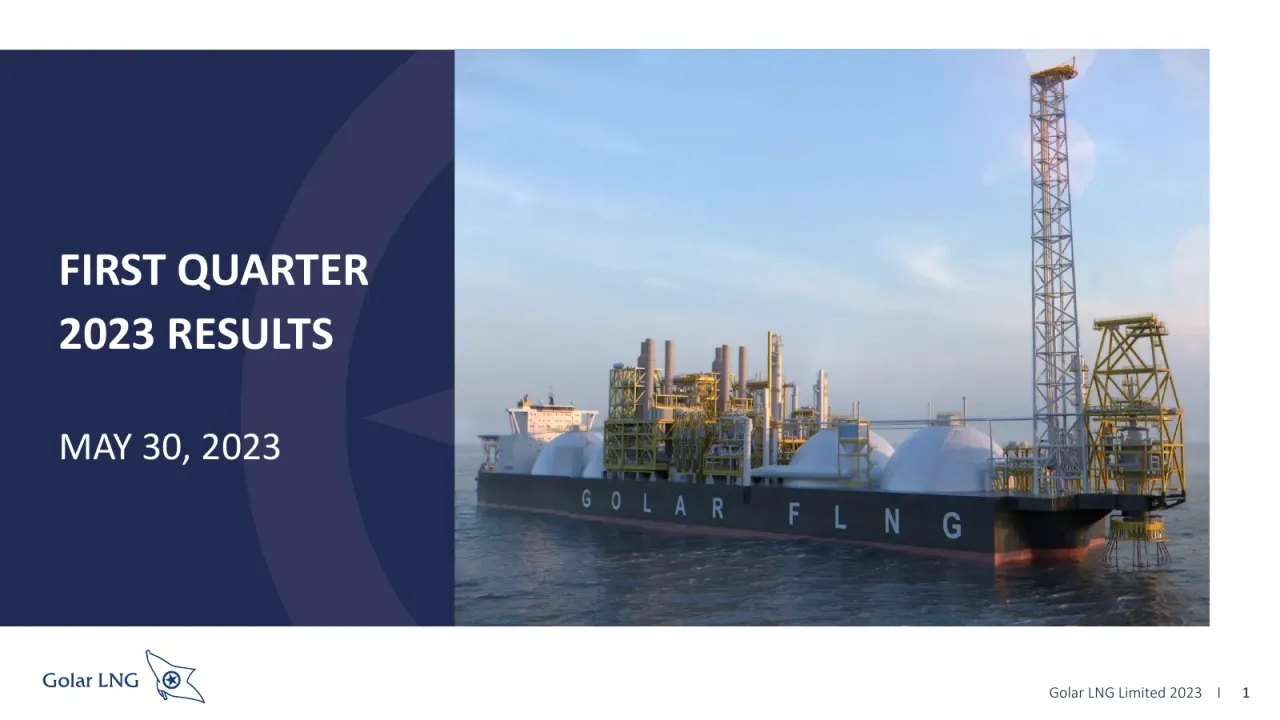
0:00 Welcome to the GOLA LNG Limited Q1 2023 results presentation. After the slide presentation by CEO Karl Fredrik Staubo and CFO Eduardo Maranhao, there will be a question and answer session. Information on how to ask a question will be provided then. At this time, all participants are in listen-only mode. I will now pass you over to Karl Fredrik Staubo. Karl, please go ahead.
0:28 Thank you, operator, and welcome to Goal RLNG's Q1 2023 earnings results presentation. My name is Karl Fredrik Staubo, CEO of Goal RLNG, and I'm accompanied today by our CFO, Mr. Eduardo Maranhao, to present this quarter's results. Before we get into the presentation, please note the forward-looking statement on slide two. On slide three, we present our company overview. During the quarter, we exited our investments in Cool Company Limited as well as New Fortress Energy. We also reacquired New Fortress equity stake in the FLNG Healy. We also sold the LNG carrier Golar Gundra and acquired the LNG carrier Fuji LNG intended for FLNG conversions.
1:18 Hence, our key assets continue to be the FLNG Hilly, operating for Perenco in Cameroon, and the FLNG Gimmi, delivering later this year to start a 20-year contract for BP on the Tor 2 field offshore Mauritania and Senegal. With the acquisition of Fuji LNG, we are advancing the potential ordering of our third FLNG, which we intend to be a mark two FLNG with an annual liquefaction capacity of 3.5 MTBA. Turning to slide four and highlights for the quarter. On the left-hand side, starting with Hylli, as previously announced, we reacquired NFE's equity stake in Hylli for a total consideration of $100 million plus our remaining 4.1 million NFE shares and taking over $323 million of debt associated with New Fortress Energy's stake in the unit.
2:20 We also unbound our TTF hedges, locking in a total of $140 million of operating cash flow on the hedges, whilst maintaining exposure to TTF-linked production. We also agreed to compensate the 0.04 tons of underproduction in 2022 with a similar amount of overproduction during 2023. We're also pleased to announce that we have agreed and received credit approval for improved terms under our existing debt financing on HILI. This will lower our debt margin and increase our free cash flow to equity from that unit. Eduardo will explain the amendments in further detail later in the presentation.
3:07 GIMI is now 94% technically complete. Our sail away dates have been pushed from first half this year until Q3 this year to allow for time to fully complete the vessel, conduct increased testing at the yard and align with the overall schedule for the project. Under business development, we have over the recent months seen significant increasing interest for our FLNG solutions, and especially for re-contracting of the FLNG Hilly, given her second half 26 availability and proven operational track record. We're currently in discussion with several gas resource owners. This includes signing of a memorandum of understanding with NMPC during the quarter, to explore FLNG deployment on specific NMPC-controlled proven gas resources in Nigeria.
4:07 On the back of increasing commercial interaction for FLNG deployment, we have advanced yard and financing discussions for a Mark II FLNG and acquired the Fuji LNG as already described. Turning to the right-hand side and corporate and others, Q1 financial highlights include a cash position of more than $1 billion, adjusted EBITDA for the quarter of $84 million, net cash proceeds from exit of NFT and pool company of $102 million. We bought back $20 million of our unsecured bonds at par and agreed to amend the bonds to increase financial flexibility.
4:54 Following the bond amendment, we have reinstated dividend payments and have approved to pay 25 cents per share for Q1. Our target is to declare a stable and over time increasing quarterly dividend, and we will address our dividend outlook ambition in further detail later in the presentation. We have also approved a $150 million share buyback program. Turning to business development and slide 6 and some further detail on GIMI. The majority of remaining works are piping, system testings and pre-commissioning. As mentioned, expected sail away has shifted from first half until Q3 2023.
5:47 The updated sail away timing is not expected to impact first seed gas on the Torque View project. Due to overall project and FLNG delays, pre-commissioning contractual cash flows have started. Parts of these contractual cash flows from BP to Golar is currently disputed and we are now working to resolve the matter. The updated sale away date and pre-commissioning cash flow dispute will have no impact on the wider execution of the 20-year project that is expected to unlock around $3 billion of adjusted EBITDA backlog to GOLAR, equivalent to an annual adjusted EBITDA of just around $150 million.
6:35 Turning to slide 7 and FLNG business development, which is the most exciting area of our business. We experience increased interest from gas resource owners for our FLNG solution. We're currently in discussion with five to six gas resource owners for potential FLNG deployments. Our key priority is to secure a charter for Hylli at the end of the current contract expiring in July 26, to secure increased cash flow visibility, increased shareholder distribution, before taking FID on a Mark II FLNG. Several of the potential clients in discussions have resources sufficient to accommodate either HILI or a Mark II FLNG.
7:27 We continue to target commercial structures where we, together with the gas resource owner, focus on attractive cash break-even liquefaction of stranded or associated gas fields and share upside through commodity price offtake. A fully utilized HILI based on current LNG forward prices has an annual revenue potential in excess of $1 billion. This will then be shared between the gas resource owner and Golar as the liquefaction provider. In April, we signed a memorandum of understanding with NMPC, which is one of the five to six gas resource owners described earlier.
8:12 NMPC is Africa's largest domestic energy company. Nigeria is currently producing 33 million tons of LNG annually, but this compares to more than 4 billion tons of proven gas reserve, and there is significant capacity and ambition to grow monetization of these volumes. Since signing of the MOU, both parties have allocated significant resources to develop a named gas field for a potential FLNG project. We've made material, technical, and commercial progress. Overall, the MOU has a five-year duration, and both parties have an ambition to explore the potential for multiple FLNG projects to be deployed on proven and stranded gas fields in Nigeria.
9:07 But we find it best to start with one named one as opposed to try to tackle all at once. Continued progress is also made with other gas export opportunities, both in West Africa and South America. Turning to slide eight, on the back of this increased charter interest, we decided to high-grade our FLNG conversion candidate. We decided to sell Gandria and declare our option to acquire the LNG carrier, Fuji. The key advantages with the enhanced FLNG conversion candidate includes younger age and better sailing condition, increased cargo capacity, larger deck space, and lower boil-off.
9:59 We continue to advance yard EPC discussions as well as progressing a deck facility for a Mark II FLNG project. The final investment decision will be linked to charter visibility on re-contracting of HILI and or a Mark II FLNG. Turning to slide 9 to further highlight the earnings potential from integrated FLNG projects. We continue to see very healthy margins for FLNG projects. We believe gas prices have reverted to a more sustainable level at the cost advantage to more polluting sources of energy, supported by long-term visibility in the commodity forward markets.
10:50 As described in previous quarterly presentation, we believe stranded or associated gas upstream opportunities can be developed between $1 to $3 per MNBTU in upstream costs. FLNG OPEX including fuel cost equate to about 60 cents per MMVTU. Add shipping cost to end users in Europe or Asia and you have a delivered cash break even of between 3 to 5 dollars per MMVTU. This compares the forward prices of north of 10 dollars per MMVTU indicating annual e-data for a fully utilized tilling of $550 million or $875 million for a Mark II SLNG.
11:43 We continue to believe in our business model where the majority of incremental supply over the next 5 to 10 years will be sourced from the U.S. Hence, if you have a business with three key cost components, namely gas source cost, liquefaction cost, and shipping cost, and you're cheaper on all three components, we believe that's an attractive competitive situation. As you can see in the top right corner, this business model has an attractive risk reward in an historical context with limited downside and significant outside potential. Current forward curves are significantly higher than that of historical LNG price.
12:33 Turning to slide 10, the world needs more and cheaper sources of LNG. Looking at gas prices over the past year, it has become clear that the world needs more LNG from a wider range of suppliers at both competitive levels. While LNG may previously have been considered a transition fuel, the events unfolding in 2022 underpins LNG and natural gas. as a critical part of long-term solutions to ensure energy security. However, existing production and current build-out of LNG plants will not be sufficient to cover the expected demand growth in the coming decade. According to S&P Global, LNG demand is set to increase from around 400 million tons in 2023 to approximately 630 million tons by 2035.
13:30 This is equivalent to a compound annual growth rate of 3.5%. Turning to the right-hand side of the slide, we are shown the estimated capex for liquefaction projects currently under construction. The steep cost inflation recently witnessed is pushing costs higher, leading to the supply cost shifting higher. You can see from the majority of the US liquefaction projects, you're talking CapEx per ton of liquefaction capacity way in excess of a billion dollars. While there are several factors impacting the ultimate economics of a liquefaction project, keeping liquefaction CapEx contained is one of the three cost drivers of an LNG export project. And the key aspect of success which makes us continued confident in Golar's FLNG solutions.
14:32 Turning to slide 11 and an update on Macau Energies. Macau Energies is a startup entity replicating Golar's model in treating and liquefying flared and stranded gas, but on the shore side. Macau was founded by the same team that created Golar Power, which was later renamed Hygo. Golar Power started with an initial investment of $5 million and grew through a joint venture between Golar and Stonepeak and was sold five years after inception at three to four times the invested capital. Golar has committed up to $25 million for the team to concentrate its efforts on constructing a proprietary modularized small-scale liquefaction unit, as well as partnering with complementary small-scale LNG businesses to develop LNG to EV charging in areas of high flaring activity, significant prepping demand, and a grid currently not capable of supercharging of EV trucks.
15:46 This will include areas like the Permian in the US and several stranded gas resources in South America. Subject to the continued development of Macau, the Macau management team and Golar will explore a spin-off of Macau Energies at a later point in time. It's a business we believe in. It's a team that has proven to deliver to us previously. and the model that's replicating what we are doing at larger scale offshore. But this will not be a significant CapEx requirement funded by GOLAR balance sheet. It will then be lifted out of the balance sheet for capital markets to fund it.
16:33 I will now hand the call over to Eduardo to present our Q1 results.
16:39 Thanks, Karl, and good morning, everyone. I'm very pleased to provide an update on our group results for the first quarter of 2023.
16:47 If we can turn over to slide number 13, I wanted to show some of the financial highlights of this quarter.
16:53 We had total operating revenues of $74 million, up 25% compared to Q4 2022. We also had FLNG tariffs of $110 million, up 15% when compared to Q4 2022. FLNG Tariff is a key non-GAAP metric comprised of total revenues from liquefaction services and realized gains on oil and gas derivative instruments. The contribution from our FLNG operations were very strong this quarter, and we recorded increased earnings from Healy of close to $98 million, up 23% when compared to Q4 2022. On a consolidated basis, this quarter we recorded an adjusted EBITDA of $84 million.
17:40 As a result of non-cash mark-to-market charges of $188 million, we recorded a net loss attributable to us of $102 million in the quarter. Those charges are inclusive of movements in the value of our TTF and Brent derivatives of $115 million, changes in listed equity securities of $62 million, and interest rate swaps of $100 million. After closing the acquisition of NFEs stake in Healy just in March, our total share of contractual debt stood at $1.1 billion. We continue to have access to ample liquidity and our cash position at the end of the quarter was just over a billion. So moving on to slide 14, I wanted to provide some further quality to our increased shareholding on the FLNG Healy. In exchange for 50% of the common units which we didn't control, We paid the total consideration to NFE of $100 million in cash, plus our remaining stake of 4.1 million shares, and also we assumed $300 million of debt. As previously announced, the acquisition of Healy is expected to increase our run rate adjusted EBITDA by $70 million per year. This transaction has closed on March 15.
18:57 However, the economic benefit to us is effective since January 1st of this year. As a result of our strong operational track record, corporate simplification, and confidence in the unit recontracting, we received management approval from the existing lender to improve some key terms under the current financial facility. A combination of reduced interest margins, extended maturity, and reduced amortization schedule is expected to generate additional distributable cash flows to us of approximately $75 million until the end of the current contract. We expect that those changes will become effective in Q3 of this year. Moving to slide 15, I wanted to provide a recap of our historical earnings from Healy.
19:48 As you can see on this slide, the Healy tariffs can be broken down into three main components, a fixed tolling tariff, a Brent-linked fee, and a TTF-linked fee that started on 1st of January of last year. The contribution from fixed tolling fees more than doubled this quarter to $34 million as a result of the closing of the transaction within a fee. Lower gas and oil prices this quarter have reduced the contribution from the TTF and grant-linked fees to $37 million and $18 million, respectively. In total, we had $88 million of adjusted EBITDA from Healy, this quarter, an increase of more than 55% when we compare to the same quarter of 2022.
20:34 Moving on to slide 16, I now wanted to provide some further details around our debt optimization strategy for healing, which I touched on before. So as explained before, we have received management approval from our existing lender to optimize certain conditions of our existing facility. We're not planning to increase the overall leverage of the unit, but those changes alone should allow us to increase our free cash flow to equity generation to the tune of $26 million per year, or approximately $75 million until the end of the current contract. In Q1 2023, we crystallized gains of around $140 million under our TTF hedging program. But it's important to highlight that we remain open and exposed to TTF prices between March until December of this year, as well as 100% between 2024 and 2026 when the current contract expires.
21:32 For every incremental dollar change in TTF prices, this will contribute $3.2 million of earnings to GOLA. In addition to that, for every dollar change in Brent prices above $60 a barrel, we will generate $2.7 million per year. Moving on to slide 17. Our balance sheet continues to strengthen, and we now have greater flexibility to allow for shareholder returns, and at the same time to fund our FLNG growth program. When adjusting for our cash receivables from the unwinding of our TTF hedges, we are now practically debt free, with a net debt position of just $25 million. Out of the original issuance amount of $300 million, We have bought back $161 million and approximately $139 million is owned by public bondholders.
22:26 On May 25, we received approval to amend certain distribution conditions under those bonds, which will now allow us to anticipate shareholder returns, including the ability to distribute up to 51% of total cool company cash proceeds, which were $371 million. as well as up to 50% of the last 12 months adjusted net income. Based on that, we're very pleased to announce the reinstatement of our dividend distribution due to a strong cash flow visibility from our contracted assets, Chile, as well as Guinea, and also the establishment of $150 million share buyback program. Now, moving on to slide 18.
23:12 When we look at the implied dollar per ton cost of liquefaction, We believe that GOLA is attractively priced considering our share of net liquefaction capacity from both Healy and Guinea. Our proven FLNG technology at only $590 a ton is extremely competitive and offers the world's leading solution to floating LNG liquefaction in the market. That supports our approach to share buybacks, and this was one of the reasons which supported our announcement to update our capital allocation strategy. I will now hand over the call to Karl who can talk a bit more about our approach to shareholder returns and also provide some closing remarks.
23:55 Thank you, Eduardo. And turning to slide 20, as Eduardo mentioned, the update on capital allocation. The way we think about it is with strong cash flow visibility with more than 70% of expected 2024 earnings based on fixed tariffs, and further upside in commodity exposure, we have clear cash flow visibility over the coming years. Add to that the delivery of GIMMI that further enhances fixed cash flow. There's also significant further upside in FLMD projects. We believe dividend should be paid from operating cash flows whilst the Strong balance sheet position should enable FLNG growth.
24:49 As reiterated numerous times during the call, we now have a cash position of more than a billion dollars. We're practically debt-free, and we have an attractive capital market pricing. Hence, we believe the current balance sheet enables FLNG growth, a buyback program, as well as debt optimization of GIMMI post-delivery and securing a debt facility for the potential construction of a Mark II FLNG. So again, to reiterate, operating cash flow is for stable quarterly dividend distributions, growing alongside the delivery of GIMMI and further upside in HILI, and the balance sheet will be put to work for FLNG growth.
25:40 Turning to slide 21 and summary. We have initiated a quarterly dividend distribution. We see embedded earnings growth following GIMI delivery, increased HILI commodity exposure, and 2026 re-contracting opportunities. And of course, further earnings growth potential from new FLNG projects. We see the current valuation as attractive and therefore have put in place $150 million share buyback program. The balance sheet has the capacity to fund FLNG growth. Therefore, we exercise the option to acquire the Fuji LNG. And we see the increasing interaction with prospective FLNG clients, including the signed MOU with NMPC, as building in momentum and gives us further confidence of attractive recontracting of HILI and commercial opportunities for Mark 2.
26:42 This concludes our Q1 earnings presentation. Thank you for dialing in and we'll now hand the call over to the operator for any questions. Thank you. So to ask a question, you'll need to press star 1 and 1 on your telephone and wait for your name to be announced. Answer or draw your question, you can press star 1 and 1 again. And please note that questions are limited to two questions per person. Once again, that's star 1 and 1 to ask a question. We'll now take our first question. Please stand by. First question from the line of Chris Robertson from Deutsche Bank. Please go ahead.
27:25 Hey, good morning, everyone. Thanks for taking my questions. Guys, you've often mentioned the cost advantage of African gas, but I think you mentioned that one of the five or six counterparties that you're currently in discussions with is in South America. Could you briefly talk about Any possible cost differential between the two regions and does this bias you to one region or another as you're in these discussions?
27:52 What we see in the South American opportunities is abundant gas reserves, a domestic market that cannot offtake the amount of potential gas development and a Source costs not too different than what we see for the West African opportunities. However, subject to what end user you end up with, there's somewhat longer sailing distances. But other than that, we see them as another area of interest for FLNG development. And that's why we're also focusing on both South America and West Africa.
28:39 Yeah, that makes sense. That's good stuff. I guess my second question relates to the MOU. Not maybe specific to this current MOU, but just broadly speaking, can you just talk about the process that an MOU would have to go through in terms of getting to a contract, in terms of how long that would typically take, what milestones you typically have to reach, and just kind of a little bit more detail there?
29:06 Thanks, Rich. I think since we signed the MOU, that's the question we've gotten the most. And being the only service provider of FLNG in the world, I don't think there's a textbook as to how these deals go about. It's custom made between us and whoever the counterpart is from time to time, and it's only been done two times in the past. So how standard or not it is, I think, is a little bit hard to describe. When it comes to the specific MOU with an MTC, The MOU is a requirement to unlock significant resources from the NMPC side, which we have certainly felt the difference in pre and post signing of the MOU. That said, we have other potential charters within the group of five to six that we mentioned, where we have not formalized the discussions through an MOU. but we're at least equally as advanced as we are with NMPC. So I think it's really down to the procurement process from the charters as well.
30:17 And NMPC being an NOC, the MOU is a requirement. What we are encouraged by is that none of us sign that MOU for the sake of signing it and read momentum with some mutual deadlines to be met have been agreed, and I think we're on track to meet those. That's where we stand at the moment. An exact timing is difficult to say, but both of us want to see a resolution sooner rather than later.
30:53 Yeah, sure. Thanks for the color on that. I know you're probably limited in what you can speculate on there. Thanks for taking my questions. Thank you. We'll now take the next question. Please stand by. And this is from the line of Ben Nolan from Stiefel. Please go ahead.
31:17 Hi. Thanks, Eduardo, Karl. I hope you guys are well. I wanted to ask a little bit as it relates to the recontracting of AHILI. Is it fair to assume in order to get full utilization of the asset that it will likely need to move? And then along with that, how should we think about the timing of contracting? Because obviously if it does move, there will need to be some infrastructure put into place in advance. And so should we expect this to be a 2023 event, or is there a little bit more time to work with on the contracting side?
31:59 So yes, it is likely to move from the existing site. There are other fields within Cameroon that could have the resources to facilitate tilling. So it will very likely not stay on current site. It could stay in Cameroon, and it could equally well go elsewhere, like the MOU with MOPC is a sign-up. In terms of the timing we would need, I think ideally from an operation and engineering point of view, you would like to know around mid-24. That should give sufficient planning for any relocation and site preparation for reconstructing.
32:49 And then obviously there are commercial aspects as to why you would want to see it earlier. from just an operational and engineering point of view, mid-24 is when we should have a particular view.
33:04 Okay. That's helpful. And then I guess as my follow-up, am I understanding it right that the order of priority is the recontracting of the hilly first and then a contract on the second vessel, which we would need in order to go FID? Yes. Just trying to think through timing. So if it is anywhere in the next 12 months, but could be as much as 12 months for the HILI, should we expect a contract on the Mark II to be some point after that, or does it not necessarily have to go in that order? Okay.
33:47 In broad strokes, you're correct. So priority number one is to recontract Hildi. Thereafter is to FID the Mark II. The rationale behind this thinking is that we don't want to be exposed to Hildi coming off contract in July 26 around the time when a Mark II also would deliver. So you want to fix at least one of the two before you FID Mark II. and based on current discussions, we believe it's significantly more likely that we fix HILI before fixing Mark 2. But if you fix HILI effectively, there's sufficient charter interest that you go ahead with Mark 2, even if it's not against the contract from day one.
34:35 Okay. I appreciate it. Thank you.
34:38 Thanks. Thank you. We'll now take the next question. Please stand by. and this is from the line of Craig Shear from Tuowe Brothers. Please go ahead.
34:55 Hi, congratulations on the progress. Picking up on Ben's questioning, you know, where does shipyards, you know, availability, the queue stand and, you know, what's kind of the drop dead time that you need to lock that up? are committed in order to maintain your Mark 2 timeline that you originally envisioned.
35:29 There's no hiding that Jarlslottis is an increasing challenge across, I guess, the whole maritime space. We are focused on shipyards, obviously, in Singapore, where we built the Hylje and Gimli, and I think have strong relationships, and we've also explored yard opportunities in China, where we believe we would also have the right team to construct a Mark II unit. We have, as you know, secured long lead items for a Mark II construction that safeguards timeline somewhat. But of course, the longer you sleep on FID, the more you push out delivery. Based on the current lay of the land, One day delay of FID is potentially somewhat less than a day later delivery because we continue to progress engineering and preparational work, like, for example, acquiring the project.
36:35 Gotcha. As you think about the Mark 2 conversion and additional prospects you have, I suppose with your half dozen discussions, it's not inconceivable that you can have something beyond the retail contracting of the Hilly and the Mark 2 deployment. So in order to be prepared for that, just how much liquidity do you need? maintain on your balance sheet.
37:12 Eduardo, do you want to have a go?
37:15 Yeah, sure. So, Craig, as you can see, under the current amendments, we have also committed to maintain an incurrence test of a minimum cash position of $100 million after the payment of a dividend. We have stated that we plan to reinstate the dividend program on a quarterly basis. So, I think this will be done, as Karl mentioned during the call today, on a sustainable basis from cash flow from operations. We believe that our current liquidity position is more than enough to allow us to develop the Mark II project. You have also to bear in mind that the CAPEX will be spread out over a period of time which not only we will benefit from the liquidity position we currently have, but we will also be generating cash during that period. So we feel quite confident that our current position is more than enough to fund both the dividend program as well as the development of a market share.
38:17 And I also just add, I think we have several liquidity levers, of course, in refinancing, give me upon completion. That's a $3 billion EBITDA backlog, which currently has $700 million of total debt against it. There's also the potential to increase leverage on Hildi upon re-contracting. I think through the refinancing announced today, the support from the existing lenders is very significant. And we are also experiencing strong support for debt facilities even during construction of a Mark II unit. So those combined, including the cash flows that Eduardo alluded to, we are confident that we can fund the foreseeable growth.
39:11 Thank you. Thank you. We'll now take our next question. Please stand by. This is from the line of Gregory Lewis from BTIG. Please go ahead.
39:29 Hey, thank you, and good afternoon, and thanks for taking my questions. I was hoping to get a little bit more color, you know, and then I guess, you know, congrats on starting the dividend. I was hoping to get a little more color around, you know, and realizing it's early days, but how we're thinking about the Jimmy Depp optimization. really just any kind of broad strokes you can give us as we try to figure out potential cash flow that's going to be available once that unit starts working as we think about the dividend rate next year. So really, you know, yeah, any type, I mean, what type of, you know, interest rates are we seeing for that type of unit? What type of, you know, What duration of debt are we thinking about? How much? Is this going to be like 60% financed or potentially more? Any kind of broad strokes you can give us, I think would be super helpful.
40:29 Eduardo? Yeah, sure. Hi, Greg. I think I can provide some updates on that one here. So when we look at some of the key alternatives we have when it comes to gaming, I think on a high level basis, considering we have $700 million of debt to date, The unit is highly under-elaborated. I think we all agree on that one. And we basically have a few alternatives that we have been exploring over the last few months, which range, for example, from existing or upsizing the existing bank facility. So we have a syndicate of around 11 banks in the current facility today. We could potentially explore to upsize that facility to a level of anywhere from $1 billion to $1.2 billion. I would say when it comes to tenure, that could be anywhere between 8 to 12 years.
41:18 But this is not the most, I would say, attractive alternative when it comes to potential volume and also when it comes to cost. So moving on to the other alternatives, we also see a potential same release back as one of the most attractive alternatives here. And we have explored the idea of potentially entering into a leasing agreement, which could unlock I would say anywhere between $1.2 to $1.3 billion in total financing amounts. When we look at tenors, I would say that these would be probably longer in duration when compared to a bank financing, so anywhere from 12 to up to 15 years, so with still a remaining tail when it comes to the contract duration of 20 years.
42:08 But we also see as a potential alternative the potential issuance of US private placement bonds when we could fully benefit from the full contract duration and the contract backlog. We believe that this alternative could offer us the highest and the biggest volume wires to the same time offering a very competitive cost. Of course, this will depend on where the market is at the time of the issuance. But based on the fact that the total amount will be sized based on the potential cash flows from the project. And when looking on a DSCR basis, we believe that these alternatives could rain raise anywhere from 1.5 to $1.7 billion. So As you can see, the alternatives, they range quite a bit in terms of volume as well as tenor. But we believe that we could benefit the most if we wait until we reach COD. And by that point in time, we will then take a decision to move on with the refinancing of Guinness.
43:13 Yeah, no, 100%. Thank you for that, Eduardo. And then, Karl, I mean, I guess just that, you know, you announced the buyback. You know, that was good to see. As you're out talking with investors, clearly you're trading at below $600 a ton on liquefaction capacity. I guess it was a large, but nevertheless, that was well over $1,000 a ton. Any kind of feedback you're getting from Clearly, we believe the stock is undervalued. Any kind of thoughts around what that dislocation is between where we've seen some market transactions and where Golar is today?
44:06 That's also one of the questions we get the most is why the stock is trading where it's trading. At the end of the day, we need to try to run the business to the best of our ability and the market needs to set the price thereafter. I think given what we see, not just from dollars per ton, but I think in cash flow multiples following delivery of GIMI and through some of the parts valuation, at least Management and Board used the valuation as very attractive, which is why we put in place the buyback program. And that's what we intend to do. Some investors obviously want us to go significantly larger on the buyback program. If you see some of the market chapter about there, what the people are speculating on. But at the end of the day, for us, I think $150 million is meaningful. And on top of that, we start the dividend, which both of them combined is, of course, The start of shareholder returns, which we just based on visible cash flows and significant upside, as we have explained, should have the ability to grow significantly over the coming quarters and years.
45:18 Yeah, thank you for that. And then just as I think about that, if we were to decide to move forward with the conversion candidate of like the Fuji fund, Any kind of, you know, realizing that there's inflation, there's shipyard availability, all the things that go into doing a mega project like this. Any kind of thoughts for, you know, what we could get that unit up and running for on a cost basis?
45:47 Yeah, we definitely see inflation. I think everybody sees that everywhere. But where we currently see it based on the EPC contract and where we have placed the long lead items, We believe it is achievable around current pricing of GOLAR, so call it $600 a ton. But keep in mind that with construction risk and a couple of years without cash flow, if you buy GOLAR today, Hill is delivering and generating cash flow and GIM is delivering this year's parking cash flow. So if you take that into account, it is more expensive to go for a new build with the integrated contract opportunities, we see also have superior economics to that of current contracts of Helene and Jimmy, which is why we still think it makes sense.
46:35 You can fund it from balance sheets without having to impact dividend as long as you base dividend on operating cash flow.
46:43 Great. As always, thanks for the time.
46:46 Thank you.
46:47 Thanks, Greg. Thank you. And I'll take our next question. Please stand by. This is from the line of Sean Morgan from Evercore. Please go ahead.
47:05 Hey, team. Thanks for taking my questions. So as we kind of circle back to HILI, I think the contract is up in July of 26. So what sort of logistical challenges are there to moving an FLNG offsite? And I imagine there's not a whole lot of precedent cases of this happening. Are there environmental concerns? And then in terms of the cost, does Parenko bear most of the costs for sort of disconnecting? And what do they do with all the undersea equipment when it's no longer connected to an apology on the surface?
47:39 That is actually surprisingly simple because this is a standard unit which is designed to be redeployed at different locations. So effectively what you need to do is to disconnect from the upstream pipe and the soft yoke, which is the mooring system, and off you go. The unit even has engine and propeller, so theoretically you don't even need tugs, but subject to where you go, you probably need a tug. And that's it. The only thing we leave in the ground, which we need to decommission, is the bottom part, which is fixed to the seabed of the mooring system, which we think has a total decommissioning of around $5 million.
48:24 Okay. And then I guess you have, on a calendar basis, about two years. But as you, you know, as a management team, you guys realize, obviously, the equity markets start to look ahead, and equity markets still tend to love uncertainty. You would have the gaming up and running by then, so it's not like you wouldn't have any assets producing, but what sort of timeline are you sort of internally thinking about for when this needs to get completed and moved so that you don't start to run into a bit of an uncertainty overhang?
48:58 I think as we tried to explain earlier, from an engineering and operational point of view, you have very comfortable time if you have charter visibility by mid next year for where the unit will be contract. That leaves plenty of time to plan decommissioning, any potential vessel upgrades or amendments and new mooring location, set up a new shore base and everything that's required. So that's comfortable. It's certainly not lost on us that the capital markets appreciate earlier visibility and frankly, so do we. But at the end of the day, there's the internal trade-off between what's industrially right in terms of optimizing economics of the project versus just fixing an uncertainty. And with the level of interest we see around the ship now, you don't necessarily want to marry the first one that shows up at the door, but have a little round on the dance floor to see who delivers best.
50:04 Okay, I like that pseudo-analogy, so hopefully this really turns out to be the and the prettiest girl at the ball. I know I have a lot of choices on where that asset goes. Thanks a lot, Carl.
50:15 Great. Thank you. And there are no further questions at this time. I will hand the call back to Carl Staubo for closing remarks.
50:27 Thanks again everybody for dialing in and listening to us and the interest and the very relevant questions. We will continue to progress the company to the best of our ability. Hopefully we'll speak before, but if not, we will speak to you all again in the next quarter. So thanks again and have a great day. Thank you. This does conclude the conference for today. Thank you for participating and you may now disconnect. Speakers, please stand by.
Follow Golar LNG Limited into a list and get an email when it puts out news.
CFO
CEO
Analyst, Stiefel
Analyst, BTIG
Analyst, Deutsche Bank
Analyst, Tuowe Brothers
Analyst, Evercore