Transcript
Automated transcript · Written by software from the replay's audio. It can mishear names and figures; the replay is the record.
0:08 Hello, everyone, and thank you for joining Giga Metals Live Investment Summit today, hosted by 6. We are joined today by CEO and Director Mark Jarvis and Manager of Development Lyle Triton. Mark and Lyle will take us through a company presentation and then we will be accepting questions live. So as a reminder, you can submit your questions at any time on the Q&A panel on the right-hand side of your screen and we will get to them after the presentation. And as always, this event is being recorded and will be available to watch afterwards on six.com. So without further ado, I'll hand it
0:40 over to you, Mark, to get the presentation started. Well, thanks very much, Dasha, And thank you everyone for showing up for this. I'll just get right into it. So this is a standard disclaimer. I won't dwell on this, but there will be an examination later. So, you know, as most of you are probably aware, and we won't dwell on this too much, lithium ion batteries are profoundly changing the nickel market. Nickel's gone from being, you know, 70% of its use is in stainless steel. Now it's something under that now, it's battery usage grows, but battery usage is just taking off. And it's estimated that you could need 40 to 70 new large mines by 2040 just to supply nickel for batteries.
1:42 And that's an enormous amount of new mines. And by large mines, we're talking about, you know, averaging around 35,000t per year of Nickel capacity, which is similar to the Turnagain.
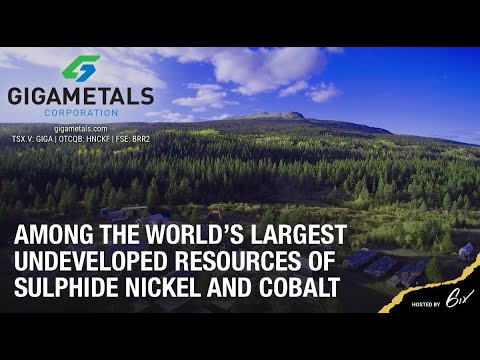
2:02 And that is our goal, is to build a 37,000t per year Nickel operation. And I want to note that our recent PEA modelled a 37-year mine life. So That's really quite a substantial operation. We are actively seeking strategic partners to help us advance this project. We're a very small company with a very large deposit and that is difficult to do all by yourself. So we're actively talking to strategics to come in at the project level. And one thing I just want to mention, you know, about that is our president, Martin Vidra, had a 31 year career at Sherratt, which is a Nickel and Cobalt producer.
2:52 That's also where Lyle Tritton came from, is from Sherritt. Martin spent a good part of his career selling Nickel and Cobalt to end users. So he's got established relationships with many of the strategics, the trading houses, the battery companies, etc. And so there are active discussions underway. Nothing happens quickly. I'm not suggesting that anything is imminent, but there is real interest out there.
3:25 So we are in Canada, which is a country where you can get large mines built. We do have stringent environmental regulations and that's a double-edged sword. It makes it difficult to bring a large project in, But as long as you fit the environmental regulations and parameters, you can actually get a large mine in. The flip side of that is that if you're buying nickel and cobalt, if we get our project off the ground, if you're buying Nickel and Cobalt from us, you can be satisfied that you are getting your Nickel from an environmentally friendly source.
4:14 So a very large measured and indicated resource that can make a very high grade concentrate. And we'll get into some details on that. One of the advantages of our deposit is that it's technically so simple. You mine the rock, big shovels, you grind the rock. Well, first you crush the rock, you grind the rock and then you put it through a froth flotation circuit. It's all old tech. It's all tried and true. There's nothing tricky about it. It's not difficult to manage and it's quite predictable. So this is a low risk project from a technical perspective.
5:01 We're also targeting to be carbon neutral and we'll get into that in later slides. You know, here's the timeline to the right. If everything goes according to plan and if we get the money, that's an important proviso, we could be starting up production in 2028. And then you would have 37 years of production, at least as is modelled in the current preliminary economic assessment. So 37,000t a year, The concentrate, we can reliably produce an 18% Nickel, 1% Cobalt concentrate, which is very low in deleterious elements with a low carbon footprint, which we are looking to improve.
5:50 And, you know, we're looking at initial CapEx of US$1.4Bn, and then phase 2, where we would double production in year 4 or 5 or 6, depending on Nickel prices and so forth, would be another 500 million dollars. And the reason there's a disparity between the 1.4 and the 0.5 billion is that we've got infrastructure costs up front that we have to pay for. And then the expansion is really just about, you know, doubling up on crushing, grinding and froth flotation. And then we can deliver nickel to the gate in a high grade concentrate to the mine gate at an average of $2.81 a pound for Nickel. And the reason we're reporting it that way is that we've modeled selling our Nickel to a smelter, But we think the market that will develop over the coming few years will provide a more direct path to the battery cathode.
6:55 In other words, we'll be selling our concentrate to someone who will be putting it through a simple pressure oxidation circuit to create precursor materials for battery cathodes. And that is a far more efficient and cost-effective route to the battery cathode than sending it to a smelter and later processing it backwards, if you will. We have done a lot of metallurgical test work over the years, and we are confident in saying that we can reliably produce an 18% nickel concentrate with very low impurities. It's a very clean concentrate. And it compares well to the concentrate grade of current operations.
7:46 The only one with a higher grade than what we're projecting is Boise's Bay. You know, and a lot of nickel producers come in with a concentrated plus and minus 10% nickel. In terms of tailings management, we've got an excellent location for tailings management, very good valley location. We've modeled doing it the right way, central line construction method. And then the tailings will largely be sub aerial. They won't all be underwater. There'll be a small amount of water in the tailings facility.
8:33 But we want to expose as much of the tailings to the atmosphere as possible to allow for carbon sequestration.
8:45 And the CO2 sequestration also involves a process of the sand gradually going through a cementation process, which further increases the security of the tailings impoundment. So very low risk tailings management in an area of low seismic risk. And the water balance is excellent here. Couldn't be better. So When you look at the world of large Nickel deposits that could feed the battery business, there's something less than 20 of them that are known, that are undeveloped. And All of them are undeveloped because their economics are marginal at the low end of the range of Nickel prices, which is where we're at right now, including Turnagain. You know, Turnagain is not economic by Western standards at current Nickel prices.
9:48 And so we, along with all of our competition, are looking for higher Nickel prices before the projects get built. I personally like this type of thing. The leverage of a large marginal deposit, if you get the commodity price right, is a wonderful thing from a speculative investment perspective. And that's the sort of thing that I've liked because I've had some success with that sort of thing in the past. Now in terms of the main competition, I mean, there are other large, low-grade, open-pittable sulphide-nickel deposits in the world, a few of them, you know, including in Canada, Australia and South Africa.
10:33 But really, the main competition is laterite deposits that are developed using high pressure, high temperature acid leach. And Lyle developed this comparison slide between us and a group of greenfields, HPAL projects. And I think this shows, you know, it's quite interesting. It shows it's a cumulative cash flow model. So you start up at 0 and then you build your mine, you spend money. So your capital goes below 0. In our case, we spend the money on the first phase and we start producing, we recover some of our capital and then we spend more money again later. And then, you know, the cash flows in.
11:18 And as you can see, it takes a long time to get back to 0 at 750, you know, at 750 a pound nickel. However, It's marginal, but it's better than HPAL economics. HPAL isn't suitable to be built in stages. So you're gonna risk more than $3 billion. To get a similar size of mine, say, roughly 35,000 tons a year of nickel, you're gonna spend $3 billion and then gradually recover your money. So it's interesting because most of these HPL projects, or a lot of them at least, are located in the Pacific, in the island nations, you know, Papua New Guinea, you know, Indonesia and so forth.
12:08 And some of them are getting built and it leads to an interesting question which I'll leave for later. In terms of carbon intensity, we analysed our deposit in our engineering report. The fact that we can access a clean hydro grid for our power means that we've got low carbon intensity right out of the gate. We're seeking to improve that, but we start off from a pretty good place in terms of carbon intensity, meaning how much CO2 is generated per ton of nickel produced.
12:49 So in the PEA, we model producing 2.24 tons of CO2 per ton of Nickel produced. That's in our base case. It gets lower than that. It gets below 1 tonne of CO2 per tonne of Nickel produced if we could adopt an electric fleet of vehicles. Now that fleet doesn't exist yet. You know, trucks that large, et cetera, don't exist yet as electric vehicles. That's why we didn't model it in our PEA. But we think that fleets like that will become available. And if and when they do, we plan to use them. And so that will get us to a very low carbon intensity and then add into that the experiments that we're doing in terms of CO2 sequestration in our tailings. We could possibly get to carbon neutral. And that's our goal.
13:52 If you compare that to matte, there's been some talk lately of Xing Shan, which is a big Chinese company that produces nickel pig iron, of taking that, converting it to matte so that the matte could then be refined into battery materials. The CO2 intensity of that is quite incredible. And it's an order of magnitude higher than what we're looking at at Turnagain. And these 3 lines are, it depends, once we produce our concentrate and we send it to a smelter, it depends on the power source of the smelter, what our carbon intensity is at the end of the day. But you can see this gap. If you're looking for low carbon nickel, certainly nickel pig iron is not the source that you would prefer.
14:48 Again, it's a very large resource. We've got 5.2 billion tons of Nickel and 312 million pounds of Cobalt in the measured and indicated category alone. The inferred resource doubles that again. So one of the world's large undeveloped deposits. And in comparison with HPEL, this will be an open pit mine. Big shovels, big trucks. And these open pit mines go deep. So, you know, in terms of the amount of material that you move, it minimizes the impact.
15:30 Whereas H-PAL projects are laterate deposits, which are strip mines. They're thin deposits. And generally they're mined by basically mowing down tropical rainforests. There is a lot of erosion involved, a lot of river and ocean contamination.
15:51 And because you're mowing down tropical rainforest, you've got a big impact on biodiversity. So if you're looking for environmentally friendly sources of nickel, you would prefer the tourniquet. No mine has 0 impact on the environment, obviously including tourniquet. It's all about relative impacts. So Canada has a very thorough permitting process, which includes consultation with indigenous people. And we've got a strong record of engaging in that kind of consultation. Canada is a low-corruption country with a strong human rights record.
16:37 And we're fortunate exactly where we are in British Columbia. Our local communities are supportive of responsible development. And in fact, you know, mining is big business in Northern BC and the First Nations have done very well economically
16:55 by working with mining companies to help develop mines. So we are aiming to be a very responsible mine. Now, cynics might say, well, it's all about cost and nobody's going to care about that. And, you know, I think there's some truth to that. However, I think in Europe and North America in particular, in particular at the upper end of the market,
17:25 people do care about responsible sourcing of materials for their electric vehicles. And so we think, you know, in addition to our economic comparisons to, shall we say, dirtier sources of Nickel, I think the fact that we are as low-carbon as it's possible to be, and that we've got high ESG standards, based partly on the country that we're operating in, that will matter to the end user, and therefore it should matter to the automobile manufacturer.
18:04 So we're getting up there this summer, we're, we've just raised $6 million. We're planning to go and gather the data through the drill bit to upgrade our engineering detail to the pre-feasibility level from the preliminary economic assessment level. And we'll be up there probably starting in June next month. We'll probably be out of there by October and with all the data. And then we'll be getting grades on our resource drilling. But we're also planning to do quite a bit of geotechnical drilling So we can have confidence in how we angle the pit walls.
18:52 It's all very technical and confidence in how sound, you know, our tailings facility will be. And so we could be starting up by 2028. We think that's a realistic timeline. I would have made a more aggressive assumption, but I'm working with Lyle Tritton who is conservative. So we're going with Lyle's assessment.
19:20 This is what we're planning, about 8,000m of resource drilling and 2000m of geotechnical drilling at the mine site. And we're doing all sorts of other work just to increase our confidence that we can build a mine here and that it can be safe and sound and that the country rock is stable and so forth. Got to do a lot of archaeological work, a lot of environmental work, and we've got ongoing environmental monitoring. So again, the world needs a lot of new sources of nickel, and we are one of the world's large undeveloped resources.
20:14 So I just think that Nickel, in order to get all of these large deposits built, Nickel has to go to a price that will incentivise construction. That's the theory at least. And another reason is that our concentrate, and in fact, let me say this, the thing that attracted both Martin Vydra and Lyle Tritton to this project is the quality of concentrate that we can make. And the fact that that gives us flexibility in terms of downstream processing, That's a real strength of this project. So we've got a board, strong board, including Martin Bidre, again, formerly of Sherritt.
21:03 Robert Morris, in terms of dealing with the strategics, is a very strong asset for us.
21:11 Robert, before he retired about a year ago, he was in charge of base metal sales worldwide for Vale, copper, nickel, cobalt, actually and precious metals. But that was depending on commodity prices, that was between a 5 and an 8 billion dollar per year portfolio that he was selling to end users. So he also knows and is known by all of the end users, car companies, battery companies, trading companies and so forth. This is our current market capitalization. And I think I'll open it up to any questions.
21:57 Thank you very much. Great. Thank you so much, Mark. So we will jump right into the Q&A portion of the summit. So if you do have a question, now is your time to submit them. But to kick things off, if your economics are competitive with HPAL, why are HPAL projects getting built?
22:17 That's a very good question. I've given that a lot of thought. I think that what's happening is the Chinese in particular, aren't driven by traditional Western economics, such as internal rate of return and so forth, and payback period, they're driven by strategic considerations. And so what they want, they already dominate the battery business worldwide. And I believe that they want to extend that domination and they want to dominate the electric vehicle market worldwide. And so in order to do that, you need to have a reliable supply of Nickel and Cobalt
23:03 at a predictable price. So, you know, even though the economics of HPEL are not good in a Western sense, to the Chinese, the cost of capital is extremely low. And so they can build an H-Pel mine. They can invest $3Bn. It can take 12 years or 15 years to pay back its capital. But with the cost of capital that low, it's all about operating costs to them. And so in lieu of getting a long-term contract at a fixed price for nickel, which no producer is going to give you, really the only way that the Chinese have realized is the only way to secure that long-term supply at a predictable price is to own a mine or a piece of a mine.
23:53 And I believe that this is gonna give them a really strong competitive advantage over Western battery producers.
24:01 Great, Thank you. So we have a question from Jacques. He's asking if you can please remind him where you are in terms of your PEA, your feasibility study and your mining license. Well, We've recently published a PEA and we have an exploration license, which we're going to be using to go and do the drilling this summer to get the data that we need to go on to produce a pre-feasibility study. We would hope to get a pre-feasibility study done by the end of the second quarter of 2022. Great, thank you. Darren's asking, do you anticipate returning to the open market for additional capital for operational use, excluding capital for equipment in the next 4 years?
24:54 Possibly. Our preferred route, which we are pursuing vigorously, is to try to get a strategic investor involved at the project level. Just simply from our point of view, the math makes more sense to dilute the project somewhat rather than dilute our equity. So Our preferred method is
25:18 some form of project financing with a strategic. At the end of the day, we'll do whatever we have to do to advance the project. Our strategy is to continue to advance the project and de-risk it, we think there's a wave coming in the Nickel market and we want to be as de-risked as we possibly can when that wave hits. Right. Well, John is asking, what price does nickel have to get to, to incentivize construction? He says the IRR seems quite low. He's correct. The IRR is quite low at $7.50 a pound nickel. You know, nickel is currently just over $8 a pound. But why don't I ask Lyle to answer that one.
26:06 Thanks, Mark. Realistically, you know, $9 looks like a reasonable threshold price for Nickel to incentivize construction for this project. That's a pretty rational long-term price for Nickel when you look at the 40-year history of it. We believe that the economics we put forward are conservative in nature. And if you compare them to other projects of a similar scale and similar metallurgy and mineralogy, you'll find that we have a higher assumed sustaining capital for our project,
26:41 you know, compared significantly higher than some other projects. Sustaining capital is one of those things that it's hard to say exactly what it will be until you're into it. But I would note that, you know, for any large project that has to move 1 billion tons of material and process, that the sustaining capital costs are going to be pretty similar. It doesn't really matter where you do it. So we think there's some room to move there, but $9 is certainly a realistic price for us to be financing this project.
27:09 All right. Well, Al is asking if you could expand on the comment you made about the ongoing discussions with end users. Okay, well, you know, this PEA was an important document to come up with. And, you know, some of the strategic investors that we're talking to are studying this as we speak. Another important element to them will be, and I don't have the exact timing on this, but we are doing an experiment right now in conjunction with Dr. Dipple at the University of British Columbia, where he is testing the CO2 sequestration properties of Turnagain material. And Lyle, maybe you could comment on that.
27:59 But before Lyle comments on the timing of that and exactly what they're doing, a lot of the strategic investors feel that it is important that we will be a low-carbon intensity source of Nickel. And so they're waiting to see the numbers.
28:20 Yeah, so that sequestration work is ongoing now. We expect to have results available to us by the end of the month from the first round of testing at UBC. You know, we know that it sequesters carbon. The only question is how quickly and how much. And that's what we're looking to find out now. So, you know, we look to be releasing something publicly on that, hopefully around the end of the month. It just depends a little bit on the timing of the assaying for samples at UBC. Got it. All right. Thank you. Claude is asking on which local First Nation land is the deposit located and How is your relationship with them? Okay, well, there's 2 First Nations primarily that we're dealing with that both claim traditional territories at our mine site.
29:14 One is the Talltan and the Talltan control access to the site.
29:22 The other is the casket Dena who are downstream of us. And in my view, both have a legitimate interest in this project. With the Talltown, we've got a communications agreement and we've got a history with both Talltown and the Casca going back 15 years or more, engaging. We hire as many Talltown and Casca as we can and often as are available. There's a lot of activity up in this area. Both groups are doing quite well off of mining. You know, mining is a good job. It's a well-paying job.
30:07 It's a job where in non-COVID times, you can take a vacation in Hawaii in the middle of winter sort of thing.
30:15 And the other thing is, you know, also, and this is where I've gotten from, you know, there's no single opinion amongst, you know, the Talltown or the Casca. You know, I mean, you can find people in the tall town that are opposed to mining, elders. But you also find elders that they really like economic development in their territory because it provides jobs for young people so that young people stay in the community growth, rather than the community gradually, you know, eroding away as people move away. So, you know, it's positive all around. I think we're really fortunate in terms of the First Nations that we are dealing with.
31:02 Great, thank you. So Leah's saying, with most natural resources selling at recent, if not all time highs, why isn't nickel? Well, I think nickel's still got a bit of an overhang from the growth of nickel pig iron and how long it will take to chew through the overhang. And as batteries become a larger percentage of nickel use, the timing is anybody's guess. I keep thinking, God, it's just around the corner. But, you know, timing is anybody's guess. I just think at some point, you know, if the Nickel used for batteries, you know, adds up, you know, annually to another, say, 40 large mines by the end of 2040, well, at some point the price is going to kick in.
31:59 So,
32:01 don't ask me timing. Okay. All right, perfect. Well, Faisal is asking, is your project something that Eric Sprott may be interested in? Eric Sprott, Personally, I don't think so. Eric Sprott's mantra is grade, grade, grade. He likes high grade. And this is a low grade deposit. So it doesn't suit his personal predilections for high grade. I want to point out you need both grade and tons. So Eric was an investor in the GGI Garibaldi, which has lots of high grade intercepts, but they've yet to publish a maiden resource.
32:48 So you need grade, but you also need tons. I wish I had Garibaldi's grade and our time. However, Sprott, the institution was a participant in our most recent race. All right, thank you. So Daniel is saying your metallurgical process seems to be classic. Did you try to evaluate ore sorting as an added value of your metallurgical process in terms of CapEx and OPEX? That is a really good question and I'm going to let Lyle answer that. For sure. Thanks for that, Daniel. We've looked at a lot of options around our metallurgical processing. Ore sorting is one of those that we think probably doesn't have a lot of value for our project but we're still keeping our eye on it.
33:40 The thesis behind ore sorting is that you get to reject chunks of material that don't contain ore before they get into the crushing and grinding process. And because our ore is very disseminated in nature, the value is throughout the rock. We don't see that there's the likelihood of rejecting a significant amount of material there. And the other factor that we weigh into that, especially at a PEA stage, is we need to de-risk the project. And adding unproven technology, and ore sorting has never been used commercially on a Pentlandite ore like ours, doesn't inspire confidence. So although it might offer some potential savings, those savings are by no means guaranteed. We're also evaluating other things like more intensive flotation techniques, things like Glencore's Jamison cell and analogs to that and high density flotation that may add value as well. But again, they add risk to the project. And so we're not inclined to put them into the flow sheet right now. Those are things that are really best tested once you have an operating mind and can test it in a real pilot stage. And that's why we have the offset between stage 1 and stage 2 of our development is in that first 5 years, it allows us to really test and pilot some of those opportunities and perhaps devise a different flow sheet for stage 2 to optimize the overall project.
35:04 Right. Thank you. Jacques is asking how much money do you have in the bank? What is your burn rates? And when do you need to finance? Well, we have, Last I looked, it was something over $9 million, 9.2, $9.3 million in the bank. Our burn rate, when we don't, you know, actually when we're not drilling or anything like that or doing metallurgy, but our basic G&A is about US$110,000 a month or a little under that. And we won't, we don't have to finance until sometime next year. We are going to spend money up at the property this summer, but we'll hold back sufficient G&A that we won't be needing to scramble to the market for more. Again, we're hoping to get a strategic involved before we have to do an equity raise.
36:08 Okay. Thank you. So Fazal is asking, who are your major shareholders and what percent do they have of the outstanding shares? I believe I'm the largest individual shareholder and it's about 6% at this point after the dilution that we took with the financing. And I think that's it. I'm the largest shareholder. That's great. All right, we have a question here asking, is it correct that GigaMetals stakes copper claims in Brazil recently? Will this project be forwarded concurrently with these projects be forwarded concurrently with the Turnagain project? Yeah, that's a really interesting project that it's regional grassroots exploration.
36:58 And I love this stuff personally. So we're centered on the South Francisco Basin in Brazil which many geologists think is a continuation of the African Copper Belt. So these high-grade copper, cobalt mines and copper silver mines, you know, in the Democratic Republic of the Congo and other African countries, you know, Africa and South America used to be joined together like pieces of a jigsaw puzzle. And so the San Francisco Craton is believed to be a continuation of that. So we've, we've done quite a bit of work so far, but it's all regional grassroots work.
37:44 We found a geologist in this area that we've got land position now established. And he's done a lot of mapping, stream sediment sampling and so forth. But also, interestingly, driving along there's someone drilling a water well. And beside the water well is a bunch of blue chips. Well, blue says Copper. And so he stopped and picked up some chips and sure enough, they run Copper and they run Copper in sediments. So this is a style of Copper mineralization that can be very high grade and the deposits can be very large. But I just want to emphasize, we're spending a small amount of our budget in Brazil.
38:31 We're going to keep moving it forward. We may do some drilling at some point this year, some very low cost, shallow drilling to test for this red bed style of a Copper mineralisation. And so it's the sort of thing that we're not going to blow the bank on, but it's capable of producing positive surprises out of the blue. Or not. It's called exploration. Right. All right. So we have a question here. So in September last year, Telsa held its battery day. They discussed a different direct method of processing nickel sulfate bypassing the traditional smelter route. They have since been silent. Is this something you can shine a light on? And if this is a process where Turnigin concentrate would be suitable, he says Tesla surely wouldn't turn to non-American laterite nickel for their needs.
39:28 Can I take that one? Yeah, I think you take that one. Sure. So I will not say anything about what Tesla is planning because you never know what Tesla is planning. They have a history of being very silent and then coming out with some seemingly random announcement that may or may not lead to anything. But yes, there absolutely is an alternative route, non-smelting route to process concentrates like ternagans to nickel sulphate directly. There are 3 refineries in the world today that were built to handle Nickel concentrate directly. I spent 25 years working at 1 at Sherrod here in Alberta. There's 1 in Newfoundland, Valet built at Long Harbor, Boise's Bay, and there's 1 in Australia.
40:15 All were built to handle concentrate directly. The processes exist today and building new ones is entirely feasible. The shared process wouldn't be what we would choose to go directly to Nickel Sulfate, but acid leaching and solvent extraction and crystallization is an entirely practical flow sheet to do that with. It does add some risk. And so whether anybody is going to build that as a direct refinery, I think is a little bit unknown. And we have not put that into our studies because we again, think that adds risk to the project that we don't want to build in there right now. We've stuck with tried and true, what we know can be done and is there today. As for Tesla's source, they do use non-American laterite Nickel and why they do it and should they do it, that's a different matter, but they're in a strategic partnership with the high pressure acid leach facility in New Caledonia, formerly owned by Valet and now being taken over.
41:19 It's been a problematic project. It's had a lot of economic issues. It's had environmental issues and it certainly had social license issues to the point where Vale is now spending $500 million to get rid of the project and turn it over to a consortium including both the locals and Trafigura and Tesla is a part of that operation and advisory role and they consume product from there. So they do it today, and I don't see that there's any reason that they would change until they had a better alternative. All right, well, thank you. So David is asking, any word from provincial or federal governments in support of this program? That's a good question. Provincially, yes. Federally, nothing yet.
42:09 Although I'm hoping that the federal government will get hip to a bunch of issues around strategic materials, including rare earths, for example, but also nickel, also lithium. From the provincial government, in our model of the PEA, we included what I call a hookup fee. BC Hydro extended the power line up highway 37 in our direction and beefed it up all the way back to Terrace and spent a bunch of money doing that a few years ago. And so what they asked for is that if you're going to access that power, that you pay a hookup fee to help them to recover their capital expenditures and beefing up that line.
42:59 And we modelled that into our PEA. They've since come out with a policy where they're no longer going to require that hookup fee. And that saves us something like US$170M as a while over the life of the mine. So that's, you know, US$170M. That's helpful. And we'll see what other support they offer going forward. But I think it's strategic to be developing battery metals deposits in Canada and battery metals deposits in British Columbia. I'd love to see a gigafactory get built in British Columbia supplied from mines in British Columbia. Yeah, so just to add to that a little bit, We haven't started a heavy government relations program yet.
43:50 You know, we wanted to wait till we have results and then start talking to government about what specifically we we are looking for. I can certainly see support coming from both levels of government to extend the power line further. Both levels of government were involved in constructing the Northwest transmission line. And certainly there's a very active conversation between the Canadian and American governments on the critical mineral space. I've been involved in some of those discussions and they're ongoing. What will that mean in terms of support for projects? It's hard to predict, right? But the key features are that The American government is very, very keen on ensuring that they have a strategic supply of minerals, that they won't get caught out by not having access to the minerals they need, and they see Canada as a partner in that. And Canada is actively trying to build an electric vehicle supply chain from mine through to batteries and EV production.
44:49 And that's entirely doable within Canada and within the larger North American context. All right, thank you. So John is asking, how does the grade 0.22% nickel compare with competing sulfide deposits? I'll take that one on. Of the large low grade open pittable sulfide nickel deposits, our grade is the lowest. Now, but it's balanced out by other considerations. Because our deposit is so young, we have less alteration minerals. So basically all of the large sulfide deposits start out like us, roughly the same grade. And then as they age, and particularly our competition is mostly more than 1 billion years old, they alter with time. And the alteration products, for one thing, they introduce metallurgical issues so that recoveries drop.
45:57 And the recovery circuits get longer and more complex to actually extract the Nickel. You need mag separation. I'm comparing us to say, Dumont, which has got a full feasibility report. You know, they've got mag separation. They've got de-sliming circuits, all things that we don't need. And the reason that they've got slightly higher grades is that the alteration, the actual deposit shrinks. And so the grade goes up because the total amount of rock is less. But then you've got a lot more of these alteration products that affect your metallurgy. At the end of the day, the economics of all of them are quite similar.
46:45 Interesting. All right. Well, the next question here is the Chinese and Japanese often partner with Canadian companies. Any interest from them so far? Oh, well, we've got live discussions going on, and that's really all I can say. We're not going to close the deal tomorrow, but there is real interest and there are real discussions underway. Thank you. So what impacts does Giga Metals expect from the pandemic issues for the summer program? Lyle, why don't you take that? Sure. So we've been building our summer program in working with a number of service providers, drillers and camp service providers, and including the considerations of pandemic issues all the way along.
47:33 We can't say for sure what issues we will have, but you know, we are certainly taking that into account. We're going to request through our service providers that everybody is vaccinated before they come to site. Of course, we can't mandate that, And there will be significant precautions taken at site. The highest risk activities are of course, camp related activities, meal time, socializing, those kinds of things. And we'll have strict protocols in place around that. And we have service providers who are very experienced with handling remote camp situations over the last year and change that we've had these pandemic issues going along. So although we don't expect a significant interruption in our plans, it is possible that we could have some interruptions that would delay some work, in which case we have a prioritization plan in place as to which work is the most important and should be prioritized, and which work will potentially be delayed to 2022 if we can't get it all done this year.
48:34 Well, thank you so much. And again, thank you to Mark and Lyle for taking us through your whole presentation and the live Q&A. And thank you for everyone who joined us today and asked all these great questions. If you do think of another question after the summit, we will be sending out a brief survey and you can leave your contact details and the Giga Metals team will follow up with you directly. You can also find more information on their website at gigamedals.com. I'll pass it back to you, Mark, for anything else you'd like to add. Well, all I'd like to add is thank you very much, Dasha, for moderating this. Thank you, Lyle, for your attendance, and just thanks to everybody that's interested in our project. Cheers.