Transcript
Automated transcript · Written by software from the replay's audio. It can mishear names and figures; the replay is the record.
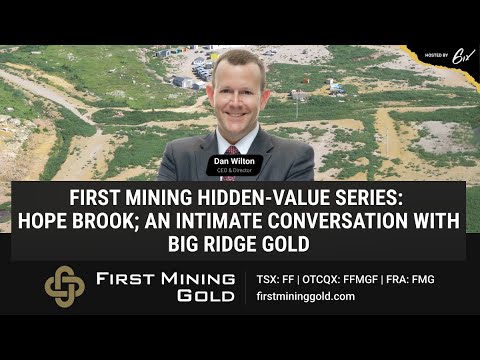
0:08 Hello, everyone, and welcome to 1st Mining Gold's live investment summit today, hosted by 6. I'm pleased to introduce the CEO and Director of 1st Mining Gold, Dan Wilton. With us today as well is our guest, President, CEO and Director of Big Ridge Gold, Mike Bandrowski. Mike is going to walk us through a presentation of his and after we'll be taking questions live. Remember that you can submit your questions using the Q&A panel found on the right hand side of your screen at any point during today's presentation. And as always, this event is being recorded and it'll be available to watch on six.com in the coming days. Without further ado, Dan, I'm going to hand things over to you
0:39 to get us started. Cam, thanks very much. And thanks to everyone for joining us. It's been a while since we've been able to connect here. And I think, you know, I'm looking up here at the title of this, the Hidden Value Series. And I think it's one of the things that kind of struck us a few months ago is, and it was actually just after a conversation I had with Mike in the spring, that there is so much going on inside the companies in our partnership portfolio that we really kind of need to find a forum to be able to let our shareholders, you know, sort of engage directly and hear about a lot of the great work that's going on that, you know, we think goes to support that $100 million of value that's not our main project sitting in 1st mining. So I'm delighted to have Mike Vandroski joining us today.
1:35 You know, the deal where Big Ridge optioned into Hope Brook was, you know, largely as a result of Mike's vision and persistence. So we've had a chance to spend a lot of time together over that, over the last couple of years as this has all come together. And Mike, I think if we can, I'll turn it over to you. And from our standpoint and perspective of sort of the attendees here, great to just get an update on where you are, maybe give a little bit of the background on how we got here, and then an update on where we are with Big Ridge. And we'll kind of, I think, just jump back and forth here.
2:21 Yeah, thanks a lot, Dan. Thanks for having me today. Yeah, I guess it was a bit of persistence, certainly a couple of years worth. But we were attracted to the project, and we're glad to be spending money on it right now and advancing it forward. So yeah welcome to Big Ridge Gold. Just by way of background the company has been around like many juniors for quite some time. It was formed in 1984 as Alto Ventures but I got involved in late 2019. The board at the time was a bit tired and they were looking for new leadership. So in 2020, we ended up closing a business combination and rolling the stock back and recapitalizing it, which resulted in changing the name to Big Ridge Gold Corp.
3:19 We completed that in July of 2020, and then I guess almost 12 months later, we were able to announce and earn an agreement with 1st Mining on the Hopro Gold project.
3:34 So our, you know, outside of Rick Major, who was with Alto, we've completely revamped the board. Myself, I've spent, you know, plus 15 years in the capital markets, based out of Toronto, covering precious metal and base metal stocks on the research side. Nick Tintor also joined us shortly after the name change. Nick and I were actually, both of us were pestering Dan for the better part of a year and a half to try and get the Hope Brook Gold project out of him. And Nick actually has quite a bit of experience in Newfoundland. He put into production the Pinecone Mine, which is still today in operation.
4:24 It's Anacondas, or now Signal Gold, I believe is the new name. We brought in Christina Bates this year. She came in to chair our audit committee. Christina is also from the Southside, worked at a few investment banks in Toronto on the sales desk doing a lot of mining work over the years. Bill Williams, Boston-based economic geologist, he joined us with a ton of experience on the exploration side, operations and permitting, working with Detour Gold and Orvana and most recently with Western Copper and Gold. Rick Major, another geologist with a lot of Toronto Venture Exchange experience. He's involved with many juniors right now. And then James Maxwell, who was put on the board for the placement for 1st Mining, who joined us this year.
5:29 So myself, President, CEO and Director. Jim Kirks, our CFO, who has also got vast Newfoundland experience. He spent over a decade with Marathon Gold before joining us. Bill McGinty is our latest addition. He joined us in January as our VP Exploration. Bill has a vast amount of knowledge. He's been a huge addition to the team, working with East Main and Queenston Mining as 2 notable names. And then on our advisory side, we've got Laurie Curtis and Bill Pearson. And just wanna highlight Bill Pearson actually ran and operated Coastal Gold for 5 years, which their primary asset was the Hope Road Gold Project before being acquired by 1st Mining in 2015.
6:19 Yeah, it's funny, Mike, going back prior to joining 1st Mining when I was a partner at a mining-focused private equity fund. When Bill was trying to raise money in, it was before the 1st Mining acquisition, and it came in, Justin Reed, who's now the CEO of Troilus, was involved with Coastal as well as a director. So that was kind of my real first exposure to Hope Brook, but that would have been probably 2013 or 2014, as they were still kind of trying to pull it together. Always thought it was super interesting, even at that time. But it's great that you guys have been able to bring some of that continuity back, because I think Bill is the one person who knows the most about this deposit in the world probably.
7:07 Oh, 100% and he's fully passionate about it and speaks of grandeur about the potential here. Fantastic. So, we are Canadian focused. You know, we're obviously spending most of our time in Newfoundland right now on the Hope for Gold project, but we do have a few other gold projects across Canada. 1, We've got a 36,000 hectare land package in Manitoba, last drilled by Noranda in the late 1980s.
7:39 And we've got another project called Destiny that's just northeast of Val d'Or with a little over 600,000 ounces in it. So we're improving gold mining camps. We're in great jurisdictions and the company's in good financial shape right now. At the end of last quarter, we had roughly 4.5 million in cash and over 1 million dollars in marketable securities. So Hope Brook, you know, it, despite not being well known, it did produce for 10 years. They produced around just over 750,000 ounces. It was put into production by BP Selco. They operated the mine as an open pit and underground operation for 5 of that 10-year period. And then the asset was, or their gold arm was sold off and this asset ended up in the hands of Royal Oak, who produced there for another 5 years until going into bankruptcy in I believe 1997, in which the asset went back to the province and it was reclaimed by the newfound government.
8:56 So we are in, you know, we're obviously in an established mining camp. We're in a great jurisdiction. Newfoundland's a fantastic place to be working. You know, it's easy to get in touch with the local authorities. Permitting's been fantastic so far, and we've got a great working relationship with them. We are on the southwest coast and
9:22 you know we are somewhat remote as well. Our getting the site is either via air or water and just like it when it was an operation they brought in their crews by boat. And so no change there. There has been some work done on a road, but it has not been permanent and is not part of our near-term future plans yet. You don't need a road. You have the world's greatest liquid highway right in front of you. Like this, the project is on tidewater, all the infrastructure, like a big pier and a kind of roll-on, roll-off barge sort of facility is all right there. So, you know, I think it's funny. I didn't appreciate until I joined 1st Mining and went to see the project.
10:15 This, I think, is still the largest ever producing gold mine in Newfoundland. Would that be a correct statement? Oh, absolutely. Like by an order of magnitude in terms of total ounces. Yeah, 4 or 5 times for sure. Yeah, And the other thing is that everyone who has ever worked in mining in Newfoundland in the 90s worked at Hope Brook. And the experience I always had, I'm sure you found the same thing. This is everyone's favorite project. Like people who work there just gushed about Hope Brook and it's like a, you know, something that was a real success that's kind of close to the heart of the mining community in Newfoundland. Absolutely. We get CVs weekly and they're people with experience from working on site.
11:04 Our consultants work there. Some of our current team actually used to work at the mine as well. There's a lot of resources there and a lot of knowledge on the asset. Yeah, for sure. So we, as you said, we're, yes, we're on tidewater and we've been utilizing that to date. We barged in all of our equipment, our drill rigs, and we've also got a 1,100 meter airstrip, which is in fantastic condition that we've been using since we started drilling in November of last year.
11:42 We bring in our, obviously our crew, food, fuel, supplies on a daily basis out of Stephenville, which is about a 15 to 20 minute flight, depending on the wind. The camp's been significantly upgraded, winterized. So it's, you know, we use it 365 days a year and we're still connected to grid power and as I mentioned you know permitting's been fantastic and we've been able to get everything in order within you know a month to a month and a half. The resource that we've stated right now is actually from a 2012 resource estimate that was put together by Coastal Gold. So it is based on $1,200 Gold.
12:29 There's about 954,000 ounces there at about 4.7 grams in the 3 gram cutoff. So it's a great starting point for us and the deposits wide open in all directions and that's what we're focusing on right now is expanding that and then hopefully moving toward an updated MRE here in late 2022 or early 2023. So as I mentioned, we commenced our Phase 1 drill program. It's 25,000m, kind of a three-pronged approach. We've started testing the deposit to the southwest, closer to surface.
13:15 That is pretty much wrapped up now, and we've had a couple of press releases on results so far. We're starting to drill a little bit deeper and try and connect the main zone and the 240 zone. Hopefully, that will be done in the next 10 to 14 days and then we'll move to the Northeast extension which, you know, effectively, you know, it's been known but effectively it'll be a potentially a new discovery for us if it comes good.
13:45 And so far the thesis is working out, you know, all the drill holes we put out, 100% of the drill holes have intersected gold mineralization to date. And we're proving that the deposit is open to the Southwest. And hopefully, you know, in the next week, we'll have our next set out to the market. So Mike, on the last point here, where you talk about the copper, you know, this was historically, it was a low grade of copper, but It produced actually a really good copper concentrate, which isn't always the case. But this was, as I recall, was a pretty sought after good, you know, blending copper con. It was very clean.
14:32 What have you guys done or what can you do to understand what the copper grades would be mixed in with the gold and the historic resource? Because even you say here, the past exploration hasn't really quantified it, But are there any things you can do to be able to include the copper in this?
14:51 So that's one of our goals going forward. And the nice thing is copper was sampled in the past, and we're continuing to do so now. And we will make it part of our mineral resource estimate when we update that, like I said, in the new year or late this year. So and to your point, it was a payable con And I don't recall the actual grade, it was I think around mid-20s, but it was my understanding as well as it was sought after and a great con for the Horn. But yeah, we've got some work to do there, but it will be updated in that resource estimate. And as far as grade, I mean, it's a little early to tell right now, but that copper is, there is a high correlation between it and the gold.
15:44 So it likely will be, you know, a payable in the future and,
15:48 you know, could cover operating costs or mining costs or something, who knows, but there will be a credit for sure if the mine goes back into production. So right now, as I mentioned, that old resource, 2012 resource is highlighted in the red. You know, we've put in some simple schematics here just to kind of show, yeah, the deposit is wide open, but where we're drilling right now. So the blue lines are, those are results that we've actually released. I think in the next few sets, you'll start to see us move further to the Southwest, stepping out further.
16:35 Post that, as I mentioned, we're trying to connect the 240 and the main zone and then our last target, as I mentioned, will be to the northeast here.
16:49 We haven't put it in the diagram, but we believe it is an offset to the main zone. And that's been primarily identified through geophysics. There are a couple holes that were drilled there in the past. One was, or both of them were by Bill Pearson and Coastal Gold. One was too far to the west and the other one actually just came up short of the target, but did have, I think, upwards of, you know, 1.8, 1.9 grams in the last few meters of the hole. So there is smoke there and we intend to test that hopefully in early to mid-July. So just back to what we've released so far, you know, our first set of drill results were more confirmatory for us and then we've started to fill in a few of these gaps and move to the southwest. So as I had mentioned, I think the next few press releases, you'll start to see this area get filled in and then we'll be stepping a little further to the southwest before drilling, you know, down 3, 4,500 meters and trying to connect the 2 zones.
18:07 So like, how are you guys thinking about the project as open pit versus underground at this point? Cause that was something that we spent a bit of time looking at and understanding, but curious, you know, you're seeing,
18:22 you know, gram and 0.5 at 11 meters, 33 meters of a gram, you know, with some higher grades in between there, but all pretty close to surface. So, you know, just curious on how your thinking is evolving on this. Yeah, and I would note too that's within a broader system too, that kind of grades range from 0.2, 0.3 to gram, gram and 0.5 over significant widths. We're kind of, you know, obviously picking what we put in as our intercepts. But I, you know, We haven't defined anything yet as to whether we're just underground, just open pit or both but I think the discussions we've had so far, we would likely envision what was done in the past and that was both, you know, an open pit component moving to an underground. It's just going to depend on, you know, what the engineers come up with and how many ounces we have to give up to go from open pit to an underground.
19:39 So what we've completed and what's happening on site so far,
19:44 you know, we updated the camp for year-round exploration. We completed a CSAMT geophysics program southwest across the deposit to the northeast. And that we're using right now to spot our holes for the drilling we're going to do on the Northeast Extension. November 3rd, we started that Phase 1 drill program. I think you'll see us wrap that up in early August at this point in time. And we should have consistent drill results out to the market depending on turnaround time but likely out toward Halloween. And Regionally, we've started to, we just finished a Geochem program property-wide.
20:37 You know, the consultants identified 42 targets for us, but, and they're quite significant. I mean, many of them dwarf Hope Brook, but in reality, there's probably 6 to 8 that look really, really interesting. So we'll get out to those in the next month or so and start to prioritize those and they'll likely become part of the program in 2023 and we'll start talking about the regional play here. I mean, if you look to the west of us, there's Matador Mining and I think they've got 2 or 3 deposits as you move a little bit northeast. Marathon's got 4.5 million ounces and 3 or 4 deposits. So we really like the regional play and
21:23 obviously we like Hope Brook and the upside there as well. On the sorting front, we started an initial program with Tomron. There was a successful study done in 2013, and we're just basically adding on to that. Their technology's improved, and we do have Mafic Dyke material in our deposit that if we can, you know, if we can, you know, up the head grade out of the mine to plus 5 grams, I mean, it's, it'd be fantastic.
22:00 And I think they've already shown that they can do that on a small scale. We just need to do it on a larger scale. And then, you know, key milestones for us post the drug program will be the resource estimate and then moving toward a PEA. And I would imagine this year the way we're moving along will complete our phase 1 earn in as part of the agreement between 1st Mining and us. So just a kind of airborne view of the camp to give you an idea of what we're looking at. So we've got the airstrip and the wharf as mentioned.
22:45 The white holes are proposed drill holes. The orange is the main zone projected to surface. So as you can see, we're moving to the southwest and towards the 240 there. The yellow highlights that northeast target, which, as I mentioned, will be mobilizing there probably in 2 weeks from now we hope. And then the last thing I'd highlight the old tailings which are in the red hash marks and we point those out. You know tailings can be a touchy topic at times. We just highlight that obviously their own site, because this was a past producer, but they're fully maintained and by the new founding government.
23:31 They're not our responsibility. The government comes to site and obviously monitors them and cleans alders and cleans up the site and just make sure that they're in full operation. So it's not our responsibility or our liability at this point in time. But do you have a sense for what kind of capacity would be remaining in those tailings facilities if you could recommission them?
24:01 Well, I guess the first point is I'm not a huge proponent of tailings operations, but there is a resource on them. So there is, I think, 130,000 ounces of gold in tails. So that's something that's obviously worth investigating in the future. But as far as life, there is a few years of life left in the tails for sure. I don't recall offhand exactly what the capacity is, but there certainly is room. Okay.
24:40 And, you know, just wanted to highlight on some of these regional targets at, on the Hope Brook site. As I had mentioned, there's a lot of interesting gold targets on the property. Only a few of them have previous drilling in them. There's Phillips Brook and Cross Gulch that were drilled, I believe in 1984 and 1986. And no one's really ever gone back there to do any work. So that's part of the program right now is to start to prioritize these. I know we'll have our team out on these targets over the next month while the weather's good.
25:26 July, I understand it can be a little bit foggy. We'll roll up our sleeves then on these targets and then hopefully to continue in August and September when it gets sunny again and we can start working on them and bring those into the fold for 2023 as the regional plan. So our agreement with 1st Mining, we had an upfront payment of $500,000 and issued them 11.5 million shares. Our stage 1 to 51% is over 3 years.
26:03 As I alluded to earlier, I think that probably maybe a year and a half in, we'll probably complete that spend and be at the 51% mark, and we'll issue another 15 million shares. A JV is created at that point and we grant 1st mining a 1.5 percent NSR. And then on to stage 2, which is another $10 million in the ground, less a step up to a 10% management fee and up to 10 million shares as well when we complete that. And then lastly is the 2 million payment to 1st Mining on commercial production.
26:50 I guess I'd highlight too, Dan, there is another royalty there on the aggregate, something that we really haven't, it's a dollar a ton, but we haven't touched on that. But for the listeners, there is what, an in-house resource of several hundred million tons of high quality aggregate there that may be of some significant value in the future. Absolutely, no we always thought that was an interesting an interesting angle of the project here And did did a bit of work on it. So hopefully at some point that that dovetails into a development plan So and to your point, it's nice to be on tide water. Yeah When you're mining aggregate, yes that's what you call a critical strategic advantage, being on tidewater and having a power line, right? You didn't make much of that, Mike, but this project has enough power to like run a mill, right?
27:47 They ran the old mill on that power line. And I was amazed the first time that I went to Hope Brook, we landed in a helicopter, you know, and it looks and feels like a pretty remote camp. And then you walk into the kitchen and you flip the breaker and the lights come on. Like it's pretty cool that way. So,
28:06 all right. Well, that's, I think that's a great overview. Anything else that you wanna cover off before we dive into questions here? We got a few of them piling up. No, let's, we can certainly move on to Q&A. Yeah, so listen, I think, you know, I've summarized it in some of our conversations, was probably a little more refurb than you expected going into it. Things were probably a little bit slower to get going to the point where you're generating real news just because ramping it up to a different level of activity needed a bit more infrastructure. But now you're midstream and you're putting out results that anyone else putting out 10, 20, 30 meters of a gram and a half plus some copper from surface, you think people would have, the share price would have had a bit of a different reaction.
29:06 So be very curious, there's obviously lots of news coming, and as we kind of get into the beginning of the next resource in the economic studies, I think that's going to be pretty interesting. Yeah, absolutely. We're actually just in the midst of what we've been getting RFPs returned to us for those 2 milestones for that resource estimate and for that PEA. So like to nail that down soon and get going on it. Fantastic. Well, in that case, why don't we jump a little bit into the Q&A here. So if you have any other questions on the Q&A tab, feel free to fire those up in there and we'll kind of run through them here. So Jeff had asked the question of how many months a year can you drill? You'd touched on it a little bit that there is some, you know, when it gets foggy it becomes a lot less reliable, but
30:08 you know, how many months basically? What are the windows when you can and can't work? We, I guess I'd say 11 months because drillers like to go home for a month at Christmas. But that being said, we can drill year-round. We have to shut down sporadically for wind storms and gales, but it's 10 hours, 12 hours, and then we're back at it again. Our biggest issue drilling-wise has been, we had to shut down for a week because of COVID. You know, we sent everyone home. So really, weather-wise and, you know, property-wise, you can drill year-round, there's just the odd day you lose here and there to weather, which you would anywhere in Canada.
31:05 And the other challenge I guess we face too is, you know, you don't want to have, or you need redundancy, either with skitters or bulldozers or whatever, because if one goes down, you can't just pull up a flatbed tomorrow and fix it. It needs to go up by barge. So we do have to have a bit of redundancy there. And how long is the barge trip when you're coming in? I mean, that would be a few hours, but you're not talking like it's on a barge for days, right? No, no, no. They come in in the morning,
31:40 and best case scenario for them is they get in there in the morning, and then they're back to Bergio at the end of the day. I mean, obviously weather on the ocean's the biggest key there. So, but yeah, it's a turnaround in 1 day. Oh, that's great. Okay, Ken has asked a question. How quickly can the project be advanced to kind of a construction ready stage and what do you think the spend would be to get you to that stage from here? That's an interesting one question. Well, yeah, I mean, if it's just Hope Brook, maybe by the end of our earn-in, we can be at that pre-fees level and starting to think about permitting. But for me in a perfect world, I hope we have 3 or 4 targets that come good.
32:43 And all of a sudden, we're looking at multimillion ounce potential here, just like our neighbors to the Northeast. And it's a different ball game at that point in time. I don't think moving to production's gonna be the top of the totem pole. It's gonna be seeing if this thing's got 5, 6, 7 million ounces in a few satellite deposits.
33:07 Yeah, and I guess you're probably, you know, we're wrapping up a drill program now. You probably are just kind of starting. We need the mineral resource estimate. The other work that's kind of coming in from there, but probably starting to scope next year's drill program a little bit later in the year when you're setting budgets. So probably unfair to ask you what the budget's going to be next year? It's certainly not set yet, no. And we also want to, I think this Northeast extension is a big part of our drill program. I know some of our investors continue to ask about it. In hindsight, maybe I should have gone there first. But the low-hanging fruit was near surface and into the Southwest. So that's where we started. Yeah, that's interesting.
33:58 Okay, Timothy's asked a question. Can you talk about the cost and logistics of extracting this kind of gold from the deposit? So maybe just historically, kind of what the flow sheet was like at Hope Brook. So it went through a few iterations. I guess they did have a, they actually had a heat bleach for that ran for several years. And then they went, I guess BP went to CIL and then when they sold the project Royal Oak put in a concentrator and that's when they started getting paid for the the copper credit. Yeah.
34:41 So a few changes there and then that last five-year period The con was shipped to the horn and I guess was quite sought after. Yeah. You know, with an ounce of gold and the copper credit, of course, it's a nice con, right? And there's, you know, as far as The arsenics and the deleterious elements, I mean, very, very low. So it was probably blended with anything. Yeah. Yeah, I know. But it wasn't, not all the gold went into the copper con, as I understand. They actually leached it and then either floated it and then leached it and then sent the remaining con off, right? Yeah. Yeah. So not atypical for this type of deposit where you'd have some copper in it that you'd want to get through flotation. So the good news is it can probably be done a bunch of ways cause it's been done a bunch of ways before.
35:39 Right? Yeah. True enough. Yeah. You don't have to worry about a pilot plant cause it's run for 5 years and produced, you know hundreds of thousands of ounces of coal. So that's great. Warren has a question. When looking at the mine zone and 240 zone, is the mineralization the result of different events? Or do you think this deposit could be a larger kind of copper gold porphyry style deposit, maybe, at depth? What's the bigger picture geological thesis at this point? Yeah, it's interesting. We hadn't thought about it as a different event, but being high sulfidation, I mean, it was probably formed as a mushroom and then got stretched and squeezed and moved all over the place.
36:32 So I think to answer the different event right now, we're probably thinking not at all. Cause we're gonna, we're gonna try and connect the 2. The, the question that I have, is why did they drill the 2 40, but nothing in between? Yeah. And no one has an answer for me on that Which is really interesting because you know, it sits deeper And we know there was some drilling done In between for a potential decline to get to the 240, but it never hit. They never drilled far enough to get into the zone. So that's what we're interested to find out, is if it's mineralized between the 240 and the main zone at that. Yeah. And that's how deep is the 240? Remind me.
37:18 It's down to about 450,500 meters, bottom of it. Not super deep, right? Like that's, you know, that's reasonable decline angle, particularly coming from where the existing underground development is. Exactly. All right. David's asked the question, are there any labor or supply chain issues that were really challenging in the 2022 season for you guys up there? 2022, no. 2021 was a different year though. So our goal was to staff up with as many people as possible from Newfoundland and it was relatively easy to do so. We had a lot of people that had interest here, tons of CVs coming in for various jobs, even stuff we didn't need.
38:20 So it was fantastic on that side. The challenge we had was getting a Newfoundland-based drill company to site. We put out RFPs and they didn't need to work. So you can imagine the pricing we got was not very competitive. So that was the only challenge we had. We had to bring in a crew that's, or not a crew, but a company that's based in Manitoba. The funny thing though is once they got going, we were able to staff up both drill rigs with Newfoundland-based drillers. All right. So as far as travel, it was pretty easy to get them in and out. We weren't paying to fly people across the country, which was great.
39:09 It's just we had to pay, I guess, a little bit higher mobilization costs to bring rigs and dozers and equipment in from Winnipeg. Oh, that's interesting. Yeah, I suspect you're competing with some pretty big programs in Newfoundland. I don't know how many rigs Newfound has going or how many they have going at Valentine. It's probably like a similar number, right? So every drill rig that's probably ever been in the province was just soaked up on those 2, let alone Matador and others who are doing real work. I guess the other point I didn't touch on that question though is the biggest bottleneck became Eastern Analytical because everyone was sending them samples or assays.
40:01 I don't know what the number was, but I think it was quite large on turnaround time. We went with ALS and started out around 12 weeks, but we've got samples back in 3.5 to 4 weeks now. So it's starting to get back to reality on the assay front. Yeah, and I'll say that same with us with some of the assays that we have going out from SpringPool. There was a real crunch period, but I think the combination of added capacity and Yeah, it's I don't think it's any more complicated than everyone raised a lot of money in in 2020 when the gold price spiked and last year they spent that money drilling and a lot of companies haven't been able to replenish the treasury to the same degree. So I think you are broadly in the industry seeing drilling slowing down here a little bit.
41:01 Although you're competing with those 2 projects in Newfoundland is the same as 1st Mining competing a little bit with Great Bear, now Kinross and a 200,000 meter drill program that's, you know, soaking up everything and every bit of capacity in and around Red Lake. So, what you have to do. 500,000 meters was a lot. Unbelievable. I know, crazy, isn't it? Right. Keith has asked a question, if there are no roads in, what would be needed if the results are positive and how do you get the product to market, which is always less of an issue with gold because the answer is, you put it on a plane or a helicopter and you get paid the moment that it hits that. So that's one of the beauties of the gold industry. But I guess otherwise, I think it's just that logistical advantage of being right on tidewater where it doesn't matter if you're moving groceries or a bulldozer in, you can put it on a barge and get it there?
42:18 100%, for me the road's not, well A, they ran it for 10 years without a road. So it's undoable. And they ran it at $300 gold for a lot of that time. Now, for me, the biggest advantage of that road is safety. If there's an injury at site, something happens and you need to get someone out quickly and it's foggy or windy, that's the challenge. And I think that's the biggest benefit to it is a safety perspective. Yeah, fair enough. And I'm sure that's an argument that can resonate pretty well with regulators as activity ramps up on the site too and you're starting to demonstrate progress on a development path.
43:11 Yes. Okay, Duane has asked a question, is the royalty of 1 dollar per ton paid to the Newfoundland government or an asset that you can recoup at a later date? And the answer to that is no the $1 a ton on the aggregate would be payable from big Ridge to 1st mining and Yeah, no the the aggregate we touched on it a little bit, but we'd done quite a bit of work in understanding that. Originally looking at what percentage of waste rock in an open pit that you could sell for aggregate. Because there is this geologic unit, the mineralization kind of occurs often on the contact of this Chetwin granite, which is a beautiful, beautiful and massive granite unit where you talked about the 500 million to 1 billion tons preliminary resource.
44:11 You know, it would be a real kind of premium aggregate product. And we know that it holds up pretty well because that airstrip that you're talking about is basically covered in this crushed Chetwin granite. And it's been bashed by the wreck house winds for 30 years and still looks like it was put down yesterday, right? Like it's amazing. It's obviously good stuff. So yeah, it was something that we'd done a bit of work on and said, you know, somewhere down the track, the reality is they're getting aggregate in the United States from a long way away. And you get to learn a little bit about the aggregate business, which is sometimes foreign to, you know, metal miners, but it's a cost and logistics exercise.
45:05 And you make a lot of money by selling a lot of rocket at small margin and really controlling your costs. But the advantage of electricity and tidewater, As soon as you get that product on a boat, it doesn't matter, you know, if it's on a boat in Mexico or it's on a boat on the south coast of Newfoundland, costs about the same to get it to New York Harbor where there's just no aggregate left on the US East Coast, right? So the economics of that are something like what you can put on a ship, you know, for 1000 kilometers compares with trucking for like 20 or 30. Like it's some ridiculous number like that, that one of the consultants who we'd had do a lot of work kind of gave us some real education on it. So yeah, I don't know. It's, I think it's a long-term optionality, but it is something that I think has real strategic value going forward. And particularly when you're leveraging the infrastructure that's already there or the infrastructure you need to build to ramp up into a production scenario in a mine.
46:19 Yeah, could be interesting. And there is an inferior product being shipped from the north side of the island down in the eastern seaboard. And it's 2 days extra shipping. Yeah. So it's, we've had discussions with that group already, they're pretty excited. Yeah, no, absolutely. And they're making decent money at it. And I think that's, it's only gonna get better as you kind of get into the real guts of the infrastructure spend that they're talking about in the US. So we'll see what impending recession does to all of that. But It's probably only a change in the slope, maybe a little bit of the line of the growth, but they're gonna need the material.
47:12 Here we see, Ken asked another question, since the shareholders wanna see the fruits of the investments, you know, can you talk a little bit about the urgency in developing the project and how fast Can you progress, you know, I'll ask the question a slightly different way. If capital wasn't a constraint, are there things that you could be doing to advance the project more quickly? Yeah, 100%. I mean, if capital wasn't an issue, then I'd probably have a drill program more comparable to say, Newfound Gold.
48:01 And we'd already have engineers on our team starting to think about how we're going to, you know, how we're going to mine it. And, you know, I would, yeah, I'd love to be, if that were the issue, and yeah, we'd be working through that right now and thinking about putting a mine back into production and keeping drill rigs on the property turning as well. The timeline to put it into production, if that were the case. I mean, it's all about the permitting. I think to definitively answer that question, we'll see when Marathon gets their permit, because it's gonna speak volumes for the island and putting a gold project into production, especially an open-pit one, right?
48:53 That's going to do plus 200,000 ounces a year. It's a big project. So when they get their permits, we'll be able to definitively answer that. But I think, you know, they've been at it for a year, right? Maybe a bit longer now. Yeah, it's, you know, I actually recall we went to what, you know, as an aside, was the most fun mining conference I've ever been to in my life, which was the Western Newfoundland Mining Conference in Bay Vert, Newfoundland. In 2019, we went to visit Hope Brook and it was a great chance. I mean, it's only at the Western Newfoundland Mining Conference that like everyone meets the premier because the premier comes and you know, is around while everyone's having a few drinks and you know, in the hockey rink in Bay Vert, they set up like, you know, a black tie dinner. Like It was amazing. The foreigners got screeched in. It was a full dose of Newfoundland hospitality.
49:52 But it is that, at that conference, this was 2019, I think they were in advanced stages of permitting. They maybe hadn't submitted the EA. We're getting to know a lot about the timing and how EA processes move forward here with SpringPool for sure, and making good progress on it. But Yeah, I think getting that across the finish line and into construction raises some pretty interesting opportunities for what can happen if we're able to advance Hope Brook reasonably quickly to mineral resource and at least a snapshot of a development scenario, make sure that you're collecting all that long lead time environmental data, and be in a position to move it more quickly because, you know, it's not that far away.
50:45 It's a sizable resource already and, you know, there are 2 or 3 projects totaling 4 or 5 million ounces of gold in the neighborhood. So at some point, it may make sense for some of that bigger picture consolidation to take place as well. Because Matador would be how far? Like 30k? Yeah, and you know, we haven't even... It's not like we've had discussions or anything, But back to the whole barging thing, do you need 2 mills? Is there something there that makes sense in the future? Because yeah, they're certainly not far.
51:31 Yeah, no, for sure. And I think when you do the compare and contrast, if you could have a port facility to be able to get all your stuff in and out versus, you know, having to go the long, the long way where roads don't exist in some pretty tough terrain. The logistical advantages of Hope Brook are pretty significant here. All right, here comes a question that I'm sure you are asked all the time. You made an illusion earlier, but how much cash does Big Ridge have on the balance sheet and how long will that last? Yeah, I touched on it. We're about 4.5 million dollars at the end of the quarter and then we've got over 1 million in marketable securities. It gets us well through our drill program.
52:22 As far as how long does it last, I said just that will depend on our plans for post the drill program. Do we keep 2 rigs on site? Do we step back and focus on the resource and the PEA and maybe get a more nimble Duralite or something on site and start testing regionally? We haven't defined our program yet, but those are some of the thoughts that are going through our head right now, and what's going to be the most palatable for the market. And like I said, We'll be figuring that out in the next month or so, and we'll update the market when we make that decision.
53:09 Talk a little bit about how the shareholder base has built out over the last year. Because I think you've obviously done good work to continue to build that and brought in a strategic investor. So when we rolled the stock back, we made the name change and did the raise. So we had 22 million shares roughly. 11 were Alto shareholders, all retail. Were Alto shareholders, all retail. There were, you know, there was a couple decent sized shareholders, but you know, nothing by way of big institution.
54:01 And then the other 11, the other 50% of the stock was Endeavor Resources shareholders, which by and large was the same thing. It was retail. They had done 1, I think $4 million raise. And looking at the warrant holders, it was broad. It was retail. So we essentially doubled the share count with our on our rollback and with our $2.2 million raise. That was done, so that raise was done literally with friends and family out of Toronto, people in the industry that I had worked with. So that's 22 plus they've already accelerated their warrant last summer. So they've got about 44 million shares you know, and I'm not delusional some of them have certainly sold their stock but Just to give you a way looking at our Nobo list we've got 60% of our shareholders on our Nobo list, which I think is really high.
55:07 And, you know, from 2020 to 2021, a lot of those actually increased their shareholdings. So it's fantastic. And then, so post that, what's that take us? It's around 45 million shares or so. And then we did a raise last year at 20 cents that brought in Mike Gentile, who is a, you know, on a partially diluted basis is 19.9. And then the 11 and 0.5 to 1st mining. So we're at 108 million now, you know, with the accelerated warrant with the raise and the shares to 1st Mining. So 1st Mining and Mike are our biggest shareholders.
55:58 And then institutionally, we actually have about 10 to 12 institutions in the name, nothing massive, but some good names that I think, or I really hope in the future they're there for, you know, to participate and support us on a bigger scale. No, that's great. That's, it's a lot of work from, you know, from the original kind of rollback and the cleanup. All of that, that all happened prior to announcement of the Hope Brook deal, right? That was, I wanna say late 2020, early 2021, that you did that? That's exactly, yeah, it was actually mid 2020.
56:43 Okay. Yeah, July 7th, we announced the, of 2020, we announced the closing, which was a sub-receipt on that raise. That was to close the business combination with ours. Right, right. Okay, well listen, we're winding down on time here. Why don't we just hit it with the key catalysts in the next 6 months? What does everyone have to look out for? And we'll let everyone get on with their day. Okay, so starting, you know, probably next week you'll start to see us with consistent drill results. I mean, we've already got out 2 batches, but they're going to start to come regularly. I think we'll probably hit our stage 1 earn in before the end of the year. And then a big catalyst will be, I think, that resource estimate update to obviously include the copper as well and then we'll get going on an economic study post that resource estimate.
57:44 Before that, obviously, we'll probably press release who we've engaged in a bit of a timeline for everyone so they can keep their eye on it. Lots going on in the next 6 months. It's exciting times. Hopefully a couple of those drill holes come back, particularly on where you're testing some of these new zones, I think it has potential to really change the perception of what's there, right? From, you know, it's one of the reasons that we, that 1st Mining kind of brought in a partner and you guys specifically was that real conviction as to the ability to grow this deposit into something that's new. And it's not gonna take much. It's not gonna take much to really move this. You're already sitting with 1 million ounce resource.
58:30 Move this into kind of another tier of development scale. So it's pretty exciting stuff. Oh, absolutely. Awesome. Mike, thanks for joining us today. I think hopefully this sheds a little bit of light on one of the great hidden values inside 1st Mining. Because you've got to remember, we even, well, right now we own 100% of this project. We aspire that we're going to own 20% of the project, which is carried to a feasibility study, that interest, even after you spend the 20. And we have the royalties on the project and on the aggregate, and we're the second largest shareholder of the company. So we're all obviously rooting for your success and cheering as loud as we can from the sidelines, but appreciate you joining us today and giving people a little more detail on the great work that you guys are doing.
59:28 No, thanks for having me. It was great. And any shareholders have any questions, my name and email are on the website, I'd be happy to help. All right, well, thanks everyone for joining us. And again, you know where to reach us if you have any questions or follow up that we can help direct to Mike as well. But thanks very much all, and we'll be back in another few weeks talking about the next element of the Hidden Value series here at 1st Mining. Lots of good stuff to come. So thanks very much for joining us. Thank you. Bye.