Tim Warrillow
Co-founder & CEO of Fevertree
Replay available
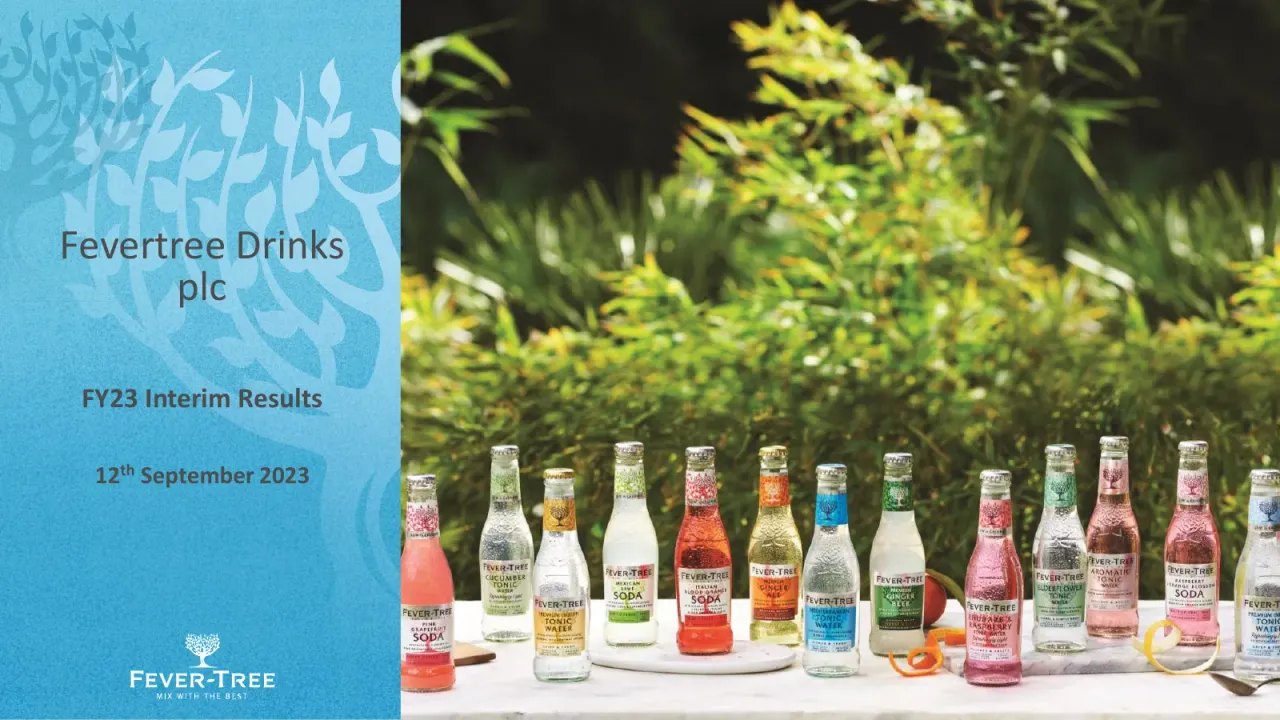
Fevertree Drinks (LSE:FEVR) Q2 2023 earnings call, held 2023-09-11. Watch the replay and read the transcript on 6ix.
On 6ix: 6ix.com/event/fevertree-drinks-plc-fevr-q2-2023-earnings-call
Automated transcript · Written by software from the replay's audio. It can mishear names and figures; the replay is the record.
0:00 Hello everyone, and welcome to the FeverTree Full Year 2023 Interim Results Conference Call. My name is Bruno, and I'll be your moderator for today. During the presentation, you can register to ask a question by pressing star followed by 1 on your telephone keypad. I will now hand over to your host, Tim Warlow. Please go ahead.
0:22 Thank you. Good morning, everyone, and thank you for joining us to hear about Fevertree's performance during the first half of 2023. My name is Tim Worrello, co-founder and CEO of Fevertree, and I'm joined on the call by Andy Branch for our CFO, Charles Gibb, our North American CEO, and Alan Hines, our Director of Investor Relations. So, over the page, slide two. This morning, I'd like to start by highlighting some of the key points that I hope you'll take away from the presentation before reminding you of the significant global opportunity for the brand and how we will take advantage of this in the most responsible way through our comprehensive ESG agenda. Following this, Andy will take you through the financial review before Charles and I present the regional strategic update.
1:16 So, slide three. The group has delivered good revenue growth during the first half of the year, especially in the US, where the brand grew by 40% to become our number one revenue-generating region for the group. We've successfully driven share gains in each of our regions, and with it, further extended our premium mixer category leadership globally. In addition, our new products have contributed meaningfully to top-line growth as we expand our portfolio to a greater number of drinking occasions. We continue to experience macro cost headwinds, resulting in gross margin pressure on the business, and our team remains focused on mitigating these through a range of projects, covering glass supply, how we work with our bottling partners, as well as the implementation of new technology to optimize our global operations.
2:10 Specifically relating to glass, we're now in the contracting phase for our UK-European glass tender process, which will give us better security supply, a more transparent approach to energy hedging, and crucially, better glass pricing. Our progress on glass alongside more advantageous transatlantic freight rates makes us very confident in delivering a meaningful improvement in gross margin next year. Slide four. Before we go into detail about how the group has performed over the first half of the year, I wanted to briefly remind you of the strategic blueprints we laid out in March. Our focus on innovation allows us to tap into ever more occasions, and with it the most popular drinking trends in each one of our markets, whether it's the growth of tequila in the US, the popularity of the split serve across Europe, or of course the gin and tonic around the world.
3:08 Our unwavering pursuit of product quality and our significant first-mover advantage has enabled us to build an unrivaled reputation with the trading consumer. And our premium but accessible price point allows us to appeal to a broad customer base that also delivers superior margins for all our customers throughout the chain. Each of the elements on this slide have propelled us to become by far the largest premium mixer brand globally. and our continued investment in the brand is driving further share gains and underpins our confidence in the future opportunity. Moreover, as the only mixer brand, premium or mainstream, with a global footprint and single ownership, we have become the partner of choice for global spirit brands, giving us a further significant advantage against the competition.
4:00 Over the page. And while we have made great progress so far, FeederTree still has a significant growth journey with an ever-lengthening runway ahead. Over and above our stronghold markets, such as the UK, where the brand has premiumized and significantly expanded the mix category to become the largest mixer brand by some margin, a substantial amount of our growth over the next few years will come from our next wave markets, such as the US and Australia. In these markets, we are investing behind the brand to increase trial, awareness, and distribution, as well as building relationships with customers across the on and off trade. And beyond this, we have a number of white space markets, particularly in Asia, where we're focused on ensuring we're working with the right partner for the right age and stage of development, such as our new partnership with Asahi in Japan.
4:54 So not only does the volume growth opportunity look compelling, but Fevertree has a unique position at the center of a number of strong global trends, from the primalization of spirits and their growth ahead of wine and beer, to consumer preferences for quality ingredients and easy-to-make cocktails. This is why we also see opportunities across many of our markets beyond our core carbonated mixes, and will continue to develop products to cater to trending categories, such as cocktail mixes and sophisticated adult soft drinks. leveraging the power of the brand. Slide six. Before I hand over to Andy for the financial review, I'd like to update you on our progress under three of our five branches as part of our ESG agenda.
5:42 Firstly, climate, where we continue to focus on our carbon footprint and strategies to promote emission reduction, including switching to renewable energy where it's feasible, ensuring that we're producing as close to our end markets as possible. Secondly, we have several ongoing programs in place to support our community, both close to home and where we source our ingredients. As part of this, we're proud to be in our tenth year of our partnership with Malaria No More, where we've raised money and supported projects that directly help the people impacted by the disease. And finally, we make sure we're supporting the most important part of our business, our people. Over the last year, we've made great progress on our diversity, equity and inclusion agenda, where our committee has been working on a broad range of initiatives to foster engagement, education, and training with a focus on collecting feedback and reflecting this in staff policies and ongoing event programs.
6:36 I'll now hand over to Andy to take you through the financial review.
6:41 Thank you, Tim, and good morning, everyone. So we set out here the key financial metrics for the first half of 2023. I will talk to the detail in the following slides, and I'll also set out why we expect this to be the turning point Profitability going forwards with upside in gross margin and overhead phasing to drive an improved EBITDA margin in the second half of the year Before we expect a significant improvement in gross margin next year due to a combination of softening inflationary headwinds and the benefit of the proactive steps We're taking setting up the group for strong profitable growth going forward So turning the page Talking to the main moving parts of the H1 gross margin, we drove 190 basis points of margin improvement through pricing. We expect further upside in the second half as we enjoy a full six months with the increases in place.
7:33 This was supplemented by a further 150 basis points of improvement from increased US bottling, with recalibrating transatlantic freight rates to provide a further benefit in the second half of this year. But as we explained at the start of the year, we are facing significant inflationary pressures across categories, with glass, as expected, driving 600 basis points of margin dilution alone. And so despite the mitigating actions we've taken, as a result of these extraordinary cost headwinds, gross margin reduced to 30.7% in the first half. This was in line with our expectations, and with tailwinds from pricing and transatlantic freight to come in the second half, we remain comfortable with a guidance range of 31% to 33% gross margin for the full year. So we move on to slide 10.
8:21 We're confident of driving gross margin improvement in 2024 with three key levers. Firstly, driving improvement in glass pricing. We've seen a relative stabilisation in energy costs following the volatility and extraordinary increases we saw in 2022. UK gas forwards for 2024 currently sit at circa 130 pence per tonne, which is significantly below our glass suppliers hedge levels for this year. although not back to the historic 50 pence per therm levels. We're at the contracting phase of our tender process, which is initially focused on UK and Europe, and we are confident that this will underpin greater security of supply, a partnership approach, and full transparency with regards to energy hedging.
9:07 As part of the tender process, we've agreed hedged energy levels with our primary supplier for 2024. Meanwhile, in the US, glass will be fully locally supplied going forward. removing the freight costs of previously imported glass bottles into the U.S. And so following the impact this year of extraordinary levels of glass cost inflation, we're confident of driving a significant year-on-year reduction in glass cost in 2024. Secondly, driving improvement in U.S. costs. We flagged in the R&S this morning an issue impacting certain U.S. production batches towards the end of the first half. Drinks PLC This issue, whilst extremely frustrating, did not affect customer relationships or our ability to continue to fulfil US demand. We've identified the root cause, remedial action has been taken, and we're now restarting production, with contingencies in place if required.
10:23 It's important to state that we remain committed to building our local US production footprint, whilst the recalibration of transatlantic freight rates also allows us to supplement US production with UK production and still drive margin improvement in 2024. Finally, we're making good progress on a wide range of efficiency and profit enhancement projects across our global operations. Discussions have well progressed with the local Australian bottler. We are working with our anchor bottler here in the UK to improve manufacturing efficiency and are delivering a program of cost reduction and technical optimizations across our raw materials and packaging. The rollout of our technology program is also progressing well. which will drive further improvements across forecasting and production scheduling and will allow for more efficient procurement and optimized inventory levels.
11:13 Subsequently, while the first half of 2023 represented the peak impact of the inflationary and operational challenges we have faced in recent years, the multiple proactive steps we've taken alongside a softening of inflationary impacts means we are confident we are entering a period from 2024 in which will drive strong growth and profitability. as we realise the benefit of these improvements going forward. Moving on, it's a reflection of our confidence in these gross margin improvements going forward that we continue to invest behind the opportunity. The phasing of overheads, which are typically more evenly spread between H1 and H2 compared to revenue, resulted in operating expenses increasing to 24.9% of revenue in the first half. This percentage will reduce as this phasing unwinds, which will allow for EBITDA margin improvement in the second half.
12:05 Turning the page, working capital has been driven by increased inventory levels, largely in the US, where we're holding sufficient product to service the strong demand in that region. Increased working capital alongside the reduction in EBITDA margin has meant that operating cash flow conversion was negative in the first half. Despite this, cash remains strong at 76 million and we expect a return to positive cash flow conversion in the second half as both margins and working capital improve. And as a reflection of the confidence we have in the business and its prospects for continued cash generation, our interim dividend is increasing by 2% year-on-year. And finally, as flagged in this morning's R&S, we're reducing our full-year revenue guidance range to £380 million to £390 million for 2023.
12:52 In the UK, we've seen more subdued trading than expected over summer, where poor weather impacted across the categories and so we're bringing full-year UK revenue guidance down, reflecting that impact and recognising that the continued soft economic backdrop will make it challenging to offset this in the remainder of the year. In the rest of the world region, we're working through a distributor transition and the establishment of our own subsidiary operation in Australia. Whilst these steps set us up for strong revenue growth in 2024, we are reducing our 2023 revenue guidance to reflect the one-off impact of this transition and associated inventory buyback. Below revenue, as I set out earlier, we are reiterating our gross margin guidance range of 31 to 33%, and we expect operating expenses in the range of 88 million to 92 million. And so the decrease in revenue guidance drops through to an EBITDA guidance range of 30 to 36 million.
13:50 Looking forward to 2024, we're comfortable with consensus revenue growth of 10%, We expect the UK to return to growth, aided by our cocktail mixer and adult soft innovation. We expect momentum to continue in the US and Europe and that this will be accompanied by a return to good growth in the rest of the world region as we realise the benefit of running our own operation in Australia whilst lapping the effects of the transition this year. I've explained why we have confidence in driving gross margin improvement in 2024 and would expect a circa 600 basis point improvement in gross margin. driven by improved glass and freight pricing. Alongside an intention to continue investing behind the opportunity, this would result in an EBITDA margin of circa 15% for 2024, which is ahead of current market expectations.
14:39 And so whilst it is disappointing to revise our 2023 guidance this morning, we are confident that we are turning the corner on the impact of the unprecedented challenges in operating environment we've faced over recent years. And we look forward to a period of strong, sustainable, profitable growth in 2024 and beyond. With that, I'll pass back to Tim.
15:01 Thanks, Andy. So Charles and I will now take you through some of our regional specific highlights as we continue to make great strides across the world. But in a change to the normal proceedings, we will start with the US in recognition that for the first time ever, this is now the group's largest revenue generating market. So over to Charles.
15:24 Thank you, Tim, and good morning. Fevertree delivered 56.1 million pounds of revenue in the first half of 2023, a strong increase of over 40% year on year and plus 32% on a U.S. constant currency basis, which included a 5% net price increase. as we extend our presence and popularity amongst US consumers and the trade. We continue to grow strongly in the off-trade, with significant sales increases across all our mixer categories over the last four years, with particularly strong growth in our sparkling mixers through our new innovative flavors, including Pink Grapefruit, Lime & Yuzu, and Sicilian Lemonade, all of which cater to the demand for longer, lighter serves with tequila, vodka, and bourbon.
16:20 In addition, we're extending our market leading position in ginger beer and became the clear market leader in tonic water. A significant achievement in a market with the largest premium spirit category in the world and a real testament to the strength of the brand and our multiple drink strategy. Moving on to slide 17. The brand is building a considerable competitive advantage at retail, enabling us to drive growth well ahead of the category. As a result of this success, we've become the clear leader and advisor with some of the largest retailers across the country, which puts us at the center of the decision-making process around the mixer category in these grocery stores.
17:05 Fevertree is also expanding into white space with new accounts added across both channels during the first half of the year. In addition, we've added considerable new distribution points with existing customers, including large off-trade customers such as Total Wine and Target, led by our can business, which is driving this incremental expansion. In the on-trade, we're also working closely with our customers to increase the number of SKUs per account by educating them about the breadth of our portfolio, providing merchandising, and writing more cocktails to excite the consumer at the point of purchase. These conversations are supported by our activations, pop-up bars, and spirit partnerships, which showcase the brand and drive trial and awareness.
17:54 Moving to slide 18. Our five drink strategy remains the cornerstone of our innovation pipeline and enables us to target a wide variety of spirits occasions. thus meeting the diverse needs of the US consumer across all trade channels throughout the entire year. We launched our Blood Orange Ginger Beer, our first flavored ginger beer in the US, with the aim of replicating the success we've had with adding flavors to our tonic range and recruiting new consumers and exciting those already loyal to the brand. We've already won a significant amount of new distribution with this product, including around 2,500 new points of distribution at major retailers, as well as significant wins in the on-trade, contributing to its initial success as now our fastest-ever new product launch in the U.S. market, far exceeding the growth of our previous additions.
18:53 In addition, we've now entered the significant non-carbonated mixer category, noting that this category is larger than either tonic, water, or ginger beer, and that's a significant long-term opportunity for the brand. Following our acquisition last year of Paolo Mahoney and the transition to fever tree branding and fever tree liquids, we now have a classic margarita, a light margarita, and a Bloody Mary mixer to attract new and existing fever tree consumers as well as leveraging our strong distribution network. We're excited to build on a good platform of distribution, Fevertree's brand credentials, and our strong relationships with the trade to drive growth, and have already seen a meaningful uplift in rate of sale with the Fevertree branding and Fevertree liquids on shelf.
19:46 As I hope you can see from the last few slides, the US remains an incredibly exciting marketplace for the group, with significant runway ahead. We're growing across all categories, opening up new opportunities through innovation and continue to increase our distribution and brand presence enabled by the quality of our ingredients and strong relationships within the trade. I'll hand you back to Tim to talk about the UK, Europe and the rest of the world.
20:17 Thank you, Charles. So, slide 19. Turning now to the UK. where sales for the first half of the year were in line with our expectations and slightly ahead of 2022 at £53.8 million. Fruitree remains the mixer brand of choice in the UK by a substantial margin, with around 45% value share of the total mixer market across both the on and off trade, materially higher than the next largest competitor, Schweppes, and over 20 times larger than the next largest premium brand. In the on trade, we continue to increase our value share, which has grown by just over 5% since 2019, as well as the number of accounts we're present in.
21:04 And in the off trade, the brand is not an enlarged mixed brand in the UK, but we now make up over 90% of premium mixer sales as we continue to lead the absolute growth of this segment of the market. Slide 20. The spirit category has been growing well in the UK over the last few years, with rum and vodka the best performers. And although gin has been softer, it still remains a significant and highly premium part of the total spirits category. Future has built an unrivaled portfolio to cater to a broad range of mixing occasions across a growing number of spirit categories, which is demonstrated on the right-hand side of this slide. We hold a strong market share across all major mixed categories, and while we remain a tonic-led business, Our ginger ale and flavoured sodas have been growing particularly well in recent years, pairing well with rum and vodka respectively, two categories that are in good growth.
21:57 We're also incredibly encouraged about our latest additions to the portfolio, adult soft drinks and cocktail mixes, which have shown positive early signs of consumer traction and growth. And I'll talk more about this on the next slide. So, slide 21. Investing in the brand, both in terms of new product development and marketing, is a vitally important aspect of our strategy and future growth. When it comes to new product development, we've been focused on cocktail mixers and adult soft drinks over the last year, which we believe have significant potential to grow and expand their respective categories. We launched our cocktail mixer range during the first half of 2023 and have seen extremely positive interest from our customers across the on and off trade.
22:43 winning distribution in three of the UK's leading retailers, as well as in a number of the largest UK on-trade chains. We believe we've been able to revolutionise the simplicity in making these popular cocktails, opening up a whole new portfolio of drinks for people to make at home, as well as enabling the wider on-trade channel to offer high-quality margaritas, mojitos, espresso martinis, serves that were previously limited to high-end bars. Our adult soft drink range is also gaining traction, as our quality ingredients, sophisticated flavor profiles, and low-calorie options have added something new and exciting to this sizable category. Our initial success following trials has encouraged us to invest further in adult soft drinks, increasing our distribution in the new slightly larger can pack, as well as launching a new 275-ml glass bottle format for the entree, and adding a new flavor to the range.
23:42 Finally, the right-hand side of this slide gives you a small insight into the fantastic work our team has done across multiple channels to showcase the brand's credentials and ensure we remain front of mind for customers when they're making purchasing decisions, with a focus in the first half of this year on showcasing our new cocktail mixes, both at retail and at pop-up bars across the summer. As I hope you've seen from these last few slides, we continue to make good progress in the UK, remaining the market-leading mixer brand and ensuring our portfolio continues to cater to the most popular drinking trends. So, over the page, slide 22. Turning to Europe. The Fevertree brand delivered 50.5 million revenue, an increase of 9% year-on-year and 5% in constant currency.
24:32 with our total European revenue including GDP portfolio brands of 56.1 million. each year for the next few years, with premium vodka and tequila the drivers of this growth. And in a similar way to the UK, we are ensuring that Fruitree has the right mixes for the most popular serves in each European market.
25:17 As you can see from the right-hand side of the slide, whilst we're growing well across all categories, our sparkling category has been growing most strongly over the last few years. These versatile mixers, including products like our pink grapefruit and Mexican lime soda, pair well with a range of spirits, but principally with vodka and tequila, with spritzers and cocktails like the Paloma becoming more popular in recent years. As well as making sure we have the right products in each market, we continue to focus on marketing campaigns to promote our mixers across each of our markets to ensure we're staying front of mind for consumers. During the first half of the year, we've had three main focuses, tonics, ginger beer, and sparkling pink grapefruit, which all cater to different popular drinking occasions.
26:04 For tonics and ginger beer, where we have dominant market shares and good consumer awareness in growing categories, we've used bold, far-reaching, above-the-line campaigns, such as billboards in Paris, along with TV advertisements in several markets, all of which showcase our ingredient quantity. For sparkling pink grapefruit, one of my most recent innovations, we focus on launch events, engaging with trade press, using influencer campaigns, and on-trade activations to build consumer awareness as a mixer and encourage trial using popular serves such as the Paloma. So, as you can see, we're making really good progress in our European market, where we aim to maintain our lead in the tonic and ginger beer cash groups and continue to extend our portfolio through a range of sparkling mixers, to expand the number of vacations our portfolio caters to.
26:57 So slide 25.
26:59 Our final region is the rest of the world, where Fevertree delivered 9.6 million revenue. This result was impacted by the transition to a new subsidiary setup and new distribution partner in Australia. The decision is an exciting step that has been encouraged by our strong growth in the market, which we believe has a long runway of opportunity ahead. Fevertree already leads the premium mix market in Australia with over 80% premium value share at retail but still has a lot of white space to grow into across the wider mixer category in both channels as the trend towards higher quality spirits, craft and provenance is well in train. Therefore, Fevertree's focus on driving the momentum in the premium mix segment in Australia has made significant steps this year to set the brand up for future growth with a dedicated sales and marketing team more advantageous distribution setup and more resource to service customers and gain synergies as we scale.
27:59 We've also been encouraged by the progress that's been made in Japan and Canada following the step changes we've made to our route to market over the last year, reflecting the potential we see across our wider rest of the world region. We therefore remain confident of a stronger second half performance and remain buoyant about the growth the brand can achieve in future years. So, turning to the final slide, page 26. I'd like to finish by once again reminding you of the strategic progress we've made in the first half of the year and why we remain so invigorated by the future opportunity. In short, in Fevertree's top 15 markets, IWSR forecasts for the next five years shows global spread to keep growing strongly at 13.5%.
28:49 and for this growth to be driven by premium category, with premium value growing from 43% to almost 50% by 27%. So, the trends remain very supportive. The brand continues to grow and gain share well ahead of the competition all around the world with especially strong growth in the biggest global premium spirit market of the US. Our innovation continues to successfully broaden and deepen our addressable market size and opportunity. And along with top line growth, the business is very focused on driving margin improvement and has worked hard during the first half of the year to set the stage for meaningful margin benefit from next year.
29:34 And while it's frustrating that in recent months our sales have temporarily been impacted by poor somewhere in the UK and the set of our subsidiary in Australia, these are very short term impacts and does nothing to change the long term prospects and velocity of the brand and business. So thank you for listening this morning. Andy and I, along with Charles in the US, are now happy to answer your questions. Ladies and gentlemen, if you'd like to ask a question, please press star 1 on your telephone keypad. That's star 1 on your telephone keypad. To withdraw your question, press star followed by 2. And please also remember to unmute your microphone when it's your turn to speak.
30:22 Our first question comes from Edward Mundy from Jefferies. Edward, your line's now open. Please go ahead. Morning, guys. I've got three, please. The first is on the 15% margin target for 2024. Given that you're a great business, I appreciate there is an opportunity for Corker to be materially better. but how do you think about the opportunity to reinvest to drive accelerated growth or are you really wedded to that 15% margin target? That's the first question. The second question is for Charles. Good momentum in the US and certainly my trip to the US, the Fevertree brand is much more visible within the on-trade than historically but my sense is that a lot of the mixing is done with the 500ml certainly behind the bar relative to having the perfect serve on the bar when you get the on the bottle alongside your drink. Is there more that can be done to boost brand visibility in the on-trade?
31:22 And then the third question is around innovation. I appreciate you've got a lot on your plate at the moment with the adult soft drinks and also the cocktail mixes, but I wanted to come back to Ready to Drink, which you launched back in 2019 ahead of the pandemic, so not a great time for it. But philosophically, is there any reason why Ready to Drink couldn't be successful over the medium term, given the strength of the brand, not just within tonics, but within I know the gingers and the grapefruits and some of your other variants.
31:51 Okay, shall we split that between us? Do you want to take the margin, Andy? Giles, and then I'll take the last one on innovation.
31:59 Yeah, good morning, Ed. Yeah, from talking to the 15% margin guidance, as I said, our focus is on driving margin improvements at gross margin level. We spoke about 600 basis points Improvement, and that's based on good confidence and visibility on glass pricing, where freight rates are, and not to mention the benefit of the wide range of projects we've been running internally to drive margin improvements. I think sort of implied in that guidance, therefore, is that overheads would remain relatively elevated as a percentage of revenue compared to recent years, so about 23% of revenue. So alongside the increasing top line, that does allow us to continue to invest behind growth. So we're allowing for that in our guidance to continue to invest behind the opportunity. As I say, the margin improvement is really focused on the gross margin line.
32:54 Sure. And then taking your point regarding the US and the perfect serve, Ed, You're absolutely right. We are focused on trying to get more and more bars to do the perfect serve, but it's changing a sort of cultural norm here where the bartender makes the drink and gives you the drink and that you don't pour your drink yourself in a bar. It also relates quite a lot to table service where a lot of bars, you actually go to a table and you get served at your table, so you don't actually get served at the bar. and in particular, we're making a lot of strides pre-pandemic, post-pandemic with lack of staffing, lack of people. They've reverted to sort of norm much, much more. That said, the best way of us ensuring visibility in a bar is in fact through the cocktail list.
33:46 And when we're on the cocktail list, not only do we see sort of obviously the brand an awful lot more but our rate of sale in those bars goes up exponentially five or six fold simply because we're integrated into the bartenders cocktails and we're integrated on the cocktail list there so that cocktail list and improving visibility on the cocktail list with proper fever tree names etc is the core driver for us and they use the 500ml because of the ease of serving and because they're serving multiple drinks in a night and again tight spaces and ease of recycling is much, much greater with that.
34:21 So that's a sort of rationale, but absolutely we are focused on trying to change the way people serve their drinks in the U.S. And I would add is that I think the U.S. team have been doing a brilliant job of getting the bottle served where they can. And these tend to be more in the sort of hotel, more sort of premium, Drinks PLC absolutely there in our thinking but as you rightly said we've got a lot on our plate in terms of our new innovation which we're really excited about the cocktail mixers that we've recently launched this year has been very quickly and very well received and that opens up a whole new interesting category and opportunity for us not just here in the UK but all around the world So that is, you know, a real focus of ours at the moment. And we see, you know, significant potential and opportunity for that going forward. And, of course, alongside the adults of drinks.
35:49 But there's no question that the RTDs is something that we've given quite a lot of thought to over the years. We've been approached, as you can well imagine, a lot and increasingly so don't be surprised if you hear us talking about that in the future but just at the moment we've got a lot on our plate that we're excited about. Okay, thanks guys. Our next question comes from Andrew Ford from Peel Hunt. Andrew, your line is now open, please go ahead.
36:29 Morning Tim, Andy and Charles. Thanks for taking the questions. A couple from me. On the U.S. sales growth, I wondered if you could give an indication of how much of that was price. And just on the cash flow, the negative was mainly through working capital build in the U.S. And Andy, you mentioned an improvement in the second half. I just wondered if demand continues to build, would we not expect further outflows here? And lastly, you've given a fairly wide range on EBITDA guidance for this year. So on 10 million of revenue, there's 6 million of EBITDA range, and then a fairly precise percentage guidance for FY24. So I understand that the quantum of the increase is expected on margins, but I wondered what was driving the uncertainty this year and why there's so much confidence next year.
37:18 Thanks.
37:23 I'm happy to take the one on US price to start with. so we achieved approximately a net 5% price increase across the market obviously with slight variations in different trade channels I think most importantly we were able to do so without losing any distribution without losing any momentum and with in fact increased retailer support in and around the brand and really that whole thing becoming this category leader and taking this Taking this role with a number of the key retailers has really sort of helped us do and shape the way the category is being viewed by them and making sure that they're organizing it in the best way.
38:08 So about 5% price increase net was what we achieved and went through seamlessly, which is I think the most positive thing.
38:20 Yeah, just picking up the other two questions, Andrew, on the cash flow. In the first half, you see the effect of increasing working capital, which is driven by inventory, and that's driven by US inventory, holding more US inventory, particularly if we compare to this time last year where we had clearly lower levels of US inventory. And alongside that, we made a low level of EBITDA for the reasons I set out. So just over 10 million of EBITDA. So the combination of increasing working capital and a lower absolute level of EBITDA means we went into negative operating cash flow conversion. If you look at the second half, see implied in our guidance is more than the doubling in absolute EBITDA in the second half to get to that midpoint, let's say 33 million EBITDA. So more EBITDA generated.
39:07 We don't expect to increase the working capital profile. In fact, we're going to be focused on bringing it back from the 25% of revenue you see in the first half. If you look historically, we've always held Drinks PLC Drinks PLC Drinks PLC What we're doing, obviously, we're bringing down the revenue range. We're maintaining our gross margin range, but we're giving a relatively narrow OPEX range.
39:56 And the result of that is that slightly wider range only bids our guidance for this year, which is similar to the range we had at the beginning of the year. Clearly, there's levers we can pull to make sure we land within that range. I think when we look forward to next year, at this point, we're not giving a range in revenue. We're saying we're comfortable on revenue growth of 10%. And so because of that, we're not giving sort of absolute EBITDA numbers. But what we're saying is we're comfortable with circa 600 basis point increase on gross margin. So if you take 31 to 33% gross margin range, that gives you a range for next year's gross margin. And then dropping down from that, it gives you that circa 15% EBITDA, which we're comfortable we can deliver against.
40:44 That's great. Thank you. Our next question comes from Matthew Ford from BNP Paribas. Matthew, your line's not open. Please go ahead.
41:03 Morning, Tim. Morning, Andy. Morning, Charles. Just a couple from me. Firstly, on the gross margin development in 2024, the 600 basis points, would you be able to kind of break that down loosely between the kind of constituent parts, you know, around glass and kind of freight and US increased US production? And then the second question is just around pricing. You know, how do you think about that kind of pricing, you know, in H223 and then into 2024 across your markets? Are there any markets where you're looking to take price? You know, how do you how do you think about that in terms of outlook for next year? Thank you.
41:46 Morning, Matthew. Yeah. In terms of that gross margin breakdown, we're We're not giving a bridge in terms of how the constituent parts of the 600 basis points, but as I said, the key drivers of it will be glass in particular. This year, we've got 600 basis points of dilution on our gross margin driven by glass costs. If you look back to last year as well, we had a lot of surcharges hitting our P&L in the second half, and we had 300 basis points of dilution on glass last year. So Glass has driven a lot of dilution in gross margin over the last 18 months. And on the basis of where we're hedged out on energy for next year, and on the basis of the pricing we've agreed as part of our tender, we're confident we can recoup a good proportion of that. And then on top of that, as we've spoken about a lot, the transatlantic freight rates, which remember peaked almost four times historic levels last year, have been a significant headwind to our overall gross margins. And the mitigation, whilst those freight rates have been so high, has been to increase on short U.S. production.
42:54 With the recalibration now of transatlantic freight rate, that exposure goes away almost independent of how we build that local U.S. production footprint. So both of those factors give us good visibility and certainty on the extent of margin improvement we can drive next year. Not to mention there's obviously other levers we're pulling in terms of efficiency programs and the benefit of the technology program that's in the implementation phase at the moment. So I hope that helps. But I think, you know, glass and the removal of that, the final removal of that U.S. freight headwind are the main components of that 600 basis point improvement for next year.
43:34 And then, this is Tim, on the subject of pricing, look, I mean, we're planning on not changing our pricing strategy. We will continue to plan on putting moderate price through across our regions, as we have done consistently and successfully over the years. So no change in pricing strategy. It's working well for us and we will continue to do and plan to do as we've done previously. Great, thank you. As a reminder, if you'd like to ask a question, please press star 1 on the telephone keypad.
44:19 That's star 1 on the telephone keypad. Our next question comes from Damian McNeill from Numies. Damian, your line's not open. Please proceed.
44:30 Okay, thank you. Morning, everybody. I've got a couple of questions for Charles, I think. I mean, last year, clearly, the supply chain issues meant that you were sort of capacity constrained in the U.S., and you weren't really able to run any promotional activities. I'm wondering whether you could give us a sense of what level of promotional activities you've been able to run in the first half and how that's shaping up for the second half is the first question and then just also on the sort of what are the strategic priorities it sort of feels from the presentation that you're sort of pushing on a lot of fronts what is the order of things that are most important is it driving sort of points of sale in an existing distribution or is it more distribution points in either channel and I'll leave it there for now.
45:28 Sure, thanks. In terms of promotional activity we've been in full inventory position throughout the whole of the first half of this year and as a result of that you know we are on a normalized promotional program and normalized promotional schedule which obviously we were not you know for the first half of last year and nor really until kind of towards the end of the year and so we're planning if you like a normal promotional calendar which obviously focuses on key holidays key holiday periods summer being obviously a peak period for us and then and then clearly from Thanksgiving through to Christmas Drinks PLC We approach the market in a number of different ways.
46:23 One is I think it's critical that we establish this multiple drink strategy and where we do we find that that's where we get the best growth from because we can appeal to the vodka drinker, the gin drinker, the tequila drinker, the bourbon drinker, the scotch drinker, the mezcal drinker, whatever it is. and so making sure that we've got tonics, ginger beers, sparklings all present in the can is really important and now that we've got all of those also adding cocktail mixers in there noting that the margarita is in fact the number one cocktail in the US which is why entering that category has been so significant and so critical for us so yes we're expanding into more and more doors and expanding into more accounts But, you know, particularly in the off-trade, and I'll just talk on the off-trade for a second, you know, we're in just about every single major grocery chain that you want to be in. So our focus switches then from just getting in the door to now having multiple offerings, establishing that five-drink strategy in all those accounts. Secondarily, in those accounts, what we're finding is that we need to have multiple SKUs. So at the moment, we lead with our 4x200ml glass, but the biggest growth is coming from our can pack because once the consumers loves the image has adopted the brand through the four pack of glass when they're looking for convenience when they're looking for easy recyclability when they're looking for simplicity of storage in their fridges
47:55 this is where the can pack plays such a critical role and that's why our can growth is way ahead of our total business growth at the moment as we expand distribution, but we also see a faster rate of sale on that. If we go into the entree, we still got a long way to go in terms of achieving peak penetration in the entree. And so there, yes, it is about knocking down new doors, but also it's about turning these one and two points of distribution accounts where they may have the grapefruit and the ginger beer, neither of which you can do on a gun, and then expanding into getting in more sparklings, more tonic waters into those accounts. So there the depth of distribution is really important for us. So frankly, the answer is it's a combination of all of the above.
48:48 A lot of that depends on the trade channel. It depends on the state. And we've got different states at different levels of maturity. So when we get down to more kind of precise, if you like, localized strategies, we look at what we need to do in that market to achieve the success. So if I took California, where we're more developed in the on-trade, it's more about depth of distribution per account, whereas if you like some other states, Let's just say Chicago for a second. We're looking to get into more accounts there in the first place. Hope that makes sense.
49:23 Yeah, no, that makes sense. That's very clear. Thank you very much, Charles. We currently have no further questions. And this concludes our call, ladies and gentlemen. Thank you for joining. You may now disconnect your lines. Thank you.
Follow Fevertree Drinks PLC into a list and get an email when it puts out news.
Co-founder & CEO of Fevertree
CFO of Fevertree
North American CEO of Fevertree
Analyst, Peel Hunt
Analyst, BNP Paribas
Analyst, Numis