Automated transcript · Written by software from the replay's audio. It can mishear names and figures; the replay is the record.
0:08 Hello and welcome to this fireside chat with Blythway News. Today I'm joined by Tim Livesey, the Chief Executive of AIM Listed Oil Resources, and also by Charlie Stevenson, the mining analyst at SI Capital. We're going to be looking at gold exploration and possibly looking for where is that next big gold find going to be. Before we get into the chat, I'm going to hand over to Charlie, who's going to take us through a brief presentation on the state of exploration for gold. Charlie, over to you. Well, thanks, Tim. Yes, so my name is Charlie Seames and I'm the ECM analyst and mining specialist at SI Capital. And basically, my role is to take my experience as a field geologist and apply it to searching for what might be the next big gold discovery in the sector. And here I've got a quick presentation on some of the aspects of exploration that I look at and the different areas and techniques people are using to discover the next major discovery.
1:15 Over the last 5, 10 years, what we found here, as you can see in this graph, is gold discoveries dropping off dramatically. Yet gold spend budgets on exploration either staying the same, going up. There's been a lot of money spent on the gold exploration. Now, with growing technology, these sorts of discoveries you would expect to increase, but it's just because really more people are focusing on brownfields exploration than the greenfields exploration. And as a result, they're going for the shorter term, low risk exploration than the high risk greenfields exploration where these major discoveries are going to be found.
2:05 Again, here we're breaking it down into kind of the 2 areas, the brownfield exploration, which we still do find some large discoveries, pure gold and Bellevue are 2 perfect examples of exploration around existing mining operations and finding extensions and they've been very successful. But the greenfields is what we're looking at today in particular and I've put together 3 kind of main areas having jurisdiction technology and just general access to an area, why people are now finding new discoveries and going moving into these greenfield areas. Starting off with access, this one's quite simple. We've got, quite sadly, Global warming is pushing back areas like the Arctic, snow in the Arctic Circle and glaciers.
2:52 So, groups like AEX are finding now major discoveries up in Greenland because of this retreating ice. You're also finding in many places like Brazil where trees are being cut down for logging roads. And again, more access is being made. And as a result, more discoveries are being made in those areas. We've also got local ownership, going to natives and local landowners who may own multiple land properties and accumulating together. This is what MENA resources and Panther resources have been doing to now collect and start exploring within no regions, no mineral regions in Australia and Canada, which have been underexplored because of this, either the uneconomic small pockets of land that were not, that are now accumulated, or native title issues that have now been resolved. Using things like a PXRF in the field gives real-time data for explorers to move forward. But then you've got also access to remote sensing technologies like satellite data, which allows to identify regions, especially on a regional scale or large scale to identify these targets.
4:11 Moving into jurisdictions, places which have historically been high conflict zones. Ivory Coast is one example with Iron Ridge and their Zaranu discovery being the result of 2010 conflicts finishing and now it's becoming a safe jurisdiction, explorers moving back in and finding these major discoveries, and also new attitudes. Aureal Resources is a fantastic example of this, where investors are more willing to go into new jurisdictions and testing new models, new exploration models, which we'll be going through today. Now, the area of exploration. Now, you've got a number of different areas within the Lassonde curve here, which you can show, which gives different exit strategies for an explorer to make value.
5:05 Kavango Resources is taking an approach of taking a large area, identifying an exploration model, which they're then looking for joint venture partners to come in and help them explore this quite vast area of exploration. Then you've got people who are developing into the resource areas, doing a large amount of drilling, MENA Resources is an example of that. Moving into the development stage of gold and charit resources, a gold producer.
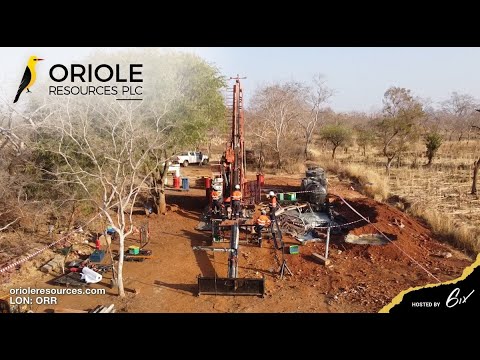
15:42 blows of mineralization of sufficient volume and quantity and grade along that trend to have multiple open pits. You know, we saw that we see that in several of the of these sort of orogenic systems in in West Africa. And this is exactly what we're appearing to see at Biberby. You know, the The diamond drilling that we undertook as the first phase, we did a lot of structural, down all structural measurements on that core. And we've added that to our surface structural mapping and our interpretation from remote sensing. And we've had structural specialists in from SRK to work with our teams to identify areas along that trend for follow-up where there's the potential for perhaps stacking of these systems, overthrusting, compression and overthrusting and ramping of systems, the competencies themselves between the tonalites and the mafics and the veins, the quartz Tomaline veins that we see included in here, and then deformation of those. We've got multiple phases of structural interplay here, compression and extension.
16:55 And it's exactly that massaging of the crust in these deep crustal zones, these mobile belt zones. That's what allows you to produce the heat and also then to relax and produce the space for these deposits to form. If you look at the results we've had to date, we've had sort of very, very high grade grab samples effectively, you know, 135 grams a ton. We had multiple, in our first program, multiple samples taken over 10 grams a ton, multiple over a gram a ton from the surface rock chipping. In the drilling itself, we've been getting a combination of narrow high-grade veins and wider lower-grade veins. Whilst it would be lovely to have wide high-grade veins, the reality is that most of these open pits in these type of systems around the world tend to be, you know, between 1.5 and 3.5 gram systems at a minable grade over, you know, widths of 5 to 15 meters.
18:00 And this is what we're chasing. We're seeing the main structures here are vertical to sub-vertical, we're also seeing an overprint of horizontal to sub-horizontal, which we're going to be chasing it a little bit more in our next program. So lots of opportunity for wider intercepts, you know, 234 gram a ton intercepts over multiple meters to give us that volume in pods or shoots along that 8.5 kilometer trend. And obviously if we get enough of them and they're close enough together, all of a sudden you take steps towards a resource and ultimately to something that could be economic in the future. Okay. Tim, let's just move the conversation on a little bit. You've clearly got lots of great data coming in from Bimimi and you know, massive stuff to analyse.
18:52 But in addition to that diamond drilling programme and all the work you're doing there, you've also just acquired a significant licence package in central Cameroon. Charlie was talking earlier about the importance of being a first mover. Now, you are a first mover. You're not following anybody. What was it about this location that made you say, right, we're gonna go there? What made you go there? And what are you finding so far? When we first looked in Cameroon, we identified the potential, we identified the right types of rocks for hosting these systems, the right sort of structures, the right sort of lineaments, the right alteration and metamorphic grades and so on, and importantly, evidence of gold. And we initially looked at the whole of Cameroon as part of our own prospecting play. And we identified a number of areas, about 7 in total, different areas within Cameroon.
19:48 And we ranked them using techniques that anybody who's worked in the industry will recognize. Most companies have got a little bit of their own sort of internal preferences, but essentially everybody does it the same way. And we've identified and ranked those 7 areas and then thankfully the Cameroonian government in the last decade has been, with the help of a loan from the World Bank, has been developing its own data sets and its own, they've revised and updated the licensing systems and laws through a system they call PreCASM with the help of GTK, the Finnish Geological Survey and BRGM, the French survey. Both well-known groups in sort of West African licensed development, licensing development and exploration.
20:41 And so the Cameroonian ministry had put together a mining cadastre website, freely accessible to anybody, and you can search for the current license holdings in the country. So we took our 7 ranked areas and we overlaid them on the cadastre system and we realized straight away that our priority 1 and 2 areas, our best pieces of ground in Cameroon, in our opinion, were wide open. Nobody had pegged any ground there at all. All of the existing granted licences were in the far east of Cameroon, where there's a lot of alluvial working. So people have been working the rivers, dredging the rivers and then picking licenses around them. But nobody looked up to the headwaters to the source of this gold.
21:27 And that is essentially where we are with our central license package. We have looked at the historical data from that area. There's evidence of gold from sampling in the 1960s and 70s. And when the license package was granted to us in February this year, all 8 licenses granted at the same time, over 3500 square kilometers of contiguous ground. When we looked at that data, we got out onto the ground and we came across artisanal miners, not very many, because it's a lot easier to dredge it out of the river in the east of the country than it is to crush the hard rocks in the center of the country. But artisanal miners extracting gold. So, you know, one of the best indicators for gold is gold.
22:17 And to find that on your new license package is very comforting. And in addition to that, we had the opportunity back in 2019 during the CIMEC conference, which is a Cameroon biannual, usually biannual, Cameroonian mining conference. The group from BRGM and the Precast and these people funded by the World Bank to develop the prospectivity data sets for Cameroon to promote exactly what we're doing, promote investment in exploration and mining. They had a show and tell session. And, you know, we looked at the data then after we'd got our license applications prepared. And, you know, there was evidence of the more recent work also showing gold in the streams in our central licence package.
23:07 So we're extremely confident that we've got a very, very good piece of ground, potentially the best piece of ground for grassroots exploration. We consider it to have the potential to be a new gold mining district. And the work we're doing now to advance that is very systematic, straightforward. You know, we've consolidated the land package. That's your first step. The next step is get in there, look at the structures, look at any available historical data, do some remote sensing interpretation. And then what we're doing right now, which is we have teams on the ground doing more detailed stream sediment sampling to try to identify which of the river basins in those 8 licenses have gold anomalies in them and then we could follow up those anomalies higher up into the river basins and identify the source of that gold. And hopefully that will come back with a whole bunch of targets which we will then traditionally rank and then carry on to the next phase of exploration. Okay, So we're saying the best piece of land for gold exploration and potentially a new gold district. Charlie, and we've heard from Tim about the approach that they're taking in central Cameroon. Charlie, what do you think about the approach?
24:31 Certainly, I approve the approach, yes. But what I'm quite interested to hear a bit about is you've been doing it drilling up in the north and I'm guessing you're learning a huge amount what Cameroon style mineralising system is. I'm guessing you're going to take that knowledge you've developed and bring it down to the central Cameroon area. Exactly that, Charlie, yes. We've got 2 advantages from having the projects at different stages in Cameroon. We've effectively got the central license package at absolute grassroots. We've got Wapuzi, which we've done soil sampling on and mapping and rock chipping on. And then we've got Bibimi, where we've done trenching and drilling. So we've got 3 different phases of exploration, but all critically, all associated with the same style of orogenic systems, associated with the same dominant structural regime and structural corridor, the Cholobanyo shear zone and the display off the central Cameroon shear zone. So understanding the structure is critical.
25:30 Any of these really intensely affected areas around the globe, it's important to understand as early as you can the different phases of deformation and to try to understand which phases are associated with the gold mineralization, which phases are likely to destroy that, the footprints, which ones are going to give you indicators that you're heading in the right area. So all of that technical understanding from Bipimi, we can apply it very directly to Wapusi right next door. Wapusi is only 20 kilometres to the north of Biberme along Trent, and we can also apply it back to the central licence package. In addition to that, understanding of the horse rocks themselves, understanding of the dating of the mineralization is going to be critical and whether there's a trend along that line of changing age dates of mineralization through the systems.
26:30 The 8 licenses in central Cameroon, 5 of them are, the 5 eastern most ones are completely, let's call it exposed, whereas the 3 western most ones do have more recent Cenozoic cover associated with the central Cameroon Volcanic Line. So there's also the potential there for other types of mineralization to potentially be either separate to cover the underlying or even to overprint it. So That's an area that'll be a little bit longer in the understanding, but the bulk of it is, is we believe, just a continuation of the same system. Okay, so you've gone in there, Tim, as first mover, you had the insight, having been the pioneer, if you will, Is anybody else following you? Are there any other groups going to the same areas in Cameroon?
27:22 There are. And it's not really a surprise. As soon as people start to break down the perceptions of the ability to do work. You know, Cameron was focused on oil and gas and on the timber industry. They weren't really focused on mining per se. And a lot of people have tried in the past and come across difficult struggles getting licensing and that sort of thing in the country. That's all changed with this new mining law, with the new pre-CASA program, with the ministry really trying to promote investment in the mining sector. So We're starting to see people coming in anyway because of that. But more importantly, since we've been successful in getting our licenses granted, that I think has been seen as a big positive for a lot of people.
28:11 And we flattery is, you know, we are flattered rather to have people coming in around us, a long trend, and even to the extent of also taking the names of West African birds to name the local companies after and this sort of thing. So we're seeing a typical sort of junior end speculatory applications for licenses. But interestingly, we're also seeing some of the larger companies coming in. Most notably, there's a large land application underway from Aramet, which is a French base and industrial minerals mining company. Now, this is a big shift off trend for Aramet because they are not known for exploration. They're typically acquirers and they certainly are not known for gold.
29:00 So to have them so request a long trend, admittedly more in the area of the Cenozoic central volcanic line. But, you know, it's interesting to note that large companies are starting to see the value here as well and putting the applications in. Comfort and almost a sense of validation to see these guys following you in there. What are the next steps for this license package? What will you be doing in the coming months? Well, we've managed to sample 0.5, well, 5 of the 8 licences. We've completed the stream sediment sampling on. Those samples are either at the labs or on the way to the labs for analyses as we speak.
29:48 The other 3 licenses are paused at the moment because we're in the rainy season in Cameroon, so, and we're stream sediment sampling, so obviously the rivers are full, we can't access them. So the first step will be to start analyzing the data, obviously, as it comes in, but then to go into the 3 outstanding licenses, finish the sampling there when the dry season starts again in September this year. And then, you know, as We like working at the bottom end, the front end of the Lausanne curve, because the exploration is simple and it's also quite cheap. So stream sediment sampling will identify, hopefully, anomalism in basins. That will focus us into certain areas within that land package.
30:34 The next step beyond that will be mapping, rock chipping, soil sampling, some geophysics. We know that the Pre-CASM program is about to wrap up at the end of this year. They'll have completed mapping the entire country. They did geochemistry, they did geophysics, and they did geological mapping. So we're hoping that data will become available at some point, which will be useful. But we also know that we can access drones in country to fly geophysics, for example, or we can do some ground geophysics on unlikely targets. So it will be a matter of progressing in a very systematic way, identifying the anomalies, ranking the anomalies, progressing the anomalies, and ultimately coming back with a picture of where are the hot spots within those 8 licenses and you know what the scale of the next steps are beyond that. Okay well look this fireside chat is drawing to an end.
31:34 You've told us about some fantastic progress you're making in Cameroon. But I'm going to hand over to Charlie for the last question, which in many ways is the key question. Charlie, over to you. Yeah, no, thanks, Dan. Yes, I think the major question is, is what actually is success for Oriel Resources over the next year or so, or eventually with these projects? Well, I think we're already having success. Success has been the intersections we've had at Bibbomi, proving up the orogenic systems there. So continuation of that will obviously be part of it, expanding the drill programs at Bibbomi to really home in on the areas of what we believe to be structural complexity, giving us volume.
32:24 So that's Bibbomy and then obviously transferring that up to Wapusi and the targets up there. The central licenses, really it's a matter of pushing the value up that Lassonde curve. We came into Cameroon on a reset for the company as grassroots explorers. We wanted to get into new frontiers, We wanted to get into new frontiers. We wanted to get into new districts and really to be driving ahead the discovery of new potential resources. So that is really successful as in the central licenses will be identification of those opportunities for new district scale gold anomalies being turned into discoveries being turned into resources.
33:14 And, you know, We know for a fact that the distribution curve of gold deposits in Cameroon at the moment is that the graph is empty. Other than the alluvial mining in the East, there's really nobody with any resources in Cameroon And yet the potential for these orogenic systems exist. And that's why we believe it's a great new frontier. The opportunity for multiple million ounce plus and maybe even, you know, giant and super giant orogenic systems exists. And if if you believe that Cameroon is a good destination for gold, then the natural progression is that you identify the best areas in Cameroon for that gold to be held, and you try and consolidate the ground. Well, we've done that. We've got the central license package.
34:07 All the licenses just granted in February this year, so full tenure under the new mining law, under the new mining license system, which is very familiar based on the Finnish system, and with great support from a Cameroonian government who with the World Bank funded programs is actively promoting investment into exploration and mining. So, you know, success for us is discovering the suite of new deposits that could potentially be, you know, the next new district of mines in Western Central Africa. Perfect note on which to end. It only falls to me now to thank our participants, Charlie Stevenson from SI Capital. Charlie, thank you very, very much. And also Tim Livesey, Chief Exec of Auriel. Aurel, I should have said, is listed on the AIM market in London with a ticker of ORR and a market capitalization of around 9 million pounds sterling. Well, that's it from Blythway Business News and our fireside chat.
35:12 Thanks for watching. Thank you. Thanks.