David Bleach
Chief Executive Officer
Replay available
EROAD (NZX:ERD) reported Q2 2027 results on this call. Replay available.
On 6ix: 6ix.com/event/eroad-limited-erdax-q2-2027-earnings-call
Automated transcript · Written by software from the replay's audio. It can mishear names and figures; the replay is the record.
0:00 Good morning, good afternoon, depending on where in the world you are. Thanks for joining us for eROAD results for the six months to 30 September 2017. I'm John Stockton with Mia Keira and our new Chief Executive David Bleach.
0:14 David Bleach Thanks for the welcome, John. Great to be here.
0:18 All right, so the results mark a handover between myself and David. On October the 12th, I stepped back from being the executive chair to non-executive, and David took over the running of the business. So I'll talk to the front up, and then Ciara and David will take over. We've got about 40 minutes here for you today, and let's get into it. So we've obviously got the talk through, the agenda, and we're into it. So five things I'd like you guys to take away today. We have a stable result broadly in line with the expectations. Revenue is flat at about 98.1 million. The enterprise deals have a long sales cycle, so the new wins are going to take a little bit longer to land as we build up the NPS.
1:11 And it's going to take a little bit of time for that revenue pipeline to build. Secondly, it's an ongoing story of three different markets. We've got there is some Australia and New Zealand and a contraction in North America. We've flagged all this before, but New Zealand is a strong cash generative in our engine. Australia is growing, winning enterprise customers, and North America, we're refocusing on Donald Defence. Okay. The third piece is the transformation is broadly on track. Some parts are going well and other parts are particularly stubborn. Most pleasingly, there's nothing on that list that we're backing away from. We're committed to doing what we said. Some will take a little bit longer and some are actually a little bit ahead of schedule.
2:00 And between myself and David, we'll handle that transition. That's where the strengths in the executive team. We have a new chief customer officer who joined in October and obviously David, who you'll hear from shortly, joined in October. And first, this will probably hopefully keep you guys right to the end. Spoiler alert, we're going to add revenue and ARR to the guidance today and just confirming we remain on track for positive free cash flow for the year. So with that, I'm going to pass over to Ciara, who's going to talk you through the financial results. Thanks John and good afternoon everyone. In short, this is a stable result. Revenue grew in New Zealand and Australia, which offsets the contraction in North America that we have previously flagged.
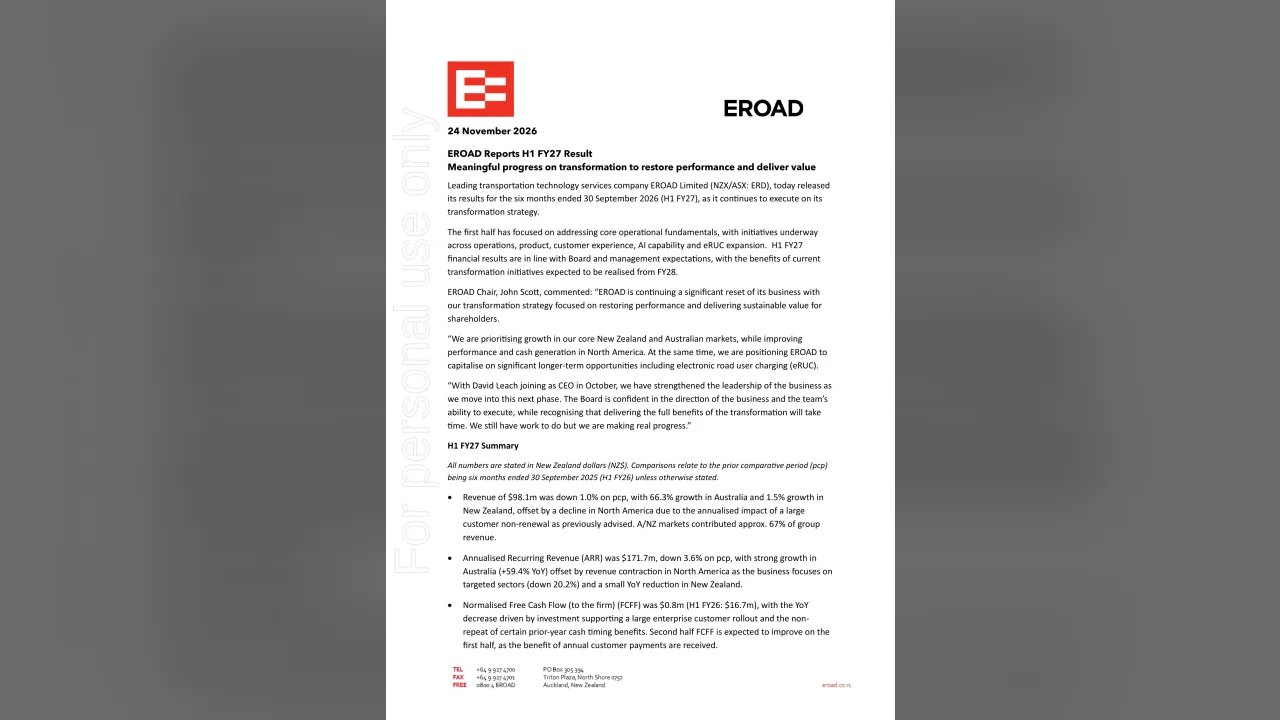
2:51 Reported revenue of 98.1 million was down 1% on the same period last year, as Australia and New Zealand grew 10% on the same period last year, whilst North America contracted 18.2%. ARR of 171.7 million is down 3.6% on last year's 178.1 million, with Australia and New Zealand reporting growth of 7.1% year-on-year and North America contracting by 20.2%. Normalised EBIT was 2.1 million, 400k below last year's 2.5 million. Normalised free cash flow to the firm was positive at 0.8 million, albeit down against the 16.7 million in the same period last year, the change mainly driven by growth investment, which I'll explain shortly.
3:44 On a reported basis, free cash flow was negative 3.1 million. The normalisations that I refer to from our transformation programme are set out in the footnotes. 3 million of one-off transformation investment across AI and platform modernisation and 0.9 million of e-work investment. They're also reconciled in full in the appendix, slide 37. Moving on to the next slide. So this slide provides a snapshot of each region's revenue for the half and how this has changed. So starting with New Zealand on the left, revenue grew 1.5% to 52.9 million. Australia in the middle grew 66.3% to 13.3 million on the back of enterprise wins, clean away in particular.
4:36 North America however fell 18.2% to 31.9 million. This reflected the customer non-renewals we have previously disclosed and flagged as we refocus the business towards our defensible core products. Australia and New Zealand now make up around 67% of group revenue. That shift is the strategic focus that was outlined in May, now showing up in the numbers. I'll come back to each region shortly. Back to you, John.
5:06 Thanks Ciara. OK, so I'm going to take you guys through the transformation work we've done. It's at a couple of different levels, so this is the highest level at the start here and your cards will repeat these kind of themes at different abstraction levels as we go through it. First of all, the translation is broadly on track. We've got much more discipline. We've got our partnership up and running with Microsoft. We've released the ERAP product called Roadrunner. Our opportunity to catch, or O2C as we call them internally, and the hardening of our processes are well underway. In the second bucket, which is one I'm personally most happy about, is the three regions are established. We've got the HGP, or e-road fully planning, or scaled agile thing, work in place. I think these are locked and loaded.
5:57 And out to the right, and at a certain point we've got the platform modernisation that's built off the Microsoft stuff but it's really sort of signalling the unlock of the AI potential. Especially in New Zealand where we've got lots of data built up over many years. Data reputation and relationship but on top of that we're processing about 80% of New Zealand's commercial electronic road users. AI, that platform allows us to unlock some more potential. It's also worth calling out that there's other things that we're not done with. Probably the one people will be focusing on is North America, where we continue to refocus, where we have some advantages at some places and our aim is to be free cash flow neutral as soon as we possibly can.
6:48 So what I'll do is I'll take you to the next level. So at the AGM, brought up our strategy house and these were the topics that we said we did. Lots of questions came in at the end of the Q&A session last year about how we would fold ourselves accountable, what how we would explain to you. So this is our best effort. So we've got the CEO in place, the go-to-market regions are set up, we have our error metrics which will take you through, the 4G rollout is complete and clean away plus or minus 36 trucks is done. In progress, we obviously have the next lot. There's two call-outs here. The e-rack and the free cash flow are on target.
7:38 So we're happy with those. Customer service and our billing. In Progress, a bit on what to call out is those ones where you start to see the benefits of AI come through. I think even a year ago, you would have had to solve those problems for start, but you start to see the benefits of AI native organization. So the open ones or in progress ones. Customer service, all the cash we've talked about. Then you've got the Cortex integration, which is particularly stubborn. And because of the complexity and how long it's been left, we're on it. That's for more modernization we've talked about is underway.
8:24 Theme hustling with this one, it's our biggest bet. and in full transparency, it's taken us probably a little bit longer to get going than we'd like if we tried to balance the issues or productivity in our platforms today. Again, you can see we're quite specific at the AGM. We spoke about ODO speed, map accuracies, dashboards, observability, stability. These ones are up the way. We have rolled out fixes for the majority of these features. It just takes a little time to walk through your organization. So depending on where in the world you are, you'll be having a slightly different experience. So we expect by the end of the year to be clear on that one.
9:10 And then finally, probably the key one for me is we said we provide the promoter score. I think at the AGM I talked about it. We were measuring four different types of NPS. We were measuring the customer service, how drivers felt, and what we'd be trying to do is single in on our economic buyer as Benefit Promoter Score that we care about. The reason this is so tricky to give you a number right now is I'll give you an example from just a QBR that we did the other day. The customer said it had come to us a year ago we would have given you a 0 or a 1 out of 10 and today you are 10 times better. It's very hard to quantify and so by the AGM we hope to quantify those numbers for you.
9:57 If you read the slide here, there's a team that's going to do it for Carolina. So, over the last year we've rebuilt the team. Jason, Helen and David are the new faces. Jason joined here in New Zealand in September and David in October. Each region now has its own general manager. Matt and Chip Braley spoke at the AGM when you met them and Conrad is running Australia so now we actually have owners of each markets and they all have are accountable for their own P&L so the way I look at this is we've got the team we focus on the go-to-market and our customer that's three general managers and our chief customer officer they obviously feed in to Paul and Andrew our chief technology and chief product who obviously make the products and they're thus supported by Ciara and Emma, our CFO and our CPO. And now we have David to lead.
10:58 Really excited to see what these guys can do for us over the next couple of years. So I think everyone's aware of this, but just clarify, Brian joined at the AGM on the 1st of June and Ian was elected at the AGM. I've got back to Shandong executive here, Rolf, as they've just taken over. David Green continues as our lead independent director. We've taken advice on the line of life independence and we'll address that at next year's AGM. We don't see it as an issue going forward. Sarah Gifford retires again as we've announced. First, I'd just like to thank Sarah for her contribution, particularly through the transformation.
11:45 She's been a huge source of insight. She's always been available. She's a friend of the company and she's always well been here. So there's a couple of slides here which are probably a bit dry for some of our friends in the financial team, but I'm going to try to take you through how we work. and the things I noticed when I first joined since February 25 was Agile, EQP. Most companies that are technical have this sort of framework and it was one of the things that I was missing. Agile sometimes was understood as a bit of a free-for-all but actually what it is is a lot of discipline.
12:30 So what we do is we set out direction from our strategy and hero metrics and now you guys will be aware of our expert hero metrics and David's going to follow up with our strategy in the next stage here. The regions and the fractions bring their requests and they rank them on a shared set of rules. Now the big change here is there's a whole set of non-negotiables that come first. Regulatory, compliance, contractual and critical bugs. That is the hygiene level that will make sure that our customers know that any contracts or any of our obligations are served before we go to do more. From day one in the quarter, the teams commit to a fixed set of deliverables. Each one has a main donor, and we track it thoughtfully.
13:17 At the end of the quarter, we measure what we call our say-do ratio. It's sort of an industry stat, and we deliver against what we're committed. And obviously, what we don't do, we roll into the next quarter with the same sort of ranking rules. This half was 71.5 and again I'll dig into that on the slide. Probably what's most pleasing to me is when David came in. He's recognized it straight away and he's understood it sturdily. He's got thoughts how to make it better, which again is exciting. What I can tell you guys is over the last 10 years I've put in Agile in four places. This is the fastest and most comprehensive I've seen a company adopt it. It isn't perfect, no, but after four cycles, it's about as good as anyone could expect. I don't think you see this in all the markets until you've done it about 12 times or over three years.
14:16 For where we are, it's really good. And I would say at this point, we're probably better than 95% of companies. So with that, thank you to our Heronetrips. at the annual meeting we promised you metrics that you could judge yourself and I actually invited you guys to come and review them with us. What I got wrong or underestimated was how to provide these numbers in a listed company format. I'm actually, or the team are, sitting on hundreds of real-time KPIs of NGC on our dashboard, but exposing them allows all sorts of attack vectors for our tissue. So I apologize for that, Bert, but what we're trying to do is we'll put these ones in front of you. There are a mix of back-looking and forward-looking measures.
15:05 We'll report them at every results session and we'll be transparent. If we do take one of these off the table, for example, if we replace free cash flow with EBIT or EBITDA for some reason, or we change contracted units to enterprise sales, we'll be really transparent. We'll see why and we'll give you the number when we change it soon. But at the moment, these are the ones we've chosen and I think they're a pretty good starting So I'll just walk you through them. At the top, we have revenue at $98.1 billion. We have ARR of $171.7 million and we have free cash flow normalised at $18 billion. On the operational side, I talked to you about net provider score a little bit. We're not ready because we just don't have a big enough sample set to expose that number. We have employee engagement at 54%, which I just spoke about at 71% contracted units at 236,000 units.
16:06 We're clearly not happy with all of these numbers, but now we've got a set of baselines for which us to grow. As I finish up here, I want to talk about my favourite slide. Probably this is our biggest achievement in the quarter from a customer standpoint and from a commercial standpoint as well. But what I like about it most is it talks to the benefits we have to the customers and the change of faith. So you can see up there we've got two bookends. We obviously doing a rollout over 3,200 trucks on it to minimize the disruption. And you can see down there we didn't want to hurt any of our installers, so we ticked that off.
16:53 We've connected over 3,200 assets. When we were just checking just before this call, we were still chasing down the final 36. So we're at 99% complete. The bits that I wanted to talk to you about that I was pleased is when we first started this on a bad day, we would only get three units installed. We were holding up the clean away team and we had a sort of first pass success rate of under 50%. In the final weeks of the slot-out, in some days we were in excess of 25. I think we may have even had a day over 30. But probably equally important is our first pass yield rate went to over 90%. Now, these are not small installations. I believe, you know, on a big one, it can go nearly up to 10 hours to install it. And probably most pleasing, we've had now...
17:54 These are the kilometers travelled under our system. And when you come back to why B&W wanted to do this, it was both safety and the benefits you get from the telemetry and the belief we've delivered. So. With that, I want to just pass back to Ciara. I feel like this one deserves a shout out to the team both outside and at CleanAway. When you're doing something this big, because it's actually gone surprisingly well, we actually have seen all the hard work. I just want to shout out to the CleanAway team and our own team for getting this done for us. Thank you. Back to Ciara. Thanks John. I'll start with how cash flow sits across the three regions and then take each one in turn.
18:46 So this page frames the half. New Zealand continues to generate strong, consistent cash flow to fund the group, whilst first half cash flow reflects investment in Australia and timing in North America. New Zealand generated 16.1 million of free cash flow on revenue of 52.9 million, or 18 million free cash flow when normalised. It's a consistently cash generative base. Australia was negative 7.3 million or 6.9 million when we normalise. This is entirely related to the upfront hardware and installation investment for our enterprise rollouts. Capital we put in ahead of the revenue which has recovered in H2 in subsequent years.
19:32 North America was negative 11.9 million or 10.3 million when normalised. This reflects the seasonal timing of large annual customer receipts, which fall in the second half, together with bad debt and inventory impacts as the region has been reset. So the shape of the half is clear. A strong, cash-generative New Zealand. A growing Australia investing to win. And a North America refocusing on our defensible core, with cash weighted to the second half. So turning to the regions and starting with New Zealand. New Zealand remains our anchor market and generates the cash that funds the group. It is a scaled market leading business. We process more than 80% of New Zealand's commercial electronic road use charges and we hold proprietary data at scale built up over many years.
20:29 That data is a real competitive advantage and very hard to replicate. Revenue grew 1.5% to 52.9 million up from 52.1 million in the same period last year. ARR declined 1.4%, reflecting elevated churn following the 4G renewal programme and competition, coupled with CPI increase in the first half last year being positioned in the second half this year. Asset retention was 88.5%. Monthly SaaS ARPU rose 3.9% to $64.50 as the customer mix continues to shift towards higher value products. New Zealand delivered $16.1 million of free cash flow to the firm in the half from more than 5,000 customers.
21:21 The next phase of growth in New Zealand comes from doing more with the customers that we already serve, deeper integrations with their systems, selling more of our platform and putting our data to work for them, alongside the longer term e-work opportunity. The platform modernisation that John has described is what makes that possible. Now to Australia, where our growth is coming from, driven by mid-market and enterprise wins. It is our fastest growing region. Revenue increased 66.3% to $13.3 million from $8 million this time last year. ARR grew 59.4% year-on-year to $24.2 million.
22:09 Monthly SaaS ARPU rose 40.3% to $73.12 and asset retention was 95.3%. We now have a full regional go-to-market team in place to drive growth and the Cleanaway rollout is nearly completed and on target. We also see multiple product expansion opportunities with our existing enterprise customers, which is where the next phase of Australian growth comes from. Free cash flow to the firm, negative 7.3 million, reflecting the capital that we invested ahead of the curve in stock, installation and deployment. With the rollout nearly complete, that upfront investment falls away in the second half and is also recovered.
22:57 Now to North America. North America has been harder and the numbers reflect that. Our response is to refocus the business on our defensible core, the verticals where we have a real advantage. Revenue fell 18.2% to $31.9 million from $39 million. ARR fell 20.2%. Asset retention was 84% and monthly SaaS ARPU down 1.2% to $61.21. This mainly reflects the large customer non-renewals previously disclosed and flagged at the half year, at the full year. Churn in non-core verticals has come through as expected, although some losses came earlier than we anticipated.
23:48 Our focus to reset and retain. We are investing in customer relationships to build trust and continuity, and NPS and our retention targets is improving. We remain committed to North America, focused on verticals where we have a competitive advantage, while maintaining a presence in other segments. Free cash flow to the firm was negative 11.9 million in the half. We expect that to improve by the full year with annual customer receipts weighted to the second half and a continued focus on collections and inventory. And we remain committed to bringing North America to free cash flow neutral in the short to medium term. Moving now to an overview of the group financial results.
24:38 Revenue and EBIT Revenue of $98.1 million, down 1% on last year Steady growth in New Zealand, new business in Australia, offset by the non-renewal of a large customer in North America. Reported operating costs rose to 75.3 million from 70.4 million same period last year. That mainly reflects higher bad debt and inventory provisions, transformation activity and targeted investment in our platform and capability, partly offset by discretionary savings. Reported EBIT negative 8.7 million compared with negative 133.9 million last year, which included the North American impairment.
25:27 EBIT includes 6.62 million of increased amortisation entirely related to the shortening of useful economic life that was made in the financial statements published in May. Normalised EBIT 2.1 million against 2.5 million last year. Operating costs. This bridge shows the movement in operating costs, which increased 4.9 million or 7% to 75.3 million. There are four drivers shown here. First, a higher proportion of development costs that have been expensed rather than capitalised. Second, increased bad debt and inventory provisions as we remediate historical issues.
26:15 Third, continued transformation investment across operational stability, e-work and AI, and partly offsetting those personnel and other savings from lower recruitment, travel, contract to spend. In short, we are investing in the capability we need while keeping control of discretion we spend. Operating efficiency. Customer acquisition costs on the left fell to 9.9% of revenue from 10.2% last year and continue to improve. Cost to service and support rose to 9.6% of revenue from 8.3%. That is deliberate. We have been investing in customer service capability because service levels have not been where our customers need them to be.
27:07 R&D, total R&D spend was 20.8 million in the half or 21% of revenue compared with 18.8 million or 19% last year. More of it is now expensed, 66% of R&D spend up from 60% with 34% capitalised. The first half has been front-loaded with maintenance and stability work, cloud platform upkeep, security, customer-facing quality improvements, incident remediation, and cost control. That sets us up for the platform modernization work starting in the second half. Free cash flow.
27:53 Free cash flow to the firm, negative 3.1 million in the half or positive 0.8 million when normalised for transformation costs. Two things drove the first half. Investments supporting the large enterprise customer rollout in Australia and the non-repeat of certain prior year cash benefits. You can see that demonstrated in the bridge at the bottom of the page where the 9.6 million large customer rollout investment and then on the left 2.5, 1.8 timing of cash that benefited the first half last year and therefore not this year. In the second half, we expect cash generation to improve through annual customer receipts, lower hardware and installation spend as the enterprise rollout concludes and value is recovered.
28:45 Finally, liquidity. We finished the half with total liquidity of £38.7 million, made up of £8.6 million of cash and £30.1 million of facility headroom. Our £60 million facility is with three New Zealand bank lenders, ANZ, BNZ and Kiwibank, and runs to October 2027. We remain compliant with all debt covenants. This gives us the flexibility we need as we continue the transformation. So with that, I'll hand you to David.
29:23 Thank you very much Ciara and good afternoon everyone. I'm really excited to be here today and before we get to Q&A time, I'm quite keen to share my early thoughts as Chief Executive and talk about where we're currently focused and what the outlook looks like for the business. This is just my seventh week at eRoad. However, I first met the team in April discussing the opportunity and been studying the business ever since. So today sharing some early observations just rather than conclusions at this stage. Firstly, part of what attracted me to eRoad was the opportunity to make an impact in a large market. It's an opportunity to develop as a better business and a faster business resulting therefore in a growing business.
30:11 And it's really great to see the transformation is on track and I have every intention on building on that. and not starting again. And the more I see of this business, the more I see a lot of upside potential. So why eRoad? I believe this company can truly become a global category leader in intelligent transportation technology by focusing on three things. Operational discipline, AI native innovation and customer satisfaction. We're not just a telematics vendor. We're a mission critical operating system for complex, highly regulated fleets. We hold proprietary data at scale. We have proven we can deliver for enterprise customers and we're deeply embedded in New Zealand.
31:00 I have six current priorities that will collectively drive more momentum and I'll just quickly go through all six. Firstly, locking in a high achievement, high performance culture with clearer purpose, stronger accountability and ownership and higher standards across our global team. Secondly, operational discipline, fewer priorities, finishing what we start, clear performance measures and free cash flow among them. and striving to consistently deliver what we commit to. Thirdly, shifting from transformation to an ongoing culture of innovation. So it's in our DNA, building on the good work of EQP that's already in place rather than starting over.
31:49 Fourth, AI native innovation, adopting AI across the entire business to drive productivity, to drive product innovation with an eye on ROI. Fifth, optimising the customer journey across every function, not just in our customer facing teams, but modernising the customer experience. I've met quite a few customers already and I can see the mission critical nature of what eRoad offers and opportunities to improve and be better and faster, as I said earlier. And sixth, setting the three year strategy for the next phase. and I am keen to come back to you all in our full year results presentation in May 2027 to explain that strategy.
32:39 Overall eRoad's really at a turning point and I see that being a better and faster business can win against global giants and I can see that eRoad really has the foundations and a credible plan to become a stronger more competitive business. Sharing a few more early observations, I can see that our focus is really clear and aligned to creating shareholder value by executing on the core business. New Zealand is a scaled market leading telematics business with strong cash generation. Our priorities are to de-risk and grow free cash flow, take a customer focused approach to our go to market, drive operating leverage through operational discipline and allocate our capital carefully.
33:27 I see a lot of upside in selling more of our existing platform to our existing customers we already serve and in the data we hold. The Australian market is a fragmented high growth market with significant opportunity for eRoad. We're rolling out a growth playbook, expanding our sales presence and building on the momentum from large wins like CleanAway. and beyond our core business in ANZ, there is additional value here. For future opportunities, including eRAC, our priority is staging our readiness so that we're positioned as the provider of choice. And finally, in North America, We're resizing the business for the current opportunity, narrowing the focus around our defensible core and the data that I've been looking at so far tells me that we are retaining customers and winning businesses in certain segments and we're striving to be cash flow neutral in the short to medium term.
34:35 Now getting to the guidance. We remain committed to delivering positive free cash flow this year. This means delivering the transformational projects with financial discipline. We're also today sharing revenue and ARR guidance for the financial year. For revenue, we expect the group to deliver between 192 million and 196 million. This reflects both the continued strength in the NZ and Australian regions, but also the North American resize and reset. For ARR, we have a slightly wider range between 165 and 171 million. This range considers the same context that I referred to with total revenue and also includes the weighted sales pipeline and foreign exchange volatility.
35:26 For free cash flow to the firm, I'm pleased to confirm that we remain on track to deliver the May guidance that John and the team communicated of positive free cash flow. So free cash flow, we've set a range of one to eight million. The reason for this wider range at this stage of the financial year is on one part, a level of confidence that we will deliver on our commitments made in May, but also an indication of working capital fluctuations. We're still working towards being a more predictable business. Free cash flow efficiency is one of my key priorities. I see the potential to improve our cash generation to enable us to invest in growth. We expect a stronger second half of free cash flow as large annual customer payments are received and the first half cash outflows from the Australian enterprise stop as the rollout has now been delivered.
36:20 All in all, to sum up, we have a strong core business in New Zealand and a data advantage to build on. We have real momentum in Australia and a clear focus on our defensible core products in North America. Our transformation is on track and I very much look forward to sharing my three year strategy with you as part of our next chapter in May 27. Thanks for listening, everyone. I'll hand back to John to open up for questions.
36:54 Thanks, David. All right, guys. I hope we did get you guys both a comprehensive and transparent update. I guess we're going to find out if we did. So let's open up with some Q&A.
37:11 All right, guys, we've got James here to help us. So James is sitting on the desk trying to process all these questions, and we'll let him ask us some questions and see how we do. Great, thanks, Sean. You can submit questions at any time using the Q&A function on the side of your screen. We'll try not to curate these questions or read them as they're received along with sort of who's provided them. If there's several questions on the same topic, we'll group those together so we can cover off as much as possible. And if we run out of time, we'll look to follow up after the call. So our first question is on North America. At the ASM, you said that North America was targeting free cash flow breakeven after reported free cash flow to the firm loss of $12 million in the first half and it's currently running at an annualized loss of $24 million.
37:59 How do you plan to reverse that trend and when do you expect for North America to reach breakeven? Perhaps Ciara, do you want to cover that? Sure. Hi, everybody. So firstly, yes, at the AGM, we said our ambition was free cash flow neutral. That is still the case. It's proving harder than we expected, as John has mentioned. Noting you can't take 12 and double it to get to 24 due to the fluctuation in timing of annual bill receipt. So let me give you some more colour there. We receive 15% of our revenue in the second half, in the last quarter, actually, in terms of annual bills. We also have, we referred to a number of adjustments or cleanups as we've been resetting North America and we've written off some revenue as a result of that and receivables in the first half that won't reoccur in the second half. So we believe we will improve our position from today, but we won't get to zero this year.
38:58 Great, maybe carrying on the same line of questioning around North America. How much of North American ARR is due to renew over the next 12 months? Have you begun renewal discussions with any other large customers? One being Cisco, which recall is due to expire in November, 2027. And are you confident that those customers will renew? Thanks James. So I won't disclose the renewal profile or comment on individual customers, but what I will say is that we have re-signed a large enterprise customer, but we are also farewelling a large enterprise customer as we indicated in May. Great. Our next question is from Owen Humphreys at Canaccord.
39:43 Can you please provide more colour on the free cash flow inflection expected in the first half? Hi, Owen. Ciara here again. So in the first half, we've had quite a year. We've had a large outgoing in the first half in terms of growth investment, as we call it, for installations, hardware, stock. That has stopped now, the large enterprise rollout that's no longer carrying on. Plus then, we're recouping some of that in the second half. Plus then, we have the annual bill receipts. So we've got quite a material incoming in the second half, nearly 20 million of these one-offs. Our next question is on debt facilities. You now have $30 million of drawn debt against a $60 million facility that expires next year.
40:30 With EBITDA declining and the US consuming cash, what happens if the banks will not extend their support and would you consider a capital raise? Thank you. So it's quite a negatively framed question. Yes, we're 30 million drawn and yes, our facility is up for renewal and we've got a supportive syndicate to New Zealand and we're going out to refinance. No, we are not looking. Great, our next question is just on operating expenses. OPEX increased 7% despite weak revenue growth and David has announced plans to hire 50 people. How does that fit with your commitment to becoming free cash flow positive, David?
41:14 Yeah, thanks. I'll take this one. A bit of context around this first and foremost is part of our transformation is work to modernize our platform and build next generation eRoad products. And that intersects with that vision that I spoke of, of eRoad becoming an intelligent transportation technology player globally. So with that vision and that current transformation project, the context of the announcement I made of those roles is the ongoing reshaping of our business around that AI opportunity. It's very important and very exciting. Not all of those 50 are new roles. That's not a net new. Some of those roles are also replacement roles as we continue to reshape.
42:01 and maybe I'll just add something in there like all these questions sort of come at a couple of points and so obviously people comparing us to the budget and what we said at the AGM and so the things that we probably weren't aware of was probably the situation with our stock and our accounts receivable situation. They are probably, I don't know what the right word is, not as good as we'd hope, or as we actually learned, more stubborn. but the other pieces like our ARR decline and our engineering and the OPEX all of that stuff we had in budget like even though David said 50 people were still going to be on the OPEX line that we budgeted the accounts receivable decline and the US would signal to everyone who were on to it so it is kind of two elements I just want to sort of run through there yeah so stock and receivables probably worse but all the other stuff we knew about budgeted for Great.
43:05 Our next question is again from Owen just on costs. Cost rose to 75 million in the first half. What does a more normalised cost base look like if we go forward a couple of years? So the answer would be it's lower for sure and we've got the five million year-on-year increase in the half is one-offs and transformation spend and The nature of transformation spend is it's going to return benefits being lower costs. So we do expect to see a lower run rate and we'll share more of that. in May when David shares his strategy and we share the financial strategy as well.
43:41 Yeah. Hey, Owen. Look, I think we've been pretty clear, right? We are running, we're probably at peak OPEX at the moment. We've got our Cortex platform, which we're trying to unwind. We've got the eRoad one, which we're running the majority of our business and we're trying to build a new one. like most people go from one to another not many people go from two so we're definitely at peak OPEX and like we understand what typical ratio run businesses look like the the reason i'm not trying to back away from this but when you've got three different market dynamics you've also got a bit of play right so the only market that you can really ratio run is New Zealand because you've got such a growth business in Australia and you've obviously got the decline hopefully the stabilization so there's a bit going on there but I don't think it makes sense to look at a hole in ratio run I think you've got to run the three markets and do your ratios like you know you understand that R&D wants to be in between you know and a tech company that's anywhere from 15 to 22%.
44:48 I understand sales and marketing ratios, you know, 8% on, you know, we understand these stuff, but at the moment it's getting our arms around us. And probably, you know, if you want to do ratio runs and look at that stuff, let's talk about it regionally. Great. Our next question is just on normalizations and probably more of a clarification. Why have you decided to focus on normalized and adjusted figures rather than the reported results? And why aren't investments into platforms and AI considered ongoing business costs? and look that's a fair enough question so a couple of points one we we are really trying to be transparent and show reported and normalized and provide there's a slide at the back of the deck that really breaks out what's in here and i'm happy to give more detail for that reason um and we do we are considering moving future to talking about inherent and growth so that you can be clear what's growing the business and what's running the business and yes agree that AI spend will be normal course of running the business but in the initial period there's quite a there's quite an investment to get up and running so we've we've had some really good outcomes with our AI innovation hub that we've set up a number of months ago in terms of developing products that can improve time to market internally so we we believe it's the right investment to take costs out
46:12 but yeah it's just a call we've been completely transparent so if you want the non-normalized one look at the other one we just tried to normalize it to help you guys i feel like some of the stuff that we've had to deal with like the order to cash is not a normal thing that you would strike in a business needing to play on ai too well the stuff we would put ai on the customer stuff you go yeah that's normal so it's just us trying to help but it's also the investment in the product in the platform modernization which it's not something we would do ongoing it will be a three-year program and that's it. Our next question is just on New Zealand retention so asset retention fell from around 92 to 88 percent while ARR experienced its first decline what's the underlying driver of this and is that evidence of sort of any other positioning around erode in the market?
47:08 and so no New Zealand business continues to perform well there has been a large resize down which is in part was Sunrise and the closing out of the Sunrise program of work where we give customers an opportunity to reduce the number of units that they had and that is the majority of the number and also a little bit of competition but we also have delayed CPI so CPI adjustment is going has gone now but it wasn't in the first half so from a year and year point of view for ARR that negatively impacted that also. Great our next question is from Sinclair Curry. Have you experienced any issues sourcing device components and does this have an impact on growth?
47:55 The answer is no to having difficulties in sourcing component parts. Great, easy one. The next question is from Josh Dale at Craig's. We can see churn in North America. Presumably the outlook is for further churn to come. If there's pressure on revenue and you wanted to get to cash break even, you need to cut costs at an even faster pace. What cost lines are the priority to optimize there? So you're right, Josh, we do see a little bit more churn to come and we've got it all. We feel like we've got our hands around it. We know what's coming within budget and forecast. We are looking at costs. The number of FTE has reduced from August to September and reduced further six Just in the last month where people have left and they won't be replaced, which was the right thing to do based on what they do. We've been looking at marketing costs and then we're also looking at the global costs allocated to the region.
49:01 Our next question is on product differentiation. What are the demonstrated points of difference around your products versus competitors? Is it safe to assume they all use AI in development? The sector seems to be heavily commoditized.
49:19 some high level comments, not feature level comments, more theme level comments. Where eRoad seems to stand out is really mature capability around the concepts of safety, health and safety, driver safety, compliance and fleet optimizations of sweating the assets of those fleets, particularly for large, complex and highly regulated fleets. But when I think about AI, no, I would not assume that AI is deeply penetrated in technology businesses and it's an opportunity and intention to accelerate our AI program to create competitive advantage. So I think about AI in three parts.
50:07 It is AI to drive the development of eRoad products which will accelerate product innovation. It's also embedding AI capability in our products so that our customers benefit and the value proposition increases. And then thirdly, adoption of AI tools across all our departments to drive productivity, but also drive time savings and cost savings.
50:30 I might pitch in a bit. So, you know, like we gave that clean away example to show why we're not a SaaS company, right? So there's just a couple other elements to add to David's, right? We've got hardware in a lot of places from cameras, to shake is to wake you up is all the good stuff but on top of that we've spoken about our market fit in New Zealand being incredibly strong so is our product fit right because we have data and road user charges on top of that so when you're doing 80 percent AI can only get you so far because it's the data it builds on. And we really do have something pretty special with 80% of the road user charges in our user base. So yeah, again, you almost have to come back to market, but there's a couple of bits there, right?
51:25 we've got a hardware defense these things do not install themselves it's six to ten hours and installed and on top of that you've got all of our regulatory walls right like governments just don't sign up and say here create a paywall with us and start transacting a billion dollars so there's there's lots of stuff in there i totally accept that ai can code almost anything at an application level but it's only as good as its data and all the inputs Maybe just staying on the theme of AI, another question that's come through. The majority of technology firms globally are seeing significant productivity gains that are allowing them to reduce headcount and increase profitability. Is this a focus for eRoad, given it operates at lower margins relative to peers?
52:15 Yes, in short, this already is a focus, was already a focus before I joined, and we will keep doubling down on this. It's a really important part of our future plans and future strategy.
52:29 I actually think you can see that in our numbers because if this was two or three years ago and you were doing a whole new tech platform and everything else, it'd be a lot more you can actually like to be able to do everything we're doing with inside the constraints of our P&L is actually pretty remarkable. Great we'll just pause there for a moment as a reminder you can submit questions at any time through the Q&A on the right hand side of your screen we'll just pause for a minute to see if there are any further questions. Is there anything more coming, mate?
53:33 How many left online? Let's just do it. I think with that, it looks like there's no further questions to cover today. With that, I'll hand over to John for closing remarks.
53:50 Alright guys, well that is my last time up on stage. Thanks for having us and we will see some of you guys on the roadshow in Sydney, Wellington and Auckland and otherwise we'll see you back for the AGM. Thanks very much.
Follow EROAD Limited into a list and get an email when it puts out news.
Chief Executive Officer
Non-Executive Chair