Matthew Key
Analyst, Texas Capital
Replay available
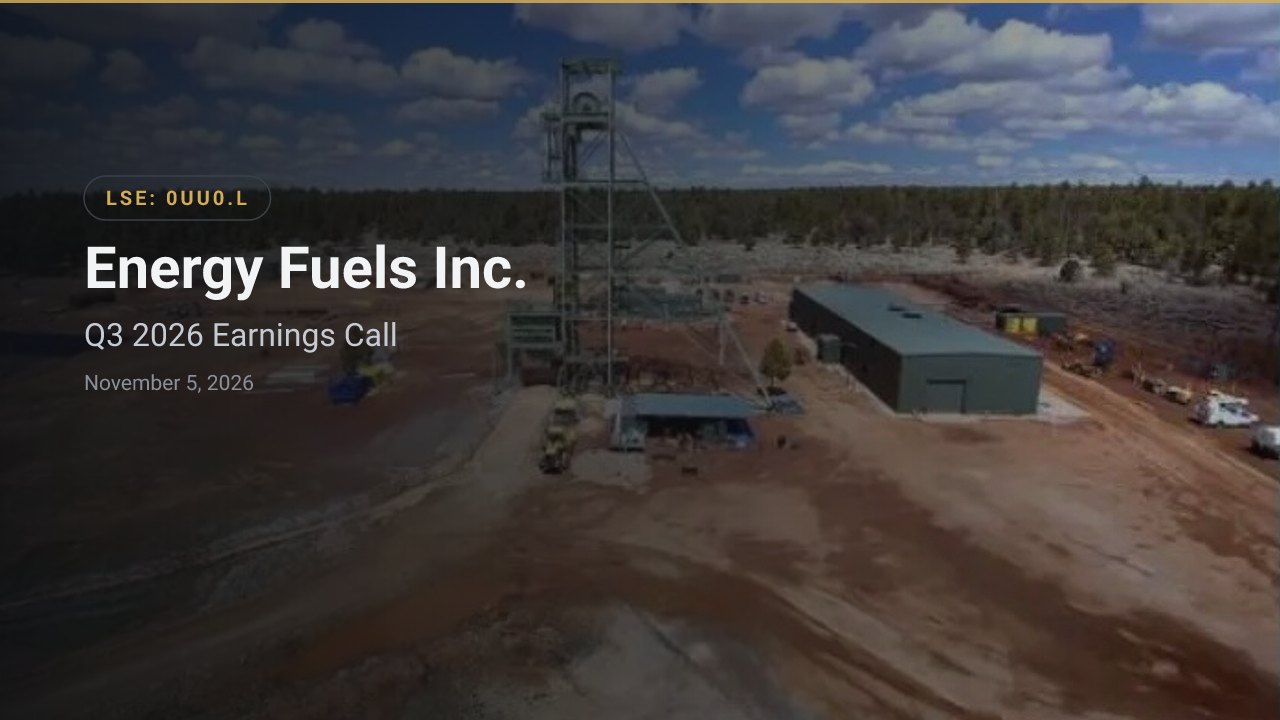
Energy Fuels (TSX:EFR) reported Q3 2026 results on this call. Replay available.
On 6ix: 6ix.com/event/energy-fuels-inc-0uu0l-q3-2026-earnings-call
Automated transcript · Written by software from the replay's audio. It can mishear names and figures; the replay is the record.
0:00 Good day, ladies and gentlemen. Thank you all for joining us for Energy Fuels' third quarter 2026 conference call. As a reminder, all phone participants are in listen-only mode to prevent any background noise. Later, you will have an opportunity to ask questions. As a reminder, today's session is being recorded. It is now my pleasure to turn the floor over to Kim Casey, Director of Investor Relations. The floor is yours.
0:29 Good morning, and thank you for joining our third quarter earnings call. Presenting today are Ross Bhappu, President and Chief Executive Officer, and Nate Bennett, Chief Financial Officer. Our earnings news release and today's slide presentation are available on the Investor section of our website under the Presentations tab. And a replay of today's discussion will also be available on the website through the event link. During today's call, management may make forward-looking statements. All forward-looking statements are based on current assumptions and beliefs as of today. Such statements are subject to risks and uncertainties, and for a detailed list of such risks, please refer to the Risk Factors section within Energy Fuels 10Qs and 10Ks filed with the SEC.
1:20 Energy Fuels is under no obligation to publicly update forward-looking statements after the date of this call, except as otherwise required by applicable law. I would now like to turn the call over to the President and CEO of Energy Fuels, Ross
1:36 Bhappu. Well, thank you, Kim. Last quarter I told you that our story was one of execution. This quarter I'm very pleased to tell you about several important steps we've taken to advance on that path. On August 28th, we closed on the acquisition of Australian Strategic Materials, ASM. During the third quarter, we continued to advance the proposed acquisition of vacuum schmelz, or as I'll refer to it during the presentation, VAC. At the White Mesa Mill, we qualified our heavy rare earth oxide production with a major global permanent magnet manufacturer, and we approved commencement of construction of our phase 1B and 1C heavy rare earth expansion, as well as our MREC processing operations. Finally, we received conditional government loan commitments for our Donald project and continued successfully moving this valuable project toward a final investment decision, which we hope to make by the end of the year.
2:30 There's still a lot of work ahead of us, but quarter by quarter, we're putting the pieces of our strategy together and advancing our goal of building a fully integrated rare earth mine to magnet supply chain, which we expect to achieve soon. While we successfully execute on our rarer strategy, we also continue to drive revenue from uranium sales, and we're readying ourselves for future uranium expansion, as we believe the demand for uranium will increase, and with it, the commodity prices. With respect to our uranium business, we experienced some lower grades in the mined areas of Pinion Plain Mine, which affected our contained U-308 Yellow Cake totals for Q3. However, we've made some adjustments to our operations and we expect to see improvements in grade and future production, which should get our mined contained U308 totals back on track. I'll come back to uranium in just a few minutes, but first, let me start with ASM. ASM, Australian Strategic Materials, we closed on this acquisition in late August, and I'm very pleased to officially welcome the ASM team to Energy Fuels.
3:36 ASM is an important component because it gives energy fuels a capability we simply did not have before. ASM takes us into metallization and alloy making, one of the critical pinch points in the global rare earth magnet supply chain. Importantly, ASM brings energy fuels and operating facility in Ochang, South Korea, just south of Seoul, that's actively producing and selling neodymium and iron boron rare earth magnets to magnet manufacturers today, including VAC. Furthermore, capacity expansions are currently underway at the Korean plant with new furnaces and a new strip caster being installed as we speak. ASM and now Energy Fuels plans to build a new metal and alloy plant here in the U.S. when the time is right. The ASM acquisition also brings to us the Double Project in Australia, which could become another near-term source of rare earth feedstock for the White Mesa Mill. I recently visited ASM's operations in Australia and Korea, and I came away more excited about the acquisition than ever.
4:37 The early integration is going well, as the local teams and technical experts have not missed a step with the transition. This is exactly the point of our acquisition strategy. Rather than developing metal and alloy magnet manufacturing capabilities internally, we're adding commercial facilities, technical capabilities, and customers at scale and in rapid time. The Korea Metals Plant has existing capacity of 1300 tons per year of neodymium iron boron alloy, along with existing commercial metallization capabilities for neodymium and praseodymium. The plant is currently being expanded to increase neodymium iron boron alloy capability to 3600 tons per year, which is expected to be commissioned early in 2027.
5:24 While I was visiting the plant a few weeks ago, we had just taken delivery of a new strip casting machine that's now in the process of being installed. We continue to produce metals and alloys and sell them to fulfill commitments we inherited from the ASM. This offers direct revenue until we're able to transition to feed our own manufacturing with the planned vac acquisition. Our focus now is on execution, scaling operations, and capturing additional value across the supply chain. ASM establishes our platform in metals and alloys. VAC will take us the final step downstream into highly sought after finished rare earth magnets. We continue to work through the appropriate applicable regulatory processes and still anticipate that the VAC transaction will close early in 2027.
6:12 I also want to directly address another topic regarding VAC and provide some context for investors. A few weeks ago, news came out that there was a dispute with a large customer of VAC's Sumter, South Carolina facility. Some inaccurate and incomplete investor narratives then developed. So please allow me a few minutes to set the record straight. Energy Fuels knew of the Sumter customer dispute before signing the VAC acquisition agreement. Indeed, the dispute was reflected in the transaction structure, pricing, and economics. Purchase price adjustments could be implemented depending on the outcome of the arbitration between VAC and its customer. An arbitration result below the agreed assumptions is expected to reduce the acquisition price, while the result above them benefits VAC and, of course, after closing will benefit Energy Fuels.
7:03 Our internal valuations and projections excluded current and future revenue and EBITDA from this customer and the related offtake. The dispute therefore does not change energy fuels valuation assumptions and rationale for the acquisition. The Sumter facility has capacity to fulfill the existing agreement, and if it does not continue on those terms, that capacity can be used to support new customer contracts. While we may need to expend some capital to meet new customer requirements, which is again reflected in our valuation, we firmly believe there is considerable demand for Sumter's rare earth magnets and processing capabilities. In addition, I'd like to stress we have no concerns about VAC's technical abilities, customer base, and the ability to produce rare earth permanent magnets to customer qualifications and specifications.
7:51 The Suttner plant is brand new. It's a state of the art facility, highly robotic, and it's located right here in the United States. I believe it's important to reiterate that VAC has approximately a thousand existing customers. They've been making rare earth permanent magnets for over 40 years, and they've delivered over a billion rare earth permanent magnets over the past decade. They know what they're doing. They're highly qualified and they're a highly unique company, and they remain the clear Western leader in the production of rare earth permanent magnets. Demand for neodymium iron boron magnets across the globe is expected to grow by more than 50% over the next decade, with Europe and North America being key demand growth drivers. VACS brings established manufacturing expertise, and when combined with ASM, it will give us capabilities spanning metals, alloys, and finished magnets.
8:42 In addition, we disclosed a bit of housekeeping with an updated $500 million prospective supplement for our existing ATM program. The program preserves flexibility to issue equity selectively and when market conditions and the stock price warrant. We've used an ATM in the past for many years, and we have a long track record of strong fiscal discipline in using it. We intend to remain disciplined using this one. That brings us back to our upstream operations. If we're going to build a meaningful downstream magnet business, we need the ability to supply it with a secure source of feed. To that end, we continue to advance the Donald Joint Venture Project in Australia. A big milestone was reached last week when we announced receipt of a conditional commitment with the Export Finance Australia and the Australian National Reconstruction Fund Corporation for $180 million Australian of a proposed $200 million Australian senior project debt facility.
9:39 The remaining $20 million Australian commitment will be coming from commercial banks. As we continue to work closely with relevant government financing authorities and we finalize term sheets, Those discussions have been constructive, and we remain on track for a final investment decision by year end. Together with our heavy mineral sands asset, Donald is intended to establish a reliable, long-duration source of feedstock for our rare earth business. Importantly, the Donald project is an excellent source of heavy rare earth minerals and is very high in dysprosium and terbium in particular. These are key ingredients for producing high-performance rare earth permanent magnets. As we move forward in developing our raw material feedstock, we're also making preparations to expand our commercial scale rare earth processing capacity at the White Mesa Mill.
10:28 During the quarter, we approved commencement of construction on our phase 1B and 1C heavy rare earth expansion. Once operational, energy fuels will have the commercial scale light and heavy rare earth production capacity. Just as importantly, the expansion will include an MREC mixed rare earth carbonate circuit that will allow us to process uranium and rare earth simultaneously, something we can't do today. Today, we have to decide whether to produce rare earths or uranium in campaigning the mill. When the expansion is complete, we expect to have a significantly greater flexibility to produce both rare earths and uranium simultaneously. The White Mesa Mill is ultimately intended to become the bridge between our feedstock assets upstream and our metals, alloys, and magnet manufacturing operations downstream.
11:18 That flexibility matters. As the downstream business grows, we'll be able to make thoughtful decisions about where our capacity creates the greatest value based on market conditions, economics, and the needs of our business. So when you step back and look at what we're putting together, the logic is quite clear. Feedstock, processing, and separation, Metals and Alloys, and ultimately the finished magnets. We are truly creating a fully integrated mined magnet company. Each piece has an important role, and our job now is to execute and put those pieces, get those pieces working together. As you can see, we're making tremendous progress. Now let me turn to uranium. Uranium remains the core business for Energy Fuels and an important operating and financial foundation for the company. We're seeing upward movement in the uranium pricing in both the spot and the term markets as supply and demand fundamentals are taking shape.
12:13 During the quarter, we mined 385,000 pounds at our operations, but we didn't process any uranium at the mill. That was idled for planned maintenance and rebuilding of our stockpiles and feedstock. Please recall that the mill processes ore and mineralized material faster than we are currently mining it. As a result, and as a further reminder, We met our planned 2026 finished uranium production guidance by the end of the second quarter and were well inventoried to fulfill next year's contract commitments while potentially selling opportunistically on the spot market. We ended the third quarter with approximately 2.4 million pounds of combined ore, mineralized material, in-processed and finished uranium inventory. To be clear, the ore grades at Tinian Plain came in below our expectations this quarter.
13:01 In response, we deployed an overnight crew to double our efforts in the quantity mine that are now seeing improvements in total production. You may recall that Pinion Plain is a small underground breccia pipe mine. These formations are quite unique. They're very high grade deposits, which are mined differently than other uranium mines. Due mainly to Pinion Plain, Energy Fuels remains the largest U.S. producer and one of the lowest cost sources of Yellow Cake, U-308, in the world. As we look to the future, we continue to progress our domestic uranium production and bring additional assets online as the pinion plane production is expected to decline in coming years. As part of that effort, we've advanced four of our pipeline projects, including the Whirlwind, Pandora, Bullfrog, and Roca Honda projects. And of course, Nichols Ranch is still there sitting on care and maintenance. and can quickly be called into service when economic environment improves to the point that we can maintain margins for production.
14:02 The Whirlwind Mine has seen activity this quarter including current dewatering and plans to reopen next year. Bullfrog, Pandora and Roca Honda permitting has progressed and we continue to move those projects forward. These four assets, Nichols Ranch and others in our pipeline can complement our existing uranium operations and give us production capacity as demand for the US uranium market grows. Now let me spend just a minute on our balance sheet and capital. We're executing an ambitious and capital intensive plan. We're not shy about this fact. Indeed, it energizes our team every day as we believe we're well down the road towards capturing highly unique and valuable market opportunities. The important point is that we're starting from a position of strength with multiple funding sources already in process which gives us flexibility in how we fund our growth.
14:56 We ended the quarter with approximately $932 million in working capital and total revenue of $29.2 million. Our results this quarter also reflect several one-time operational and transactional related items which Nate's going to walk you through here in greater detail. As we finance our growth, we have several sources of capital available to us including our balance sheet, several government funding sources, Our term loan facility, our ATM program, and other conventional financing alternatives. We will evaluate those funding options as well as the viability and timing of actual asset development on a project by project basis. We will not progress a project, an expansion, or a funding source if it's not advantageous or accretive.
15:45 Our objective is simply not to fund growth, but it's to fund the right growth at the right time and in a way that we believe creates the greatest long-term value. When I look back at the quarter, I'm encouraged by the progress we've made. ASM is now part of Energy Fuels and operating today. Donald is nearing FID. White Mesa is efficiently processing uranium, and the heavy rare processing expansion is advancing. We continue to work towards closing on the VAC acquisition, and despite some operational challenges this quarter, our uranium business continues to deliver. There's still a lot of work ahead of us, but the path is clear. Last quarter, I said our story was about execution, and that hasn't changed. Quarter by quarter, we're moving the strategy from plans on paper to operating assets.
16:32 We're building the capabilities that we believe are necessary to establish a fully integrated Western rare earth supply chain while continuing to grow our uranium business. That's what execution looks like, and that's what remains our key focus. Now I'd like to turn the presentation over to Nate Bennett for our financial results. Nate?
16:53 Thanks, Ross. Before I get into the numbers, I encourage everyone to review today's discussion alongside our Form 10-Q and other public filings, as those documents provide additional detail and context around our results, risk factors, and related disclosures. As we continue to grow and diversify the business, it's important to remember that we manage and evaluate our operations by commodity line. Today, that primarily includes uranium while our rare earth and heavy mineral sands, metals, alloys, and magnet businesses continue to advance through development activities. Turning to our financial results, Energy Fuels continues to have a solid foundation.
17:38 As of September 30, 2026, we had approximately $932 million of working capital and $1.7 billion of total assets, which provides us with a strong foundation for our strategic growth initiatives and allows us to be flexible in our projects as we put capital to work. During the third quarter, we reported a net loss of $52.2 million, or 20 cents per share. The loss was driven primarily by $35.3 million of non-cash, unrealized mark-to-market losses on our marketable securities. At the same time, our investment portfolio generated $9.4 million of cash interest income during the quarter, which partially offset the unrealized valuation loss. The majority of our marketable securities are interest-bearing debt securities, primarily U.S. Treasury bills and government agency bonds. During the quarter, higher market interest rates put downward pressure on bond values and, because these securities are carried at fair value, those market movements resulted in unrealized losses.
18:51 Importantly, these losses did not represent a current cash outflow. We are excited to highlight that our uranium segment remained profitable for the third straight quarter. The weighted average realized price per pound of U-308 sold also rose for the third consecutive quarter, increasing 10% from Q2 and 27% from Q1, while operating cost per pound and cost of goods sold remained steady. Turning to our operating results. Performance benefited from improved realized uranium pricing and higher margins on uranium cells. SG&A was $18.3 million during the quarter, with the year-over-year increase primarily reflecting higher personnel costs and the inclusion of approximately one month of ASM following the acquisition.
19:47 We also incurred $9 million of transaction and integration-related costs associated with the ASM acquisition and pending back acquisition. Our uranium segment generated 28.7 million of revenue and 17.9 million of gross profit, representing gross margin of approximately 63%. We sold 320,000 pounds at an average realized price of $88.90 per pound, while our weighted average cost applicable to uranium revenues was approximately $34 per pound. The uranium segment continued to generate positive operating income, helping to support our exploration and development activities and corporate costs.
20:34 This steady quarter-over-quarter performance highlights the resilience of our uranium business, reinforces our position as the leading US uranium platform, and provides a strong foundation for our strategic growth plans across our businesses. In contrast, The losses incurred with our rare earth elements and heavy mineral sand businesses primarily reflect planned developments to advance projects including Varamatta, Donald, and Bahia toward future production. These investments include drilling, engineering, permitting, infrastructure, development, and organizational growth. We closed the ASM acquisition on August 28th.
21:19 and therefore our third quarter results include only a limited contribution from ASM. In the near term, we intend to take a disciplined approach to utilization of the Korean metals plant as we focus on completing the planned expansion. As such, we expect ASM's contributions to our financials to be limited over the near term. Over time, we expect that contribution to build as the individual components of our mine-to-magnet strategy come online including ASM, VAC, Donald, and additional feedstock sources. As these pieces come together, we expect to be better positioned to realize the Korean metals plant's expanded capacity and drive a more meaningful contribution to our operating and financial results.
22:10 Turning to uranium, the segment generated strong revenue during the quarter. Pinion plain ore grades averaged 1.04% during the third quarter, which improved meaningfully from 0.71% in the second quarter as we continue to progress through the ore body. While the improvement has taken longer than we initially anticipated as mining transitions between higher grade zones, the trend is positive and we expect grades to continue to improve as we advance through the current mining zones and ultimately into the juniper zone. Year-to-date, we have mined approximately 1.1 million pounds of contained U-308. As Ross mentioned, we have added an overnight crew opinion plane, effectively doubling the number of operating shifts, and we expect grades to improve as mining progresses through the current mining zones and into the juniper zone.
23:07 Turning to cost, our finished U-308 inventory carried a weighted average cost of approximately $34 per pound as of September 30th, broadly in line with the end of the second quarter and down from approximately $36 per pound at the end of the first quarter. Our finished inventory reflects production and purchases from various sources over time and does not yet fully reflect the recently mined pinion plane ore, which has not been fully processed. The pinion plane ore process in the most recent mill run had a weighted average cost of approximately $23 per pound. As this lower-cost material is processed and moves into finished inventory, we expect it to benefit our overall uranium inventory cost profile.
23:54 We believe this low-cost production base provides us with a meaningful competitive advantage as we continue to grow our uranium business. The mill completed planned maintenance during the third quarter. and we currently expect the next uranium processing run to begin in the fourth quarter of 2026 or early 2027 as we continue mining and building our ore and mineralized material stockpiles. Our uranium inventory remains a significant strategic asset providing flexibility to meet customer commitments while supporting our long-term strategy to build a fully integrated critical minerals platform. With approximately 2.4 million pounds of U-308 at quarter end, we have the flexibility to fulfill long-term contract deliveries, pursue spot sales when market conditions warrant, and manage the timing of production and sales to maximize value.
24:51 As we move through the remainder of the year, our focus remains on executing our uranium production plan and positioning the business for continued growth. Turning to our 2026 guidance, as shown on this slide, we have already achieved the low end of our full year guidance for processed pounds and remain on track to achieve the low end of our full year guidance ranges for sales. We remain hopeful that the additional shift in higher grades at Pinion Plain will help us reach the low end of our mining guidance. Our uranium operations continue to provide a strong economic foundation for the company, supported by attractive market fundamentals, and the value generated across our production and sales activities. Overall, we continue to advance our uranium operations, maintain a competitive cost structure and reinforce our position as a leading U.S.-based uranium producer.
25:46 The progress across our operations coupled with the significant production potential of our existing asset base provides a solid foundation for expanding our capabilities, capturing future opportunities and strengthening our presence across the nuclear energy and critical minerals markets. And with that, I'll turn it back to Ross.
26:07 Thank you, Nate, for that summary. With that, I'd like to conclude with a few comments and summarize the milestones we've accomplished and where we are as we head toward the end of 2026. Looking ahead, our priority is to make the pieces of our strategy work together. At the White Mesa Mill, the heavy rare earth expansion and terbium oxide qualification provide a foundation for advancing our production capabilities. With ASM now part of Energy Fuels, our focus is on integrating and scaling our metals and alloys operations. The proposed VAC acquisition, subject to regulatory approvals, will extend Energy Fuels' platform into finished rare earth magnets. Our goal is not simply to own assets across the supply chain, but to build and connect a scalable business from mine to magnets. That means advancing the Donald project from conditional financing for the final investment decision while continuing the permitting and government work needed to support a future investment decision at Varumata.
27:06 We're also advancing both the engineering and permitting of the White Mesa Mill phase two expansion. It also means continuing our low cost uranium production while progressing permitting and development of our uranium pipeline to support future production. We will approach these opportunities with discipline, matching development and capital commitments to the project readiness and economics. The bigger picture is a company with two complementary priorities. First, building an integrated rare earth magnet materials business, and second, sustaining a strong uranium foundation. There is still work ahead and progress continues to depend on execution, government approvals, and sound investment decisions. But our direction is clear. We intend to turn the capabilities we're assembling into operating business units that create substantial cash flow and long-term value for our shareholders. With that, I'd like to thank you for joining us today and thank you for your interest in energy fuels.
28:04 At this time, we will begin the question and answer session. If you would like to ask a question, please press star followed by the number one on your telephone keypad to raise your hand and join the queue. If you would like to withdraw your question, press star one again. If you would like to ask a question, please press star followed by the number one on your telephone keypad to raise your hand and join the queue. If you would like to withdraw your question, press star one again. Your first question comes from Brian Lee with Goldman Sachs. Your line is open.
28:44 Hey guys, thanks for taking the questions. Maybe just to start off, I know things are fluid and there's a lot of sort of Regulatory approvals and different things that are pending to move forward on some of your projects and assets. When I look specifically at the slide five in your presentation, I might have missed this, but it seems like a few things may have moved out to the right a little bit. Bahia from 2030 to 2031. Maybe just comment on kind of The latest thoughts around this flow sheet in terms of ramping up different capacity across your various segments.
29:29 I know Donald sounds like it's kind of back on track to be end of this year after a few slippages this year, but just in general, kind of what you're seeing on the broader flow sheet here in terms of capacity timeline?
29:43 Yeah, thanks, Brian. Thanks for the questions, and good to talk to you. Look, Donald, I think, is pretty much in line. We hope to make the FID, like I said, before the end of the year. I think that's going to be really important to get that into construction, and we hope that'll kick off fairly quickly after FID, 22-month or so construction timeline to bring that into production. On the varmata front, we remain subject to government approval, to government work there. And so there is a little bit more uncertainty around timing of varmata. But I think we are making good progress there. We can talk to that if that would make more sense later.
30:28 But I do think that we are on track to a large extent for most of these. Phase 1B and 1C, we're probably looking at early 28 for that work. Phase 2, I think we're very much on track for getting our environmental approvals. That's being done through the state of Utah and very much on track for those approvals sometime next year, and then we'll make an FID post that. The AMP, the timing of the AMP is really going to be dependent on market conditions. So what we're looking at there is we're expanding the KMP, the Korean metals plant. That works going very well. We're going to have capacity of around 3,600 tons with the addition of our new strip caster there.
31:22 We've got good capacity, and then it'll really be driven when we build the ASM facility, or the AMP facility, the American Metals Plan, depending on market conditions, and we're projecting that sometime in 2029 for right now. So there is a little bit of fluidity on areas that we don't have control over, but where we do have control, I think we're on track with what we're projecting to be done.
31:50 Okay, that's helpful. Maybe a follow-up just on Donald. Assuming you reach FID by the end of this calendar year there, how quickly do you start to see some operational impact from that asset? What are the milestones that are still needed to be achieved there? How do we see it show up in your operations in P&L? Would there be something that we actually start to see in 2027 or is this all 2028 and beyond?
32:21 Yeah, for Donald, it's really 2028 and beyond. Like I said, the construction timeline is about 22 months for Donald. So assuming we kick that off late this year, early next year, you're then looking at late 2028 for first production. And that will get fed to the White Mesa Mill. And so we'll start seeing that in late 2028.
32:45 Okay, great. Maybe last one from me and I'll pass it on. You know, I know there's only so much you can comment on in terms of, you know, VAC and the issue with the off-take customer. Can you just maybe, you know, zooming out, talk to, you know, the ability for that Sumter capacity to be allocated elsewhere? What are sort of the fallback plans in terms of being able to secure, you know, more offtake and commercial traction on that 2,000 tons of capacity and in what timeframe maybe?
33:24 Sure, so again, You know, I want to reiterate, we were aware of this customer dispute before we announced the transaction. It was built into our economics. It was built into our cash flow assumptions and our EBITDA assumptions. So nothing's changed as a result of that customer dispute, and that was already built into our economics. What I would say is there is capacity available. We are utilizing the software facility for a few contracts right now. but there is additional capacity available if that contract does in fact end so we do have capacity we are in discussion with a number of different groups to fill that capacity there's a lot of interest out there and we anticipate we'll fill that hopefully fairly quickly so but again I want to reiterate that that there's been no change in our minds with what was put out in the press about that contract
34:25 Okay, sounds good. I will pass it on. Thanks for taking the questions.
34:28 Thanks, Brian. Good talking to you. Your next question comes from Nick Giles of B. Reilly Securities. Your line is open.
34:41 Yeah, hey, thanks, operator. Good morning, guys. It was nice to see KMP contributing its first alloy sales. Ross, you mentioned the expansion to 3600. Huns. I was just wondering if you could walk us through kind of the economics of that plant, how we should kind of think about the margin profile there, and ultimately ahead of White Mesa Oxide becoming available in 2028, you know, how you're looking at sourcing oxide to fill any of the expanding capacity and just how that supply is structured. Thank you.
35:26 Thanks, Nick, and good talking to you. ASM has been on this continued growth path. Over the course of the past year, the company and the project they've installed eight new furnaces. I think a key milestone was getting this new strip caster. That strip caster, as I mentioned on the And that's a major piece of equipment that allows us to go from 1200 or 1300 tons per year to 3600 tons per year. Of course, the one issue that ASM always has and will continue to have is, as you point out, sourcing the raw materials and ensuring they have adequate feed to grow that business. Part of the strategy, this whole integration strategy, is removing the reliance on external third parties to source that raw material feed. And that's where our mines and the White Mesa Mill come into play. So keep in mind that the mines will feed ore to the mill.
36:33 The mill will produce oxides. Those oxides will then be sent to the Korean metals plant where they're converted to metals alloys. And then those metals and alloys get sent to VAC where they'll get converted into magnets. So ASM has a number of contracts with existing magnet manufacturers. As it ramps up, the economics of the plant will continue to improve. And those margins will continue to hopefully improve as capacity ramps up and the operating costs go down. That's about as much as I can say on the profitability of the plant. It is a facility that effectively operates on a tolling business today, but it'll transition now to a key part of our value addition stream and a key part of our process.
37:28 So that whole vertical integration, this is a pinch point that we think is very important.
37:35 No, I appreciate those comments, Ross. And yeah, I think when White Mesa comes online, it's clear the value of that asset. I guess just to clarify, we shouldn't think of that operation as one that could really generate positive free cash flow ahead of White Mesa sourcing. Is that a fair assumption as we try and model that asset?
37:59 I think it's fair to say that that asset will generate some Some positive cash flow in EBITDA, but it won't be a massive generator until we get White Mesa ramped up and fully operational.
38:14 Understood.
38:16 Sorry, Nick, just to be clear, I mean, I think that would come from Phase 1B and 1C, where we could see meaningful supplies being provided to the KMP.
38:27 Correct. Right. Right. Okay. Thank you for that. My second question was really just around I was hoping you could give us some more color on kind of where the process stands in finalizing that capital. Is there anything that Energy Fuels still needs to provide from a due diligence perspective? Appreciate any update.
38:54 Yeah, it's a good question because it's very timely. We're right in the middle of due diligence with the OSC. and DOSC has three outside firms that they're using to conduct due diligence. I have to say it's very, very thorough. And in fact, we have a due diligence on site at some of the operations today as we speak. So that due diligence is continuing. We anticipate moving to final documentation hopefully over the next couple of months. And I don't have a specific timing on closing, but we're hoping kind of by year end we'll have good clarity on that and hopefully early in the new year being able to draw on that funding.
39:45 But they still are in the middle of their due diligence and it's very active.
39:52 Good to hear. I'll jump back in queue, but appreciate the comments.
39:57 Thanks very much, Nathan. Your next question comes from Haiko Ayo with HC Wainwright. Your line is open.
40:08 Hey Ross and team, thanks for taking my questions. You obviously finished the transformational acquisition of Australian Strategic Materials. It's been a few months now. Is there anything that you've seen after closing that was a bit unexpected in your first, call it, dozen weeks of ownership? and I mean now that the deal is closed is there maybe something that you want to share with us and the market and just the analyst community in general that maybe we're not as excited about as we should be and that's maybe underappreciated?
40:50 Heiko, great to talk to you again and I think that's a great question because I think there are some points there with ASM that are missing that the market doesn't appreciate. The first one is the value of this strip casting machine. This is a fabulous new machine. It's state of the art. It's highly automated. It's going to dramatically improve the operation in terms of the quality of the products that they sell, as well as the cost will come down as they ramp up. So it's a piece of equipment that, again, is brand new. These are not pieces of equipment that are easy to come by. and I don't think the market fully appreciates just how valuable that is to the operation.
41:35 I think the other, I wouldn't call it a pleasant surprise, but it's been really welcome that the ASM team has integrated very seamlessly into the energy fuels team. They had a separate office in Perth, that office has been closed and the ASM team has now moved into the energy fuels office in Perth. That's been a very seamless transition there. We've had teams of people on the ground at the Korean Metals Plant. It's been seamless there. I was there a few weeks ago. And I'd say the transition and the integration has gone very, very smoothly. Day one, they all had Energy Fuels email addresses.
42:22 Again, the integration was pretty seamless. So we're very pleased with that. But I think the biggest... The biggest unappreciated part of this transaction is the new strip caster and the 12 new furnaces we have at the facility for processing oxides.
42:43 That's fair. And then just a little bit on the site here. With the mill maintenance, can you give some color on the actual cash spent at the site? The early forecast for Q2 and maybe even a bit of color on what exactly... or you anticipate doing the next mill run? I mean, next week we'll be at the midpoint of the quarter.
43:04 Yeah, so our plan right now, the mill has been shut down. As you recall, the mill will outrun the mines. And so we, you know, we're producing it, call it two million pounds or thereabouts per year from the mines. But the mill has a capacity to go up to six million pounds per year. So the mill that we campaigned as or is available. We ran the mill all of the first half of the year, and we shut it down on June 30th, both for care and maintenance, as well as to allow the stockpiles of ore to build again. Those stockpiles are now being built, and we're anticipating restarting the mill probably around the first of December. So we'll get one month of operations this year.
43:52 and then we'll continue to operate the mill probably through Q1 of 2027. And at that time we would hope that, and we're sort of anticipating at this stage that we would then transition to processing rare earths after that uranium mill run. So that would be sometime kind of Q2 sort of timeframe.
44:16 Well, that's very helpful. I'll get back in queue and thanks for taking my questions. And again, sorry about the noise.
44:22 Thanks, Heiko. Good to talk to you. Your next question comes from Matthew Key with Texas Capital. Your line is open.
44:35 Good morning and thanks for taking my question. I just had a quick follow-up on kind of like the economics and accounting treatment of the intercompany sales to ASM from White Mesa. Is the plan to sell oxide production to ASM at market pricing? Basically what I'm just trying to determine is obviously scale improves as feedstock availability improves, but do their cost of feedstock also get enhanced as they get tied into White Mesa?
45:08 I'm going to let Nathan Bennett, our Chief Financial Officer, respond to that.
45:17 Yeah, thanks, Matt. Good to talk to you. So we will have transfer pricing studies in between the different locations. So essentially, you'll be selling the goods from White Mesa Bell at market prices to ASM. And they'll treat it like an arm's length transaction. But then in the financial statements, we'll eliminate those intercompany transactions and revenue. So you'll be able to see it grossed up, but then also the elimination of those transactions.
45:47 So hopefully that helps. Got it. Yeah, no, very, very helpful. I appreciate it. And just a quick one on kind of CapEx spending in 27. You have a great slide that highlights the near-term growth CapEx. I think it appears that that would include spending expectations in 2028 as well. But what would be the spend in 27 specifically and kind of the main buckets that would drive that?
46:17 Matt, can you hear us? Hello? Sorry, Matt. Yeah, sorry about that. We dropped off for some reason for a second. I apologize. So CapEx spend, look, I think the key there is we have phase 1B and 1C, which will largely be spent next year. That's roughly $100 million. We do anticipate the Donald FID, and with the Donald FID, there will come a fair bit of CapEx that goes into that. Now, Part of that will get funded from the debt facilities that we announced with EFA and NRFC, but part of that will be from energy fuels. And once we build our position to 49% with ASTRON, then we share those expenses with ASTRON.
47:18 Yeah, so we have $60 million that's remaining to earn into our 49% to do some content. I hope that helps.
47:37 Then we'll have ongoing costs. There are various other projects for Varmada and just our ongoing operating costs and then other work that we're doing at the mill. But I think it's summarized pretty well.
47:58 Great. Well, I appreciate the color and best of luck.
48:02 Thanks, Matt. Appreciate it. The next question comes from Thomas Devick of Private Investor. Your line is open.
48:15 Thank you very much. How does your Brazil mine fit the picture now or what's the game plan or some background on how critical it is to your process?
48:29 Thomas, thanks for the question. So our first priority on the mining side is going to be Donald. We want to get that up and running just as quickly as we can. I would say when we look at the order that these mines will come in, I think Baramata would hopefully come in next. Then Another coming back to Heiko's question earlier, pleasant surprises. One of the pleasant surprises we've had is just the excitement around the Dubbo project. The Dubbo project came with the ASM acquisition, and we've been doing a tremendous amount of work on that. And it looks like the economics of that project are going to be very favorable.
49:14 So we may move Dubbo up in the queue, or we thought it would be fourth. If we may move it up in the queue in terms of priorities of which ones we develop next. That being said, Bahia is still an important project. We're continuing to do drilling work out there, but it's a little bit behind in terms of engineering and development work that's required. It's a little bit behind the other three projects. So I would kind of rank it moving more towards the fourth in line of our mines that we're developing internally.
49:50 Aberg somewhere said Brazil may want to get in the processing process, not let everything leave the country. So that was kind of what I was asking.
50:02 Yeah, we've heard about that as well. And that's not uncommon for a lot of countries where they want to see more downstream processing. And it's just something that we're going to continue to follow and improve. and we'll address at the time we're looking to put these projects into development. But certainly something we're following.
50:23 Okay, thank you. Thank you, Thomas. Your next question is a follow-up from Nick Giles of B-Rally Securities. Your line is open.
50:36 Yeah, thanks for taking my follow-up. If I saw correctly, it looked like long-term uranium deliveries were largely complete for the year. And, Nate, I think I heard you allude to it in your prepared remarks, but can you just kind of walk us through what's realistic in terms of 4Q sales and just as Pinion Plane remains strong? Thank you.
50:59 Yeah, so that's correct. We've essentially completed all our long-term contract sales for the year. but we still anticipate to meet the low end of our guidance of 1.5 million pounds sold in 2026. So that's what we're targeting and that's what we're on track to meet for the rest of the year.
51:21 Okay, thank you. And then just on some of the exploration work to advance the pipeline, can you just speak to kind of what What type of activities went on throughout the quarter and what you think realistic timelines are for some of those projects just as we think about backfilling pinyon plain further down the road? Thanks.
51:47 Yeah, thanks, Nick. Yeah, we've been doing a fair bit of work there. We've been doing some drill work, drilling at Nichols Ranch to expand that resource. We've had a lot of preparation work at Whirlwind. mostly dewatering that facility and prepping it for production and we anticipate bringing it online sometime next year. We've got a lot of work going on in New Mexico with our Roca Honda project and that's more of a permitting process. And so we've been spending a lot of time there on the regulatory side. So yeah, look, we're making progress across all fronts and then we have Bullfrog and the EZ minds that we're advancing as we speak.
52:34 So there's quite a full pipeline there of projects that we're focused on.
52:45 Understood. Well, good to hear. And thanks again, guys, for the update.
52:49 Great. Thank you, Nick. That concludes our Q&A session. I'll now turn the call back to Ross Bhappu for closing remarks.
53:01 Well, with that, look, I'd like to thank everybody. I'd like to thank our energy fuels team. I mean, I've been pushing them to the brink. They've been working extremely hard, and I think it's showing in all the successes we're having. I'd like to thank the shareholders for your continued support. You know, these are kind of uncertain times, and certainly our share price has been very volatile. But what we can control, I think we're doing a very good job. And I'm excited about the future of energy fuels. And I think our results will show for themselves here over the next couple of years. So again, thank you very much for your support and for participating on the call. This concludes today's call. Thank you for attending. You may now disconnect.
Follow Energy Fuels Inc. into a list and get an email when it puts out news.
Analyst, Texas Capital
Analyst, HC Wainwright
Director of Investor Relations, Energy Fuels
Chief Financial Officer, Energy Fuels
President and Chief Executive Officer, Energy Fuels
Private Investor
Analyst, B. Riley Securities
Analyst, Goldman Sachs