Roley Bustos
Internal Investor Relations Representative
Replay available
Draganfly (CSE:DPRO) Q3 2023 earnings call, held 2023-11-09. Watch the replay and read the transcript on 6ix.
On 6ix: 6ix.com/event/draganfly-inc-dpro-q3-2023-earnings-call
Automated transcript · Written by software from the replay's audio. It can mishear names and figures; the replay is the record.
0:00 Greetings and welcome to all shareholders and stakeholders to today's Dragonfly 2023 Q3 earnings call. My name is Roley Bustos, and while I know most of you, I remind all others that I am the Internal Investor Relations Representative here at Dragonfly. We appreciate you joining us today. We'll start as usual with our CEO and President, Cameron Chell, discussing the third quarter operational highlights. From there, our CFO, Paul Sun, will discuss the financials, As always, we will conclude with our lead director, Scott Larson, facilitating the Q&A portion. You are welcome to reach out to me individually after the call at investor.relations at dragonfly.com. Once again, I remind everyone that this presentation may include forward-looking information and statements. These statements are not guaranteed their future performance or financial results, and undue reliance should not be placed on them.
0:55 Any future events or financial results may differ from what might be discussed here. The full forward-looking disclaimer can be found on page two of this presentation, and I'd be happy to send that to anybody upon request. So, Cam, please go ahead.
1:11 Thanks, Ruli. Thanks to the members of the management and executive for being here. I know we also have multiple customers and partners. attending and most prominently, thanks to our shareholders for being here today. I'm pleased to announce that we have just had a record quarter in 2023 on revenues of $2.138 million with product sales of $1.6 million and provision of services of just under half a million dollars. Also exciting to report is our gross margin of just under 42%. So we had a gross profit this last quarter of $894,000. Our cash balance at the end of the quarter was $2.4 million, and we did a subsequent financing of $4.5 million, which closed on October the 30th.
2:09 I think most notably in this as it relates to the revenue is that our two plants are now up and operational. We finished the second plant and just turned it on in Q3. And I think we've started to see that now production flow off of the benches and off of the line. and if you've been really good about how we're now going to be able to satisfy the order book and start to see scale. I think it's really important to note the world and geopolitical situation and really what's happening in the drone space as it relates specifically to scale. So we have in the past talked about the scaling of the commercial industry and how it's really starting to come into its own with first the advent of many regulations, but most prominently beyond visual line of sight.
3:07 But a little around two years ago now, as the Ukraine conflict broke out, the reality is that small UAVs have proven incredibly effective in the fear of conflict and defense. So much so that the entire strategy and tactics around air dominance has shifted. So previously, air dominance was all about large manned systems, integrated communications, and others, integrated data analysis and real-time impact analysis. And today, from 5,000 feet down, air dominance is all about small UAVs. So almost regardless of the mass and the size of the manned and large infrastructure air dominance that we've known or come to know in the defense field, If in a given area you're putting up multiples of small UAVs, you will have strategic advantage and tactical dominance on your area of operation. And that is a significant change.
4:17 Now, we've kind of been preaching that this would happen for years, but it took the unfortunate conflict in Ukraine for this to become completely understood. So we're now seeing budgets, massive budgets. from the NATO countries, those are the only ones that we have visibility with, that NATO and friendly countries are now moving not just to autonomy, well, certainly to autonomy, but predominantly within that autonomy, they're moving to air autonomy. Because again, that is where you can establish dominance for the most part. So whether it's Eastern Europe, whether it's the unfortunate circumstances in the Middle East, whether it's the incredible burgeoning market of border security in Africa that now can afford to do border security because they don't have to build air forces or satellite comms or satellite observation to be able to do it.
5:07 So we see huge opportunities now in that market as it relates to border security. and small UAVs, or the Southeast Asia theater, you know, including Taiwan and the potential challenges around territorial disputes and such with China. It is absolutely being dominated by UAV discussions. To speak to this a little bit, approximately we're looking at about $20 billion of growth between now and 2038. in the small UAV market. This is being led by defense. So rather than large infrastructure systems, defense is now looking to put in tens of thousands of swarms of drones in order to counterbalance the threats that may be out there and the efficiencies that come along with the small relatively. and many more inexpensive units.
6:03 So Defense Innovation Unit announced the replicator program. This is a Pentagon program dedicated to basically deploying tens of thousands of drones in the next couple of years of various sizes. So these will range from the category three all the way down to category one, probably more focused around category two and category three, which we play in. And we're really excited about what these opportunities We have seen a marked increase in pipeline, which we think will be adding to our order flow here shortly. I think it's a really important note within the space. So you can see by our product, the products that we have built historically and that we have in market now, the type of work that we've done with our contract engineering division and the personnel that we have. Up and to the right, that's AI and military type of operations. And down and to the left is consumer toy-type drones.
7:04 and so you can see that our Dragonfly 3XL drone, our search and rescue drones, our heavy left drones, they're all skewing up and to the right. And so of course we don't play in the pure military space, we play in the commercial slash military space. Now, whether by design or by luck, this is the space that the military is looking to pull from, right? It's from the consumer space, the ability for, The ability for militaries to tap into the commercial manufacturers who are now starting to gain some scale, including Dragonfly. In fact, I would say led by Dragonfly, that have the ability to field and deploy this type of equipment and do rapid innovation, iteration, and production in order to meet the demands of this market.
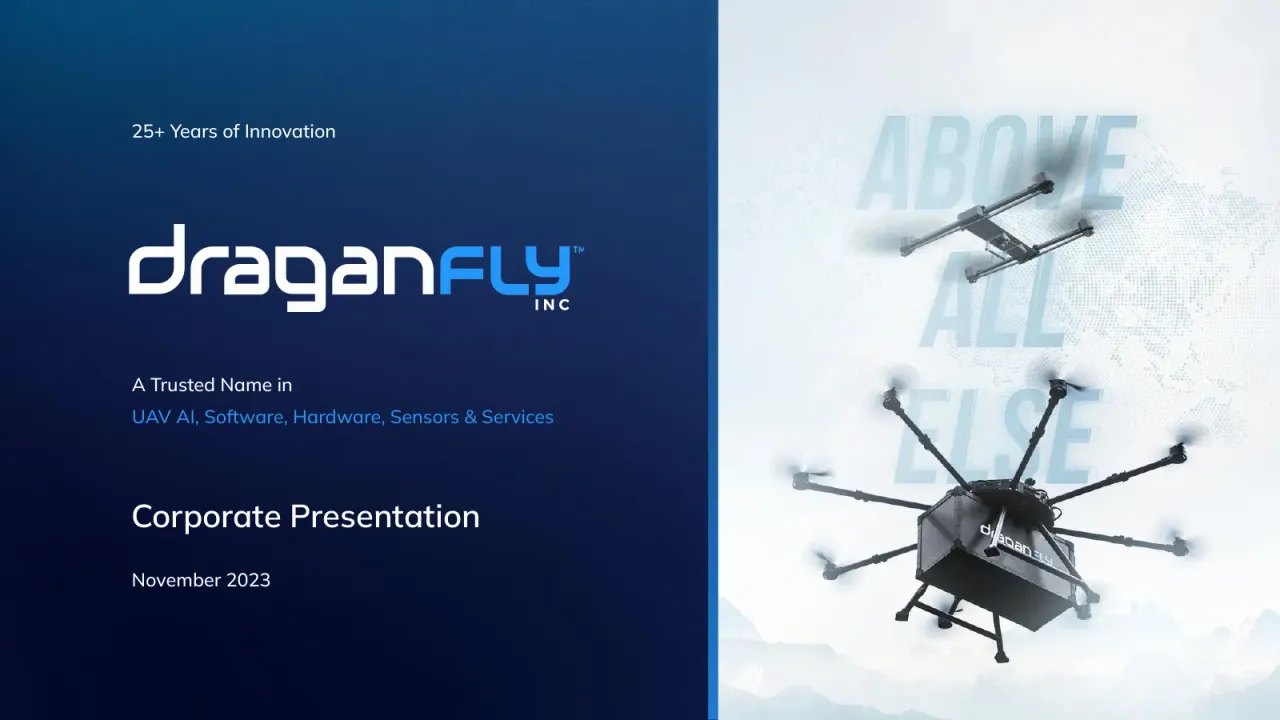
7:49 This is what's won the day in the Ukraine theater. This seems to be what we'll be pushing forward on the agenda in the other theaters as well, proven by data and proven by actually what we've seen happen in the Ukraine, where, again, Dragonflies had the fortunate opportunity to be very active. Just taking a quick look at our products here. We've got our heavy lift drone. This is about a nine-foot across drone, carries 70 pounds. It's got a 50-minute operational flight time. It can be used for multiple types of operations, whether it's sensor, ISR, delivery. Even in the commercial space, this is being used in wildfire type of situations to carry in equipment, to carry in chainsaws, as is the 3XL to the right there. Now, this last quarter, we did introduce the 3XL hybrid.
8:43 We've got incredible demand on this hybrid. So basically what happened is, you know, we built the 3XL, and our customers, particularly our military pipeline, came back and said, we need this drone, but we need it in a format that can fly for three-plus hours. and so we designed, along with a partner, a 70cc engine that integrates onto the 3XL and can provide up to three-hour flight times with an additional four kilograms. That's just under nine pounds of payload. So it's got lots of sensor capability. It's got lots of payload and ordinance capability still at that weight. It can actually go longer than that if you make the payload gasoline as well. So you could fly this thing for eight-plus hours.
9:28 So it's potentially everything from a loitering munition to a very sophisticated ISR platform. The precision drop-down WIT system, we introduced that in Q2. We now see orders happening in Q3 for it and pushing into Q4. This has got lots of applications, both commercial and military. Right below that is a quick-release delivery box. Greenberg. Important to note on this box is really the innovations around this box that allow for a number of other military applications to happen, but this is built on top of the medical delivery platform that we introduced into the market about a year and a half ago. The Starling X2 drone is getting terrific traction. There are a number of pre-orders coming in. We have not officially and Paul Mullen.
10:33 really is in a category by itself. It's not that small type of ISR drone. It's a very competitive market. Not that we don't make those on our workbenches, but on our production line, you know, this is the area that we're focusing on a bit more category two-ish and up and above between this and the heavy lift drone, you know, to be able to provide longer battery lives, multiple different sensors. We've got dozens and dozens and dozens of different integrations that are built For this drone, it's really that multipurpose drone that can be used for anything from ISR through to delivery of any type of, you know, almost imaginable payload that you can think through. And it's, you know, it's really just a big flying battery. And that's really, you know, everything ends and begins and ends with your design of the battery. So, you know, lots of other product initiatives that are happening. They're all customer driven.
11:22 But this platform is really what's launching us right now. Some operational highlights for the last quarter. We secured the first defense orders for the Commander 3XL with the U.S. military, and it's being utilized to enhance mission success in particular in GPS-denied environments. Mullen, and Paul Mullen. at our training center going through testing and preparing for the specs on production. We were also selected by a state geological survey.
12:16 Now, this is important on lots of reasons because that geological survey is a heavy lift in terms of the battery requirement and the sensors that they are using. and it is helping standardize this drone for this type of work across the other state geological survey organizations. Now, again, in order to do this, you have to be an NDAA compliant Greenberg, and Paul Sun. and because we have that proven track record.
13:15 That said, we are working diligently as it relates to green UAS and expect those types of certifications to follow as well. We had a very significant sale this last quarter into the Department of Corrections, and as many people would know, the corrections market for the drone industry is significant. We do believe that this is probably the largest sale of equipment into the corrections industry to date. And our pipeline, though it's not represented yet in our order book, our pipeline is very, very robust in the corrections market. And that would be both drone and counter drone technology, as well as our vital intelligence technology, which provides health monitoring simply through the camera for prison populations and intake protocol.
14:04 We also, this last quarter, went to work for the Canadian governments, in particular a provincial government that had over 300 wildfires raging at one particular time. And so we've signed a multi-year contract with that province where we're providing crews and our drones in order to provide visual oversight, hot spotting, Mullen, Paul Mullen, Paul Sun. A leader in the energy research industry has standardized, an association has also standardized on the Commander 3XL drone, and this is really important because this particular customer is responsible for making the recommendation of how they inspect Greenberg, and Paul Mullen.
15:44 A couple of, or the last few operational highlights that I'll just mention is certainly the unveiling of our Commander 3XL hybrid. This is the first time we've gone into the gas engine business. It's not the first gas engine drill that we've made, but in terms of doing it at scale, this is the first time that we've done it, and we've really, I think, nailed this particular product. and, again, the pipeline, not quite yet the order broke yet, but the order broke significant, but that pipeline is much bigger than we expected on this thing. The other thing I wanted to mention here is we had our first customer, what we call the Dragonflyer experience, so our first user event or our first customer event at our joint air center down in Texas.
16:29 And that joint air center has become a real strategic differentiator for us. It's allowing us to bring in multiple groups and give them time on the stick, give them time with the software, run use case scenarios, do everything from landmine detection right through to hostage situation, right through to combat scenario, right through to policing scenarios, mapping, survey, energy inspection. It is really a differentiator for us and anything of size, we're actually pushing Greenberg, and Paul Sun. So we look forward to having a very, very busy year at the Joint Energy Center in Texas. But I can't stress enough the new manufacturing plants. I was asked a question today, when are we really going to see this industry scale and who is scaling?
17:42 in the industry. And we've talked about a number of companies who have some fantastic products, but the fact is nobody yet in North America has scaled. And it's got nothing to do with – the demand signals are all there. There's no question about it. The issue is that the manufacturing base has still been so young and immature that it has not been able to be at the point of where it can commit to and guarantee – The demand signal that is coming. So you don't get a government customer that comes up and says, hey, we want 100 or 200 or 500 of these things. Can you produce them? Anybody can say yes, but the next thing they'll do is they will go and they will check out your facilities, check out your infrastructure, your processes, and ensure that you can produce 500 in that next month or two.
18:27 And if you don't have that capacity, you don't get the order, no matter how good your equipment is. So right now, the industry is all about who can produce. and so I really want to stress again just how impressed I am with the team that have put the new plants together, where we stand on them and the capacity that we're now able to meet. On that note, I'm going to turn it over to Paul Sun, our CFO, to review the financials.
18:52 Paul? Yeah, thanks, Ken. Thanks, everyone, for joining. Yeah, here's a quick snapshot for Q3. As Ken mentioned at the outset, Q3 revenue did represent our best Q3 to date. Revenue for the third quarter was up 14% to $2.1 million, up from $1.8 million in the third quarter of last year. Third quarter revenue comprised of $1.65 million from product sales, with balance coming from drone services. And the increase in revenue is due primarily to higher product sales versus a year ago. Gross profit, Cam mentioned 895, actually would have been a bit higher at 903, excluding a small one-time cash write-down of inventory. Gross margin as a percentage of revenue was 42% and would have been a little bit higher than that, 42.2 this quarter, up 44.1% from Q3 of last year.
19:48 The increase in gross margin as a percentage was primarily a result of sale that was using inventory that had previously been written off, which made the margin higher. Total comprehensive loss for the quarter was $5.5 million compared to a comprehensive loss of $5 million in the same quarter last year. This quarter includes a non-cash change comprised of a small write-down of $8.6 thousand of inventory. and an impairment of notes receivable of 105,000 and would otherwise be a comprehensive loss of 5.4 million. In Q3 of 2022, there was a loss that included a gain in fair value of derivative liability of 305,000 and would otherwise have been a loss of 5.3 million. So as a result, the year-over-year change in loss was minimal and mostly driven by the benefit of an FX translation from last year, as SG&A expenses this year was down this quarter year-over-year.
20:50 If you can go to the next slide on slide 10. So yeah, we just went through year-over-year changes. So now we looked at quarter-over-quarter. Again, for Q3, revenue was 2.1 million, increased by 12.6%. Greenberg, Paul Sun, So on an adjusted basis, gross margin would have been up 71.5% quarter over quarter. The increase is primarily due to sales that used previously written off inventory, as we just mentioned.
21:44 Total comprehensive loss, again, for Q3 was 5.5 compared to a comprehensive loss of 6.9 million in Q2 of this year. and again, we'll recall that there was a small non-cash write-down of inventory in Q3 and a write-down of notes receivable. So if we excluded that, loss would have been 5.4. While in Q2, we had a write-down of inventory of 122,000. So if we excluded that, so it's a fair comp, Q2's loss would have been 6.8. So our loss this quarter was quite a bit better quarter over quarter, primarily due to higher revenues and lower operating costs. And then on the next slide, looking at our balance sheet, you can see our total assets decreased from $14.6 million at the end of 2022 to $9.1 million, which was largely due to the use of cash.
22:37 Working capital surplus at the end of this quarter was $2.7 million versus $10 at the end of 2022. And you can see we continue to have minimal debt. Mullen. Our company's cash balance was at $2.5 million compared to $7.8 million compared to December 31 of last year. And as Ken mentioned at the outset, we did complete financing for U.S. $3.5 million. And with that, I'll pass it back to you, Ken.
23:09 Thank you, Paul. Scott, I'll turn it over to you, if that's okay. Okay.
23:15 Yeah, thanks. We have had a, as is kind of typical for us, we get a bunch of questions that come in prior to this. And so we have a number of questions here. We'll try to get through as many of them as we can. Of course, Cam has already answered, I think, several of them, as has Paul, with regards to the numbers and the results and so forth. So, but there's a few here that are different. Cam, we'll start with you. What are new areas of that we're seeing most opportunities and kind of large opportunities in the pipeline. Where did that come from? Is it within corrections, facilities, energy, scanning? Just give us a little color maybe on some of the new opportunities that we haven't seen in the past.
23:54 Yeah, so I think the thing to note is that most of the opportunities are coming from government, one form or the other. So we certainly have a nice flow of inbound commercial that are working through the system that we've obviously closed a few of them. But if we look at the system's Mullen, Paul Sun, and from that it's lots of agency work and the vast majority of it now is military work. So whether it's, you know, Airborne or Army or Air Force or Marines or like all of those different groups.
24:49 And they all have sizable orders. They really like utilizing the air center that we have. And yeah, that's it's, you know, and it's not not uncommon to history where we see that the military adoption really set the tone and build the use case for what then also that comes in the commercial sector as well.
25:10 Okay. Can you provide a little bit of an update on the production facility in Saskatoon? You did talk about it, but maybe a little more color. What's the capacity, supply chain issues that have come up in the past? Maybe a little more commentary on some of those issues.
25:24 Yeah. So, you know, I think Paul Mullen and team have done an excellent job in terms of the design of the product right from the ground up from years, you know, a few years ago when we started working through our plan. and around the design that we had to have so that we ensure that we weren't going to be in a situation where we were overly dependent on supply chain, that we didn't have some sort of management influence or swappable equipment or processes too. So with the advent of the new plant in Saskatoon in particular, we've now even eliminated that more because of the actual manufacturing additional capabilities that we've built in there. So, you know, our plants organically should be able to do $45 million a year worth of production.
26:11 And beyond that, we can push everything up to contract engineering. You need your initial couple of plants at least to be able to do those types of numbers and get your certifications and your ISOs and and others, and build your prototypes and get your initial production runs off before you can be in a position to put it out to contract engineering. So we feel we're at that spot now where we can scale. And at least me personally, I have confidence that we'll be running at full capacity this coming year.
26:42 Any more news or updates on Ukraine? Is it still a focus? Hasn't been a whole lot in the last little bit. Where do you see the next three to six months look like, both from a UAV standpoint and perhaps how Dragonfly fits into the mix?
26:56 Yeah, so initially we were quite focused on humanitarian efforts and very pleased to do that. As that conflict has matured, the type of drone that is in theatre there has also matured significantly. So a drone that we would have put into that environment within the first few months or even six months of that scenario. It wouldn't last 10 minutes there now. I mean, it's just the level of sophistication around jamming and radio frequency skipping and GPS-denied environments and such like that. So, you know, I think Ukraine potentially in terms of a news factor has been overshadowed as of recent because of the unfortunate events in the Middle East. But the demand for drones is actually increasing.
27:44 And the amount of people that have a level of sophistication Mullen, and Paul Sun. So that is ISR as well as other potential combat scenarios is really a big appeal for that market. So we're very active. We're a little quieter than we have been over there for probably some good reasons. But that is still the biggest immediate drone market in the world that we're actively engaged in.
28:38 Any plans on reducing cost expenses going forward?
28:41 Yeah, absolutely. We actually have gone through a cost reduction exercise. It started a bit last quarter. We saw that in the numbers. We were able to implement that on many levels here very recently. And a big part of why we were able to do that, I believe, without losing any operational efficiency, is because we have very clear visibility with our order book now. So let's talk about a year ago. A year ago, there are 15 markets or 15 protocols has the greatest opportunity, which is regulatory, has regulatory impact, et cetera, et cetera. And so you're moving through those.
29:28 At the same time, we're building out plant capacity and trying to be very careful about where we place the specifics of that plant capacity in terms of resources because we're not sure exactly which one. Eventually, five years from now, these will all have popped and been incredible markets. But, you know, as you're working through the startup phase and through the scale phase, Mullen, and We have a national judgment here that this cost is okay to let go right now because the opportunity over here doesn't cost us by not going after it a bit more aggressively.
30:19 So we're able to measure opportunity costs now and be more focused in the approach that we have in the very specific markets that we're going after.
30:28 A few more here for sure, a few more good ones actually. Comment on current business with Windfall. We mentioned it on the last earnings call. Things are moving up ahead. Any updates there? What does that look like? Obviously, we're not giving guidance here, but maybe a couple of thoughts or comments on some of the downstream stuff, particularly within the mining sector that we do with Windfall Geotech.
30:52 Yeah, we're absolutely committed and understand clearly that we are an important player in the data world. And in fact, I would suggest that over time, Dragonfly will be a data company. I mean, we'll always be known as a drone company. Our advantage being is that we can customize drones and sensors in order to collect data for our customers that maybe others can't. Smith, which is really the strategic differentiator for our customer. Again, whether that's a commercial, an energy, a government, a military, it's all about, in many respects, the quality of that data. And so because of our integrated approach and capabilities, that is a major strategic differentiator for us going forward. So mining is one of those first areas that allows us to collect data and provide it back to the customer that other people necessarily haven't been able to collect. So I'm not at liberty right now to speak specifically about windfall, but I can say that it is a very robust market and it is an absolute focus for us in the commercial market, mining in particular and mining data.
32:02 It will be a template for how data is collected and used and how AI is employed into other markets. Mining will be that way. Windfall's got an incredible platform that we're building on and again, where last quarter I could have talked about an order book. Excuse me, last quarter I could have talked about a pipeline with windfall. Next quarter we'll be able to talk about an order book. So we're really excited about what's happening there.
32:31 When Dragonfly goes to drone conferences and UAV shows and things like that, how do you see the competitive mix between Dragonfly and some of the other drone companies? Where do we see that the company fits into this? What are some of the other things that other companies are doing that Dragonfly might want to emanate in the future, copy in the future? Maybe give a little color and context in terms of how we fit into the market.
32:58 Yeah, there's incredible, incredible creativity and brainpower in this space. And I never want to profess we're even closest to the smartest folks out there. Every time I go to a show or I get to meet, you know, other folks in the drone space, it's just like, wow, where did you come up with that? And how did you think about that? You know, like really, really stuff that just like grabs you and just goes, it's really impressive. I think some of the differentiator in particular around dragonfly having been around so long is that the objects that we chase are customer driven and so there's a lot of shiny objects that we don't go after and because we know that they're not going to have a production capacity either in terms of being able to be produced or have a demand signal where it might be the coolest thing in the world but it might be a Greenberg, Paul Sun that our drone capability was minimal. And certainly compared to what it is today, it was.
34:09 But we were still in the drone business producing drones where no other North American manufacturer to speak of was there. But we were doing contract engineering for the military contractors. We were doing really interesting projects in academia and getting paid for it. So we've been able to move with the market. And now what we see is that the market is ready to scale and have production. And I think that we're meeting that right there where it's at. I also think that we're very focused on utility-type drones as opposed to, one, the coolest, latest thing, or kind of like the smaller backpack-type drone. I think that's a very competitive market. We do build those off of our workbenches but off our production line.
34:56 That's a pretty tough low-margin business to be in unless you've got something really strategic. And we think we do, and some of that will happen in time, but the demand signal is just not quite there yet.
35:10 There's been a number of other drone companies that have closed down. We keep hearing reports about that in the market. Are we getting to consolidation? Where does Dragonfly fit into that mix? Are we looking at other kind of opportunities for companies that have wound down, closed down, selling technology? What does that look like? And I think this is the last question, by the way, so go ahead and answer that.
35:34 Yeah, you know, walking the floor at the last CUAB show, it seemed to be kind of like a reoccurring theme. It was like, you know, half these companies aren't going to be here next year type of thing. So, yeah, there's definitely consolidation in the industry. The commercial market has taken longer to adopt. and get there again for about the fourth or fifth time in the cycle. And the difference here is though, is that the regulations are much further along and we are seeing commercial adoption. The second and the bigger difference that's come to the forefront is the fact that the military market is now not just prevalent, it's just overwhelming. The challenge for companies that generally, not all, but generally haven't been around for a long time or gone through a bunch of the rigor that's required in order to sell into government-type customers, military in particular, is that it doesn't matter if you've got the greatest whiz bang. If you can't get to production, if you can't – I mean sizable production and all those types of things, it's just not a viable product for those types of customers.
36:40 We're going to see consolidation. We're very focused on organic growth right now. Our hands are full. We don't need to do an acquisition. We don't need to bolster sale. We just need to execute on what's in front of us right now, and we'll Greenberg, and I think likely there's a couple of others out there that might be in that same position. I'm speculating a little bit, but I can speak with confidence that that's where we're going. Not that we're opposed to acquisitions at all, but given where some of the valuations are right now and given where the market's going and given what we need to do organically just to meet demand, we're probably not looking at acquisitions at the time right now. That said, something's going to come up in two quarters from now. We're going to an
37:30 Okay, well, that's the list of questions. I'll send it back to you to adjourn the meeting, wrap it up, and then that'll be it for this shareholder call.
37:41 Thank you everybody for taking the time. We went this time without taking the live questions as we got a bunch of feedback that it seemed quite distracting, actually. So we really encourage, I love the live question piece of it. So we'll look to see some feedback and if we revert back to that or not next time. But by all means, don't be afraid to reach out to us. Roli's always available. The rest of the executive will certainly do their best to respond quickly as well. First and foremost, I'd like to thank our employees for sticking with us. It's been a real grind, and we've gone through some cost reduction stuff as well. at the same time that we're scaling the business. So thank you for your time, trust, and patience to our customers. You know, our business is all about you, and so thanks for your time, trust, and patience, and our shareholders will look to work hard to create shareholder value for you.
38:33 So thank you for your time today, and we look forward to a great quarter coming up.
Follow Draganfly Inc into a list and get an email when it puts out news.
Internal Investor Relations Representative
CEO and President
CFO
Lead Director