Bill Slater
Chief Investor Relations Officer
Replay available
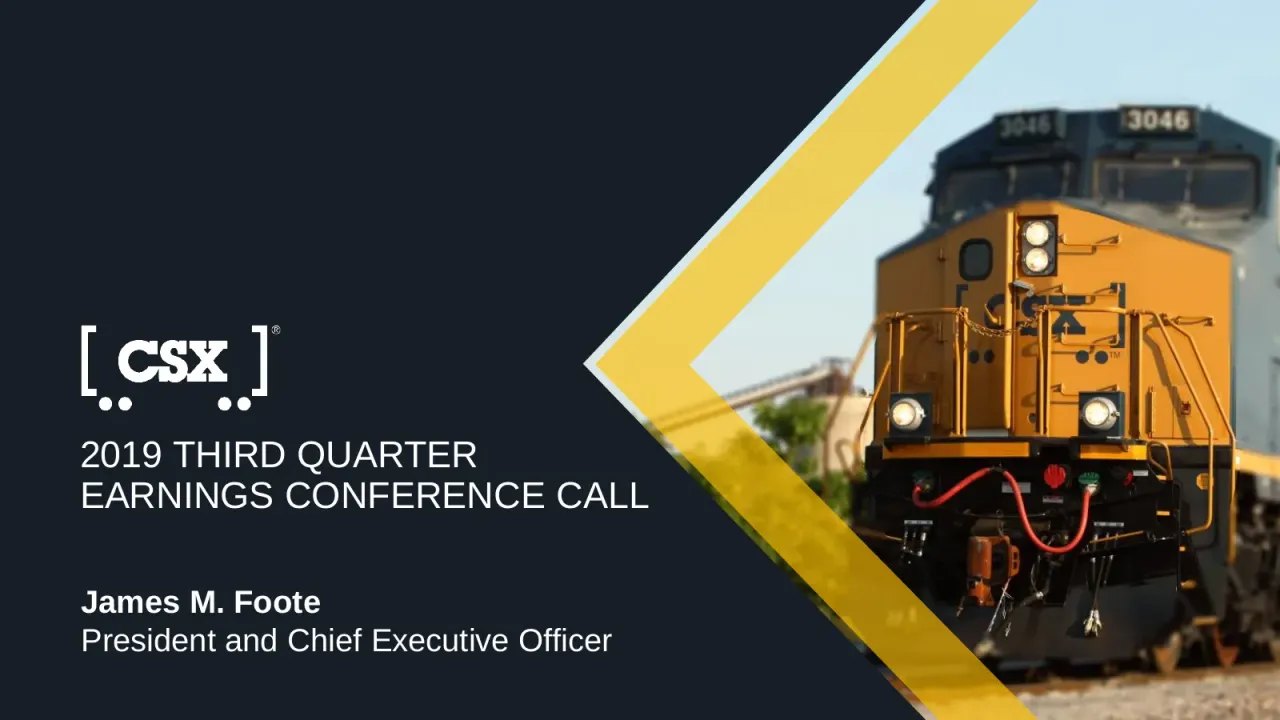
CSX (NASDAQ:CSX) Q3 2019 earnings call, held 2019-10-16. Watch the replay and read the transcript on 6ix.
On 6ix: 6ix.com/event/csx-corporation-csx-q3-2019-earnings-call
Automated transcript · Written by software from the replay's audio. It can mishear names and figures; the replay is the record.
0:01 Good afternoon, ladies and gentlemen, and welcome to the CSX Corporation third quarter 2019 earnings call. As a reminder, today's call is being recorded. During this call, all participants will be in a listen-only mode. Following the presentation, we will be conducting a question and answer session. To ask a question, press star 1. For opening remarks and introduction, I would like to turn the call over to Mr. Bill Slater, Chief Investor Relations Officer for CSX Corporation.
0:36 Thank you and good afternoon, everyone. Joining me on today's call is Jim Foote, President and Chief Executive Officer, Mark Wallace, Executive Vice President of Sales and Marketing, Kevin Boone, Chief Financial Officer, and Jamie Boychuk, Executive Vice President of Operations. On slide two is our forward-looking disclosure, followed by our non-GAAP disclosure on slide three. With that, it is my pleasure to introduce President and Chief Executive Officer Jim Foote.
1:02 Good afternoon and thank you, Bill. Before we begin the presentation, I'd like to first congratulate the over 21,000 strong CSX workforce for a great job in delivering a really good quarter. They again showed that they are the safest, most customer-focused, and best operators in the industry. Breaking their own record with an all-time low operating ratio for a U.S. Class 1 railroad of 56.8% was no easy task. So hats off to all of them. I'd also like to mention several recent leadership announcements, beginning with the appointment of Kevin Boone to Chief Financial Officer and Jamie Boychuk to Executive Vice President of Operations. Both Kevin and Jamie are skilled leaders who have played big roles in this company's transformation and are excellent additions to our executive team.
2:00 I'm very pleased that Ed Harris will remain a key part of the executive team as we drive hard to get even better. CSX is lucky to have both Ed and Jamie, two of the best operators in our business. We also announced changes in sales and marketing as Mark builds a new team that is intensely focused on identifying and capitalizing on opportunities to grow the top line. Adam Longson recently joined as Vice President of Energy. Adam's deep knowledge of the commodity markets is a valuable addition. The recent appointments of Farouk Bezar as Senior Vice President of Marketing and Arthur Adams as Vice President Merchandise Sales demonstrate our commitment to working with our merchandise customers to find new and creative ways to first add value to our customers, which will then drive long-term profitable growth.
3:01 CSX's service has never been this good. Now is the time to harvest the opportunities. With that, let's turn to the presentation beginning with slide five and our financial results. The third quarter results are straightforward with only a few unique items, which Kevin will point out. Third quarter EPS increased 3% to $1.08 versus last year's figure of $1.05. Our third quarter operating ratio improved by 190 basis points to, as I said, a new record of 56.8. Turning to slide six, our improved service is driving industry-leading merchandise volumes as customers continue to trust CSX with a greater share of their freight.
3:49 Despite the softer industrial economy, merchandise volumes held flat. However, the strength of merchandise was offset by declines in coal, intermodal, and other revenue, resulting in a 5% decline in total revenue to $3 billion. I'm encouraged by the performance of a merchandise franchise. Had it not been for the Philadelphia refinery explosion at the end of June, merchandise volumes would have been up approximately 2% for the quarter versus declining industry volumes. In total, merchandise revenue increased 1% on flat volumes as pricing gains were partially offset by mixed headwinds.
4:35 Intermodal revenue declined 11% on 9% lower volumes. Much of this associated with the impact of lane rationalizations implemented last fall and early this year. We have now lapped the first round of lane rationalizations and will lap the final 5% of rationalizations at the beginning of next year. Coal revenue decreased 12% on 9% lower volumes, with declines in both domestic and export markets due to lower natural gas prices and weaker export demand and lower benchmark prices. Finally, the decrease in other revenues was primarily driven by lower storage revenue at intermodal facilities and demurrage charges.
5:29 Moving on to slide seven, I am pleased with the continued positive momentum in our safety performance. Our FRA personal injury rate was again the best in the industry, and we further improved upon last quarter's record FRA train accident results to set new company records for both fewest train accidents and the lowest accident rate. We still have opportunities to improve. Technologies such as the increased use of automated track inspection cars and drones are helping to identify small problems before they become big issues and are also improving our day-to-day execution across the network.
6:16 We constantly strive to make the railroad as safe as it can be. Moving to slide eight, let's quickly review our operating performance. Velocity improved both sequentially and year-over-year. Dwell increased slightly for the quarter, but we see opportunities to improve this metric going forward. We also set another fuel efficiency record. CSX is the only U.S. Class I railroad to operate below one gallon of fuel per thousand gross ton miles. Not only does this reduce cost, but the environmental impact of this is significant. This has been partially enabled by the increased use of distributed power, which has been a focus of the operating team. This technology, which CSX had historically not deployed, allows us to disperse locomotives throughout the train, which improves fuel efficiency and enhances safety and reliability by reducing train separations.
7:22 For the quarter, we averaged 87 distributed power trains per day, but we frequently operate with over 100. On slide nine, most importantly, as we focus on running a better railroad, we are creating better service for our customers. We continue to improve trip plan compliance figures for both carload and intermodal customers, with 75% of merchandise cars and 94% of intermodal containers hitting their hourly trip plan targets, both new quarterly records. We're now providing individualized, real-time trip plan tracking to our intermodal customers, and we'll be rolling that information out to merchandise customers in the fourth quarter. These new tools, again, differentiate CFX from other rails, and our customers are very excited about the tool.
8:21 I'll now hand it over to Kevin, who will take you through the financials.
8:26 Thank you, Jim. Before I get started, I want to thank Jim and the board for their support and confidence. I'm excited to continue to work with this great team. Turning to slide 11, I'll walk you through the highlights of the summary income statement. As Jim mentioned, total revenue was down 5% in the third quarter. As the impact of intermodal and coal headwinds, as well as lower fuel recoveries and other revenue, more than offset the benefit of pricing gains across nearly all markets. Expenses declined 8% year over year, really a great performance. The team continues to drive efficiencies across all areas of our business. Overall, third quarter expense results reflect the company's sustained operating improvements and significant progress in labor and asset efficiency.
9:12 Before running through the expense line items, I want to note a couple of unique items in the quarter, including a $22 million impairment related to an intermodal terminal sale agreement and a net headwind of $15 million related to state fuel tax matters. These two items, totaling $37 million, impacted MS&O and fuel expense respectively. Real estate saw $65 million in gains this quarter, an increase of $12 million year over year. We continue to see a pipeline of real estate opportunities, though the impact of these transactions will remain uneven from quarter to quarter and year to year. Labor and fringe expenses were 8% lower, with average headcount down 6%.
9:58 Our ongoing refinement of the operating plan continues to drive savings from fewer crew starts, enabling a 9% year-over-year reduction in active train and engine employee base and driving a 6% improvement in crew utilization, as measured by gross ton miles per active train and engine employee. T&E overtime and relief starts are also down 12% and 77%, respectively, as we operate more efficiently. As I mentioned on the second quarter call, Overtime is a strong focus area across all operating departments. Through workforce efficiency and management execution, we reduced overtime across all operating departments by nearly 14% sequentially. Additionally, the active locomotive count was down 11% year-over-year in the quarter.
10:45 The smaller fleet combined with fewer cars online and freight car repair efficiencies helped drive an 8% year-over-year reduction in our mechanical workforce. Also, while velocity, on-time originations, and on-time arrivals improve sequentially quarter over quarter, Jamie and the operating team are confident there remains additional opportunity to continue to improve train speed and dwell, which further deliver cost savings. MS&O expense improved 12% or $59 million versus the prior year, driven by efficiency and operations support costs and savings related to lower volumes. We continue to see efficiencies attributed to lower active locomotive count, driving savings in locomotive materials, and maintenance costs.
11:34 Brake car repair costs were also lower, driven by significantly fewer train accidents in the quarter. In addition, we are intensely focused on driving engineering efficiency. This led to significant savings in the third quarter on materials, travel, vehicles, and outside services. Our continued train plan refinements also drove savings in crew travel and repositioning expenses, which were down 10% year-over-year. Fuel expense was down $45 million, or 17% year-over-year in this quarter. These savings were driven by a 13% decrease in the per gallon price, record efficiency, and lower volume. Our focus on utilization of distributed power and energy management software combined with train handling rules compliance drove another quarter of record fuel efficiency.
12:29 As I noted earlier, there was also a unique item related to state fuel tax matters that had a $15 million unfavorable impact in the quarter. Looking at other expenses, depreciation increased 1% due to the impact of larger net asset base. Going forward, we expect a sequential increase of approximately $15 million to depreciation in the fourth quarter. mainly related to group life depreciation study on equipment assets that occurs every three years. Losses associated with previous asset sales are amortized over the life of the remaining assets. This obviously has no impact to free cash flow. Equipment rents expense increased 17% as the impact of inflation and other items more than offset the benefit of lower volume related costs and efficiency gains.
13:18 As we reduce dwell and improve days per load, We should see further improvement. Equity earnings increased $3 million in the quarter due to higher net earnings at our affiliates. Looking below the line, interest expense increased primarily due to higher average debt balances. Income tax expense increased $13 million primarily due to cycling of 2018 benefits related to the settling of state tax matters. Absent unique items We would expect an effective tax rate of approximately 24.5% going forward. Closing out the P&L, as Jim highlighted in his opening remarks, TSX delivered nearly $1.3 billion of operating income in the third quarter, in line with 2018, despite a weaker volume environment.
14:08 We also delivered a record operating ratio of 58.6%, 56.8%, and improvement of 190 basis points. and earnings per share $1.08 representing a 3% improvement over third quarter 2018. Turning to the cash side of the equation on slide 12, we continue to invest in our core track infrastructure to provide safe and reliable train operations. Year to date, capital investment is down 49 million or 4% year over year. Overall, our reduced asset intensity has enabled us to sustain lower levels of capital investment without compromising safety or reliability. The level of PTC spending has also come down significantly in the last two years.
14:54 Free cash flow remains a focus for this team. Generating operating improvements while driving better capital efficiency has produced differentiated free cash flow growth. Growth in CSX's core operating cash flow generation including improvements in working capital drove a 15% increase in adjusted free cash flow to 2.8 billion through the third quarter. Year to date, we have returned nearly 3.4 billion to shareholders, including approximately 2.8 billion in buybacks and 600 million in dividends. Dividend payments in the quarter reflect the 9% increase from 22 cents to 24 cents per share we announced in February this year, net of the lower share count. With that, let me turn it back to Jim for his closing remarks.
15:41 Great. Thank you, Kevin. Turning to slide 14, let's wrap this up by reviewing our outlook for the year. Brake demand is generally in line with the expectations set out at the end of last quarter when we adjusted our forecast to reflect what we felt was a realistic view of softer underlying economic activity. Nothing in the industrial economy has really changed since then. Despite the swing from a plus 1% to 2% growth environment to a down 1% to 2% environment, we are maintaining our full-year operating ratio guidance of below 60%. And we are still on course for record operating cash flow.
16:26 These are impressive accomplishments. We have fundamentally changed CSX over the last two years. Not just in how the company operates, but also the way we approach our business and our customers. We are encouraged by our customers' positive response to our improved service and are working tirelessly to find innovative new ways to better serve their needs. Despite the significant progress made to date, there are still meaningful opportunities to operate more efficiently and reliably as we move towards our goal of being the best-run railroad in North America. Thank you, and I'll turn it back to Bill.
17:09 Thank you, Jim. In the interest of time, I would ask everyone limit themselves to one question and one follow-up only if necessary. With that, we will now take questions. Thank you. We will now be conducting a question-and-answer session, and our first questions come from Chris Weatherby with City Research. Your line is open.
17:32 Oh great, thanks, good afternoon guys. Maybe if we could start on sort of the OR, obviously significant progress here yet again in spite of meaningful volume declines. I guess when you think about sort of the outlook, maybe if we can go beyond sort of the near term target of sub 60 and the efficiency and other opportunities that you have highlighted are still on the table, How can we start thinking about things, I guess maybe putting your hat on for 2020 and thinking about what the world may look like? Is this going to be more of a return to volume and maybe a little bit less operating ratio when we think about 2020, or maybe a little bit more operating ratio? Just want to get a sense of maybe how you're thinking about sort of guiding the business into 2020, which hopefully has a more stable volume outlook.
18:18 Great, Chris. Well, first of all, we're not going to get into 2020 just yet. We'll wrap up the fourth quarter here, and then we'll start trying to give guidance as to what 2020 is going to look like. I guess only just two general comments, and then either maybe Kevin or Mark want to jump in with some additional commentary, but just two general comments. It's difficult, still very, very difficult to gauge where the overall economy is going. You know, I think we feel very confident for the fourth quarter, you know, as we called what we thought was a pretty soft outlook going forward.
19:10 And so we're going to have to wait to see to start figuring out what the revenue is going to look like next year. But again, generally speaking, our plan is to grow this business. And to the extent that we can grow this business, we're going to do it. And then secondly, our plan is to run this company as efficiently as we possibly can, and we're going to continue to focus on that. So this is not a – they're not mutually exclusive. We're going to do both at the same time, and that's what we've been showing we can do this year.
19:47 Okay, that's very helpful, and if you'll allow me a quick follow-up along those lines. You've made some changes within some of the sales positions of the business, and it seems like merchandise is an interesting, potentially big opportunity for you as you move forward. Can you talk a little bit about the opportunities that you see, maybe put some sizing around some of them as we move forward, 2020 and beyond, just kind of get a sense of what you see as the opportunity for CSX and merchandise?
20:14 Sure, Chris. Hey, it's Mark. Listen, this is not something this is new. We've been talking about it for quite some time now. As we look at the future of this business, we see a huge opportunity in our merchandise segment, two-thirds of our business. I think going back a quarter or two when we initially put Kevin as the head of marketing, we highlighted the fact that We were going to grow our marketing department because traditionally CSX did not have one, a traditional marketing department. Kevin did a great job in the short time that he was there of bringing in some people both externally and internally, looking at some things differently and focusing on growth. We've now, with these recent additions, moved Farouk over as Senior VP of Strategy into the head of marketing department, so he's going to carry on and and we've split out the sales and marketing roles from a lot of our directors.
21:14 Some people used to wear dual-hatted hats. Now we've got directors of sales and in Frook's group we've got directors of marketing. And so, you know, as Jim said in his opening remarks, an intense focus on the marketing sector, on the merchandise sector. Clearly, if we look at the size of the opportunity in the North American spend for transportation every year, There's a lot of truck volume out there, and we believe that by renewing our focus on the merchandise segment and looking for truck conversion opportunities, that we're going to go out there and capture that market share. So a huge focus for us going forward, and we're pretty excited by the work that's already been started.
21:58 Got it. Thanks very much for the time. I appreciate it. Thank you. And our next question comes from Allison Landry with Credit Suisse. Your line is open.
22:15 Allison Landry Thanks. Good afternoon. Good job on the OR during the quarter. I wanted to ask about the coal yields. They seem to have held up a little bit better sequentially than I would have expected given the export benchmarks. So maybe if you could talk about the mixed trends within the segment in the quarter and compare that to what you saw in the second quarter, and then if you could just maybe comment on how we should be thinking about Q4.
22:43 Yeah, let me highlight mixed, Allison. I always get the mixed questions, so let me address that overall, and we can get into coal if you want. But overall, we experienced a negative mix within most of our business segments this quarter. And as I've talked about many, many times, and as usual, you see within each business segment, and again in coal, there was always ups and downs between the commodities that hold different RPUs. And we'll continue to see these mixed issues quarter to quarter. And we don't manage the business to solve for how mixed falls in any given quarter. and we're focused on delivering long-term sustainable growth.
23:29 But clearly on the coal side, we did have negative mix on coal. A lot of that was a shorter-haul business to some utilities in the north. I think that was a phenomenon we saw in the second quarter and we also had some growth to some shorter-haul growth to Mobile. out of the mines in Alabama and less going export as the export volumes were impacted by the benchmarks. So as I said a lot of mixed issues going in overall in each of the commodities but again in coal just given the decline in some of the longer haul export and then we picked up some shorter haul utility business.
24:17 So that phenomenon continued.
24:21 Okay, perfect. And do you have any thoughts on Q4, just given the one-quarter look back in the benchmark for the export met?
24:30 Well, I'll tell you, Q3, I would say that export, the met side, which again is two-thirds of our export coal, the business was soft, but the global steel markets have continued to weaken with the industrial slowdown and some of the sourcing issues in Europe. have impacted, obviously, the benchmark prices. As you know, the majority of our contracts reprice quarterly. So in Q3, we were less impacted by price because the price of the export, the match benchmarks in Q2 were relatively strong. But as we move into Q4, and given where the benchmarks were in Q3 and where they are today of about $150, Clearly, there's going to be some RPU impact in Q4.
25:25 Perfect. Okay, thank you. The next question comes from Todd Wadewitz with UBS. Your line is open.
25:34 Yeah, good afternoon. It's Tom. I wanted to ask you on the overtime initiatives, Kevin, it sounds like you're getting a lot of traction on that pretty quickly, you know, which is great. Wanted to see if you could give us kind of a ballpark of You know, maybe on an annual basis, how large is the opportunity for cost savings from reduced overtime? Is it, you know, 50 million? Is it, you know, just some kind of a ballpark for that? And perhaps how much of that you would have captured on a run rate basis in the third quarter?
26:07 Yeah, we haven't gotten real specific, but it's not a single million digits. It's tens of millions of dollars that we execute across mechanical engineering and the T&E employees out in the field. So it's a large opportunity for us still going forward where we've just begun. And I'm sure Jamie can talk more to all the efforts that we've started probably in the late second quarter as we saw some of the volumes come down and we started to focus on this item.
26:34 Yeah, Tom, one of the obviously what we've really seen some good traction is on that engineering and mechanical side. We have seen some traction on the transportation end, but that's where our bigger opportunity is. And as the team spends time out in the field visiting locations and continuing to look for opportunities. That's one of the larger opportunities that we see out there still left on the table going forward.
26:58 But, Tom, going back to the magnitude of the size, I think, you know, previously I mentioned in many categories we're at 30% plus over time as a percent of straight time. So, you know, the opportunity is still pretty
27:10 significant there. Okay. Okay. And then I guess a related question to that, in the per worker comp and benefits in the quarter were a little bit lower than we expected, down about 2% year over year. Was that primarily a function of lower overtime? Was there something going on that, you know, incentive comp or something else? And, you know, is that something we should model in fourth quarter in terms of lower per worker costs?
27:40 No, I would say it was a combination. I think you got it right. You know, certainly overtime played a factor in that. You did see some, you know, slightly lower incentive comp year over year as well. We'll continue on a good trend here going forward.
27:58 Okay, great. Thanks for the time and, you know, good quarter.
28:01 Thanks, Tom.
28:02 Thank you. Thank you. comes from Ken Hexter, Bank of America, Merrill Lynch. Your line is open.
28:11 Hey, great. Good afternoon, and congrats on a solid operating ratio. Great to see. Jim, maybe just your thoughts on, you mentioned kind of nothing's changed in the outlook, but maybe get a little more specific if there's anything shifting, in particular coal, metals, fertilizer, taking a step down. Is there anything in the market that you look out that alters your view as you look out?
28:37 You know, all of the external metrics to try and get a sense for where the business is going have seemed to somewhat stabilize at this lower, softer numbers. My personal opinion is it took a while for them to get there. And if they're going to turn around, it's going to take a while for them to turn back up. And while there is some sense, more sense today of optimism than maybe there was 10 days ago, these metrics and these numbers are not going to turn around in a couple of weeks. So we see this kind of a slow growth environment throughout the quarter.
29:28 And as we get nearer to the end of the year, hopefully we can have a little more light shown on the pathway beyond the end of this year and we'll be in a better to opine on it.
29:42 I appreciate that. I guess for my follow-up then, since you're sticking with your sub-60 OR, are you somewhat indicating a step up in a horrid fourth quarter margin or any reason you're not taking it down just given the run rate for the three quarters is sub-58? Yet you're not going to a sub-59 or even at a 58. Are you indicating something is going to happen in the fourth quarter or just keeping a high number as an easy bogey?
30:13 Boy, when we were in New York a couple of hours, about 18 months ago, Kenny, when I said we were going to get to a 60 in 2020, I didn't hear you say, boy, that's an easy quest, Jim. So... Yeah, we're going to get to our target. We said we would beat our target a year early and clearly had not put in our plan this kind of softening in the overall economy, not only in the U.S., but globally impacting all of our business units here kind of at one time. So are we being cautious? No, I think we have the same realistic viewpoint of the economy today that we had three months ago when we told everybody we didn't see a hockey stick coming at the second half of the year in terms of growth.
31:16 We also have what is traditionally... The fourth quarter, from a seasonality perspective, we expect similar kinds of behavior on the cost side this year. So that's just, I think it's just a realistic assumption, as we always do. You know, we hope we do better than that. But putting it to say that we're going to have an annual operating ratio below 60% This year is a pretty good achievement in a difficult time.
31:55 I don't disagree. Just you're three quarters in. You're already at 58. So it just seemed like I didn't know if you were sending a signal that you expected a deterioration in fourth quarter beyond normal. But I appreciate the insight. Thanks, Jim. All right. The next question comes from Amit Mahotra with Deutsche Bank. Your line is open.
32:17 Thanks, Operator. By the way, congrats, Kevin and Jamie, on the new appointments. Well deserved. I wanted to ask a question about the operating ratio, shockingly, and just the company's ability to maintain or grow profits in a down-revenue environment, because this is supposed to be a business with theoretically high incrementals and decrementals. It's a capital-intensive business. So I'm just trying to understand how much runway you have on the cost and efficiency side because you decided to put that in extra this time on the forward-looking slide. And so I'm just trying to understand how much room there is on the cost and efficiency side that's going to allow you to continue to hold the line on profits or grow profits on a year-over-year basis in an environment where revenue continues to be challenging or down.
33:09 Well, just a clarification so I can answer the question correctly. I think our slide in terms of what we're talking about in terms of efficiency and operating ratio, it's the exact slide that we used three months ago, and I think that's the exact slide we used the quarter before that.
33:26 Well, unless I'm mistaken, I think you added significant remaining opportunities to further improve it. I mean, we're nitpicking here, but I think you added another bullet regarding efficiency use and service and efficiency further improvement there.
33:39 Well, like I said, we're always trying to get better, and we believe there's a lot of opportunity out there for us to continue to get better. It would be a hell of a lot easier to get to a better number with a little bit more robust economic environment. So we're going to continue to always always always focus on efficiency and running the railroad in the best way that we possibly can and we believe that there are many many opportunities out there for us to continue to do that and I don't think that's anything different than I've ever said before and comment in terms of Are there opportunities? Yeah, they might be a little more difficult to find, identify, and execute on. But there are always tons of opportunities out there for us to get better.
34:42 We've always believed that. We've always been optimistic and bold in our convictions of where we thought we could take the company. And I don't think anything's really changed.
34:54 So would you be, Jim, would you be, I'm just trying to understand this, and this is a follow-up to this question. As you look out over the next 12 months, and I know you're not talking about 2020, but just conceptually, given the opportunity you see on the cost side, could revenues, if revenues are flat to down next year, do you think you could see you're on your OR improvement in 2020?
35:12 Well, again, we'll give you a more solid view of that At the end of the quarter, aspirationally, do I think that this team can repeat the fantastic job they did this year with revenues? Again, as I said in my comments, we started the year thinking that revenues were going to be up, you know, as much as 2%. and now we're saying that revenues could be down as much as 2% and for us to have delivered this operating, you know, 56 something operating ratio was nothing short of amazing. Am I going to challenge this group and is this group going to accept the challenge to try to do the same thing again next year?
36:13 I certainly hope so but in terms of Putting it in the books and saying that that's our forecast, we're going to wait three months before we make that kind of bold statement.
36:26 That's very fair. My second question is just on the pricing environment. When I just look at revenue per RTM kind of adjusted for other income and ex-fuel, it continues to moderate. And I know it's not a perfect metric or proxy for pricing because there's a lot of stuff that goes into it, especially mixed. but can you just talk about kind of when we should see revenue per RTM, you know, what is that a proxy for and can we extrapolate that into the overall pricing environment just, you know, making it harder to get pricing in the volume environment? Any comments around that would be helpful.
37:02 Yeah, I mean, it's Mark. Listen, I won't repeat what I told Allison when I talked about the mix, but clearly that has a significant impact on the revenue per RTM. But let me address the pricing because I always get this question on price. Let me be crystal clear here. We're not sacrificing volume for price or price for volume. Within merchandise and intermodal, our same store sales pricing in Q3 was the strongest that we've seen in the past three years. On our contracts that come up for renewal in the quarter, we exceeded our same store sales pricing. and we're going to continue to price to the value of the business and price to the value of the service that we provide.
37:51 But again, you know, on RPU and revenue per RTM, you're always going to see these mix issues. But don't read into it that it's a pricing issue. We're still continuing to generate the best price for the value of our product.
38:07 Okay. That's very helpful. Thanks, guys, and congrats on the great results. Appreciate it. The next question comes from Brandon Ogulinski from Barclays. Your line is open.
38:20 Good afternoon, everyone, and congrats again to Kevin and Jamie. Well-deserved. So, Jim, maybe just to clarify that last line of questioning, I think, you know, some investors have gotten really focused on maybe more glossy, quote-unquote, PSR presentations at your competitors. And, you know, the Maybe the common thought here is that CSX really has nothing more to go on precision scheduled railroading. So maybe in that context, you know, you guys have headcount down roughly in line with attrition this year. I think you're sticking with that. I mean, should we be thinking that when we get back to a growth environment, there's still more to go on the cost side? Or can you scale into this new level of cost with a lot more growth? I guess, how can you help us on that line?
39:08 Well, yeah, we don't have good slogans, but we're working on fixing that whenever we can. What we're doing is, yeah, I mean, we're responding to a softer environment and looking for every opportunity we can where we don't impact service or safety. and what we're doing here is that we're building in an enormous amount of operating leverage into this organization so when the economy, not if, but when the economy begins to turn around and we begin to see a slight uptick and a better environment to work in, we're going to see the impacts of that leverage And we're not going to, you know, we have tons.
39:59 The way we run the company today has created a tremendous amount of potential growth opportunity for us on the capital side. One, because we've freed up a tremendous amount of capacity because of the way we run the railroad today. And we've said many times we could probably put 30% growth into the organization without adding any additional capital. and the same is true on the operating side. We've got capacity on our existing trains today where we could put a lot of growth on the railroad incrementally and not have to start adding bad expenses. And so both from a cash perspective and an operating perspective, I think we're well positioned to perform well in either direction, either in a soft environment or in a strong environment.
40:56 Appreciate it, Tim. I'll keep it to one.
40:59 Thank you. The next question is from Brian Ozenbeck with J.P. Morgan. Your line is open.
41:09 Hey, good evening. Thanks for taking the question. First one, just to follow up on the extra capacity theme, Mark, what are you thinking in terms of some of the bigger chunks of truck load conversion How have some of the larger shippers or maybe some of the industries received better service, better tools, increased visibility? What's your sense as to when you can start to make some of those conversions even at a smaller scale?
41:36 Brian, we're seeing it today. We're seeing it every day. I would say I'm blessed and my team is blessed. The work that Ed and Jamie and their teams have have done, you know, Jamie deserves to be sitting at this table today and the work that he's done over the last two and a half years to really give us the service product that my team now has the ability to go out and sell and we think, you know, tap into the truck conversion opportunities that this franchise has never been able to go after in the past is exciting. And so we're seeing those truck conversions today. We're seeing it across the board, all across our merchandise segments.
42:21 Large things to talk about right now, no, but we're seeing incremental volumes from existing customers. Dane and Dale, we're talking to customers who maybe used to ship by rail, but because of the poor service that they experienced over the last couple of decades, abandoned rail is a thought and have been using truck ever since. Those are the kinds of shippers that we're talking to. and we're penetrating those markets and that business and we're being successful. Listen, we're also on the technology side. As Jim mentioned in his opening, trip plan compliance is a huge, huge game changer for our customers. They now, and as we said, we rolled this out for Intermodal on October 1st and our merchandise customers will see trip plan compliance visibility December 1st on ship CSX. This is a game changer for them.
43:16 They will see every car that they ship on CSX in every lane and our performance against the trip plans. We rolled this out a couple of weeks ago at our customer engagement forum and I can tell you customers are excited. So we've got great visibility into their service. No other railroad is doing this. We're blessed with the great service that we've got. that the operating team has worked very hard to deliver to us. And so right now it's for us to go out and identify those opportunities and convert on them with the new team that I've put in place here over the past week.
43:55 Thanks, Mark. I appreciate all the details there. Kevin, maybe a quick housekeeping for you. The revenue line continues to come down for the reasons you mentioned on the merge and the storage. Is this the current run rate that you expect for the rest of this year? And just wondering As shippers sort of figure out what to do with the new operating models that are being rolled out through the U.S., do you think this stays, the merge in general, do you think it stays structurally higher as some shippers just use the storage as part of the cost of doing business, or do you think this eventually goes back to sort of where it was pre-PSR?
44:32 Yeah, I think, look, I think we told you we expected this to come down and it's kind of trended in that direction. In terms of the run rate going forward, somewhere between the second quarter run rate and the third quarter is probably where we land. So in that $110 to $120 million range is probably the new normal, unless something dramatically changes from here. I might let Mark talk to the additional opportunities, but look, I think we expected this. Without something meaningfully changing from here, probably at these same run rates.
45:11 Okay, thank you. The next question comes from Scott Group with Wolf Research. Your line is open. Hey, thanks. Afternoon, guys. So I want to ask the productivity question maybe a little bit more directly. Do you think you can do another mid-single digit reduction in headcount from here? And then does a 570R with revenue down five give you more confidence that Ultimately, you can run this business not next year, but longer term, closer to mid-50s OR if you're growing revenue.
45:50 Scott, this is Kevin. Look, I know that Focus has been in a headcount. I know we report headcount numbers every quarter. Labor represents roughly 35% of our cost base. There's a lot of other costs to go after as well. you know we're looking at those I think you saw great improvement in MSNO which is a huge cost line item for us there's other ways to reduce costs than pure headcount reductions or we talked about over time it's a huge huge category for us so we're getting there's a lot of other areas for us to go after than just simply headcount but you know if the volumes continue to be challenging we'll look for new ways to drive costs down you know we run faster and take down Dwell, the assets drop out and the costs go down significantly.
46:40 So we'll look at every way to go after these costs. In the OR more broadly?
46:50 Sorry? In the OR. Scott, again, we're not going to get into 2020, you know, as we've said. We think we have opportunities to continue to improve on the efficiency side. We said that we would improve on efficiency in a good environment and in a bad environment when we started the year. We've done it. Some people didn't think we could, but we've shown the world that there's no limit to what hard work and ingenuity can produce. Okay, that's fair. And Jim, just one other. It's been a busy three months in Washington with rate case proposals and assessorial proposals and a lawsuit from you guys on one-man crews.
47:39 Maybe just give us a lay of the land as you see it in D.C. and any of the proposals from the board are a real concern. Your thought, maybe just some color on this lawsuit on the one-person crews, just D.C. broadly as you see it.
47:53 Well, I would now want to, on an open microphone, My real thoughts are about what's going on in Washington, D.C. So I'll just stick with what's going on at the STB. The STB, after a number of years of not being really fully staffed, is stepping up and taking care of some issues that have been lingering out there. for a long time. And I think that they're just doing their job. And they put forth some suggestions which have been kicked around for a long time in terms of is there a way to change, simplify, modify some of the procedural steps that shippers have to go through if they have complaints.
48:39 and I think the industry, we have thoughts on what they want to talk about and the rest of the industry does as well. And I think we'll work through all of that in due course. And it's similarly on trying to begin to have some discussions at least about what revenue adequacy might be. That's a long-term process. So I just think that the STB is kind of working back to work and being in a business in an industry that's regulated, you just work with the regulator in due course. So I'm not freaked out about anything that's going on there.
49:25 You know, and hey, you know, we're starting your comment about litigation over... Labor negotiations. We're just now starting a long process to begin the new round of industry-wide bargaining. And, you know, everybody starts out trying to posture and get themselves in the right position. And so, again, nothing out of the normal course of business there. So I think, you know, it's just business as usual. and we'll continue to remain vigilant and active in that area. When I send Nathan to DC, I try not to go there unless I absolutely have to.
50:21 Thanks for the time, guys. The next question comes from Ben Hartford with Baird. Your line is open.
50:31 Hey, good evening, guys. Jamie, maybe just some perspective on Your view looking into 2020 from an ops perspective. This quarter, good progress on train velocity improvement, but dwell hours were flat. Any specific projects into 2020 that you have on the horizon that you think can really affect change, particularly on the dwell hours side? Maybe talk us through how you see the next 12 months progressing from an operations point of view.
50:57 Thanks. For sure. Thanks for the question, Ben. The operating team is completely focused on controlling costs but providing the best service, as Mark mentioned, and not only providing the best service but doing it safely. So as we continue to assess the market conditions and making sure that we're nimble enough to make the moves that we need to heading into the next quarters, we're getting out there as an operating team. I've been able to work really close with the guys over the last couple of years and developed a fantastic team of railroaders out there. and to your point Dwell is one of those metrics that isn't where we want it to be particularly on the network side of Dwell and that comes along with car hire and car hire is a big expense that we want to continue to work towards going into the next few quarters and just getting out in the field being out there traveling with the guys I've spent the past couple of years really performing most of my work or a lot of my work here in the network center with the team Now we're kind of spreading our wings again out there and working with the operating guys on the ground and making sure that the team is taking a look at every opportunity we have out there to continue to bring those costs where they need to be. But ultimately this is about providing the best service we can and giving our marketing team a product that they can go out there and continue to sell while we continue to drop those costs.
52:25 Any notable projects on the immediate horizon or is this going to be kind of iterative from here forward?
52:30 Look, there's a lot of projects out there with respect to getting out, as I mentioned, getting out on the ground and trying every, you know, minimum every two weeks, taking a team out, flying into different terminals. Last week, we made a trip over to St. Louis, unannounced, sat down with the operating team and came up with some ideas on how we can move cars quicker, faster, and reduce headcount. So those opportunities are what we're going to continue to push and drive forward. the senior vice presidents both Bob Frula and Brian Barr are traveling with me out there and we're finding the external talent we have sorry internal talent we have within our company and moving boxcars as quick as we can and most efficient that's really what we're going to continue to do pushing forward with the assets.
53:17 Appreciate the time. Justin Long with Stevens your line is open.
53:26 Thanks and congrats on the quarter. Jim, you mentioned the industrial environment and your view that things really haven't changed relative to your expectations last quarter, but could you comment on what you're expecting on the retail side of the equation and just curious to get any updated thoughts around peak season and maybe what intermodal volumes could look like once we lap all the rationalizations and start to see more normalized numbers in 2020.
53:58 Yeah, sure, Justin. And, you know, again, one of the issues we've been struggling with throughout the year is the fact that everything Whether it's the stock market, whether it's interest rates, whether it's all of these consumer-driven sides of the economy, we're all doing so well and we saw very early in the year that The industrial economy was separating and was not performing very well at all. And so last quarter, when I said this was confusing, I think we had a pretty good sense of where things were going.
54:46 and you know it's proving out as we move through the second half. With that I'll let Mark who's totally on top of intermodal and whether or not we're going to have a peak or not to answer your other question.
55:00 Hey Justin, yeah I mean our expectations for peak are somewhat muted this year. I think we'll see a little bit of a bump but not the traditional fall peak. I mean you know stuff is still coming into the sort of the consumer economy is still doing relatively well. So, you know, the apparel and the toys and the plastic Christmas trees and stuff are still coming in. But as we all know, you know, intermodal carries a lot more than just that kind of stuff. They carry a lot of stuff that goes into the industrial economy, machinery and auto parts and a whole bunch of other stuff. So because of the economy, the industrial economy being soft, and IDP being so weak. Yeah, it's affected a lot of the intermodal volumes.
55:49 You know, fourth quarter, because of the economy and because of the consumer economy, we're hoping to have a relatively good post-Thanksgiving holiday peak. So, you know, into the Christmas timeframe, hopefully people order a lot of stuff online. and we have the pleasure and the honour of moving a lot of that stuff so I think that'll help our intermodal volumes this quarter but going into next year as we said we're not going to give you a lot of guidance there but it really depends on what's driving the economy and where we are but longer term as we get through all these Wayne Rationalizations and get through all this mess you know in a good solid economy you know I would expect Intermodal to do very well.
56:51 Okay great and maybe as a quick follow up for Kevin gains on sale there was a Step up relative to what we saw in the first half on just the quarterly run rate. Could you talk about what you're expecting from a games on sale perspective in the fourth quarter and then any early read on what we should be looking at in 2020?
57:14 Yeah, I mean, you know, $65 million was a little bit above the normal run rate that you've seen historically. I would expect something well below that in the fourth quarter, something more on the normalized rate in that mid-20s, low-20s range for the fourth quarter. We'll hold off on 2020 to go through. We still have a great pipeline. Timing is always difficult to predict on when those transactions will hit, but I know Mark and his team have continue to see a really good pipeline going forward.
57:47 Okay, great. I'll leave it at that. Thanks for the time. Jordan Alliger with Goldman Sachs. Your line is open.
57:56 Yeah, hi. Just a real quick question. I know it may be tough because of the demarketing of the lanes and intermodal, but I'm just curious when you look at domestic versus the international intermodal. Can you give a little color on both those pieces of business, relative order of magnitude, weakness, or thereabouts?
58:15 Thanks. Our international business has been stronger than the domestic business. So as I talked about just a minute ago, the domestic business has been impacted by a number of factors. The economy is certainly one of them, but I think clearly a lot of capacity. We saw very tight truck capacity last year. Clearly a lot of new trucks came into the market, a lot of new drivers opened up a lot of additional capacity, and so I think intermodal has been competing with that truck capacity this year. Prices, obviously, in the truck spot prices have come down since from last year. They're still above sort of the five-year average, but clearly prices have come down. So I think the domestic business, while good, has just been soft, but our international business is still relatively okay.
59:24 Just a real quick follow-up, just from perspective, do you have a sense for what proportion is just international versus domestic of the total car loads or revenue in the intermodal?
59:38 Yeah, it's about 50-50. It's about 50-50.
59:42 Thanks very much.
59:44 Absolutely. Next question is from Fadi Shamoon. Your line is open.
59:50 I always say 40%, so that actually is a useful answer in the future.
59:54 Perfect.
59:58 Yeah. Who's Fadi?
1:00:01 Sorry, you're on. Maybe take your phone off and move.
1:00:05 What did we get for the port data? Oh, sorry. And you're ready for the next question, correct?
1:00:14 Yes, please, next question. That is Fadi Shamoon with BMO Capital Markets. Your line is open.
1:00:20 Okay, thank you. There's a lot of noise and feedback, so...
1:00:24 Sorry, Fadi.
1:00:26 Apologize about that, but just to follow up on this intermodal conversation, maybe... Your service product is obviously getting a lot better and the network is highly efficient. Correct me if I'm wrong, in intermodal you tend to have less capital intensity as far as how you run the business. Is there, over the medium term, given the truck opportunity, a potential to reinvest OR to Accelerate Growth, or you don't think that's a needed strategy to grow intermodal?
1:01:07 Well, you know, Fadi, it's Mark. You know, this company spent a lot of capital dollars over this year, over the past decade or so, to grow intermodal volumes, and it was not very successful. And so, you know, today we have, you know, we've spent the last year and a half, two years reengineering the traditional hub that spoke intermodal franchise that was built over the past little while. So to answer your question, no. I don't believe and I don't think we believe that we need to spend any significant capital dollars to continue to grow our intermodal franchise.
1:01:53 The team's focus right now is about taking touches out of the system As you know, the more you touch and handle an intermodal container, your costs go up and the profitability goes down. We're focused on streamlining that business, on getting it as efficient as possible and bringing on additional capacity. We've got ample capacity now to grow intermodal. When the volumes will return, to Jim's point, the economy will turn around. and when intermodal volumes do come back, we have ample capacity in the network now without spending any additional capital to move that product.
1:02:37 Okay, and just also a follow-up on the previous question. So if contract rates, truckload contract rates are flat or slightly down in the next 12 months, can you still grow domestic intermodal in that environment?
1:02:53 Well, you know, the majority of our intermodal business is locked up in long-term contracts body. So, you know, we don't have any short-term opportunities to replace a lot of the business. So again, a lot of the focus has been on the cost side and the efficiency side. But clearly, as the economy comes back and we handle more intermodal business, and are handling it in a more efficient way. We can grow the business that way. Thank you. The next question comes from Robbie Shanker with Morgan Stanley.
1:03:40 Your line is open.
1:03:42 Thanks. Good evening, everyone. Just a clarification. At the start of the call, Jim, I think you said something along the lines of 5% rationalization in lanes. Can you just clarify that a little bit? Is this more intermodal lane rationalization in 2020? Is this what's left over from the 2019 ones? What exactly are you implying?
1:04:05 Ravi, it's Mark. Let me be clear and... and just so everybody has all the facts here. January of 2018, we began the rationalization of about 7% of the franchise. Last October, October 1st of last year, we took out an additional 3%, rationalized an additional 3% of the lanes and then in January of this year, we did another 5%. and so we, to Jim's earlier comment, we will be lapping in the fourth quarter the 3% rationalization that we took out last year and then in January the length of rationalizations will be completely behind us.
1:04:55 So no more rationalizations in 2020? No. No. Okay, and just as a follow-up, thanks for the color on the export coal pricing and the quarterly reset into next quarter. I think in the past you guys have said that you have take-or-pays in the export coal business to a certain extent until your contracts renew. Is that again on the same quarterly cadence you're talking about or is that more of an annual thing and Did that have any impact in 3Q?
1:05:33 No, both, Ravi. Both on the thermal side and on the meth side, we have built into the contracts contract minimums. So, as I mentioned, I think in Q2, given the weakness in API 2 and everything that was going on globally with thermal coal, We were experiencing the slowdown in volumes and we saw our customers shipping at their contract minimums. That has not changed given the continued weakness in export coal benchmarks. I will say Something that hasn't come up, we still expect our export coal volumes to hit sort of the 39 to 40 million ton range for the year.
1:06:39 Last year we did about 43 million tons, but even with everything that's gone on, we still expect to be between 39 and 40 million this year.
1:06:48 And Robbie, just to clarify, we didn't have any liquidated damages in the third quarter?
1:06:52 Correct.
1:06:53 I understood. You articulated much better than I did in terms of the minimum volume ship. So Mark, I know you guys are not talking about 2020, but if the benchmark were to stay at current levels, you would expect that 40 to be lower next year once the minimum shipment levels reset?
1:07:18 If I could only predict what's going to happen to things that are completely out of my control, You and me both, Mark. That's understandable. Thank you so much. Great. Baskin Majors with Susquehanna Financial Group. Your line is open.
1:08:04 Kevin, now that you're firmly in the CFO seat, can you share your priorities for the finance organization via balance sheet management, capital deployment, and over the next two, three years, what could change and what definitely won't? Thank you.
1:08:21 Thank you for the question. My priority is cash. I think when we look across the organization, and I was talking to my team last week, sometimes we prioritize OE over capital, and I think we have a lot of ability to look at our capital spend and focus there and make that a lot more efficient. there's you know there's opportunities Jamie and I now sit right across from each other we're talking every every day about and sharing information about where we see the opportunities whether it's over time like we've mentioned time and time again that was a new initiative and you know he's working closer and closer with all the people in finance and just to uncover those opportunities yeah there's there's opportunities everywhere you know there's small buckets that can add up to a lot of dollars over time But that's my priority is really looking at particularly just the return on capital.
1:09:15 You know, if there's really high return projects out there that we can invest in, we generate a lot of cash flow today. I wouldn't love nothing better for my organization to come with me with 20% plus return projects that we can invest in our business to drive value over time. That's really where I'm focused on the next quarter. a few months. Procurement also is in my area and I know that group is doing a great job of finding additional cost savings from our suppliers, working with them. But we're not afraid of investing in the business going forward.
1:09:51 Thank you.
1:09:52 Congrats. David Vernon from Bernstein, your line is open.
1:10:02 Hey guys, thanks for taking the time. So Mark, I wanted to ask you the export quote question a little bit differently. If you think about 2 to 3Q, did we see any weakness in the rates you guys were getting on the export shipments that you still retained or any sort of increase or decrease? Just to kind of how that has moved and just wondering kind of, you know, what percentage of the tonnage you guys are moving right now is hedged at prices from earlier in the year?
1:10:25 Well, again, on the thermal side, These contracts are annual contracts. For this year, they were negotiated late last year, early into 2019. They were tied to the benchmarks, and the benchmark for API 2 was a lot higher at the beginning of the year and late last year. On the MET side, as I said, they get replaced quarterly. Most of them. Some of them are monthly, but the majority are quarterly. As I said, in Q2, you know, the benchmark prices was over 200 bucks. Q3, you know, it fell to, you know, 160-ish. And so we're going to feel that impact heading into Q4.
1:11:09 But did we see that from 2 to 3Q? Or is this going to be showing up
1:11:15 in 4Q? No, we saw it on thermal, on the volumes, in Q3. And we saw it in volumes in MET as well.
1:11:26 But not in the rate, though, right?
1:11:33 The beginning of the process where because of the lag, just the beginning of the process, and yeah, we'll see more of it as we go into the fourth quarter and next year.
1:11:43 The rates were set, for thermal, the rates were set, and really it's been a volume play.
1:11:49 Okay. Maybe just on the petroleum products business, can you give us a sense for what you're running right now in terms of the split between crude and NGLs? For the crude shipments, is this mostly Bakken origination coming into the East Coast? Give us some idea of what the flow is on the crude that's still in the business.
1:12:08 I don't want to speak too specifically because others are listening. We're moving crude today, mostly from the Bakken. We've had, obviously, with the refinery explosion, we've seen some slowdown there. which has impacted us for the remainder of the year but it's probably as much as I want to go I should mention both on coal and on all the crude business we brought in Adam who is our new VP of Energy he's taken a fresh look at all these portfolios and tasked with figuring this all out for us Clearly, these are interesting commodities to manage, but Adam's a very, very smart guy, and he's doing a great job looking at different things to help us out longer term, so look forward to updating everyone in the future on that.
1:13:18 Any split on the crude versus NGL? No, I don't want to get into that.
1:13:24 Not right now. We won't smoke that out for you. The last question today comes from Walter Spracklin with RBC Capital Markets. Your line is open.
1:13:39 Thanks very much. Thanks for squeezing me in here. Jim, you made reference to some technological innovations that you might or are currently looking toward implementing. I know there is at least one other rail that is investing significantly in those technologies. How much Would you say, and maybe this is a better question for Kevin, how much of your current CapEx envelope is dedicated to, let's call it these pure technological innovation type of projects? And what's your strategy there? Is it more to see what others develop, and then if it works, we'll devote dollars to it? Or would you see yourselves adding more incremental dollars to your capital envelope to look for these technological innovation opportunities.
1:14:30 Yeah, Walter, hi. Thanks for asking the question. You know, right now, you asked a bunch of questions. I'll try to answer them all. What we spend today out of the total amount is a very small amount, but it has a meaningful impact on what we do. In many respects, Historically speaking, the rail industry and CSX being known differently, we were kind of beholden to the supplier to come up with new ideas and new technology. I think now we work more collaboratively with the way to do things. And we talk amongst ourselves in the rail industry about what works and what doesn't work and how we can do things more effectively and efficiently. and leverage technology, and technology is changing all the time, so creating new opportunities for us.
1:15:25 So it probably, number one, probably should, and therefore probably will, that dollar amount that we spend on technology to help us run the railroad more efficiently will become bigger, but it's clearly, you know, it's never going to get to the point where, you know, it's equal to what we spend on rail. And we're all over everything, whether it's automated artificial intelligence to help us do dispatching, using more and more technology in our locomotives, not just PTC, but other technology that's available out there to help us do things more effectively and efficiently. I mean, geez, just this little amount, you know, we've got three of these cars that are out there running around the railroad doing constant inspection of our rail and the subsystem and everything else.
1:16:24 We've seen a big improvement in our reducing our slow orders, our incidence of rail breakage, all of this because we catch it earlier than we would have when we weren't doing as much. so we're leveraging the heck out of that as much as we can and we're going to add more again next year and next year and next year and next year because it's hard to put a dollar value on what can happen if you have a big derailment associated with a rail break if you knew you had a rail car out there that could have found it before that happened So we're all over it and we're going to continue to do that.
1:17:13 And I would say it'll creep up over time.
1:17:19 Looking way out, is there anything, and maybe Jamie, you might have seen something that hasn't crossed Jim's desk yet, is there anything way on the horizon, conceptual, that if implemented really could hit the ball out of the park here in terms of those type of disruptive technologies?
1:17:38 I think a lot of the technology that we're on to, the only thing that I would really mention on top of those are train inspection portals. Not only are we looking at the track, we're also making sure that we x-ray vision and take camera footage of cars going by through inspection portals. We've got a very strong IT development department within CSX, probably one of the most impressive I've seen in the industry. We are developing some yard intelligence, crew intelligence. The crew intelligence is really something that I truly believe as we've been working on it for about a year now almost done that project that's going to allow us to look 12 to 24 hours in advance to make sure that our crews are lined up where they need to be and in position where they need to be. So as much as we balance the railroad you still got to worry about availability and that crew intelligence and and some of the art intelligence that our team is working on here at CSX is going to really help us carry forward.
1:18:42 Appreciate the time. Thank you. I will turn the call back over to the speakers.
1:18:50 Thank you everyone for joining. I believe that concludes our call for today. This concludes today's teleconference. Thank you for your participation in today's call and you may disconnect your lines.
Follow CSX Corporation into a list and get an email when it puts out news.
Chief Investor Relations Officer
President and Chief Executive Officer
Chief Financial Officer
Executive Vice President of Sales and Marketing
Executive Vice President of Operations
Analyst, City Research
Analyst, Credit Suisse
Analyst, UBS
Analyst, Bank of America Merrill Lynch
Analyst, Deutsche Bank
Analyst, Barclays
Analyst, J.P. Morgan
Analyst, Baird
Analyst, Stevens
Analyst, Goldman Sachs
Analyst, BMO Capital Markets
Analyst, Morgan Stanley
Analyst, Susquehanna Financial Group
Analyst, Bernstein
Analyst, RBC Capital Markets