Bill Slater
Chief Investor Relations Officer
Replay available
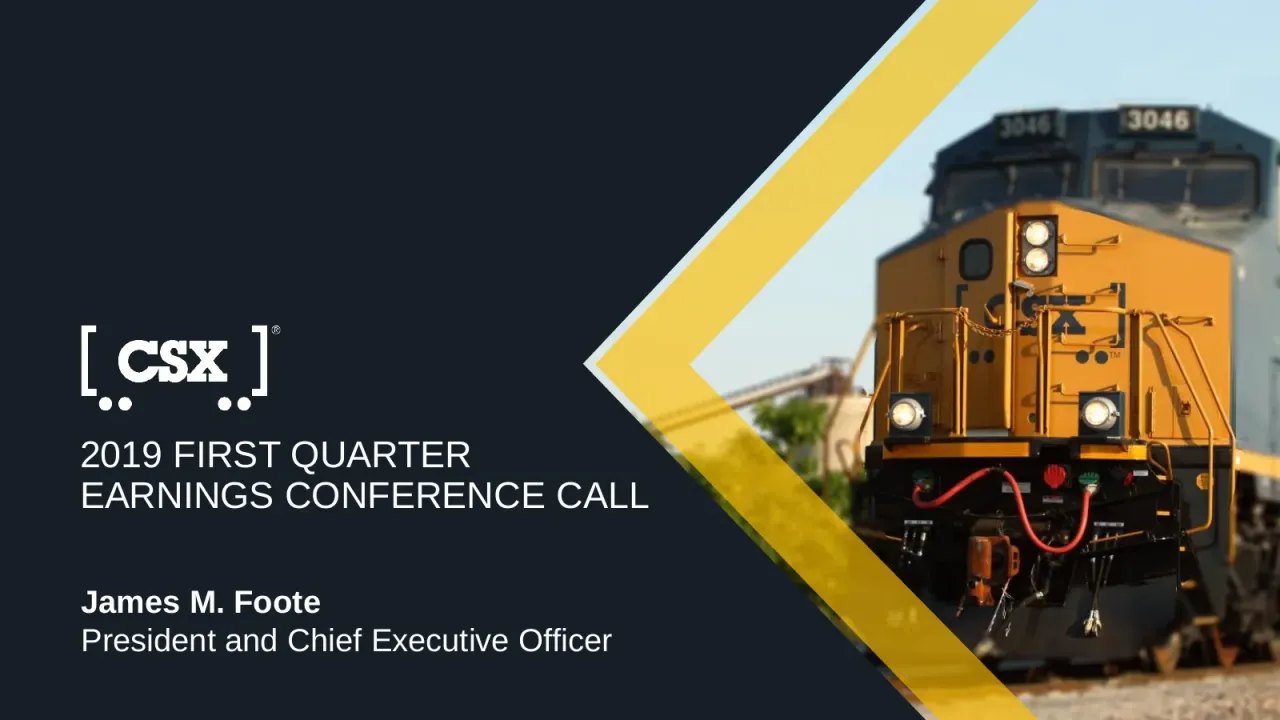
CSX (NASDAQ:CSX) Q1 2019 earnings call, held 2019-04-16. Watch the replay and read the transcript on 6ix.
On 6ix: 6ix.com/event/csx-corporation-csx-q1-2019-earnings-call
Automated transcript · Written by software from the replay's audio. It can mishear names and figures; the replay is the record.
0:00 Good afternoon, ladies and gentlemen, and welcome to the CSX Corporation first quarter 2019 earnings call. As a reminder, today's call is being recorded. During this call, all participants will be on a listen-only mode. Following the presentation, we will be conducting a question and answer session. To ask a question, please press star 1. For opening remarks and introduction, I would like to turn the call over to Mr. Bill Slater, Chief Investor Relations Officer for CSX Corporation. Sir, you may go ahead.
0:30 Thank you and good afternoon everyone. Joining me on today's call is Jim Foote, President and Chief Executive Officer, Franklin Agro, Chief Financial Officer, and Mark Wallace, Executive Vice President of Sales and Marketing. On slide two is our forward looking disclosure, followed by our non-GAAP disclosure on slide three. With that, it is my pleasure to introduce President and Chief Executive Officer, Jim Foote.
0:54 Thanks Bill, and thank you all for joining us today. As you know, Kevin Boone is taking on new responsibilities and I'd first like to thank him for the great job he did in leading our investor relations effort and for helping me directly over the last 15 months. We are happy that Bill Slater decided to join CSX and with his experience on the buy side and in private equity, he will be a great addition to the team. As for the quarter, Solid performance across many measures produced both record financial results and record service. I want to thank all of the CSX employees, especially those in the field, for their hard work in keeping the railroad running on time during difficult weather conditions.
1:40 Despite the challenging conditions, CSX set new records in Q1 for just about every service metric. While we are all proud of these accomplishments, nobody is resting on that success. I'd also like to add a little more detail on the recent appointments of Kevin to Vice President of Marketing and Strategy and Arthur Adams to Vice President of Sales and Customer Engagement. Both report to Mars in the expanded sales and marketing organization and are part of the continuing effort to build a highly skilled team focused on finding creative ways to address are customers key transportation needs and drive profitable, sustained growth.
2:25 Kevin will develop and lead a group focused on utilizing deep research and analytics to identify and advance new business opportunities and high priority growth initiatives across our merchandise markets. Arthur, who is our head of marketing services, is leading the transformation of customer service operations and eSolutions in addition to directing our TransFlow operations and he's adding an expanded team targeting small and medium sized customers to his responsibilities. His initial area of focus will also be the merchandise segment. Both Kevin and Arthur will do a great job for us and ultimately our shareholders. Now let's get to the presentation, slide five, and start with our results.
3:14 The results are once again straightforward with only a few small unique items that Frank will point out. First quarter EPS increased 31% to $1.02 versus last year's figure of 78 cents. Our Q1 operating ratio improved by 420 basis points to 59.5, a new first quarter record for the company. Turning to slide six, you can see there was broad strength across our merchandise and coal businesses, partially offset by the impact of changes in certain intermodal business segments. Our top line increased 5% to over $3 billion.
3:59 Merchandise volumes, pricing, other revenues, and fuel recovery all contributed to growth. I'm encouraged by the strong performance of our merchandise business with 6% overall revenue growth. Merchandise volume growth of 3% is the result of positive growth across every market with the exception of fertilizers which were slower primarily due to the impact of difficult weather conditions which delayed spring applications. The continuing turnaround in our merchandise business is without a doubt the result of our improved service levels. Despite continued growth in the international segment, intermodal revenue declined by 5% on 5% lower volumes due to the additional land rationalizations implemented following peak season.
4:58 Coal revenue increased 7% as strength in domestic steel and industrial markets combined with growth in export coal more than offset domestic utility declines. Finally, growth in other revenue is primarily the result of a settlement of a customer contract dispute. Excluding this impact, other revenue would have been flat versus last year. On slide seven, let's review our safety performance. The safety of our employees remains my top priority and we are getting better. As you can see in the charts, we achieved significant reductions in FRA personal injuries and train accidents, both sequentially and year over year.
5:49 While this progress is encouraging, and we may be the best in the industry this year, I can tell you that we will never be satisfied with our performance if one of our employees gets injured or killed while at work. It is just unacceptable. During the slide eight, let's take a quick look at just a few examples of the areas of improved operating performance. On the service side, Velocity and Dwell both improved sequentially and year over year to reach new record levels for the company. And our more fluid network allows us to get more out of our assets and increase efficiency. In total, relative to the first quarter, We reduced the number of cars online 10% and gross ton miles per available horsepower improved 9%.
6:42 With that, I'll hand it over to Frank who will take you through the financials. Thanks, Jim, and good afternoon everyone. Turning to slide 10, I'll walk you through the highlights of the summary income statement. As Jim mentioned, total revenue was up 5% in the first quarter, driven by strong pricing gains, favorable traffic mix, increased other revenue and higher fuel recoveries. Moving to expenses, total operating expenses were 2% lower in the first quarter. Labor and fringe expense was down 3%, as average employee headcount was 5% lower on volumes similar to last year. Continued refinement of the operating plan and our ongoing focus on trip plan compliance led to year-over-year improvements in velocity and on-time arrivals.
7:30 CSX operated significantly fewer active trains at higher performance levels leading to reduced road crew starts and savings in ancillary crew costs such as crew balancing expense. In addition, non-productive re-crews and road crew overtime, indicators of network fluidity, improved significantly year over year. Least favorable operating results enabled a 7% year over year decline in the active train and engine employee base and drove an 8% improvement in crew utilization is measured by gross ton miles per active train and engine employee. Shifting to the mechanical side, the active locomotive count was down 10% year over year and over 600 locomotives are currently in storage. The total active locomotive count is now down over 1,200 units since the end of 2016.
8:21 The smaller locomotive fleet combined with fewer cars online and freight car repair efficiencies helped drive an 8% year-over-year decrease in our mechanical craft workforce. Regarding our total workforce, which includes management and union employees, as well as contractors and consultants, we achieved reductions of nearly 500 resources in the first quarter versus the end of 2018 benchmark. Improved service, a more fluid network, and fewer assets in operation, together with opportunistic streamlining in our support functions, continue to drive labor productivity. As discussed on our fourth quarter call, we expect to absorb normal levels of attrition this year, and our first quarter results indicate we are on track to meet that goal. During the quarter, we also recognized railroad retirement tax refunds related to relocation reimbursements from prior years. We do not expect any additional recoveries going forward.
9:17 MS&O expense improved 1% versus the prior year. Lower intermodal volumes resulting from previously announced lane rationalizations drove reduced expense including terminal, trucking, and other freight handling costs. We continue to see efficiencies attributed to our lower active locomotive count, driving savings in materials and contracted services. Train accident costs were also favorable in the quarter. Real estate and line sale gains were $5 million lower in the first quarter versus the prior year. We are making good progress against our three-year and the $300 million cumulative real estate sales target and continue to see a strong pipeline of real estate sales and line sale opportunities, though the impact of these transactions will remain uneven from quarter to quarter and year to year. Looking at the other expense items, depreciation increased 2% due to the impact of a larger net asset base.
10:11 Fuel expense was down 9% year over year, driven primarily by a 5% decrease in the per gallon price and further aided by efficiency. are enhanced focus on utilization of distributed power and energy management software combined with train handling rules compliance for record first quarter fuel efficiency. Specifically, in this year's first quarter, we utilized 1.9 million fewer gallons to move a similar level of gross ton mile. Equipment rents expense decreased 1%, driven by improved car cycle times in automotive, merchandise, and intermodal. Equity earnings decreased $6 million in the quarter, Thank you very much. The effective tax rate in the quarter was 21.6%, reflecting benefits related to stock option exercises and the vesting of other equity awards, as well as the settling of state tax matters.
11:20 Absent unique items, we would expect an effective tax rate of approximately 24.5% for the remaining three quarters. Closing out the P&L, as Jim highlighted in his opening remarks, CSX delivered operating income of $1.2 billion, first quarter record operating ratio of 59.5%, and earnings per share of $1.02, representing improvements of 17%, 420 basis points, and 31%, respectively, year over year. Turning to the cash side of the equation on slide 11, capital investment was relatively flat year over year, We continue to invest in our core track infrastructure to provide safe and reliable train operations. Overall, our reduced asset intensity, especially in rolling stock, has enabled us to sustain lower levels of capital investment without compromising safety or reliability.
12:11 The level of PTC spending has also come down significantly in the last two years. Growth in CSX's core operating cash flow generation drove a 33% increase in adjusted free cash flow in the first quarter. The company converted net income to free cash at more than 100% during the quarter. Similar to last year's first quarter, we returned approximately $1 billion to shareholders, including approximately $800 million in buybacks and $200 million in dividends. In the quarter, we completed the prior share buyback authorization and began purchasing shares as part of the new $5 billion program we announced in January. Our share buyback activity in the quarter netted an average repurchase price of roughly $69 per share. Dividend payments in the quarter reflect a 9% increase from 22 cents to 24 cents per share we announced in February of this year, net of a lower share count. With that, let me turn it back to Jim for his closing remarks.
13:09 Great. Thank you, Frank.
13:11 Turning to slide 13, I'd like to wrap things up by reiterating our outlook for the year. Very little has changed with our view of revenue performance, so we are still expecting full-year growth in the low single-digit range. We expect growth to come from merchandise, the core of our franchise. Intermodal revenues are expected to remain muted as we work our way through the impact of intermodal lane rationalizations, and the outlook for coal looks as expected and many more. The top line outlook, of course, remains dependent on underlying economic conditions.
13:59 We are diligently monitoring our markets and are in constant dialogue with our customers. But generally, end market demand remains stable. Additionally, we are maintaining our full year operating ratio guidance of below 60 percent as well as our 1.6 to 1.7 billion dollar CapEx outlook. The efficiency reflected in our operating costs also translates to the capital side of the business and we are able to do more work on the network at lower cost. Efficiency also creates additional network capacity which allows us to maintain an efficient capital spending program. We are, in fact, investing in the core infrastructure of the railroad and above our historical average rates.
14:55 This quarter reflects the strength of our operating model, as we are able to more efficiently manage our business through what is traditionally our most challenging operating quarter, while still improving customer service. CSX is an exceptional company with an extraordinary heritage. Our transformation to becoming the best-run railroad in North America is beginning to find traction. The railroad is running better, but we can still make many improvements. We are continuously looking for new ways to serve our customers and eliminate bureaucracy that slows us down. We are working hard every day. to make CSX the best-known road in North America.
15:45 With that, thank you, and I'll turn it back to Bill.
15:49 Thank you, Jim. In the interest of time, I would like to ask everyone to limit themselves to one question. Michelle, we'll take questions now. Thank you. We'll now be conducting the question-and-answer session. To ask a question, please press star 1, and to withdraw your question, please press star 2. Allison Landry from Credit Suisse, you may go ahead.
16:11 Thanks. Good job on the quarter. I guess not to start out with a negative question, but in terms of export coal and where API2 prices are currently trending, could you maybe tell us what percent of the overall book for export is under contract and when those might roll off?
16:33 Yeah, so it's Mark. So we've got about 90% of our total export tons walked in for the year. So as I think I said back three months ago, last year we did about 43 million export tons. We expect to be in the low 40s for this year.
16:56 Okay. And then on the intermodal network redesign, is there a way to think about the delta between the profitability of legacy franchise and where you think ultimately you can take the margins, whether that's this year or 2020 or whatever, but could that be enough to insulate consolidated margins in a flat or declining revenue scenario?
17:24 Listen, I think we're clearly pleased with the progress we're making on the intermodal changes that we announced. We all know that combined with the changes that we announced In October of last year, and then again in January, we took out about 8% of our volumes. I think we're down 5% revenue for Q1. So net-net, we're sort of ahead, up three. Listen, we've got a lot of work to do. This is a long game here. These changes are going to take place over the next several quarters and several years. We don't have any major structural changes that are laying in front of us that we're going to implement, but clearly we're working hard every day to drive out costs and improve the efficiency and the speed and the reliability of our intermodal business.
18:24 So we're pleased with the progress to date, but we're not satisfied yet, and we hope, as we've talked about many, many times, that the profitability of that segment will continue to increase over time. Thank you. Our next question comes from Chris Wetherby from Citigroup. You may go ahead.
18:42 Hey, thanks. Good afternoon, guys. I guess I want to start on the operating ratio. So, no change to the target yet. You guys are below, I guess, the target in the first quarter. If I look at seasonality over the last several years, you sort of had about a 300 basis point swing between first quarter and full year OR. How should we think about seasonality this year? Understanding maybe the back half, there's going to be some potential pressures from cold, but how do we think about that? It would seem like we've made already very, very strong progress to that full-year target. Hey, Chris. It's Frank. You should expect some seasonality as you think about the normal dip that you see between Q1 and Q2, and then for But, yeah, we expect to make progress, you know, Q2 versus Q1.
19:39 And, you know, obviously we've got our eyes on the macro like everybody else and feel pretty good about where we started out the year.
19:46 Okay, that's helpful. And just a quick follow-up here just on the labor side. I wanted to make sure I understand the cadence. I think, Frank, you talked about absorbing attrition. We should assume that's somewhere in that kind of almost 7% type of range from a headcount perspective as we move through the rest of the year. Yeah, the guidance that we put out on the Q4 call and then Jim reiterated in some of the conferences he was at, you know, our historical attrition levels would be in that 6% to 7% range. And we're really talking about the total workforce, which would include not just management and union folks, but also contractors and consultants. And the roughly 500 or so that you saw here to date is a pretty good start against that target. Thank you. Our next question comes from Ken Hexter with Bank of America Merrill Lynch.
20:32 Great. Great job on the quarter. Just thinking about the state of the market, Jim, can you talk about historical thoughts as pricing in the truck market loosens and pricing pulls back a bit there on intermodal? Can merchandise remain solid? Can you talk about the correlation we could expect to see given the pressure on the intermodal pricing side?
20:56 Well, again, our focus has been since the day I walked in the door here that this operating model works best for transforming the merchandise business into a much more effective competitor with the highway. And we already know that the customers are paying 15% to 20% more to ship by truck in those market segments. So, again, so that the Spot market pricing of trucks really is irrelevant. It's all about how much we can improve our service, which will allow us to grow our business in the future in merchandise. On the intermodal side of the business, again, we have long-term relationships with various channel partners and are interested in jointly developing transportation solutions.
21:53 that are going to make us both competitive in the marketplace. And again, the spot market and somewhat loosening of the truck market there does not diminish the significance and the value that the railroad plays in the transportation marketplace and intermodal when you're looking at Some of these long-haul moves, Chicago, New York, Chicago, South Florida, or up and down the East Coast. So we still have a significant advantage in terms of cost in those long-haul moves, and we'll continue to work with our partners to leverage that.
22:39 That's great. If I could just get a quick follow-up on that same subject. As you improved the performance so significantly versus where you were, you always talked more about taking business from the highway. Do you feel like that's where you're really winning from? Are you seeing the competitor make strides in improving their performance relative to where they had been to keep that gap narrow, or are you seeing any significant gains there?
23:05 Well, I think our growth over the last 12 months in the merchandise business segment at CSX has been a significant transformation. You haven't seen this kind of sustained volume growth at CSX. You have to go back to kind of like 2014, early 2015 in order to find this kind of growth. And it's directly related to the fact that we have a product now that the customers are willing to rely upon and give us more of their transportation spend. Whereas in the past, they've maybe given 50 or 60% of the volume to rail and 40% to truck because they didn't trust the reliability of the railroad to get their products to market. And that is where we are seeing our growth come from. It is from our existing customers to a large degree where we are gaining a larger share of their transportation spend each and every day.
24:03 and hopefully that will continue. Thank you. Our next question comes from Brian Ossenbeck with JP Morgan.
24:10 Hey, good afternoon. Thanks for taking the question. So Mark, maybe it's on the export call again. We have seen a pretty sharp drop in both the API too and also Newcastle. But given your comments about 90% being locked in, do you think the business is relatively well insulated? For that, you know, export thermal coal was actually up in the first quarter, but just wondering how the drop we've seen is going to play out in the markets and for CF fixed volumes later this year.
24:42 Yeah, I think, so again, you know, the API2 is low, you know, a lot of our thermal coal, as you know, goes to Europe. Mild winter temps there, high stockpiles, low natural gas prices. all create this low API 2 number. You know, we definitely have seen a little bit of softness. You know, as I said, we do have a lot of that volume locked in for this year. We were fortunate enough in the first quarter to pick up a nice win because of our service from our key competitor. So that helped with some of the volumes there and some of the business in the first quarter.
25:29 Clearly, I think when you think about the thermal side of the export business, it's going to be a challenge, but we do have minimum volume guarantees there, so I think we're pretty insulated on the MET side. The benchmarks remain strong. Forward curve is around $200. Good demand. We did see a little bit of producer issues in the first quarter with some of the weathers and and some of that kind of stuff. But I fully expect that that will rebound and we'll see some good strength there. So again, as I mentioned to Allison in the first question, we still expect low 40s.
26:16 And as I said in my concluding remarks there, as it related to our outlook for the year, we had always expected Three months ago and earlier when we were putting together our guidance for the year, which we talked to you about on the last call, that this thermal benchmark was more likely than not to soften somewhat based upon all kinds of macro issues in Europe. We kind of thought that would be the case last year as well.
26:55 And as we all know, we got a little bit of tailwind last year because it didn't. So we've always been somewhat cautious on this topic, and so our number that Mark's talking about there is where we thought it would be. So that's why we're kind of telling you that we don't expect the coal... to continue at the rates that it did in Q1, and that it's not going to be a big factor in the overall top-laying growth of the company this year.
27:33 I appreciate that. Mark, if you can just give us the updates on the stockpiles, domestic utilities in the north and south.
27:41 Yeah, so stockpiles in the north are somewhat flat year over year. Going into the year, going into January, February, the south was at 13-year lows. Those have soared. They're still down versus where they were this time last year, but some of them have been replenished. And so we'll see what happens over the course of the year, but we're all praying for a nice hot summer in the south here so that we can burn all our Utilities convert a lot of coal. We can move more. Thank you. Our next question comes from Amit Marhosha from Deutsche Bank. You may go ahead.
28:25 Thanks, operator. Hi, everybody. Congrats on the good quarter. My first question is just on the competitive dynamics. Norfolk Southern is obviously pursuing PSR via a yield-up strategy. That provides CSX with a pricing umbrella for your business, and I think we saw some of that in the quarter. But I would assume it also allows you to go after some market share. If you can just help us understand how you're thinking about or approaching that opportunity. Are you seeing market share opportunities as a direct result of those initiatives, and would you be maybe willing to have a more balanced approach between volume and price, given the structural cost advantage that you have after the PSR initiatives? Thanks.
29:10 Yeah, clearly it will be inappropriate for me to comment on Norfolk Southern's pricing strategy, but clearly we priced to the value that we had, and we are seeing some really good results there. We have a superior service product that's in the market now that we're providing to our customers, and I am very pleased with the The pricing that we are extracting for the value that we are adding to our customer base.
29:43 Okay. And just one follow-up if I could. Jim, just really about any structural factors that are limiting CSX's profitability. I believe when you guys started this journey, you talked about CSX's profitability relative to everybody else in the industry. Almost everybody in the industry is now pursuing PSR and arguably has big targets out there. So is CSX still committed to being the best in North America from an OR perspective? And if so, what are the other areas of focus that can drive further OR improvement after the stellar results you guys have already done to date?
30:21 Well, I would say that there clearly were two structural disadvantages when CSX started this. transformation under Mr. Harrison's leadership. And Hunter dealt with those effectively. He ate the spaghetti and got rid of the spaghetti bowl of wine, so that myth is gone. And he obviously put a dome over the railroad because we were not impacted by the weather this quarter. We are the leader. We are the leader in efficiency. We are the leader in operating ratio, and I believe were probably this quarter going to be, if not, clearly probably in the U.S., maybe not North America, the leader in growth.
31:06 And I got a couple other leadership targets that we're going to hit hopefully by the end of this year. So we are the best. My focus is and everybody's here focus is to make sure that we continue to be the best. And there is no impediment, none whatsoever, should stop us from achieving that. Thank you. Our next question comes from Tom Wadowitz from UBS. He may go ahead.
31:38 Yeah, good afternoon. Let's see. Impressive operating ratio in first quarter to be below 60. Wanted to ask you on the intermodal revenue per car, that was, I think that was roughly flattish. I would have expected maybe that, you know, the Rationalizations might help you from a mixed perspective. I don't know if mixed was a factor, but what's happening with revenue per car? Is that a function of, you know, you have longer kind of contracts with your customers and you can't do much on price? Or maybe just help me think about how much of the intermodal you can reprice in, you know, this year or a typical year.
32:18 John, it's Mark. Thanks for the comments. Revenue per car for intermodal, yeah, I mean, it's a mixed issue. Clearly, lane rationalizations play into that. But, you know, most of our intermodal businesses are under contracts. So, you know, 90% plus, very little spot business. So, but the lane rationalizations had the biggest impact on on the RPU and intermodal this quarter. Tom, it's Frank. One other thing to just keep in mind, we do have a small piece of our intermodal portfolio, which is what we call door-to-door, and that one's got some higher RPUs.
33:06 Okay. So you're implying that was part of the rationalization, was the door-to-door? It really wasn't part of the rationalization. It was more in just a small segment of the business, which didn't grow nearly as much, so Okay. All
33:28 right. And then for the follow up, I just wanted to see if you could offer a thought on how we might model revenue, or excuse me, comp and benefits per employee. It sounds like you might have had a benefit in the quarter or you did from the railroad retirement tax. I don't know if you want to quantify that and offer a thought about, you know, how much inflation per worker should we think about looking forward? A couple of questions in there, Tom. I think we were about $30,000 per employee per quarter. It's relatively flat on a sequential basis. Not really much to do with the railroad retirement item, which was about $15 million in the quarter, so not tons on that big of a laboring fringe line. What I think you're going to continue to see is some Thank you. Our next question comes from Scott Group with Wolf Research.
34:19 Hey, thanks. Afternoon, guys. Mark, just one more follow-up on export thermal. Does your pricing adjust quarterly
34:44 with the API index, or are the rates locked with the contracts? I'm just not sure if we should think about it like met coal or not from a pricing standpoint.
34:53 No, the contracts are priced annually. Okay. On the met side, they're repriced quarterly based on the benchmarks.
35:10 Okay, that's helpful. And then just bigger picture, so I think you talk more directionally about pricing these days. It looks like pricing is still improving sequentially. Core pricing is still improving sequentially. Is that right? And do you think that that can continue going forward into the rest of the year? Or does pricing at some point start to moderate a little bit just as we're seeing truckload and intermodal pricing start to moderate?
35:37 Across the board, Scott, you know, again, 66% of our business is merchandise. And to the extent that we continue to drive and improve our product, we're going to consistently get price increases. It's just plain and simple. We don't view that segment of the business, hardly any of our business, as a commodity. It's just out there trading around based upon who's got the lowest price in town. Our focus is on making sure that we have the best run railroad and the best reliable service that we can sell to our customers. And the customers have indicated a willingness to pay for that level of service and reliability.
36:22 So there is no reason in the world for us to discount our price. Again, if there's a customer out there that says to me, Jim, I could care less about your service. I just want the lowest price in town. Well, guess what? I'm the lowest cost guy in town. So if I wanted to play that game, I could play that game too. But that is clearly, clearly not our focus or our intention.
36:51 We implemented a level of discipline here, and I can tell you that every contract now gets my review. And so what I can tell you is, as I said previously, I'm extremely pleased with the value that we are extracting for the value of the service product we're delivering.
37:17 Okay, that's a good answer. Thank you, guys. Appreciate it.
37:20 Great, Scott. Thank you. Justin Long from Stevens, you may go ahead.
37:27 Thanks, and congrats on the quarter. So maybe to start with one for Jim, you classified the demand environment as stable, but one of your IMC partners said yesterday they're not seeing a snapback in demand in March and April as they had hoped. When you strip out the noise from weather, are you seeing anything that gives you pause about the economic backdrop, or are you confident that we'll see volume growth from CSX over the remainder of the year?
37:57 Well, the volume growth from CSX will be, as I described in my concluding remarks, principally from merchandise because of these aberrations, muted growth in intermodal, as I said, because of the blind rationalizations, and coal because of the factors associated with the export to thermal coal. So to respond directly to your comment about someone else in the transportation space that's already talked about how they saw the first quarter, from what I've heard from other people in the transportation space who've already talked about what they saw in the first quarter, nothing surprised me whatsoever.
38:48 Clearly, everybody knew that there was bad weather, especially in the West, that was impacting traffic volumes. Everybody knew that everybody had moved as much traffic as they possibly could forward in anticipation of tariffs. Everybody knew that there was a unique factor this year with the tariffs possibly being implemented with the start of Chinese New Year. So there was a lot of noise and a lot of aberration and a lot of issues in the first quarter that everybody was going to have to work their way through. and so there's been no surprise to me at all. I think we'll all just kind of now kind of figure out what's gonna happen with the material that's already in the warehouse that needs to move.
39:39 Clearly you're gonna start to figure out seasonal changes. Right now I'm sure everything's kind of pre-positioned for the Memorial Day sales and probably the Fourth of July. But that stuff's got to move out so we can get the fall goods in and that sort of thing. But everybody's going to wait and see. But no surprises right now. It's about what we had expected it would be related to the tariffs. And the reaction in the marketplace due to the difficulties with weather is something that those of us who have been around the business for a long time have lived through before.
40:22 Thanks. That's really helpful. And then secondly, going back to the truckload conversion opportunity, when you think about that addressable market, what percentage of that market would you say is in the intermodal business versus the general merchandise business? And are the incremental margins on those conversions pretty similar when you compare intermodal to general merchandise?
40:46 The biggest opportunity for us is in the merchandise business. Again, when I talk to whether it's a paper producer, a steel producer, a plastics producer, or whoever they are out there, that I'm moving their product today long distance in a hopper car and making a really good buck doing it, we maybe have 60% of the business because they won't entrust us with the other 40% because we're not reliable enough and our service is not good enough for them to serve their customers. So that's the key. That is the focus, that is the greatest opportunity, and that is business that today is very, very, very good business for the railroad. In the intermodal business, clearly, once we get our network reconfigured and more focused, we will... We will begin to offer an alternative product there to a large number of shippers of different types of commodities that are, again, also looking for extremely reliable service.
42:03 Whether you're a plastic shipper, a steel shipper, or whether or not you're a shipper of a whole bunch of little bitty boxes with smiles on the side of them, you're not going to use the railroad if it's not reliable. So we need to get as reliable in that area in order to make sure that that traffic moves in intermodal service as well. Hey, Justin, Frank, on the incremental, I mean, obviously they're going to be high on both because they're using existing trains, existing crews. You know, you maybe burn a little bit of fuel and touch it in the yards, but they'll both be high.
42:37 Okay, great. Thanks for the time. Great questions. Thank you. Ben Hartford from Baird, you may go ahead.
42:46 Yeah, thanks. Maybe just to follow up on that intermodal question, as you think about getting through this lane rationalization this year and you start to continue to see service improvement. As you look out over the next several years, is there a good number to think about in terms of what the pace of domestic intermodal volume growth can be annually as you look at the market? Is it low single digits? Is it kind of in line with IP or GDP growth? Or can we still think of it as being a multiple of that underlying market growth rate?
43:19 Yeah, I think, you know, I would expect that we would get back to the high single-digit growth number.
43:29 Okay, good. And is that something in 2020 that's conceivable, or is that going to take a little bit of time to get back into that high single-digit growth pace?
43:38 Tell me what the economy is going to do, and I'll tell you when we're going to get it. But all things being equal, yeah, I mean, I could see us, you know, getting back there next year, getting into 2021. Yeah, I mean, that would be my expectation. Listen, we're not focused on driving volume right now. We're focused on driving profitable growth. And so we need to fix, as Jim just alluded to, we need to continue to fix the intermodal segment. We're working through that every day. But we want to bring business onto the railroad that's going to be profitable and that's going to be around here for a long time.
44:19 Thanks. And then just to follow up on the international intermodal side, how do you think, Mark, about the long-term growth opportunity there? Is that more in line with import growth or is there still kind of a total addressable market expansion opportunity there as well?
44:35 Well, there's still an addressable market that we're going at. I mean, listen, there's a lot of stuff coming in, West Coast, East Coast, all that stuff. And, you know, we... Thank you. Thank you. Our next question comes from David Vernon with Sanford Bernstein. You may go ahead.
45:17 Hey, good afternoon, guys. So maybe just as you think about the service levels that you guys are getting right now, if we strip out that 23 million on the contract settlement, you're still running around 150 in the accessorials and sort of other revenue. Is there a point where that number starts to fade off a little bit as the incidents which are causing some of the demurrage issues and stuff like that as customers adjust their supply chains, or should we be kind of baking in that 150 level kind of going forward? Hey, David, Frank. Yeah, I think you've got it right. The idea is that it will come down a little bit. We got it earlier on the Q4 call that on a four-year or four-year basis, it would be lower. So if I were plugging in, I'd be in that 130 to 135, a quarter number. Now, that's absent anything unique.
46:04 Okay.
46:05 Again, that's a good news story. because our customers aren't holding on to our cars and they're spinning them faster and we're getting better asset utilization. So we're not looking at driving that number higher. We're looking at driving them, you know, hopefully it goes lower, but those cars spin, better asset utilization, better service. That's what the charge is in there for. All right. And then, Frank, maybe just to clarify to make sure I got the list of the stuff on here. So the $23 million was the contract renewal. The $15 million in the labor line, is that recurring or is that just the one time in the first quarter? Are we going to see that every quarter? One time first quarter only. And then $27 million in land sales, right? Yeah, which was down $5 million year over year.
46:50 Okay. Anything else within dogs and cats that were in that sort of like $5 to $10 million range or is that $65 the right number?
46:57 No, I think you got it. All right. Thanks, guys. Thank you. Thank you. Our next question comes from Ravi Shankar with Morgan Stanley. Please go ahead, sir.
47:10 Thanks, Agri. Just to follow up on the intermodal conversations, when do you think you might see that big inflection where the service is good enough that shippers acknowledge the value proposition of IAM over truck and you start to see this? kind of big conversions to your intermodal business?
47:37 Well, you know, as Mark said, you know, Mark's pretty optimistic about where he thinks the growth rate's going to be. If you look at last year, you know, we started this rationalization last year. We took off 7% of the business last year, and we finished the year up two. So, you know, those growth rates that Mark's talking about, you know, upper single digit are clearly not unrealistic once we get our network in order. And, you know, again, our intermodal service I think right now is pretty fantastic. What we got out of in terms of lane rationalizations was that a regional kind of a short haul intermodal service that had really nothing to do with the rates, but it was the number of multiple handlings associated with it that it was difficult to absorb those costs in the intermodal business.
48:45 So we decided to exit that regional strategy and get back to a more traditional Network Strategy, leveraging the franchise we have, linking together our 25 or so key intermodal terminals and working with truckers that clearly see the advantages to the intermodal services because it reduces their overall costs as well. So once we get through this Some of these challenges that we have from a structural standpoint, which should be by the end of this year and maybe a pitch over into next year because some of them were just started this quarter of this year.
49:36 Then I think you'll start to see this business growth rates coming back to their more appropriate levels.
49:47 God, and just to follow up on something you said earlier about some shippers wanting just the lowest price, I don't know if you can answer this question, but can you kind of quantify what percentage of your shippers, specifically in intramodal and merchandise, are folks who prioritize service versus folks who just want the lowest price?
50:09 I think in the... I think without a doubt, without a doubt, 100% of our merchandise customers, which are, and 100% of our merchandise customers, clearly, if you ask them, the number one priority is reliability. If you, the cold customers, you know, again, were part of a supply chain that involves piers, involves terminals, involves ships, involves utilities running. They want reliability. They don't want to screw around and they don't have the flexibility in their supply chain to absorb inefficiency. If you ask the domestic Intermodal customers, especially those associated with e-commerce, when they make a commitment to a customer that they're going to have a package delivered across the country in 24 to 48 hours, they don't screw around.
51:10 They want it there in 24 to 48 hours. That kind of leaves a little group left over that you can figure out who would like to bundle up a whole bunch of containers and pull into a steamship port someplace and say, we're interested in price. So that's a small minority of our customers.
51:35 Great. Thank you. Thank you. Our next question comes from Walter Spracklin with RBC Capital Markets.
51:45 Thanks very much. Good afternoon, everyone. So I just want to come back to a prior question just so I understand it. Mark, when asked about any indication that you might have picked up in recent conversations with your customers with regards to potentially waning demand again just in a recent month or so saying that, okay, yeah, we did have, you did have demarketing, yes, we did have weather and all that, but all that aside, are you detecting any change in tone with your customer conversations that would indicate perhaps a slightly lower growth rate or lower demand for freight cars than you had when you set your guidance at the beginning of the year?
52:24 No. Listen, again, Our service in the first quarter is very good. Customers are recognizing that service. Q1, a lot of noise. Jim alluded to it. We had bad weather in February, lane rationalizations, intermodal. Our channel partners were out for bid season. We had Chinese New Year. We had a lot going on. So You know, try to put all that in the blender and try to figure out what exactly is happening in intermodal. Good luck with it, because I'm still trying to figure it out. But, listen, we've got a good service product out there. Our partners, whether it's intermodal or in the card mode side, are clearly seeing the value of that. They're at home with us.
53:15 If it's changing, it's only getting better and better every day. I've spent recently a lot of time with a lot of different customers across the portfolio. We're winning new business every day, both from truck and from rail. They're pleased with us. And so, yeah, I'm very happy with where we are. I'm cautiously optimistic for the remainder of the year. You know, people are as well. Business confidence remains relatively good. Nobody's sounding any fire alarms. and so given all that and given Jim's comments earlier about the strength of what we see in our key merchandise portfolio, I'm really confident there but we do have some issues with these rain rationalizations that we did and the coal but no, we're good.
54:09 Okay, that's comforting and just a follow up here, I think if I wrote it down correctly last quarter, Mark, you had indicated that your volume expectation for the full year would be flat to slightly up and that your intermodal would, I would say, I wrote down low intermodal growth. Now, you've got negative 4.5% in the first quarter and then full year, total volume negative 0.1. Are we going to see just an improvement here as we go through the quarter and get back up to some kind of positive overall growth and Perhaps not quite as strong a downturn for the rest of the year in intermodal as we saw in the first quarter?
54:53 No, I think we're expecting some growth there in Q4. So it should be, we'll see sort of flattish and then hopefully up in Q4. But the expectations for intermodal on a volume is still, you know, I'd love to be flattish, and I'm hoping that's what the, we may be, I'll use Jim's word, a pitch below that, but hopefully we can come in flat.
55:29 Okay, perfect. That's all my questions. Thank you. Thank you. Our next question comes from Brandon Oglenski with Barclays Capital.
55:39 Good afternoon, everyone, and thanks for getting me in here at the end. Mark, I guess, you know, investors have really, you know, Mark can be fickle and we've all turned our attention to the new PSR stories, you know, across the street and the East Coast and, you know, with the bigger railroad out West. But I guess maybe folks don't appreciate all the changes that you've made on the sales and marketing side. So, you know, one, can you talk about what you're doing different now and approaching the market with the organization that you have in place and is the organization fully built out? And then I guess number two, I think at your analyst meeting last year, you called out like a 4% long-term growth category for merchandise. Is that still the right outlook given the changes you've made on the team?
56:23 I certainly hope so. That's exactly what we're chasing and going after, and I'd lie to you if I said I wasn't trying to beat that number. Listen, I think we have a very solid team now. I've been in this job for about nine months now. The first half of my time, three quarters of my time, I was out meeting with a lot of customers, introducing myself and learning about their businesses and how we could provide value to them. Most recently, I've been spending a lot of time with our team. We just announced three weeks ago, a month ago, a major reorganization in the sales and marketing team. Now it wasn't only Arthur Adams and Kevin Boone that got new jobs. What we're trying to do with Kevin's team, my view was while as good as we thought we were with sales and marketing, we were really lacking or missing the deep core understanding of our customers' businesses and how we could help them succeed in the marketplace and how we could provide value as a transportation logistics solutions provider to enable their growth. And so we needed to up our analytical and our data-driven business and get some people in the organization that had that skill set and really
57:56 drive value there by understanding our customers and how they're going to grow going forward and how we can be a provider with them and grow with them. So that's what Kevin's team is doing. That's where we're going to grow. We're spending a lot of time. Kevin, we brought some people in to focus on regional sales. We brought some people in to focus on our short-line strategy, growing with our short-line partners. If you look back over the last five years, our volumes with our short-line partners has declined. Kager, I think, 3% every year. That's not acceptable. We've got to turn that around. We've got to grow that. We're working on our port development strategy and a whole bunch of these other initiatives, including trying to be better partners and provide better customer relations with our customers under Arthur Adams' group. So lots of different things going on. I think all this culminates into growing merchandise, and that's my focus. That's the growth area for us.
59:00 That's where we've lost volume over the last four or five years. My goal and my job is to grow this organization and figure out ways to enable that growth. We are not leaving any stone unturned. It's a full force ahead. I've got the resources. I've got the team. I'm probably a trade or two away from having a full complement of a team that I really want to go forward with. Maybe one or two extra little Moves here to make in the next little while, so stay tuned for that. But clearly we're heading in the right direction. We've got a fantastic team under me right now, and we're focused on the future and focused on growing.
59:43 I appreciate it, Mark. Thank you.
59:45 Thank you. Thank you. Sherilyn Radborn from TD Securities. You may go ahead.
59:51 Thanks very much. Good afternoon. I wanted to pivot away from sales and marketing quickly and ask if you could talk about how your use of distributed power has expanded and how much further runway you think you have with that particular lever.
1:00:07 Well, you know, distributed power was not used by CSX really until some of our operating team got here and were just more familiar with using it for years and years either in Canada or in the West. And so we have been aggressively implementing that across the network from zero a little over a year ago up to about 68 to 70 trains a day now. So we've got a big portion of the key trains operating in that manner today. with a lot more, in my opinion, a lot more opportunity for us to grow that as we go forward.
1:00:59 Great. And then quickly on share buybacks, you bought back about $800 million in the quarter. Frank, any thoughts on how quickly you might complete your latest program there? We really didn't set a time frame on this one. We'll take a look at how we're doing, how the economy is doing, what the share price looks like in the quarter. We did get a bit of a slow start because we were still finishing up the prior program, which exhausted right around the Q4 earnings call, so we really weren't that heavily in the market in the first two or three weeks of this year.
1:01:33 That's all from me. Thank you. Thank you. And our last question comes from Baskin Majors with Susquehanna International. Thank you.
1:01:43 Yeah, can you guys talk in broad strokes about the contractual prices that you're achieving this year and how they compare to the pricing increases that you achieved last year? And specifically to that question, really across the truck competitive business, maybe separately for Merchandise and separately for Intermodal. Thank you.
1:02:03 Well, I'll turn it over to Mark for my answer. The short answer is no. But we can give you some general guidance along the lines that we've been talking about by just generally what our philosophy is towards merchandise, intermodal, and cold.
1:02:19 Mark will do that. I don't want to repeat no. Again, we're continuing to enjoy solid results. for the value that we provide to our customers. And so not only in intermodal, now again, a lot of our intermodal business is locked up in multi-year contracts. So, you know, rates are predetermined, you know, with escalators every year. But on the merchandise side, again, it's about winning incremental business, converting that that freight from the highway. As Jim talked about, some shippers ship both by rail and by truck because of our lack of having a good service product and lack of reliability in the past. As we become more reliable and consistent, they want to use rail. And so if we can convert that business, it's all incremental. and the merchandise sector, it's good business for us and we're happy to have it on the railroad.
1:03:37 So that's our strategy and that's where we're winning but that's about as far as I want to go on the pricing side.
1:03:46 Fair enough. Thank you for the comments.
1:03:49 Thank you. Great. Thank you everyone. I think that concludes our call for today. Thank you very much everybody. And thank you. This concludes today's teleconference. Thank you for your participation in today's call. You may disconnect your lines.
Follow CSX Corporation into a list and get an email when it puts out news.
Chief Investor Relations Officer
President and Chief Executive Officer
Executive Vice President of Sales and Marketing
Analyst, Credit Suisse
Analyst, Citigroup
Analyst, Bank of America Merrill Lynch
Analyst, JPMorgan
Analyst, Deutsche Bank
Analyst, UBS
Analyst, Stephens Inc.
Analyst, Baird
Analyst, Sanford Bernstein
Analyst, Morgan Stanley
Analyst, RBC Capital Markets
Analyst, Barclays Capital
Analyst, TD Securities
Analyst, Susquehanna International