Srinivasan Ravi
Chairman and Managing Director at Craftsman Automation Limited
Replay available
Craftsman Automation (NSE:CRAFTSMAN) Q2 2027 earnings call, held 2026-10-29. Watch the replay and read the transcript on 6ix.
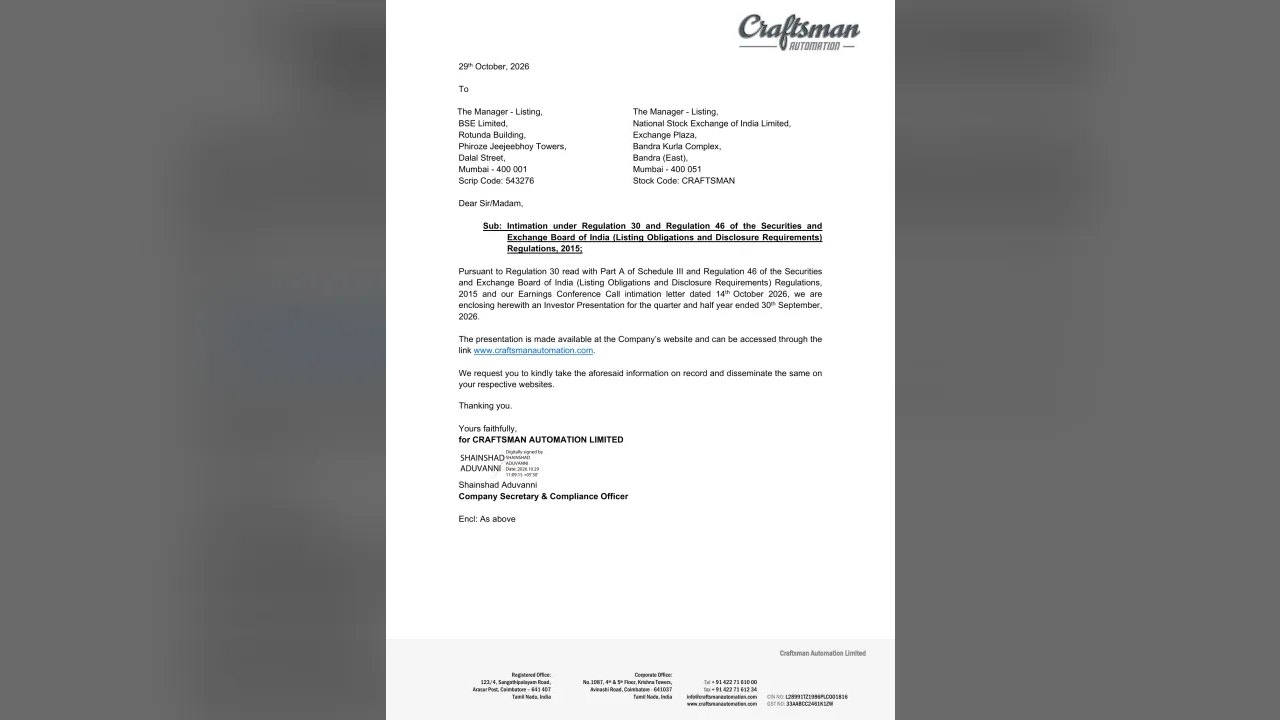
On 6ix: 6ix.com/event/craftsman-automation-limited-craftsman-q2-2027-earnings-call
Automated transcript · Written by software from the replay's audio. It can mishear names and figures; the replay is the record.
0:01 Ladies and gentlemen, good day, and welcome to the earnings conference call of Craftsman Automation Limited. As a reminder, all participant lines will be in the listen only mode. There will be an opportunity for you to ask questions after the opening remarks are concluded. I now hand the conference over to Mr. Srinivasan Ravi, Chairman and Managing Director of Craftsman Automation Limited. Thank you, and over to you, sir. Good afternoon, everybody, and thank you very much for joining the earnings call for today.
0:47 I just want to touch upon briefly on the last two quarters and about the opportunity for Craftsman as well as the headwinds we had with the war as well as the commodity prices, which was spiking very sharply. And now it is on a lower trajectory. So we have weathered all these situations. We have put up a lot of capacity. Still capacity is getting created as we speak. Not all capacities have come into production. And some of the pipelines are not fully yet. Yes, we are on a growth path, and we will be continuing this growth path into H2 as well as in the next two financial years. And the some of the orders, what we are doing is some are short term, medium term prospects and also long term prospects. The long term prospects, the CapEx has been done bulk in the stationary engine side, which you all are aware.
1:41 The revenues will start from FY 2029 and go into FY 2020, where we'll peak at around $100,000,000 And the next level of peak we're expecting, the inquiries and order position is quite strong. Aluminum is having a strong headwind, and we are adding more capacities across our plants and our subsidiaries also. The DiaRaxion plant too has started at its trial production, I would say, and the order book is also strong there. Sunbeam has gone through a very good transformation, and we are in close contact with the customers on the way forward. Q3 and Q4 will be looking better for Sunbeam. And next financial year, I think we will be also getting new orders from new customers while we are leveraging the capacities for newer products, which will give better benefits.
2:36 And also across all customers and all product lines, especially the legacy products, we are in contact with customers for the price rationalization or price reset in cases of legacy products. And this has to be done for almost all suppliers is what we feel because of the sharp rise in manpower cost, energy cost and all other associated costs. The capital goods cost has been steadily rising, I mean that any new projects cannot be done at all prices. So we are also very careful. One good thing about Craftsman is we have been continuously doing CapEx and bulk of the CapEx has been even before the big rise in the capital goods cost has increased. Now capital goods also, it is not easy to put up CapEx because of the long gestation period, there is a huge bottleneck for supply of capital goods across the world.
3:40 So we are in a strong position to win more orders and also we are winning more orders as we speak. We are a little more selective on the customers as well as the product, looking at the life cycle and profitability since we have now the base, which is stronger. And our ability to attract slightly larger customers with more profitable products for supply within India or outside India is better now in the position because of our bigger size. The growth in powertrain is expected to continue and also strong growth in aluminum. Yes, we have seen some correction of the margins in aluminum. That's not a correction, it's a temporary correction.
4:25 We had increased our inventory because of the shortage of raw material and also the prices which were increasing dropped suddenly. So we had an impact of that. So with the price increase, what we are negotiating with the customer or correction or compensation for the aluminum price correction also, which will play out in the coming 0.5. I think most of the customers are open to that discussion. We'll see that benefits coming into the next two quarters. Now I will leave the floor open for any Q and A. Thank you very much. We will now begin the question and answer session. Please note that some of the statements made during this earnings conference call may constitute forward looking statements, which are subject to risks and uncertainties and are not guarantees of future performance.
5:39 We encourage you to refer to the disclaimer section in the company's investor presentation. Further, the management will now be addressing any customer specific queries due to confidentiality obligations. Participants are requested to avoid mentioning customer names while asking questions. We also request participants to limit themselves to a maximum of two questions at a time so that all participants have an opportunity to ask their questions. Ladies and gentlemen, we will wait for a moment while the question queue assembles. Question is from the line of Chandramauly Muthiya from Goldman Sachs. My first question is just around the gross profit line. I think that's easier line for you to manage growth on.
6:37 First half growth has been at about 30 Y o Y on gross profit. 2Q has also been around that range. So just related to a lot of the business that you've been winning and the capacity that you've been adding, just want to understand over the next twelve to eighteen months, when you expect the inflection in gross profit growth just related to all this capacity that's coming on board and business that's being won? Thank you for the question. I would say that this sort of growth will continue if you look at a year on year basis for quite earnings two quarters, three quarters. So we are quite confident about the growth because of the past investments and past developments on the products and the pipeline, which is already there, products being approved or plants coming on stream.
7:33 Other than the headwinds what we had on the energy costs, mainly the gas and also the aluminum spike, which has led a little ripple in this quarter, last quarter. Otherwise, we feel that overall growth will continue in all the segments in the powertrain, not all segments of powertrain, of course, tractor, we will see some contraction in the next two quarters. Apart from that, on the powertrain, we'll see growth. So overall, growth on the powertrain is we are quite confident about that. Similarly, on the aluminum, the pipeline is quite long for the whatever order wins we have. There is some headwinds on the new plants where we have to put in the working capital and we have to start up the plants, which is also happening as suboptimal as of now. So the operating leverage on those plants will take another two quarters to get into a profitable situation, more profitable situation.
8:38 So this is dragging down a little, but this is temporary, I would say. But whereas the mature plants are having an advantage on the operating leverage. But as I said earlier, bulk of the margins also will come from the price correction, which has to happen across almost all the OEMs. Got it. That's helpful. And just a follow-up on the price correction. Roughly what magnitude do you think you need to take price hikes for the factors you mentioned, manpower, energy costs and so on? See, it depends from customer to customer, product to product also and the time of the first when the order was placed. The orders were placed in the last few quarters, I don't think that is feasible for any customer to give.
9:31 But if there are legacy products, which are not corrected and also the volume has contracted on some of the legacy products where it is a drag. Yes, it requires a big reset, I would say, that case. And in certain cases, yes, it is more on manpower and power and other regular inflation, which is related. It may vary, but anywhere between 67% all the way to 15%, 20% will be there depending on the commodity, the product and the time of win of the order. This is I'm talking about not on the top line, but on the gross margin or the value addition portion. So it might not impact too much on the volumes on the on the top line, I would say, as far as we are concerned. So top line maybe with the commodity prices, we cannot really put a number to it or what is the percentage there.
10:32 Got it. Got it. That's helpful. And my second question is just around there's been recent news flow around one of the large domestic passenger vehicle manufacturers and then their partnership now expanding with all the global passenger vehicle manufacturers. Just want to understand there are some news reports that there might be a local engine of the local passenger vehicle maker becoming an expanded scope in the global platform in this partnership. So just want to understand your thoughts on how that situation is evolving and what the opportunity size could be for a company like Craftsman? Not only the customer, I mean, the OEM we are talking about, but I can guess, it is across all the OEMs who are present in India or multinational and also Indian OEMs.
11:28 Whatever product is suitable in India for the Indian passenger vehicle consumer, those products are very competitive and these are the same products which are required in some of the underdeveloped markets or even South American, African markets and some of parts of Asia. So logically, India will become a manufacturing hub, if not for the vehicles themselves, but at least for the powertrain, which is logical. The second thing is there is a proof here on tractor, on the small tractors up to, say, 120 horsepower. India has become a global power for tractor manufacturing. And all the OEMs across the world have invested into India for capacities or export out of India also.
12:18 So the same trend we have also seen on the two wheeler side that exports of two wheeler from India is increasing. Also on the construction equipment on the not on high end construction equipment, but on the construction equipment where we have bulk requirement India, we see exports also happening. So exports out of India as a product or an aggregate will continue to grow. So there is opportunity for all Tier one, Tier two suppliers like Craftsman for on the growth strategy. Got it. That's very helpful. Thank you very much and all the best. Thank you.
13:05 Thank you. The next question is from the line of Senthil Kumar from Joendre Capital Services. Please go ahead. Good evening. Am Adi good, sir? Yes, please. Yes. I just want to know with the gross debt. The gross debt increased from INR 3,340 crores in March 2026 to INR 3,618 crores in September 2026 consolidated EBITDA. This is despite debt repayment using to make it 80%. Could you elaborate what is the reason for this increase? Net debt is only around INR 3,000 crore because we got a lot of cash available and some capital advances which we have paid.
13:53 So we have done yes, the working capital as our top line growth is quite significant. So working capital as ballooned and also the other, say, GST credit has ballooned and some of the pipeline we have added more lines or more plants. So that pipeline inventory is yet to materialize into revenue on the matter. So yes, and we are also carrying some safety stock of material, which now will get diluted in the coming quarter. So overall, the CapEx, we have done a significant CapEx in the first half. So overall, I think we will be at INR 1,700,000,000, 1,800,000,000 net debt to EBITDA on a consolidated basis for the year. And mentioned that the inflection point for us is around $18.50 crore sort of an EBITDA, which we will reach next year. After that, we will be able to be self sufficient for funding our CapEx as well as the maintenance CapEx.
14:56 So we have done a big surge of CapEx to cater to a larger customer base and in segment base. So this is a onetime we have pivoted that we want to keep the growth path more than we have committed a 15% CAGR. Of course, some years we'll grow much more than that in the real terms, not adjusted for inflation is what we say that we'll be growing at 15%. Our base is quite strong, I mean large. So considering all that, I think this is we have taken land for putting new plants. The land is partially utilized, but that land will serve for the next three, four, five years for our expansion. And infrastructure also has been basic infrastructure has been put. So additional equipment will not take too much CapEx.
15:44 So this is like building a new airport, I think we have taken this decision to expand our footprint in manufacturing. Okay, sir. And what would be the gross debt level by end of FY twenty twenty given this challenging environment? I would rather say it will be 1.7x, 1.8x net debt to EBITDA overall on a consolidated level. I don't want to give a forward looking statement on EBITDA, but you know the EBITDA, you can reverse calculate it for H1. And definitely, H2 revenue will be more and there is to normally the EBITDA also is better. So I would leave it at that. Okay, sir. Thank you. Thank you. The next question is from the line of Vignesh from Sima Weld.
16:40 Go ahead. Hi, Zakanda. Good set of numbers. Just want to understand on the medium term outlook, are we looking for any other new segments entering into it apart from heavy HP engines? Practically new no new segment, but we are vigorously expanding the powdering capacity, the aluminum casting capacity and machining capacity and we have done bulk of it. So we expect that to yield results in the coming quarters in a better way. Otherwise, we are also broad basing on the new product on the aluminum components, not only the legacy parts, but I think there are more opportunities coming in not only on the EV, but in general, the product offerings of the OEMs have become more wider. So we are seeing opportunities there.
17:44 Okay, sir. And regarding the second phase of this high engine, sir, how is it coming out? Like, what are the revenue targets we are planning? When is it commissioning kind of thing? So as we speak, we are getting inquiries for the next level of capacities on most of it is on the same products, what we are only developing. That is welcome. That means gestation period to market will be improved. We are discussing that to add some capacities there. Second thing is we are looking at broad basing the value added subject that hereafter we are trying to build up facilities, which are a little more flexible in nature to cater to various customers looking at the global market outlook.
18:34 So all this will add not add, I would say it will more attractive for the customer to reach out to us to get that product quickly developed or quickly ramped up. So I would not like to reveal that how much inquiries we received, but I think it is still going strong. Today, AI, I think, is here to stay and the backup power generators or the mainstream generators required for that will continue to grow over the next five, seven years. So tentatively as the first phase reaches a peak revenue in FY 'thirty, once that is done, we'll start the second phase? We can assume like that, sir? Yes, you can assume like that and second phase will not be capital intensive because our infrastructure is already in place for the foundry as well as the fundamental machine shop. So thereafter that, it becomes interesting that incremental CapEx and the incremental revenue growth will be more attractive.
19:43 Okay, sir. Thank you. That's it. You. Thank you. The next question is from the line of Joseph George from IIFL. I had a couple of topics to discuss. One was on cash flows. So this year, you have raised INR 2,000 crores of UIP. And if I look at the run rate of CapEx in the first half of the year, which is about INR 1,100 crores, plus there's a lot of cash drain on working capital. Considering all of that, how do you see the net debt position at the end of FY twenty seven compared to FY twenty six end? So I said today that one thing is that our growth on absolute terms has been, say, 50%, but I would discount that with the commodity side.
20:39 But on an overall base, if you look at it as a stand alone, the real terms itself, have grown 35%, 35% on a larger base. That means our capacities are much more than that in total. So this means the CapEx and the working capital cycle is yet to play on the number of days, which we'll see more. In the Q4, the exit rate will give a very clear indication of what are the things to come in next year. So we are in the buildup stage now. So I don't think we need to calculate I mean, this giving the right picture about what is happening at our rate. Okay, sir. Fair enough. And in terms of CapEx for the full year, should we expect a similar kind of run rate in 2H as we have seen in one inch?
21:32 No, I think we are quite clear about Q3 to a decent extent. But Q4, we might not do much CapEx for the simple reasons that our other CapEx are a little bit long term and that will be pushed into subsequent years in a phased manner. It will not be coming as big as this because we have broken the one level where we have put up greenfield facilities across India, I would say, on both the powertrain and aluminum segments. So in general, yes, we look at the okay, to answer your question, Q3 on a console level will be between crores, INR600 crores on the CapEx.
22:23 Okay, sir. Understood. The second question, topic I wanted to touch on was the Sunbeam business. So I remember about a couple of quarters back, you had mentioned that you will give up on low margin business, low margin revenue and improve the mix and get to early teens or mid teens kind of a margin, maybe in a year or two. I want to understand where we stand on that journey. Have you started giving up low margin businesses? Or what's the path from here? Yes, we were our customers request us to support until the festive season, which we have done for this festive season. So those products will go away in the next couple of months handing over is happening, where they're developing alternate or whatever maybe. So overall, the exit of certain smaller customers is mostly complete, but the bigger customers we are hand holding.
23:20 So our top line may reduce, but our absolute margins will improve because some of them are negative on the EBITDA itself in general. There's no point in trying to reset those prices. So with that, the P and L will be very healthy. Understood, sir. Thank you. Thank you. The next question is from the line of Sagar Shetty from Valdivaya. Please go ahead. Hi, Krishna. Good set of numbers. So my question was regarding, first of all, that we had we have recorded a good top line growth.
24:05 And at the same time, we have seen that the margins were a bit declining. Right? So is it right to assume that we have seen some type of sort of aluminum pass through during this quarter? So if we could just draw some light on that and why was the margins a bit lagging here? Yes. The aluminum, some of it we are still in discussion with the customer for the corrections on the matter until we come to a conclusion we cannot book the differences, number one. Number two is the steep rise and there is a panic in the market of the availability of material itself. Added to that is the Middle East crisis. See, we wanted to protect our customer product lines. So we had to take an extreme step of ordering more, not knowing which material will supply or which material will not be supplied.
24:55 So we have gone a little overboard, but I think that will stand us in the long run. Even to be frank with you, some of the customers asked us to give the aluminum to them to for them to give to other suppliers. That was the situation. So for that, we have taken some brunt that when the prices drop, yes, we have some impact. That's a onetime impact, but it doesn't going to impact on the longer term, yes, on Q2 especially, yes. And in Q3, there will be very marginal. And Q4, there will be nothing there going forward. Okay. Okay. And my next question was around when I view at the your Q2 there was a new German subsidiary. So if you could just throw some light on it, like what is the purpose and investment plan in it? And at the same time, if you would also like what is the growth rate in German subsidies as of now, like what is the quarter and rate which we should expect going forward?
25:49 So I will just explain the German subsidiary, even though it looks a number of companies. Fundamentally, there is one holding company, which is holding a real estate company and then the holding company is holding the foundry, that is it. The foundry is the only manufacturing company as of now. And that company is quite I think it has reported a healthy growth in the revenue. And also, the profitability is very decent, and this is also supplying to large engine family products and which is sustainable going forward. And all the expenses are indexed with the customer. The case of power, all the raw materials and also the labor cost.
26:34 So we don't see any risk on the business, and it's a steady business and it is profitable. Coming to the what is the new company which we have done, only the formation has been done there. The machining portion is now outsourced to some smaller companies in Germany. Since our growth is big, we thought Craftsman, yes, we have capability in machining. So we want to hold and take a small put a small machine shop there, which will help our customers to give more orders to us there. So in this case, we have not decided the quantum of investment. It will be very small. You know that we have invested around 100 crores, something like this in the German subsidiary. But Mission Shop will be a small a very small percentage when compared to that.
27:26 Okay. And would we be focusing on any CXMs going forward in Sorry, I think line is not clear, please. Can you repeat the question? Sorry to interrupt you, sir. Line is not clear. Is this better? Hello? Yes, please. Yeah. So I just wanted to know, like, are we planning any future CapEx, like, you know, in the foreign subsidiaries going forward? Like, apart from the 500, you know, outlay which we are anything extra for the foreign subsidiaries going? No, foreign subsidiary, no. As I mentioned, it will be nothing the subsidiary is a small machine shop. So what we are thinking through is only very small, maybe INR $20.30 crore on some few couple of machines there. So that we can support the foundry and reduce the working capital intent because now we are sourcing the machining outside and there's a delay. We'll continue to outsource the machining with other machine shops there, but the incremental requirement, we may do it inside. This is only an optional subject. It's not any CapEx intensive business what we Thank you. I want to make one very clear statement is we are not a fan of investing outside India in a big way because we understand the risks which are associated. This is a very strategic investment, and we'll keep it in
28:56 that way. Just adding one more question. So is this does this also rule out a possibility of foreign acquisition like any? Yes. If you look at our history, we are always very averse for many, many decades instead of our checking a number of times. We see what is the life cycle left in this sort of businesses, which is coming for a position. So we believe that any company coming up for sale may the good companies will get merged with the bigger brothers there in Europe itself. There are other companies there. So we feel that we stand more exposed or we more risky for us. Unless there is a technological advantage or it's very small when compared to the parent. Look at our size of revenue outside India, it is almost 1%?
29:51 No, no, it's 34%, right, top line of subsidy, German subsidy. 4% of our revenue is coming from our subsidy. And if you look at the gross I mean, net block of the investment also, it may be hardly 2%, 3%. Okay, okay, okay. Thank you so much, sir. And all the best. The next question is from the line of Akshay Karwa from Aviva India. Firstly, congratulations on the good set of numbers. My answer my first question pertains to the stationary engine segment for data centers.
30:37 In the opening remarks, you alluded that the current order book is around $100,000,000 So just on that, when do we expect to book revenues within this? And what would be your target by, let's say, by F 'twenty nine and approximately your monthly run rate for this on the stationary engine segment? FY 'thirty, we will reach the run rate at least in by Q3 or Q4 for that INR 100,000,000. 30% by FY 'twenty eight is what we feel, 50% by FY 'twenty nine. Okay. Thank you, sir. And lastly, on the margin guidance, if you could comment in this quarter, aluminum segment has seen a margin decline of almost 6.5% EBIT margins.
31:32 You mentioned that you will talk to customers. So when do you see what would you see for the closing margin for F 'twenty seven and F eight? Can you I think I lost you. Clarity of the call was not there in the last few seconds. My apologies, sir. Just on the margin guidance for the Aluminum segment for F27 and F28? No, we'll go back to the normal after our discussions with customer happens. Yes, we are still in discussion with the customer. Some are for the past impacts what you have taken and some are for the future corrections. Both will be discussed finally. It will not be only for Craftsman, it will be for the entire aluminum supplier community and also the OEMs. OEMs are also aware of this. A lot of dialogues are happening.
32:18 Beyond that, because of sensitivity of the information, I cannot share. Again, the commodity price has gone up. So you have to equate the same commodity price, then the margins should come back to normal after the discussions with customer. But commodity price is subject where we cannot get to the increased aluminum price, we cannot get a margin on that aluminum also. So we have to look at it that way. Some moderation Okay, understood, sir. And that's all from my side. I wish you all the best. Thank you. Thank you. Thank you. The next question is from the line of Chirag Jain from MK Global. Please go ahead. Suppose GST cut, we have seen very strong growth for the entire auto industry. And this year also growth seems to be surprising.
33:12 What are your thoughts for the overall auto industry growth for probably next one or two years? And particularly the 15% growth guidance that you gave, how much that is dependent on the underlying automotive industry? And how much will be more driven by bottom up order wins that we have done across various customers and platforms? We have not factored too much auto growth, but I feel that auto growth will continue in a way quite a strong way, especially on the passenger vehicles as well as two wheelers because of the inflection point of per capita GDP. And also the value per product is also increasing because of the two wheelers, I think, the 150 cc and above also is going to grow in the near future, which will give more opportunities for us.
34:00 Similarly, also on the passenger vehicle, newer models with newer prices and there will be realignment on the supplier base. We'll get more opportunities. So we will have a combination of new products replacing old products and we will be maybe a supplier for the new products. That is one advantage. Second thing is exports out of India is also continues to increase. The third thing is value, For example, if the hybrid vehicle comes in, there will be more transmission parts which are available. If Euro seven comes in also then BS seven, then the product will the new engines also will come in. All this gives an opportunity for us. The last but not least will be the in house manufacturing to outsourcing.
34:51 The trend for in the future will increase for outsourcing. Many of the OEMs are still manufacturing lot of aluminum components in those, but we see the trend slightly starting to shift now. At this point of time, any sense? I mean how much will be in house and how much will be outsourced from an OEM perspective on the aluminum side? The major market player, I think, almost most of it is in source, the key parts, totally. The second largest player also quite a big percentage is inside that company. I don't want to make names here. Yes.
35:37 And for two wheelers also, it's the same trend. There are somebody who's totally outsourcing, almost totally outsourcing. Some are still almost totally at least on the machining side, on the two wheeler side. So and some of the two And some wheelers of the people are still making the castings also, so without getting the news. Okay. And what is driving the shift towards more outsourcing? Earlier, the capability of suppliers were not there, number one. So they had to bring in the suppliers from their own group companies or from overseas, I would say, to invest heavily. Technology was quite protected and to get into that league was very difficult. Today, I think the confidence level is getting more and more for and as an open market, why do you want to invest inside the plant when it's available for the same quality at a reasonable price or even a better price.
36:39 Understood. And just on the export side, since you touched upon, while obviously on the powertrain side, we are doing reasonable exports. On the aluminum side, when do you see, let's say, a major inflection point from an export opportunity standpoint? We have got orders for from companies, multinational companies who are doing going to do aggregate exports from India. And already some aggregate exports, maybe engine and gearboxes are happening or some of the multinational OEMs who are set up base in India. So we see this trend continuing to increase going forward. First, it was for products which are suitable for India, manufactured in India, sold in India, those powertrains are getting exported.
37:24 But we also see now that the whatever can be manufactured in India is getting shifted to India, and India is being used as an export hub for the aggregates also. So 1.5 liter and below for the passenger vehicle, especially on the gasoline side, it makes a lot of sense for any OEM to get the powertrain out of India, I mean, it's called out of India, whether it's Europe or anywhere in the world. It's a big advantage. So also on the two wheeler side, below 150 cc, I think India has become a very big manufacturing country overall. And the capacity in India is significantly higher than the other Asian countries, I would say, in general.
38:19 Maybe the biggest Asian country has moved towards more to passenger vehicle, that may be one reason. But I think we are still growing on the together side. All this gives an advantage for the next three, four years on the growth cycle. We also see that the consumers are preferring more premium products even in the two wheeler side. This also will increase our share of business going forward. Understood, sir. And second, on the profitability front, do we I mean, would you like to share in terms of any particular segment of customers where we are seeing major challenge in terms of pass through? And the challenges only for conversion costs with respect to manpower and energy or even, let's say, passing on the commodity cost is becoming a challenge?
39:11 I have to be candid here, but I think wherever the fairness is there, yes, we will get it done. If the fairness is not there, I think it is very difficult to accommodate any customer who is not allowing a pass through, especially in the commodity. I think it's very risky for any supplier to continue to serve those customers in the way we used to serve in the past. We have to be very careful there. Second point is also for the legacy products that has to be reset. So our margins are in spite of our operating leverage has improved the margin and whatever some of the margins that we need may all these issues. This will be corrected. But what we believe is new products will come at new prices.
39:58 This is allowing us that we can pick and choose or be selective. I will not say pick and choose, be selective on new developments is very important for the profitability. At the same time, how the negotiations go on the existing projects with existing customers, we have to wait and watch on this matter, and we'll take some logical decisions for some of the capacities of fungible. Just lastly, as you said, 15% growth generally, you should be targeting, your profit growth should be much higher because obviously, the basic that you have put up, I mean, the CapEx that you have done over the past, let's say, few years. I mean apart from the price side that you will get from the OEMs with respect to this compensation?
40:44 See, in the powertrain also, there is a lot of problem about all the consumers have gone up. The cutting tool consumables, the oil consumables, power, labor, everything has gone up. But our operating leverage was able to and the new product development and the newer prices was able to offset some of these challenges. And these plants are also not suboptimal, the powertrain plants, because they are quite we have entrenched ourselves over a period of time. Aluminum, the opposite is true, not all plants are at the optimum level. Still there's a lot of capacity to be added to be at the optimum level. And we are on ramp up pace, which is also preoperative costs, which is heating into our margins. Second, third thing is on the aluminum front, it is a commodity price and the fuel cost, which was quite it is more energy consuming there for us for the gas and things like that. So that has also hit us.
41:45 If not for these two things, our margins would have been at least equal, if not better, and it should get better over a period of time when operating leverage improves in each of the plants. We have grown significantly in the aluminum business in the last two years. So that sort of accelerated growth has taken some toll on the profitability also. Understood, sir. Thank you so much. All the best. Thank you. Thank you. The next question is from the line of Vinay Nathkarani from Hardaway Investments Private Limited. Please go ahead. Thanks for the opportunity. Most of my questions are answered. Just one question on the aluminum mark to market loss that you have said that you have to book in Q2 because of the drop in aluminum prices.
42:40 Can you quantify what would be the impact in this quarter? No, we'll not be able to exactly quantify because the material is purchased at different times at different times and some of the materials is still sailing to come here and some are we had to secure some contracts. So I don't want to get into the detail. But what I can say that the effect on Q3 will be very minimum, almost will not be having any impact. Q4, then nothing will be there. Yes. But then this drop in price, I mean, mark to market in this quarter, will it help better margins in Q3 because you have already booked that loss in Q2? No, no, no. It's not a loss. It is the see, we are continuously buying material and continuously selling the products. So when the price we have booked more raw material, it's not a market to market loss, it's a consumption cost which is increasing for us. Our COGS has improved. It's not a market to market loss.
43:41 Okay. Okay. That's it then. Thank you. Thank you, Edithya. Thank you. The next question is from the line of Shubham Madra from Ambit AMC. Please go ahead. Hi, sir. Thanks for taking my question. Sir, in the aluminum business, we have roughly grown 45 odd percent in h one. Just wanted to understand, of this, how much growth would be driven by commodity inflation and pass throughs, which we have got from the customers and how much is the underlying volume or real growth for us? Between Q1 and Q2, there is nothing significant on the commodity. It will be very marginal. Actually, all other things between Q1 and Q2, we have to take it as real growth mostly.
44:32 Got it. Got it, sir. And secondly, in terms of the alloy wheels business that we were ramping up, could you give any any update on how is it ramping up? We are at around 70% sort of current utilization level in the current... The past couple of months, I would say. Got it, sir. Okay. Thank you. Thank you. Next question is from the line of Momoksh Mandlesha from Anandrati. Please go ahead. Sir, I want to understand more on the how do you see the EV penetration happening within two wheeler and four wheeler segment. So just want to understand how we have placed in the EV related segment, what kind of products we cater to that segment and how would be the revenue mix from the EV related products?
45:34 Yes. For the two wheeler, the penetration is significant in the scooters very clearly, and it will continue. On the motorbikes, I think it is you have the public data, I think it will move more slowly in general. And what we see is the motorcycles also moving to premium, if not super premium, at least on the premium. That means the requirements for higher power, the EV will be more difficult because of the battery size, battery weight and the packaging of the battery in the motorcycle. So we feel that scooter is the first transition, partially on the basic motorcycles, yes, and maybe some very high performance motorcycles, but that's not our range, which a normal user will have.
46:34 So I would rather leave for the OEMs to make estimated cost here because I don't want to double guess the market flow. On the passenger vehicle, there will be steady increase of the in the EV side. At the same time, the recycle I mean, sorry, the resale value of the cars will also have an important role in the decision making for a normal consumer. The second car, third car, a city car, yes, the EV penetration for faster cars will be very high. Beyond this, again, I will leave the commentary of the OEMs for you to decide on which way it is going to go.
47:25 Which product are we offering for the two wheeler for the EV? It is negligible, I would say. Currently, it is only the alloy wheel. But the aluminum structure when it comes into the picture in a bigger way for light weighting of the two wheeler more, cost economics will drive it. If it is favorable, then more aluminum content will come in. But on the passenger car, aluminum content is set to grow on the all passenger cars, more so on the EVs. Putting on PV, sir, how we are placed on the products what we supply for the PV, EV, sir? Yes.
48:13 Structural parts other than alloy wheel and other than aluminum forging, we are there in the segment. Yes, we are not there in aluminum extrusion also. But looking at the castings, low pressure, high pressure and gravity, which is bulk of the structural parts there, we are present there. Got it. So just to get a sense, sir, for the in PV segment, if you compare ICE PV versus the PV EV PV, how the content would be different, sir, for us? For us, the engine parts will not be there in total. Yes, for a hybrid, actually, our content aluminum increases.
49:03 The addressable market for EV, it will depend on the special parts, adoption of special parts, which will be more common with EV as well as for ICE. The penetration will increase over the period of next two, three years. Got it. Broadly, we can say, sir, in a vehicle, broadly, IC and vehicles, 50% would be around engine related, 50% would be around structural parts. Can just give more sense on how that mix would be there within the structural engines, I think that there is a lot of reports on aluminum content per vehicle, which is in public domain.
49:48 And India has got one of the lowest aluminum content per vehicle on the ICE also and plus on the EV also, both. So comparably, as a percentage of the vehicle weight on the ICE, we are less than half of the developed market, not even half, maybe onethree. So there is a lot of scope to go on the ICE also. Similarly, on the EV also, new platforms have to be evolved. The current platforms are not built for adopting aluminum. That is why we see more OEMs investing for new assembly lines with so that they can lightweight the vehicle. Got it, sir. And sir, on the PV EVs or the general EV side, how we are placed among some of the key customers, sir? Are we present now a new PV space, sir?
50:44 Yes. Bulk of the business is with passive vehicles only. And we have also seen the volume growth in the last few quarters. And our commentary is that our aluminum business will continue to grow very strongly in the coming quarters. It means our order books are quite strong and we are quite selective in taking new customers and new orders, which are more sustainable and profitable going forward. Yes, we were very reluctant to take EV parts even a few quarters back because the EV is going through an evolution. The parts order we if we had taken, we would have seen early changes to the product design and even parts getting discontinued or modified.
51:29 So we would have been a victim of that. So now the market is maturing or the product designs are maturing, new platforms are emerging. So we will be extending our services on high pressure die casting, low pressure and gravity and also sand castings wherever applicable. And our technology is fungible, I would say. It is not for ice alone, it is for EV also. The same missions do not understand whether it's EV or ICE. But light weighting of the Passer car is here to stay. Got it, sir. Thank you. Thank you so much for the answer, sir. Thank you. As there are no further questions, I now hand the conference back to Mr. Srinivasan Ravi for his closing remarks.
52:14 Thank you very much for staying with us for the full meeting. What we say is now size matters to cater to the larger OEMs, including the multinational OEMs. I think the critical mass or critical size the Craftsman will be reaching in this financial year. This will help us for almost next five, ten years for being a very stable and growing company. Thank you very much. On behalf of CRAFTSMAN Automation Limited, that concludes this conference call. Thank you for joining us, and you may now disconnect your lines.
Follow Craftsman Automation Ltd. into a list and get an email when it puts out news.
Chairman and Managing Director at Craftsman Automation Limited
at Goldman Sachs
at Joendre Capital Services
at IIFL
at Valdivaya
at Aviva India
at MK Global
at Hardaway Investments Private Limited
at Ambit AMC
at Anandrati