Deborah Pulaski
Investor Relations, Columbus McKinnon
Replay available
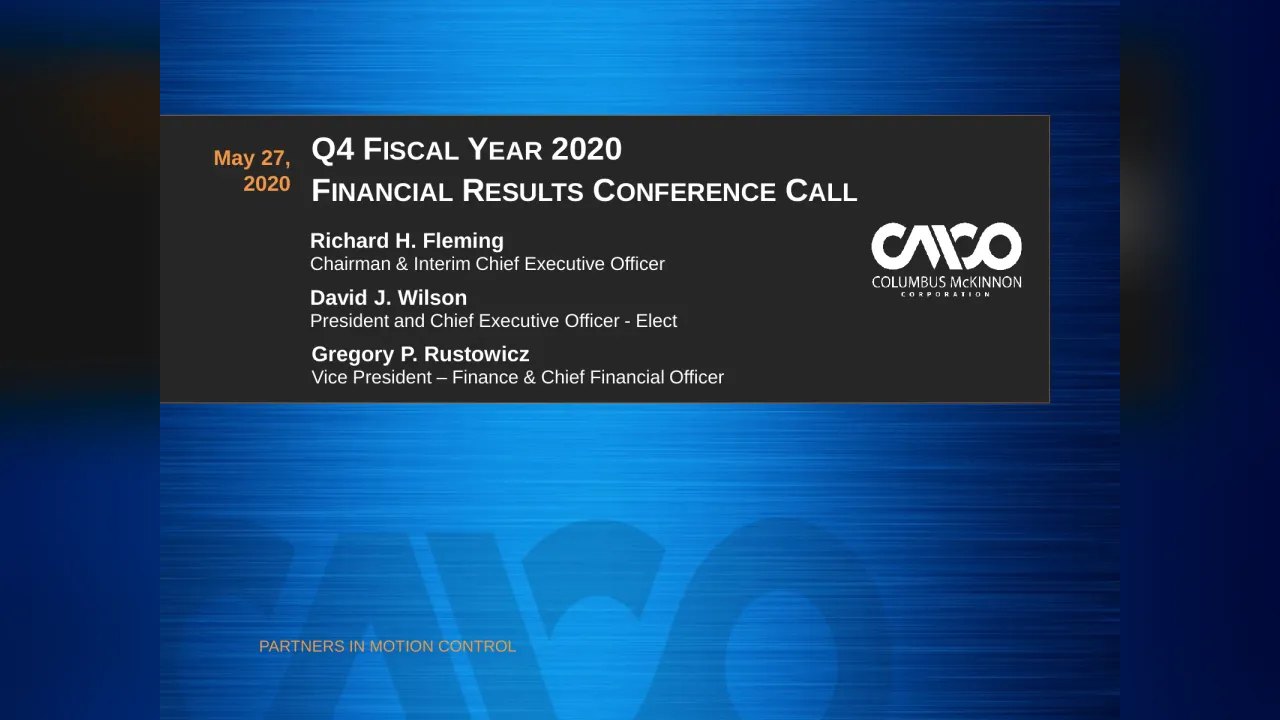
Columbus McKinnon (NASDAQ:CMCO) Q4 2020 earnings call, held 2020-05-27. Watch the replay and read the transcript on 6ix.
On 6ix: 6ix.com/event/columbus-mckinnon-corporation-cmco-q4-2020-earnings-call
Automated transcript · Written by software from the replay's audio. It can mishear names and figures; the replay is the record.
0:01 Greetings. Welcome to the Columbus McKinnon Fourth Quarter Fiscal Year 2020 Financial Results. At this time, all participants are in a listen-only mode. A brief question and answer session will follow the formal presentation. If anyone today should require operator assistance during the conference, please press star zero from your telephone keypad. Please note that this conference is being recorded. At this time, I'll turn the conference over to Deborah Pulaski, Investor Relations for Columbus McKinnon. Ms. Pulaski, you may now begin.
0:29 Thanks, Rob, and good morning, everyone. We certainly appreciate your time today and your interest in Columbus McKinnon. Here with me are Rick Fleming, our Chairman and Interim CEO, and Greg Rustowicz, our Chief Financial Officer. Also joining us today are our President and CEO-elect David Wilson. You should have a copy of the fourth quarter fiscal 2020 financial results, which we released this morning before the market. If not, you can access the release as well as the slides that will accompany our conversation today at our website, www.columbusmckinnon.com. After our formal presentation, we will be opening the line for Q&A. We kindly ask that you ask only one question with a follow-up question, and then please get back into queue to allow for a continuous flow and adequate time.
1:22 If you'll turn to slide two in the deck, I will first review the Safe Harbor Statement. You should be aware that we may make some forward-looking statements during the formal discussions as well as during the Q&A session. These statements apply to future events that are subject to risks and uncertainties as well as other factors that could cause actual results to differ materially from what is stated here today. These risks and uncertainties and other factors are provided in the earnings release as well as with other documents filed with Securities and Exchange Commission. These documents can be found on our website or at sec.gov. During today's call, we will also discuss some non-GAAP financial measures. We believe those will be useful in evaluating our performance. You should not consider the presentation of additional information in isolation or as a substitute for results prepared in accordance with GAAP.
2:09 We have provided reconciliation of non-GAAP measures with comparable GAAP measures in the tables that accompany today's release and the slides for your information. So with that, if you turn to slide three, I will turn it over to Rick to begin.
2:21 Rick? Thank you, Deb. Good morning to all of you. Thank you for joining us today. As Deb mentioned, we have a special guest today. During our last earnings call, I shared with you that we hope to identify and hire a new CEO by June of this year. So I'm extraordinarily pleased that even with the challenges of COVID-19, we were able to achieve this target and hire our candidate of choice, David Wilson. As we announced on May 14th, David joins us from FlowServe Corporation, where he was the president of the pumps division. Effective on June 1st, he will be our new president and chief executive officer and a director of the company. You will hear from David before we open the Q&A session. Now let's turn to slide three. Before we discuss our results for the quarter, I'd like to briefly update you on COVID-19 and its impact on Clemens McKinnon.
3:11 During these unprecedented times, our response to this pandemic has been guided by our core values, with the preeminent values being the health and safety of our employees, the trust of our customers, and business continuity. In early March, we established a COVID-19 task force which rolled out a communication process to keep our locations continuously informed. We quickly implemented stringent processes to reduce the spread of the virus with the goal of ensuring the safety, health, and well-being of our employees and their family. We seamlessly transitioned over 1,000 employees to a remote work environment. We also implemented the appropriate processes and took the necessary steps to be an essential business and critical supplier so that we could serve our customers while manufacturing in a safe environment that protected our employees.
3:57 As a result of these actions, I'm pleased to report that all of our manufacturing facilities have been able to remain open except Mexico, which was closed until recently due to government restrictions, and our Brighton, Michigan facility, which was impacted by the shutdown of the auto industry. Regarding business continuity, it was clear to us that the sudden and significant downturn in the demand for our products required swift action. We also knew that cash generation and liquidity preservation will be critical given the lack of visibility regarding the duration of the pandemic. So we rapidly took the necessary actions to align our operations to the significant decline in market demand that we were experiencing. We quickly implemented furloughs, layoffs, and short work weeks. We also developed a plan to reduce inventories while continuing to focus on strong on-time delivery performance.
4:46 Also, we suspended merit increases and bonuses for the first half of fiscal year 21. and importantly, given the successful execution of our blueprint for growth strategy and the discipline provided by our business operating system, EPAS, we entered this crisis with significant financial strength. Due to our record cash generation during fiscal 2020, we had almost $200 million of liquidity on March 31st, which consisted of $114 million of cash on hand and $84 million available on our revolver. Further, our strong cash generation during the year allowed us to pay down our debt by $51 million, leaving us with a leverage ratio of just 1.1 times. Given the COVID-19 recession, we elected to pay only the minimum debt service of $1.1 million in Q4 to reserve cash, and we will likely continue at this level during the remainder of the pandemic.
5:40 Lastly, our solid financial position enables us to continue to selectively invest in growth initiatives even during this slowdown. I will cover some of these initiatives following Greg's discussion of our financial results. Turning to slide four, I will now discuss our near-term and long-term objectives. For the near-term, our goals are to continue to generate positive cash flow and operating income. Our blueprint for growth strategy is key to our ability to achieve these goals. In addition to the cost reductions taken to address the COVID-19 recession, we are continuing our focus on the 80-20 process and operational excellence. In fact, we are ahead of schedule regarding the closing of our Lisbon, Ohio facility. We expect to have this shutdown completed by July and continue to expect about $5 million in annualized savings.
6:26 Given our positive cash flow and our confidence in our financial strength, we also expect to maintain our dividend during this recession. For the long term, our objective is still to become the market leader in safe and productive motion control products and solutions for our customers. We recognize that our future growth requires continued investment in technology and new products, building and retaining our enterprise talent pool, and advancing phase three of our blueprint for growth strategy. David joins us at an opportune time to drive the portfolio optimization and M&A efforts of phase three of our blueprint for growth strategy. Let's now turn to the results of our fiscal 24th quarter and the year that ended March 31st. Please turn to slide five.
7:12 The success of our strategy was demonstrated throughout the year as we expanded margins and achieved many of our financial goals, even as the industrial markets were slowing. Despite the falloff in demand in the latter half of March, we had a record adjusted gross margin of 36.1% in Q4. For the year, net income was nearly $60 million, and our adjusted EBITDA margin expanded 60 basis points to 15.7%, Further, the return on invested capital improved to 11.5%. As you can see on slide six, we had record cash flow from operations and record free cash flow in fiscal year 20. This performance was facilitated by strong working capital management, as indicated by working capital to sales ratio of 14.5%, a 200 basis point improvement over our third fiscal quarter of this year.
8:03 Turning to slide seven, I will now update you on the progress we are making with our 80-20 process. Not only did we outperform our original goal of a $12 million contribution to operating income in fiscal year 20, we also exceeded our updated goal of $18 million. As you can see, 8020 contributed $20.4 million to operating income during the year. Most of this contribution was realized in the gross profit line. As previously noted, it also includes the $2 million in savings realized from the closure of the Salem, Ohio facility at the end of fiscal 2019. We achieved this performance despite the $10 million reduction in sales that occurred in the latter half of March due to COVID-19. In fact, we were on track to achieve our previous revenue guidance for the quarter were it not for the pandemic.
8:49 We expect to continue to realize contributions from 80-20 in fiscal 21, although it will be difficult to quantify these amounts until we have more visibility regarding the shape of the recovery. The 80-20 process remains a key element of our operating discipline and will continue to be so under David's leadership. With that, I'll now turn it over to Greg to review our financial results in greater detail. Greg?
9:12 Thank you, Rick. Good morning, everyone. On slide 8, net sales in the fourth quarter were $189.5 million. Clearly, COVID-19 impacted our business results in the quarter. We were tracking towards our $200 million top line, but saw order rates for our short cycle business decline in the second half of March. We estimate that volumes were negatively impacted by about $10 million in the quarter, all occurring in the second half of March when countries began the lockdown. Later on the call, Rick will further discuss the COVID-19 impact that we are seeing today. As you know, we completed three divestitures last fiscal year, which reduced sales this quarter by $4.8 million compared to last year. Volume declined by approximately $23 million or 10.8%. While volume was down, our pricing power was evident as we saw year-over-year pricing improve by 1.3%.
10:04 About three quarters of this pricing was a result of our 80-20 strategic pricing initiatives. Foreign currency also continued as a headwind and reduced our sales by 2.3 million. Let me provide a little color on sales by region. For the fourth quarter, we saw sales volume decline in the U.S. by 13.1%. This was partially offset by price increases of 1.3%. Sales outside of the U.S. were down 9%, adjusting for the effects of divestitures. Solid price improvement of 1.4%, partially offset a volume decline of 8%. Sales volume was down in all international regions by mid to high single digits as a result of COVID-19.
10:49 Turning to orders and backlog, both our short cycle and project-based businesses were impacted similarly by COVID-19. Adjusted for divestitures and the impact of foreign currencies, orders were down year over year by 11.3%. Sequentially, we did see orders improve approximately 10% in both our short cycle and project-based businesses. As a result, backlog grew by 4.5% to $131 million from $125 million at the end of December. It's important to note that quoting activity continues at pre-COVID-19 levels, but our sense is that many projects are being delayed, especially in the U.S. While there is much uncertainty globally on the effects of COVID-19 and the shape of the recovery, we believe that we have bottomed out in April, and encouragingly, there are signs that our customers and channel partners are getting back to work globally.
11:44 As an essential business, all of our factories are operating today. We stand ready to flex production volumes back up at the appropriate time. Our strong market position and leading brands continue to serve us well, especially in times like these. We continue to focus on customer responsiveness and on-time delivery as the channel has been reducing inventory levels, and this will be more important than ever. On slide nine, our gross margin was 34.9% in the quarter. On an adjusted basis, eliminating the effects of factory closure costs and business realignment costs, we achieved a record adjusted gross margin for the quarter of 36.1%. For the fiscal year, as Rick mentioned earlier, We achieved a record GAAP gross margin of 35%.
12:32 We clearly benefited from the 80-20 process, which drove $5.5 million of gross profit expansion in the quarter and $20.4 million in the fiscal year through strategic pricing, indirect overhead reductions, and certain volume gains at our targeted accounts. This benefit more than offset the impact of the divestitures, lower sales volumes, and lower fixed cost absorption in our factories, due to lower sales levels in conjunction with significant inventory reductions that we are undertaking to drive free cash flow. Let's now review the quarter's gross profit bridge. Fourth quarter gross profit of 66.2 million was down 8.9 million compared to the prior year adjusted for the divestitures.
13:17 We did see gross profit expansion from pricing net of material cost inflation and tariffs were lower than the prior year as we imported less Chinese product. We incurred $1.3 million of one-time costs for the factory closures in Ohio and China, which was the same amount as the prior year, so this did not have an impact on the gross profit bridge. Foreign currency translation reduced gross profit by $800,000. Productivity net of other cost changes was negative $1.6 million. About half of this negative variance was related to higher workers' compensation costs incurred in the quarter related to three old claims. As shown on slide 10, RSG&A was 46.3 million in the quarter, or 24.4% of sales.
14:05 RSG&A was 2.7 million lower than the previous year. Reduction in RSG&A was due to several factors. The best years reduced RSG&A by 400,000, and we benefited from FX translation of approximately 600,000. In addition, we lowered our RSG&A costs by 3.9 million, which was partially offset by $2.2 million of additional costs for the CEO search, higher bad debt accruals, and business realignment costs. With the current COVID-19 pandemic, we have taken quick and decisive actions to reduce our RSG&A costs in the coming quarters. We have eliminated merit increases, foregone bonus accruals, reduced headcount, and significantly reduced travel to name a few. We will monitor market demand and will add back resources when the timing is right. We will, however, continue to invest in select growth initiatives as Rick will discuss further. Taking all of this into account, we are forecasting Q1 FY21 RSG&A of approximately $39 million.
15:13 Turning to slide 11, adjusted operating income was $20.2 million. Adjusted operating margin was 10.7% of sales, an 80 basis point decline from the prior year. The driver of this decline was the impact that COVID-19 had on our sales volume. Decremental operating leverage in the quarter was a negative 17%, which is significantly better than what we saw in the 2009 timeframe. For the year, our adjusted operating income declined $2 million on lower revenue of $67 million, Yet adjusted operating margin expanded 70 basis points to 12.1%. This represents a decremental margin of 3%, which is outstanding performance considering the circumstances.
15:59 Our blueprint for growth strategy and specifically our 80-20 process and operational excellence initiatives helped to drive this margin expansion. As you can see on slide 10, GAAP earnings per diluted share for the quarter was 39 cents. adjusted earnings per diluted share was $0.58 compared with $0.69 in the previous year, a decrease of $0.11 per share, about 16%. For the full year, adjusted EPS was $2.78 per share, an increase of 1.5%. We expect fiscal 21's full year tax rate to be approximately 21% to 22%. On slide 13, we continue to expand our adjusted EBITDA margin.
16:44 For the year, our adjusted EBITDA margin was 15.7%, an increase of 60 basis points from last year. Our return on invested capital was a solid 11.5%, an increase of 30 basis points from last year. Our Blueprint for Growth financial goals of 19% EBITDA margin and mid-teen ROIC remain unchanged. However, the shape of the recovery curve from COVID-19 will determine when we are able to achieve these goals. We continue to utilize our 80-20 process to drive efficiencies so that when the recovery comes, we will be able to accelerate our growth and further strengthen our margin profile. Moving to slide 14, you have heard me say many times that one of the hallmarks of Columbus McKinnon is its ability to generate cash throughout the business cycle.
17:34 That cash from operating activities for the quarter was $36.5 million, which was a year-over-year increase of $10.8 million or 42%. For fiscal year 20, we generated a record $97.4 million of free cash flow. This represents about a 45% increase in free cash flow. We were clearly ahead of the curve in reducing our working capital needs heading into the pandemic. We took rapid actions to preserve and generate cash. We drove our working capital as a percent of sales to 14.5% which contributed to the record free cash flow. Going forward, we believe we still have opportunities to reduce our inventory levels further. In addition, we will manage CapEx to $5 million in the first half of the year and we'll reassess our CapEx in the second half of the year based on current economic conditions.
18:28 Turning to slide 15, our total debt at the end of the quarter was approximately $251 million and our net debt was $137 million. Our net debt to net total capitalization is now approximately 23%. We repaid the minimum required debt in Q4 of $1 million and plan to pay the minimum required debt in fiscal 21. We have made excellent progress delevering and have achieved a net debt to adjusted EBITDA leverage ratio of 1.1 times, which provides us the financial flexibility to weather the current pandemic. We have a flexible capital structure, which is covenant life. which means our financial covenant is only tested if we have outstanding borrowings against our revolver. Subsequent to March 31st, we did draw $25 million on our revolver for liquidity and working capital purposes while demonstrating that we have a supportive bank group led by JP Morgan.
19:25 Please turn to slide 16 and I will turn it back over to Rick.
19:30 Thank you, Greg. I will now discuss some of the select strategic initiatives that we are continuing to fund even during this slowdown. Our transformation into an industrial technology company requires a strong digital platform and we are continuing to invest in this area. Our digital platform project has been underway for the last two years and it is a critical underpinning of our strategy. If you've not been to our website lately at www.clumbasmckinnon.com and for this audience, investors.clumbasmckinnon.com, I encourage you to check it out. Our new digital platform provides a unified and comprehensive presentation of all of our brands, further enables our customers to have a seamless, integrated digital experience where they can use our configurator, communicate with the appropriate support staff, and buy our products.
20:19 This slide shows the home page from the website, and it depicts an operator controlling our equipment from a computer. As part of this effort, we have developed a product information management system, or PIM. which is a single digital asset that contains a comprehensive product catalog. The PIM feeds the website, our configurator which is known as Compass, and our e-commerce capabilities. It's also a critical tool that will support our channel partners and an essential element of our transformation into an industrial technology company. Another critical factor in our transformation is the continued development of new products. Shown on slide 17 are product advancements that we are making in automation and simplification for Crane Solutions customers. These branded solutions create safer work environments for our customers by protecting the health and safety of their employees.
21:10 For example, IntelliProtect is a further evolution of our no-fly zone solution. It's now offered with a single zone using limit switches or a multi-zone configuration that addresses eight different zones using laser positioning. This product has easy programming and control that is driven by an app that can be used on laptops, cell phones, and tablets. Most importantly, Intel Protect is a standardized offering versus an engineer-to-order solution, and this reduces its lead time from roughly seven weeks to just seven days. Another automation solution that addresses both productivity and safety is our Crane Kit, which we have continued to enhance and expand in terms of lifting capacity and product features such as explosion protection, Rain Covers, and Stainless Steel Control Panels.
21:58 In addition, we've added load displays and rail sweeps providing more complete product offering. Importantly, we have also enhanced our crane kits to be plug and play. This makes the crane easier and quicker to install, and it eliminates the errors that can occur during assembly and wiring. We are excited about the advancements that we are making with our products and the opportunity to grow this revenue stream. As such, even during this downturn, we are continuing to find ways to solve our customers' high-value problems through product design and development. If you now turn to slide 18, I will provide some details on our outlook and then introduce David. The near shutdown of the Americas and Europe in April resulted in a 37% drop in orders compared to April of last year. However, orders have since stabilized and even firmed a bit during May. At these demand levels, we now expect that our first quarter revenue will be in the range of about $130 million to $140 million.
22:54 However, even at these low revenue levels, we expect to achieve our near-term goals of generating positive operating income and cash flow. As mentioned, to conserve cash, we plan to make only the minimum required debt payments during this downturn. However, it should be noted that we reduced debt by nearly $186 million over the last three years due to our strong cash flow. and this gives us considerable financial flexibility. Given this financial flexibility and our confidence in our ability to generate positive cash flow, we expect to maintain our dividend at its current level. Regarding our other long-term priorities, we will continue to invest in select strategic growth initiatives and in our phase three M&A research and outreach, albeit at a more measured pace due to the pandemic.
23:40 And importantly, we will continue to execute our blueprint for growth strategy with his focus on operational excellence and ramping the growth engine. Now, it is my pleasure to turn the call over to David Wilson, our president and CEO-elect, but first I want to tell you why we are so excited that he will be joining us shortly. During the search process, David became our candidate of choice because of his proven success with operational excellence and customer-centric commercial growth. He has substantial international and business development skills and a demonstrated track record for delivering results, and most importantly, He has strong leadership skills and a proven track record of driving performance cultures to even higher levels. Given his background, leadership capabilities, passion for excellence, and his cultural fit with Columbus McKinnon, the board unanimously decided that David J.
24:28 Wilson should be our next president and CEO, and we are delighted that he will be joining us on June 1st. So with that, I will now welcome David. David.
24:38 Thank you, Rick, and good morning, everyone. It's a pleasure and an honor to have the occasion to address you today, even before I'm officially on board at Columbus McKinnon. First, allow me to introduce myself, and then I will tell you why I am very enthusiastic about having the opportunity to lead CMCO. I'll be joining the company on the 1st of June after I finish the transition of my responsibilities at Closer Corporation, a leading fluid motion and control products and services company with approximately $4 billion in revenue. I joined FlowServe back in September of 2017. Since then, FlowServe has been undergoing a transformation, and as part of that effort, we consolidated two divisions into the pumps division. I've been the president of the pumps division since it was formed in July of 2018.
25:27 Prior to FlowServe, I was president of the industrial segment at SPX Flow, which was spun out of SPX Corporation in September of 2015. Combined, I was with SPX in the spinoff for nearly 20 years. At SPX, I served as president for a number of their industrial, technology, flow control, automotive, and food and beverage equipment businesses, many of which were similar in size or larger than Columbus McKinnon. In these roles, I was responsible for defining the strategic visions for the businesses, developing growth initiatives, implementing business simplification processes, and restructurings. as well as leading acquisition and portfolio management strategies. I also have quite a bit of international experience having spent the better part of a decade living and working abroad in both Asia and Europe.
26:20 I began my career as an engineer for Polaroid Corporation and advanced quickly into manufacturing and product development leadership roles. I'm an electrical engineer by education and I'm originally from the Northeast as is my wife. My family and I are sincerely looking forward to our move to Buffalo. You may be wondering what attracted me to this opportunity at Columbus McKinnon. First, I was impressed with Columbus McKinnon's industry leadership. This is clearly demonstrated by the company's well-known brands and strong customer relationships. In addition, Columbus McKinnon has a logical foundation for its growth strategy with its focus on smart movement and being a lifting specialist. Finally, I believe there are tremendous opportunities to grow Columbus McKinnon by advancing our motion control technologies with new product development and acquisitions that expand our addressable markets and target growth trends.
27:18 For these reasons, I was truly drawn to this opportunity. I'm also impressed with the effectiveness of the blueprint for growth strategy, which defines direction, provides for accountability, and has clearly improved the earnings power of the company. I'm looking forward to working with the team to advance Columbus McKinnon's 80-20 process and operational excellence initiatives. I'm also excited about phase three of the strategy. While we're currently in unprecedented times given the pandemic, I've seen that the team has acted quickly to adjust to the current market environment while also pursuing the select strategic initiatives that Rick discussed. I look forward to working with our team to navigate through this period and leading the development of a stronger, more sustainable growth platform centered around market segmentation, innovative product development and acquisitions.
28:12 Initially, I'll be getting to know the global team and operating cadence. Then as restrictions lift, I plan to get out to meet customers and in the midst of all that, hope to have the opportunity to meet some of you, even if only virtually for now. In closing, I'd like to add that I have very much enjoyed my interactions with the Columbus McKinnon Board throughout the recruiting process. I'm impressed by how intelligent, thoughtful, and engaged each of them is individually and how aligned they are collectively. I'm truly looking forward to partnering with them as a member of the Board of Directors. On that note, I'd like to extend a big thank you to Rick and the other members of the Board for this opportunity. I'm ready to build upon the solid foundation that the team has established and take Columbus McKinnon to the next level.
29:01 I'll turn it back to you now, Rick.
29:03 Thanks, David. Operator, we can now open the call for questions. Thank you. We'll now be conducting a question and answer session. If you'd like to ask a question, please press star 1 on your telephone keypad and a confirmation tone will indicate your line is in the question queue. You may press star 2 if you'd like to remove your question from the queue. For participants that are using speaker equipment, it may be necessary to pick up your handset before pressing the star keys. In the interest of time, and to allow as many as possible to ask questions, please ask one primary question and one follow-up question. You may then return to the queue for additional questions. One moment, please, while we poll for questions.
29:43 Thank you. Our first question is from the line of Chris Howell with Barrington. Please receive your questions.
29:50 First off, congratulations, David, and I look forward to meeting you in the not-too-distant future. Thank you, Chris. Just starting off, looking big picture, as we look at your current liquidity position of 1.1 times and 1.1 times leverage ratio in combination with your overall balance sheet position and the current environment that we still sit in, how should we think about the impact this has on the timing of your Phase 2 initiatives? in combination with Phase 3, which is on the horizon, understanding there might be some delay given the uncertain optics that we're currently in.
30:35 Perhaps you can comment on that, and then I have one follow-up.
30:40 Yeah, Chris. Hi, it's Greg. How are you? Good. So as you know and as you follow, we're in great shape from a capital structure perspective and well below our Our covenant level three times and just to remind you again that the covenant test only comes into play if we were to draw off of our revolver. So I think, you know, we're going to continue to pursue the phase two operational excellence items as well as 8020. And regarding phase three, you know, we're still doing a lot of pre work to get ready for that. But I think we've just got to be responsible in this current timeframe until we know that Things have stabilized and it makes sense to move forward with potential acquisitions.
31:27 And I think this also gives David time to get on board and learn the business, understand it better, and help set the strategic direction for the company.
31:37 Great. That's helpful. And then following up on that, has there been any change or material shift in what you're seeing as far as the backlog situation? of opportunities that would be viable for Phase 3 as companies similar to your size or smaller are stressed during this time and as they come out of this pandemic environment.
32:00 Chris, this is Rick Fleming. I would simply say that as we do our work on Phase 3 to date, we have not seen any major change in parties' willingness to consider strategic initiatives. The pandemic is still kind of fresh in their minds and people are kind of working through it. But I assure you that we have continued our research. We've had some outreach, albeit at a more measured pace, as I've indicated, because of the pandemic. And a lot of the heavy lifting on strategy will, of course, continue, particularly as David joins us and helps us through that strategic analysis. So I don't want you to think that it's not top of mind with us. but the pandemic does provide some constraints such as travel and certainly due diligence in this market right now.
32:50 Okay. Thank you for taking my questions. I'll hop back into the queue. Thank you. Our next question is from the line of Joe Mandela with Snowdian Company. Please proceed with your question.
33:05 Hi, everyone. Good morning. Hope you're all doing well. First question, just related to the RSG&A guidance that you provided for the first quarter. I was just a little surprised given that your sort of revenue guidance is calling for sales down around 35%, 37% year-over-year. The RSG&A guidance is just about 12% year-over-year decline, so I'm just curious of why that would not decline a little more given the revenue guide?
33:41 Yeah, so I think, Joe, this is Greg. So clearly there's a piece of our selling costs that truly are variable. And we have taken out a significant amount of cost in the IRS G&A line, mostly in the selling and the G&A in particular. But by its nature, it's going to have more fixed costs in it than You might see in the manufacturing area or gross profit area. So we have taken substantial headcount reductions as a company overall. And we've also implemented short work. As Rick mentioned, we've eliminated merit increases, foregone bonuses in the first half of the year, cut travel to virtually zero.
34:32 Professional services have, for the most part, been eliminated. So as we looked at our cost structure, we've taken an aggressive approach to reducing all costs to protect liquidity and profitability of the company. But I think just by its nature, SG&A is going to have a little bit higher proportion of fixed costs in it.
34:53 Okay, my follow-up would be, could you provide an update on sort of at this point in terms of your visibility, what you see for cost savings for fiscal 21? I believe you were sort of calling out about $13, $14 million on one of the prior calls. Could you just update us on what you foresee in terms of 80-20 and further cost cuts, facility closures, etc.? ?
35:22 Yeah, so in terms of, you know, actions we've taken on an annualized basis, it's about $36 million of cost. And that's all the items that I mentioned before. And I would say, though, that we are going to flex up when volume does start to return. So I wouldn't look at it as, you know, that our cost base is going to be down $36 million for the entire year. But it's really running at about a $9 million a quarter rate. And regarding 80-20, we do have, as Rick mentioned on the call, the Lisbon, Ohio facility will be completely shut down by July. So we'll get three quarters of the benefit of that, which is a $5 million annualized benefit.
36:08 We have a little bit of a carryover from our consolidation in China, which is about three quarters of a million dollars. So in total, we should see about $5 million from We are continuing to develop plans for further consolidations, but we're not ready at this point in time to announce any further consolidations. And it's a little bit hard right now with the travel restrictions as well.
36:34 And if you don't mind, I just want to follow up really quick just so we're clear. The $9 million per quarter, $36 million, that's not incremental, correct? That's what you've already sort of realized and taken out of the business?
36:45 Yes. No, that's incremental in the quarter, additional actions. So that's part of the reason. Yeah, just to be clear. So remember, our typical RSG&A is about a $45 million run rate. So, you know, dropping down to 39 in the quarter is $6 million of the $9 million. It hits in that line, and then the other $3 million would be more or less direct and indirect costs and cost of goods sold.
37:15 Okay, got it. Thanks for taking my questions. Next question is from the line of Mike Schliske with Starting Company. Please proceed with your question.
37:27 Good morning, everybody, and David, welcome to you. Thank you, Mike. So I've been hearing a lot of companies, as they kind of reopen, are finding at least some of their machines were not designed for a 68-week layoff. These are kind of unprecedented shutdowns for a lot of these companies out there. So some machines were broken, corroded, or otherwise out of service after that time frame. And some of the first phone calls that they made were to some of their suppliers or shop for equipment to either repair or just send them a new one. I was kind of curious. I know it's early. It's just some areas are just now coming back. But have you seen that happen at any customers? Are they calling you on their first day saying things just are not working here? Can you come in and fix them?
38:14 Mike, this is Rick Fleming. Clearly, as companies come back, the auto industry is a good example, we are seeing more quoting activity, we're seeing more orders, but in all fairness, I'd say right now it isn't showing up necessarily in actual shipments yet, although things in May certainly were better than April, starting to firm and stabilize, is the way I characterize it, and it looks like as June, it Thank you very much. We've also had a number of projects, surprisingly enough, in oil and gas that were committed that seem like they're going forward. They may be a little bit delayed, but we haven't seen outright cancellations to a high degree yet.
39:25 So we're feeling that things are starting to get a little bit better, but I don't want to overstate it right now.
39:34 Okay. My follow-up was just on the pricing outlook. I guess Can you give us some view as to your near-term outlook on that part of your business? I'd imagine you're not planning to chase a lot of pricing in this environment. It might not be worth it given what could be a somewhat short downturn. But I'm just kind of curious to see your thoughts on the pricing outlook for the near
39:55 term. Yeah, so, you know, we typically do announce price increases in the U.S. in the March timeframe. We did, you know, pull that up a little bit. So we would expect, you're right, the market right now is not all that receptive to price increases. But nonetheless, I would expect that we will see positive price increases as an enterprise in the upcoming quarter. So we're not seeing price declines, which I think is a good thing, and there should be some incremental pricing that we see. It might not be to the level that we have seen this past year, which is around 1.3%, but it should still remain positive year over year.
40:39 Got it. Okay, thank you. I'll pass it along. Our next question is from the line of Jon Townsend with DJS. Please proceed with your question.
40:51 Hey, good morning, guys. David, congrats on the appointment. My first one's for you. I know it's a little bit early and you still need to, you know, take more time to peek under the hood. But, you know, maybe coming on board, looking at it with a fresh set of eyes. What's jumping out as the most immediate opportunity or challenge for you personally as we prepare for a post-pandemic world?
41:12 Thanks for the question and appreciate the opportunity to talk to you. I guess I'm pretty excited about the fact that Columbus McKinnon is an industry leader and has well-known global brands and a strong set of customer relationships and As you have seen, the company has made significant progress with the Phase 1 and Phase 2 initiatives they've implemented over the past few years, executing on the Blueprint for Growth strategy. I mean, just to cite a few examples, progress in establishing the mission, vision, and values-driven performance culture, the discipline and rigor with which the team has implemented its business operating system, including the implementation of the 80-20 process, and then the resulting gross margin expansion and reduced debt levels that enable the company to deliver returns with a lower risk profile.
42:04 I believe that Columbus McKinnon is in the early stages of a significant transformational agenda and I'm truly energized by the opportunities that lie ahead. We must advance the company's blueprint for growth strategy and advance the performance differentiation that will be enabled through true operational excellence. and in parallel, we need to pivot hard towards growth, both organic and acquisitive. And I believe there are many attractive avenues for us to pursue. Clearly, we're in unprecedented times and we need to focus on first things first. And the team has demonstrated their ability to be agile and to respond rapidly in this pandemic environment, safeguarding employees, complying with CDC, federal, state and local requirements and adjusting new market levels but I'm confident we can get through this and I'm truly excited about becoming a leading global industrial technology company.
43:01 Got it.
43:02 Thank you for that. Greg, I was just trying to get a sense of which quarter may end up being the trough for you as it stands now. You know, what are your clients telegraphing to you about the third calendar quarter? Are they planning for You know, is SETI ramped back up, or is it maybe a second dip or wave that's maybe in the cards? Are you planning for, you know, such a scenario at all, and what would you do in that case?
43:24 Yeah, so as Rick mentioned, we would expect, you know, clearly with things firming up in May and countries getting back to work, in Germany, for example, all the automotive manufacturers are back working. In the U.S., states are now opening up. So my personal sense, and I'll ask Rick to comment on this as well, that I would expect that our first fiscal quarter is going to be the toughest quarter for us and that we should start to see things returning to normal. But having said that, my personal belief is until there's a vaccine, it's going to be a year before we see year-over-year growth that while things will improve, They're not going to be above this current year, which was really an outstanding year for us from a company perspective. Maybe, Rick, you'd like to comment as well?
44:16 Thanks, Greg. Let me just set the table a little bit regarding trends, and then we can talk about the outlook. But just to give you a flavor for the period of March and April, we've given you some aggregate numbers, but one way I look at it is sequentially, and March orders for the industrial business, which is our short cycle business to a high degree, basically came in at 88% of February. And then April was 70% of March. That gives you a sense of the dramatic drop that we had. And it mirrored pretty much a lot of the statistics that you've seen from the indexes like the supply chain index. But having said that, May has firmed.
45:04 and we haven't closed the books yet, obviously on May, but it may even be up a bit. And we're starting to see some interesting trends on orders. We had a large automation division order recently for the Army Corps of Engineers. We, surprisingly enough, had a 433,000 rail order that came in. 825,000 for radio controls for a Chevron project so as I mentioned the project business continues to seem to be active and now as Greg alluded to we're starting to see sections of the economy come back you know our entertainment vertical has been really radio silent since the pandemic and now you're hearing talk of Las Vegas at least starting to come back so there are some early signs that things could get better so to Greg's point I think the first Thank you very much.
46:30 You've got the base case. You've got the level two actions that you can go to. They're all pre-vetted, and we have been thinking a lot about them. And obviously, David will be helping us with that. But we have another layer of earnings actions and cash actions that we can implement if necessary. But we're hoping that we've seen the worst, and we're hoping that we start to come out of this. I think Greg also summarized it well. We have a collective view that this pandemic is not going to be behind us. Thank you so much. I wanted to touch on one more point. You mentioned the break-even revenue level in your press release. I'm wondering, what does that include in terms of cost reduction, either from 80-20 or the temporary stuff that you're doing?
47:27 Is there more cost reductions after that? And then does the true break even become even lower? Or is that kind of the trough level and then trough, you know, where you expect even margins to be at the worst?
47:40 Let me take this one. So, yeah, so the break even level, we felt that it was important that people understand the magnitude of the cost savings actions that we have taken. So that's with everything that has been implemented to date. And so if, for example, orders were to take another decline from current levels, there are certainly more actions that we could take. They would be very painful for sure. But, you know, they are we know what we would do. So, you know, I think what the takeaway is, is with the revenue guidance that we've given and given the break even, we would expect positive operating income. But the one thing you do have to remember is that we do have to carry about $3 million of interest expense.
48:26 So if you're looking at it from a net income perspective, you know, that's got to be factored into your calculus on it. But once again, at the current, you know, at that $125 million level with the actions we've taken to date, we believe we would be, you know, break even or slightly better from an adjusted operating income perspective. and that takes into account all of the 80-20 that we've done last year, the benefits of the Lisbon consolidation, all the additional actions we have taken. But there would be more taken if need be. Thank you. Our next question is from the line of Walter Liptak for Seaport Global. Please proceed with your question.
49:13 Hi. Good morning and congratulations, David, on a new job. Thank you, Walter. My question is about the revenue guidance, the 130 to 140. It looks to me like the midpoint of 135 is down about 37%. And so I just wanted to get a better idea. You talked a couple of times about what firming up means. Does that mean that we've kind of taken the step down and we're now at a kind of stable level like on a week-to-week basis? Or in the first couple of weeks, I wonder if you can compare the first couple of weeks of May to what you're seeing now in the last few weeks of May and get a better idea about the firming that's going on?
50:08 Yeah, so... Well, let me start with that. And so we clearly have seen May levels firm, as Rick said, which means that they are, you know, equal to or slightly better. Now, we do have variability, you know, day to day in orders. And so that's a part of what has to be taken into account. But when I look at like the average order rates through Friday of last week, they are slightly better than they were for the whole month of April.
50:44 Okay.
50:45 And I wonder if you could talk a little bit about the trends in distribution versus projects, because it sounds like there's some projects that might be skewing the number a little bit. And if you could help us think about your distribution business, how big is that now as a percentage of revenue? and, you know, if there was de-stocking that was going on that, you know, I guess should come to an end at some point.
51:15 Yeah, so, you know, when we look at April orders, you know, we were more impacted in our short cycle business, down probably over 40%. Projects not quite as bad, you know, maybe in the 30% range. We do, as Rick said, we are, you know, still getting large projects. We just won a large project in Saudi Arabia, which is over almost 3.5 million euros. So that's a nice order that we'll get and be able to fill in the latter half of the year. So I would say that projects, it's still down double digits, maybe not quite to the same extent as what we're seeing in our short cycle business. And in terms of your question on distribution, about 62% roughly goes through distribution. and the channel is being very, very careful about adding inventory. And, you know, the one part of the channel that's doing really well are the specialty distributors, which are, you know, the MSCs and the Fastenals, you know, where they've got a lot of MRO activity and they're open and they're supplying lots of different pieces or MRO products to their customers.
52:30 So that channel seems to be more active for us. Okay, great.
52:36 And maybe the last one for me would just be, you know, geographic. You guys have a lot of business in Europe, I think about a third, and you've got some Asia business. I wonder if there's any trends going down there or out there. And what I'm thinking of is, you know, it seems like China, Asia is maybe ahead of the curve with opening back up for business, followed by Europe, and then, you know, the U.S. later. Are you seeing any trends?
53:06 This is Rick, and yes, China is starting to come back. Surprisingly enough, even the entertainment business is coming back a little bit in China. But it's relatively small as a part of the company, but we are seeing positive trends in that area, less so in Japan right now, just to give you a flavor for the fact that not all countries in the region are on the same time horizon right now as it relates to recovery. In Germany, as Greg mentioned, it's just starting to open up. The autos are coming back. We're starting to have factories have more activity. Commerce is starting to move ahead from a near standstill. So that seems to be improving in that part of the world as well.
53:54 And then Latin America, I would say, and Brazil just totally shut down right now. So nothing going on down in that area. And Mexico just... It's a situation where it really does vary by region, and the U.S. is probably one of the areas that are a little more active right now, in addition to Europe and China. Our next question is from the line of Greg Helm. Please proceed with your question.
54:28 Hi guys, this is Danny Ayrton for Greg Palm. Congratulations and welcome to David. Thank you, Danny. I guess as we're looking at kind of the start of opening back up the economy and getting past this pandemic, are you seeing or planning on seeing any increased interest for automation or smart sensor technology or anything like that?
54:57 We are very excited about these prospects for our new automation division and we are seeing interest. Right now we've been booking about a million dollars a month up until lately in that area with the new division that we formed. So we feel pretty good about the opportunities and particularly the fact that automation is probably going to be a mega trend in the new post-COVID economy, particularly in the warehouse area. So we see some pretty good reasons to want to consider that as an area for future growth as well as new products. So the answer is yes. And a lot of that, by the way, is going to be oriented toward making sure that facilities have a lot of health and safety considerations and automation adds in that area to health and safety.
55:49 Yeah, makes a lot of sense, I guess. And then just one. Any update on the kind of competitive landscape given this unusual time in the market?
56:01 Yeah, so I'll take that one, Danny. So, you know, clearly our competition has been affected by COVID like we have. And both of our main international competitors, they're both public companies, they both have websites where you can Take a look at different things. I know in the case of Kona Cranes, they've taken dramatic actions in Finland where they have a very large workforce to move to short work weeks and lay people off. So I think everybody is right-sizing their businesses to the volume levels, but I would say that you could probably take a look on their websites and get more information.
56:50 All right, that's it for me. Thanks, guys. Thanks, Danny. Thank you. As a reminder, you may press star 1 to ask a question. Thank you. At this time, we'll turn the floor back to you, Rick, for any closing comments.
57:09 Well, thank you. Thank you for joining us today. We look forward to reporting our first quarter of fiscal year 21 in July. Thank you everyone. This will conclude today's conference. You may disconnect your lines at this time. Thank you for your participation.
Follow Columbus McKinnon Corporation into a list and get an email when it puts out news.
Investor Relations, Columbus McKinnon
Chief Financial Officer, Columbus McKinnon
President and CEO-elect, Columbus McKinnon
Analyst, Seaport Global
Analyst, Barrington
Analyst, Snowdian Company
Analyst, Starting Company
Chairman and Interim CEO, Columbus McKinnon
Analyst, DJS
Analyst (for Greg Helm)