Raheet Mardwaj
Chief Financial Officer
Replay available
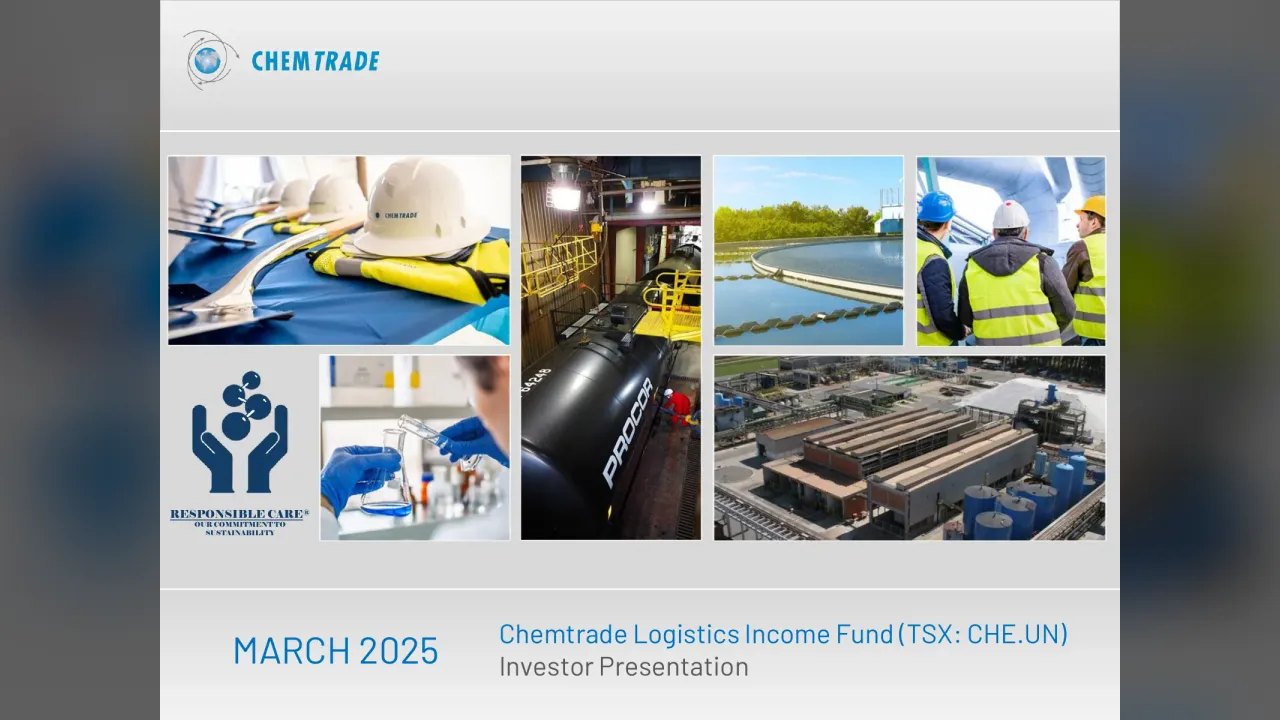
Chemtrade Logistics Income Fund (TSX:CHE.UN) Q4 2024 earnings call, held 2025-02-28. Watch the replay and read the transcript on 6ix.
On 6ix: 6ix.com/event/chemtrade-logistics-income-fund-chedbd-q4-2024-earnings-call
Automated transcript · Written by software from the replay's audio. It can mishear names and figures; the replay is the record.
0:01 Good morning, ladies and gentlemen, and welcome to the Chemtrade Logistics Income Fund Q3 2024 conference call. At this time, all lines are in a listen-only mode. Following the presentation, we will conduct a question-and-answer session. If at any time during this call you require immediate assistance, please press star zero for the operator. This call is being recorded today, Friday, February 28, 2025. I would now like to turn the conference over to Raheet Mardwaj. Chief Financial Officer, please go ahead.
0:34 Thank you, John. Good morning to everyone joining us on today's call to discuss ChemCrate Logistics Income Funds fourth quarter and full year 2024 results. Joining me on this call is Scott Rook, our President and Chief Executive Officer. We will begin today's call by reviewing our key achievements in the fourth quarter and full year 2024. Then we will share our outlook for the year ahead and what we expect for Chemtrade's business moving forward. Following our prepared remarks, we will open the call to analysts for Q&A. This call has an accompanying slide deck available on our website, chemtradelogistics.com, which we may refer to throughout our presentation.
1:21 Please note that this call will contain certain forward-looking statements that are based on current expectations and are subject to a number of risks and uncertainties. Actual results may differ materially from expectations. Further information identifying risks, uncertainties, and assumptions, and additional information on certain non-IFRS and other financial measures referred to today can be found in the disclosure documents filed by ChemTrade with the Securities Regulatory Authority available on CDARplus.com. One of the measures that we'll refer to in this call is adjusted EBITDA, which is EBITDA modified to exclude non-cash items such as unrealized foreign exchange gains and losses. While our slide deck refers to adjusted EBITDA, we'll simply refer to it as EBITDA in our prepared remarks.
2:19 2024 was another strong year for ChemTrade. We had an outstanding year from a safety perspective, as well as having strong financial and operating performance. The results we reported earlier this morning exceeded our expectations at the start of the year. This is a reflection of the resilience of our business, the effectiveness of our strategic initiatives, and the commitment of Chemtrade's employees. In 2024, we delivered the second highest annual EBITDA in Chemtrade's history. We also made significant progress on a number of strategic initiatives to position Chemtrade for long-term value creation. We invested further in our two primary growth areas, water chemicals and ultra-pure acid, demonstrating our commitment to capitalizing on the strong growth outlooks for these products.
3:10 In addition to our growth investments, we took additional steps to optimize our capital structure to ensure that we are continuing to maximize value for our unit holders. These activities included initiating a normal cost issuer bid that provided us another tool to drive incremental unit holder value and return additional capital to our unit holders. I will discuss these balance sheet initiatives in a bit more detail in a few minutes. All of these achievements reinforce Chemtrade's strong foundation as we continue focusing on sustainable growth, operational excellence, and long-term value creation. Our strong performance in Q4 and throughout 2024 was reflected across our key financial metrics. including over $213 million of distributable cash generated for the year.
3:59 This resilient and robust cash flow generation is key to our strategy, supporting our attractive distribution, our growth investments, and strong financial position. The biggest contributors to Chemtrade's growth in recent years have been water chemicals and chloralkali chemicals. These products continue to deliver solid results throughout 2024, including in Q4. Meanwhile, our other key products, including retail and merchant sulfuric acid, remain steady contributors to our results during the year. For the full year 2024, we generated consolidated revenue of $1.79 billion and EBITDA of $470.8 million. These results were in line with 2023 if you exclude the impacts of the P2S5 business sold in Q4 2023.
4:50 the North Vancouver turnaround in Q2 2024, and the Canadian railway work stoppage in Q3 2024. This once again highlights the resilience of our business and our ability to deliver strong performance regardless of the broader operating environment. Now looking at the fourth quarter, we generated consolidated revenue of $446.5 million and EBITDA of $108.6 million. Excluding the impact of the P2S5 sale in the prior period, our Q4 revenue grew by 7% and EBITDA by 31%. Water chemicals were the biggest driver of this year-over-year growth, while higher selling prices for regen and merchant acid, HCL and chlorine also contributed.
5:35 In addition, with Northeast Asia caustic soda index pricing strengthening over the course of 2024, caustic shifted from being a headwind in the first half of the year to a growth driver in the second half. Now, turning to our capital allocation, in 2024, we continue to balance capital allocation across our three key pillars, reflecting our disciplined approach. First, we prioritize high-return strategic growth opportunities that strengthen our competitive position and enhance our long-term earnings potential. In 2024, we invested $81.3 million of growth capex, primarily into our key growth areas of water chemicals and ultra-pure acid, positioning us for sustained value creation. Looking ahead, we plan to invest between $40 million and $60 million of growth capital in 2025.
6:25 Importantly, our growth strategy is fully funded through internally generated cash flow and the availability of our revolving credit facility, ensuring that we can execute on the attractive opportunities ahead while maintaining financial flexibility. Second, as our earnings and distributable cash flow continue to grow, we remain committed to returning capital to our unit holders. In June of 2024, we launched an NCIB. Given Chemtrail's current valuation, we believe that purchasing our units represents an attractive use of our capital. Under this program, we purchased 5.1 million units in 2024, and we have remained active on our NCIB in 25, purchasing an additional 2.7 million units here today. We will continue to take a disciplined approach to capital returns, balancing distributions, buybacks, and other strategic priorities. We expect to remain active on our NCIB through its expiration in June.
7:21 Additionally, in January 2024, we increased our monthly distribution by 10%, and in January 2025, we announced another approximately 5% increase, bringing it to 5.75 cents per unit or 69 cents per unit on an annualized basis. The latest increase reflects the confidence of both management and the board in ChemTrade's outlook. With a conservative 37 payout ratio over the last 12 months and an attractive 6.6% yield, we believe ChemPay continues to offer compelling returns for our unit holders. An overarching tenet of our approach to capital allocation is to maintain a strong balance sheet. Our prudent financial management ensures that we have the flexibility to invest in growth, return capital to unit holders, and financial flexibility as we navigate some uncertain macro conditions in 2025.
8:11 Looking more closely at our balance sheet, we took several key actions in 2024 to further optimize our capital structure. First, we successfully completed a substantial issuer bid for our 8.5% September 2025 convertible debentures, followed by the full redemption of the remaining debentures that were not tendered or converted into units. These actions reduced our near-term debt obligations, limited unit holder dilution, and strengthened our overall capital structure. Since 2022, we have reduced the principle of all convertible debentures on our balance sheet by approximately 34%. Additionally, we closed our first ever offering of non-convertible debt in 2024, issuing $250 million of 6.375% senior unsecured notes. This offering combined with our debenture redemption will help us lower our overall cost of capital. Following this, in January 2025, we closed a private offering of an additional $125 million of these notes.
9:13 We also extended the maturity of our revolving credit facility by two years to 2028, giving us greater long-term visibility into our available liquidity. As we enter 2025, our balance sheet remains strong with a net debt to EBITDA ratio of 1.8 times at year-end and over $750 million of available liquidity. Our debt, which has a well-staggered maturity profile, combined with significant liquidity, provides us with financial flexibility for future growth. Now switching to our outlook for 2025, we reaffirmed the guidance that we introduced in January. We expect that our EBITDA this year will be between 430 and 460 million. Achieving the midpoint of this range would mark the third highest annual adjusted EBITDA in ChemTrade's history. As we have seen from our performance over the past three years and our expectations for this year, the earnings and cash flow generation of our business have undertaken a positive step change in recent years.
10:12 Based on the assumptions that we have laid out in our disclosure documents, achieving the midpoint of our EBITDA guidance would translate into approximately $165 million of distributable cash in 2025. With the recent increase in our distribution, this level of EBITDA would result in a payout ratio below 50% per year while maintaining balance sheet leverage close to 2x at the year end. I'll now hand the call over to Scott to provide additional information on our outlook moving forward. Scott?
10:40 Thank you, Rohit, and thank you to everyone participating in this morning's call. Building on Rohit's comments, we closed out 2024 with a strong fourth quarter capping off a solid year. It's clear that chem trade has evolved over the past few years. Our business is more resilient, and our operations are safer and more reliable. The strong cash flow generation has provided us with additional capital allocation options, which is evident from all the steps we took during 2024 to deploy capital. These sustained improvements have contributed to a strong track record of performance that we intend to build upon in 2025. Before I get into our financial performance and outlook, I'd like to highlight our outstanding safety performance last year. Over the last three years, we have improved our injury rate to be in the top quartile of North America chemical companies.
11:35 Safety is an integral part of our culture, and these results are only possible with the unwavering commitment and focus of all of our chem trade employees. Over the last three years, we've increased our annual EBITDA by more than $190 million, representing a compounded annual growth rate of approximately 19%. This growth has come from both of our operating segments, with the key contributors being water chemicals, chloral alkali chemicals, and sodium chlorate. Focusing on our water chemicals business, the EBITDA contribution of that business has more than doubled over the past three years. Water chemicals are the largest contributor to our EBITDA and continue to be an opportunity for growth.
12:24 We've made modest but high return investments across our water chemicals footprint in recent years. aimed at both improving performance and expanding capacity. These investments complement our significant commercial and operational excellence initiatives and together have driven the step change in our financial results. We anticipate that water chemicals will continue to be a key growth driver for chemtrades alongside ultra-pure acid, our other area of growth. Looking ahead, we see strong opportunities for growth in unit holder value creation. Our goal is to grow adjusted EBITDA at a rate above GDP over the medium term. Additionally, we intend to continue purchasing ChemTrade units, reducing the total unit count. This will drive incremental EBITDA and de-cash growth on a per-unit basis.
13:17 These strong results will allow us to continue returning capital to unit holders in the form of unit buybacks and distributions. In the near term, a key topic on everyone's mind is the potential impact of U.S. import tariffs on our business. The tariffs being contemplated are unprecedented, and it's difficult to estimate the impact on the overall economy, our suppliers, and our customers. Having said that, we have conducted an assessment across our business, and I will now provide additional color. First, we do not import anything to the U.S. from Mexico, and our imports from China are minimal. The majority of our U.S. customers are supplied directly from our U.S. plants. However, there are three main products in our portfolio that are imported into the U.S. from Canada, sodium chlorate, chlorine, and merchant sulfuric acid.
14:13 If these products are subject to tariffs, we will work diligently to mitigate their impact by passing these costs on to our customers. While we're optimistic that we'll be successful in passing a significant portion of the cost to our customers, this situation is without precedent. Our success would depend upon, among other things, the impact of tariffs on our customers' businesses and industry dynamics in the U.S. It's important to note that geopolitical tensions and macroeconomic uncertainty has led to a significant decline in the Canadian dollar relative to the U.S. dollar. A weaker Canadian dollar is a net benefit to Chemtrade. It makes our Canadian products produced more cost competitive, and it enhances the value of cash flows that we repatriate from the U.S. and Brazil. For added context, every one cent decline in the Canadian dollar against the U.S.
15:11 dollar translates into approximately $4 million of additional EBITDA and an additional $2.9 million in de-cash. The weaker Canadian dollar helps mitigate the impacts of tariffs on our financial results, although we have some foreign exchange hedges in place for this year. Turning now to the outlook for our SWC segment. There are some important items that we would like you to keep in mind as we set expectations for this year. First, we have seen sulfur costs increase in recent months, which leads to higher sulfuric acid prices. Sulfuric acid is a key input for our water chemicals business, and therefore higher costs for acid will put some pressure on the margins until we have the opportunity to renew or renegotiate customer contracts.
15:59 However, for our sulfuric acid businesses, we don't expect a material impact, thanks to the risk-sharing agreements for merchant acid. And typically, there is a correlation between sulfur costs and higher sulfuric acid pricing. Second, 2025 will be an elevated year for maintenance turnarounds in our acid business, with the cumulative impact of these turnarounds expected to be roughly $5 million. Aside from these near-term factors, the outlook for SWC remains strong. Demand for water chemicals continue to grow, driven by its non-discretionary nature and increasing water consumption and stricter water treatment requirements. We also anticipate some improvements in our ultra-pure acid fundamentals this year, with stronger growth anticipated in the coming years as semiconductor onshoring accelerates.
16:53 Regen is expected to remain stable, with U.S. refineries continuing to run near full operating rates. And while merchant acid is more exposed to macroeconomic conditions, the risk-sharing agreements we have with customers and suppliers helps to mitigate market volatility. Turning now to our EC segment, the Northeast Asia caustic soda index continued to increase in early 2025. Encouragingly, Taiwan contract prices in forecasts from industry experts suggest that pricing could further strengthen throughout the year. Every US dollar or every 50 US dollars per ton change in caustic soda index pricing translates into roughly $14 million of incremental annual EBITDA.
17:40 For other coral alkali product chlorine, market forecasts are calling for some moderation of North American merchant chlorine in 2025. This could have a knock-on impact on HCL pricing as well. However, HCL demand remains relatively strong at present with strong fracking demand as reflected in the latest rig count data. Regarding sodium chlorine, one of our largest customers curtailed their production in 2024. This led to consolidating our chlorate production into our large, low-cost, branded Manitoba facility last year. Compared to 2024, we do expect a decline of approximately 20,000 metric ton of sodium chlorate production. In 2025, this decline primarily reflects the annualized impact of this customer's production curtailment.
18:32 Despite these factors, we remain confident in the future of the electrochemicals business. Our access to low-cost renewable energy provides us with a distinct competitive advantage globally, and the long-term outlook for chloralkali chemicals is strong. With respect to our North Vancouver chloralkali facility, we remain active in active discussions with the Vancouver Fraser Port Authority on negotiating the lease extension. The next step for us is to go through a rezoning process with the District of North Vancouver to obtain approval for the safety upgrades we have plan for the facility. We expect this process to officially begin later in the year. We look forward to sharing additional information on this process with you in due course.
19:19 I would now like to provide you with an update on some of our growth investments. As Rohit mentioned, we plan to allocate between $40 and $60 million for growth CapEx in 2025. This year, the primary areas of investment that we're targeting include additional expansions of our water chemicals, ongoing upgrades to our ultrapure acid production, and a few other select projects. In water chemicals, the investment and returns that we have made in recent years are indicative of what to expect this year. Primarily, we are expanding our capacity for higher growth products while continuing to improve plant reliability. We're also making progress on the new specialty water chemical line at our Augusta, Georgia plant, which is expected to generate an additional EBITDA of three to five million once operational.
20:13 This project remains on schedule and on budget and construction is expected to be complete in the first half of this year, followed by commercialization. In Ultra Pure Acid, our Cairo, Ohio expansion and upgrade project completed construction in Q4 of last year. We are now progressing through the startup process. We expect to begin sampling customers with products soon, which would start the quality validation process. Ultimately, we plan to begin selling some merchant assets from this new line this year, with incremental ultra-pure earnings contribution expected to begin in 2026. As we have discussed previously, we continue to evaluate various M&A opportunities that would strategically complement our business lines.
21:01 It's important to note that any potential acquisition would need to be highly strategic, synergistic, and accretive to ChemTrade for us to pursue them. Additionally, as Rohit outlined, given our current low trading multiple in the public market, purchasing our own units is an attractive use of our capital to drive unit holder value. Considering the valuation at which we can purchase our own units, M&A opportunities would need to be very compelling for us to consider them. In summary, ChemTrade is well positioned to drive long-term value growth for our unit holders in 2025 and beyond. We have demonstrated the resiliency of our business supported by strong execution across our operations, and we remain confident in our ability to navigate an evolving market environment.
21:52 With a strong balance sheet in place, we have the financial flexibility to pursue strategic value-enhancing opportunities, including attractive growth opportunities in water chemicals and ultra-pure acid. Our commitment to disciplined capital allocation remains steadfast, ensuring sustainable distributions, as well as active buyback program that supports strong total unit hold returns. Thank you for your time today. We look forward to contributing to build on our strong track record in the coming quarters and keeping you updated on our strategic process. I would now like to ask the operator to please open the call for analyst questions. Thank you. Ladies and gentlemen, we will now begin the question and answer session. Should you have a question, please press star followed by the number one on your touchtone phone. You will hear a prompt that your hand has been raised.
22:42 Should you wish to decline from the polling process, please press star followed by the number two. Your first question comes from the line of Steve Hansen from Raymond James. Your line is now open.
22:55 Yeah, good morning, guys. Thanks for the time. Just quickly on the Northland facility process, and I can't give us too much, but if you're going through the rezoning process already, is that suggestive that the city is supportive?
23:09 I say, Steve. Good morning. Like, I would guess I don't want to say too much about that other than we feel after a lot of discussions with with the port authority. I would say that we end the port feel that the next step in us to move this closer to the finish line is to go through the rezoning process and get approval with that rezoning process for the safety upgrades that we have proposed. So we just leave it at that. And I think that's, we have begun the process for the rezoning, but that will soon become a public process and that'll be fully available to see here in the near future.
24:01 Understood. Thanks. And then just moving to the growth projects quickly, I think you referenced two sort of interim steps. It sounds like the Augusta line will start to commission and ramp up in the back half of this year. But I mean, should there be any contribution of EBITDA in the back half of this year? Or is that more of a 26 event, the three to five million you referenced? I'm sorry.
24:26 Steve, go ahead. It sounded like you wanted to ask more.
24:29 Oh, no, that was it. I'm just curious if we expect any EBITDA in the second half of the year.
24:34 Yes, we do expect some EBITDA in the back half. It's going to be somewhat muted, but it's certainly three to five on an annual basis, but we'll be starting up in the second half of the year, so there will be some.
24:51 Understood. And just as a clarification point for the Cairo facility, you're selling samples and you're selling some acid this year, but the ultra-pure contribution is next year. That's sort of the next step, as I understand. So is there, I guess, what does that mean for this year, ultimately, is kind of the question.
25:08 Yes. So this year, we have started the plant up. And as we first start running acid through the plant, we will be selling that acid, but that'll go into the merchant market. And as we transition into ultra pure, which is happening soon, that ultra pure acid then will, and we have a detailed plan for that to go out to the fabs, and then those fabs will start their qualification process. And the qualification process is different among the FABs.
25:54 On the short end, it could be six months. And on the longer end, it could be a year. And then what goes along with that as well, FABs are already coming through the plant and auditing our facilities, checking out the quality processes and all of the processes that we have in place. So that's ongoing. So that's part of it, and then sampling or looking at our samples is another part.
26:22 I think from a modeling perspective, the earnings will really start coming in 26. 25 will not have any meaningful uptake.
26:32 Understood. Okay, that's great. I appreciate that. Okay, I'll turn back to you. Thanks, guys. Your next question comes from the line of Nelson Ong from RBC Capital Markets. Your line is now open.
26:45 Great, thanks. So you provided a bit of color on the tariff situation, but have you seen any US customers stock up on inventory prior to the tariffs, which might come in later this week? I know the tariff date has been, they keep pushing it back. So I'm wondering whether you've seen any behavioral changes like in January, they got pushed to this month. So yeah, what are you seeing?
27:14 there's no meaningful, you know, that that's not really happening. Uh, you know, typically our customers don't have, you know, a lot of storage in any case. So, uh, we don't, that's not a meaningful phenomenon right now.
27:28 Okay. And then just from a practical and logistical perspective, like if tariffs are put in place, um, Are you going to, like, are there plans to halt shipments to certain customers or, like, and then you'd need to negotiate who bears the risk and risk sharing? Like, what are the, like, if there is the green light for tariffs, like, what practically happens from your perspective to those customers who are impacted? Or have you already reached that agreement?
28:05 Well, look, so I'll say those discussions, have been going on for really almost the last 45 to pretty much 60 days they're happening with all of the customers that are impacted and and those discussions are continuing to happen look this is a this is a fluid situation we we do well we we are working with our customers and trying to pass those through And at this point, it's a fluid situation, and our intention is to do everything we can to try to pass those through, but we're working with our customers. And as I said, it's unprecedented. We'll get through it, and I think we'll all know a lot more on a week-by-week basis.
29:02 Okay, and then just one more tariff-related question. So on the region side, are there any refineries that are heavily relying on Canadian oil?
29:13 So we don't think that the ones that we deal with on the Gulf Coast in particular, that have to rely on. But frankly, even if that is the case, we think energy will keep flowing.
29:27 Okay, got it. And then just one last question. Can you just provide any... updates, big picture updates on the ultra-pure acid environment in the U.S., but then also on your Casa Grande project. It seems like it's been on hold for a while, and I'm just wondering from a planning and budgeting perspective, are you keeping any dry powder available in case it eventually moves forward? Are you just kind of working on the assumption that it doesn't happen for now and you're just going to deal with it if it doesn't move forward?
30:07 Yeah, so number one, when it comes to Ultra Pure, the rate that the fabs are starting up, that the fabs are finishing construction of their plants and that they're starting up and running We have definitely seen a delay in the fabs both finishing their plants as well as the total number of plants that they're going to build. Compared to the outlook three years ago, we've seen the fabs coming on between one to two years late.
30:58 In some cases, FABs had announced that they were going to build two, three, to four plants, and we've seen that number reduced. That's number one. However, the FABs are in construction and finishing construction, so TSMC is now complete. That's complete. But the others right now, that's the only one that is complete. The others are still in the process, but coming soon. Next, you asked about, you know, our funds or potential funds from the U.S. CHIPS office.
31:44 And I'll say we are waiting to hear. We have been working closely with the CHIPS office for well over a year. I think we've answered all the questions, and we're in a wait-and-see mode, including we had a call really just within the last 10 days or so. And I would say now in the CHIPS office, there's some level of uncertainty whether how much is going to remain available to be to be shared by the government, and if that's even going to be supported by the new administration. So we're certainly in a wait and see mode for that, and I won't comment on, we're waiting to see what's going to happen.
32:34 I will say, look, the new administration has proposed tariffs now on chips coming in from Asia, And we would also hope that there's going to be tariffs on other raw materials coming over from Asia. But I think that it's possible that the tariffs on chips will accelerate both the rate that the fabs come on as well as the total capacity and production capacity that they're going to bring on. We'll see how all this plays out.
33:22 But those tariffs should help the ramp-up rate as well as the potentially total demand for acid, for our ultra-pure acid in the U.S.
33:38 Okay. So just to clarify, in terms of, I guess, projects finishing later and fewer projects So is the U.S. market well supplied now? Can you just comment on that from an ultra-pure perspective?
33:57 From an ultra-pure perspective, is it well supplied? Right now, there are two producers, Chemtrade and one other producer. that have, that are in the process of finishing, that have finished construction of new quality ultra pure lines and both Chemtrade and the other company are both in startup mode and sampling mode. So, the US though will, with these two expansion projects though, that's, that in our estimate, that is probably sufficient capacity to supply the market. Our view is maybe for the next three years or so. And so beyond that, it is most likely not enough to supply after three years.
35:02 Great, thanks. That's great, Connor. I'll leave it there. Your next question comes from the line of Gary Ho from Day Jardin. Your line is now open.
35:14 Thanks. Good morning. Maybe just follow on to Nils' questions, that last one on the Cairo project. So, it appears there was a $3.8 million impairment loss that was booked in the quarter. So, wondering if you can provide a bit more color what that's related to. And it sounds like maybe your outlook has changed and any conversations with your Canto partner.
35:40 So in terms of the impairment, so obviously it's not a material amount, but what happens is, you know, the impairment analysis is more of an IFRS accounting analysis. And we, you know, we've been watching that carefully, but clearly when you go through an year-end audit, there's a lot more rigor that goes into that analysis. And we concluded that You know, it made sense to impair it, but because the threshold for accounting purposes is different from what we might view from a commercial perspective. So the project is, you know, is on hold. There's no other outlook change on it. But from an accounting perspective, it just felt that we had crossed a line at which point we should be taking the impairment. So I wouldn't read too much more into that than the fact it was more of an IFRS thing that we just took the impairment. It's not a material amount and just made sense to get it off the books.
36:31 Got it. Okay. And then on the tariffs discussion, Scott, you mentioned your ability to pass on costs onto customers. Can you talk about what discussions you've had with customers on the volume side of the equation if prices do increase?
36:51 Well, look, I would say right now we certainly don't have – you know, specific comments that we can share on the outlook. And I would just say that this is going to be a fluid situation. And we'll see. I think it's important to note that we think it's possible that as tariffs go into place, that's going to lead to a weaker Canadian dollar. And I think the weaker Canadian dollar helps to, you know, to offset that. I think There are, and so, look, it's a fluid situation. I probably won't get into speculating on what's going to happen by different industry because, again, right now the position on tariffs has, you know, I think even in the last three to four weeks it's probably changed four to five times. I think it's, and so we just don't know.
37:53 We'll wait and see how this happens, how this plays out, but It's too much uncertainty right now, let's say, to make too many or to start making predictions about the impact on specific industries.
38:09 Okay, great. And if I can sneak one more in. You left your caustic price assumption unchanged for 2025. I think it's 395. But the spot is quite above that. And the data has also been tracking above that number. Are you expecting pricing to decrease later in the year or just being a bit more conservative with the assumption at this point?
38:30 So we are sitting in February right now, so I think it's a little too early to start changing assumptions. So I think we'll just see how the next – the early part of the year has always got some nuances to it with the Chinese New Year and some maintenance turnarounds. So we'd like to get through the next, you know, four or five weeks and then see how the rest of the year is shaping up. And if we start to get belief that, you know, the current recovery is going to remain or get better, then the right time for us to revisit that assumption would be one, but it's a bit early to – sorry, it may actually save the release results, and so it's a bit early right now to start making those kind of changes.
39:13 Okay, got it. Those are my questions. Thank you.
39:16 Thank you. Your next question comes from the line of Joel Jackson from BMO Capital Markets. Your line is now open.
39:26 Good morning, everyone. Maybe you'll stop. I won't ask about tariffs. Thank you, Joel. No, you're welcome. So if we look at the 24 to 25 EBITDA bridge, which I think is about a $25 million EBITDA contraction, could you sort of high level spell out, how does that break down 25 million or so between the two segments? Thanks. And corporate costs, I guess.
39:52 Yeah. So let me take a, let me take a shot of that. So if you look at 24 versus 25, I think, you know, we would expect that the SW side would have a little bit of a pullback. We had a very strong year and, you know, both region and merchant acid, and we think there may be a bit of pullback there. Water was very strong. Now, we've seen a little bit of raw material pressure on water, so we'll have to see how that translates out for the rest of the year. In terms of our EC segment, again, we don't want to get too specific about segments, but if you look at our assumption on the MECU net back, we've actually said that we expect the net back to be about $115 per MECU lower. So we are thinking that there may be a bit of pullback.
40:47 The caustic assumption is just flat or slightly up. On the HCl chlorine side, there might be a bit of pullback as we see how LNG volumes shape up and things of that nature. So there'll be a little bit of pullback there. But I would say the bigger kind of pullback might be in the SWC. In terms of corporate, I think we should actually see a slight improvement there because we had pretty high LTIP expenses in 2024. But the actual corporate, once you strip the incentive comp out, should be relatively flat.
41:25 Okay. And then, Roy, let's say the cost of prices are not your forecast. adding on to the prior question, the earlier question. Let's say caustic soda prices remain at the spot levels for the rest of the year. On a sensitivity analysis, what would be the uplift to EBITDA for that?
41:41 So basically, you know, I think we said that our assumption was 395. So with 405, that's $10 for the year, which would be, you know, in the, let's say, in the That would be in about the $2 million, $2, $3 million. It's not that significantly different at $10.
42:04 Thank you very much. As a reminder, if you have a question, please press star 1 on your telephone keypad. Your next question comes from the line of Zachary Ebershed from National Bank Financial. Your line is now open.
42:22 Good morning, everyone. Congrats on the quarter.
42:24 Thank you.
42:25 Thank you. I'm really happy to hear that the NCIB is still a priority and M&A would have to be pretty compelling to pull your attention away from there. Maybe you could give us a refresh on how strong the pipeline is looking and what kind of opportunities you're evaluating in the moment.
42:42 All right. So, yes, I did want to just continue to emphasize that as we look to prioritize our capital allocations, Right now, we feel the best use of our capital, particularly where our units are sitting right now, is to continue to buy our own units. We think that's going to create the most value. After that, we think the way to generate value is to allocate capital to organic growth. And again, I'll emphasize that buying our units right now, we think could generate a little more value than some organic growth projects. And then after that, we will look at smaller, moderate M&A opportunities that would be strategic, synergistic, but they would have to be quite compelling.
43:41 And so, again, just in terms of the priority, it's our units, it's organic growth, and then looking at at some M&A opportunities that would be modest and strategic synergistic. And we would, in terms of what we would be willing to pay, it would have to be a compelling story for us to allocate capital to go after those.
44:14 I think what's also important, as we mentioned, is The overarching, you know, tenant there is that we want to maintain a prudent balance sheet. So in the short run, we might allow leverage to go a little bit above our target of two and a half if it's something compelling, but we would have a clear line of sight as to bringing it back down to our target. Right now, as you know, we are, you know, well below our target. We're at, you know, 1.8, in that range. So we've got, you know, a bunch of dry powder to execute on, but we're not going to allow leverage to creep up too high.
44:49 Great messaging, thanks. And then on the integration or consolidation of Prince George and Brandon, any updated color on the cost savings we'll see there?
45:01 So I think we've already, you know, it's a bit of a, so there are two things at play, right? One is we lose some volume because obviously the customer curtailed one line. But then we get the cost savings that offset that. So I would say that those are baked into our numbers. And net-net, you know, we have saved some costs, but we also lost some volume. And they're right in our numbers. If you look at the volume, we actually give you our credit volume. You'll see it's down year over year. And we've taken advantage of the cost savings. So it's in the numbers now.
45:34 Great, Gali. Thanks. And then if we look at Susanna moving to hike pulp prices three times in three months, Have you heard any details on their growth plans and whether they're leaning towards maybe rationalizing or expanding capacity at the moment and what that means for you?
45:51 Yeah, so Suzano have been adding capacity in Brazil, and I think the long-term outlook for Brazil we feel is quite strong. There have been some, let's say some, there have been upgrades, some modest expansions at the facility where we supply an air cruise. But air cruise is, I would say, we don't see significant expansions. We don't believe there are significant expansions planned. I'll quote, we can't really speak completely for Susano. But Susano, as an example, have added two or three uh mills uh in other locations in in brazil so air air crews of soda that we're at it's uh there have been upgrades it's there but uh but we are closer to uh let's say to capacity there so we don't see significant uh upgrades uh or opportunities for improvement if you look at the global pop market it grows at roughly one to 1.5 million tons a year
47:04 A world-scale pulp mill is about 2, 2.5 million tons. So what Susano have done and the other participants is, you know, a new mill comes on every 12 to 14 months, and then you start to look at how that compares with how the global pulp market is improving. But these are all new mills. They've already done a bunch of investment in our AeroCruise mill. So if you recall, a few years ago, our volume had actually dropped off at our mill, but then Susano put a whole bunch of investment in there to bring it up. So now it is operating at, you know, marginally there's a bit of up there, but nothing that significant.
47:44 Thank you. And just one last one for me. We're seeing some announcements of new deepwater caustic soda storage in Quebec. Any expectation that could change the supply-demand dynamic in eastern Canada by accommodating Gulf Coast production?
48:00 Yeah, we don't think so. We don't see that having any significant impact on the business right now.
48:08 And for us, you know, we don't really participate in the Eastern Canadian anyway. We're very much Northwest U.S. and Western Canada, so it wouldn't really be of impact to us.
48:19 Great. Thank you. I'll turn it over. There are no further questions at this time. I will now turn the call back to Scott Ruth. Please continue. All right.
48:33 Well, I'd like to thank everyone for their time this morning. I'd like to say a special thank you to the ChemTrade employees, and thanks for a tremendous 2024, and look forward to continuing to bring strong results in 2025. Thanks, everyone. Have a good day. Ladies and gentlemen, this concludes this conference call. Thank you for your participation. You may now disconnect.
Follow Chemtrade Logistics Income Fund into a list and get an email when it puts out news.
Chief Financial Officer
President and Chief Executive Officer
Analyst, Raymond James
Analyst, RBC Capital Markets
Analyst, Day Jardin
Analyst, BMO Capital Markets
Analyst, National Bank Financial