Kiran Mukhadam
company secretary and compliance officer of the company at Chembond Chemicals Limited
Replay available
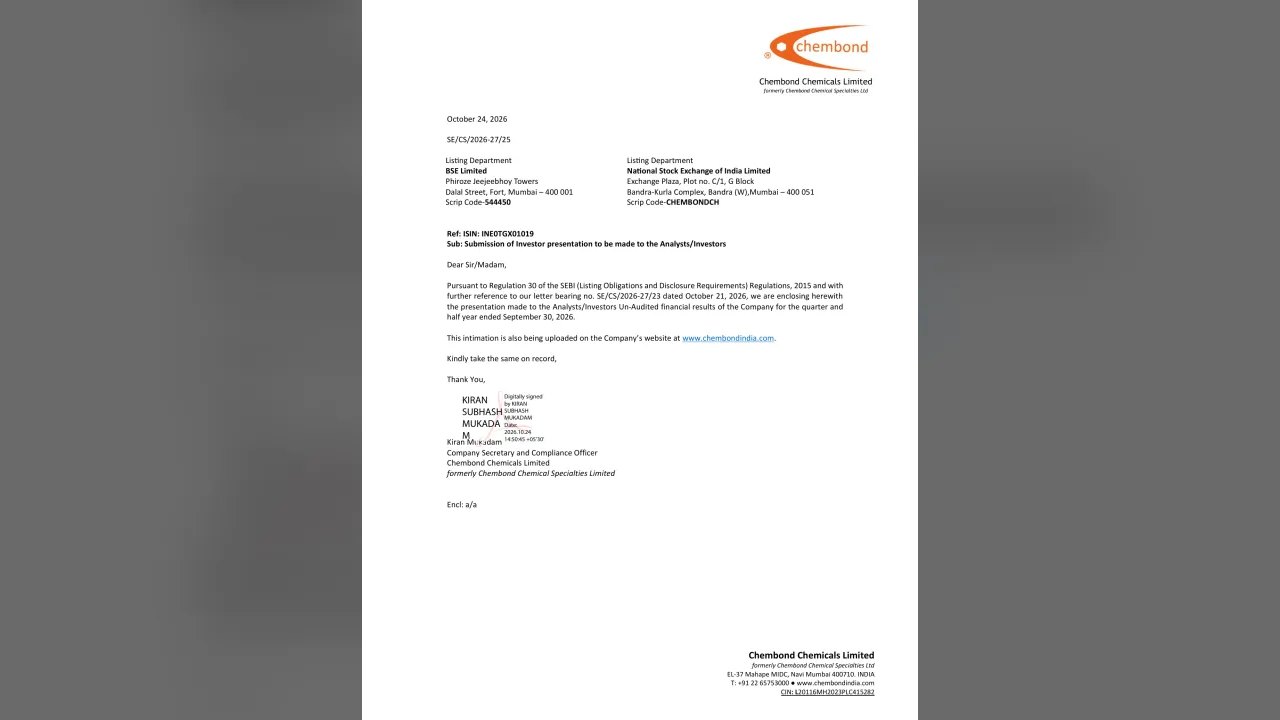
Chembond Chemicals (NSE:CHEMBONDCH) Q2 2027 earnings call, held 2026-10-24. Watch the replay and read the transcript on 6ix.
On 6ix: 6ix.com/event/chembond-chemicals-limited-chembondch-q2-2027-earnings-call
Automated transcript · Written by software from the replay's audio. It can mishear names and figures; the replay is the record.
1:07 Good afternoon. Good afternoon, Kiran. Yeah. Can we start? Yes. Please do. Good afternoon, Kiran. Thank you. Good afternoon, everyone. On behalf of company, I would like to welcome you all Chembond Chemicals Limited first analyst investor meet for quarter two and half year ending financial '27. Today on this meet, we have with us the management, mister Nirmal Shah, chairman and managing director myself Kiran Mukhadam, company secretary and compliance officer of the company and Prachi Mahadi, chief financial officer of the company.
2:07 We will begin the meeting with a brief opening remark followed by presentation on financial result. After the presentation, we'll proceed with question and answer session. Participants who will ask to ask question can click on question answer icon on the bottom of your screen and post your question there. We request to all participants to keep their microphone muted during the opening remarks and the presentation to ensure a smooth session. Please note that certain statements made during this meeting may be forward looking in nature. Such forward looking statements are subject to certain risks and uncertainties that could cause the actual result or projection to differ materially from those statements.
2:53 Chembond Chemicals will not be in any way responsible for any action taken based on such statements and undertake no obligation to publicly update this forward looking statement. Now I would like to hand over the... To mister Nirmal Shah for his opening remarks. Thank you. Over to you, sir. Hi. Very good afternoon, everyone. I'm Nirmal Shah, the chairman and managing director of Chembond Chemicals Limited. With me in this room is Mr. Prachi Madik, our chief operating financial officer. Together, we both will try to put some perspective on the quarterly results and half yearly results that were just declared a few minutes ago. Apologies for the slight delay. There were certain technical issues for uploading these numbers on time due to which this meeting had to be delayed by fifteen minutes.
3:52 We'll walk you through some common stuff which you already might be knowing about what the company does just for the benefit of people attending this meeting for the first time and spend much more time on the numbers itself and questions from your side, which we will try to answer to the best possible extent we can. So let's not waste any more time. Let me just keep moving. So, Chembond, everyone by now would be aware that we had a demerger and the parent organization itself was established in 1975.
4:43 This is our fifty first year. We have over nine fifty people. Last year, our consolidated revenues stood at $2.90 crores, and our operations were done from three manufacturing sites. Our head office and the R and D center is situated at Navi Mumbai in Maharashtra. Our board of directors is unchanged from the last quarter. Professor, Mrs., myself, and Mr. Are the members of the board of Chembond Chemicals Limited. Our core values, have been with us ever since the start of the company, are as relevant today as they ever were.
5:32 And we continue to work and abide and try to create as much customer delight as we can. Our businesses are structured in four buckets. The water technologies business is the largest. Construction chemicals follows that. Distribution is the third largest. And the cleaning and hygiene business is a joint venture with a German company called, formerly used to be a part of. So we'll talk a little more about what we have to offer for... In water technologies. We do chemical solutions. We have equipment solutions that complement the chemical solutions. We do wastewater remediation, and there's a lot of traction happening in this space.
6:22 And all of these are backed by a very deep technical service team that's monitoring and controlling the operations on customer sites on a daily basis. Our chemical programs are offered across cooling water for boiler water treatment, for raw water clarification, effluent treatment and its recovery, foam control, so RO membrane treatment, thin cleaning, and drinking water disinfection. It's a cross section of heavy and light industries that we serve. Recent addition to this segment and of a sizable volume is the calls and the data centers that are being set up across the country.
7:15 Like to inform that we are supplying to largest telecom company and also to a lot of independent data centers, some of them international ones in Maharashtra as well as in other states. Our construction chemicals business is about modification of concrete used in infrastructure. We do sealants. Core area for us is the polysulfide and acrylic sealants. Waterproofing solutions are offered as post construction as well as during construction portfolio. And we have a range of products for repairing concrete or use grouts in engineering equipment foundations and for tile adhesives.
8:12 Customer segments, as you would all guess, would be on, you know, all kinds of infrastructure, some industrial, and we work a lot through applicators and distributors to sell our solutions. Cleaning and hygiene business is a JV between Chembond and Colvertis. We have industrial and institutional segments within this company. It's run as Chembond Colvertis, Industrial Hygiene Systems Limited. In the industrial portion, we serve large beverage, food processing, dairy, and brewing industry. And in the institutional applications, it's commercial kitchens, laundries, and housekeeping teams and departments in institutional installations.
9:05 In chemical distribution, we import, stock, and sell various specialty chemicals. We structure them for construction chemicals. We have additives, in paints and inks. These two form the largest component. Some additives in water treatment, and then sealants and polyurethane coatings for an allied industry to construction chemicals. Coming to the h one executive commentary, I'll let Prachi do a little bit of the talking now, and I will step in again to give you a little more context. Hi. Good afternoon, all. So coming to the financial part, this is half year executive commentary.
9:52 So for half year twenty twenty six, twenty seven, our consolidated revenue stood at $1.82.25 gross, higher than last half year by 32%. And segment wise, you can see water technologies is higher by 28% on account of good order book growth. Construction chemicals, we focus more on sales expansion in few territories in West... In Gujarat, Maharashtra, which contributed to 30% increase. Distribution at 86%, higher as compared to last half year, and cleaning and hygiene, 59% for last half year. Coming to EBITDA at 22.55 growth, so higher by 2% for last half year, And our consolidated profit before tax is at 19.79 growth, higher by 2% as compared to last half year.
10:53 Actually, here, we have seen in quarter one and now again in quarter two, our material cost have gone up, and this material cost have eroded our profitability. So in spite of higher volumes, the profit before tax still remains at same level in absolute numbers. And as a percentage to sales, it is down and on account of material cost going down. Yeah. I'd just like to add here that the costs have been increasing at a pace that's faster than us being able to pass them on to our customers. There is a little bit of delay in customer acceptance because these increases have been happening repeatedly through this last six months ever since this Iran war has broken out.
11:45 Even today and even yesterday, we've been receiving some imports on material costs further increasing. It's an extremely volatile situation and something that we haven't experienced in all these years. It's even more volatile than it was in COVID because COVID, you know, at least the material costs did not go through the roof. Here, there is a little bit of fatigue at our end. Our sales teams, by the time they finish one round of price increases, there's already another one to go back to the customers and seek. And there doesn't seem to be any immediate end in sight because all the predictions that we've heard, we've read about articles indicate that there will be stability soon, but that's not really being delivered.
12:44 But we continue to maintain efforts on broad basing our sales growth, so revenues grew on the back partially due to price increases, but the major component was the volume growth. You'll see later in this presentation a little more about that. Coming to next slide on revenue track. So this is a quarter wise comparison for Chembond Chemicals on a consolidated basis. These are last 10 quarters. So here, we have covered financial year 2425, financial year 2526, and the current two quarters, quarter one, quarter two of financial year twenty six, twenty seven. So quarter two financial year...
13:31 Current year, it is at 95.8 growth. Over quarter one, revenue has grown by 11%. And if we compare quarter two of last financial year, it has grown by 31%. So revenue has grown on a... Coming to profitability track of Chembond Chemicals Limited consolidated numbers. These are EBITDA and profit before tax numbers, again, quarterly comparison of last 10 quarters. So quarter two of current financial year, our EBITDA is at 8.4 crores, and profit before tax is at 7 crores.
14:20 In quarter one, EBITDA was 14 crores, and profit before tax was at 12.8 crores. So if we can just track from quarter four, our quarter one has gone down and quarter two has further gone down. This has updated and minimal material cost has gone up and profits have eroded in quarter one and quarter two as compared to quarter four and all the earlier quarters if you see. This is on a half year financial performance. So current year, April to September has come back to last year, April to September.
15:06 Revenue, we see there is a sales growth of 32%. So we are at $1.82.25 gross as compared to $1.38 gross in last half year. Operating EBITDA for current half year is at 22.55 gross, which is 12% of sales. And last half year, it was 22.20 growth, which was 16% of sales. Profit before tax, we are at 19.79 growth, which is 11% of sales. And last half year, we were 19.39 growth, which is percent of sales. Absolute numbers, it has remained same, but as a percentage to sales, it has gone down. Coming to sales volume, this is quantity in metric ton.
15:58 Here, we have the... Divided our sales volume into water treatment chemicals, construction chemicals, and trading and industrial hygiene. So water treatment chemicals, our volume in this half year is at thirteen thousand three forty three metric ton, whereas last half year, it was nine thousand two sixty eight metric ton. So volume has gone up in water treatment. Construction chemical, if you see, the volume actually has gone down, but sales have gone up on account of price increase. So from nineteen eighty eight metric ton, we are now at thirteen thirty metric ton. Trading and industrial hygiene, the volume has gone up from six ninety metric ton to one three six seven metric ton. Yeah. I'd like to add a little context to construction chemicals. Our product portfolio also underwent a change. We had a higher sales contribution from our sealants business as opposed to the admixtures last year, and that is also one of the reasons.
16:56 So, all this reduction of about 550 tons is not due to reduced or increased prices. It's also due to a change in the product mix sold. And so, at a group level, we talk of revenue. About 82% of our revenues come from water, 8% from construction chemicals, 9% this year from distribution, and 1% from industrial hygiene. It's pretty much in line with what it was, but we are increasing the share of some of the other businesses at the cost of water treatment. Coming to expense summary, I mean, a half year to half year comparison.
17:48 This is as a percentage to sales. So material cost for current half year is at 56% of sales, whereas last half year, it was 46% of sales. So material cost has drastically gone up. Employee benefit is at 20% of sales, and now it is 17, so it has gone down. Other expenses as a percentage to sales are 15%, whereas last half year, it was 18%. So we see here the major cause is material cost, which has gone up from 46% in last half year to 56% in current half year of financial year 2627. Coming to our employee strength, this we have compared as on 03/31/2026 as compared to 09/30/2026.
18:48 The composition here, we have divided it into sales, technical services, plant operations, support, and r and d. So as on March 31, the total strength was nine twenty, and now it has gone to nine forty. And the division is technical services, where at six seventy four numbers, and now they have gone up to six ninety four. At Salesforce, 91, and now it is at 97. Plant operations, stable around 65 employees. Support staff from 71 to 66, and r and d from 18 to 19. So this is the employee strength what we have overall Chembond. That's it on financial presentation.
19:39 No. So I think without spending more time on this, I'd like to open up the session for questions. Yeah. Kiran? Mister Nasi? Hello? Yes. Can you hear me? Yeah. Please, sir. Yeah. Good afternoon, Nirmanji.
20:27 And I think as you mentioned that we have been undergoing cost pressure. Our EBITDA margins this quarter have fallen, I think, to around 8%, 8.5%. How do you foresee these going ahead, sir? At least what would the aspirational EBITDA margin be? Do you think by the end of this year or early next year, we could get back to that 15%, 15.5%? Yes, Mr. Nasir. What we are finding is that there have been multiple issues. One is the first round of increases that happened on in the Q1, which was driven by a lot of the solvents.
21:14 Q2 has been driven by key components that are being imported from China due to fluctuation in currency as well as the availability and the material cost. So all three factors came in together. Q3 has been as of now the same as Q2 with supply chains not easing yet, freight rates also being higher, and availability continuing to be a challenge. There's a little, you know, fluctuation also in domestic markets. Some materials are suddenly going through the roof due to unplanned shutdowns by a couple of the manufacturers. And then import and export country has also not been able to ship out that material because of a shutdown in their country.
22:08 So, these are some time specific issues that we feel should ease out in some time. But, unfortunately, we've become so cautious that it's becoming very difficult for us to put any kind of, provide any visibility to how soon we can normalize. We take solace in, the fact that the volume growth our teams are putting in all the effort And just the whole fatigue aspect is one thing that we will definitely overcome. But the silver lining is that once these prices start normalizing, usually we found that there's a couple quarters of tailwind, so we would not need to reduce prices.
22:57 A lot of the new businesses that we've acquired in these last couple months are at the higher prices. So, they will continue to deliver those margins, higher margins, and when costs come down, those margins can improve. So I think double headed challenge, one was earlier we were able to maintain a 10% top line. We made a lot of changes. We started adding, you know, focus on growing the business and the volumes. And now we've come across the situation. Should normalize hopefully by the end of this financial year. Sir, we can't put can't give you any any we have seen a good growth in the top line.
23:49 So... And and generally, q two... H two is better than h one. Do you at least see that trend sustained going forward, sir? Very much so. So the order book is very strong. There's also all the continuing orders go well into the next financial year. There is no doubt that this momentum will continue for the remainder of this year. And q four, which has historically been a high quarter, high sales and profit quarter, should also be nothing different this year. Sir, what is the biggest threat to business as you see it? See, because we are a very customized kind of specialty chemical company.
24:41 So do you think there is there is any any risk from the source manufacturers in terms of setting their own products in the company or no? I mean, if there's a moat enough in our business. I'm unfortunately not able to fully understand or comprehend your question. But if I got it right, you want to know whether there is customer stickiness. Is that the question? Yes, sir. Yeah. Yeah. So, yes, of course, customer stickiness is definitely there. Our customer attrition rates are extremely low, and new business keeps growing. In fact, even some of the customers that we do lose or we do let go experience poor treatment performance from our competitors and do want us to get back.
25:36 That is the case in two or three of the accounts that we had lost last year, which we are back into at better prices and higher margins. So some light on the AI data center clients of yours, sir. How how is that segment panning out, and what kind of demand do you foresee going ahead on that? So we... The top telecom company, all their data centers are being treated by Chembond's water treatment. There's also NTT, YOTA, and a couple others control as large data centers. Each of these is taking up our automated solutions. So, they have an online monitoring and feed control system.
26:28 Remote monitoring is what they seek. So, that's one component. And the other is the makeup chemicals that they need, which is not significantly large, but the sheer numbers of these in a concentrated locality provides an opportunity which is for itself by, you know, better monitoring teams and routine customer visits. And, sir, before I come back to the queue, the taxation, sir, we have ended up paying, I think, 35% and a half year. So why is that? Taxation? Yeah. I'll just let Prashi talk about why our track. But I believe it would be a lot related to the capital gains on redemption of investments and on some of it would be... So, Prachi, can you pull that out and throw some light?
27:28 We can come back to this in a few moments. That'll be fine, sir. Thank you. Yes. Thank you very much. Thank you. Mister Ditesh? Yeah. Hello? Thank you for the opportunity. Am I audible? Yeah. Yes, sir. Yes, sir. Yeah. Yeah. Thank you, sir. Bye bye. Good afternoon. Sir, just wanted to know this margin erosion is across the segments, or is it more into the distribution because it grew... Its growth is quite high at 86%? That's number one. Second, in construction, you said that there is a product mix change. If you can give some more insights into it, why sealants are more and admixtures are less.
28:15 Is there a change of strategy or something on that is... It will be helpful for us. Sure. But on employee base, on a... Can you give us idea of what is this technical service employee base? It's quite unique for the... I mean, to us, and also seven... 18, 19% employees to sales ratio is also quite high for the comparable companies in the chemical segment. So how are you different and what we can envisage this in years ahead? Thank you, sir. Awesome. Thank you very much, Ritesh, for posing these questions. I'll take them not necessarily in the order you asked.
29:02 Chemical segment is divided. It's very, very versatile. You would have polymers. You would have refining products. You would have clothing, you'd have so many different segments within chemicals. We cater to a specialty chemical segment, and within specialty chemicals, our business is highly customized and customer centric. Our teams are deployed at customer sites, monitoring and treating their water treatment water systems day in and day out. Large sites demand a larger team because the, business value and the complexity is significant. Our teams are qualified.
29:47 Are chemists or chemical engineers. They need to know what chemical processes are. And the... Our customer base includes refineries, steel mills, power plants, to petrochemical complexes, and to the small ones, like institutional hotels and hospitals. So, with the larger segments, we need to have our teams deployed. Within that large site, there are multiple applications. One could be in raw water treatment. That's the fresh water that is taken into the factory premises. Then we treat the cooling, the process water application, so we would treat boilers, we would treat RO membranes, we would treat cooling towers, and then there's the wastewater that's generated that needs to be treated before it is discharged into public domain again.
30:54 So for that also we have to have around the clock monitoring, feed control, and make sure that the discharge meets the regulatory norms. So for all of these, there are certain requirements that the customer puts up front. Our bids and prices incorporate the cost of manpower and technical support that needs to be provided. As you would understand, water is not stagnant. It is dynamic in quality. Seasonal changes as well as source changes as well as certain leakages from within the factories can disturb the water balance and the quality, which needs immediate course correction in terms of, the treatment we provide.
31:42 So that's why we need people in the field. Our I think our employee cost as a percent of sales used to be even higher in the past periods, has come down because it's a higher top line this quarter for sure. And it's been like this for ever since we've started this business because this is something we thrive on. I think one of your questions was also on the product mix mix in construction chemicals. Yes. There were certain orders that we had for admixtures. Those projects came to an end, so there was no more future supplies to those projects. And that sales was replaced by a proactive action by the team to build up customers for regular moving items, and those were the sealants.
32:36 Sealants, we have, over the years gained good a reputation for performance, and it's the preferred benchmark in the industry in polysulfide sealants that the Chembond sealant is considered to be, t one. So that's what's getting back some customers on sealants, and we are also aggressively pushing. We also repurposed, one of our lines in the plant in Gujarat to make additional quantities of sealants, so we're able to churn out more volumes for that. Was there any other segment question that I missed? If I have Third one was on margin.
33:21 Is margin erosion across the segments, or is it more in the distribution side? No. It's across the segment, not so much in distribution because as a total percent, distribution is still about 8% or 9% of the total. So water is the major concern, and we were just doing a quick calculation that had margins even remained at Q1 levels, our profit would have been higher by about 20 crores. So that's the erosion in numbers just because of these raw material prices that have shot up. Yeah. If I can add a a couple of more questions. So you mean to say you have a product business also and there is a service element to it because you need to have technical staff. That's right.
34:12 That's right. If you can give some idea what percentage of revenue is catered by this technical staff. 80% of our business revenues come from businesses that need manpower dependencies and are driven by technical solutions. And about 15 to 16% is purely driven by product sales. And the remainder is a hybrid where the basket is sold, so some products and some technical selling. So if your people are to the the refinery or to their water treatment plant, can we say that you have some mote to that extent that if your...
35:06 The client will not run away from you just for pricing purpose? Yeah. That's true. Yes. Very much so. And that's what I mentioned. Our customer attrition rates are very, very low. And even in instances where we have lost... Where the customer has... Customer is not running away from us, they are throwing us out, They actually invited us back and agreed to pay a premium to solve their issues created by a competitor. Only one last question. Any revenue concentration if you if you can give, like, top 10 customer concentration or something? No. Actually, that's something that's a little too specific and, you know, it's something that we really wouldn't want to be in, you know, discussing in this forum.
36:00 Thank you very much, sir. It's very helpful for us. You. Yes, I think the next question is from Mr. Sridharthaji. Yes. Thank you for the opportunity. Am I audible? Yes. Good afternoon, Nirmal. In the previous calls, you had mentioned about these new age industries like solar panels, copper plants, and data centers. So approximately, what percentage of our water revenue comes from these new age industries? Roughly about seven to 8% so far. Okay. And do you see this concentration growing in the next three years?
36:46 Yes. If this industry continues to execute all the projects that are in the pipeline, we expect it to hit about 12 to 15%. Okay. And just the last question. So these customers, are they on tenders or are they on contracts? In the initial phase, they come with the technology supplier's contract. However, with the performance that we deliver, they end up becoming bid contracts. And in the bidding, there is usually premium that they are willing to pay for somebody who has already delivered. Okay. So you can negotiate better prices with them?
37:35 Correct. Better prices, not necessarily. But, yes, they would want to continue to work with us. Okay. Thank you. Yes, sir. Thanks. Mister? Hello? Good afternoon. Yeah. Hi. Am I audible? Yeah. Yes, sir. Please. Yes. Good afternoon, Omar. Yes, I mean, I heard your comments on the margin side, and obviously, that makes sense. That was a big hit. I just wanted to understand since your commentary has been very positive on sales on growth ahead, what is driving this positivity, if you may kind of... If you can break it down?
38:25 Yes. Hi, Jinal. Most of the segments that we cater to, not only most, all the segments have seen volume growth, whether it's it's across the board. There's not one industry that is slowing or which has slowed down. Refining, pet chem, chemical manufacturing, agrochemicals, fertilizer, power, steel, cement, every segment, Janal, has experienced growth. This is interesting, you know, because, I mean, when we are tracking some of these industries, I mean, obviously, it's a mixed bag what we hear. So I'm simply trying to understand, has there been a change lately that is helping us with this strong growth?
39:19 I mean, something on the regulatory front. I don't know. I'm just kinda trying to understand because, I mean, in the last few years back and in the last couple of years, I mean, there's clear bump up in the pace of growth that we are at. Right? So I'm just trying to understand what has changed. Is it... Obviously, I am... And I I know last time you did mention about newer products that have been introduced as well that's helping, and then you did answer the previous one where, you know, the new age. So I'm just... I mean, what is that that change that has led to this strong growth? So what? Yes. Primarily, it is an expansion of the volumes being produced by these industries. Second is their effort on water conservation and recovery.
40:07 They are trying to reuse as much water as they can, and as a result of which, they continue to need better designed treatment programs. There's also certain amount of regulatory change and move in public sector from elemental chlorine to using other oxidative treatments. But that impact in our performance has been not even four to 5%. So that uptick is not driven primarily by regulatory, you know, regulation, basically, mandates.
40:54 Okay. And so finally, I mean, I know that your commentary for this year is strong. But when you see the opportunity in front of you and when when you're talking to clients, you believe that this sustain... This growth and opportunity can sustain for the next few years? Few years. I mean, it's just... I'm I'm I'm trying to get a gauge of the opportunity. Right? I'm not I'm not trying to hold you to a guidance or something. I'm just saying that... Yeah. So you... Yeah. You can resolve your... Yeah. No. We expect, of course, the industry. Because, see, as... I look at it as an overall, we're seeing certain positive indicators on the country and its exports that are happening. The free trade agreements are only going to make it easier for Indian companies to export.
41:43 There's more and more products that are getting into the manufacturing domain within India, which did not exist a few years ago. So this momentum is going to continue, and I don't see that stopping, you know, within a year or two. These are long term commitments that companies and the industry makes, so they are likely to continue. Coming to... So we are very, very excited about this opportunity. And at the same time, with these cost pressures, I am positive because I don't think anything at this level is sustainable, number one. Number two, even if it is, our teams are working on alternate that we could develop or use that could probably reduce our reliance on these specific materials.
42:33 So our work has to be to come up with alternate and in the face of adversity still come out with, you know, winning solutions. So our teams are capable and are aligned to doing this on a continuing basis, and that's what gives me confidence that, you know, this growth is good for us, and we will be able to tide over the situation. That's fantastic. And lastly, Herman, how are you seeing the competitive landscape? Any changes there or it's the same or... Yeah. No. It's pretty much the same. There's been, of course, a little bit of change in one of our competitors who's been taken over by another process chemical manufacturing company.
43:20 And I think that transition phase will last for a few more quarters. And we expect that, and I continue to maintain that that should be a positive for us because it's a larger, better organized company. Okay. Thanks a lot, Nehemiah, and good luck to you and the team. Thank you. Thank you very much. Mister Madhu? Thank you for the opportunity. Sir, so firstly, if you could help us understand that how should I look at our margins going forward because you mentioned that we have been able to pass on some raw material cost increases to our customer. And if you can help us understand how is the execution cycle of these projects, and when can we expect the increased margin of...
44:13 In... Margin or the realization improvement that you have taken with customers to reflect in our margins? Yeah. So, Madhuji, ours is a continuing business. It's not like an equipment supply that will end with one project. So 90% of our water business is driven by the chemicals, which are like a consumable. And most of the contracts have... Are either annual or biannual, so twice... Two year contracts. They come up for renewal. Public sector contracts are fixed price, very difficult for us to revise those prices within the contract period unless we terminate the contract ourselves.
45:07 Private sector, they are much more reasonable. They will listen. They'll talk, evaluate, and pass on at least a portion of the increase that we would seek. New bids and new tenders, new proposals are constantly being submitted. Those are submitted at prices that would factor in the current material cost. And again, those would also result if it is a positive result in orders that would be for one or two years. So this kind of a cycle will continue. So it's a continuing business. It's not a one off.
45:52 Pipeline, when I say pipeline for equipment, I think our book would be about 15 to 20 crore as of now for this financial year. And on chemical sales is everything else is a continuous business. Overall, maybe 25, 30% of our total sales in water comes from PSU, which are fixed price contracts. I hope I've been able to answer your questions. Yes, sir. So... Yes. Sir, so would it be fair to assume that over the... Maybe what... Next one or two quarters, our margin might be on the... There could be some pressure due to... If the raw material prices don't decrease in proportion to the extent where the price lag happens with our customers. Is that a fair understanding?
46:44 Yeah. So as long as everything else is constant in the current situation, if the Iran war refuses completely and crude and all the logistics lines come back to pre war levels, we expect that in one or two quarters, we should be able to see all the effects of the, you know, cost increases be overcome. Got it. So so I was... So if I look at your gross margin, they've... Not considering these two quarters, but f y twenty six versus f y twenty four levels have improved. So how should we look at our gross margins going forward considering we are moving into these new age industries where our product might be much more critical as well as the quantum or the business with our customers, like, is growing. So can we expect this to move to 40...
47:42 No. So see, there is nothing nothing like more critical and less critical. Water is a critical element for any industry. And if not treated well, it can cause several production related issues and downtime and higher costs for the customer. So whether it's a data center or a refinery or a power plant, water is equally valuable and important to be treated well. So from that perspective, there is nothing, you know, that needs to be more weightage to water treatment. And what New Age industries, when I say that, I'm saying that industries that did not exist in India, they've started to come up. And as a result of which, market itself is expanding, these industries did not exist in India until two, three, four years ago.
48:36 And now we see that there's... They are becoming a sizable component of industrial manufacturing. So that's what I mean by new age industries. Got it. So so what metrics should we look at? So so considering... So what metrics should we look at for the margin improvement for Chembond as a business together? It... It be more driven by the chemistries that we provide, or would it be more driven by us manufacturing whatever that we are... I don't think I can throw anything more than what we've already been talking last thirty, forty minutes. There's not much more to add to help you understand this Margin improvement will come when costs will reduce.
49:26 Everything else is in its position, in its place. So it's not that our CapEx has driven interest costs up nor has employee costs shot up through the roof. So all those are still where they were. It's only the material costs that have hit us. And as soon as those prices pull off and the effect of price increases sets in, margin improvements will be seen. Got it. So just one final question from my end. Sir, can I ask one final question? Yeah. Sure. Sir, so just one... Sir, how would we... Our competitive competitive intensity versus a EPC or a water treatment solution provider? So what is the competitive advantage or right to in that Chembond has versus these integrated peers who are building the plant as well as providing these chemicals together as a service to their end customers, whoever that might be?
50:22 I think the relationships that we have and the credentials that we carry still make us a preferred choice because all the other EPC companies that are not into chemicals do not want to award their chemical business to our competitors who are doing everything themselves. So from that standpoint, we are a preferred vendor to those companies. And we have a couple partnerships or, I would say, informal or formal partnership in place with these large equipment companies where we are their preferred partner supplier. Thank you. Yes, mister. Hello.
51:09 Sir. Am I audible? Yes. Very much so. Thank you. Good evening, and the management team. I have three questions. The first one is you made a remark that your profits would have been higher than 20 crores if prices in quarter two would have been similar to quarter one. Were you referring to the EBITDA or PBT for the first half in that remark? I was referring to the product margin itself. The gross profits? That's right. For for the entire half year. Correct? Q two q two and q one. Yes. Our... For six months, it would have been... I have a good week of course. Okay.
51:56 Got it. Also, the second question is, if I look at your quarter two versus quarter one, the falling gross margin is not very dramatic. It is just a 1% drop from 42.7 to 43.7 to 42.7. So the bigger pain actually has come from other expenses. It has gone from 11 close to 16 and a half. So can you throw some more light on what exactly has happened there? So our revenue mix has got technical service as one of the revenue. Here, we employ our labors. So there are few customers from wherein we have got technical service orders.
52:41 So labor cost has increased in other expenses. And also to some extent, freight cost and traveling cost has increased. So this has contributed to increase in our other expenses. Okay. Got it. Third question is, if I look at your employee base, majority of them are into technical services. So does that mean all of them are at the customer site? Yes. Okay. So what is the scope of cost optimization in this line item with, say, remote monitoring and any other development in technology? So these cost are, like, when we receive orders, the employee call... The labor and the employee call number is specified in our order, and that is the service what we have to provide.
53:37 So that is what we are currently following. So I don't see any optimization in terms of number. So that would still remain the same. Got it. One final question is in the previous calls you have mentioned about the vision of. Can you talk what they have done in the last few months with respect to this vision? Maybe new categories, new segments, new geographies? What are you gonna share? I think a lot of it is across the board, and I think the revenue growth itself would be an indicator that some of those are obviously delivering the goods. We had aims that in three years, we'd be at that number. So one was an organic growth and that's something that we are pushing.
54:27 Second was to grow the smaller business within the company operation, and that's also what we're trying to achieve in the distribution, in the cleaning and hygiene, as well as in the construction chemical space. So both of these are something that we can do within our company. And the third is looking at inorganic opportunities. So every now and then, we keep receiving certain pieces on opportunities of where the company could acquire some businesses. We keep evaluating them. Some, you know, are worth getting deeper into, and we do evaluate them. And if it's something that seems logical and synergistic, we, you know, try to dive a little deeper.
55:19 So that's the third leg on which we expect to hit this. Okay. Just one on that. Just just one follow-up on this point. The disrupting organic opportunities, what is what is the framework there? What kind of acquisitions would, you know, be like to do? And specifically product or, you know, whatever you can share in terms of framework? No. I mean, there's a... It needs to be synergistic. It needs to be an area in which we have some credible presence and strength, and it needs to be a precise that we can digest and manage to operate without creating constraints for the continuing business.
56:09 Simple and logical from that perspective. We don't want to get into something unconnected, something fancy, and something unsustainable. Okay. One final question. Think I'm now running into finals a lot. So, yeah, let's let's hear that. Yeah. Go ahead. Yeah. Sure. So I think we have done a very good job with cash flow in the in the first half. So I want to understand if we are looking to use that to say buy... Doing buyback or in this in the payment payout or anything of that sort? Do Yeah. We we would we would surely be looking at it because if there's not an immediate need for this cash, then we'd like to return it to all our shareholders.
57:02 Got it. Thank you so much, and wish you all the best. Thank you very much. Yes, sir, Zaki. Mister? Yeah. Sir, so, Niraj, you mentioned thousand corona aspiration three years down the line. So what what capacities has... Are we already sitting on for this aspirational number, sir? And what... If required, what CapEx would further be required? Yes. I think this is something I answer every quarter or every every time we interact with all of you.
57:55 So, our products are formulations and capacity is not a constraint. We have large enough plants and that are small incremental expansions are yielding magnified capacity expansions. So addition of a warehouse section would increase the material handling capacity multi fold. Adding two reactors would increase, you know, capacity multi fold. It is not linear or constrained by the, you know, the the processing cycle is short.
58:42 And so so... And the businesses that we are into, addition of capacity is not a multiyear project. It may at most take two months to expand. The plants are made and designed in a way that it is modular expansion, Whether it's on inside the shop floor or an additional block or building to be made, they can be expanded without disturbing the running operations of the plant. So from that perspective, that's the least of our concerns. Our concerns are, you know, typically towards profitability management and cash flow management.
59:30 On cash flow management, we've done, I think, a credible enough job. On profitability management, we've tried, but due to some reasons beyond our control, we have not been able to deliver to our own expectations, and I'm sure your expectations too. Thank you, sir. Best wishes for the management. Yes. Sir. Thank you. Thank you very much. Alright. I think there are... Mister, do you still have a follow-up question, or it's raised from the previous question itself? Yeah. It's raised from previous question. Okay. Okay.
1:00:19 So great. I think we've reached the end of our time anyways, and if there are no more questions, Kiran, can we conclude this meeting? Yeah. Yes, sir. Please. Okay. Thank you. Thank you, everyone. Yeah. Thank you. Thank you all. Thank you Thank you for all rest of your day. Yes. I wish everyone a happy Diwali festivities ahead. Yeah. Thank you. Thank you.
Follow Chembond Chemicals Limited into a list and get an email when it puts out news.
company secretary and compliance officer of the company at Chembond Chemicals Limited
chairman and managing director at Chembond Chemicals Limited
chief financial officer of the company at Chembond Chemicals Limited
chief operating financial officer at Chembond Chemicals Limited