Gavin Ferrar
CEO at CENTRAL ASIA METALS PLC
Replay available
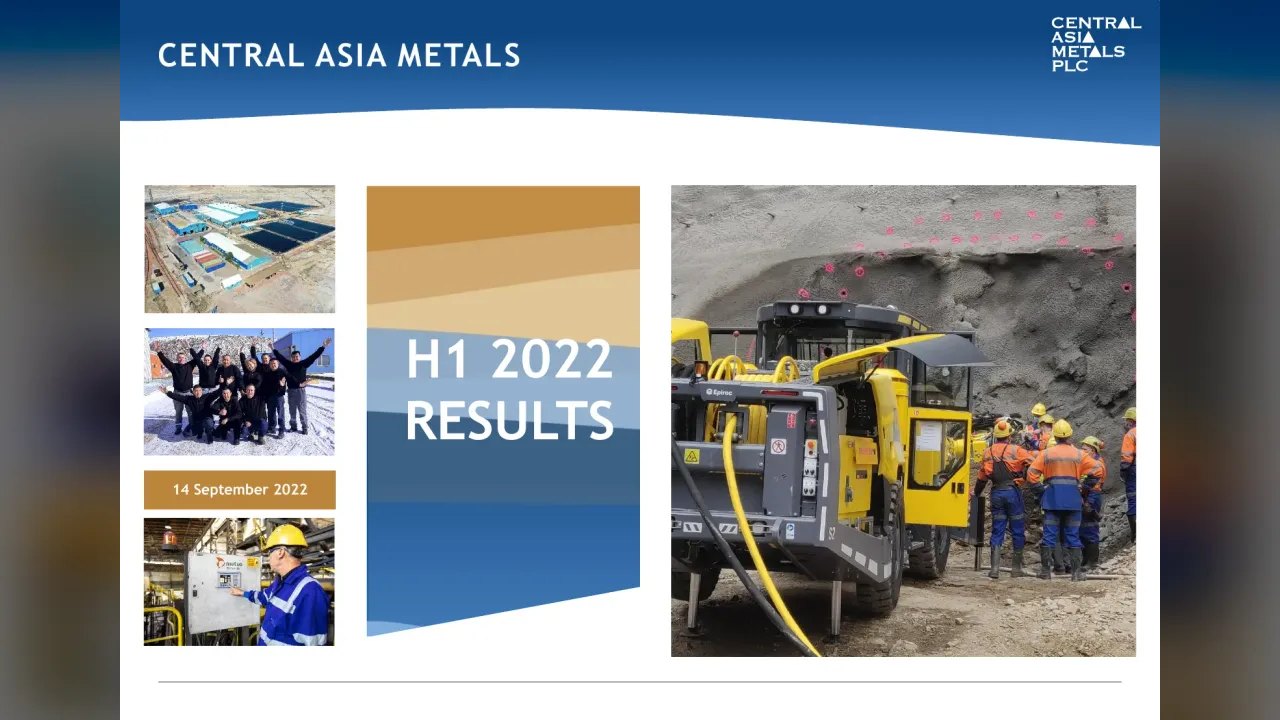
Interim Results hosted by Central Asia Metals (LSE:CAML) on Investor Meet Company, held 2022-09-14.
On 6ix: 6ix.com/event/central-asia-metals-plc-caml-interim-results-2
Automated transcript · Written by software from the replay's audio. It can mishear names and figures; the replay is the record.
0:00 Good afternoon, ladies and gentlemen, and welcome to the CENTRAL ASIA METALS PLC Interim Results Investor Presentation. Throughout this recorded presentation, investors will be in listen only mode. Questions are encouraged and can be submitted at any time using the Q and A tab situated on the right hand corner of your screen. Just simply type in your questions at any time and press send. The company may not be in a position to answer every question received during the meeting itself. However, the company review all questions submitted today and publish responses where it's appropriate to do so. Before we begin, we'd like to submit the following poll. And if you could give that your kind attention, I'm sure the company would be most grateful. I'd now like
0:32 to hand over to CEO, Nigel Robinson. Good afternoon, sir. Good afternoon, and many thanks for that, Mark, and good afternoon to the audience. First of all, on behalf of the company, the CAML board, myself as the CEO, and all the staff here at CAML, I'd like to pass on our sincere condolences to King Charles the third, and the royal family on their loss and pass on our greatest respect and gratitude for the life and times of her majesty, queen Elizabeth the second. She was a wonderful woman, a loving mother, and an inspirational monarch and leader. And I think against that, while the sad and somber background, I'm pleased to pass on some very positive results for CENTRAL ASIA METALS for the first half of twenty twenty two in terms of our performance.
1:21 We move over to Slide two. You can see that we've had a record first half to the year. EBITDA, that's earnings before interest tax, depreciation and amortization, just under $75,000,000 up from $64,000,000 a margin of 63% and generating free cash flow of $52,100,000 We also on the balance sheet post the period end paid off all the debt that we took on when we acquired SASSA back in November 2018. That was a $187,000,000 of debt now fully repaid. And the strength of the balance sheet and the financial performance in the first half of the year gave the board the confidence to announce a record interim dividend of 10p per share. That's 40% of that free cash flow number and an increase from 8p in the prior period of h one twenty twenty one.
2:14 Aside from the finances, we improved our ESG credentials. We were continuing on sustainability reporting and our climate change report. We issued our third sustainability report in Q2 of twenty twenty two. And our
2:29 climate change report, the first one we've published. And we continue to set targets for greenhouse gases, water management, waste management and gender diversity and across the patch on sustainability. We've also approved and got the final engineering designs for solar farm, solar plant, should I say, in Kazakhstan close to our Kunrad SXEW plant and where we'll commence on that in Q4 twenty twenty two and complete in 2023. Over at North Macedonia, the Sassa mine, we managed to achieve in August, just post the period end, the environmental and social impact assessment after a public hearing in May. And this was a significant hurdle for us, which now allows us to move on to the construction phase of the project and leads us on track for delivering that in H1 twenty twenty three next year and completing the dry stack tailings aspect of the program in H2 2 of twenty twenty three.
3:26 Operationally, we had a good performance both at Sassen and at Kunrad, and in particular at Kunrad where we've increased our operational guidance or production guidance, should I say, from what it currently was up to 13,500 tons to 14,000 tons now and maintain guidance for zinc and lead. So a good half for us. And on that note, I'll hand over to Gavin, who can talk more in detail about the finances. Thank you, Nigel. In half one twenty twenty two, CAML benefited from elevated metal prices. These in comparison to H1 twenty twenty one have driven that increase in revenue and EBITDA that Nigel was talking about. We also benefited from lower treatment charges. These are the charges that smelters charge us to convert our lead and zinc products into the metals that have been sold.
4:16 We also benefited from some currency tailwinds where the operating currencies weakened against the U. S. Dollar in both Kazakhstan and North Macedonia. Inflation is obviously a big theme these days, and we experienced inflation rates of 15% in both of our operating jurisdictions, which we mitigated by placing early orders back in the back end of 2021. And we also enjoyed a fixed price electricity contract that expired on the June 30. So if we look forward into the second half of the year on the right hand side of that slide, we can see some of the actions that we've taken by providing our staff a 15% inflation beating pay rise. And we are going to experience some cost inflation in addition to that payroll cost, consumables and reagents up around 4%.
5:08 And the energy markets, again, a big thematic across the whole of Europe, where we can see that fixed price contract in the graph on the bottom right in brown, converting to a spot contract at the end of June, which resulted in a four times increase in the price that we experienced just in that short period. So if we assume that, that price continues for the rest of the year at rate of 3,500,000 kilowatt hours per month, that translates into an increase in our cost base of around 6,300,000 just to give you some context on the magnitude of that particular cost. But if we look at the income statement, as Nigel said, record EBITDA of $74,900,000 at a margin of 63%. That is basically as a result of those higher metal prices.
5:58 The other gain that you see on that income statement of $7,000,000 relates to foreign exchange. Some of that is in relation to those currency depreciation, but then it's also to do with some of the intercompany accounting that we do on intercompany loans. Admin expenses, dollars 1,100,000 of that increase is actually noncash and related to share based payments at PLC level. And we have seen finance costs come off remarkably since we've paid down much of the debt. So EPS from continuing operations up by almost 50% overall on the group level, a very good performance. If we look at the left hand side of the slide, Kunrat and SASA on a segmental basis, both operations performing very well financially with EBITDA margin at Kunrat at 79% and at SASSA 60% EBITDA margin.
6:53 Moving on to the next slide. You can see some of that cost inflation coming through on the CUNRAL C1 cost. We're still, however, at the very lowest end of the cost curve on an industry basis. Payroll costs having gone up $1,000,000 that was really put in place to incentivize and keep hold of our staff in response to the social unrest that Kazakhstan experienced due to a cost of living crisis at the beginning of this year.
7:20 You'll see reagent costs have come off, and that is, if you recall from H1 last year, we had a few metallurgical issues which are now being resolved, resulting in reagent consumptions returning to normal levels. And, we have seen some other minor increases across the patch, again, just in response to inflation, yet still managing to produce copper at an EBITDA margin of 79%. Let's move on to the size of C1 cost. If we just not get distracted by the pie chart on the left, but if we look at a couple of key lines on the table on the right hand side, the first one I'll draw your attention to is total site based operating costs. We have experienced, again, inflation there. They're up 6.4%.
8:06 Site based unit costs, two lines down, up from $41.6 per ton to $45.5 per ton. That's 9.4% increase. That is the cost of actually producing the lead and zinc products that SASSA produces. So you can see that around 10% inflation experienced on a unit basis there, offset by the realization costs, which are actually down 17% period upon period to mean that our total dollar costs for the half compared to the previous corresponding period are actually down by $900,000 So again, driving that 60% margin, which is up from the previous year as well. So really good financial performance and cost control at both sites.
8:55 Balance sheet, I think Nigel mentioned our corporate debt facilities repaid. We ended the period with net cash of $38,900,000 That would have been higher by around $3,200,000 have we not run into a slight clerical area at the bank, but the repayment of the June debt collection was actually done a day late. Either way, it doesn't really matter now because we've repaid that all. The only other thing I'd draw your attention to on the balance sheet is the reduction in PPE, which partly is down to depreciation, but there is an element of foreign exchange adjustment in there as well because we book the assets in the local currencies. Moving on to CapEx. Nigel will talk in more detail about the cut and fill CapEx, but we have spent $3,500,000 on a cut and fill project at SASSA in the half.
9:45 We're still guiding 15,000,000 to $17,000,000 to be spent on that particular project. And we're about to start accelerating that expenditure as we move into the construction phase this month. Payments we've made so far include elements such as the paste backfill plant, it will decline, reticulation pipework, which is the pipes that will move the paste product back down underground and dry stack tailings, which is our new tailings facility, which we are going to implement come next year. So that all remains on track CapEx wise, sustaining CapEx, no surprises there, just usual sort of course of business, underground development, some updates to some equipment and fleet and replacement of some anodes and new pipe work at Conrad. So everything set fair on the CapEx side and we're still guiding that 28,000,000 to $30,000,000 for the year.
10:40 Just to give you an idea of what has affected the cash flows over the half. So ended well, opened in January really at $59,200,000 generated $68,800,000 of cash from operations. That's a good result given the cash... I'm sorry, the metal prices that we experienced. Big outflows, final dividend, many of you of whom would have enjoyed that, which was paid in May. Debt repayments. We also reduced our overdraft commitments in North Macedonia. We have two facilities there, which total around $10,000,000 We were running those at close to the fully drawn through sort of periods of economic uncertainty related to COVID-nineteen, but we have repaid half of those. So we have that liquidity available to us should it be required.
11:29 Ending the period, as Nigel said, at $57,700,000 with free cash flow of $52,100,000, and that's the number that we used to calculate the dividend that was announced today. So I'll hand over to Louise now to run through some of the sustainability elements. Thanks, Gavin. Yes, we'll kick off with an update on our safety performance for the first half of this year. We did have an improved performance versus the first half of last year. We had zero incidents at CAMRD. And at SASSA, we had one lost time injury.
12:06 While it was a relatively minor incident, obviously, we do learn lessons from these things, and so we have made some changes as we go forward. We also had one restricted work case. This is a new category for us, actually. It was it was brought along by our new group health and safety manager, very experienced chap that we hired just just over just over six months ago. And he he advises that we should add this into our total recordable injuries. Therefore, CAML Group, we've got one lost time injury and we've got two recordable injuries. Our lost time injury frequency rate for the first six months is zero point eight five. And as a reminder, our target for this is for on an annualized basis is to improve upon our one point six nine lost time injury frequency rate that we delivered last year.
12:59 On to the next slide, just an update on our sustainability reporting from the first half of the year. In the second quarter, we published our annual report. We published our sustainability report for 2021, and we published our climate change report for 2021 as well. In terms of the sustainability report, this is the third standalone report that we have published and the second that we published according to the global reporting initiative standards, the GRI standards. We've been able we felt able to add an additional two of the 17 UN sustainable development goals this year given some of our work on the ground. That's the affordable and clean energy one and the climate action. And for the first time, we've incorporated our efforts reporting towards TCFD in the climate change report and also the sustainability report and annual report as well. And as a result of these efforts, MSCI has upgraded our rating from a triple b to an a, which obviously we're very pleased about. MSCI is an independent external ESG ratings agency, and a lot of our investors take what they say, you know, with lots of importance in terms of making their investment decisions. So it's very important to us that they were able to upgrade us.
14:18 Going forward for the rest of the year, we've several work streams we're working on. We we, last year, we updated our asset retirement obligation work for SASSA. And this year, we're working on that for CAMLRad as well, and we'll completed that by the end of this year. We're also updating our stakeholder engagement based materiality assessment. We lasted this two years ago, and the result of that work tells us what all our stakeholders believe are the most important and relevant material topics for sustainability reporting. And that then really frames the data that we present and the information that we disclose in our sustainability reporting. We're redoing that. It's very good practice to do that every couple of years anyway.
15:07 But GRI is changing, their approach to what they call in the universal indicators that takes into account a double materiality aspect of not just societal impacts, but also impacts on the economics and therefore value of a business as well. So that work is underway. We'll also be doing some training as a team to make sure we fully understand, what we need to deliver in terms of the next sustainability report to the new standards. We're also, doing some climate change scenario analysis, and I'll touch on that a little bit more in a minute. And we've made some progress towards the global industry standards for tailings management, the new GISTM, and we have committed to aligning with that by 2024.
15:54 Move on to the next slide. So our sustainability target, so we've laid out here the targets that we committed to for 2022 or the long term in our 2021 sustainability report. And these targets are all linked to executive director and senior management remuneration. And and these... As a result of a lot of the work we've done on the ground last year, we've been able to set targets in a couple of key areas where we didn't previously have targets. One of those in particular is towards diversity, and we've committed to a 25% increase in our group female employees by the end of twenty twenty five. The other key areas are some, environmental areas, reduction in our greenhouse gas emissions.
16:40 We've committed to a 75% reduction in surface water abstraction at SASSA by the end of twenty twenty six. And also a 17% of our tailings, were committing to those being stored in a more environmentally responsible manner by also by the end of twenty twenty six as well. And that's in the paste backfill or the dry stack tailings. Go on to the next slide. And just an update on climate change and where we are with that. As I said, we put up first standalone climate change reports out for last year. And that's really our first efforts reporting towards TCFD. And I say towards because we still have some areas, which we still need to cover off in the next eighteen months or so before we believe we'll be fully reporting everything that is expected of us.
17:31 TCFD covers four key components of governance strategy, risk management and metrics and targets. And we made progress towards all of those areas last year. In terms of strategy, we've honed that down into five key areas really. One is to be involved in producing the right metals, which contribute positively towards the energy transition. We're also working towards decarbonization. We need to ensure that we're operationally resilient going forward, and we need to ensure that our business and our strategy is is resilient as well. And then the last part of that is obviously providing transparent reporting. As a result of the work that we've done, we've been able to set ourselves two key targets for emissions reduction.
18:16 The first one is a 50% reduction in our greenhouse gas emissions Scope one and Scope two at our two sites by 2030 from a 2020 base. And then the second one is a commitment to net zero by 2050. Obviously, that means that we,
18:33 we look into, all of these climate change issues when we're looking at business development and assets that we may at some point buy in the future with a life out towards 2050. As I said, there's a couple of key areas we've still got work to do, that scenario planning and scope three emissions. Scenario planning, we've got that work underway this year. We've been working with some consultants to help us on that, and we'll be fine tuning that, which may lead to some adjustments in, obviously, our strategy or risk management depending on the output from the work that we
19:05 undertake in this year, we should be able to report on our efforts on that next year. And then the final part is really Scope three emissions. Our plan for that is to look into reporting those next for next year in the 2024 period.
19:27 Onto my final slide, which is unlocking value for our communities. This is last slide, but not least. We've got strong community relationships at both of our sites, which we certainly do not take for granted. We've got two charitable foundations set up, one at CAMRD and one at SASSA, and we fund those with no point 25% of our gross revenue every year. One of our targets is committing to moving that towards 0.5% of our gross revenue in the longer term. In terms of the first half of this year, what we've been working on at CAMLRad, we've been working on some important infrastructure projects. We've provided financial support for a new children's rehabilitation hospital in the local town of Balkash. We've also purchased and installed some bus shelters in the Kunrad Village and also materials for an automated railway crossing, again, in Kunrad Village.
20:22 At SASSA, we've been undertaking a very interesting piece of work with consultants, Prime Point, and with the local mayor and the local community. And this is to develop what's called local environmental action plans and local economic development plans. This is really to work together to find long term sustainable employment opportunities for the community for the very long term that are largely unrelated to the mine. This is of looking forward to whenever the mine does close, making sure that the community can still thrive without the mine. In terms of what we do with the community, it's not just financial support. There's obviously key issues like local employment where we've got 100% local employment at CUNRAD, 99% local employment in North Macedonia.
21:14 And there's also preferred procurement, which policies we have in place at both sides. We spent 40,000,000 with suppliers in North Macedonia, 8,000,000 with suppliers in Kazakhstan. We also undertake training for key skills in the community, etcetera as well,
21:32 and obviously, other support as and where we can. I'll now hand back to Nigel for the operational update. Thanks very much, Louise, for a very thorough update on our activities on sustainability. And also thanks to Gavin for a and detailed update on our finances. Operationally, if we can move on to slide 18, we've got an aerial view of our operation in Kazakhstan. As many of you know, you'll have seen this diagram several times. Think we don't do traditional mining in Kazakhstan. This is in situ leaching,
22:02 hence why it's a very low cost operation. On the diagram there, the aerial shot shows you our Eastern Dumps, and the Western Dumps and the old open pit mine from which the material is actually initially extracted from. We estimate, at the half year of this year that we have about a 119,000 tons of recoverable copper from the East and the West dumps, the majority of it being on the Western dumps. And the little diagrammatic process flowchart you can see on the right hand side explains what we do, which is to irrigate those dumps with little drip feed pipes. We then get off from the leaching process, what we call PLS, which is pregnant lead solution. So small elements of copper in that solution. We then put it through a traditional, what's known as an SXCW plant, that's solvent extraction electro winning plant. You can see that shown just by the Eastern dumps there, and that's at a nominal capacity of 15,000 tons per annum. We extract the copper, we strip it, and we get it through electrode winning to produce pure cathode copper with no additional refining costs required. It's pure copper at that stage that we ship through our off taker. Just turning the slides over, there's a chart there showing over the past ten years and we've been operating at Coonrad now since April 2012, so over ten years now.
23:18 The fact that it is a seasonal operation, we produce copper throughout the year, but we do produce more in the summer months than the winter, although we do continue operations right right throughout what are extremely cold winters getting down to minus 20, minus 25 degrees Celsius and a very continuous production path there. And on the left hand side, just a little bit of guidance on the difference between our Eastern dumps and our Western dumps. Eastern dumps tend to be not quite as high than the Western dumps, and also we tend to recover more. 45% to 50% is our planned recovery, although we have achieved better than that in Eastern dumps. And on the Western dumps where we're focusing primarily now it's 35% to 42% with a longer leach time and that's where most of the recoverable copper now sits.
24:04 Moving on to the next slide, which is just a few more statistics on our production over those ten years. You see the main things that have changed over that period has been the increased area that we leach, and the flow rates of the PLS cubic meters per hour. We play with these levers to effectively get us something around about 50 tons of cathode copper per day through the plant. We have introduced what we call an intermediate leak system, And the the rationale for that is it enables our teams on-site to operate older blocks that we may have finished leaching to go back to those older blocks and actually re leach them and use them for a longer period and maintain PLS grade. As I said, very low levels of grade, but high volumes of solution to get that 50 tons of cathode copper per day that we aim for. The construction and commissioning of the full ILS will be completed this year, and then it will be, onto, hopefully, operations in future years.
25:01 Last thing on Kunrad, we've talked about this a couple of times in previous presentations. We've been looking at, building a solar farm to assist us from our green credentials out in Kazakhstan. We have now got the detailed design work for that, and work will commence on that once we finalize all the permits in q four twenty twenty two. That's this year. So the board has approved the the designs, effectively giving us the go ahead, and it's a 4.77 megawatt unit for about $5,000,000 that will supply the Kunrad plant with around about 16 to 18% of its electrical requirements and reduce our greenhouse gas emissions in Kazakhstan by around about 10%, and I think it's about 6% at group level helping us towards that target that Luis mentioned before, a 50% reduction by 2030.
25:52 Over to North Macedonia, the Sasa Zinc And Lead Mine, a more traditional mine. We've owned this mine now for five years almost. In November of this year, we'll have owned it for five years. We did pay just over $402,000,000 for it. But since that time, it's generated EBITDA, as you can see on the slide there, of $230,000,000 It has got reserves and resources in a life of mine out to 2037 and we've now fully repaid the debt from the acquisition of that particular facility. Turning over a few production statistics that highlights on the table on the right, you can see going back to 2018, how mature we've mined the plant fee fairly consistent really. And in the first half of this year, we're mining at the rate of around about seven ninety to 810,000 tons per annum. And we're well on track to hit our guidance, which is 20 to 22,000 tons of zinc in concentrate and 27 to 29,000 tons of lead in concentrate.
26:53 Turning over, Emma, onto the cut and fill project. This is something we initiated when we first bought the mine, which was a review just to see, was it being mined optimally effectively and could we do anything better? Could we extend the life at all or did we need to change things? And we concluded that we needed to transition to a different method of mining called cut and fill, which brought many benefits or will bring many benefits. That work on the actual capital expenditure on this program started last year, and it consists of a number of aspects of that project. One is a new decline, new tunnel into the old body. We've created or developed, should I say, about 1.1 kilometers of that that tunnel, both from the surface and from the 910 level. We expect that tunnel to join next next year in h one of twenty twenty three, and then we'll mine further lower into the seven fifty to six thirty levels, and it's about a four kilometer, length of decline overall.
27:49 The pace backfill, which is important to it, how we manage the waste, waste. The tailings currently go to a traditional tailings dam, but in the future, we'll be putting approximately 40% of our tailings back into the voids underground. I mentioned earlier that the ESAA was an important permit for us. We actually managed to get that granted by the government in August. And that was a key permit and that keeps us on track for actually delivering on the construction of this plant and then the commission of it into operation during the first half of next year and into operation, sorry, in the second half of next year. But commissioning and construction will be completed in the first half, so we're on track with that. And the final piece of the jigsaw effectively on dry stack tail is the dry stack tailings aspect for the cut and fill project.
28:37 We have now completed the designs for the filtration plant, the processing plant, and also well advanced now on where we're going to put those dry stack tailings and also the land form to actually civil engineer the area, which will put the dry stack tailings. So good changes in the first half of this year and we're on track to deliver on that project. The next slide really, excuse me, just shows the three ore bodies we have. The one that we're primarily mining at the moment is the Spinureka ore body on the left and the blue line going down into it is just the cross section of where the new decline is going from the processing plant on surface down to the ore body and then eventually down to the six thirty levels and, for easier access and better ventilation into the actual ore body itself.
29:27 So a combination of the strong finances, the sustainability work and strong operational performance, leads us to the question of how do we allocate our capital. We've always got a good track record on returning money back to shareholders. As I said before, we've announced a record interim dividend this morning. That was 10p, and that's 40% of the free cash flow. It's the middle of the range of our policy. Since we, we started paying dividends back, we've now paid $277,000,000 in dividends back to shareholders at £1.42 and the chart there on the left just shows that growth and the amount of money we've given back to shareholders. We have now fully paid the debt down and the waterfall chart on the right simply shows that we've been paying back effectively $38,000,000 per annum of that debt and we've now fully repaid it. So those are two key aspects and I suppose it leads on to one of the key questions is what do we do with the money that is no longer gonna be paying the debt down. And if we move to the next slide, our priority is to grow the business. We are increasingly, activity on business development work.
30:34 Current chart there just shows the kind of activity, 10 NDA signed, 23 opportunities reviewed. It is opportunistic. Not everything that we look at, obviously fits the bill for us to invest in. In fact, most things so far that we've looked at, we haven't invested in, But we continue to, look for those opportunities. And now as we grow the cash balance, we have got cash on the balance sheet for looking at probably earlier stage opportunities where we can invest in those, opportunities and improve, improve them by investing capital and development. Set a black screen here, guys. That's why I hesitated a little bit there. So I'll carry on reading to the slides. Hopefully, you can still hear me and possibly even still see me. But as I said... Slides are still there, Nigel. So please do carry on. Okay.
31:24 As I say, delivering growth is a key challenge for us really and we now have this benefit of on capital allocation. How do we allocate that capital? I've already mentioned dividends and paying the debts off. We would like to think that we can find an opportunity in the coming months and years to invest some of that cash into. If by any chance in, you know, several months, years that we haven't done that, we will look at how we actually distribute that capital back to shareholders if we cannot find an opportunity in which to invest that is sensible for our shareholders. Just a few bullet points there of what we look, it's pretty, pretty generic really in terms of geography. We have got a preference for the European time zone and and Kazakhstan. We're comfortable operating in Kazakhstan. Stages of development, we can look across the patch really from anything from early stage all the way through to things in production.
32:11 And then commodity exposure, we have made a commitment really to sticking with base metals and what we say are metals that are produced for modern living sustainably and safely. In terms of size, we have a strong balance sheet. We have debt capacity now. We've operated with the bank successfully over the last five years and shown that we can acquire a decent sized asset and have the discipline to pay that debt back. And now having fully paid it back, I think the banks will be happy to work with us on the right asset moving forward so we can look for slightly larger assets and thereby increase our scale and improve our liquidity. But it is, as I said before, it's always gonna be opportunistic, and we do look at lots of things and hope that we can find something in the near future. So just summarizing before we move over to questions, We've got a strong sustainable business. We've just announced some really good results for the first half of this year.
33:06 I have to emphasize the second half of the year could be more challenging. We are facing some inflationary pressures, particularly energy prices in Europe at North Macedonia where we operate. But we have a strong balance sheet, good discipline over capital allocation. And as we look to the future, we look to improve our sustainability credentials, develop the solar farm that I mentioned before, and look to grow the business. And on that point, that ends the presentation, and I'll hand back to, for any questions, you've heard. That's great. Thank you very much indeed for updating investors this afternoon. Can I please ask investors to continue to submit their questions using the q and a tab situated on the right hand corner of the screen? I just want the company to take a few moments to review the questions submitted already. I'd like to remind you that recording this presentation along with a copy of the slides and the published Q and A can be accessible via your Investor Meet company dashboard.
33:57 You have received a considerable number of questions through today's presentation. So if I may just hand back to Emma. And if I could ask you please to read out the questions and obviously give a response where it's appropriate to do so, and I'll pick up from you at the end. Thank you very much, Mark. Our first question is pre submitted. Why haven't you implemented a share buyback scheme to create some shareholder value? You want try, Gavin? Look, I think we're always looking at creating shareholder value. And I think the capital returns, as Nigel was describing earlier, that we've got with a 30% to 50% dividend policy, so provides a lot of those returns and provides our shareholders with the exposures to the commodity cycle as well. So currently, we think we're doing all the right things. I mean, all we can do is keep producing things at a low cost and high margins, and hopefully, the sort of market will respond on the share price as well. Share buybacks,
34:56 special dividends, all those things get considered by the board from time to time, but we've never quite got comfortable with any of those things up over and above the sort of current capital allocation program. Yeah. Thank you, Gavin. Next question from, Mark a. Considering that the life of mine for SASSA and Kunrad are similar, is this a consideration when looking at acquisitions and an interest that will terminate over a different period? I'll try and answer that one. And you're right, they are. I mean, CAML is out 2034 and SASA 2037. So we would view those at the moment as long life assets. They're both over ten years. So we don't feel under any particular pressure to do M and A work or grow the business. But as I said before, having now paid off the debt, we do feel we're in an opportunity, a window of opportunity, should I say, in which it would be good to have another asset in our portfolio.
35:46 It's not something we necessarily lose sleep on. We've got two really good assets, cash flowing assets you've seen from the results we've just announced. But it is something that we we would like to. And if we're here in five years' time, they will then be becoming slightly shorter,
36:01 life assets, obviously, by five years. And, and we might become a bit more of a, you know, consideration and and a slight problem, really. But at the moment, we don't view it that way. We just look to find opportunities to grow the business, as I mentioned before. Thank you, Nigel. Question from Steve Kay. What is your view on your commodity prices over the next six months? Again, Emma is looking at me, so I'll try and answer that one. I think, copper, let's take copper, first of all, which I think got a little bit ahead of itself earlier in the year, and we benefited from that. So we're not gonna be critical of that. But I think the fundamentals are are coming through in the market now, really. And, most of Europe certainly is in recession. Lots of, economies across the world are actually struggling or struggling a little bit, and you'll find copper as a bellwether metal will respond to those aspects of the world recession that we seem to be going into. And I think demand has been destroyed to an extent. So as demand comes down, you will find the prices come down. I think the supply side of the equation, we did it, you know, over the past couple of years. We've had some issues with supply both in South America and across the world for various reasons, it the COVID crisis or whatever. So supply struggled to keep up, which I think led to the high prices. Supply is now slowly coming into the market. So I think the fundamentals are balancing out more.
37:20 So personally, I would view that the metal prices for copper are probably, well established where they currently are, which is closer to $8,000 per ton for the for the short term. But I do think longer term, and I don't know when this will happen exactly, the the rationale for stronger copper prices, which is basically a large increase in demand with a less increase in supply effectively because it's getting harder to find copper assets will feed through to the copper price, and, you will see an increase in copper prices will be my view on that. The zinc market on the other hand, it's probably got some similar fundamentals, but I think it's quite tight. Inventories are very low at the moment and there's issues to do with the smelters and smelters closing down because of energy issues, etcetera, and energy prices. And therefore, the market is quite tight, but it's also suffering because of the demand aspects in terms of how it's used and a little bit on supply side. But they are fairly elevated. In the first half of the year, half on half between the two years, we had a 30% increase in zinc prices that we achieved. So they're fairly elevated for some of the fundamentals. So I'll possibly see in the near to short term maybe zinc prices coming off a little bit.
38:32 But as I said, the inventory levels are extremely low by historical standards. So there's a bit of a support for zinc prices there. Thank you, Nigel. Do you still have an interest in Copper Bay? I'll take that one. Yes, we do still own just over 75% of Copper Bay. That asset has effectively been held for sale on our books for for about three or four years now. We have had one sort of semi aborted sales process, and we're sort of reinvigorating that sales process now, so looking for for buyers. I think the the reason we're selling it is that it's just going to be too small and too distant for us to manage effectively.
39:19 Thank you. Question from Keith M. You've obviously got a very strong balance sheet. Do you intend to make any further supplementary returns to investors? Or are you looking at further acquisitions, investments? Think we partly answered that. I think we partly answered that, Keith. I would say we're there towards we want to grow the business. So we're looking to use the balance sheet for further acquisitions and investments. Question from Paul R. Nigel, given the significant volatility in energy costs and the effect on smelting and refining costs, what is your perspective on those charges going forward?
39:56 Volatility. Okay. I mean, this is something purely for SASEVAL. It doesn't really affect us as badly in Kazakhstan because we have low energy costs and it's a it's a the end product does not need any further treatments or or refining, etcetera. So it's really about the smelters in Europe. I mean, Gavin and his team have got good relationships with them. We've we've talked to them. We have established contracts out to March of next year. We're fairly confident in despite they must be suffering a little bit, obviously, with the energy cost, but we're fairly confident that they will continue to operate and take our products. I think it will, when we come around to the negotiating cycle for the following year, which takes us from March 2023 to 2024, possibly have some impact on the treatment charges that we may suffer. But the other side of the equation, you've got to remember for certainly the smelters is that they are experiencing very high premiums on some of the refined metals that they're producing. So I think they're suffering from electricity clearly, but they're also getting benefits on the refined side. And then we have seen some close down, which tightens the market.
40:56 But we're comfortable with the smelters we operate with at the moment. Thank you. A question from Keith M. What would the maximum level of leverage be that you're comfortable with from a debt EBITDA perspective? Again, I can have a go at that. I mean, there's no right or wrong answer to this. It's not something we've got a definitive policy on, but I think we're comfortable around the two, 2.5 level depending on what the pro form a cash flows look like on the asset we were looking to acquire effectively. When we took out SASSA, I think right on... From out of the box, we were maybe 2.5, Gavin, something like that where we are. A bit lower than that. Yeah. Think provided that the deleveraging cycle is quick. We don't wanna stay at that sort of level for very long. We just much much more comfortable under the two times.
41:43 Thank you. We have one final question from Keith Emlien. Of the acquisitions you've considered and rejected, can you give us more reasons for why you rejected them? And have you missed any that you regret? How far back are we going on this, Keith?
42:04 Have we... Do we... Well, let's answer the first bit, of the acquisitions you've considered and rejected. Can you give some reasons? It could be a myriad of reasons, Kate, to be honest with you. What what is difficult, I I I find it growing your mining business is that you have to look at so many different aspects and variables of each one. It might be the jurisdiction. It might be the country you're going to, as I say. It might be the met... It might be the technical, position of the company. They might have reengineered it incorrectly. It could be the finest. It could be a whole number of things. So there's no one particular answer I can give you on that. It's just a collection of does this make sense for us and our shareholders? Does it add enough value to the business? And and those are the grounds on which we, you know, either move forward and get to the next stage or reject it outhand. Are there any of... We've we've actually regretted?
42:47 I can't can't think specifically. I'm looking at Gavin as well, and he's nodding. So I don't, you know, shaking his head. I say nodding, saying yes. I I don't don't think there actually are. I I think Yeah. I mean, the the only thing I'd add to that is that there have been things we've looked at where we just haven't... We've been... Haven't we found anything wrong with them, so not rejected per se. We just haven't been able to agree a price. Yeah. Just gotta get over the line for it. Yeah. So maybe a couple of disappointments on that front, but otherwise Yeah. Absolutely. Move on. Yeah. That's fair. That's great. Might be a great time for me just to jump in seeing as you've taken on pretty much all the questions from investors this afternoon. So thank you very much for for your engagement. Nigel, I know that investor feedback is particularly important to you and to the rest of the company, and I'll shortly redirect investors on the call to give you their feedback.
43:34 But I guess before doing so, if I may, just ask you for a few closing comments. In some ways, I actually feel that we we covered it off on some of an outlook slide, which is, you know, in in closing, we've announced some record performance in the first half of the year. That gives a very strong platform to grow from here. But I must caution that the second half is going to be harder, but I think we have a strong balance sheet to weather that storm as everybody is going to have a difficult time in the winter, certainly in the European sphere. But we've got a good business to look forward to in the future and growing that business. And that's the challenge we now face with the two good assets and how do we grow the business. But we're delighted with the performance of the first half and delighted to pay shareholders back a 10p record dividend. That's great. Nigel, Gavin, Louise and Emma, you very much indeed for updating investors this afternoon.
44:24 Can I please ask investors not to close this session as we will now automatically redirect you for the opportunity to provide your feedback in order that management team can better understand your views and expectations? This may take a few moments to complete, but I'm sure will be greatly valued by the company. On behalf of the management team of CENTRAL ASIA METALS PLC, we'd like to thank you for attending today's presentation. That now concludes today's session, and may wish you all a very pleasant afternoon.
Follow Central Asia Metals PLC into a list and get an email when it puts out news.
CEO at CENTRAL ASIA METALS PLC
CEO at CENTRAL ASIA METALS PLC
CFO at CENTRAL ASIA METALS PLC